UPDATE Feb. 16: 12 Years A Slave just won BAFTA 2014 Best Film and Chiwetel Ejiofor, Best Actor.
UPDATE: 12 Years A Slave is nominated for 9 Academy Awards including Best Picture, Best Director, Best Actor, Best Supporting Actor, Best Supporting Actress, Best Adapted Screenplay, Best Costume Design, Best Production Design, Best Film Editing.
Movies this season seem to come in pairs in terms of subject matter, which makes interesting viewing. Gravity and All Is Lost is a pair. Lee Daniel’s The Butler and 12 Years A Slave another. I watched them purposely back to back.
12 Years A Slave is powerful in many ways, most readily is the aesthetics and styling, both visual and audio. Before he turned to directing, Steve McQueen was a visual artist trained in fine art in London and New York, and it shows. His cinematic work is a testament to the fact that film is a mixed-media art form. More importantly, it shows that film art does not have to be esoteric, or be appreciated only by an ‘artsy’ few. 12 Years A Slave is an exemplar. It carries no elitism but speaks to all. What more, the subject matter may be ugly, but the medium depicting it can be artistically gratifying, thus, conveying the message with even greater potency and inspiration.

The film is an adaptation of the 1855 memoir written by Solomon Northup, a free black man, known for his skills in playing the violin. He was living happily with his wife and two children in Saratoga, New York. One day, two men came to offer him a gig to play the fiddle at a circus. Solomon was deceived, drugged, and later smuggled to Louisiana to be sold as a slave. There for twelve years, he endured insufferable hardships until he miraculously met a Canadian carpenter named Bass who stood against slavery. With his help Solomon found freedom and rejoined his family.
I disagree with some critics who assert that the film is too artfully directed, pristine and sanitized to convey the ugliness of the subject matter. One of the qualms they have is with a scene at the beginning of the movie wherein a beating is being shot with artful camera work and lighting. After he is drugged and chained in a dark holding cell, Solomon is fiercely beaten until the torturing paddle breaks in two. Amidst the total darkness in that filthy cell, we see him cower in pain, yet his white shirt literally shines. I noticed that scene too and appreciated how well it was shot. For me, I saw the glowing white garment as a powerful symbol of purity and innocence amidst utter depravity. I’m glad there’s an artist/director to helm this film. We are seeing how the cinematic medium can be sculpted to its full potential. I don’t see anything ‘art’-ificial about it or sense any contrivance.
The issue here is the paradox of conveying ugliness in a well-crafted and artful frame. I have no qualms with that. Should art capture beauty only? Or, should ugliness be depicted by casual and shoddy work in order to be ‘realistic’? The answer is elementary. A quality medium can only enhance the poignancy of the message.
On another level, the film shows us that amidst evil, beauty can still be found. It exists in the persevering spirit of Solomon Northup. Herein lies the inspiration of the story. I found this quote from an excellent interview article with director Steve McQueen. It speaks to the fact that, in the midst of utter sadness, the human spirit can still glean what’s positive and beautiful. From the memoir of Solomon Northup we read these words:
There are few sights more pleasant to the eye, than a wide cotton field when it is in the bloom. It presents an appearance of purity, like an immaculate expanse of light, new-fallen snow.
Acclaimed British actor Chiwetel Ejiofor’s performance as Solomon Northup is inspiration itself. His nuanced expressions portray clearly some very mixed and intense emotions under the most desperate of circumstances, like consoling a female slave lying next to him at night and yet keeping his integrity, or being forced by the sadistic Epps to whip another slave. Even at the point of despair, Solomon maintains his self-respect, remains upright and kind, and upholds a human spirit that no whips can break. The actor is also heading straight to the Oscars according to consensual predictions.
 The excellent supporting cast also renders beauty to the overall production, some of whom might garner recognition of their own come Awards time. Newcomer Lupita Nyong’o is impressive as fellow slave Patsey, a desperate soul dangled on the edge of survival and despair. Paul Giamatti (who won a Golden Globe as John Adams in 2009) plays a mercenary slave trader. The excellent character actor Michael Fassbender (in both of McQueen’s previous films Hunger, 2008 and Shame, 2011) as slave breaker Epps embodies the wickedness of the system and a soul derailed. Paul Dano (There Will Be Blood, 2007; Prisoners, 2013) is within type as the murderous slave driver Tibeats. Again the paradox appears. We’re glad to see actors giving superb performance playing villainous roles.
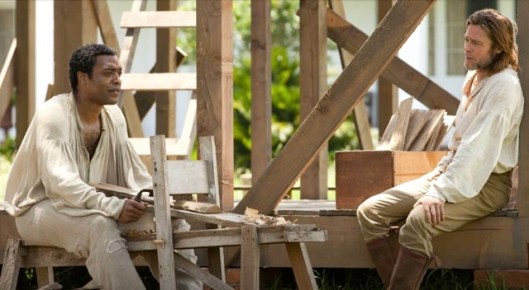
Then there’s the versatile Benedict Cumberbatch, picking up a Southern drawl to portray the kind slave owner Ford. His scenes with Solomon offer some needed relief. Unfortunately, those better days are short-lived. The man who helps Solomon to freedom is Canadian Samuel Bass, very short screen appearance by Brad Pitt. He is an itinerant carpenter working on Epps’ land. This chance encounter makes Solomon aware of Bass’s anti-slavery stance. For the first time in all those years of captivity, he confides his true identity in someone trustworthy and pleads for Bass to contact help in his home state up north.
The music and sound, or the lack of it, are equally effective. Composer Hans Zimmer’s soundtrack ‘Solomon’ is epic and heroic. The spirituals sung by the slaves on the plantation express their deep yearnings for release and freedom. In one scene towards the end, we see other slaves singing their heart out the spiritual ‘Roll Jordan Roll’. At first Solomon listens as a bystander. After a while he can’t help but pour his soul out and join in. That’s the point he totally identifies with the others in their hopeless condition, calling out to God for deliverance.
What follows is memorable. Sometimes silence speaks louder than sound. That moment of silence marks the change of fate for Solomon. I was captivated by the lack of sound, and the camera static, closing up on Solomon’s face of apprehension and despair for a long minute. Often it is the slow, silent space a director allows us to absorb and wait that I appreciate most.
As I stepped out of the theatre, I breathed out a sigh of satisfaction. True there was much sadness in Solomon’s story, but I was relieved to see ultimately his perseverance pay off. I was gratified too that this story of the human spirit triumphant is well told in a meditative pace, sculpted artfully, and delivered by poignant performance. This is the beauty of film art.
~ ~ ~ ~ Ripples
***
Related Links:
My Review of 12 Years A Slave the memoir by Solomon Northup
Download 12 Years A Slave the book
Solomon Northup from Wikipedia
The Underground Railroad
***


 Ripple Effects