Went out to Vancouver Island recently. Saw many Great Blue Herons, birds that are not rare but still not as abundant in my neck of the woods. The herons are common sights along the West Coast.
This is what I found when I saw them––there was always some human presence nearby. I know it’s humans that are impinging on their habitat, but still love to see the picture of coexistence, how they still thrive living side-by-side people, unlike what I’m used to at the Pond in my neck of the woods, where they are usually far away, solitary, and would fly away instantly when humans come near.
A heron silhouetted with the sailboats:

I like this sight too… a shared seashore:

I spent almost an hour with this bird at the beach that late morning. Took many photos of it, walking close to it to take some of these shots, and watched it pick out its brunch:
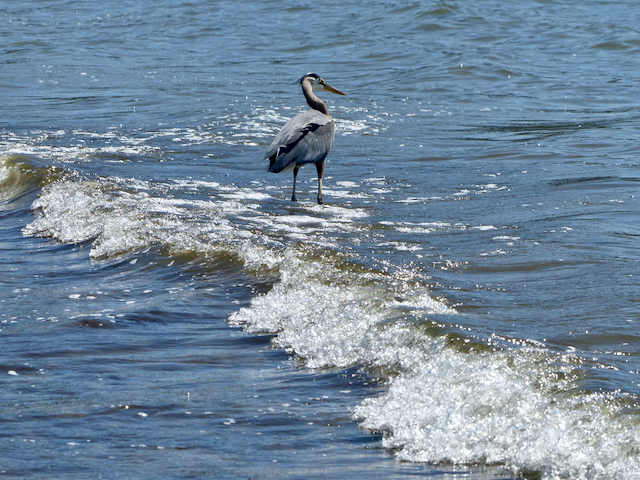


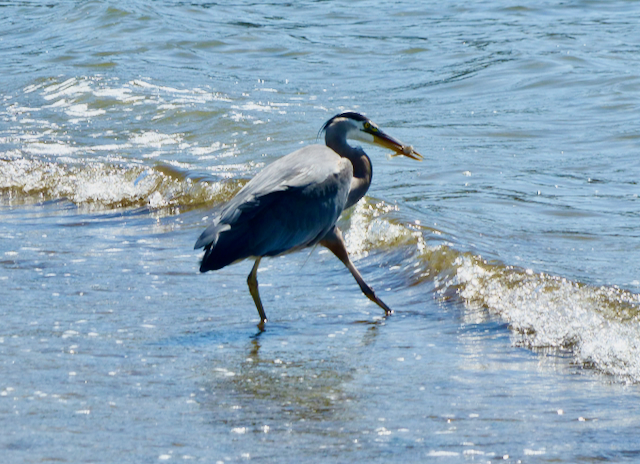
You can see the small fish in its beak.
__________
As a postscript, here are some birds I saw visiting the Butterfly Gardens in Victoria, B.C. While I saw some birds I hadn’t seen before, like the Flamingo, or the Macaws or Parakeets not as house pets, I found them ‘too easy’ to capture in photos. The place was very interesting to visit, no doubt, with butterflies flying freely everywhere and very informative and educational displays, yet, I felt like an imposter bird photographer.
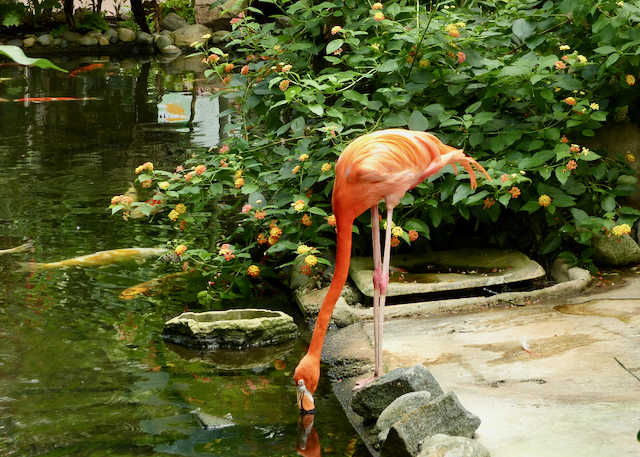

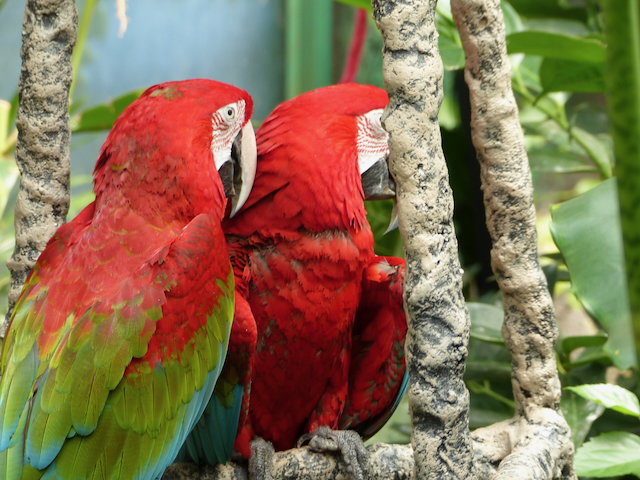
Something like taking pictures of animals in a zoo as opposed to photography on a Safari. Surely, lacking the opportunity of the latter, I suppose seeing them in a confined environment is a second best way to meet them? A contentious issue.
***

 Ripple Effects
I think a lot of people don’t like the idea of having animals in cages, but two things come to mind. First, the captivity of animals these days is much more humane than it used to be. The enclosed areas are made to represent the animal’s natural habitat and not just a cage. Second, without access to seeing the animals in the zoo, most people would never see a live specimen of all those animals and never learn to care about them. I have mixed feelings about animal captivity, but I can see the benefits of having the public more informed than not.
LikeLiked by 1 person
I just realized that I was in your ‘neighbourhood’, Anneli! Vancouver Island is beautiful, and this time visiting Victoria, I’m impressed by it more. It’s quite different from years ago when I made a few short trips. Thanks for throwing in your two pebbles into the Pond in sharing your view. Of course, like so many issues in life, there’s no perfect solution. As an avid birder, I’m all for watching birds in their natural environs. As for animals, nowhere can one encounter a beast like a lion or tiger, hippo or elephant, if not in a zoo in lieu of an actual Safari. Here in the Calgary Zoo, we can see polar bears even… how many would have the chance to go to the Arctic?
LikeLike
I like living on Vancouver Island – have been here for 62 years and don’t plan to live anywhere else. Sadly it is getting overpopulated and it’s not the same wonderful place it once was, but still better than other options. I’m glad you enjoyed your visit to the island.
LikeLiked by 1 person
Herons are always fun to spot. Glad you had the wild variety to shoot your shots. Great capture of the brunch!
LikeLike
Surely a fresh view of the herons on the West Coast seeing so many of them and so adapted to living side by side with humans.
LikeLike
Love the heron photos! Birds in captivity are hard. I’ve been privileged to see many I would never see otherwise, but they are so sad and it is unnatural. I remember once as a kid seeing a bald eagle at a zoo and while they still looked regal they were also somehow diminished. Now when I see them flying free over my house or near my neighborhood lake, they are huge and filled with such strength and power and dignity.
LikeLiked by 1 person
I can see it’s painful to see birds in captivity. On the other hand, I know, it’s for us human’s interest, seeing animals in the zoo is the only way one can encounter an animal in lieu of going to their natural habitat. We have polar bears in our city zoo, how many has the chance to go to the Arctic? As with many issues in life, there’s no perfect solution.
LikeLiked by 1 person
This looks like a wonderful holiday and I suspect after your challenging year or so, it is more than sorely needed — it is essential. Of course (as usual) every photo is tremendous but what really makes me smile is knowing you were there.
LikeLiked by 1 person
Thank you for your very kind thoughts and words. My trip to the West Coast was more than just birdwatching, it was a small family reunion as I spent the time there with my son and his family, yes, a six and a four year-old, two very energetic and curious boys. They loved the Butterfly Gardens and the beach of course. 🙂
LikeLike
Herons are gorgeous birds, and your photographs are lovely Arti.
I know what you mean about feeling like an imposter bird photographer when you photograph birds in captivity, but they are still beautiful birds and photographs. Hopefully the birds are healthy and happy.
I have a 7 year old grandson and 3 year old granddaughter, and they keep us busy when we visit them as we do as often as we can.. They live nearly 700km away from us.
LikeLiked by 1 person
Haha, WG, I wish my grandkids live just 700 km away. I just googled, they are 3,241 km away … that’s the distance between Calgary and Toronto. I try to head over there during TIFF season, and they come visit whenever possible. Vancouver Island vacation was our meeting place this time.
LikeLike
Ah, I thought many they were in British Columbia but now I understand. And understand the additional attraction of TIFF.
BTW I haven’t seen many films lately but today I saw The life of Chuck. Interesting film.
LikeLike
I enjoyed seeing your great blue heron pictures. They are one of the waterbirds I miss seeing often now that we’ve moved so far inland. It was a pleasure to watch them fish and then watching them swallow whole the fish they caught.
LikeLiked by 1 person
I’d thoroughly enjoyed my time with the heron at the Pacific shore, a birding experience that’s totally new for me coming from a Prairie province. Thanks for stopping by, Barbara. 🙂
LikeLiked by 1 person
I’ve seen great blue herons at the coast a couple of times, but they seem to prefer fresh or brackish to salt water. On the other hand, when wade fishermen toss them a fish, they’re smart enough to realize that a ‘hand-out’ is easier than waiting at the water’s edge.
As for flamingos: they’re not just for Florida any more! A fishing guide spotted four of them in flight a couple of weeks ago, and some one the east side of Galveston Bay. This article has some photos of them, and some other rare birds.
It’s great that you had some time with your grandkids — and the rest of your family, of course. The boys are at that age when children usually appreciate the world’s wonders.
LikeLiked by 1 person
They are two very energetic and curious boys, having fun everywhere, not just the playground. Other than the beach and the Butterfly Gardens, we’d visited the museum, a rose garden, a children’s zoo where they could freely pet and brush the hair of goats and sheep, and Victoria’s Chinatown, the oldest in Canada, lots of history there dating back to the 1800’s.
LikeLiked by 1 person
It was really good to read of the waiting and spending time with the beautiful subjects of your pictures. It’s a good reminder that the best things are not available immediately, you have to spend time. A good reminder to us to look all around us, and to be thankful when other people bring us things we may never see ourselves.
LikeLiked by 1 person
You’re absolutely right. Patience is the first lesson a birder has to learn and practise. But it’s not all testing, for it’s total enjoyment standing in the shoreline waters of the Pacific to capture these photos. Quite an experience.
LikeLike
I always feel very lucky to see a heron too. There are about 335 lakes within Sudbury, you’d think we’d see a lot more herons than we do, but we do enjoy seeing many other birds.
I was thinking of you the other day, wondering if you know about Sarah Cox’s book Signs of Life. There are a couple of chapters in which different types of owls are considered at some length and I have found it very illuminating. There is also some very interesting information about the role that zoos (particularly the Toronto Zoo) can play in conservation regarding gene sequences which was mostly new to me, other than a few headlines and cursory articles, plus the focus on Canadian data is most welcome. (I’ve not finished reading, only 2/3 through.)
LikeLiked by 1 person
Thanks for stopping by the Pond, Marcie. No, I don’t know that book, but it sounds like an interesting and informative read. Thanks for sharing. Have a good long weekend! 🙂
LikeLike
Dear Arti,
It is mid March and I’m thinking about you. You are coming upon the first-year anniversary of your husband’s passing, and I wanted to send my thoughts and prayers for this time. Last year, i went through my second year as a widow and it was quite difficult for me. I hope you are out in nature and enjoying the pond, and the birds; outside is where I feel closest to God. I miss your beautiful writing and your voice. Maybe, one day, you might put together a book of your favorite blog posts and your wise interpretations of nature, books and movies. I always learned something from you.
Sending you strength and love,
Blessings to you,
heather from Denver, CO
LikeLike
Thank you Heather for your comment. Pls. check your email for my reply.
LikeLike