Snow Cake: Autism and Beyond

Snow Cake

Snow Cake (2006)–For those who wait for a movie to come out on DVD before seeing it, here’s a recommendation. Snow Cake came out a few months ago on DVD but is still on the current release shelf. It opened the 2006 Berlin International Film Festival with a gala screening, and was shown at numerous film festivals last year including the TIFF.

Seems like a long wait, but well worth it. And for those who have already seen it in theatres, the DVD release could well be the second wind. Considering all the special features of interviews with director and cast, as well as the quality deleted scenes, you might want to keep this one.

Filmed in Wawa, northern Ontario, the Canadian and British collaboration is one of those gems that can be found quite readily in the indy batch. Welsh director Marc Evans has won several European film awards. On top of his sensitive handling of the story, the film benefits greatly from an amazing cast.

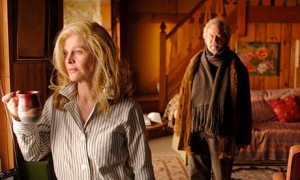
Alan Rickman is Alex Hughes. While driving through Ontario to Winnepeg,  he picked up a young hitchiker, Vivienne (Emily Hampshire, who was nominated for a Genie for this role).  During the trip they got into an accident and the girl was tragically killed.  Propelled by guilt and responsibility, Alex went to look for Vivienne’s mother Linda, played by Sigourney Weaver, in the town of Wawa.  Upon finding her, it did not take long for him to notice that she had received the news with a very different light. Linda was autistic. From his short stay with her, coming to invovle in Linda’s life and getting to know her mysterious neighbour Maggie (Carrie-Anne Moss), Alex drove on to his destination a few days later with a new perspective on himself and his ordeal.

Even though short-lived, Vivienne’s character is memorable. Her enthusiasm for life and acceptacne of those around her underscores the film.  The sound of Broken Social Scene adds a touch of lively, contemporary flare, like a tribute to the affable character of Vivienne. In contrast, Alan Rickman’s role as Alex is painfully affective. At times it is heartwrenching to watch as he deals with his internal torments as the story reveals itself.

Sigourney Weaver had spent a whole year researching on autism to ready herself for the role of Linda.  And for most parts, she has delivered a convincing performance. But it is the screenwriter Angela Pell that has so poignantly depicted the limitations but also the different views and insights an autistic person can offer those who are considered ‘normal’. Pell has mingled her characters, autistic or not, into a pool of humanity, revealing the indistinguishable, common thread joining them all.  Her script is at times very funny, and at times permeates with pathos. Through the words of Linda, the punchline is delivered ever so aptly at the end. Angela Pell has indeed written from her heart and her own experience.

She is mother to a nine-year-old autistic son.

~~~3 Ripples
Field of Dreams: Baseball for the uninitiated?

Saw Field of Dreams (1989) on AMC last night, and this time, it hit me harder.  Watching the movie again has stirred up some ripples, deeply and belatedly.  To say that Field of Dreams is about baseball is like saying Cinderella Man is about boxing.  Movies like these speak to us not because we are necessarily sport enthusiasts, baseball or boxing fans, but that we, every one of us, belong to a family, or at least in memory, and that we are a part of the human race.

By heeding a voice telling him to build a baseball field in his cornfield, Ray Kinsella unknowingly began a journey of reconciliation.  Using baseball as a springboard, and through the characters and the ingenious twists in the story, the movie leads its viewers, who are as unknowing as Ray, to taste the almost mythical reality of dreams fulfilled, past yearnings realized, and lost relationships redeemed.  The film satisfies by simply portraying the very possibilities that these miracles can happen.

It is because of these universal themes that the film can reach far beyond nationalities and borders.  In fact, the original story is not written by an American.  The movie is based on the book Shoeless Joe, which is written by a Canadian author, W. P. Kinsella.  Born in Edmonton, Alberta, Kinsella used to teach English at the University of Calgary.  (I still remember listening and taping his interview on a CBC radio program…oh, those were the days.)  Among the numerous awards and nominations the movie has garnered including an Oscar Best Picture nomination, it won the 1991 “Best Foreign Film” category in the Awards of the Japanese Academy.

Critics who love to associate Kevin Costner only with Waterworld should at least remember that, he is the man who brought us such American modern classics as Field of Dreams and Dances with Wolves….all other failings are forgiven, easily.

~~~3 Ripples

Away From Her

away-from-her

Update Jan. 28, 2008:  Julie Christie has just won the Screen Actors Guild’s Best Actress Award for her role in Away From Her.

Update Jan. 22, 2008: Julie Christie has just been nominated for a Best Actress Award and Sarah Polley for Best Adapted Screenplay in today’s Oscar Nominations announcement.

Away From Her (2006)–How can you make a good short story even better? … By turning it into a screenplay written by an equally sensitive and passionate writer, and then, through her own talented, interpretive eye, re-creates it into a visual narrative. Along the way, throw in a few veteran actors who are so passionate about what the script is trying to convey that they themselves embody the message. Such ‘coincidents’ are all happening in the movie Away From Her. Sarah Polley has made her directorial debut with a most impressive and memorable feat that I’m sure things will go even better down her career path. What she has composed on screen speaks much more poignantly than words on a page, calling forth sentiments that we didn’t even know we had. Julie Christie and Gordon Pinsent stir up thoughts in us that we’d rather bury: how much are we willing to give up for love, or, how would we face the imminence of our loved ones’ and our own mental and physical demise. Based on the story by Alice Munro, ‘The Bear Came Over the Mountain’, Polley brings out the theme of unconditional love not by your typical Hollywood’s hot, young, and sexy on screen, but aging actors in their 60’s and 70’s. It may not be as pleasurable to watch wrinkled faces hugging and kissing, or a man and a woman in bed, bearing age spots and all, but such scenes effectively beg the question: why feel uncomfortable? Why does love has to be synonymous with youth, beauty, and romance? It is even more agonizing to watch how far Grant is willing to go solely for love of Fiona. Lucky for us, both writers spare us the truly painful at the end. It is through persistent, selfless giving that one ultimately receives; and however meager and fleeting that reward may seem, it is permanence in the eyes of love. And it is through the lucid vision of a youthful, 28-year-old writer/director, that such ageless love is vividly portrayed….Oh, the paradoxes in life.

~~~ 3 Ripples

(Photo Source: Guardian.co.uk)