Jane Austen’s Bath

CLICK HERE to read my newest post on Bath:  Bath’s Persuasion

In early December, my travels took me to another World Heritage Site: Bath, England.  Jane Austen lived there from 1801 – 1806 after her family moved from her birthplace Steventon when she was 26.  The City of Bath at that time was a meeting place of high society, the centre of fashion and the hub of stylish urban development, with elegant and spectacular Georgian buildings and Palladian architecture.  What’s interesting is, today’s Bath remains more or less the same as it was in Jane’s time.  The buildings have been maintained in such immaculate condition that a visitor to Bath today can actually walk the paths of Jane’s and behold the city and landscape she had seen, and eat at a place that she could have frequented, the Sally Lunn’s.  This little bakery and eatery is located in the oldest house in Bath, dating back to the 1400’s, a historical site even for Jane.

Jane Austen chose Bath as the setting for Northanger Abbey and Persuasion, both novels published posthumously.  According to sources, in particular Claire Tomalin’s biography Jane Austen: A Life, Jane did not like the City of Bath.  The superficiality and frivolity of high society were met with her satirical critiques.  Further, her disdain could well be caused by the very purpose she suspected of her parents’ decision to move there:  opportunities to meet favourable suitors for their daughters.

Nevertheless, for me as a modern day visitor to Bath, and a Janeite at that, I’m impressed to learn that most of what I see have lasted through hundreds of years.  The Roman Baths, the Bath Abbey where the first king of England Edgar was crowned in 973 A.D., the Pump Room, the Gardens, The Royal Crescent, Queen’s Square, The Pulteney Bridge, the same streets and architecture are situated just as they were in Jane’s time.

Here are some of the famous places in Jane Austen’s Bath.

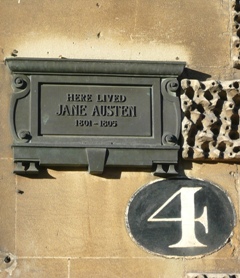
Jane Austen’s first residence in Bath 1801 – 1805, No. 4 Sydney Place:

Jane Austen’s Residence 4 Sydney Place

Jane Austen’s Residence No. 4 Sydney Place

Jane Austen’s second residence in Bath, No. 25 Gay Street, now a dentist’s office:

JA’s second residence No. 25 Gay Street

Gay Street:

The Street Where Jane Lived

Queen’s Square across from Gay Street: Good spot for people-watching for Jane and Cassandra:

Queen’s Square across from Gay Street

The Pump Room: The meeting place of the Who’s Who in Jane Austen’s Bath:

“In the Pump-room, one so newly arrived in Bath must be met with…”  –Chapter 9,  Northanger Abbey
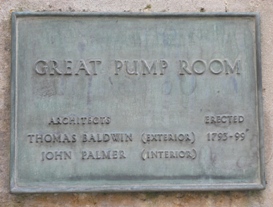
The Pump Room

The Pump Room Exterior

The Royal Crescent:  Georgian buildings spectacularly arranged in a crescent form, where the rich and fashionable took their Sunday afternoon stroll in Jane’s time.  Jane’s view is satirically clear:

“…they hastened away to the Crescent, to breathe the fresh air of better company.” –Chapter 5,  Northanger Abbey
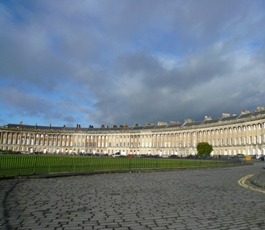
The Crescent

Pulteney Bridge over the River Avon:

Pultney Bridge Over the River Avon

Sally Lunn’s:  Famous buns since the 1680’s:

Sally Lunn’s

All photos originally taken by Arti of www.rippleeffects.wordpress.com

Text and photos All Rights Reserved, December, 2007.

More interesting posts coming up…and for Janeites, look for Lacock Village in my next post.

Update:  Due to the keen interest from readers of “Jane Austen’s Bath”, I’ve published another post, “Bath in December“, with more photos of my recent visit to that beautiful City.  After you’ve finished reading this post, you’re welcome to visit “Bath in December” and… enjoy!

Vision not Illustration

Read a post entitled “It’s All About the Story” on the Austenblog relating the controversial remarks the Welsh filmmaker Peter Greenaway made recently in an international film festival.  He criticised modern blockbusters like the Harry Potter and Lord of the Rings series, dismissing them as “not films but illustrated books”.  As for all the Austen movies sprouting up in recent years, Greenaway said:

Cinema is predicated on the 19th-century novel.  We’re still  illustrating Jane Austen novels—there are 41 films of Jane Austen   novels in the world.  What a waste of time.”

This is my response.  I recognize that not all attempts of turning books into films are successful, many far from being effective.  However, a good movie should be the portrayal of a vision, not mere illustration or graphic representation of the written words.  As I have commented in that post, let’s just say a film is the visualization of the novel, not mere illustration.

And there is a major difference between vision and illustration: the former is seeing through an interpretive lens, rather than simply transferring images from one medium to another like the latter.

That’s why we may like a certain adaptation over another of the same Austen novel, and that’s why there can be more than one movie on the same story… Just as Bach had created Theme and Variations, we can have Story and Adaptations. That’s the reason why we still go to the concert hall and listen to different masters playing the same pieces of music, infusing into their performance their own unique persona and interpretation.  As an art-house filmmaker, Mr. Greenaway should have grasped this very fundamental notion.

As for future endeavors to turn Austen novels into films, I say, “All the best!”

Becoming Jane (2007)

I’ve delayed watching this movie till now.  I wanted to avoid all that hype about Jane Austen.  Even as a JA fan, I’ve hesitated jumping on the Austen bandwagon of what I suspect to be mere commercialism.  Well, after a few months waiting for the dust to settle, I went into a second-run movie theatre this crisp October day with very little expectation, and was pleasantly surprised…I thoroughly enjoyed the movie!

Becoming Jane

As I mentioned in my reply to a visitor who had left a comment on my WWAW post, like many of life’s simple pleasures, a movie does not have to be ‘deep’ to be enjoyable.  However, simplicity does not mean superficiality.  Becoming Jane is heart-felt story-telling.  It has many witty renderings especially carved out for Austen readers, like the mirror images reminiscent of Pride and Prejudice.  The first part of the movie moves along breezily with its humour; but it is the sombreness in the latter part that makes the story so poignant.

Based on the recorded short-lived courtship between Austen and a young lawyer named Tom Lefroy, the backdrop of the movie has its historical accuracy:  the Austen family, Jane’s close relationship with her sister Cassandra, the inequitable social environment wherein Jane as a female, had to write anonymously, and the torment that one had to face having to choose between marrying to survive and marrying for love, and suffer the social disgrace and financial ruins resulting from it.

Other than the basic background, the movie never intends to be a serious, historically grounded account.  It is pure fiction, and as one of the contemporaries of Jane Austen the Gothic writer Ann Radcliffe says in the movie,  it is the imagination, and not real-life experience, that gives rise to story-telling.  From this spirit evolves the beautiful story of Becoming Jane, purely imaginary, idealistic, noble, and yet painfully poignant.  The movie leads us ever so subtly to realize the bitter taste of love over the sweetness of romance.

The simple script will not work if not for the great acting, or understated acting rather, of all its cast members.  Anne Hathaway has once again robbed the Brits of a coveted role, yes, an American playing one of the best-loved British authors (The other one I’m thinking of is Renée Zellweger playing Bridget Jones). James McAvoy is comparable in his charm as Tom Lefroy.  The supporting roles are all played by excellent veterans like Maggie Smith, Julie Walters, Ian Richardson, and James Cromwell.  Anna Maxwell Martin as Cassandra provides immeasurable support to Hathaway.  I was deeply affected by her lead role as Esther Summerson in the BBC production of Bleak House (2005).  Here once again she has demonstrated that her acting is superb.

I have enjoyed the cinematography, the costume, the music, and yes, even the disheartened twist at the end.  I came out of the movie theatre contented.   So what if the story is pure speculation.  Sometimes it takes the imaginary to lead us to look more directly at love, life, and the choices we make.   Maybe that’s why we are always drawn to stories, fiction … and movies.

~~~3 Ripples

Pride and Prejudice on my BlackBerry

For a more updated post on eReading, CLICK HERE to go to “The Great Gatsby On My iPhone”.


pride and prejudice book cover

How do you keep in touch with the Classics in this techno-postmodern age?  Just like you can listen to Bach’s Goldberg Variations on your iPod, you can also read up on the Bennet vs. Darcy saga on your BlackBerry.  That’s what I’ve been doing this past month.  Everyday, I receive through my email in serial, one of the total 149 parts of Jane Austen’s Pride and Prejudice sent to me by Daily Lit, an on-line elibrary… So, wherever I may be, whenever I can grab a moment, I’m accessible to news from Longbourn and Pemberley just by pressing a couple of buttons on my cellphone…oh the conveniences of modern technology, making time-travel easy.

But of course, if you’re reading the book the first couple of times, I don’t recommend you do it this way.  Nothing can replace holding a real book in your hands, lying in the couch or in bed, turning the actual pages of an Austen classic as you savor every word Elizabeth has to say in response to Darcy’s marriage proposal.  But if it’s your fourth or fifth reading, there’s no harm getting it electronically just to touch base.  It’s pure convenience…no books to carry with me; actually, I’ve more than one book sent to me this way.  Daily Lit carries most of the well known classics, including works by Austen, Balzac, Conrad, Dostoyevsky, Eliot, Flaubert,…oh, you name it.

Exciting?  Just imagine reading a section of Moby Dick while waiting for your favorite sushi in a restaurant.  Or, catching up on War and Peace during half-time between the Oilers and the Flames (I’m writing from Alberta after all).  Or how about Taming of the Shrew while anticipating the bride to walk down the aisle in a wedding?  Wouldn’t it be a great use of your idling time in the frenzy of urban living?

…Oh yes, the other book I’m reading on my BlackBerry?  … The First Book of the Bible, Genesis.


CLICK HERE to go to my three-part review of Pride and Prejudice (1995, BBC Production).

WWJW: What Would Jane Write?

thejaneaustenbookclub2

The Jane Austen Book Club

Calgary International Film Festival 2007

Some time ago, I was using the phrase “intellectual chick lit” to describe the book Literacy and Longing in L.A. to a friend and was instantly retorted with: “Isn’t that an oxymoron?”  I had no reply.  Maybe to respond to the bad rap “chick lit” and “chick flicks” have been getting, a few writers have infused literary ingredients in their concoction in their attempt to create more intelligent work.  The Jane Austen Book Club falls into this short list.  The book written by Karen Joy Fowler (2002 Pen/Faulkner Award finalist) was turned into sceenplay by Robin Swicord (Screenplay, Memoirs of a Geisha, 2005) who made her directorial debut in the movie.  I had the chance to view it on the first day of the 2007 Calgary International Film Festival.

The book club is established with the original intent of consoling Sylvia, who is recently divorced from her husband Daniel.  It is a plan conceived by her good friend Jocelyn, a never-been-married dog breeder.  Following the theme of Austen’s Emma, Jocelyn has brought along the only male, Grigg, to the club, intended for her friend Sylvia.  What follows is the expected outcomes, Grigg falls for Jocelyn instead of Sylvia, who later reconciles with her estranged husband, while the other members of the group also are either hooked up with new found love or have their relationships mended.  Very neat, very happy, very clean ending.  Is this what Jane would have written if she were around today?

TJABC reminds me of the British movie Love Actually, which was released during the Christmas season in 2003.  Dealing with the love affairs of eight different couples in the midst of the hustle and bustle of the season has got to be a swift and jolly feat.  The movie remains a montage of famous British faces delivering superficial Christmas cheers under the banner of love.  TJABC has just slightly fewer characters, with six members in the group responsible for leading discussion on one of the six Austen novels.  Despite the juxtaposition and parallels of Austenian motifs and plots, I feel that both the movie and the book circumvent the periphery of contemporary life and relationships without offering much depth and insights as Austen’s own work. But of course, who is comparing Fowler with Austen?  Having said that, I must say I’ve enjoyed the acting of some of the characters, especially Prudie (Emily Blunt, The Devil Wears Prada, 2006), and Hugh Dancy (who would have thought he’s a Brit?)

Coming back to my original question:  What would Jane Austen write in this 21st century?  Would she fall for “chick lit” that can be turned into romantic comedies, for good cheers or box office successes?  Would Jane Austen be a mere romance writer, or “chick flicks” producer? Carol Shield noted that Austen’s heroines “exercise real power”, given their disadvantaged social positions.  Martin Amis stated “her fiction effortlessly renews itself in every generation.”  Virginia Woolf said about Austen’s writing: “That was how Shakespeare wrote.” Harold Bloom commented on the somberness of her work.  Thornton Wilder claimed that Austen’s “art is so consummate that the secret is hidden.”   Fay Weldon summed it up well:  “I also think … that the reason no one married her was … It was just all too much.  Something truly frightening rumbled there beneath the bubbling mirth:  something capable of taking the world by its heels, and shaking it.”  Thanks to Fowler for including such commentaries at the back of her book.

Austen is a sharp and incisive social commentator of her time, a progressive thinker holding a sure sense of morality, and a brilliant observer of human nature and relationships.  Her wisdom is well crafted in the disguise of humor and satire, her vision covered under seemingly simple, idealistic fervor.   Her critique of the manner and injustice of society, if transferred into modern day context, might not appeal as “chick” or as “romantic” as many of us would want to see, or can accept.

What would Jane write?  Definitely not “chick lit”.

~~1/2 Ripples for both book and movie