But is this Art?…But is this Prodigy?

The comments in my last post have spurred some insightful ideas on the whole notion of what Art is, and whether a child’s production can include such inherent elements as soulful expression, and purposeful creation driven by theoretical stance.

I think a more appropriate question is, “But is this Prodigy?”

In his review of the documentary My Kid Could Paint That, New York Times film critic A. O. Scott acknowledges that it is natural for parents to cherish their children’s work. Those doodlings and finger paintings posted on the fridge door are priceless. He goes on to say:

The untaught sense of color and composition that children seem naturally to possess sometimes yields extraordinary results, and the combination of instinct and accident that governs their creative activity can produce astonishing works of art.

Except that these magical finger-paint daubings and crayon scribblings aren’t really works of art in any coherent sense of the term, but rather the vital byproducts of play, part of the cognitive and sensory awakening that is the grand, universal vocation of childhood.

The influential abstract art critic Clement Greenberg had made the following controversial remark: 

In visual arts, prodigies don’t count. In music and literature, yes, but not in art.”

The statement reiterates his view that:

The making of superior art is arduous.”

I tend to agree with him. 

I have seen music prodigies, not having reached the ripe old age of 10 or 12, performing complex pieces of classical compositions.  In contrast to a child pouring paint and spreading it out intuitively with her fingers, I saw behind those performances the countless hours of excruciating practice, the intricate and sometimes impossible eye-hand coordination, the mastery of the theory and the appreciation of the structure of the work, to ultimately evoking the very spirit intended by the composer as they perform. 

Not only that, the best of them make it deceptively simple.  They make the audience feel that they are watching a natural, born with such ability and talent, rendering hard work an oxymoron.  I’m not doubting there’s intuition and instinct involved.  But in every superb playing I see intuitive musicality alchemized with extraordinary mastery of skills and discipline. 

As for literary prodigies?  Maybe because of my limited exposure, I have yet to read one.

Vision not Illustration

Read a post entitled “It’s All About the Story” on the Austenblog relating the controversial remarks the Welsh filmmaker Peter Greenaway made recently in an international film festival.  He criticised modern blockbusters like the Harry Potter and Lord of the Rings series, dismissing them as “not films but illustrated books”.  As for all the Austen movies sprouting up in recent years, Greenaway said:

Cinema is predicated on the 19th-century novel.  We’re still  illustrating Jane Austen novels—there are 41 films of Jane Austen   novels in the world.  What a waste of time.”

This is my response.  I recognize that not all attempts of turning books into films are successful, many far from being effective.  However, a good movie should be the portrayal of a vision, not mere illustration or graphic representation of the written words.  As I have commented in that post, let’s just say a film is the visualization of the novel, not mere illustration.

And there is a major difference between vision and illustration: the former is seeing through an interpretive lens, rather than simply transferring images from one medium to another like the latter.

That’s why we may like a certain adaptation over another of the same Austen novel, and that’s why there can be more than one movie on the same story… Just as Bach had created Theme and Variations, we can have Story and Adaptations. That’s the reason why we still go to the concert hall and listen to different masters playing the same pieces of music, infusing into their performance their own unique persona and interpretation.  As an art-house filmmaker, Mr. Greenaway should have grasped this very fundamental notion.

As for future endeavors to turn Austen novels into films, I say, “All the best!”

Landscape, Seascape, and Mindscape

“For oft when on my couch I lie
In vacant or in pensive mood,
They flash upon that inward eye
Which is the bliss of solitude;
And then my heart with pleasure fills,
And dances with the daffodils.”

– William Wordsworth

What can be retained in travels are the images etched in the mind…the thoughts and feelings they had evoked.  As time passes, we can still relive those moments as we extract the gems from our mindscape.

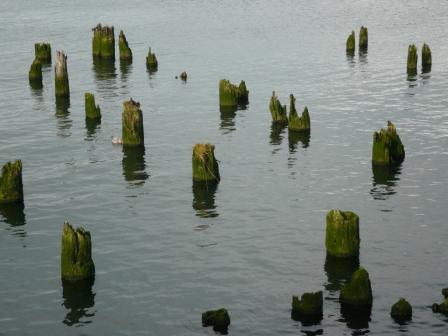
blog-pilings-in-astoria.jpg

These pilings once formed the foundations of houses built on the waters of Astoria. They are now resting posts for cormorants and gulls. Once useful for human settlement, they now blend in the natural seascape like mazes for the birds…still offering a haven of rest despite their weathered and beaten forms.

pilings-in-astoria-ii.JPG

The old and the new can co-exist in the elasticity of the mind.  The human imagination and creativity can reach boundless horizons, and connect timeless landscapes in the mind’s eye.

blog-trolley-in-astoria.jpg

Trolley in Astoria, Oregon

.

blog-disney-concert-hall.jpg

Frank Gehry’s Disney Concert Hall in L.A.

Disney Concert Hall, L.A.

Photos taken by Arti of www.rippleeffects.wordpress.com,

October, 2007. All rights reserved.

To read more about Frank Gehry, the architect who designed the Disney Concert Hall, Click Here.

Memorable Movie Quotes

CLICK HERE to an even more updated post: QUOTABLE QUOTES FROM DOWNTON ABBEY, dated March 23, 2012.

For an update of this post, a newer version on the theme of love, click here.  Again, you’re most welcome to contribute to the list there.

Many movie lovers are fond of collecting, mentally at least, memorable movie quotes.  They might watch a movie a few times, savor their favorite dialogues, might even memorize them and use them in their daily conversation.  For others, certain movie quotes ring so true in their depiction of life, love, loss or lust, that they’d treasure them as commentary of their own experiences, or maybe even adopt them as credo for their life.

What’s interesting is, as these words are quoted out of context, they can still conjure up images from the movies, or elicit the particular sentiments that we had when we were watching the film.  This is the power of story-telling when accompanied by visual images, edging in our minds meaningful thoughts and unforgettable sentiments.

I suppose every movie lover has his/her own favorite movie quotes.  Here are some just to tap into that subconscious, hidden repertoire of your movie quotient. First the easy ones, the more recognizable quotes.  Can you tell which movies they are from:

.
* We’ll always have Paris.

* If you build it, he will come.

* After all, tomorrow is another day.

* Love means never having to say you’re sorry.

* Life’s a box of chocolates…You never know what you’re gonna get.

Easy?  Now try these more obscure ones, but just as memorable nonetheless:

* You look stupid and rich…I’m smart and poor.

* I like you very much…just as you are.

* We read and write poetry because we are members of the human race.

* I gotta keep breathing, because tomorrow the sun will rise.  Who knows what the tide could bring?

* Pain is God’s megaphone to rouse a deaf world.

* My life is made up of units of time. Buying CDs – two units. Eating lunch – three units. Exercising – two units.  All in all, I  had a very full life.  It’s just that it didn’t mean anything.

Hey, I just thought it would be a good idea to hear from movie lovers what their personal favorite quotes are.  Let’s hear from you all. Send in your memorable movie quotes in the “Comment” section.  Let’s have a Memorable Movie Quotes Fair!