Inside Llewyn Davis: A Serious Man in Greenwich Village

As preparation for the movie, I bought the CD soundtrack a few weeks before. This has proven to be a mistake, for I’d been listening to it so much that when I watched the film, I wasn’t surprised by the music at all. I consider that a loss. It would have been much better that I were mesmerized by that haunting voice of Llewyn Davis (Oscar Isaac) for the first time as I watched the movie.

Inside Llewyn Davis copy

Music is a major player in many Coen brothers movies, often used to comedic and acerbic effects. The whole odyssey in O Brothers Where Art Thou (2000) comes to mind readily, or Jefferson Airplane in A Serious Man (2009) where ‘Somebody to Love’ reinvents itself, or even in True Grit‘s (2010) ‘Leaning on the Everlasting Arms’ as we see the one-arm Mattie Ross riding into the sunset.

But in Inside Llewyn Davis, music is no laughing matter. Llewyn is the serious man here, a folksinger down on his luck. T. Bone Burnett has crafted an impressive music production. It should be noted too that Marcus Mumford, lead singer of Mumford and Sons and husband of Carey Mulligan, is also involved in the song arrangement and singing, in particular, the part of Llewyn’s duo partner Mike in ‘Fare Thee Well’.

The setting is New York City’s Greenwich Village, 1961. Llewyn is a folk music purist, an idealist. All he wants is a gig to kick off as a solo performer. The backstory is that his singing duo partner had committed suicide by jumping off the George Washington Bridge. The record he has produced as a soloist isn’t selling. It’s cold in NYC, Llewyn is homeless and coatless. Maybe it’s arrogance coming from being a music purist that makes him callous and abrasive, even to fellow folk singers, or maybe he needs to have that aloof hardness as an armour to sustain the slings and arrows life hurls his way.

O, if only Llewyn’s personality were as charismatic as his voice, he probably would have done better in life. Despite his musical talents, our protagonist, like a Shakespearean tragic hero, is trapped by his own character flaws and tripped by no small amount of fate, he slips slides into the wayside. Sadly, that’s exactly where he lands at the end of the movie.

He has friends and acquaintances, but there’s not much that they can do to help. He has already made the best use of their couches, and some of their wives. The latest to get pregnant is Jean, played against type by the sweet Carey Mulligan, all wrapped up in anger, understandably so, for her friend Llewyn is more concerned about a lost cat than her upcoming abortion. Jean has a very limited vocabulary to express herself except the overused expletive. Not a pleasant role to play I’m sure. Her character could have been written with a bit more depth.

Oscar Issac, Justin Timberlake, Carey Mulligan copy 2

Jean and her husband Jim (Justin Timberlake) are also folk singers but ‘careerists’ according to Llewyn. They would one day concede to life in the suburb, settle down and have kids. ‘Is that so bad?’ Jean asks Llewyn. The answer is obvious. Llewyn is definitely not going down that path.

Talented folk singers converge at the Gaslight Café in Greenwich Village during the 1960’s. Why some succeed and others don’t, the Coen brothers seem not so much to offer rational explanations than to depict the misfortunes of one. In that dim, brick-walled and smoke-filled Café, we hear some fantastic singing. We hear Jim, Jean and their friend Troy (Stark Sands) perform ‘Five Hundred Miles’, evoking Peter, Paul and Mary. At one point, to an oblivious Llewyn, we see the silhouette of what looks like Bob Dylan and hear his voice singing ‘Farewell’.

Cinematography (Bruno Delbonnel) sets the mood from the opening scene. In that basement Café, we see the place dimly lit with spotlight on Llewyn’s face, as his ‘Hang Me, O Hang Me’ captivates us right away. We follow him later as he steps outside to a pitch-dark alley where he meets his nemesis. Even during the day, we see him walk on wind-swept streets under dull, grey sky. The overall bleakness can be soothed only when Llewyn picks up his guitar and sing. His voice seems to be able to neutralize any outrageous fortune.

Llewyn takes a surreal road trip to Chicago to try his luck with a club owner Bud Grossman (F. Murray Abraham, a double for Bob Dylan’s manager Albert Grossman?) He is stuck in the car with the old and sardonic Roland Turner (John Goodman) who wraps up his opinion in one short line: “Folk singer? I thought you said you were a musician.” If the trip seems absurd, it could well be the exact impression the directors intend. We follow one week in the life of Llewyn Davis, a week of failed attempts, gloomy encounters, and bleak prospects. The only light is the voice.

~ ~ ~ 1/2 Ripples

***

Related Reviews on Ripple Effects:

A Serious Man (2009)

True Grit (2010)

***

12 Years A Slave (2013): Beauty and Sadness

UPDATE Feb. 16: 12 Years A Slave just won BAFTA 2014 Best Film and Chiwetel Ejiofor, Best Actor. 

UPDATE: 12 Years A Slave is nominated for 9 Academy Awards including Best Picture, Best Director, Best Actor, Best Supporting Actor, Best Supporting Actress, Best Adapted Screenplay, Best Costume Design, Best Production Design, Best Film Editing.

Movies this season seem to come in pairs in terms of subject matter, which makes interesting viewing. Gravity and All Is Lost is a pair. Lee Daniel’s The Butler and 12 Years A Slave another. I watched them purposely back to back.

12 Years A Slave is powerful in many ways, most readily is the aesthetics and styling, both visual and audio. Before he turned to directing, Steve McQueen was a visual artist trained in fine art in London and New York, and it shows. His cinematic work is a testament to the fact that film is a mixed-media art form. More importantly, it shows that film art does not have to be esoteric, or be appreciated only by an ‘artsy’ few. 12 Years A Slave is an exemplar. It carries no elitism but speaks to all. What more, the subject matter may be ugly, but the medium depicting it can be artistically gratifying, thus, conveying the message with even greater potency and inspiration.

12 Years A Slave Poster copy

The film is an adaptation of the 1855 memoir written by Solomon Northup, a free black man, known for his skills in playing the violin. He was living happily with his wife and two children in Saratoga, New York. One day, two men came to offer him a gig to play the fiddle at a circus. Solomon was deceived, drugged, and later smuggled to Louisiana to be sold as a slave. There for twelve years, he endured insufferable hardships until he miraculously met a Canadian carpenter named Bass who stood against slavery. With his help Solomon found freedom and rejoined his family.

I disagree with some critics who assert that the film is too artfully directed, pristine and sanitized to convey the ugliness of the subject matter. One of the qualms they have is with a scene at the beginning of the movie wherein a beating is being shot with artful camera work and lighting. After he is drugged and chained in a dark holding cell, Solomon is fiercely beaten until the torturing paddle breaks in two. Amidst the total darkness in that filthy cell, we see him cower in pain, yet his white shirt literally shines. I noticed that scene too and appreciated how well it was shot. For me, I saw the glowing white garment as a powerful symbol of purity and innocence amidst utter depravity. I’m glad there’s an artist/director to helm this film. We are seeing how the cinematic medium can be sculpted to its full potential. I don’t see anything ‘art’-ificial about it or sense any contrivance.

The issue here is the paradox of conveying ugliness in a well-crafted and artful frame. I have no qualms with that. Should art capture beauty only? Or, should ugliness be depicted by casual and shoddy work in order to be ‘realistic’? The answer is elementary. A quality medium can only enhance the poignancy of the message.

On another level, the film shows us that amidst evil, beauty can still be found. It exists in the persevering spirit of Solomon Northup. Herein lies the inspiration of the story. I found this quote from an excellent interview article with director Steve McQueen. It speaks to the fact that, in the midst of utter sadness, the human spirit can still glean what’s positive and beautiful. From the memoir of Solomon Northup we read these words:

There are few sights more pleasant to the eye, than a wide cotton field when it is in the bloom. It presents an appearance of purity, like an immaculate expanse of light, new-fallen snow.

Acclaimed British actor Chiwetel Ejiofor’s performance as Solomon Northup is inspiration itself. His nuanced expressions portray clearly some very mixed and intense emotions under the most desperate of circumstances, like consoling a female slave lying next to him at night and yet keeping his integrity, or being forced by the sadistic Epps to whip another slave. Even at the point of despair, Solomon maintains his self-respect, remains upright and kind, and upholds a human spirit that no whips can break. The actor is also heading straight to the Oscars according to consensual predictions.

Glimpse of hopeThe excellent supporting cast also renders beauty to the overall production, some of whom might garner recognition of their own come Awards time. Newcomer Lupita Nyong’o is impressive as fellow slave Patsey, a desperate soul dangled on the edge of survival and despair. Paul Giamatti (who won a Golden Globe as John Adams in 2009) plays a mercenary slave trader. The excellent character actor Michael Fassbender (in both of McQueen’s previous films Hunger, 2008 and Shame, 2011) as slave breaker Epps embodies the wickedness of the system and a soul derailed. Paul Dano (There Will Be Blood, 2007; Prisoners, 2013) is within type as the murderous slave driver Tibeats. Again the paradox appears. We’re glad to see actors giving superb performance playing villainous roles.

Then there’s the versatile Benedict Cumberbatch, picking up a Southern drawl to portray the kind slave owner Ford. His scenes with Solomon offer some needed relief. Unfortunately, those better days are short-lived. The man who helps Solomon to freedom is Canadian Samuel Bass, very short screen appearance by Brad Pitt. He is an itinerant carpenter working on Epps’ land. This chance encounter makes Solomon aware of Bass’s anti-slavery stance. For the first time in all those years of captivity, he confides his true identity in someone trustworthy and pleads for Bass to contact help in his home state up north.

The music and sound, or the lack of it, are equally effective. Composer Hans Zimmer’s soundtrack ‘Solomon’ is epic and heroic. The spirituals sung by the slaves on the plantation express their deep yearnings for release and freedom. In one scene towards the end, we see other slaves singing their heart out the spiritual ‘Roll Jordan Roll’. At first Solomon listens as a bystander. After a while he can’t help but pour his soul out and join in. That’s the point he totally identifies with the others in their hopeless condition, calling out to God for deliverance.

What follows is memorable. Sometimes silence speaks louder than sound. That moment of silence marks the change of fate for Solomon. I was captivated by the lack of sound, and the camera static, closing up on Solomon’s face of apprehension and despair for a long minute. Often it is the slow, silent space a director allows us to absorb and wait that I appreciate most.

As I stepped out of the theatre, I breathed out a sigh of satisfaction. True there was much sadness in Solomon’s story, but I was relieved to see ultimately his perseverance pay off. I was gratified too that this story of the human spirit triumphant is well told in a meditative pace, sculpted artfully, and delivered by poignant performance. This is the beauty of film art.

~ ~ ~ ~ Ripples

***

Related Links:

My Review of 12 Years A Slave the memoir by Solomon Northup

Download 12 Years A Slave the book

Solomon Northup from Wikipedia

The Underground Railroad

***

Lee Daniel’s The Butler (2013): The Trouble with Famous Faces

The Butler is none other than Cecil Gaines, an African American who has worked in the White House serving eight presidents from the late 50’s to the 80’s. Never heard of him? Good, because, as screenwriter Danny Strong (who wrote the Sarah Palin satire Game Change) has emphasized, Cecil Gaines is a fictional character, albeit there was a real life person who had done similar things for thirty-four years through eight Administrations in the White House. He was Eugene Allen. The movie is fiction inspired by that true story. But here, it’s all about Cecil Gaines, a character that Forest Whitaker portrays convincingly.

That leads to this Disclaimer: This is not an Accuracy Police report. But, uh… just a memo from the Facial ID department.

The Butler Movie Poster

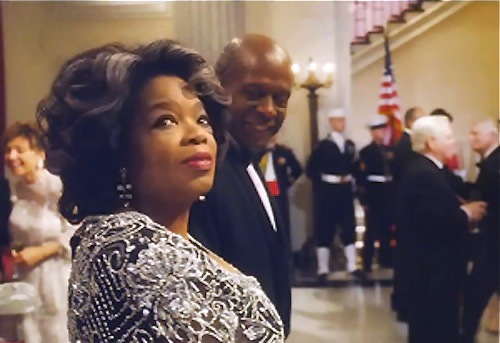
After watching The Butler, I’d like to recommend that movie stars go on sabbatical leaves. After a certain number of years of high-profile, on-screen appearances, famous actors or talk show hosts should pursue other interests, anything that’s behind the camera… write, direct, produce, compose, climb K2… before coming back out for another movie role. For here, I can see the distractions that can come from too famous a face.

Why? It takes me a long while to adjust to Oprah being the alcohol-dependent Mrs. Gaines, despite her strong performance, or, tell myself that’s Dwight D. Eisenhower I’m looking at, not Robin Williams. With every Administration that flashes by, my focus as a viewer is more on figuring out which famous star is playing which famous politician. That’s James Marsden as JFK, and Liev Schreiber as uh… comical LBJ… sitting on a toilet while barking instructions to his staff?

By the time John Cusack comes on screen, I’m asking myself, now, who is he supposed to be? I can only see John Cusack, and it looks like he’s trying to convince me that, “No! I’m Richard Nixon!” He too, looks like a caricature. Later when Ronald Reagan appears, I can only see the make-up. Sorry Alan Rickman,  didn’t recognize you. Looks like you’re wearing a Halloween mask. I must say though, hats off to Jane Fonda, she’s one good Nancy look-alike, although I know she has her share of protests. Now, that’s another issue… the incompatibility of ‘Hanoi Jane’ taking up the role of Nancy Reagan. I can understand why some Vietnam War vets are up in arms.

The Butler & his wife

The trouble with famous faces… they have a hard time convincing viewers that they are not who they appear but the character they are playing. In The Butler, that just might not be a problem because it seems the filmmakers are confident that star power can get us through. Further, the sequences of Administrations go by so quickly, they are more like passing spectacles than memorable episodes.

Other than star powers that function only on appearance, there are some riveting scenes from the main storyline, that of a father-son relationship against the backdrop of racial turmoils in America. While Cecil Gaines works as a butler in the White House all those years, his son Louis (David Oyelowo) has been deeply involved in the Civil Rights Movement, arrested and jailed several times, often putting his life at risk. Major differences in political viewpoints generate sparks and tensions to eventual deep gulf between father and son.

A memorable scene is when father and son argue at the dinner table over Sidney Poitier winning the Academy Award. Cecil thinks that is a sign showing white people are accepting and honoring blacks. But son Louis points out Poitier is appeasing white viewers in presenting himself as a white, black man. Interesting thought, not unheard of. The subsequent result of the argument makes a memorable scene.

Juxtaposing actors’ performance with visceral archival footage of racial violence like the lunch counter sit-ins, the Freedom Bus burning by the Ku Klux Klan, the assassination of Martin Luther King… makes some informative and engaging storytelling. That may be the reason why, after the pivotal historical accounts of the Civil Rights Movement, the movie begins to lose my attention. What looks to be significant begins to appear parochial towards the end, where I even feel some partisan undercurrents.

Overall, the movie may have been too ambitious in covering everything, a father-son relationship, the black family, the country’s racial conflicts, the Vietnam War, to South Africa’s Apartheid. Its Forest Gump-esque storytelling lacks a unified and consistent styling. The incompatibility applies to the choice of music too. I’m fine with the period music of the eras, but using the Schumann Piano Concerto in A Minor at the opening scene feels like a mismatch. Other familiar classical pieces like Mozart’s piano sonatas for White House scenes sound like casual and superficial picks.

A movie riding on its star-studded cast… a mixed bag of famous faces. If you like a parade, this is fun to look at.

~ ~ 1/2 Ripples

***

Screenwriters Talk and Bloggers Blog

Thanks to blogger Sim at Chapter 1-Take 1 for the heads-up, I watched the whole 54 mins. of The Writers Roundtable via Hollywood Reporter. Gearing up for the upcoming Awards Season, these Roundtable talks give us a chance to hear some possible award contenders talk about their craft. I’m particularly drawn to the writers.

“No great film would have been possible without a great screenplay.” That’s how the clip begins. Sitting around a table to discuss their experience are some of this year’s acclaimed screenwriters.

The panel includes (In alphabetical order of the movie title):

John Ridley: 12 Years a Slave
Julie Delpy: Before Midnight
Nicole Holofcener: Enough Said
Jonas Cuaron: Gravity
Danny Strong: Lee Daniel’s The Butler
George Clooney and Grant Heslov: The Monuments Men (release date has since been delayed till next Feb.)

There are lots of interesting exchanges, and it’s refreshing to hear them talk uncensored and unscripted. Take for example the following dialogue relating to independent writing vs. writing for studio:

HR (Hollywood Reporter): Have you written any studio films?
Holofcener: Only for money (chuckle from somewhere). I mean like, not for myself.

*

HR (to all): Do you like writing?
Strong: I do. I really enjoy it. I spent years as an actor. You just can’t go do it. You get hired to do it, so I started writing, to get my mind off the auditions…
Holofcenter: What if you can’t act, and you can’t write?
Clooney: You direct.

*

There are lengthy discussions on the issue of historical accuracy, the truths vs. dramatization. I feel this is the hot topic lately, with The King’s Speech a couple years ago, to last year’s torture scenes in Zero Dark Thirty, the accuracy of Argo, and this year’s Captain Philips, and Lee Daniel’s The Butler.

Here’s The Butler‘s screenwriter Danny Strong’s defence:

Strong: Well, in the case of The Butler, I made very clear that this was a fictionalization. So much so that I changed the character’s name to Cecil Gaines in the hope of saying: “This isn’t Eugene Allen. This is something else.” But the history in the film is all true…”

And then comes Clooney’s allegation unplugged.

Clooney: This is a new thing, by the way. This is all, like, bloggers — if that existed when Lawrence of Arabia came out, believe me, Lawrence’s own autobiography would not hold water. Patton wouldn’t. You can go down the list of movies — Gandhi — these movies are entertainment… These are not documentaries. You’re responsible for basic facts. But who the hell knows what Patton said to his guys in the tent?

*

Whoa… bloggers? Thank goodness, bloggers get a chance to prod screenwriters to dig deeper into their facts, even if fiction is to be made from them. Because of bloggers, viewers can sharpen their senses to not just accept the dramatization as facts. Because of bloggers posting about movies, people are made more aware of historical events and background info. I see not all sites do, but the ones I frequent can have the effect of honing one’s judgement and critical thinking, even (maybe more so) when opinions differ. How we need these skills as we watch movies nowadays instead of just being passively entertained (or not).

Thanks George, for spelling out the importance of the work bloggers do.

You’re right too, George, because of the blogosphere, filmmakers now have to deal more rigorously (or, don’t they?) with the dichotomy between truth and fiction, historical accuracy and dramatization. Yes, the butler Cecil Gaines is a fictional character, but there are many real historical figures in that story context… like, say… Ronald Reagan, whose son Michael Reagan had protested against the film for painting his father with a racist brush.

As someone with a half-baked screenplay in the closet, I know how hard it is to even get to finish the first draft, and after that, hopefully, find someone qualified and experienced enough to read it and advise on rewrite. Then you go and rewrite, and rewrite some more. So I’m all respectful for all who can not only sell their spec script but actually see it produced, and not only produced, but distributed and shown on our theater screens. That’s why I attempt at every review with appreciation and humility.

At the same time, I’m also glad to see that the blogosphere has leveled the playing field for opinions and critiques, for accountability, and for creative expressions with checks and balances. I don’t see an end to the dichotomy between fact and dramatization, accuracy and entertainment, but at least we are free to challenge and critique. Don’t forget, George, bloggers are also the ones ready to defend and promote worthy productions. All for the better.

***

Related Posts on Ripple Effects:

Before Midnight: Reality Check

The King’s Speech: Fact and Fiction

Zero Dark Thirty and Argo

***

All Is Lost (2013)

If Life of Pi (2012) is magical realism, then All Is Lost is absolute realism. Some say it’s a modern version of Hemingway’s The Old Man and the Sea. I tend to see it as the flip side of Life of Pi. It is the magical, the supernatural that we pant for while watching the man in the film silently struggle to stay alive in the middle of the Indian Ocean. Without a miracle, this is what it is.

At the back of my mind was this query… In our age driven by visual spectacles and mega sights and sounds, why would someone take up a project of this nature, a 106 minute feature film with just one character and no dialogue, except for a few words from voice over in the opening when the man utters what seems to be his last words to his loved ones.

I admire the courage and talent of writer/director J. C. Chandor, who writes a 32 page script (according to IMDb) and directs it as a minimalist production in a time when the movie industry has gone ultra mega and high tech. All Is Lost is only Chandor’s second feature film. His directorial debut which he also wrote? Margin Call (2011), about the tempest in the tumultuous ocean of investment banking. Versatility is the mark of talent indeed.

But the film belongs to Robert Redford. No longer The Sundance Kid (1969) here but a 77 year-old actor playing a man dangling over the edge of survival. Redford just might have put forth the definitive performance in his long career. He has taken on the role with grace and gentleness, a paradox to his predicament in such a physical drama. He carries the whole film by engaging our empathy. His screen presence is the replacement of fancy plot lines, setting and dialogues. He plays a character with no name. Only when the end credits roll do we find out that he is called ‘Our Man’. 

Robert Redford in All is Lost

Unlike Tom Hanks in Cast Away (2000), who speaks and yells his mind, and socializes with a volley ball, Our Man is the epitome of restraint. He is the strong and silent type of veteran sailors on a solo voyage, who encounters the misfortune of being stranded in the vast ocean. At the beginning of the film we see Our Man wake up to find his sailboat has been hit by a loose cargo container floating by. The sailboat is taking on water through a hole in the hull. The radio and equipments are damaged. Our Man deals with the situation resourcefully. He uses a repair kit to mend the damage, pump water out, dry out his boat. We see him eat and shave. 

Just as he has made some headway to restore safety, an impending storm blows his way. Our Man is no match for nature’s callous ferocity. He ends up having to escape a sinking boat and jump into a life raft, bringing with him a meager supply of food and water. He learns to use a sextant, and carefully charts his drift. His only hope is to be seen if his raft drifts into the course of cargo ships. He utters no words except for a futile S.O.S. call while in his sinking boat, and one expletive out of total frustration in the raft after a few days of bare survival.

One man, one raft, one sea. The wide-screen cinema is probably the best medium to depict such an existential predicament. We don’t need special effects, for this is all that we have. And the nameless ‘Our Man’ shows how universal he is. And what of him? A patient and courageous man trying with all that he has and all that he is to stay alive, waiting to be found, hoping to be saved.

Do we need to know the name on that cargo container that hit his boat? It really is immaterial considering all that Our Man has gone through and all the efforts he has put forth to be saved. But just for information, we see the name in English, ‘Ho Won’, an obvious translation from the two Chinese words below: “Good Luck”. A jest too harsh.

Spoiler Alert. If you have not seen the film, you might want to skip the next paragraph, just that one. If you have seen the film, you’re most welcome to share your thoughts on the ending.

Like Life of Pi, the ending is open to your own interpretation. Two lines of thoughts conjured up as I watched the open-ended final scene: Only when one has lost all would one be saved. Or, go into that good night with gentleness, for brightness awaits. I can see both these scenarios to be applicable here. Again, this is one of those films that leaves the viewer to draw the conclusion, a type of ending which may not be very popular but one that conveys the multiplicity of reality.

As the credits roll, we hear the song for the film. I first thought singer songwriter Alex Ebert was calling ‘Our Man’ throughout his song. As I later found in the credits, it was ‘Amen’ (with the ‘Ah’ sound). Yes, ‘Amen’ is the title of the song.

A fine movie to watch with a quiet mind and patient disposition. A necessary offering in our present day of excess among some numbing and mindless entertainment. It’s like holding your breath in your hectic course of life for 106 minutes, and survive.

~ ~ ~ Ripples

***

Click here to listen to Alex Ebert’s song ‘Amen’ and watch the trailer of the movie All Is Lost.

***

The Disappearance of Eleanor Rigby: Him and Her (2013)

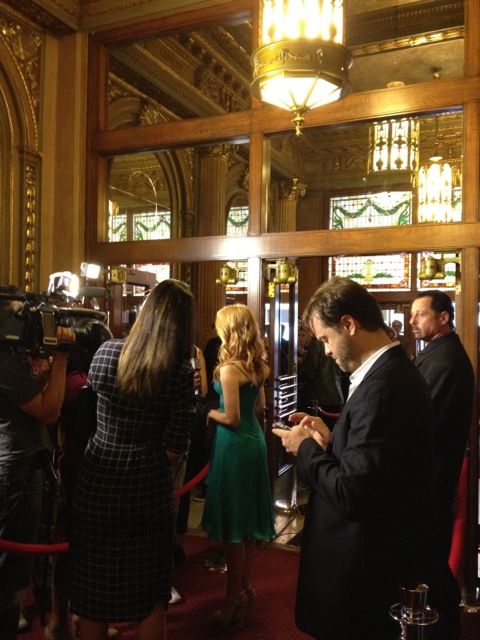
I keep reminding myself, my evaluation of The Disappearance of Eleanor Rigby: Him and Her should not be affected by the appearance of Jessica Chastain, her real self, in the theatre. That was an unexpected and most exhilarating episode in my TIFF13 experience.

After over an hour waiting inline outside, we were ushered into the historic building (100th anniversary this year) that housed the beautiful Elgin and the Winter Garden Theatres. And lo and behold, I saw Jessica Chastain standing right there in a press line answering questions. Who can take a focused shot with steady hands while being herded like sheep quickly passing by Jessica Chastain?

Jessica Chastain

Here’s a sharper view but no better vantage point:

JC Another View

**

Disappearance is two films in one. It tells how a couple deals with loss, and the subsequent effect on their relationship, from His and Her point of view. Each is a 90 minute film that can stand on its own. We were shown first Him, then Her, with no intermission. I know at some other screenings, it’s the other way round. Now, that is intriguing. Will the audience perceive quite a different story then?

The concept had been found in previous films. Kurosawa’s classic Rashomon comes to mind. It presents four different points of view consecutively in one film from those involved in a crime. A more recent movie Vantage Point uses the idea but is miserably repetitive.

With Disppearance, we have a fresh, contemporary take on this high concept. Being made into two films allow deeper character development and more complex storytelling. It is innovative but not redundant as one might suspect. And that’s the ingenuity of writer/director Ned Benson. His screenplays for both are intelligent, perceptive and thought-provoking.

The first part Him is more elliptical. As viewers, we know little to start, but are eager to find out more about the couple. Why does an amicable and romantic relationship becomes incommunicable, and with the wife disappearing, walking out of the relationship? We soon find out the reason. I would not spoil it for you.

To deal with his situation, the husband, Conor (James McAvoy, Atonement), spends his energy on saving a losing business, his little restaurant in NYC. I suppose, as a man would, diverging his focus into career and business. Ciaran Hinds plays his father, a successful restaurateur who offers his son what he has established, a proposal that is turned down.

Bill Hader is deadpan funny as Conor’s good friend and chef in the restaurant. A friend can help him cope, but Conor knows ultimately he has to walk the path himself. The last scene is open-ended, a good lead into the Her perspective.

Him: ~ ~ ~ Ripples

**

After watching Him, I was eager to find out Her story. Jessica Chastain (Zero Dark Thirty, The Tree of Life) is Eleanor Rigby, her parents having met in a Beatles concert, thus the namesake. But the film is not about the song, albeit we do hear the relevant line.

This second part is most gratifying. Not only does it fill in the gaps, it has gone deeper into Eleanor’s pains and her struggles to find herself once again… or maybe, for the first time. While Conor immerses himself in his restaurant, Eleanor returns to her family.

William Hurt plays Eleanor’s dad, a psychology professor who stands by as a loving father would, albeit helplessly. He suggests Eleanor take courses part time, which she does. Thus leads to some interesting scenes and meaningful dialogues with her prof played by Viola Davis, a role that the talented actor deserves. She gets to deliver that poignant line in the Beatles song:

All the lonely people, where do they all come from?

The veteran French actor Isabelle Huppert is Eleanor’s mother, always with a glass of wine in hand. There is no perfect family. She has her own issues to deal with, let alone contributing to a healing process.

Jess Weixier as Eleanor’s sister puts forth an excellent, complementary performance to Chastain’s. She is a single mother living in her parents’ house and raising an eight year-old son. She too, has to play the hand life deals her as best she can. From the Q and A after the screening, we learn of the long-time friendship between Chastain and Weixier, and it shows. Their performance makes me long for the experience of sisterhood.

And we learn too that Ned Benson wrote Her especially for Jessica Chastain, who ten years earlier introduced herself after watching Benson’s short film and was much impressed by it. Chastain was emotional when recounting the incident, moved that now ten years later, Benson is finally being acknowledged.

With such a high calibre cast, I could have sat there for another hour. There are lots to think about, and the cast makes it enjoyable for us to do just that in the films.

How can a response to any situation be shared while we see and feel so differently? One’s perspective is uniquely one’s own, an interplay of subjective perceptions, past experiences, psychological makeup, temperaments, rationality…. These two films screened back-to-back is the most vivid way to convey this point. How then can two people unite despite differences in perspectives?

As I write this post, Proust’s madeleines eating episode comes to mind. The memory and sentiments elicited from an experience is personal and subjective. And that’s what these two films show us. Even within the same scene, the camera takes on a different angle and point of view. Most interesting is that, even the dialogues are different. We can see the discrepancies in their memories and knowledge (or lack of) of themselves and each other. And when it comes to love, how each would want to hear the other taking the initiative to say ‘I love you.’

Her: ~ ~ ~ 1/2 Ripples

**

To top it off, we were given a chance to hear the cast share their experience in a Q and A session after the screening. From left to right Jess Weixier, Cirian Hinds, James McAvoy, Jessica Chastain.

Disappearance of ER Q & AWhole Experience: ~ ~ ~ ~ Ripples

***

All photos in this post taken by Arti of Ripple Effects. Please do not copy or reblog.

***

Munch 150: The Works Still Scream

This captivating documentary is the second installment of the ‘Exhibition: Great Art On Screen’ series with host Tim Marlow. An ‘event film’, the term refers to this kind of doc focusing on a special occasion, here, the 150th year of the renowned Norwegian expressionist Edvard Munch’s birthday (1863-1944). To celebrate, a comprehensive exhibition of Munch’s works is being held in two venues in Oslo from June to October, 2013, the National Museum and the Munch Museum. The film captures the highlights of this exhibition.

I soon learned too that the theatre charged more for the experience. However, the $17 ticket is acceptable. Short of seeing the actual paintings at the two venues and being free to walk around, I’ve saved a hefty plane ticket to Oslo, and I get to see the works magnified clearly on the big screen and hear expert commentary so I can appreciate even the minute brushstrokes up close. Sure, I can always wear a headphone, if it’s available, to hear the commentary while walking through the exhibition. But it’s a refreshing experience to look at the paintings enlarged on a giant screen, hearing in-depth analysis juxtaposed with dramatized biopic vignettes as I sit back and eat popcorn in a dark, air-conditioned theatre on a hot summer day.

The film Munch 150 has aptly taken advantage of the medium of the cinema. Unlike the previous film in this series, Manet: Portraying Life, which ironically, is devoid of life, Munch 150 has presented to the viewer what such a medium can best do. The camera as a guide and magnifying glass, projecting onto the big screen images larger than life, accompanied by insights from curators and host Tim Marlow, an audio-visual experience. Yes, I’ve mentioned ‘big screen’ several times. That is essentially the benefit that the TV screen or your computer monitor would not suffice.

Edvard Munch (Norwegian pronunciation: [ˈmuŋk], in English, something like ‘Moonk’ with a glottal sound on the ‘n’) was born in 1863 in a small Norwegian village. His family moved to Kristiania (now Oslo) the next year. From an early age, Munch was haunted by death and illness. He first saw his mother die of tuberculosis when he was five, and later, his beloved older sister Sophie tormented and died of the same illness when he was fourteen. He himself was plagued by frequent sickness, and at one time was near death with tuberculosis. Physically struggling with poor health, inwardly, Munch was often stricken by desires and guilt. Nihilistic thoughts added burning fuel to an already troubled soul. These all led to alcoholism, depression and breakdown later in life.

Writing and painting became his outlets. Journals allowed him to spill his thoughts, and the canvas was the visceral medium for him to release deep, psychological turmoils. His fears and anguish, all angst and pains found expression in his art.

The Sick Child

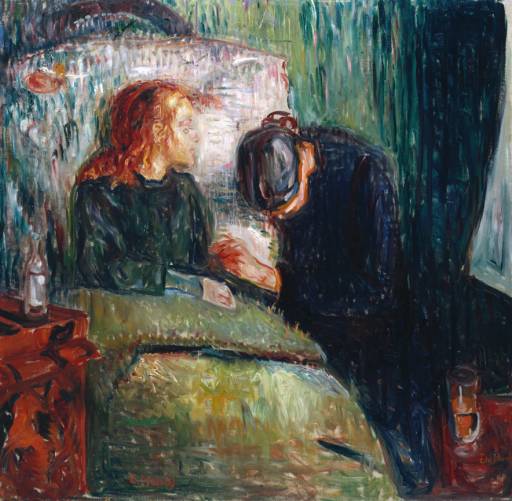
I was particularly impressed by his early work The Sick Child (1885-86), depicting the trauma he had experienced as he watched his beloved, ailing sister Sophie lay in bed frail with tuberculosis. A grieving woman holding her hand, head bowed in sorrow. It was a disturbing scene, and yet I’d appreciated the colours and brushstrokes that seemed as if they were just rendered in a free and haphazard way. From the commentary, I felt the poignancy.

The Sick ChildThe camera and commentator guided me to see the scratches left on the canvas, most noticeably on the pillow near Sophie’s face, something which I wouldn’t have noticed if I just walked by it in the museum. These scratches were troubling to look at, probably made by a pallette knife, or a hard brush. They were marks of anguish and frustration, the outburst of emotions during what must have been a painful process. Munch always left ‘blemishes’ on his paintings. Here, the scratches and patchy layers of paints on paints showed raw emotions unleashed. That was the reason the work was met with criticisms and rejections in his day. It was not pretty and neat as his predecessors had done. He was, literally, painting outside the lines.

The Frieze of Life

Many of Munch’s more well known works are in the series called The Frieze of Life—A Poem about Life, Love and Death. The Munch Museum in Oslo exhibits the paintings as a series on four white walls in a room — and here’s the unconventional — without frames. The curator commented that this was what Munch would have intended. Without the distractions of the frames, the paintings speak out loud and clear. In The Frieze of Life, Munch explored the very essence of being human, the frameless, existential experience that is universal.

The Scream (1893)

The_ScreamThe Scream is in the section of The Frieze of Life categorized as ‘Angst’. It is the most well-known of Munch’s paintings. A deathlike skull-face devoid of gender, hands covering the ears and screaming out into the void. Munch painted this after an actual experience while he was walking in the woods, hearing a huge scream inside him. He was overcome with fear. After that episode, he painted The Scream. In it is a figure that has since become the epitome of existential angst. I’d appreciated the comment in the film stating that ‘it’s an icon, not a cliché.’

The Scream made history just last May. It had set an auction record for a piece of art work, fetching $119.9 million (£74m) at Sotheby’s in New York. Almost seventy years after his death, Munch’s works still scream.

The Girls on the Bridge (1901)

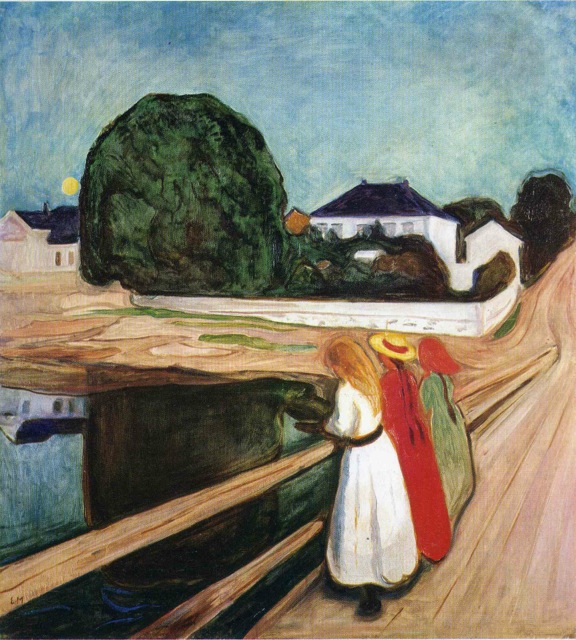
The Girls on the BridgeA more delightful painting, The Girls on the Bridge is fresh, bright, and colourful, exuding a summer spirit. But even in this work, Munch depicted the struggles between innocence (white dress) and desire (red). And while we see the green clump of a tree, full of life, we also see its ominous, dark reflection on the water. In the midst of life, we are in death. Munch seemed like a party pooper, but maybe that’s why he needed to scream. Or else we wouldn’t have heard him.

~ ~ ~ Ripples

The next and last installment in the series is Vermeer and Music.

Sources of images: Wikipedia

***

Related Posts:

Art and Cliché

Arles: In the Steps of Van Gogh

Inspired by Vermeer

Edward Hopper, William Safire: The Visual and the Word

***

Our Mega Culture

A look at our summer offerings on the big screens can readily point to one fact: Bigger and louder is what we get. Apparently, they seem to be the key to box office sales. After all, aren’t those figures the raison d’etre, the reason why movies are made in the first place?

From Box Office Mojo come these stats: Iron Man 3 ($400m+ domestic box office sales, 8 weeks in release), Star Trek Into Darkness ($200m+, 6 weeks), Man of Steel ($200m+, 2 weeks), World War Z ($88m, 1 week). Don’t think it’s only the superheroes and zombies that dominate, Luhrmann’s spectacle The Great Gatsby rakes in $142 million in 7 weeks.

Here’s the irony: the bigger your city is, the more small movies you can see. And if you’re like me dwelling in one of those hamlets not on the list of ‘selective cities’, then you’re stuck with bigness all summer, like it or not. (This is my list of ‘small’ movies I’m waiting for.)

The French director Jean-Luc Godard once said:

As soon as you can make films, you can no long make films like the ones that made you want to make them.

The legendary film critic Pauline Kael interpreted his statement as follows [1]:

This we may guess is not merely because the possibilities of making big expensive movies on the American model are almost nonexistent for the French but also because as the youthful film enthusiast grows up, if he grows in intelligence, he can see that the big expensive movies now being made are not worth making. And perhaps they never were: the luxury and wastefulness, that when you are young seems … magical, become ugly and suffocating when you’re older and see what a cheat they really were.

Kael wrote that in 1966, that’s forty-seven years ago. How I wish she could be around now. Sure like to hear what she has to say about all the summer blockbusters we’re getting. What we have mainly are sequels to previous blockbusters, their makers hoping the trend would perpetuate. Would Kael revise her view now? Big movies not only are still being made, they have become more and more popular. It seems viewers don’t care much that the emperor has no clothes.

It’s Gatsby’s idea, isn’t it? The grander, louder and more spectacular the party you throw, the higher chance you just might get what you’re looking for. Alas, look at the ending.

Who makes the trend? The marketers of movies would tactfully say they’re just offering what people want. But subtly, or not so subtly, what people want is also shaped by marketers. Mass appeal and popularity have overridden discernment and individuality. Do you find viewers’ tastes have changed over the years? Or, do movie goers nowadays belong to a different demographics than before?

What I’m concerned is the obliteration of the already elusive notion of film as an art form. We’re now too dominated by bigness, and spectacles, and technologies, rather than going into the story, characters, techniques, meaning… the still, small voice of fine artistry.

Star Trek Into Darkness

I’d the chance, ok, my choice, to go watch Star Trek Into Darkness and Man of Steel recently. Interesting contrasts there. I used to be a Star Trek fan. Yes, used to be because the Star Trek we have today is a totally different product altogether, albeit the character names remain the same. This current one looks like school children play-acting… serious pretending, frantic scurrying here and there, and loud blasts into oblivion. The only adult seems to be Benedict Cumberbatch as Khan.

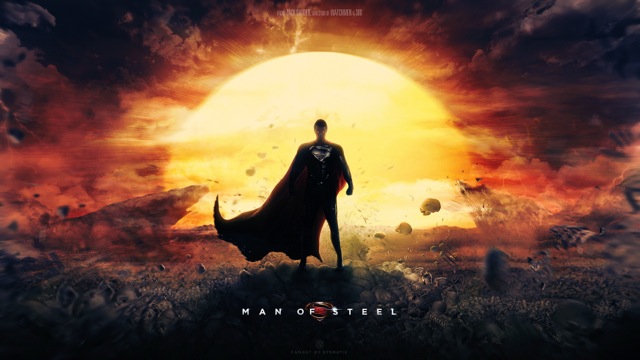
Man of Steel has more mature actors and more serious acting, but the second half is not much different, gratuitous CGI action sequences that are 30 minutes too long, and loud blasts into oblivion.

The constant bombardment of expanded loudness in the theater had only one effect on me, made me turn off my receiver, same effect as somebody wanting to win an argument by raising his voice at me.

Man of Steel 1

Truth be told, because of the cast I went to see this revision of Superman. Kevin Costner and Diane Lane as Clark Kent’s earth parents? Who can miss that? Amy Adams as Lois Lane? I’m sold. And, Michael Shannon as the evil General Zod coming to turn earth into Krypton? I must see how he does it.

And the current Star Trek, what strange new world it has gone to where no one had predicted before. My favorite is still the original TV series. As for the movies? It’s Star Trek VI: The Undiscovered Country (1991). That’s the swan song of the original TV cast and one where Christopher Plummer as the Klingon General Chang recites Shakespeare like he’s at the Stratford Festival. His lines come from The Merchant of Venice, The Tempest, Romeo and Juliet, Julius Caesar and Hamlet. If you want postmodernism across the media, here you have a perfect mash-up. Yes, light years away from the Star Trek of Summer 2013, and generations apart.

Steven Spielberg in a recent statement made at the opening of a new USC Cinematic Arts building predicted there would be an ‘implosion’ in the movie industry, ‘where three or four or maybe even a half-dozen megabudget movies are going to go crashing into the ground, and that’s going to change the paradigm.”

He also added we might have to pay $25 to see the next Iron Man, but $7 to see Lincoln. A scenario which George Lucas echoed. Umm… if those are the ticket prices for the different kinds of movies in the future, not a bad sort of a paradigm shift.

***

[1] These two quotes are taken from Pauline Kael’s review of Jean-Luc Godard’s Band of Outsiders (1964), from American Movie Critics: An Anthology from the Silents Until Now, Expanded Edition, edited by Phillip Lopate, published by The Library of America, N.Y., 2008.

Summer Viewing List

Summer Reading Lists have begun to sprout everywhere. Some prefer lighter beach reads, and others use this time to catch up on heavier non-fiction works.

While I love book lists and recommendations, as a cinephile, I also have my list… films to be watched, those I highly anticipate to come around hopefully soon to my city. Here’s my TBV (To Be Viewed) list for this summer on the big screen:

Frances Ha – A NYC set black and white film in 2013? The trailer evokes Woody Allen’s Manhattan. I know Noah Baumbach has his own style, considering some of my favourite films are his works, The Squid and the Whale, Fantastic Mr. Fox. Co-writer and star Greta Gerwig, who is a good balance to Ben Stiller in Greenberg and distinctive in To Rome With Love albeit in a minor role, should be a delight. This I highly anticipate.

Before Midnight – The third and final instalment of Richard Linklater’s chance encounters of Before Sunrise, and Before Sunset. Real time, dialogue driven films almost created a genre of their own in the first two instalments. Ethan Hawke and Julie Delpy regroup nine years later in Greece. Whatever had happened in their lives between years?

Summer breeze, makes me feel fine…

Before Midnight

Much Ado About Nothing – Shakespeare and summer go hand-in-hand. Not in the park, this one’s shot right in director/screenwriter, of Avengers’ fame Joss Whedon’s own backyard in Santa Monica, CA. A postmodern take, and … black and white? Keeping the original work handy can help to reveal what’s Shakespeare’s and what’s Whedon’s.

Blue Jasmine – Woody Allen has been bringing us a new film a year over the past four decades. Can you not admire the stamina and creativity of this man, now 78. Allen’s 2013 instalment brings him home to NY and CA. Cate Blanchett, Alec Baldwin, Peter Sarsgaard star. I highly anticipate his 2014 work though, already announced and in pre-production. This time, back to France with Colin Firth. Yes folks, just another year.

Blowing through the jasmine in my mind…

Jasmine

Gambit – scheduled to come out later this year, Colin Firth and Cameron Diaz reprise the 1966 British comedy that starred Michael Caine and Shirley MacLaine. Alan Rickman also in this new remake. Much ado about a fake Monet painting. Should be another breezy flick but probably after summer, if it ever comes this way.

To The Wonder – Terrence Malick’s 2012 work just one year after The Tree of Life still hasn’t arrived here, albeit screened months ago in other more major cities. Not as highly acclaimed as the mesmerizing Tree of Life, To The Wonder is still alluring for me, a Malick fan. Good to see that the reclusive director seems to be busier now so we don’t have to wait for a decade to see his next work.

What Maisie Knew – Again, still not here albeit has been screened in other more major cities. Just rubs it in once more as to where I’m living. Julianne Moore and Alexander Skarsgård lead the cast in this newest Henry James adaptation. I’ve enjoyed previous James’ work on screen like The Wings of the Dove, The Golden Bowl, and The Portrait of a Lady. What Maisie Knew seems like a smaller work, looking at the novel. So would like to read that before seeing the film.

Summer in February – After Downton Abbey, Dan Steven’s new film … looks like an artsy romance. Alas, don’t think it will come to North America though. But hopefully PBS or HBO or the Movie Channel will one day pick it up. Dominic Cooper and Dan Stevens fall for the same girl in an Edwardian artist colony in Cornwall. From the trailer, looks very artsy and Downtony.

Inside Llewyn Davies – Coen Brothers’ newest film on 1960’s NY folk music scene. Oscar Isaac, Carey Mulligan, Justin Timberlake star. And they all sing… Music and singing play a key role in many Coen films. Now this one focuses on a musical period I love, and follows the erratic life of a fictional folk singer/songwriter. Just found out it is scheduled to be released in December. Long wait, but considering the timing, this one is bound to show up as a contender comes next Award Season.

And, while waiting for all these to come on the big screen (yes, I still feel movies ought to be viewed on the big screen, at least the first time), summer is also the best time to catch up on some classics I’ve missed in past years/decades. This list can be unending. Another post.

***

Related posts you might like:

Upcoming Books to Movie Adaptations

Woody Allen’s Midnight In Paris movie review

Terrence Malick’s The Tree of Life movie review

True Grit: A Cool Summer Read and Movie

***

Jasmine photo from Wikipedia Commons, Movie Poster original source unknown

Roger Ebert, A Close Encounter

In memory of Roger Ebert, I will recount an unforgettable experience I had two years ago. I took the following photos, which now are even more memorable.

He was still tweeting just two days before his passing on April 4. Ebert’s presence and influence had been ubiquitous over his four-decade career as a film critic. But it just takes one single encounter to make all the difference to me.

***

Thanks to the Toronto International Film Festival, in September 2011 I had the chance to meet the legend. It was only natural for me to think that wherever there were film festivals, there were film critics. But I never would have thought that I would see Roger Ebert in person and to shake hands with him.

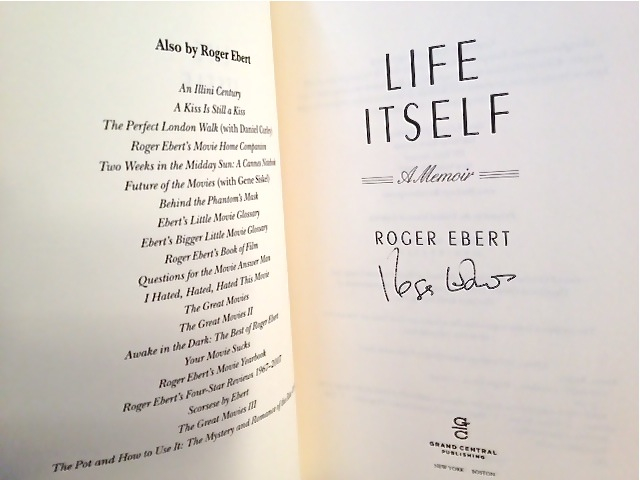
It was pure serendipity. While browsing in Indigo Books on Bay Street, I noticed a sign saying Roger Ebert would be in that store signing his memoir Life Itself a few days later. I had long followed his reviews since his “Siskel and Ebert” days, the two-thumbs-up duo. By the way, Ebert’s right thumb-up had been trademarked. Reviewing films for the Chicago Sun-Times since 1967, Roger Ebert was the first film critic to win a Pulitzer Prize for criticism (1975). He remained prolific even unto his last days.

Roger Ebert autograph Life Itself

So after seeing the sign I was thrilled to know I would have a chance to see Ebert in person, right there in Toronto. To me, such an encounter was not just about an autograph, or seeing a celebrity up close. It was about seeing a man who after torturous cancer treatments and surgeries for his thyroid, salivary gland and jaw, had lost a part of his face and the ability to talk and eat, and yet still maintained his humor and passions, who continued to press on to new ventures… this was about seeing life itself.

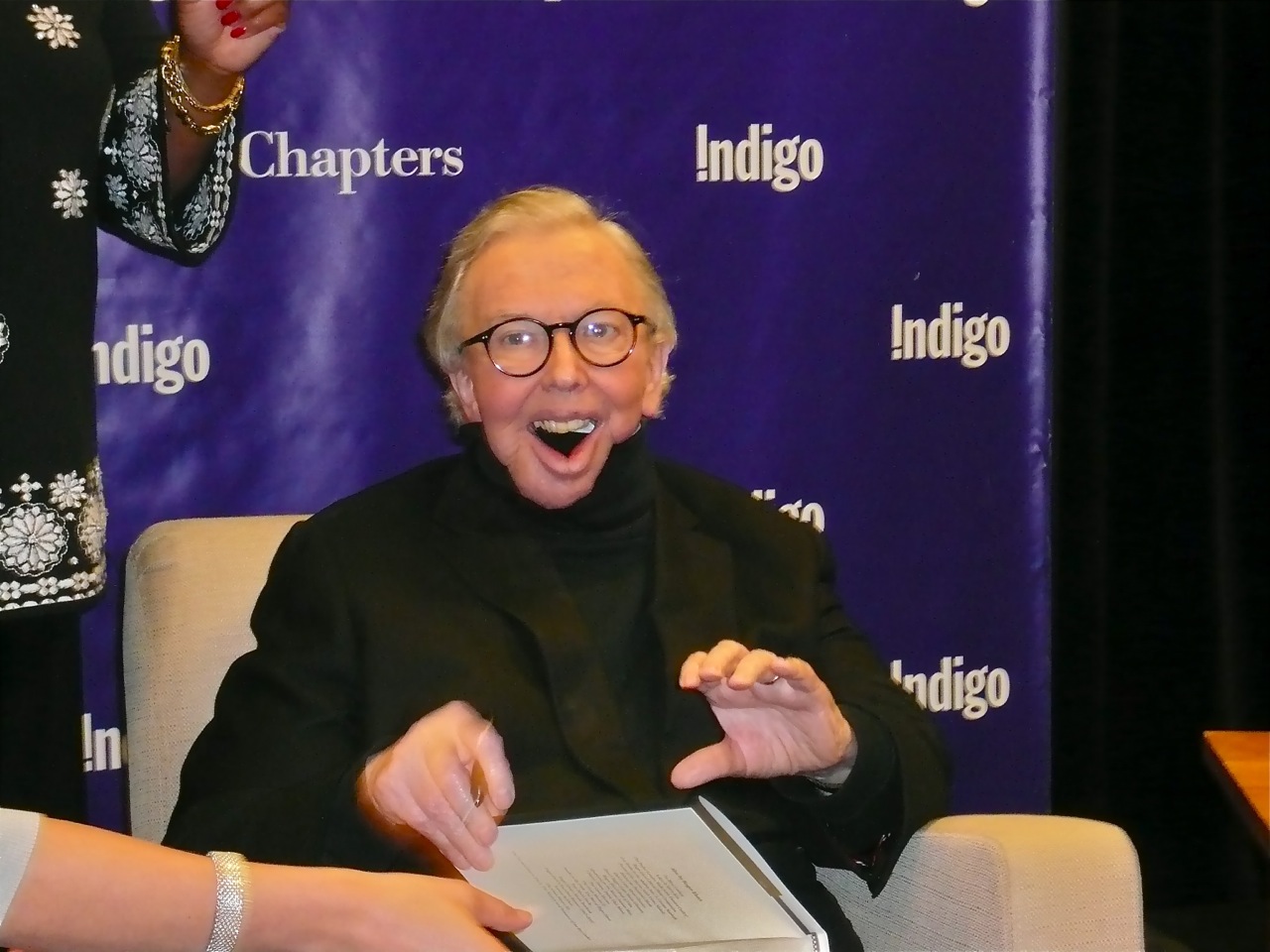
In the late afternoon on September 14, 2011, at the signing area in Indigo Books on Bay Street, people had been lining up for over an hour. I was one of them. At 7 pm, Roger came in walking slowly and with aid, stepped on stage and faced the crowd.

Ebert Signing

Together with his wife Chaz, they gave us a wave. Then he sat down and began signing. Photographs were allowed except for the rule of no posing. I waited my turn to go up to him, shake his hand and get his autograph in my copy of his memoir.

The Q & A session also began.

Roger’s wife Chaz was his voice. Personable and a film lover herself, Chaz shared some of her views of the TIFF selections. As executive producer of “Ebert Presents at the Movies”, she answered some questions without consulting Roger. But for most questions addressed to Roger, he would write in a small coiled notebook, handed it to Chaz to read out his answer.

Roger & Chaz

Here are some of the notes I had taken. Keep in mind this was a casual Q & A session in September, 2011. I’m sure Roger’s view towards 3D and CGI had changed considering his 4-star review of Ang Lee’s Life of Pi.

Q. Who influenced you the most?
A. He pointed to his wife standing behind him.

Q. Which decade is your favorite?
A. The 70’s… where you had The Godfather, Raging Bull…

Q. Buster Keaton or Charlie Chaplin?
A. Buster Keaton, albeit both are great.

Q. 3D?
A. Don’t ask. Story is number one.

Q. CGI (computer-generated imagery)?
A. Movies with CGI are soulless.

Q. All time best?
A. Citizen Kane.

Q. Favorite actor?
A. Robert Mitchum.

Q. Contemporary?
A. Al Pacino, Philip Seymour Hoffman, Tilda Swinton

Q. Favorite Canadian directors?
A. Atom Egoyan, David Cronenberg, Norman Jewison, Guy Maddin (thumb up)

Q. James Cameron?
A. Is James Cameron Canadian? Chaz asked in surprise.

Q. Favorite book?
A. A Fine Balance by Rohinton Mistry (Canadian! A voice came from the back)

Q. Any pressure from movie producers to write a good review?
A. No, he hasn’t been pressured. He was beyond reproach, Chaz answered.

Q. Any movies you haven’t seen?
A. The Sound of Music

Q. If there’s a movie made about you, who’d you want to play you?
A. Philip Seymour Hoffman. Chaz added, Oprah to play me. Diana Ross would be good too.

Q. Advice for potential film critics?
A. Do you want to get paid?

Q. Yes and no. (The questioner covered all bases.)
A. Start blogging. Roger replied. 

Q. How does your life influence the way you review a film?
A. It generates every word.

Definitely more than just an autograph. What an encounter. What a night.

***

Photos of Roger Ebert were taken with just a pocket camera at the event, book autograph page shot with iPhone at home.

Saturday Snapshot is hosted by Alyce of At Home With Books. Click Here to see what others have posted.

Becoming Jane (2007)

I’ve delayed watching this movie till now.  I wanted to avoid all that hype about Jane Austen.  Even as a JA fan, I’ve hesitated jumping on the Austen bandwagon of what I suspect to be mere commercialism.  Well, after a few months waiting for the dust to settle, I went into a second-run movie theatre this crisp October day with very little expectation, and was pleasantly surprised…I thoroughly enjoyed the movie!

Becoming Jane

As I mentioned in my reply to a visitor who had left a comment on my WWAW post, like many of life’s simple pleasures, a movie does not have to be ‘deep’ to be enjoyable.  However, simplicity does not mean superficiality.  Becoming Jane is heart-felt story-telling.  It has many witty renderings especially carved out for Austen readers, like the mirror images reminiscent of Pride and Prejudice.  The first part of the movie moves along breezily with its humour; but it is the sombreness in the latter part that makes the story so poignant.

Based on the recorded short-lived courtship between Austen and a young lawyer named Tom Lefroy, the backdrop of the movie has its historical accuracy:  the Austen family, Jane’s close relationship with her sister Cassandra, the inequitable social environment wherein Jane as a female, had to write anonymously, and the torment that one had to face having to choose between marrying to survive and marrying for love, and suffer the social disgrace and financial ruins resulting from it.

Other than the basic background, the movie never intends to be a serious, historically grounded account.  It is pure fiction, and as one of the contemporaries of Jane Austen the Gothic writer Ann Radcliffe says in the movie,  it is the imagination, and not real-life experience, that gives rise to story-telling.  From this spirit evolves the beautiful story of Becoming Jane, purely imaginary, idealistic, noble, and yet painfully poignant.  The movie leads us ever so subtly to realize the bitter taste of love over the sweetness of romance.

The simple script will not work if not for the great acting, or understated acting rather, of all its cast members.  Anne Hathaway has once again robbed the Brits of a coveted role, yes, an American playing one of the best-loved British authors (The other one I’m thinking of is Renée Zellweger playing Bridget Jones). James McAvoy is comparable in his charm as Tom Lefroy.  The supporting roles are all played by excellent veterans like Maggie Smith, Julie Walters, Ian Richardson, and James Cromwell.  Anna Maxwell Martin as Cassandra provides immeasurable support to Hathaway.  I was deeply affected by her lead role as Esther Summerson in the BBC production of Bleak House (2005).  Here once again she has demonstrated that her acting is superb.

I have enjoyed the cinematography, the costume, the music, and yes, even the disheartened twist at the end.  I came out of the movie theatre contented.   So what if the story is pure speculation.  Sometimes it takes the imaginary to lead us to look more directly at love, life, and the choices we make.   Maybe that’s why we are always drawn to stories, fiction … and movies.

~~~3 Ripples