Death Comes to Pemberley by P. D. James

This is how I see it. Living to 91 is an achievement in itself, let alone write a book at that age. I admire the adventurous spirit of P. D. James, sailing out to new waters at this stage of her career. This is her first attempt at creating an Austen sequel, a Pride and Prejudice fan fiction. So, how do I reconcile the flaws in this book with her previous acclaimed mystery works?  Let’s just say… the editor did it.

Take for example the error in referring Darcy as an Oxford man, who had actually gone to Cambridge, and with Wickham too. The ubiquitous redundancy of retelling, or the irrelevant details such as taking an inventory of how many candles are lit in which room.

Or, this dialogue between Sir Selwyn’s, the magistrate, and Darcy, as Darcy goes to his home to report to him a body is found in the woodlands. Are lines like these necessary? I find them incredibly amusing. Greeting Darcy, Sir Selwyn says:

Please sit. That chair with the carved back is said to be comfortable and should hold your weight.”

Since it was the chair Darcy usually occupied he had every confidence that it would. He seated himself and told his story…

The book begins with an epilogue detailing the story of Pride and Prejudice framed by a Jamesian view. It then starts off with the Darcy household preparing for the annual Lady Anne’s Ball at Pemberley, a tradition honouring Darcy’s mother ever since he was a child. A screaming Lydia comes charging in, uninvited, manically hysterical. Somebody has shot her dear husband Wickham, she claims. A search party led by Colonel Fitzwilliam soon takes action, and a body is found lying in the dense woodlands on Pemberley grounds. Wickham, very much alive, is seen hovering over it, blood stained and drunk. The episode comes early, the rest of the book is the revealing of the facts, whodunnit and why.

This is no CSI. The body is removed once found and brought back to Pemberley. Wickham, the key witness also now the key suspect, is washed clean of the blood on him, given a sedative, and is deep asleep when the magistrate arrives to question him. The later inquest at Lambton and final trial at London’s Old Bailey sound like child’s play when compared to, what comes to mind for me, Dicken’s Bleak House trials.

Simple, straight forward, not much mystery to it. But readers get to be entertained by James’ literary rendering and imagination of all the main characters from Pride and Prejudice, six years after it has ended in Austen’s hands. Darcy and Elizabeth now are parents to two boys, Fitzwilliam, 5, and Charles, 2. Readers so fond of their courtship would be disappointed at not seeing them together much in the book. Georgiana still lives in Pemberley, has two suitors, Colonel Fitzwilliam and a young lawyer Alveston, who seems to have a much higher chance.

At the end, we see the problem that has given rise to the motive of the crime neatly resolved by … Harriet Smith, who is married to farmer Robert Martin, no kidding. You’re right, that’s the Harriet Smith who used to go to a successful girl’s school run by Mrs. Goddard in Highbury, and the farmer Robert Martin who is a good friend of Mr. and Mrs. Knightley. All characters from Emma. This part reads like a parody. But we ought to be familiar with this sort of things by now in our current culture, a total mash-up.

All in all, I say, don’t resist your curiosity. Despite its flaws, and if you don’t take Austen or James too seriously, this just could make one great escape from all the demands of rationality in your daily routines.

~ ~ 1/2 Ripples

***

For all Jane Austen / Pride and Prejudice fans, this review from The Guardian is a must-read.
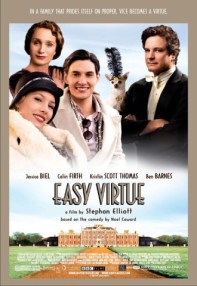
Easy Virtue (2008)

Easy Virtue posterCan we all get along?  That poignant plea is ever applicable,  from L.A to all corners of the world, today or years past.   And when it comes to families, which one doesn’t have its ups and downs?  So, since the answer is obvious, might as well make comedies out of the situation.
Based on the play by Noel Coward, and lavishly adorned with his songs, credits to the Easy Virtue Orchestra, the film is otherwise re-written to appeal to a contemporary audience.

The story takes place some years after the First World War, in the 1920’s.   The eldest son of an English aristocratic family, John Whittaker (Ben Barnes, The Chronicles of Narnia: Prince Caspian), comes home from abroad and brings back his new wife Larita, a race car driver (Jessica Biel, The Illusionist).  What ensue are battles on the home front between the audacious new bride and the stuffy and snobby matriarch of the family, Mrs. Whittaker (Kristin Scott Thomas, I’ve Loved You So Long).  The main spark of their explosive confrontations:  Larita is American.  And Larita does not disappoint.  She is exactly what Mrs. Whittaler expects her to be, and some more:  a gale of forbidden ideas and scandalous history.  For her performance, Kristin Scott Thomas received two Best Actress nominations.

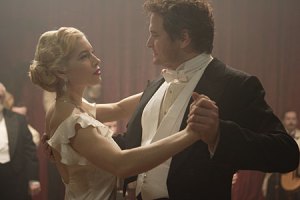
The most intriguing character is Mr. Whittaker, played by Colin Firth (When Did You Last See Your Father, The Girl With The Pearl Earring, Pride and Prejudice).  A veteran of the Great War, Mr. Whittaker is a disillusioned man, aloof, perceptive, and cynical all at the same time.   He is the only one in the family extending a welcoming hand to Larita, and stands by his new found comrade in the domestic clash of cultures.   The climax of the story comes near the end in an enthralling scene of the two tango dancing.  Naturally, what follows is just anti-climatic.

Easy Virtue 1

The Whittakers live in a humongous mansion on acres of lush grounds for generations, reminiscence of Darcy’s Pemberley (yes, Colin Firth again), and for Mrs. Whittaker especially, no short supplies of pride or prejudice.  Whether it’s intentional of the director or not, at one scene in the Whittakers ballroom, I see Darcy, poised and tall.  But director Stephan Elliott and co-writer Sheridan Jobbins are no Jane Austen.  This comedy of manners may appear to be a burlesque of the traditional upper-class English family, but it lacks the depth of characterization and cathartic effect of an Austen work.

And that’s alright.

Easy Virtue may be frothy, loud, and ephemeral, but it is effective in delivering some witty lines, great comedic timing, some cool cinematography, and fine performance not just from the main characters, but the supporting roles.  I must mention the butler Furber (Kris Marshall), and the two Whittaker sisters Hilda (Kimberley Nixon) and Marion (Katherine Parkinson).  They have added much delight to the film.  A fun ride all the way.

I have not seen Colin Firth and Kristin Scott Thomas together in a movie since The English Patient (1996).  And truth be told, they are the reason for me to see this one.

Easy Virtue is currently released on limited screens across North America.

~ ~ ~ Ripples

Vision not Illustration

Read a post entitled “It’s All About the Story” on the Austenblog relating the controversial remarks the Welsh filmmaker Peter Greenaway made recently in an international film festival.  He criticised modern blockbusters like the Harry Potter and Lord of the Rings series, dismissing them as “not films but illustrated books”.  As for all the Austen movies sprouting up in recent years, Greenaway said:

Cinema is predicated on the 19th-century novel.  We’re still  illustrating Jane Austen novels—there are 41 films of Jane Austen   novels in the world.  What a waste of time.”

This is my response.  I recognize that not all attempts of turning books into films are successful, many far from being effective.  However, a good movie should be the portrayal of a vision, not mere illustration or graphic representation of the written words.  As I have commented in that post, let’s just say a film is the visualization of the novel, not mere illustration.

And there is a major difference between vision and illustration: the former is seeing through an interpretive lens, rather than simply transferring images from one medium to another like the latter.

That’s why we may like a certain adaptation over another of the same Austen novel, and that’s why there can be more than one movie on the same story… Just as Bach had created Theme and Variations, we can have Story and Adaptations. That’s the reason why we still go to the concert hall and listen to different masters playing the same pieces of music, infusing into their performance their own unique persona and interpretation.  As an art-house filmmaker, Mr. Greenaway should have grasped this very fundamental notion.

As for future endeavors to turn Austen novels into films, I say, “All the best!”

WWJW: What Would Jane Write?

thejaneaustenbookclub2

The Jane Austen Book Club

Calgary International Film Festival 2007

Some time ago, I was using the phrase “intellectual chick lit” to describe the book Literacy and Longing in L.A. to a friend and was instantly retorted with: “Isn’t that an oxymoron?”  I had no reply.  Maybe to respond to the bad rap “chick lit” and “chick flicks” have been getting, a few writers have infused literary ingredients in their concoction in their attempt to create more intelligent work.  The Jane Austen Book Club falls into this short list.  The book written by Karen Joy Fowler (2002 Pen/Faulkner Award finalist) was turned into sceenplay by Robin Swicord (Screenplay, Memoirs of a Geisha, 2005) who made her directorial debut in the movie.  I had the chance to view it on the first day of the 2007 Calgary International Film Festival.

The book club is established with the original intent of consoling Sylvia, who is recently divorced from her husband Daniel.  It is a plan conceived by her good friend Jocelyn, a never-been-married dog breeder.  Following the theme of Austen’s Emma, Jocelyn has brought along the only male, Grigg, to the club, intended for her friend Sylvia.  What follows is the expected outcomes, Grigg falls for Jocelyn instead of Sylvia, who later reconciles with her estranged husband, while the other members of the group also are either hooked up with new found love or have their relationships mended.  Very neat, very happy, very clean ending.  Is this what Jane would have written if she were around today?

TJABC reminds me of the British movie Love Actually, which was released during the Christmas season in 2003.  Dealing with the love affairs of eight different couples in the midst of the hustle and bustle of the season has got to be a swift and jolly feat.  The movie remains a montage of famous British faces delivering superficial Christmas cheers under the banner of love.  TJABC has just slightly fewer characters, with six members in the group responsible for leading discussion on one of the six Austen novels.  Despite the juxtaposition and parallels of Austenian motifs and plots, I feel that both the movie and the book circumvent the periphery of contemporary life and relationships without offering much depth and insights as Austen’s own work. But of course, who is comparing Fowler with Austen?  Having said that, I must say I’ve enjoyed the acting of some of the characters, especially Prudie (Emily Blunt, The Devil Wears Prada, 2006), and Hugh Dancy (who would have thought he’s a Brit?)

Coming back to my original question:  What would Jane Austen write in this 21st century?  Would she fall for “chick lit” that can be turned into romantic comedies, for good cheers or box office successes?  Would Jane Austen be a mere romance writer, or “chick flicks” producer? Carol Shield noted that Austen’s heroines “exercise real power”, given their disadvantaged social positions.  Martin Amis stated “her fiction effortlessly renews itself in every generation.”  Virginia Woolf said about Austen’s writing: “That was how Shakespeare wrote.” Harold Bloom commented on the somberness of her work.  Thornton Wilder claimed that Austen’s “art is so consummate that the secret is hidden.”   Fay Weldon summed it up well:  “I also think … that the reason no one married her was … It was just all too much.  Something truly frightening rumbled there beneath the bubbling mirth:  something capable of taking the world by its heels, and shaking it.”  Thanks to Fowler for including such commentaries at the back of her book.

Austen is a sharp and incisive social commentator of her time, a progressive thinker holding a sure sense of morality, and a brilliant observer of human nature and relationships.  Her wisdom is well crafted in the disguise of humor and satire, her vision covered under seemingly simple, idealistic fervor.   Her critique of the manner and injustice of society, if transferred into modern day context, might not appeal as “chick” or as “romantic” as many of us would want to see, or can accept.

What would Jane write?  Definitely not “chick lit”.

~~1/2 Ripples for both book and movie