Paris in July 2025 – Delightful reads by Antoine Laurain

For Paris in July this year, I want to read an actual Parisian author writing Parisian stories. I did some digging and found Antoine Laurain. I’m late to the party, for Laurain has written more than a dozen books, which have been translated into twenty languages, an award-winning novelist whose talents are multi-faceted: author, journalist, screenwriter, film director, antique collector and dealer.

I’ve read or listened to four of Laurain’s novels in the past weeks: The Red Notebook (2014), The President’s Hat (2012), The Readers’ Room (2020), and The French Windows (2024). I still have many more to savour. These ones I’ve read are all like novellas, less than 200 pages, each unique in its storyline, very entertaining, easily accessible but not shallow. Laurain’s writing is a fusion of the literary and the popular, weaving suspense and romance, or adding a dash of magical realism as in The President’s Hat. Among these four, The Red Notebook is my favourite.
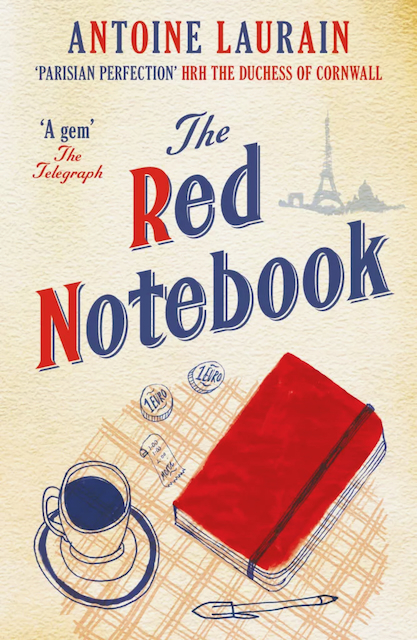
The Red Notebook by Antoine Laurain, Gallic Books (English edition), 2015,
159 pages.

Ahh… The contentment of being sought and found… and to be known.

Laurent, a bookstore owner, finds a woman’s leather handbag in good condition on top of a garbage bin on the street one morning, obviously stolen and discarded there. He takes it to the police station, but is told to wait. Doesn’t have time to spare, Laurent decides to leave it till the next day to hand it in. The mauve handbag is just too much of a lure for Laurent to keep his curiosity in check. That night at home, he opens it gingerly and explores the personal effects inside, hoping to find a name and address so he can return it to its owner.

Among the perfume, hair clip, keys, and numerous other items, there’s a red Moleskin notebook. Just too tempting, how can he not open it? The elegant and fluid handwriting records the owner’s self-reflections, her likes, her fears, her dream.

He had opened a door into the soul of the woman with the mauve bag and even though he felt what he was doing was inappropriate, he couldn’t stop himself from reading on.

It could sound creepy, but Laurain lets his readers empathize with this curious middle-age bookseller, for he is now a detective of the soul. And Laurain knows how to tell his story with humour. As he searches the bag, his girlfriend shows up, complicating matters. Later, adding zest to his quest, his daughter joins in his detective work readily and offers invaluable assistance.

Augmenting Laurent’s eagerness to find the owner of the bag himself instead of letting it go to the police is another object in the handbag, the book Accident Nocturne signed and with a line of dedication handwritten by the French author and Nobel laureate Patrick Modiano. The bookseller is overcome by a surge of passion, for Modiano is his favourite writer. Herein lies the clue to someone who shares the same mind as his. From the line of inscription, Laurent knows the first name of the owner of the bag, Laure.

While ordinary love stories might focus on a person looking for the right one to love, here in The Red Notebook, it describes the complementary side of the search as well, by revealing the one aspect which might be the most gratifying of true love: being sought and found… and to be known.

I like the idea of a man going to so much trouble to find me (no one has ever gone to so much trouble for me before)

While Laure has had men in her life before, but there has never been one who had really stepped inside her mind. Yet here is one stranger who has known and admired her inner being, and is passionate enough to go the distance to find her, and yet…

The ‘and yet…’ is purposely unwritten as I don’t want to give any spoilers. I highly recommend The Red Notebook as a light and entertaining read, one that touches that soft spot of the human heart, to be sought and found… and deeply known.

I await a filmmaker to take this up, write an English screen adaptation and set in New York City, find a perfect cast, and I’m sure it will make one marvellous rom com, or a little more serious but equally heartwarming rom dramedy.

Ah… Celine Song, would you be interested?

***

Paris in July 2025 is hosted by Words and Peace and France Book Tours

‘Miracle and Wonder: Conversations with Paul Simon’ by Malcolm Gladwell

This is the best use of the audiobook format. You listen to conversations held by Malcolm Gladwell and his colleague, journalist Bruce Headlam, with the legendary singer songwriter Paul Simon; you hear him talk about his creative process and share interesting tidbits along the way; you hear myths debunked from Gladwell’s trademark inquiries; you discover new personal insights. Above all, you can hear the music icon who had created many world famous tunes over his 65 year career, now at 80, pick up his guitar and sing his own songs or listen to the recordings that had made him and his singing duo Art Garfunkel a household name. And more, you can hear reflections from other influential musicians like Renee Fleming, Sting, Herbie Hancock… For me, this listening experience has opened the floodgate of reminiscence and memories.

A myth debunked. No, Simon didn’t write his breakout hit “The Sound of Silence” in the subway under hauntingly existential circumstances, but in the bathroom of his parents’ house. The walls were tiled and the water running, he played his guitar in the dark and could hear echoes. He was 22. That was all he remembers now. No matter, that tune and the lyrics had sent echoes to the heart and soul of millions around the world.

The inspiration of “Bridge Over Troubled Waters” came from a line in the Black Gospel singer Rev. Claude Jeter’s (1914-2009) song “Mary Don’t You Weep”–– it says “I’ll be a bridge over deep water if you trust in my name,” a Biblical metaphor. While the title and lyrics were sparked by Jeter’s Gospel song, the melody was inspired by J. S. Bach. Another interesting tidbit is that sound engineer Roy Halee reminisces that it took him more than 100 hours to make the recording of “Bridge Over Troubled Water” as they explored different mixes of sound effects. Simon notes that the song had rippled to many different stylings and sung by so many others that he doesn’t feel it’s his own anymore. And he’s fine with that. In particular, he pays tribute to Aretha Franklin’s soulful rendition.

A poignant moment. When the first “Saturday Night Live” came back on after the tragedy of 9-11, the producer called Simon and asked him to perform in his show. I think you have to do “The Boxer”, he said. An iconic New Yorker song, a fighter that carries the reminders of being struck down yet still remains with resilience and tenacity. In the audiobook, Simon recollects that he had tried to put words in the bridging stanza but none came and so he decided to just use “lie la lie…lie lie lie lie lie lie lie lie la lie…” not knowing such wordless echoes would cross linguistic borders when live audience around the would join in spontaneously when he performed.

Where to locate Paul Simon? He refuses to be called a folk singer. His songs inspired by very different sources. His creative process often sparked by distant memories of tunes and rhythms. After the breakup with Garfunkel, he ventured into a musical fusion of cultures and stylings. Gladwell spends some time talking with Simon about how the song “Take Me to the Mardi Gras” came to be. There are at least five sources of creative contributions: the Black Gospel singer Claude Jeter, R & B musicians from Alabama, a New Orlean jazz brass band, Jamaica reggae, and plausibly, according to Gladwell’s instinct, a Yiddish riff. Such freedom to adapt different cultural roots in his compositions leads him later to his album “Graceland.”

Herein lies Gladwell’s sensibility, one I totally embrace and thanks to him, lays out in words the notion that has long lodged in my mind. Using Simon as an exemplar, a Jewish singer songwriter from Queens, NY, Gladwell says:

As a New Yorker, your cultural identity is something you get to hold loosely. It influences you, but it doesn’t define you. You’re free to roam and window shop and come up with your own combination.

The melting pot theory debunked––as attuned to Nathan Glazer’s social theory in Beyond the Melting Pot––well, at least in NYC during Simon’s early creative decades, this kind of freedom existed. But isn’t that a true requirement for one to be a global citizen, a member of our shared humanity, transcending ethnic borders and arbitrary barriers? Unfortunately, such a fluid cultural perspective has shifted in recent years to a narrow view demanding artists, writers, filmmakers… to stay in their cultural lane, to use Gladwell’s metaphor.

Another fascinating tidbit…wait till you get to where Gladwell links taste with memory when he talks about how Stephen Sondheim regrets that his lyrics in the “West Side Story” song “Maria” aren’t quite right, and then goes on to discuss with Simon about finding faults in his own compositions. BTW, “Homeward Bound” is Simon’s “Maria.”

Another issue Gladwell investigates is the mystery of longevity in the creative process, using David Galenson’s book Old Masters and Young Geniuses to compare and analyze why some artists hit their peaks as young prodigies while others are late bloomers, sustaining a long creative journey. Where to locate Paul Simon in this spectrum? I’ll leave that interesting topic for you to experience when you listen to this exceptional audiobook.

~ ~ ~ ~ Ripples

Miracle and Wonder: Conversations with Paul Simon by Malcolm Gladwell and Bruce Headlam with Paul Simon, audiobook ©2021 Pushkin Industries and Paul Simon (P)2021 Pushkin Industries and Paul Simon

***