Lost in Austen: Episode 2 (2008, TV)

For all of us Canadian viewers, who have patiently and faithfully waited VIVA to show us one episode at a time of Lost In Austen two months after its premiere in the UK, we have been short-changed last night! I knew Amanda Price would have to face some musical challenge in this episode. But I purposely did not try to find out what it is by reading others’ reviews. I want to see it first hand. But I was not given that opportunity. Why would VIVA cut out the most hilarious part of this second installment?

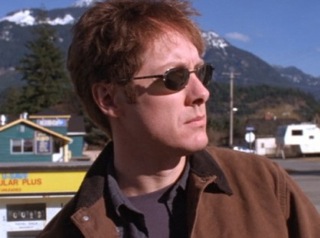
For those who don’t know what they have missed last night, here is the clip from YouTube:

Darcy’s “All ladies can sing.” is such a funny parallel to his statement in P & P: “Every savage can dance.”

I’m afraid though, the above may well be the few funny parts in this episode. And with VIVA cutting it out, we’re left with not much commotion. I admit that my earlier excitement from last week has died down. Without the Petula-Clark-inspired parody, this episode seems to have lost some of the initial lustre. There are still funny moments, and humorous lines, but the overall appeal seems to have waned.

I hope I’m not experiencing another version of lost in Austen. I find in this episode the screenwriter has taken us as far away as possible from the original P & P story just for the sake of gratuitous divergence. I was looking froward to seeing more of the LOL parody it has set up in Episode 1, more wild rides from the free-wheeling imaginary scenario. I was a bit disappointed to see its freshness replaced by banality. The slapstick humor makes me wonder what’s left in the bag of creative antics.

One more thing: I was most perplexed as to why the dress with the lowest neckline was being worn by none other than Mrs. Bennet, the mother of five daughters. Lady de Bourg would definitely have exclaimed: “Is she still out?”

However, all is not lost. I’m still eager to see how Amanda can right the wrongs and get out of the mess from her intrusion into the Bennet family. And if nothing else, this episode has at least achieved in making me love the original even more, not just JA’s ingenious creation, but the 1995 BBC production as well, yes, even Mr. Collins there. Further, last night’s episode just confirmed my view that nobody can do Darcy better than Colin Firth.

Episode 1

Episode 3

Episode 4

Lost in Austen: Episode 1 (TV, 2008)

lost-in-austen

What a delight it was for me to catch the Canadian premiere of Lost in Austen on the new VIVA channel last night, two months after its UK debut on ITV. No, I had not anticipated it with much eagerness, I admit, nor had I held any expectations before I watched it. But, what a pleasant surprise.

I was somewhat skeptical about another time-travel movie and yet another take on Pride and Prejudice. It seems we are doing Jane Austen a disservice to have so many different “versions” of her ingenious work, turning P & P into a modern day literary cliché. How many more original antics can screen writers squeeze out after all the adaptations and fan fiction spin-offs in recent decades? But this one is fresh and original. It is laugh-out-loud funny, entertaining, with intelligent dialogues and a new perspective. I’m afraid to say too, that there are moments with SNL type of parody on the story and its characters, especially Colin Firth’s role as Mr. Darcy.

But it’s all harmless fun. “No offense taken.” I’m sure Jane, with her sense of humor and satire, would have responded, or Colin, for that matter.

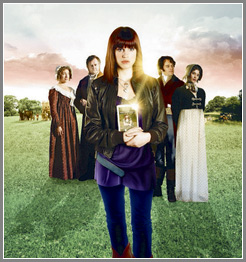
lost-in-austen-amanda-priceAmanda Price (Jemima Rooper, The Black Dahlia, 2006), a modern day working female living in Hammersmith, London, is a JA addict. Reading Pride and Prejudice has become her escape from her lacklustre life. She reminds me of Renée Zellweger’s Bridget Jones, although Amanda here manages to keep her weight under control and has a boyfriend that gets drunk on beer and proposes to her with a beer bottle tag as a wedding ring. So, it is a real fantasy for her to find Elizabeth Bennet (Gemma Arterton, Quantum of Solace, 2008 ) in her bathroom, showing her a portal that leads straight to the Bennet house. But understandably, Amanda is a bewildered and reluctant time-traveler, at least at this point.

The freshness of the story comes from all the twists that do not follow Jane Austen’s story. As with my usual reviews, I don’t like to give out spoilers. But I have to say, the key to these ingenious renderings is that Amanda Price swaps places with Elizabeth Bennet. With Lizzy out of the picture in P & P, the rest of the story is up to the screen writer Guy Andrews’ and director Dan Zeff’s own imagination.

In this first episode, most of the major characters are introduced. All of them deliver a lively performance, although I’m particularly fond of Amanda and Mr. Bingley (Tom Mison). The music reminds me of the 1995 BBC production, energetic and swift. In turn, the pacing is quick and effective. My main criticism though, is the set design of the interior of the Bennet house. It looks more like a modern day rather than an early 19th Century setting, quite incompatible with the exterior of the house.

Right from the start, I have resolved to not take this TV production too seriously, but just immerse myself in the wild and fanciful ride it freely takes me. After all, Jane herself had excelled in this very act, transporting us to meet all sorts of characters and situations through the imaginary worlds of her novels. I’m sure she would have a good laugh too tonight if she were watching with me… now that would be a fantasy indeed.

Just Click to read my review of the other episodes:

Episode 2

Episode 3

Episode 4

*****


Mamma Mia! (2008) Movie Reivew

If beach reads is to superficial page-turners, then summer movies is to mindless, senseless, jovial entertainment.  If you allow yourself to devour less than literature under the summer sun, you can have your fill by indulging in Mamma Mia!  Why not, what other times of the year can we immerse ourselves in superficiality, if not in the name of summer fun.

Like the recent re-emergence of past heroes such as Indiana Jones, Rocky Balboa, and the like, I suspect making Mamma Mia! is the mid-life fix for its actors and actresses.  And for stars like Meryl Streep, where else can you, as a 59 year-old, sing and dance like a rock diva, jump up and down on your mattress like it’s a trampoline, dance to you heart’s content on a Greek Island with the whole village backing you, and make a splash, literally, to end a wild number.  Looks like Streep has the time of her life making this movie.  What more, she’s got Pierce Brosnan, Colin Firth, and Stellan Skarsgard swinging and jiving with her.

On the eve of her daughter’s wedding, Donna (Streep) finds herself faced with three of her past lovers who have shown up upon receiving invitation from the bride to be, Sophie (Amanda Seyfried).  Before getting married to her sweetheart Sky (Dominic Cooper), Sophie feels the urgency to find her real father and have him walk her down the isle. Director Phyllida Lloyd did a passable job churning out a simplistic but fun-filled movie adaptation of her Tony Award winning musical.  What captures the audience is not so much the story but the popular songs written by ABBA’s Benny Andersson and Bjorn Ulvaeus.  Titles like “Mamma Mia”, “Take A Chance On Me”, “Dancing Queen”, “Knowing Me, Knowing You”, “The Winner Takes It All”, “SOS”, and “I Have A Dream”… supply the bulk of the movie goers their mid-life fix.

So who cares if it’s a silly, senseless, mindless escape.  At least, it works… well, more or less.  As I sat in the packed theatre, where families had to sit separately to find seats, where teenage boys came with their mothers, where I heard middle-age men laughing out loud, and where I caught myself watching the movie with a smile on my face and tapping my toes to the tunes, it sure worked as a great escape.  Don’t expect in-depth characterization, complexity in plot structures, insightful dialogues, and please don’t mind the miscast (Bond in song?)… it’s summer after all.

Adapted from the successful musical showcasing the songs of the sensational Swedish group ABBA, Mamma Mia! the movie features authentic singing from the movie stars themselves.  Yes, there are LOL moments listening to them singing in their amateurish voices.  Don’t expect professional vocal performance… from Pierce Brosnan?  The fun is hearing him seriously belt out “SOS”, now that’s entertainment.  And all ye fans of Colin Firth, he has definitely smashed the Darcy image, if it still lingers in your Janenite mind.  Here you can see him play the guitar, sing, hang loose, and dance like a rock star.

There seems to be no middle ground in our summer movies this year:  Mamma Mia! is as light and giggly as The Dark Knight is dark and gloomy.  If you can overlook the subliminal implications seeping through Mamma Mia:  The celebration of promiscuity and the appeal of the stereotypical senseless female, then this movie adaptation is a sure escape.  But if you’re expecting more, I’m sure there are other offerings under the lazy summer sun.

Photo Source:  Seattle Times and Universal Pictures


~ ~ ½ Ripples

Update December 11:  Mamma Mia! has just been nominated for a Best Picture Award (Comedy or Musical) at the 2009 Golden Globes, and Meryl Streep nominated for the Best Actress (Comedy 0r Musical) category.

Then She Found Me (2007)


Then She Found MeLet me guess, movie making is as demanding and draining as child rearing…and, if you’re doing both together, well…kudos to you.  Case in point, a gaunt and much thinner Helen Hunt.  Well, maybe that was on purpose for her role.  Anyway, after some intermittent hiatus since her second marriage in 2001 and the birth of her daughter in 2004, the Oscar winning actress (As Good As It Gets, 1997) comes out with a film that she co-writes, directs, and stars in.  Then She Found Me shows that Hunt is alive and well, and that she certainly can multi-task.

As a directorial debut, Then She Found Me is a gem of a film. Based on the novel of the same name by Elinor Lipman, TSFM has been on the drawing board for a long ten years.  To read NY Times’ Interview with Helen Hunt, Click Here. Hunt adapted the book into screenplay with Alice Arlen and Victor Levin throughout a few years’ period. 

Dramedy is the word for this genre of film.  The drama component of the movie spurs on some meaningful exploration:  of motherhood, adoption, marriage, parenting, faith, and God… But it’s a comedy, first and foremost, and we’re rewarded by its remaining so.  The movie is funny, smart, warm-hearted and entertaining…and best of all, we’re spared all the possible preachy sessions that could have come out from dealing with its subject matters.

Juggling motherhood and movie-making could have explained Hunt’s tired and thinner look.  On screen, such an appearance is suitably in character, for she portrays a 39 year-old kindergarten teacher April Epner, newly married, and in a desperate rush to become pregnant before time runs out.  As an adopted child, April is all the more longing for a baby of her own, thinking of the deeper relationship, bonding and meaning that can naturally come out from giving birth to and raising her own child as opposed to adopting one. To this view, her step-brother, the natural son of her Jewish adoptive mother responds, “No, it’s the same”.

Well, she soon finds out.  Her excitement of finally getting pregnant is not shared by new husband Ben (Matthew Broderick).  It is obvious that he is not eager to become a parent, or a husband, for that matter.  Actually, this news comes to him after he feels that he has made a mistake in getting hitched for life, and has moved back to live with his mother.  Sadly, Ben is still a boy, donning a baseball cap and expects everyone, especially his wife, to accept his Peter Pan confusion.

But that’s not all.  Just after her husband has left her, April’s Jewish adoptive mother dies.  And to top it all off, April encounters her birth mother Bernice (Bette Midler).  Well to be exact, her mother has found her.  But at this chaotic point in her life, April is ambivalent about coming face to face with her birth mother, especially one who is so brassy, imposing and self absorbed.  Bernice is a local TV talk show host.  After 39 years of absence, she suddenly decides she wants to find her daughter.  But upon questioning by April why she had given her up after a short parenting gig, Bernice may have understood April’s ambivalence.  And I like it when the film leaves the queries as queries… simple answers to questions like these are never easy to find.

Helen Hunt and Colin Firth

Confused and emotionally fragile, April finds new romance and support in Frank (Colin Firth), the recently divorced father of a student in her class.  His artist wife has left him for another guy and at the moment, she’s travelling the world with him. Underneath Frank’s calm and affable demeanor is a very hurt, confused, and anguished man.  If Colin Firth thinks he still has not shed his stereotyped Darcy image, this is the time to do it.  His versatility as an actor just shines through in this conflicting character.  Once bitten, twice shy.   Frank is emotionally vulnerable, yet he also yearns to establish a meaningful and loving relationship with April.  The intermingling of two fragile and affable characters is the springboard to some amusing and poignant moments.

As a first time director of a full length movie, Hunt has done a proficient job, despite some minor problems with pacing and congruence of scenes.  Certain shots could have been shortened to maximize the intended humor while some scenes ought to be connected more smoothly.  The audience may need to fill in the blanks at times.  Having said that, I feel that my enjoyment is not tampered a bit.  One note of caution though, the language is part of the reason it gets an R rating, and that might turn away some viewers.  

Kudos should go to the admirable acting by Hunt herself, as well as Firth and Midler.  Midler is effective as a self-serving intruder at first, yet is sensitive enough to change, especially as she empathizes with April’s anxiety … learning to be a mother after all these years.  And I must mention Salman Rushdie, yes, the Salman Rushdie, who plays a supportive role as the obstetrician.  He has effectively sprinkled in some subtle humor.

Further, I admire Hunt for not shying away from the problem of faith, loss, and God.  The plot lends itself naturally to the exploration of these complex issues, and Hunt has boldly dealt with them directly. The religious expressions and prayers uttered might be in Hebrew, but the yearning, and the angst, is poignantly human and universal. 

Well, Mother’s Day has come and gone, but motherhood lasts a lifetime.  As a devoted single-parent to his children, Frank in the movie has demonstrated that the marriage vow “for better or for worse, in sickness and in health” can aptly apply to parenting.  And for all mothers, birth, adoptive, as well as those like Frank, who has to bear the responsibilities as one, it is in the nitty gritty of everyday realities that motherhood, or parenthood for that matter, finds its meaning and fulfillment. 

(The indie film is currently being screened on limited engagement in North America. It’s rated R in the U.S. for language and sexual content. In Canada, it’s rated from 14A to G, depending on the Province where it’s shown.)

To read my review of the book Then She Found Me, click here.


  ~ ~ ~ Ripples
                          

And When Did You Last See Your Father? Book Review

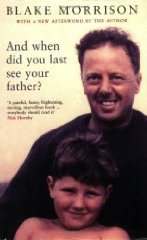
when-did-you-last-see-your-father-book-cover2I saw the movie When Did You Last See Your Father? at the Toronto International Film Festival last September, twice. I didn’t have the chance to read the book until a couple of days ago, about 7 months later. But as I read, all the scenes came back to me, and I appreciate the film even more than before. Yes, this is definitely a successful attempt at turning Book Into Film…and a hugely impressive one at that. The stellar cast with Jim Broadbent as the father and Colin Firth as the adult son, plus the exceptional supporting roles have brought out the spirit and the essence of the book poignantly, thanks to the very artistic and sensitive treatment by director Anand Tucker. To read my review of the movie, click here.

Blake Morrison is a contemporary British poet and writer. He was literary editor of The Observer and the Independent on Sunday before writing full time in 1995. AWDYLSYF is a memoir of his relationship with his father, Arthur Morrison, who died of cancer at age 75. Published in 1993, the book has won literary awards, and has been translated into many languages, from Japanese to Syrian.

The name of the book has its source in a painting of the same title by the Victorian artist W. F. Yeames. Yeames depicted an imaginary scene during the English Civil War. The young son of a Cavalier (Royalist) was questioned publicly by the enemy, the Roundheads (Parliamentarian), as to the whereabouts of his father. The question posed a serious dilemma for the boy. If he answered truthfully, he would endanger his father. If not, he would be commiting the immoral act of lying. Click here to read the story behind the painting.

And Painting by W. F. Yeames, When Did You Last See Your Father

Such a dilemma finds a parallel in the book. And it is apparent that Morrison has chosen to do the former, for the story he tells is incredibly candid, up-close and personal. As a reader, I’m glad he has done that. Eulogies are sometimes euphemism honoring the dead in order to please the living. But what Morrison has delivered is a courageously honest narrative of a precarious father-son relationship marked by ambivalence and love-hate sentiments. I can sense the pain such exposure could bring to the people involved, his mother, his sister, close family and friends. But I feel Morrison has burst the romantic bubble of the naturally congenial relationships we assume as we look at other people’s family portraits, or see families depicted in movies and novels. Love does not come naturally because of the tie that binds. Respect still needs to be earned, and loving acts need to be learned, for both parent and child.

The 20 independent, short chapters darting back and forth across the landscape of memory record the poignant reminiscence of a son living under the shadow of a powerful father. Arthur Morrison was a revered doctor in the town of Earby, in the County of Yorkshire…revered because of his imposing, domineering and callous demeanor. He could always get his way, and get out of troubles. In his recalling of childhood episodes, son Blake has aptly intermingled humor with pathos, all the more bringing out the complexity of character, and the ambivalence we sometimes feel towards our loved ones.  And to be fair, Arthur had cared for his family, albeit in his own patriarchal and egotistic manner.

He was gregarious.  In all social situations, he was the one leading the conversation and successfully avoiding topics that he was ignorant about…and was sure to stay away from games like Trivial Pursuit.

He hates feeling fallible: ‘I may not be right but I’m never wrong’ is the motto on a horrible brass wall-plate he has. He isn’t a vain man, but he is a proud, even bumptious one, a man with a puffed chest who learnt to water-ski in his fifties and thought he could go on forever.

How can such a character be brought to face his own imminent demise? Blake Morrison describes his father’s fast deterioration after diagnosed with cancer. The preparation though seemed to be harder for those who were going to be left behind than the patient himself. There was a relationship that needed mending, and, there were truths to be revealed. For years, Morrison had suspected the intimate relationship between his father and Auntie Beaty, a family friend. It had affected his perspective on his father, and on himself as a son. But he wasn’t given such a privilege. Other people’s secrets are theirs to own, even though that person is your father. And the living won’t tell: “Please leave me one last small piece–it’s mine” Auntie Beaty pleaded.

So the pressing question is: How is a son to prepare for the imminent demise of his own father, having lived in such a precarious relationship? The revelation comes at the end of the book. Death and mortality has a way of helping us put things in perspective:

Don’t underestimate filial grief, don’t think because you no longer live with your parents, have had a difficult relationship with them, are grown up and perhaps a parent yourself, don’t think that will make it any easier when they die.

Faced with the finality of death, all grievances one has towards the dying seem minute in comparison. As a son now, Blake has to learn to let go of his father, ironically, a lesson his father had failed to learn in the raising of his own son. Grievances give way to caring, to the consoling of the living, to the respect of a life lived on its own terms, to forgiveness, to closure.

In his Afterword, Morrison writes:

When young, we were impatient with our parents: now we want to atone for our callowness, and to acknowledge what they were and all they did.

Poignant words for us to ponder.


And when did you last see your father? by Blake Morrison is published by Granta Books, London. 1993. 230 Pages.

A movie tie-in edition by Granta Books is published October 2007.
~ ~ ~ ½ Ripples

The Jane Austen Centre Online Magazine

I’m excited to see my three posts on PBS’s Pride and Prejudice (1995 TV, Parts 1 to 3) have been selected for publication in the March issue of  The Jane Austen Centre Online Magazine

The posts have been combined into a single article. Magazine editor Laura Boyle has given it a new name “Pride and Prejudice Revisited”.  If you go to the Magazine’s home page, it can be found under the category of Jane Austen’s Work: Jane Austen’s Books and Characters .  You can also click here to go directly to my article.

While you’re there, browse through the many interesting and informative articles on topics relating to Jane and the Regency world, including fashion, recipes, histories, Jane’s work, media reviews, biographies, hands-on crafts and projects, and a short story mystery featuring Northanger Abbey characters entitled ‘There Must Be Murder’.

The Jane Austen Centre

I visited the Jane Austen Centre in Bath last December.  It’s located a few doors from Jane’s second residence in that Georgian City at 40 Gay Street.  The Centre houses a permanent exhibition, a gift shop, tea rooms, and sponsors walking tours and an annual Jane Austen Festival.  

For pictures of my Bath visit, here are my posts Jane Austen’s Bath and Bath in December.

Pride and Prejudice (Part 3): Ideals Universally Acknowledged

I have watched this miniseries countless times, but I still wanted to see it again last Sunday night, the finale of Pride and Prejudice (1995) on PBS’s Masterpiece. I knew I was partaking in a communal experience shared by kindred spirits across North America. Every time I watch it, I glean some new insights, and I cherish the story all over again.

This time, I look into the characters convinced that Jane Austen has depicted the ideal woman and the ideal man in Elizabeth Bennet and Fitzwilliam Darcy. Ideal, not perfect. While they have virtues of their own, they have character flaws that if remain unchecked and unaltered, could well lead to a downfall like a tragic hero. Elizabeth, biased by her confidence in her own judgment, initially found Darcy to be utterly despicable. And Darcy, acting according to his own hubris, only fuels the very prejudice held by the one he admires. In circumstances like this, the ideal scenario is for the characters to change, to transform themselves into a better person in order to earn requited love. And that is exactly what Austen has done, and I think it is one of the main reasons why we love her story. She has put together two flawed characters and placed them in an ideal scenario wherein they strive to improve themselves, and turned into a better person for the sake of the other…Well, maybe more on the part of Darcy, and we love him for that. I like the title Pride and Prejudice more than Jane’s original First Impressions. It gives a bit more depth and sets readers out searching for the universal shortfall in us all. Often our own prejudgment and overconfidence in our myopic view confine us squarely inside the box, unable to see the world beyond.

The portrayal of such transformation is vividly and sensitively acted in the miniseries. Colin Firth and Jennifer Ehle effectively help us envision such an ideal scenario, satisfying our quest for the good, the wholesome, universal ideal of love hidden in us all. Kudos to Andrew Davis. I think he has written an ideal screen adaptation of Austen’s novel. Because of its loyalty to the original and still keeping the integrity of the work even when Davis presents to us imagined visions arise from his own interpretation, I believe this miniseries is the definitive version of Pride and Prejudice on screen.

Again, I have several favorite scenes. Which heart will not melt by that burning gaze of Darcy ardently holding Elizabeth as she rescues his disturbed sister in Pemberley upon the malicious mention of the name Wickham by Ms. Bingley? (BTW, this is Andrew Davis’ favorite scene in all of his Austen adaptations!) Who will not rejoice in Elizabeth’s assertive and eloquent rebuttal against the diatribe of Lady Catherine de Bourgh, and her calm refusal to promise never to enter into any engagement with Darcy? Whose heart will not stir as a restrained yet passionate Darcy extends his second marriage proposal to Elizabeth?

Elizabeth has demonstrated time and again that she has the autonomy to make her own choices, yet Austen has also poignantly shown us that while Elizabeth can choose who to love, she cannot force the other to choose her, especially after her family’s reputation has been ruined by Lydia’s elopement. Darcy learns this lesson much earlier, in a most traumatic and humiliating manner, as he realizes that wealth and social standing, or even his own declaration of love cannot force another person to accept him. Here lies the paradox of love, one can choose who to love but cannot demand requited love. Choosing one’s love manifests the autonomy of self, but having to earn and wait for the other to choose you is a most humbling discipline. Maybe the ideal thing to do in such a circumstance is just to become a lovable person. That could well create the best chance of gaining love.

In the end, it is heart-warming to see both Darcy and Elizabeth, even having decided on each other, yet still quietly pines and waits for the other to declare his/her choice. A sense of uncertainty is what keeps us humble and instills in us the virtue of hope.

“It taught me to hope as I had scarcely ever allowed myself to hope before.”

Knowing our innermost yearning, Jane Austen brings her characters together in the most humbling circumstance, with their mutual admission of wrongs and weaknesses while esteeming the other higher than him/herself, fulfilling the ideal state of love.

“Do not repeat what I said then…I have long been most heartily ashamed of it.”

“As a child… I was given good principles, but left to follow them in pride and conceit… and such I might still have been but for you, dearest, loveliest Elizabeth!”

Through such mutual respect and admiration, our beloved author delivers the ideal ending to the love story of two imperfect persons…and sets us up for another round of watching and reading.

The Ideal Ending

********

Click to go back to Pride and Prejudice Part 1 and Part 2.

If you have enjoyed reading this article, you might like to click on “Jane Austen” in the category cloud on the side bar for more Austen articles here in Arti’s Ripple Effects.

Several of Arti’s articles have also been published in the Jane Austen Centre Online Magazine.  To read more about Jane and the Regency Period, just click on the link highlighted.

********

The Independent Spirit Awards

Some pleasant results from the Independent Spirit Awards held in Santa Monica today (Feb. 23). This is the dressed-down film awards ceremony honoring low-budget indie films, which takes place in a tent, and has gone green, completely environmental friendly according to host Rainn Wilson. For a full list of winners, click here. Some results I’m happy to see:

Cate Blanchett and Ellen Page

Juno: Winning Best Feature, Best Actress Ellen Page, and Best First Screenplay Diablo Cody. Ellen Page’s awestruck face and shaky voice as she gave the acceptance speech is the icing on the cake…sweet.

The Diving Bell and the Butterfly: Best Director Julian Schnabel, Best Cinematographer Janusz Kaminski.

Also, there are some very pleasant moments seeing:

  • A very pregnant Cate Blanchett winning Best Supporting Female for I’m Not There.
  • A still attractive Marisa Tomei, nominee for Best Supporting Female in Before the Devil Knows You’re Dead.
  • And last but not least, Darcy in jeans, yes, Colin Firth, the man himself, presenting the Best Screenplay Award.
Colin Firth

Great momentum, great spirit, all charged up for the grand movie award of the year, tomorrow’s Oscars Ceremony. And, Colin, we’re ready just the same to watch Pride and Prejudice after that, for the…ooh…I’ve lost count how many times.

(Photo Sources: Cate Blanchett and Ellen Page from Gossip Girls, Colin Firth from Wikimedia.)

Pride and Prejudice (Part 2): My Favorite Scenes

Unexpected encounter with Mr. Darcy

The second installment of Pride and Prejudice aired on PBS carries some of my favorite scenes in the whole miniseries. The ‘wet shirt’ episode, the favorite of many, is naturally one of them. Thousands have already talked about it, but allow me to add one small voice here. I find the surprise and embarrassing encounter of Elizabeth with the dripping wet Darcy to be an ingenious creation by Andrew Davies, an imaginary addition easily forgiven by many Jane Austen purists, I suppose. My reason for adoring this scene can be summed up in one word: vulnerability.

Both are caught unprepared and their vulnerability makes them equal. The inhibition of Elizabeth’s fondness of the place and her bewilderment of Darcy’s character based on the housekeeper’s compliments are well matched by Darcy’s eagerness to make a good impression but alas, while being caught in the most uncouth manner. Both clumsily and comically try to regain composure and maintain some form of civility. In the spontaneity of the moment, pride is laid aside and prejudice banished. And Darcy, stripped of his usual formal attire, presents his dripping and humble self in the most unguarded manner. Colin Firth has so vividly shown us that genuine and dishevelled appearances can be utterly appealing.

Another favorite scene of mine comes shortly after this chance encounter. As Elizabeth is driven away in the open carriage, she looks back at Darcy in a distance, wearing the fulfilled and satisfied smile on her face, while the camera, from her point of view, captures the handsomely poised Darcy seeing her off, his tall and slender physique growing smaller and smaller in the distance as the carriage is being pulled slowly away…how much tenderness can a camera shot elicit?

But before this beautiful departure at Pemberley, there is the duel of words. The scene I like most in this Part 2 of Pride and Prejudice is probably the first marriage proposal in Hunsford parsonage. Darcy’s words have but achieved one function: confirming every single prejudice Elizabeth might have held towards him. Through Elizabeth, Jane Austen has eloquently delivered her social commentary on the female predicament of her time. While love can be the most attractive reason for marriage for idealistic Lizzy, her better, rational self challenges the form, the motive, and the consequence of love. Would she be satisfied with the kind of love that is condescending, unequally bestowed, that is based on feelings ‘despite of’ and not admiration ‘because of’? Austen has articulated her critique on marrying for financial gains, even for the common good of securing the future of one’s whole family. A condescending relationship, despite the appearance of fondness and love, does not warrant the sacrifice of one’s dignity and value. Elizabeth has demonstrated clearly she has a choice, and she exercises her freedom to reject despite of the lure of wealth, status, and security. Just this scene is reason enough for me to admire Jane Austen.

*******

Click here to go directly to The Finale, Pride and Prejudice Part 3.

Click here to go back to Part 1.

Arti’s three posts on Pride and Prejudice (1995) have been combined into one article and published on the Jane Austen Centre Online Magazine.  To read that and other interesting articles about Jane and the Regency Period, click here.

Memorable Movie Love Quotes

To celebrate Valentine’s Day, I’ve compiled a list of memorable quotes from movies, all on the theme of love. All come from movies I’ve seen, some I’ve reviewed on this Blog (click on title to my review). They represent dialogues that have stirred some ripples in one small heart. And love…being a many splendid thing, embraces all kinds of human relationships, and transcends cultures and boundaries.
.

Here’s Arti’s Collection of Memorable Movie Love Quotes:

  • Medicine, law, business, engineering, these are noble pursuits and necessary to sustain life. But poetry, beauty, romance, love, these are what we stay alive for. — Dead Poets Society
  • The greatest thing you’ll ever learn, is just to love and be loved in return. — Moulin Rouge
  • The things that people in love do to each other they remember, and if they stay together it’s not because they forget, it’s because they forgive. — Indecent Proposal
  • I like you very much. Just as you are. — Bridget Jones’s Diary
Bridget Jones' Diary
.
  • When the planes hit the twin towers, as far as I know none of the phone calls from the people on board were messages of hate or revenge — they were all messages of love. — Love Actually
  • Maybe it is our imperfections which make us so perfect for one another. — Emma
  • And now, I’m back…and I’ve lost her all over again. I’m so sad that I don’t have Kelly. But I’m so grateful that she was with me on that island. And I know what I have to do now. I gotta keep breathing. Because tomorrow the sun will rise. Who knows what the tide could bring? —Castaway
  • I don’t believe in quantum physics when it comes to matter of the heart. — Bull Durham
Kevin Costner in Bull Durham
.
.
  • Shoot me. There’s no greater glory than to die for love. — Love in the time of Cholera
  • I need to feel strongly, to love and to admire, just as desperately as I need to breathe. — The Diving Bell and the Butterfly
  • For you, a thousand times over. — The Kite Runner
  • Come back…Come back to me. — Atonement
  • Natalie:  Do you believe in love at first sight?
    John:  Yes I do. Saves a lot of time. — The Stickup
    .

.

While a few are lucky enough to save time and escape the torments of love by creating a lasting flame from the first spark, some have to go through tumultuous pining, even the arduous and humbling experience of transforming oneself to gain requited love. And who, other than the following, epitomizes such kind of yearning:

Love Quotes From Downton Abbey:

“I love you Mr. Bates. I know it’s not ladylike to say it, but I’m not a lady and I don’t pretend to be.”  — Anna, S1E5

“I’m not a romantic… But even I concede that the heart does not exist solely for the purpose of pumping blood.” Violet Crawley, S2E2

“I’d rather have the right man, than the right wedding.” — Anna, S2E5

***

You all are welcome to contribute to this list. Just submit your favorite movie love quotes in the comment box below…and have a memorable Valentine’s Day!


Pride and Prejudice (1995 TV)

Colin Firth and Jennifer EhleIs it coincidental that PBS has chosen, of all the six Jane Austen adaptations, to air Pride and Prejudice the Sunday before Valentine’s Day? I think they must have strategically placed it there, knowing that this novel is one of the most-loved books in literature, as the results in recent polls have shown. They must have known that Pride and Prejudice is ranked the third most reread books in Britain, and first in a poll on books that people in the British nation can’t live without.

Other surveys reveal similar results. In a 2003 BBC poll, Pride and Prejudice ranked second as UK’s favorite book. In 2007, it ranked first.

Only in Britain, you might say…but it seems like this is a phenomenon across countries.

In Australia, Austenmania and Janespotting are the common terms to describe this unprecedented occurrence since the mid 1990’s. The Pride and Prejudice miniseries (1995) broke TV ratings, books and sales records.

Jane Austen takes an international stance as it goes multicultural. In Bride and Prejudice (2004), the best-loved Austen novel received a dashing Bollywood makeover. Which country doesn’t have its own class system and prejudice? The movie has also put Aishwarya Rai (with Colin Firth in The Last Legion, 2007) on the world map.

Most recently, Venezuelan director Fina Torres is getting ready to film Sense and Sensibilidad, with screenplay by Mexican Luis Alfaro. Locations of filming will be in Mexico and East L.A., and to be released at the end of 2008. If Jane is around she would be much gratified and amused to see her books gaining such a multi-cultural following.

Just last Friday, the February 8th issue of the Taiwan-based (North American East Edition) Chinese Newspaper World Journal has a full-page coverage on Jane Austen and her many movie and television adaptations.

In the cyberworld, as recent as this past week, Project Gutenberg ranks Jane Austen as the third most downloaded author in the past 30 days after Mark Twain and Charles Dickens, while Pride and Prejudice is the most downloaded Austen books.

But of course, statistics are irrelevant when it comes to matter of the heart.

We who love Austen’s works and in particular, for me, Pride and Prejudice, will continue to reread the book and rewatch this TV miniseries regardless of what the polls show. Different people might find different reasons for its appeal. But I, for one, feel that Austen has created through Elizabeth Bennet and Fitzwilliam Darcy the ideal (note: not perfect) woman and the ideal man. I see in them the essential ingredients of relationships, with oneself, and with others: respect, compassion, kindness, generosity, hope, and grace, but above all, the willingness to change and be transformed for the better. I’m much grounded to expect perfection in the human world, but through Austen’s depiction I can cherish and admire the ideal.

With Valentine’s Day drawing near, and with our world unfolding as it is, cherishing the ideal could well be the key to help us build a more beautiful tomorrow.

*******

Click here to go directly to Pride and Prejudice: Part 2.

Click here to go to Part 3, The Finale of Pride and Prejudice (1995 TV).

Andrew Davies Interview

Thanks to a Jane Austen and film fan, I just received a link to an interview with Andrew Davis on CNN dot com.  Davis’ recent adaptation of Northanger Abbey (2007) will be shown as the second installment of Masterpiece Theatre’s “The Complete Jane Austen“, to be aired on PBS this Sunday, Feb. 20.

Master of screenplay adaptations of literary classics and especially Jane Austen’s works, Davis has some interesting views to share in this AP article entitled:  Sex, Class, and Exposing the Heart of Jane Austen.  Here’s the link:

 http://edition.cnn.com/2008/SHOWBIZ/TV/01/18/apontv.andrew.davies.ap/index.html

Enjoy!