Lost in Austen: Episode 1 (TV, 2008)

lost-in-austen

What a delight it was for me to catch the Canadian premiere of Lost in Austen on the new VIVA channel last night, two months after its UK debut on ITV. No, I had not anticipated it with much eagerness, I admit, nor had I held any expectations before I watched it. But, what a pleasant surprise.

I was somewhat skeptical about another time-travel movie and yet another take on Pride and Prejudice. It seems we are doing Jane Austen a disservice to have so many different “versions” of her ingenious work, turning P & P into a modern day literary cliché. How many more original antics can screen writers squeeze out after all the adaptations and fan fiction spin-offs in recent decades? But this one is fresh and original. It is laugh-out-loud funny, entertaining, with intelligent dialogues and a new perspective. I’m afraid to say too, that there are moments with SNL type of parody on the story and its characters, especially Colin Firth’s role as Mr. Darcy.

But it’s all harmless fun. “No offense taken.” I’m sure Jane, with her sense of humor and satire, would have responded, or Colin, for that matter.

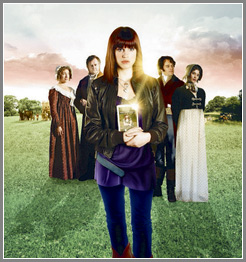
lost-in-austen-amanda-priceAmanda Price (Jemima Rooper, The Black Dahlia, 2006), a modern day working female living in Hammersmith, London, is a JA addict. Reading Pride and Prejudice has become her escape from her lacklustre life. She reminds me of Renée Zellweger’s Bridget Jones, although Amanda here manages to keep her weight under control and has a boyfriend that gets drunk on beer and proposes to her with a beer bottle tag as a wedding ring. So, it is a real fantasy for her to find Elizabeth Bennet (Gemma Arterton, Quantum of Solace, 2008 ) in her bathroom, showing her a portal that leads straight to the Bennet house. But understandably, Amanda is a bewildered and reluctant time-traveler, at least at this point.

The freshness of the story comes from all the twists that do not follow Jane Austen’s story. As with my usual reviews, I don’t like to give out spoilers. But I have to say, the key to these ingenious renderings is that Amanda Price swaps places with Elizabeth Bennet. With Lizzy out of the picture in P & P, the rest of the story is up to the screen writer Guy Andrews’ and director Dan Zeff’s own imagination.

In this first episode, most of the major characters are introduced. All of them deliver a lively performance, although I’m particularly fond of Amanda and Mr. Bingley (Tom Mison). The music reminds me of the 1995 BBC production, energetic and swift. In turn, the pacing is quick and effective. My main criticism though, is the set design of the interior of the Bennet house. It looks more like a modern day rather than an early 19th Century setting, quite incompatible with the exterior of the house.

Right from the start, I have resolved to not take this TV production too seriously, but just immerse myself in the wild and fanciful ride it freely takes me. After all, Jane herself had excelled in this very act, transporting us to meet all sorts of characters and situations through the imaginary worlds of her novels. I’m sure she would have a good laugh too tonight if she were watching with me… now that would be a fantasy indeed.

Just Click to read my review of the other episodes:

Episode 2

Episode 3

Episode 4

*****


Then She Found Me: Book Review

This is one of those frequent examples where a film is so drastically different from the book that they are virtually two very separate entities. But what’s unusual is, I’ve enjoyed them both.

Then She Found Me, published in 1990, is written by award winning New England author Elinor Lipman. Helen Hunt, together with Alice Arlen and Victor Levin, wrote the screenplay and turned it into a movie. I can understand why those who have read the book first before seeing the movie are flabbergasted. The only commonality between the book and the film other than the title may just well be the two main characters, the quiet and rational high school Latin teacher April Epner and her birth mother Bernice Graverman, the ostentatious TV talk show host who wants to claim back the daughter she had given up for adoption more than 30 years ago. There are almost no traces of the original story in the movie.

The amusing character contrast in the book is a springboard for some creative channelling for Hunt and her screenwriter team, kudos to Lipman’s original conception of the story idea. Despite its digression from the book, the movie still works and entertains. What more, it has preserved the spirit of the book and has brought to the screen the basic issues the book touches on, the major one being the meaning of motherhood, and the inevitable debate over the value of the birth versus the adoptive mother. For my detailed review of the movie, click here.

The She Found Me is my introduction to Elinor Lipman, the acclaimed author of eight books of fiction and short stories. The book is almost script ready, for it is predominantly dialogues, witty, intelligent, and incisive dialogues. Lipman’s sensitivity and subtle humor effectively bring out the nuances of her characters and their relationships, at times sarcastic, at times genuine, at times poignant.

36 year-old April Epner is a high school Latin teacher, quiet, rational, academic, and single. Her long-sleeved cotton jersey and drop-waist Indian cotton jumper persona hides a kind and genuine soul. The only parents she has known all her life are her adoptive Jewish parents Trude and Julius Epner, Holocaust survivors, who have lovingly brought her up and given her a Radcliffe education. After they have passed away and as she stands in the crossroads of her life, the last thing April needs is to be found by a brassy and impulsive talk show host Bernice Graverman, who claims to be her birth mother. Conscientious April has to match wit with evasive Bernice, with the help of her school librarian Dwight, who happens to be much more than just a supplier of encyclopedic information. Without giving out spoilers, let me just say the story unfolds with sprightly twists and turns, effectively driven by Lipman’s first-rate, cutting and entertaining dialogues.

Those who have seen the movie but have not read the book should move right along to savor the source material. In here you’ll find the intended closure to the seemingly unsolvable conflict and ambivalence. I can see this as a good choice for book/movie discussion in reading groups and book clubs.

As I was reading, I thought I saw Jane Austen cameo. What Lipman has created here is something close to what Austen would have written today: a contemporary comedy of manners, a likable heroine reminiscence of Anne Elliot, an anti-Darcy male character, albeit with similar height and social ineptness, and through the characters and their situations, dares to explore some serious social issues that are masked by very funny, sharp and witty lines. The result is a tasty concoction of humor and heart.

And lo and behold, guess whose portrait I see when I open up Elinor Lipman’s website ?

Then She Found Me by Elinor Lipman is published by Washington Square Press, 1990, 307 pages.

~ ~ ~ Ripples

Mamma Mia! (2008) Movie Reivew

If beach reads is to superficial page-turners, then summer movies is to mindless, senseless, jovial entertainment.  If you allow yourself to devour less than literature under the summer sun, you can have your fill by indulging in Mamma Mia!  Why not, what other times of the year can we immerse ourselves in superficiality, if not in the name of summer fun.

Like the recent re-emergence of past heroes such as Indiana Jones, Rocky Balboa, and the like, I suspect making Mamma Mia! is the mid-life fix for its actors and actresses.  And for stars like Meryl Streep, where else can you, as a 59 year-old, sing and dance like a rock diva, jump up and down on your mattress like it’s a trampoline, dance to you heart’s content on a Greek Island with the whole village backing you, and make a splash, literally, to end a wild number.  Looks like Streep has the time of her life making this movie.  What more, she’s got Pierce Brosnan, Colin Firth, and Stellan Skarsgard swinging and jiving with her.

On the eve of her daughter’s wedding, Donna (Streep) finds herself faced with three of her past lovers who have shown up upon receiving invitation from the bride to be, Sophie (Amanda Seyfried).  Before getting married to her sweetheart Sky (Dominic Cooper), Sophie feels the urgency to find her real father and have him walk her down the isle. Director Phyllida Lloyd did a passable job churning out a simplistic but fun-filled movie adaptation of her Tony Award winning musical.  What captures the audience is not so much the story but the popular songs written by ABBA’s Benny Andersson and Bjorn Ulvaeus.  Titles like “Mamma Mia”, “Take A Chance On Me”, “Dancing Queen”, “Knowing Me, Knowing You”, “The Winner Takes It All”, “SOS”, and “I Have A Dream”… supply the bulk of the movie goers their mid-life fix.

So who cares if it’s a silly, senseless, mindless escape.  At least, it works… well, more or less.  As I sat in the packed theatre, where families had to sit separately to find seats, where teenage boys came with their mothers, where I heard middle-age men laughing out loud, and where I caught myself watching the movie with a smile on my face and tapping my toes to the tunes, it sure worked as a great escape.  Don’t expect in-depth characterization, complexity in plot structures, insightful dialogues, and please don’t mind the miscast (Bond in song?)… it’s summer after all.

Adapted from the successful musical showcasing the songs of the sensational Swedish group ABBA, Mamma Mia! the movie features authentic singing from the movie stars themselves.  Yes, there are LOL moments listening to them singing in their amateurish voices.  Don’t expect professional vocal performance… from Pierce Brosnan?  The fun is hearing him seriously belt out “SOS”, now that’s entertainment.  And all ye fans of Colin Firth, he has definitely smashed the Darcy image, if it still lingers in your Janenite mind.  Here you can see him play the guitar, sing, hang loose, and dance like a rock star.

There seems to be no middle ground in our summer movies this year:  Mamma Mia! is as light and giggly as The Dark Knight is dark and gloomy.  If you can overlook the subliminal implications seeping through Mamma Mia:  The celebration of promiscuity and the appeal of the stereotypical senseless female, then this movie adaptation is a sure escape.  But if you’re expecting more, I’m sure there are other offerings under the lazy summer sun.

Photo Source:  Seattle Times and Universal Pictures


~ ~ ½ Ripples

Update December 11:  Mamma Mia! has just been nominated for a Best Picture Award (Comedy or Musical) at the 2009 Golden Globes, and Meryl Streep nominated for the Best Actress (Comedy 0r Musical) category.

The Stone Angel (2007): Book Into Film

** The following review contains spoilers**

Since its publication in 1964, this is the first time The Stone Angel is adapted into a movie. As I mentioned in my review of the book last week, whoever that attempts to do this has a formidable task. This classic Canadian novel by Margaret Laurence is a depiction of memories encased in deep inner turmoil. The fleeting and random reminiscence of 90 year-old Hagar Shipley juxtaposing with the present would also prove challenging to bring on screen.

Director, screenwriter, and producer Kari Skogland has made a bold attempt at filling this tall order. Filming the movie in rural Manitoba, The Stone Angel delivers some nice shots of the prairie backdrop, even though Manawaka is a fictional town in the story. The sequences of flashbacks are aptly dealt with quite seamlessly.

The movie has its greatest asset in the cast, in particular Oscar winner Ellen Burstyn (Alice Doesn’t Live Here Anymore, 1974) as Hagar Shipley, and Christine Horne as her younger counterpart. Canada’s own Ellen Page also plays a minor role as Arlene, the girl Hagar’s son John (Kevin Zegers) wants to marry, and of course, against the wish of his mother. The two Ellen’s have some tense moments together. Page’s screen time may be too short though to gratify her fans.

Any fine actor, however, can only perform within the confines of the script. Here lies my major concern: the alteration of the crux of the story, maybe to appeal to a contemporary or a younger audience. The film is a much more mellow and sexed up version of the book. The fiery, ingrained pride of Hagar is much subdued. In fact, she has been changed to an even amiable character. Further, I feel the shifting of the time from the 60’s to modern day somehow trivializes the story. Who would have thought Marvin (Dylan Baker) would be talking on the cell phone and Hagar smoking marijuana…one item off her bucket list?

What author Margaret Laurence has depicted is not just any ordinary stubborn, grumpy old woman, but Hagar Shipley, the tragic heroine, however disdainful. She rages against the dying of the light and doesn’t go gentle with just about everyone because of her deep-seated hubris…even while facing death. The book’s final image of her wrestling the glass of water from the nurse, drinking it without help, wraps up the life of this fierce character. And it’s pathetic to see her pride leading her to make decisions and to act in ways that could well have caused the tragedies in her life.

The scene at the abandoned shed should have led to the poignant, climatic revelation. In the book, Hagar tries to run away from the fate of being confined to a nursing home. She spends a night in this derelict shack and encounters a stranger. During their conversation, she unknowingly verbalizes the pain and guilt she has been carrying all her life by talking about the tragic end of her beloved son John. The name of this newly formed confidant, Murray F. Lees, yes, Flees, points to her perpetual running away from constraints, or maybe even from herself.

But in the movie this stranger is Leo (Luke Kirby), who uses the shed to make out secretly with his girlfriend and then goes on to discuss forbidden sex and share a ‘joint moment’ with the 90 year-old woman.  In the theatre, I heard laughter.  The pathos that should have accompanied this pivotal scene either did not materialize or has been much lessened.

The portrayal of young Hagar played by Christine Horne, while proficient, may have also missed the gist of the story. We see a beautiful red-hair Hagar and a romanticised Bram (Cole Hauser) immersed in blissful courtship and marriage, at least in the first part of the movie. In the book Bram Shipley, a widower-farmer fourteen years her senior, is as rough and callous as Hagar is proud and obstinate.  Their marriage is rocky even from the start, reinforcing the notion that in defying her father, Hagar has made a decision that would later bring her great torments.

By depicting a softer Hagar, and toning down her abrasive pride, the film has diluted much of the poignancy and intensity of the conflicts. The strained relationship between Hagar and her favorite son John has not been sufficiently developed to elicit the emotional impact of the tragedy. Hagar has long placed her hope on John, whom she has esteemed to be worthy to wrestle with the angel, but he ends up breaking her heart. The swift dealing of the mother son relationship in the film fails to depict Hagar, like the stone angel, has been blind to her circumstances. Fortunately, the film has kept the authentic scene of Hagar reconciling with her elder son Marvin, who has taken care of her in her old days. It is Marvin who has wrestled with the angel and won.

The final scene with the Pastor Rev. Troy (Ted Atherton) singing the hymn, touching even the ‘holy terror’ in her death bed, draws the film to a poignant and peaceful close. The audience sees a yielding Hagar going gently into the good night. The voice over of Dylan Thomas’ quote seems inconsistent with what we see.  If Laurence could have her way, she likely would have concluded with the last image of the book where Hagar stubbornly tries to drink from the glass without the help of her nurse, defiant to the end.

I have a reader, a student apparently, once asked me whether he should skip a book he was studying in class and just use the movie version for his course work.  My advice is, watch the movie for entertainment, but read the book for your assignments… the two could be very different entities.

~ ~ ½ Ripples

A Room With A View (2007 TV)

It will probably take another Merchant Ivory production to best an earlier version.  The 1985 movie A Room With A View has ingrained in my memory certain images of sight and sound that are difficult to replace, like Lucy opening the window and the camera slowly zooms in the beautiful view of Florence, highlighting the Il Duomo. Or the ending shot of the silhouettes of Lucy and George sitting by the same window… To me, A Room With A View is Kiri Te Kanawa singing Puccini’s aria “O mio babbino caro” (O My Beloved Father), achingly depicting the agony of unrequited love.  Further, it is also the humor that underlies the whole story as Forster has intended, as evidenced by the chapter (or scene) titles.

Nevertheless, I came to watch this newest BBC production with an open mind.  I was eager to see how a 21st Century, Andrew Davis rendition would present this E. M. Forster love story.  Every new adaptation of an old classic should offer us a new vision.  With such endeavors Andrew Davis has proven to be relatively successful in the past with his Austen and Dickens adaptations.  Here, I anticipate another window opening out to a fresh and different view.

For this adaptation, Davis writes the screenplay as Lucy’s flashback.  And, letting his imagination roam, he has Lucy coming back to the same Florentine room in The Bertolini, by herself, as a young widow.  So with this in mind, the overall sepia tone throughout fits well with the context, a memory re-lived, through the eyes of a lonely young woman who has lost her husband in the war.  The colorless overtone might well depict the sombre mood of a very different Lucy.

But there’s the rub. With this new “twist”, Davis has put himself in a difficult position in that, the present might be sombre and sad, but the past is most vibrant and radiant.  He’s got in his hands the difficult task of reconciling the two. What mood should he establish?  The sombre loss of the present or the fantastic journey of self-discovery and the ecstasy of a young heart heeding true love of the past?   umm…alright, let’s just go on with the show…

I have appreciated the fine cinematography and camerawork. The attraction of the Florentine art and architecture as well as Rome’s grandeur are caught with a sense of depth, not just picturesque shots, ironically, thanks to the lack of color.  They are frames from Lucy’s point of view, a well-protected, English young woman’s first encounter with greatness and history outside of her familiar, parochial life.

As for the actors, I have mixed feelings.  In the 1985 movie, Helena Bonham-Carter’s fresh persona of Lucy Honeychurch is sensitively matched by Julian Sand’s poised portrayal of George Emerson, an ideal image of young love.  Somehow, I don’t feel the chemistry here between Elaine Cassidy (When Did You Last See Your Father, 2007) and Rafe Spall.  The film is supported by some excellent acting though by veterans like Sophie Thompson (Emma, 1996) as Charlotte Bartlett, Mark Williams (Sense and Sensibility 2008 TV) as Mr. Beebe, Sinead Cusack as Miss Lavish, and Timothy Spall (Enchanted, 2007) as the elder Emerson.  Tim and Rafe Spall dispaly an authentic father son relationship on screen, naturally.

Timothy and Rafe Spall

A weak link I feel is Laurence Fox as Cecil Vyse.  No, I’m not trying to compare him with Daniel Day Lewis’s performance, which is inimitable.  But I truly feel it’s a miscast here.  Fox as a chap who is no good for anything but books, one who is so physically inapt to avoid a game of tennis?  Not very convincing.  What we have in this TV version is more like an eerie and chain-smoking Wickham or Willoughby.  Speaking of which, the smoke screen connecting to his almost every appearance may well be intentional, visually depicting how marred and distorted Cecil is in his view of himself and of others, particularly, Lucy.

Indeed, as the title well conveys, it is the metaphor of seeing that is the key notion throughout the TV adaptation.  In order to impress into our mind, the director has us see lots of scenes by the window. But of course, it’s not so much of looking out but looking in that is crucial here.  The whole story is built on Lucy’s seeing clearly what is in her heart, and that the one who has drawn her out of her own self-deception is the one who can offer her ultimate bliss, and that is George Emerson.  It is not just about Cecil turning down a tennis match, but it is the last straw, the pivotal turning point where Lucy realizes how egotistic Cecil  is. Lucy to him is but an object of art and music, but not as a woman, definitely not as a lover.  Forster describes it most strikingly, “The scales fell from Lucy’s eyes.”  A Biblical allusion no less than an epiphany.

In this case of course, by following her heart, Lucy is making the moral choice of defying the long tradition of the English class system, smashing the inequalities underneath the civility, and unmasking the snobbishness she has been raised to aspire to.  In her new voice, as Cecil has noticed, Lucy has announced a new-found insight.  As an admirer of Jane Austen along with his fellow Bloomsbury writer Virginia Woolf, Forster might have written lines that Elizabeth Bennet could have uttered, lines like:

I won’t be protected.  I will choose for myself what is ladylike and right.  To shield me is an insult. Can’t I be trusted to face the truth but I must get it second-hand through you?

Or,

If a girl breaks off her engagement, every one says: ‘Oh, she had someone else in her mind;’ … It’s disgusting, brutal!  As if a girl can’t break it off for the sake of freedom.

Unfortunately, these lines find no place in the film.

Forster is not afraid to let us see a very muddled Lucy, being confronted by her own feelings and passions that are contrary to her up-bringing, loving someone from a lower social status.  The open view of Italy has offered her a wider spectrum to what she is accustomed to seeing. Here lies the muddled complexity of characterization…For often in life, we are walking confusion, unsure of our feelings, insecure about our actions, isn’t such muddledness the very commonality of our being human?

But thanks to her humility, Lucy comes to realize what is in her heart, and who she wants to be.  In her recanting of her engagement to Cecil, she admits to be less educated, not as well-versed in the arts and music as Cecil.  Maybe because of that, she is more flexible to explore and to associate with those allegedly seen as socially lower than herself.  Here lies the paradox, It takes the uneducated eye to find understanding. Cecil is an intellectual, expert in things but not people, his highly educated mind has done nothing for him but left him in a room with no view.

Zadie Smith in her brilliant 2003 Orange Word Lecture entitled “Love, Actually”, discussed the writing of E. M. Forster and Jane Austen. Regarding Lucy’s gaining insight, Smith observed incisively:

It is not by knowing more that Lucy comes to understand, but by knowing considerably less.

As for Davis’ new “twist” at the end … I think that has altered the whole story from a light-hearted piece of social satire and endearing love story to a sombre drama with an awkward ending.  And for the last scene, Lucy going on a picnic with the cab-driver, and their final gesture… I think Davis has gone too far with his gratuitous imagination.  If that is the new vision he is offering us,  I’d rather stick with the old view.

~ ~  Ripples

*******

Photo Source of window with a view: StudentsVille
Nim’s Island (2008)

I don’t want to miss any Jodie Foster movies.  She’s one of my all time favorites.  I’m also eager to watch Abigail Breslin again after her Little Miss Sunshine.  Further, after reading Annie Dillard’s novel, I just need something light and mindless.  Coincidentally, between these two, I only have to change lenses, for the view is more or less the same: the beauty and wonder of nature. 

Nim’s Island is a mixture of Swiss Family Robinson, Home Alone, Stranger Than Fiction, and Mr. Brooks.  Based on the popular children’s book of the same name by Wendy Orr, it’s about a girl called Nim who lives an idyllic life on a pristine island with her scientist dad Jack.  The island’s rich natural resources and wildlife are the sources of Jack’s research and Nim’s pleasure.  Her friends are Selkie the sea lion, Fred the iguana, Galileo the frigate bird, and the giant sea turtle…what’s his name? … Anyway, it’s a zoo out there on Nim’s island, but Nim and Jack keep it real organized, educational, and fun.

One of Nim’s favorite past time is reading the stories of her adventure hero Alex Rover (Gerard Butler, P.S. I Love You, 2007).  So, when a huge tropical storm hits the island, and her dad hasn’t come home for a few days collecting protozoa samples out in the open sea, she calls to Alex Rover for help.  Actually, it is the creator of Alex Rover that emails Nim first, asking about information to write the next novel, mistakenly thinking Nim is Jack’s research assistant. 

Far from being an adventure hero, Alexandra Rover, the author, is a recluse suffering from agoraphobia, whose best friend is her Purell hand sanitizer. She hasn’t been out of her San Francisco apartment for months. But knowing Nim is all alone on an island needing help, and prodded by her own adventure hero, she ventures out against her fears.  So there’s the interesting set up of the plot, the rest of the story is the adventures of Alex Rover the writer heading to the island to help out Nim, the real heroine.

The film suffers from some scenes and dialogues that appear to be banal and trite.  With its interesting storyline I think it can be done better with more creativity and imagination.  Having said that, I must say that the movie is beautifully shot on location in Queensland, Australia.  In a day and age when kids, and parents, for that matter, find it impossible to have fun outside of video games and electronic gadgets, this movie and the book can offer a wholesome alternative.

There is a new edition of the book that’s a movie tie-in, including 8 pages of color pictures from the film. It is illustrated whimsically by Kerry Millard.  A fun read.  And for all the budding biologists, zoologists, oceanographers, and for that matter, environmentalists in your home, this is a must-read. 

The intended age group I feel should be a bit lower for both the movie and the book.  I’d say a target audience and reader Age 6 – 10 would be more appropriate than the now 9 – 12.  

The best combination:  Go see the movie and then to the bookstore.

Now with that combination, I’ll have to give it

                  ~ ~ ~ Ripples 

Sense and Sensibility (2008 TV): Part 2

Even though the last kiss in the movie goes to Elinor and Edward, I feel this second part of Sense and Sensibility belongs to Marianne and Colonel Brandon.  Indeed, David Morrissey’s Colonel Brandon has been the leading man and Charity Wakefield’s Marianne shines.  Their lines even bring back some epic images of a past Austen adaptation.  Just dwell on them again:

Marianne: My feelings for him has changed so much…I love him.

Elinor: Then I am happy for you.

Words of endearment reminiscent of Davis’ adaptation of Pride and Prejudice (1995)…flashback to Lizzy’s response to Darcy’s second proposal, and as she explains to her unbelieving father of her accepting it, and of course, Mr. Bennet’s loving consent upon hearing her declaration of love for Darcy.  As for the imaginary scene of the fencing duel?  Isn’t that just reminds us of Darcy’s own struggle?  Further … isn’t it true that such an improvised addition could work just as well with Darcy and Wickham too?

I think we have seen enough Davis adaptations to not be surprised by his interpretive visions…not authentically out of Austen’s book, but effective just the same … and we forgive him yet again.

Indeed, not only the fencing duel, which is nicely shot, mesmerizing and dream-like, but all the scenes we see in this new version that are Davis’ own imagination are all quite effective, thanks also to the excellent camerawork and cinematography.  Scenes such as Brandon’s gentle touch of Marianne’s hand as she lay ill in her bed, the invitation to his own library and leaving Marianne to the privacy of her own enjoyment of the pianoforte, to the taming of the falcon, all vividly depict Brandon’s patient and quiet yearning for her.  And Marianne, even though by nature a free-spirited creature like the falcon, would eventually fly back and rest on the arm of the one who beckons her with his steadfast love.  Davis’ imaginary scenes are most effective in portraying Marianne’s turnaround.

There are some very moving moments for Elinor too.  Desperately seeking solitude in her silent suffering, Elinor finds shelter in a cave by the seaside.  The camera’s point of view from inside the cave looking out, framing her silhouette against a tumultuous ocean, a stunning vision.  Or, when she sits on a bench, again alone, facing the wide open sea, waiting, doubting, or just plain accepting… Our hearts pour out to her, and yet, it is Elinor’s perseverance that has won us over, not sentimentality.  Now that is authentic Austen.

At the end, as Edward enters the Dashwood cottage to propose to Elinor, the slightly shaky camerawork is most effective in depicting the agitated anticipation of both lovers, for Edward, the nervous uncertainty of his reception, and for Elinor, the restless suspense and later unpredictable euphoria….kudos to the screenwriter, director, and cinematographer.

The Welsh filmmaker Peter Greenaway once made a controversial remark criticising film versions of literary work as mere “illustrated books”.  Regarding Jane Austen’s work, he said:

“Cinema is predicated on the 19th century novel.  We’re still illustrating Jane Austen novels–there are 41 films of Jane Austen novels in the world.  What a waste of time.”

(Click here for the Wales news article containing the above quote.)

To which I respond:  The visual can powerfully bring out the essence of the literary.  A good film adaptation is more than illustration of printed words, but an inspiring visual narrative.  At best, it can offer an interpretive vision and a new perspective to a timeless piece of writing.

The present adaptation is a vivid example.

******

Click here to go back to Sense and Sensibility Part 1.

Don’t forget to vote in the Poll on the sidebar, Which Austen heroine do you think Jane was most like?

******

Sense and Sensibility (2008 TV): Part 1

Sense and Sensibility 2008

What can I say after watching just half of a movie?  But First Impressions last, and the notion has multi-layered meaning.

First off, I can’t help but compare this Andrew Davis version with the 1995 Emma Thompson’s screenplay.  And secondly, I’m eager to watch Part 2 next week to see how some of my feelings from Part 1 hold out, of course, to also quench my Austenian thirst.  PBS sure has underestimated the patience of Janeites who, I think, would not mind spending three hours to watch the whole movie in one sitting.

The two adaptations play out exactly as the story does.  Emma Thompson’s screenplay is an almost literal and reserved view of the novel, while Andrew Davis’ is an imaginative and free-spirited rendition.  The two versions are very much a parallel image of Elinor versus Marianne, sense contrasted with sensibility, or should I say, sense and sensuality?  The perfect scenario, of course, is a balance of the two.  And last night, while appreciating the fresh angle Davis has led me to look at the novel, I also long for a more literal, more authentic representation.

Davis has taken the liberty to create scenes intended to appeal to (what he thinks is the expectation of) modern day viewers, a much more erotic and sensual rendition than the Austen novel. Not authentic, but I admit, some of those scenes are quite effective. Not that I think Jane Austen needs that kind of help though.

Marrianne and Willoughby

I have particularly enjoyed the set design and cinematography.  The sumptuous Norland Park, the elegant costume, and the picturesque natural scenery, the almost Gothic billowing seaside of the Dashwood new home.  Barton cottage by the cliff?  Again, not authentic, but quite effective.  The howling winds and crashing waves are sharp contrast to the once quiet and comfortable life of Norland Park.  They also signify the turmoils in the hearts of the characters, betraying their calm composure.  There is a beautiful shot when Elinor runs up the windy mountain, the camera follows her wind-swept hair and fluttering dress.  As she stops at the edge of the cliff, looking down onto the rising waves, she opens the book Edward has given her as a parting gift, slowly caressing the words he left in there.  That is one moving scene.

I have thoroughly enjoyed the camera work.  Like an omniscient narrator, it captures not only the macro views, but by its silent pan and close-up shots, reveal the inner emotions and deeper characterization.  The blurry shots of the wind-charm hanging outside the cottage, strung up sea shells Margaret has collected by the craggy shore,  slowly dancing in the quiet breeze, a metaphor for the passing of time, or the changing of scenes…very effective indeed.

young-cast-of-sense-and-sensibility
This adaptation features a younger cast.  Hattie Morahan as Elinor, Charity Wakefield as Marianne, as well as Dan Stevens and Dominic Cooper as Edward Ferris and Willoughby are much more compatible in age to the story’s requirement than the 1995 movie.  However, I feel the contrast between the sisters are more proficiently acted by Thompson and Winslet….so far in this Part I anyway. The younger cast brings in a fresh perspective, but I miss the maturity and talent in the previous version.  I like Lucy Boynton’s Margaret (Miss Potter, 2006), a very clever performance and lucky girl…she has some of the best lines in the movie.  Another favorite character of mine in just watching this first part is Janet McTeer as Mrs. Dashwood, her performance almost overshadows her daughters.
Janet McTeer as Mrs. Dashwood

David Morrissey’s Colonel Brandon is portrayed as a more lofty and noble character than an emotionally tormented soul, a role Alan Rickman has mastered.  In the present version, Brandon meeting with Willoughby is an obvious reminiscence of a previous Andrew Davis adaptation, yes, the first, chance encounter of Darcy and Wickham in Meryton.  The cold and awkward expression on their faces are brought back here.  Morrissey’s tall and stately stature sharply contrasts with the much shorter, scoundrel-looking Willoughby, obviously contrasting not just a difference in physical appearance but in character. However, this is not what Austen intended.  The Willoughby she has described has all the social charm, height and good looks so to bring young girls under his grasp.  A deceitful character masked by a handsome appearance. Again, not authentic here, but as to effects, it depends on how much an Austen purist you are.  Nonetheless, I feel the Darcy and Wickham allusion is apparent.

Overall, I have enjoyed this first part of the new Sense and Sensibility.  The cinematography and camera work has done a great service to enhance a very elegant adaptation.  I anticipate eagerly to see how my First Impressions will play out in the concluding part coming up next week.

…if only I can just watch it now.

Update: Click here to go directly to my review of Part 2 and Conclusion of Sense and Sensibility (2008).

And… Don’t forget to cast your vote on the sidebar, Which Austen Heroine Was Jane Most Like?

******

Emma: Miss Woodhouse Regrets

UPDATE:  To read my posts on the new BBC production of Emma (2009, TV), Episode 1 CLICK HERE.Episode 2 CLICK HERE... Episode 3 Conclusion CLICK HERE.

.

Andrew Davis created another proficient and loyal adaptation of Austen’s work, a year after his success with Pride and Prejudice(1995).  Emma (1996 TV) shown on PBS last night is effectively written for the screen, bringing out all the crucial scenes in congruent sequences. Great acting from all, except I must say, Mark Strong’s Mr. Knightly seems to be a bit too severe and lacks the forbearing and benevolent nature he possesses in the book. Maybe because of that, Kate Beckinsale is a more subdued Emma, less spriteful as Gwyneth Paltrow’s portrayal. I have enjoyed Olivia Williams as Jane Fairfax and Samantha Morton as Harriet Smith, who is more appropriately cast than Toni Collette in the 1996 movie.

“I am going to take a heroine whom no-one but myself will much like.”  –Jane Austen on Emma

Is Emma such a despicable character that Jane Austen thought no one but herself would much like?

At first, I thought so. Emma is manipulative, imposing and snobbish. In her pride, she has toyed with Harriet’s emotions, misdirected her path, and dominated her decisions. In her blindness, she has misjudged intentions and at times, behaved disdainfully. If Lady Catherine were around, her words targeted at Elizabeth Bennet would be most appropriate here: “Obstinate, headstrong girl!”. Lizzy would also decry: “Insufferable!”

But, why did Jane Austen still like her?

In her ingenious style, Austen has led us in a most gratifying way, to see our heroine regret. Emma is not a perfect human being. Far from it. She probably has more ingrained flaws than most of the other characters in the story. However, that is the way our beloved author likes to sculpt her heroines: making them earn their respect by their mending their ways. And she knows how gratified her readers must feel to see Emma enlightened and humbled. By showing a regretful and corrected Emma, Jane Austen has aligned our views with hers, helping us to appreciate our heroine as a respectable character who is not afraid to own up to her blunders.  Emma’s tears of regret have melted our hearts away.

Moreover, and most importantly I think, Austen has inconspicuously led us to see Emma from the eyes of Mr. Knightly towards the end of the story. Mr. Knightly has been Emma’s moral compass and benevolent mentor. While he can see her errors clearly, and does not hesitate to correct and admonish, he is also ready to forgive. He has chosen to love her from a distance while she is still an immature and self-deluded girl, albeit an imaginative one.

At the end, we are rewarded to see Emma gaining self-understanding:

“I seem to have been doomed to blindness.”

Hearing Knightly’s declaration of love, the undeserved euphoria is unspeakable. But of course, Mr. Knightly sees it otherwise:

“I have blamed you, and lectured you, and you have borne it as no other woman in England would have borne it.”

His kindness and love for Emma compel him to still give her credit in her most self-deprecating state. In his eyes, she is ‘faultless in spite of all her faults’.

So, from Mr. Knightly’s point of view, we’ve come to appreciate a very human Emma, humbled by experience, regretful of her ways, and in the end, ever so ready to change. After all, it’s about time that a blissful match is made for herself.

******

Update:  You can read this article as well as other interesting and informative articles on Jane Austen and the Regency Period in the Jane Austen Centre Online Magazine.

3:10 to Yuma (2007)

How many movies have inspired you to read the original book or story right after you’ve watched it? You might think of films like The Kite Runner, Atonement, or Away From Her. But a cowboy flick?

Yes, it sure did for me. And while I’m still looking for Elmore Leonard’s book Three-Ten to Yuma and other stories to read his short story, the source material for this film, I can’t wait to write the movie review. It’s also timely because of the recent release of the DVD.

This is one film that should have received a lot more attention at the Oscars. It got two nominations, one in Original Score, the other in Sound. Well it did get a nod from the Screen Actors Guild for an Outstanding Performance by a Cast in a Motion Picture nomination. It’s also a nominee for Best Picture and Best Supporting Actor (Ben Foster) Satellite Awards.  But if it’s being touted as the best Western since Unforgiven, then why aren’t there any more commotion? Anyway, I’m here to stir some ripples.

This is a modern remake of the highly acclaimed 1957 movie with Glenn Ford. I missed that one. This new version sees Russell Crowe, Christian Bale, Ben Foster and Peter Fonda join hands to create an action movie with a heart and mind. In a way, it’s one typical western, with gunslinging outlaws, headed by the notorious Ben Wade (Russell Crowe), aided by his despicable right-hand man Charlie Prince (Ben Foster), a defenceless cattleman (Christian Bale) and his family, and a few lawmen pathetically trying to enforce some sort of law and order.

I’m captivated by the riveting sequences and twists of the plot leading to the engrossing climax at the end. Anything typical is only a backdrop for the ultimate moral dilemma it sets up for its main characters. Basically it’s a duel of will and conscience for Crowe and Bale. 15 year-old Logan Lerman is right on a par with these two veteran actors.

The movie surprises me with the intense and deep depiction of psychological battles, internal conflicts, and moral choices one has to make in the face of life and death. Its fast action scenes, effective camera works and great acting from the whole cast mask the deeper issues the story is challenging us to ponder: What makes a man? What is the most important legacy a father can leave to a son? I say mask because you think you’re just watching, but actually you’re thinking. How we need this kind of movies these days. The poignant ending is what makes the film beautiful and rewarding.

From Jane Austen to Elmore Leonard…it’s all about life.

~ ~ ~ Ripples

Pride and Prejudice (Part 3): Ideals Universally Acknowledged

I have watched this miniseries countless times, but I still wanted to see it again last Sunday night, the finale of Pride and Prejudice (1995) on PBS’s Masterpiece. I knew I was partaking in a communal experience shared by kindred spirits across North America. Every time I watch it, I glean some new insights, and I cherish the story all over again.

This time, I look into the characters convinced that Jane Austen has depicted the ideal woman and the ideal man in Elizabeth Bennet and Fitzwilliam Darcy. Ideal, not perfect. While they have virtues of their own, they have character flaws that if remain unchecked and unaltered, could well lead to a downfall like a tragic hero. Elizabeth, biased by her confidence in her own judgment, initially found Darcy to be utterly despicable. And Darcy, acting according to his own hubris, only fuels the very prejudice held by the one he admires. In circumstances like this, the ideal scenario is for the characters to change, to transform themselves into a better person in order to earn requited love. And that is exactly what Austen has done, and I think it is one of the main reasons why we love her story. She has put together two flawed characters and placed them in an ideal scenario wherein they strive to improve themselves, and turned into a better person for the sake of the other…Well, maybe more on the part of Darcy, and we love him for that. I like the title Pride and Prejudice more than Jane’s original First Impressions. It gives a bit more depth and sets readers out searching for the universal shortfall in us all. Often our own prejudgment and overconfidence in our myopic view confine us squarely inside the box, unable to see the world beyond.

The portrayal of such transformation is vividly and sensitively acted in the miniseries. Colin Firth and Jennifer Ehle effectively help us envision such an ideal scenario, satisfying our quest for the good, the wholesome, universal ideal of love hidden in us all. Kudos to Andrew Davis. I think he has written an ideal screen adaptation of Austen’s novel. Because of its loyalty to the original and still keeping the integrity of the work even when Davis presents to us imagined visions arise from his own interpretation, I believe this miniseries is the definitive version of Pride and Prejudice on screen.

Again, I have several favorite scenes. Which heart will not melt by that burning gaze of Darcy ardently holding Elizabeth as she rescues his disturbed sister in Pemberley upon the malicious mention of the name Wickham by Ms. Bingley? (BTW, this is Andrew Davis’ favorite scene in all of his Austen adaptations!) Who will not rejoice in Elizabeth’s assertive and eloquent rebuttal against the diatribe of Lady Catherine de Bourgh, and her calm refusal to promise never to enter into any engagement with Darcy? Whose heart will not stir as a restrained yet passionate Darcy extends his second marriage proposal to Elizabeth?

Elizabeth has demonstrated time and again that she has the autonomy to make her own choices, yet Austen has also poignantly shown us that while Elizabeth can choose who to love, she cannot force the other to choose her, especially after her family’s reputation has been ruined by Lydia’s elopement. Darcy learns this lesson much earlier, in a most traumatic and humiliating manner, as he realizes that wealth and social standing, or even his own declaration of love cannot force another person to accept him. Here lies the paradox of love, one can choose who to love but cannot demand requited love. Choosing one’s love manifests the autonomy of self, but having to earn and wait for the other to choose you is a most humbling discipline. Maybe the ideal thing to do in such a circumstance is just to become a lovable person. That could well create the best chance of gaining love.

In the end, it is heart-warming to see both Darcy and Elizabeth, even having decided on each other, yet still quietly pines and waits for the other to declare his/her choice. A sense of uncertainty is what keeps us humble and instills in us the virtue of hope.

“It taught me to hope as I had scarcely ever allowed myself to hope before.”

Knowing our innermost yearning, Jane Austen brings her characters together in the most humbling circumstance, with their mutual admission of wrongs and weaknesses while esteeming the other higher than him/herself, fulfilling the ideal state of love.

“Do not repeat what I said then…I have long been most heartily ashamed of it.”

“As a child… I was given good principles, but left to follow them in pride and conceit… and such I might still have been but for you, dearest, loveliest Elizabeth!”

Through such mutual respect and admiration, our beloved author delivers the ideal ending to the love story of two imperfect persons…and sets us up for another round of watching and reading.

The Ideal Ending

********

Click to go back to Pride and Prejudice Part 1 and Part 2.

If you have enjoyed reading this article, you might like to click on “Jane Austen” in the category cloud on the side bar for more Austen articles here in Arti’s Ripple Effects.

Several of Arti’s articles have also been published in the Jane Austen Centre Online Magazine.  To read more about Jane and the Regency Period, just click on the link highlighted.

********

Pride and Prejudice (Part 2): My Favorite Scenes

Unexpected encounter with Mr. Darcy

The second installment of Pride and Prejudice aired on PBS carries some of my favorite scenes in the whole miniseries. The ‘wet shirt’ episode, the favorite of many, is naturally one of them. Thousands have already talked about it, but allow me to add one small voice here. I find the surprise and embarrassing encounter of Elizabeth with the dripping wet Darcy to be an ingenious creation by Andrew Davies, an imaginary addition easily forgiven by many Jane Austen purists, I suppose. My reason for adoring this scene can be summed up in one word: vulnerability.

Both are caught unprepared and their vulnerability makes them equal. The inhibition of Elizabeth’s fondness of the place and her bewilderment of Darcy’s character based on the housekeeper’s compliments are well matched by Darcy’s eagerness to make a good impression but alas, while being caught in the most uncouth manner. Both clumsily and comically try to regain composure and maintain some form of civility. In the spontaneity of the moment, pride is laid aside and prejudice banished. And Darcy, stripped of his usual formal attire, presents his dripping and humble self in the most unguarded manner. Colin Firth has so vividly shown us that genuine and dishevelled appearances can be utterly appealing.

Another favorite scene of mine comes shortly after this chance encounter. As Elizabeth is driven away in the open carriage, she looks back at Darcy in a distance, wearing the fulfilled and satisfied smile on her face, while the camera, from her point of view, captures the handsomely poised Darcy seeing her off, his tall and slender physique growing smaller and smaller in the distance as the carriage is being pulled slowly away…how much tenderness can a camera shot elicit?

But before this beautiful departure at Pemberley, there is the duel of words. The scene I like most in this Part 2 of Pride and Prejudice is probably the first marriage proposal in Hunsford parsonage. Darcy’s words have but achieved one function: confirming every single prejudice Elizabeth might have held towards him. Through Elizabeth, Jane Austen has eloquently delivered her social commentary on the female predicament of her time. While love can be the most attractive reason for marriage for idealistic Lizzy, her better, rational self challenges the form, the motive, and the consequence of love. Would she be satisfied with the kind of love that is condescending, unequally bestowed, that is based on feelings ‘despite of’ and not admiration ‘because of’? Austen has articulated her critique on marrying for financial gains, even for the common good of securing the future of one’s whole family. A condescending relationship, despite the appearance of fondness and love, does not warrant the sacrifice of one’s dignity and value. Elizabeth has demonstrated clearly she has a choice, and she exercises her freedom to reject despite of the lure of wealth, status, and security. Just this scene is reason enough for me to admire Jane Austen.

*******

Click here to go directly to The Finale, Pride and Prejudice Part 3.

Click here to go back to Part 1.

Arti’s three posts on Pride and Prejudice (1995) have been combined into one article and published on the Jane Austen Centre Online Magazine.  To read that and other interesting articles about Jane and the Regency Period, click here.