The Railway Man (2013) Movie Review

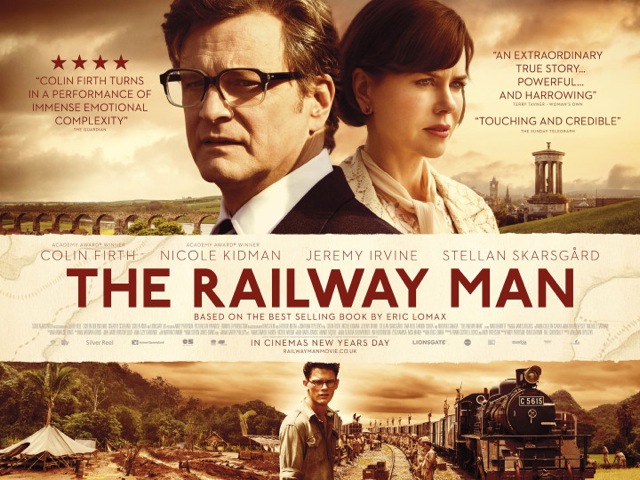
Premiered at the Toronto International Film Festival last September, ‘The Railway Man’ has only recently made its way into North American theatres, a slow train considering the story dates back to a chapter in World War II history that has generally been ignored. It had taken Eric Lomax decades to open up and tell his story as a Japanese prisoner of war. His autobiography The Railway Man was published in 1995, half a century after his ordeal.
The Railway Man


Noting the demographics of the audience in the theatre I was in, it is likely that the passing of a generation could mean the eventual silencing of eyewitnesses and victims, or those who have heard from them first-hand. While a movie adaptation of Eric Lomax’s autobiography is important for raising awareness of the events in the Pacific theatre during the War, the real difficulty is to attract younger viewers today to go into a movie theatre to watch it.

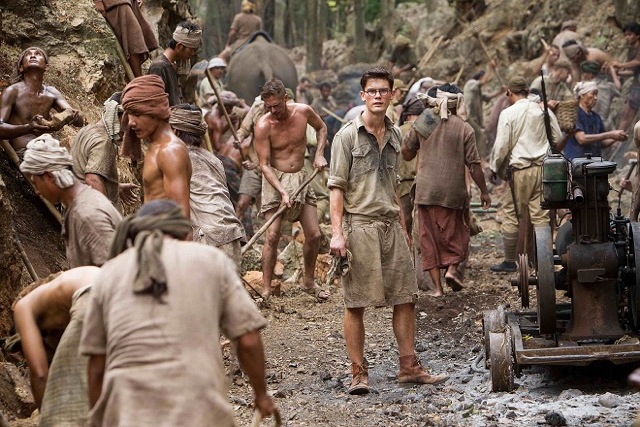
Of the numerous full-length features on WWII, only David Lean’s 1957 “The Bridge on the River Kwai” comes to mind for a movie that deals with this chapter in history. Eric Lomax was a young signals officer in Singapore when the British surrendered to the Imperial Japanese Army in 1942. He and other British soldiers were transported to Thailand to work on the Thailand-Burma Railway as slave laborers. Notoriously known as The Death Railway, the conditions there were horrendous. Many POW’s died and others were tortured. Lomax was one of them.

Having read his memoir, I find ‘The Railway Man’ a more realistic depiction of the POW’s conditions. Lean’s film where the men are portrayed in top physical shape marching to the famous whistling tune looks like a summer camp when compared to the atrocities Lomax and others had suffered. The war ended in 1945, but not the psychological torments of former POW’s.

‘The Railway Man’ begins with Lomax (Colin Firth) in 1980, a middle-aged veteran, still a railway enthusiast, encountering Patti Wallace (Nicole Kidman) while travelling on a train. This first part of the movie is the most enjoyable in that we see Colin Firth in his most natural and easiest demeanor, romantic yet reserved, with a dash of quirkiness. Nicole Kidman, with minimal make-up, gives an admirable understated performance. The two make good screen chemistry. Viewers will have more of their partnership in some upcoming productions.

Colin Firth & Nicole Kidman

As they chat on the train, David Lean’s ‘Brief Encounter’ is mentioned, a life imitating art experience thus ensues except this one leads to a long-term relationship. Eric and Patti soon get married. On their honeymoon, the nightmares of Lomax’s traumatic past begin to expose. He drops on the floor wrenching from fearful flashbacks.

Observing in anguish, Patti seeks to find out more from Lomax’s fellow veteran Finlay (Stellan Skarsgård) who cautions her of the scars of war and the never-ending torments. Thus leads to the second act where we see flashbacks into Lomax’s horrific POW experiences.

Jeremy Irvine puts forth an impressive effort in his portrayal of a courageous and decent young Lomax. After the radio he has made and his hand-drawn map of the railway line are discovered by his Japanese captors, the young Lomax bravely steps out to admit his involvement in order to spare his fellow soldiers the punishment. He is beaten, interrogated as a spy, and repeatedly tortured. Throughout, the young Japanese officer Nagase (Tanroh Ishida) is in full command.
Jeremy IrvineThe film goes back and forth in time during the bulk of the story, not roughly, but in an unbalanced way. The WWII sequences are intense, but the present day scenes exude a lethargic sense of inaction. While the talents of both Firth and Kidman can readily be tapped, the screenplay allows no further development other than the close-ups of a repressed and traumatically disturbed Lomax and a loving but exasperated Patti watching from the sideline. Here is a time when you would wish the director (Jonathan Teplitzky) and screenwriters (Frank Cottrell Boyce and Andy Paterson) had exerted more artistic freedom and creative energy into the film.

The plot turns a new direction as Finlay finds out that the Japanese officer Nagase (now played by Hiroyuki Sanada) who was involved in Lomax’s torture is still alive. Adding to Lomax’s burden, Finlay has pressured him to take revenge. Indeed, it is with a vengeful resolve that Lomax seeks Nagase out in a war museum in Thailand, where Nagase is a tour guide by the River Kwai, showing visitors the same prison camp wherein Lomax was once a captive.

As the torturer and the victim confront, tension rises. In the most critical moment, the murderous vengeance that Lomax has harbored is snapped. Nagase expresses genuine remorse and offers his apology to Lomax. Vengeance is thus dissolved into forgiveness.

This third act is supposedly the most moving section. Unfortunately it drags on too long, losing the power of the cathartic punch. While Firth’s performance is riveting as he enters the torture room and relives the past, the verbal exchanges between the adversaries and their ultimate reconciliation look contrived. As in the book, which leaves readers little explanation as to Lomax’s change of heart, I assume therein lies the difficulty for the screenwriters to invent a realistic and dramatic scenario.

Nonetheless, stories like this ought to be told for the understanding of historic truths and of the human heart. It just may sound like an over-simplification, but maybe the long road to reconciliation does start with a word of apology.

~ ~ ~ Ripples

CLICK HERE To read my book review of The Railway Man by Eric Lomax.

***

This movie review was published in the May 10 issue of Asian American Press.
Old Tales, New Takes

From the comments in my post What Maisie Knew (2012): From Book to Film, I see literature lovers, especially those who have read Henry James’s novel, are curious to watch the movie, wondering what a modern day film version could offer. Here is a good example of an adaptation exerting artistic and creative freedom to transpose while bringing out the spirit of the source material, ideas transferred as types onto the screen.

I can imagine too for literature purists, this is horror story. To them, movie adaptations are by definition a lower form of creation. They may be more acceptable if they follow exactly the same story lines and characterization. Any diversion spells disloyalty. How faithful and literal they are in the transposition is the sacred measure of their quality.

Having seen some retelling of literature effectively turned into cinematic form, I had long discarded the ‘loyalty’ criterion in my personal viewing. A ‘faithful adaptation’ doesn’t guarantee success, an example is the newest Romeo and Juliet (2013) which, using a modern day term, is pretty ‘lame’.

On the other hand, you might have enjoyed some movies without being aware of the literary source on which they are based, however loosely:

Apocalypse Now – Joseph Conrad’s Heart of Darkness

Bridget Jones’s Diary – Jane Austen’s Pride and Prejudice

The Claim – Thomas Hardy’s The Mayor of Casterbridge

Clueless – Jane Austen’s Emma

Cruel Intentions – Choderlos de Laclos’s Les Liaisons Dangereuses

Easy A – Nathaniel Hawthorne’s The Scarlet Letter

The Hours – Virginia Woolf’s Mrs. Dalloway

Jude – Thomas Hardy’s Jude the Obscure

The Lion King – Shakespeare’s Hamlet

My Fair Lady – Bernard Shaw’s Pygmalion

From Prada to Nada – A Latina version of Austen’s Sense and Sensibility

O Brother, Where Art Thou? – Homer’s Odyssey

Ran (Kurosawa’s, another evidence that literature is universal) – Shakespeare’s King Lear

West Side Story – Shakespeare’s Romeo and Juliet

Of course there are those that still use the same title without having to hide an alter ego, but have given the source material a contemporary spin. Because of their new angle to an old story, viewers can glean fresh insights and gain a deeper appreciation. Here are a few productions in recent years that are worth watching:


Coriolanus (2011)


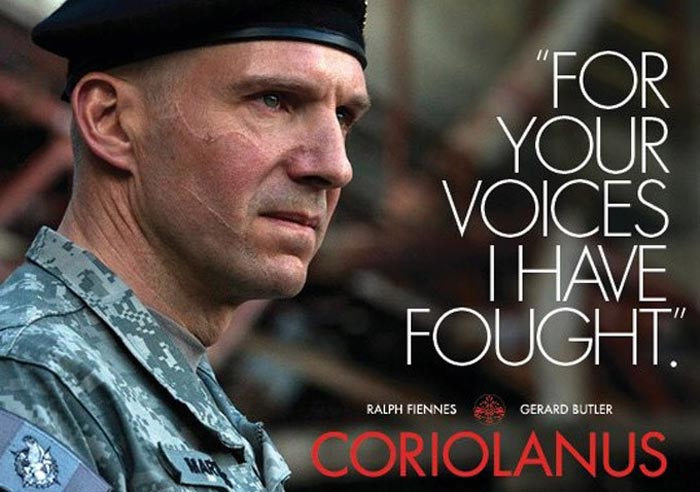
coriolanus_03Ralph Fiennes’ directorial debut. Shakespeare’s Coriolanus is placed in present day, fictional Rome. Modern politics, urban warfare, but same old human hunger for power, the treachery of pride and the ever complex entanglements of family ties. Ralph Fiennes is superb as Coriolanus rivalling and later aligning with his archenemy Aufidius (Gerald Butler). Vanessa Redgrave and Jessica Chastain play the two significant others in the life of Coriolanus the vengeful career warrior, his mother and wife. Alas, what’s a woman to do?


Much Ado About Nothing (2012)

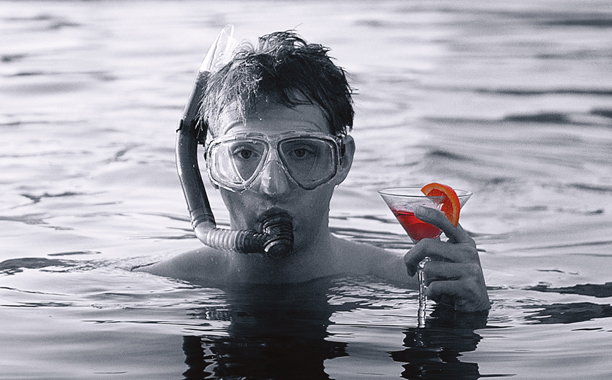
Much Ado About Nothing (2012)If a movie adaptation had already been made by Kenneth Branagh with Emma Thompson and all the Brits in full period costumes and a colourful set, what is one supposed to do for a remake? Joss Whedon was ingenious enough to shoot it in a couple of weeks, like on a whim, right in his own Santa Monica, California home, in black and white. Every room, furniture, wine glass, and the swimming pool is Whedon’s, but every line is Shakespeare’s. Old story, modern humour. A most creative take.


Trishna (2011)

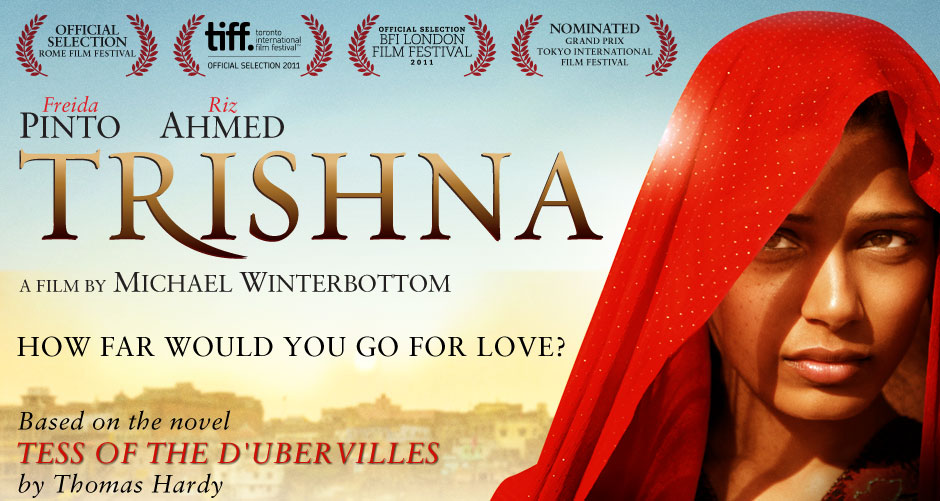
TrishnaThis is British director Michael Winterbottom’s third adaptation of a Thomas Hardy novel, after Jude (1996, Jude the Obscure) and The Claim (2000, The Mayor of Casterbridge set in 1860’s California). This time he transports us to India. From the mass of humanity, we zoom in to one innocent girl in a poor rural area, 19 year-old Trishna. The trajectory of her fate and encounters parallel Tess of the d’Urbervilles in Thomas Hardy’s novel, equally poignant and tragic. The transposition is convincing. Freida Pinto of Slumdog Millionaire fame is perfectly cast as Trishna. Winterbottom’s naturalistic style matches the mood of the novel. Not easy to watch at times as we follow a powerless female in a class-centred, male dominated world. A beautifully shot film.


Blue Jasmine (2013)

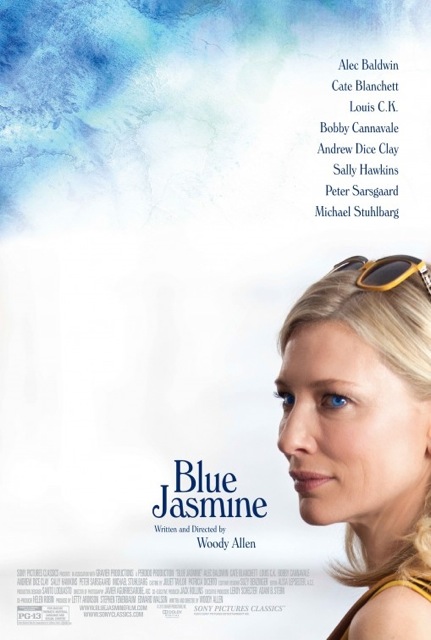
Blue Jasmine Movie PosterI’ve written a full post on this. I see Blue Jasmine as Woody Allen’s homage to Tennessee Williams’ A Streetcar Named Desire. A different time and place, altered names and backstories, but same kind of struggles, parallel character types. Vivien Leigh won an Oscar for her role as Blanche in the 1951 movie version as a displaced, worldly older sister coming to take shelter with her younger, less well-to-do sister. Cate Blanchett won hers playing Jasmine who faces similar predicaments. In typical Woody Allen style, a pathos and humour mashup. Blue Jasmine is an excellent new take on a piece of classic literature. Of course, in this case, we only see the overarching parallels, but it does speak to the subliminal power of old tales.


***

RELATED POSTS:

Can A Movie Adaptation Ever Be As Good As the Book?

Tess of the d’Urbervilles (2008 TV): The Lite Version Part 1, Part 2

Blue Jasmine: Homage and Re-imagining 

Slumdog Millionaire (2008)

A Summer in Genoa (2008, Michael Winterbottom, Colin Firth)

Book Sale 2014: A Very Restrained Purchase

It’s that time of the year again… no, I don’t mean nesting habit of birds. I’m referring to The Crossroads Market Annual Book Sale. A diversion from my usual avian pics for Saturday Snapshot, here’s a photo of my very restrained purchase this year.

Readers familiar with my previous annual book loot will know how I’d hauled back home dozens of like-new or even unopened books at $2 each. All for the good cause of supporting Servants Anonymous Society.

Due to the boxes of still unread inventory from previous years, I’d decided to refrain from gratifying my hoarding instinct this time. The result is this minimal bagging of just four books, which I’d spent hours hand picking. Again, $2 each, all in mint condition:

Book Sale 2014


The reasons for these selections? Three had sold film rights and two of them are already in development for a movie adaptation. The fourth  one isn’t going to be a movie, but no less dramatic.

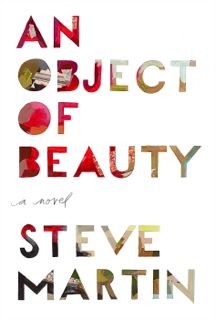
An Object of Beauty by Steve Martin 

Other than being known as the Father of the Bride, Steven Martin is also a talented banjo player. I’ve heard his banjo playing, but as for his books, quite a few of them actually, I still haven’t had the pleasure to enjoy. So here it is, a Steve Marin novel with 22 full-colour art reproductions inside. Story is set in the demanding art world of Manhattan, about Sotheby’s up-and-coming and very ambitious Lacey Yeager who has set her mind on climbing high on the career ladder. Amy Adams had bought the film rights, aiming at producing and starring in it. Who is writing the screenplay? Ned Benson, who wrote and directed The Disappearance of Eleanor Rigby Him and Her, which had me mesmerized at TIFF last year.

The Secret Scripture by Sebastian Barry

The novel won the prestigious James Tait Black Memorial Prize in the UK and the Costa Awards in 2008, Irish Book Awards’ Novel of the Year, and short-listed for the Man Booker Prize. Roseanne McNulty has lived in a mental asylum for fifty plus years. Now at the ripe old age of one hundred, she decides to write her life story. Fascinating. So the book chapters transport the character and her readers between the present and the past. I look forward to the movie adaptation, just take a look at this perfect casting: the legendary Vanessa Redgrave as the older Roseanne McNulty and the talented Jessica Chastain as the younger. Producer is Noel Pearson, the Irish theatre and film producer who brought us the Oscar winning My Left Foot (1989, Daniel Day-Lewis). The Secret Scripture film adaptation has great potentials. Shooting is reported to be starting in June this year.

The Sisters Brothers by Patrick DeWitt

Here in Canada, this is a multiple award winner: 2011 Governor General’s Literary Award, 2011 Rogers Writers’ Trust Fiction Prize, 2011 Scotiabank Giller Prize Finalist, 2011 Man Booker Prize Finalist, and selected as Amazon #1 Best Book of 2011. Film rights have been purchased by John C. Reilly’s production company… yes, the actor John C. Reilly, to turn this Western, yes, cowboy novel in the style of Elmore Leonard and True Grit into film. Should be an interesting read and movie. I don’t know about John C. Reilly, but, would he be willing to collaborate with the Coen brothers for the project?

The Film Club by David Gilmour

This is not the David Gilmour of Pink Floyd fame. Again, despite being an award-winning Canadian author, one time TV personality and CBC film critic, university lecturer, people outside of Canada upon hearing the name would likely think of someone more famous, at least Google does. Due to his recent incendiary remarks on his preferences re. writers and literature, this Canadian Gilmour just may have raised some awareness, adding notoriety to his name.

However, for me it’s not about him but about this audacious parenting experiment he conducted. At the time, his son was a 16 year-old who had an incurable avoidance of school. Watching him loiter at the edge of the cliff of boredom and aimlessness, what is a father to do? Well, Gilmour let his son drop out of school, but on two conditions: watch three movies with him every week, and, no drugs. Not a bad offer. A father and son film club instead of school… only in Canada, eh? Which titles were in his syllabus? As a film buff, I’m totally intrigued by his unorthodox parenting method, already half way through the book. Will definitely share with you eager parents when I’m done.

***

You might want to see what others have posted for their Saturday Snapshot. CLICK HERE to Melinda of West Metro Mommy Reads.

What Maisie Knew (2012): From Book to Film

With all due respect to Henry James, I’d rather be watching this contemporary adaptation of his work than slashing through the thickets of his novel. A thicket of a book, the last time I used this description was with Proust. And, if I’m to decipher long and incomprehensible sentences I’d rather be reading Proust than James. Nevertheless, James’s novel is a dense and deep psychological analysis of a dysfunctional marriage and its fallout on the child, a relevant issue today. Nobody wins in cases like that.

When published in 1897, it was probably one of the earliest fictional depictions of divorce and child-custody. Precocious Maisie knows much more than her parents could ever imagine. Like a volleyball, she is being tossed back and forth between her Mama and Papa, whichever side she lands on loses, for they both want their life to be free from child-rearing, free from ties and obligations. The notion of being ‘free’ recurs in the last chapters of the book, a key to how Maisie ends up choosing who to follow — her governess Mrs. Wix, someone who is not obsessed with being ‘free’, but who is committed to Maisie’s welfare.

What Maisie Knew


Again, may I reiterate here as in previous posts about books to movies, the two are totally different art forms. Here, one is a 300 page literary work, internal, dense and deep. The other is a 93-minute production of visual storytelling, enhanced by dialogues and musical score. To achieve this end, screenwriters Nancy Doyne and Carroll Cartwright have to pick and choose the most relevant storyline and characters, and opt out of lengthy, internal exploration of psychological entanglements, something the literary form can describe readily. The screenwriters have done a good job in their choices, keeping the story simple and relevant for viewers a hundred years after the book was published. Despite the subject matter, the movie is enjoyable and highly watchable.

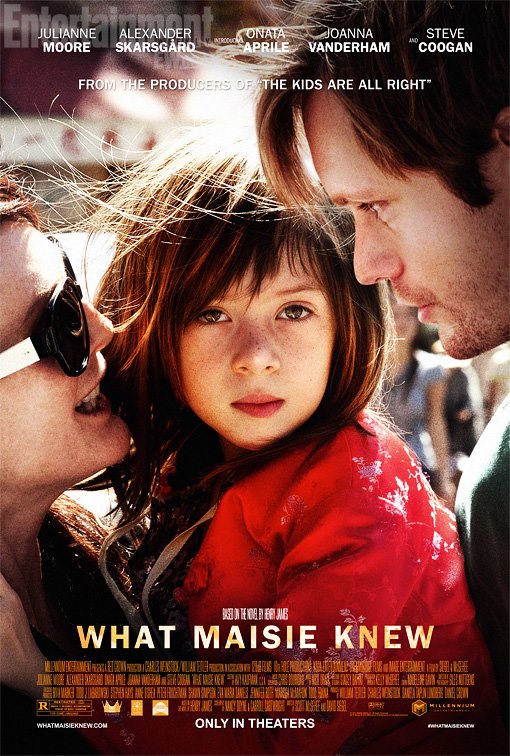
Set in modern day NYC, it smoothly tells a poignant story from the child’s point of view. Six-year-old Maisie (Onata Aprile) is eyewitness and victim of her parents’ constant quarrels and later divorce, a young child caught in the thorns and thistles of adult relationships. It is unfortunate that the most sensitive and observant child is often the most vulnerable. The naturalistic capture by the camera of Maisie’s quiet observations is most heart-wrenching. Maisie learns that the adult world is a busy place, her presence, an inconvenience. Thanks to the screenwriters’ gentler treatment, the movie spares us from some cruel, hateful fights in the book. We see Maisie ultimately get a taste of what it’s like to be cared for and to have some simple, childhood joy. The ending shot is beautiful.

Unlike Maisie in the novel, there is no moral dilemma for her in the movie. No doubt, the moral element is crucial in James’s novel. Divorce and adultery must have poked deep into the heart of James’s readers in his days. But our contemporary society has, alas, evolved into a ‘morally neutral’ state of numb resistance. The screenwriters may well know too that entertainment value comes before the didactic. We see no moral choices here with Maisie in the movie. After all, a young child will readily cling to whoever that loves her in deeds rather than mere words. Kudos to the filmmakers, they know the heart of a child.

Directors Scott McGehee and David Siegel capture the story from Maisie’s viewpoint, natural and realistic, camera lens often at a lower angle. Certain shots are particularly affective, from inside a taxi, the transport of choice in Manhattan, at different times the vehicle that takes away Mama, Papa, and caring Margo. We would see from inside the taxi out to Maisie standing on the roadside, abandoned and distraught.

The wonderful cast is what makes the movie so absorbing, and at times, even heartwarming, despite its subject matter. The then seven year-old Onata Aprile is a natural. Julian Moore’s solid performance as her mother Susanna is convincing. She is a touring rock-and-roll singer who has passed her prime. Jealous and temperamental, Susanna’s love for Maisie is possessive, and often displayed in empty words. British actor Steve Coogan, known to North American viewers by his recent starring role in Philomena, plays the career-minded art dealer father Beale. Like his ex-wife, he is too busy with his own life to care for a child. They both say they love Maisie, showering bursts of affection whenever they see their child.

What saves Maisie is the awkwardly positioned step-parents, her father’s new wife and Maisie’s former babysitter Margo (Joanna Vanderham, the parallel of Ms. Overmore in the book) and her mother’s new love interest, the tall and young bartender Lincoln (Alexander Skarsgård, a Sir Claude parallel). As predicted, they soon are abandoned themselves and the two quickly form a tie that includes Maisie in their life. Diverging from James’s story, the two are genuinely loving and caring, a soothing balm to Maisie and the viewers.

Overall, a fine, contemporary adaptation of the novel. To James purists, a loose reinvention; for viewers seeking meaningful entertainment, this should be on the list of films to watch.

~ ~ ~ Ripples


 ***

More Downton Ripples

Two years ago, some time after Downton Abbey Season 2 had finished airing on PBS, I wrote my first “Downton Ripples” post. I subtitled it “How I Overcome Downton Abbey Withdrawal Syndrome”. In that post, I’d listed some books and movies/TV productions that relate to the setting similar to Downton Abbey, for I was fascinated by the Great War period after watching Downton.

Some of the authors I read included Robert Graves, Hemingway, Evelyn Waugh, and watched Brideshead Revisited, A Handful of Dust, Easy Virtue and discovered Lost Empires, the TV series with a young Colin Firth together with Laurence Olivier, amazing.

This time, after Season 4, the withdrawal syndrome seems to have numbed a bit, but the ripples continue to spread. Again, Downton has prodded me to seek out the literature around the time between WW1 and WW2 Europe. While there are many present day authors writing about that era, I’d like to hear more authentic voices. I went looking for writers actually living in that period of history to hear their stories.

The following is a list of titles I’ve gone through this time, some I have finished, some still on my ‘To be’ agenda:

Parade’s End (2012, BBC/HBO co-production)

Parade's End Blu-Ray Cover

This series complements Downton Abbey perfectly. While Downton is light and heart-warming, soapy in its feel, Parade’s End is cerebral and literary, its social commentary of the time harsher and more incisive. I think the difference is, Julian Fellowes creates as a contemporary screenwriter, and knowing what modern day viewers want, he caters to their desire. Yes, he has offered us charming entertainment, and for the stars and the show, opportunities for Emmy and Golden Globe noms and wins.

Parade’s End is another story. Playwright Tom Stoppard (Emmy and BAFTA nom for this) adapts from Ford Madox Ford, a writer during WWI period, contemporary of Hemingway, Fitzgerald, the Lost Generation after The Great War, and witness to the destruction of the old world order and individual lives. Sure social barriers were dismantled, but together with such collapse came the shattering of long-held values and beliefs. Through the protagonist Christopher Tietjens, we can feel the intense struggles and poignancy of a man caught in such desolation.

I first saw Parade’s End on HBO when there was a window of free viewing. After watching one episode, I knew I must subscribe to continue with the rest of the series, and so I did. Effective advertising indeed. That was last year, and I recently just finished re-watching Parade’s End on Blu-Ray.

Parade’s End is the first time I watch Benedict Cumberbatch in a leading role (Emmy nom), an impressive performance as Christopher Tietjens, one of the last remaining honourable men struggling to stay afloat in the drowning waves of social change and ideals. Rebecca Hall (BAFTA nom) is effective as the scheming and seductive wife Sylvia. The young, almost ethereal Adelaide Clemens as suffragette Valentine Wannop is perfect. She makes me think of Carey Mulligan. And what a wonderful connection — Mulligan will be the star of the new film Suffragette, which I highly anticipate.

Parade’s End by Ford Madox Ford

Parade's End BBC Book Cover copy

This will be my major challenge in TBR books this year. Image here is the BBC Book edition I bought in a book sale a few years back. It has 906 pages, and is made up of four novels — Some Do Not, No More Parades, A Man Could Stand Up, and The Last Post. A more recent edition is the reissue of Penguin Modern Classic, with a new introduction written by Booker Prize winner Julian Barnes (The Sense of an Ending). You can read the intro here.

Parade’s End by Tom Stoppard

Parade's End Script by Tom Stoppard

I enjoy reading the scripts of productions I like. It’s a kind of deconstruction, if you will, demythisizing of sort. I’m fascinated by the skills of a screenwriter who uses words to elicit images for the director to execute, translating the literary into the visual using words. To write for the screen almost sounds like an oxymoron. I’ve read Julian Fellowe’s Downton Abbey scripts and found it most interesting. I’d like to explore Tom Stoppard’s journey of adaptation. But first, I need to tackle Ford Madox Ford’s original texts.

T. S. EliotT. S. Eliot — After Downton and Parade’s End, I’m all geared up to explore deeper into the the psyche and spirituality of the time. Why, after all, what had lost in a generation was not just the physical bodies or social structures, but the internal, the destruction of a value and belief system. I’d like to read and reread Eliot’s works, delve into a time that prompted the poet to see hollow men, and women come and go, talking of Michelangelo. What’s underneath the façade of human progress?

The Europeans by Henry JamesThe Europeans by Henry James — A voice from the dawn of the 20th Century. I have finished listening to the amusing auidiobook of The Europeans. Yes, unlike many readers’ impression of James’ works, The Europeans is a delightful read (listen). It is like a medley of E. M. Forster and Jane Austen. Humorous depiction of the different POV’s between a pair of European sister/brother coming to visit their American cousins residing in the outskirt of Boston. With some LOL moments. My next James read is The Ambassadors.

The Collected Stories of Stefan ZweigStefan Zweig — While Lady Edith’s love Michael Gregson headed to Germany and mysteriously gone missing, the then famous (real life) writer Stefan Zweig in Austria was lamenting the spread of anti-semitism in the continent. It’s interesting that Downton has led me to connect, at least in historical timeline, with an author I’ve just recently discovered, thanks to Wes Anderson’s The Grand Budapest Hotel, to which he has credited the works of Stefan Zweig. I’ve recently read Zweig’s Chess Story, and now delving into his short stories.

***

86th Academy Awards Made History

Oscar Selfie

The following is a partial list of last night’s 86th Academy Awards winners. I’ve included Production Budget from Box Office Mojo, just for comparison:

Gravity: 7 Wins

Best Directing, Cinematography, Film Editing, Sound Mixing, Sound Editing, Visual Effects, Music (Original Score).

Production Budget: $100 Million

12 Years A Slave: 3 Wins

Best Picture, Supporting Actress, Adapted Screenplay

Production Budget: $20 Million

Dallas Buyers Club: 3 Wins

Best Actor, Supporting Actor, Make-up and Hairstyling

Production Budget: $5 Million

The Great Gatsby: 2 Wins

Best Costume Design, Production Design

Production Budget: $105 Million

Blue Jasmine: 1 Win

Best Actress

Production Budget: N/A

Her: 1 Win

Best Original Screenplay

Production Budget: $23 Million

12 Years A Slave Poster copy

The Oscars last night made history in two categories… and I don’t mean Ellen Degeneres’ star-studded group selfie setting retweeting record. First, there was Gravity’s director Alfonso Cuarón as the first Latin American to win the Best Directing Oscar. Gravity seemed to be the major winner last night with seven Oscars. Basically the 3D, sic-fi movie had snatched all technical wins, as predicted by many.

But in every Academy Awards, the top prize is Best Picture, here we see 12 Years A Slave make history with Steve McQueen becoming the first black director to garner the Best Picture Oscar honour. Lupita Lyong’o also came out victorious as this is her first feature film. I’m happy to see too that John Ridley win the Best Adapted Screenplay, the second black winner to fetch a writing Oscar, after Geoffrey Fletcher for Precious in 2009. Ridley has turned Solomon Northup’s poignant memoir into a script for an impressive visual testament. Because of the film, this eye-witness narrative of Solomon Northup hopefully will find its way into school curricula soon. This is the power of cinema in transforming society.

Cate Blanchet‘s win for her role in Blue Jasmine gives her a chance to counter a misconception: “… and perhaps, those of us in the industry who are still foolishly clinging to the idea that female films, with women at the centre, are niche experiences. They are not. Audiences want to see them, and in fact, they earn money.”

Hopefully after all the ‘history’ being made, one day we won’t have to identify the colour, ethnicity, or gender of winners in saying so-and-so is the first black, or hispanic, or woman to win this or do that.

**

The reason I’ve included the Production Budget in the above list is that I remember the ‘implosion’ of the movie industry‘ Steven Spielberg had predicted a year ago as he cited productions getting more and more costly, aiming at mega, iron-man effects to please the general public. While Gravity might fit that category with its 3D, high-tech, CGI-driven grandiosity and out-of-this-world spectacle, there are also worthy, smaller productions that cost only a fraction of a colossal budget, but still can move audiences and touch the human heart.

**

Related Posts on Ripple Effects:

History Made At The Oscars: Kathryn Bigelow Wins Best Director

Our Mega Culture

12 Years A Slave: Beauty and Sadness (Movie Review)

Narrative of Solomon Northup: A Voice that Must Be Heard (Book Review)

Nebraska: Color is Superfluous (Movie Review)

The Great Gatsby Movie Review

Blue Jasmine: Homage & Re-imagining

***

Books to Movie Adaptations Updates

Here are some updates that look promising, books that are in various stages of development into movies. For yourself or your book group, should make a good reading list:

East of Eden Book CoverEast of Eden — This just came out two days ago, Hunger Games director Gary Ross will write the screenplay of this new adaptation of John Steinbeck’s classic, with Jennifer Lawrence to star. For J. Law fans, this is good news. But for devotees of the original 1955 movie adaptation directed by the legendary Elia Kazan with the debut breakout role for James Dean, this modern version definitely is uncalled for, a rebel without a cause.

An Object of BeautyAn Object of Beauty — The movie version of Steve Martin’s novel about the NYC art gallery scene is now a project of Amy Adams’, with Ned Benson writing the screenplay. I have high expectation of this one, having seen Benson’s wonderful works The Disappearance of Eleanor Rigby: Him and Her last year at TIFF. The cast has not been announced but Amy Adams will be the producer and actor in her new project.

A Walk In the WoodsA Walk In The Woods — from the vast open sea in All Is Lost to the Appalachian Trail, Robert Redford will appear in this adaptation of the 1998 personal memoir by Bill Bryson, a walk on the Appalachian Trail to ‘rediscover America.’ Nick Nolte is also reported to be in the cast. Screenplay by Michael Arndt (Little Miss Sunshine, Toy Story 3, The Hunger Games), directed by Ken Kwapis (The Office). The movie is scheduled to come out in 2015. Enough time to read or reread, or even walk the Trail yourself. Who knows, you might see the film crew while there.

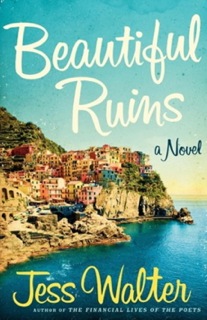
Beautiful RuinsBeautiful Ruins Author Jess Walter of this popular novel will co-write the screenplay with writer/director Todd Field. I’ve seen Field’s Oscar nominated adaptation of Little Children (2006 with Kate Winslet nom. for Best Actress), a haunting film. I trust his talents with Beautiful Ruins. Considering the Italian coastal setting of the book, the movie would likely offer some beautiful cinematography. Imogen Poots is on board, so far.

The Dinner The Dinner — Dutch author Herman Koch’s novel is like a dynamite. I’m half way through the lighted fuse as I type this post, so it’s not full-blown yet, but I’m totally engrossed in this book based on a real-life crime. The dinner menu in an elegant restaurant ingeniously parallels the plot development. I missed it at TIFF last year. And since, I’m not aware that it has made its presence on the big screens here in North America. But hopefully this year we will have the chance to see it. Even if it doesn’t show in your city, read the book still. (Update: to read my book review on Goodreads CLICK HERE.)

Hundred Foot JourneyThe Hundred-foot JourneyAnother culinary movie. This one is much lighter than the above, based on Richard C. Morais’s novel. Story is about a family from India moves to France, opening an Indian restaurant across from a Michelin-starred fine French restaurant. Cultural clashes, the reverse of The Best Exotic Marigold Hotel. The book is quite entertaining, the movie comes with some big names. Producers Steven Spielberg and Oprah Winfrey, Helen Mirren to star, and directed by the prolific Lasse Hallström (Chocolat, 2000; The Shipping News, 2001; Salmon Fishing In the Yemen, 2011)

The GiverThe Giver – The highly popular young adult book by Lois Lowry finally gets a movie appearance, over twenty years after its publication in 1993. Utopia turned bad, ideals and reality. With so many movies on a dystopia, will this still look fresh? Cast include Jeff Bridges as The Giver, and look here, Meryle Streep, Taylor Swift, Alexander Skarsgard, Philip Noyce directs. One of Noyce’s previous works is the adaptation of Graham Greene’s novel The Quiet American (2002). Many may have read this title in school. Time to reread.

The Little PrinceThe Little PrinceLots of talents are behind this newest animation based on the beloved story by French author and pilot Antoine de Saint-Exupéry. Those lending a voice include: Rachel McAdams, James Franco, Marion Cotillard, Jeff Bridges, Paul Giamatti. While I love the earlier musical version (1974, with Gene Wilder as The Fox), I welcome a new adaptation, for I know this will bring the book to the limelight for a new generation. Making a movie nowadays looks to be the most effective way to introduce literature to a younger generation (or whatever generations).

Secret ScriptureThe Secret Scripture — By the Booker Prize short-listed Irish author Sebastian Barry. The novel is an internal dialogue of a close to 100 years-old patient in a mental hospital, Roseanne McNulty, reminiscing her younger days. The older character will be played by the brilliant Vanessa Redgrave, her younger self by the talented Jessica Chastain. I last see them together in a film was in Ralph Fiennes’s directorial debut, the modern version of Shakespear’s Coriolanus. Don’t think these two ladies will appear in the same scene in The Secret Scripture since they are of different time periods, but good to know that the roles are being played by two wonderful actors.

***

Previous Books to Movies Lists:

2014 Book To Movie Adaptations

Upcoming Book to Movie Adaptations

Great Movies Expectations

Related Posts:

My book review of The Dinner posted on Goodreads

Book Review of The Hundred-Foot Journey by Richard C. Morais

Do We Need Another Rebecca Remake? Another Grapes of Wrath?

***

12 Years A Slave, Narrative of Solomon Northup: A Voice That Must Be Heard

“Is everything right because the law allows it?” — Solomon Northup

This is one of those cases where after watching the movie, I knew I must read the original source material, especially that it was written by Solomon Northup himself. If the movie is an artistic, cinematic account of a dark page in history, Solomon’s narrative is the quintessential eyewitness report, a first-person, authentic voice that is both a victim and a legitimate accuser of an inhumane and unjust system.

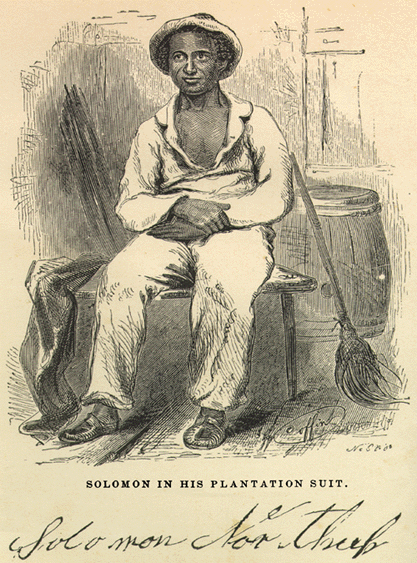
Solomon Northup copy

Born a free man in the State of New York, Solomon was happily living in Saratoga Springs, married to Anne and enjoying a loving family life as father to Elizabeth, 10, Margaret, 8, and Alonzo, 5. In March, 1841, his life was tragically altered when he was deceived by two men, Brown and Hamilton, and followed them to Washington, believing that he was to be hired to play the violin in a circus. Solomon was later drugged, kidnapped, chained and beaten. Together with other captured victims, he was smuggled to New Orleans and sold as a slave, his name changed to Platt, erasing any evidence of a previous life.

Having no free papers to prove his identity, transported and sold like a chattel to the Bayou in Louisiana, Solomon’s fate was sealed hundreds of miles away from home. His agony was heart-wrenching:

Were the events of the last few weeks realities indeed? — or was I passing only through the dismal phases of a long, protracted dream? It was no illusion. My cup of sorrow was full to overflowing … To the Almighty Father of us all — the freeman and the slave — I poured forth the supplications of a broken spirit, imploring strength from on high to bear up against the burden of my troubles, until the morning light aroused the slumberers, ushering in another day of bondage. (p. 77)

Solomon Northup’s eloquent writing immediately draws me in. It has a traditional and formal ring to the ear, but not archaic; it exudes clarity, finesse and grace. I’m struck by his stylish narrative even when he is describing depravity and injustice. After reading, I can see how the book had inspired director Steve McQueen’s beautifully rendered, artistic cinematic work on such an ugly subject matter. 

The movie follows the memoir closely, albeit leaving out a lot of details. Reading the source material after the movie can fill those in, making it so gratifying.

It was strictly forbidden of slaves to learn to read or write; pen and paper were prohibited. Any slave found to have even minimal education would be severely punished. Solomon had to feign ignorance all the years as a slave to survive. His memoir was written after he gained back his freedom in 1853.

I was most impressed that while Solomon yearned for deliverance and justice, he harboured no traces of personal vengeance against his tormenters. He had proven himself a man of integrity. Often he was sought after for his resourcefulness and his skills in playing the violin. He had entertained masters, and offered momentary relief to fellow slaves.

For two years Solomon was under the kind master William Ford, but had to be sold to the ‘slave breaker’ Edwin Epps to escape from Ford’s jealous and murderous slave driver Tibeats. The subsequent ten years with Epps became an extended living nightmare.

While the movie adaptation is an excellent production which I gave 4/4 Ripples, I find  Solomon Northup’s memoir even more engrossing. I’m particularly impressed by the fact that the book is not a self-absorbed account of sufferings, but as a careful memoirist, he records many details that are informative and even interesting, such as the natural vegetation of the Bayou environment, the cotton and sugar cane crops growing from seeding to harvesting, and the geography of the locales.

Like a perceptive ethnographer, he chronicles plantation life as a slave, the dwellings, diet, work load, daily chores, maltreatments. From his candid revealing, we are led into the subjective world of slavery, being sensitized to what it is like living in bondage and helplessness, constantly fearful of severe whipping and even death. Like a suspense writer, Solomon leads us to follow his risky attempts to seek help, and await in bated breath the day of his rescue. 

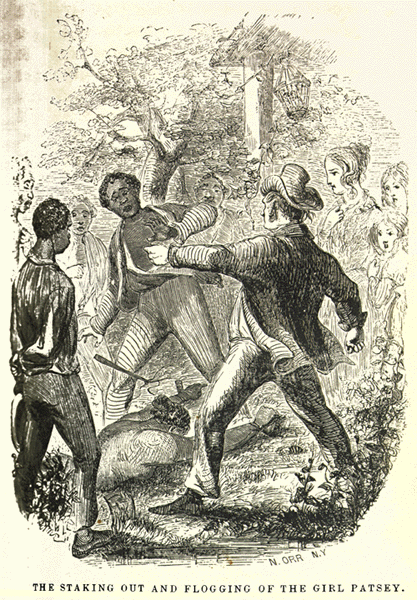
An incisive observer of human nature, Solomon sharply describes the psychological makeup of the alcoholic psychopath Epps, and the conflicting power relation binding Epps and his wife, complicated by his gratuitous fondness of the slave girl Patsey. We see in the movie Patsey suffers the brunt of her Mistress’ jealousy, and the maltreatment under her Master who tries to please his wife. The traumatic scene in the movie where Solomon is ordered by Epps to whip Patsey is described even more poignantly in the book. I’m surprised that the literary narrative has a more powerful hold on me than the visual rendition in this scene.

Flogging of Patsey copy

The memoir serves its purpose as a piece of personal narrative that’s poignant and deeply moving. The resilience and faith of Solomon Northup is crucial in his later being rescued. His longing for freedom and justice that is devoid of personal vengeance is most admirable and inspiring.

The rescue is a long and testing process, not so short as in the movie which I feel is a bit off balance. The adaptation should have given viewers a sense of the actual attempt especially in his home state of New York among those who try to find and rescue him. Thanks to the free-thinking, itinerant carpenter Bass from Canada who came to work for Epps for a short time, Solomon saw a crack opened for a chance to relay news back to the North by way of Bass.

Solomon had disappeared from the lives of his wife and three children for twelve years. Thankfully they were all well. When he reunited with them, he had the pleasure of seeing his newborn grandson, named after him by a devoted daughter. His youngest son Alonzo had the plan to make enough money to buy back his freedom if he could be located. It was indeed a moving scene as depicted in the following sketch from the book:

Family Reunion copy

After he had regained freedom, the slave trader Burch, ‘a speculator in human flesh’, was arrested and brought to trial in Washington, where he kidnapped and sold Solomon into slavery. However, Solomon was denied the right to be a witness against Burch for he was a black man. Burch was later found not guilty and discharged. Solomon wrote in his memoir:

A human tribunal has permitted him to escape, but there is another and a higher tribunal, where false testimony will not prevail, and where I am willing, so far at least as these statements are concerned, to be judged at last. (p. 319)

His faith in that ‘higher tribunal’ and an ultimate judge had carried Solomon Northup through the twelve years of slavery. His narrative not only is a voice that testifies against the injustice of man, but poignantly declares that freedom transcends physical bondage. Amidst inhumanity and despair, he had chosen to remain human, and to value integrity and faith. Solomon Northups’ ordeal is a glimmer of light in a dark page of history.

The Oscars dim by comparison.

~ ~ ~ ~ Ripples

CLICK HERE to read my movie review of 12 Years A Slave

***

Free Download:

Twelve Years A Slave, Narrative of Solomon Northup, NY, Miller, Orton & Mulligan, 1855, 336 pages, with appendix of legal documents and papers. You can download the PDF version of the original 1855 publication free here.

***

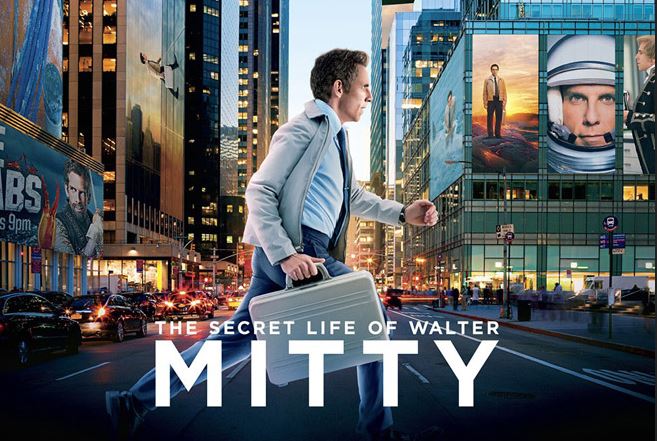
The Secret Life of Walter Mitty (2013): The Love Hate Gap

This new adaptation loosely based on James Thurber’s 1939 short story was a highly anticipated year-end movie, possibly aiming for a spot in the coming awards season. It was released on Christmas Day, 2013, only to meet with disappointing critical reviews.

The-Secret-Life-of-Walter-Mitty

Any movie version derived from James Thurber’s short story first published in the March 18, 1939, issue of The New Yorker is allowed plenty of room for reinvention, since the original story is only about 2,000 words in length. If you’re interested to read or reread it, here’s the link. The story saw its first movie adaptation in 1947, starring Danny Kaye as Walter Mitty.

In Thurber’s story, Walter Mitty is a man living with an overbearing wife. He intersperses his meagre existence with heroic daydreaming. Behind the wheel of his car driving his wife to the hair salon, he would zone-out and imagine himself a fighter pilot piercing through a storm. At another time he would cast himself as a world-renowned surgeon saving a dying patient on the operation table, or as an expert shooter, or a war hero.

Over the years, Thurber’s Walter Mitty seems to have turned from a fictional character into a concept. The daydreamer has gathered mass appeal. Walter Mitty the character unleashes the escapist in us. It takes us out of our mundane, ordinary life and catapults us to brave, new worlds. It empowers and makes a hero out of Everyman.

This recent movie version has taken up such a challenge with fine colours. Walter Mitty (Ben Stiller) works for LIFE magazine which has just been acquired, and a major downsizing ensues. The upcoming issue will be the last of its print edition. As the ‘Negative Assets Manager’, Walter Mitty is responsible for the cover. ‘Negative assets’ means, literally, the negatives of photo collection. And here’s the rub, the slide that is meant for this last cover is missing. Feeling responsible, Walter Mitty takes up the challenge to seek out its reclusive photographer Sean O’Connell (Sean Penn), who leaves his tracks in the remotest parts of the world.

Not quite a dramatic story arc, not quite a believable motive either, considering the digital age of the setting, seems an unrealistic task to conduct a real-life globetrotting search for a missing slide. But out of curiosity, I let the story lead and enjoy what comes next.

The arduous journey to find the mystical photographer offers me an array of visually stunning and surreal Walter Mitty-esques sequences. The initiation is when Walter Mitty jumps onto a moving helicopter in Greenland, upon imagining his love interest Cheryl (Kristen Wiig) singing ‘Ground Control to Major Tom’, urging him to take flight. Other breathtaking scenes that follow include longboarding by an erupting volcano in Iceland (my favourite), scaling the mountains in Afghanistan, and playing soccer with Himalayan dwellers against the setting sun.

Soccer match in the setting sun

In the office, Walter Mitty is the target of bullying from the hatchet man of the acquisition Ted (Adam Scott). Walter is also the secret admirer of coworker Cheryl. Too timid to declare his love, he hides behind eHarmony to hopefully connect with her anonymously. After Walter’s adventurous journey to find the mystic photographer, he is transformed into a braver man; ultimately, his true colours shine through, fantasy fulfilled.

Shirley MacLaine plays Walter Mitty’s supportive mother, an endearing role. Together with Kathryn Hahn as Walter’s sister, they bring some normality into our protagonist’s life. The three offer a few heart-warming moments.

Now, mind the gap. From the reviews and audience feedbacks, it looks like this is one of those ‘love-it’ or hate-it’ movies. Here are the stats of approval on Rotten Tomatoes: critics 48%, audience:76% On Metacritics it is similar: critics 54% and viewers 76%.

Why the discrepancy? I must stress that there are critics who love it, and, audience who don’t. Not that this is purely a ‘critics vs. viewers’ kind of showdown. But we do see the obvious gap between the two groups. What accounts for the gap? Here’s my analysis and speculation:

Those who hate the movie, see Ben Stiller. They see this as a self-serving project of the A-list Hollywood star directing himself in a role that sends him to all the improbable heroic scenarios. They see the production as a self-absorbed ego trip. Unrealistic storyline, much ado about nothing.

Those who love the movie, or find it entertaining and enjoyable, see Walter Mitty. They see the daydreamer, the self-defeating underdog going on a series of life-transforming adventures. They see the Wlater Mitty of today, a tiny screw in the humungous economic machine, dispensable, unappreciated, the tireless worker saving the day. They see love requited; they see dreams fulfilled.

What if… What if this whole production is Ben Stiller’s Walter Mitty fantasy realized? Why should we mind? Anyone too high on the A-list to have no need for a Walter Mitty moment?

~ ~ ~ Ripples

Related Links: 

CLICK HERE To read the short story by James Thurber, ‘The Secret Life of Walter Mitty’, published in The New Yorker, March 18, 1939.

CLICK HERE to read an article detailing the LIFE magazine covers in the movie: “Walter Mitty and the Life Magazine Covers that Never Were”. 

***

August: Osage County (2013), Ad-Lib in the Literal Sense

Tolstoy writes at the beginning of Anna Karenina this famous line: “All happy families are alike; each unhappy family is unhappy in its own way.”

That explains why we see more movies about dysfunctional families than happy ones, because there are just too many more unhappy stories to tell and countless ways to tell them.

August Osage County

Tracy Letts’s play August: Osage County was the 2008 Pulitzer Prize winner for drama. The stage production was well received as a hilarious satire and biting commentary of the contemporary, declining family. Surely, it’s ironic that we find humour in something that we ought to lament. However, it’s also true that the most accessible way for a writer to communicate is probably by means of drama, satire, humour, and entertainment.

The movie version evokes very different reactions. Reviews are mixed, and there are some harsh criticisms. One thing I find though, many of the critics admit to not having seen the stage performance. Well, I haven’t either, but I’ve at least done my due diligence, also to guard myself from A-list stars influencing my interpretation, I read the play before I went to see the movie.

First the reading experience. I’d thoroughly enjoyed it. The long quote like an epigraph at the beginning of the play prepares me for the content following. It describes parent/child relationships, from All The King’s Men by Robert Penn Warren. Let me just quote the last lines:

And the good old family reunion, with picnic dinner under the maples, is very much like diving into the octopus tank at the aquarium.

Three Weston daughters, Barbara, Ivy and Karen reunite in their childhood house outside Pawhuska, Oklahoma, in a family crisis. Their father Beverly had been missing, later found drowned, an apparent suicide. Beverly was a one-time award winning poet who in later life drenched his misery in alcohol. The matriarch is the foul-mouthed Violet Weston, a destructive roadside bomb that explodes upon the slightest human contact. What makes her even more bitter is what could well be her nemesis, mouth cancer. She is often high on prescription drugs, while she prides herself that nothing slips by her without her noticing. She’s not demeaning, just ‘truth-telling’.

There are dark secrets in that old house unknown to the daughters, exposed during this present crisis. The twists and turns in the plot only accentuate the decayed skeleton of a family. But Letts’s lines are thought-provoking, albeit well mashed-up with curses and abrasive language. But there are LOL dialogues and humorous moments, and overall, an entertaining, well crafted play. It starts off with this line: “Life is very long… T. S. Eliot”, and before the final Blackout it finishes with: “This is the way the world ends, this is the way the world ends, this is the way the world ends…” Hollow men in their precarious condition.

Intelligent lines, a far-fetched character, but not impossible situations, and yes, some nasty verbal and literal combats. I must say, having read the play helps me appreciate the movie more despite its faults.

So, here we go round the prickly pear…

Streep and Roberts in August Osage County

THE MOVIE

If you haven’t read the play or seen the stage production, you just might be in for some rude awakening. Director John Wells is known more for his TV series than his one full length feature The Company Men (2010). I’m glad though that Tracy Letts writes the screenplay himself. He keeps many of the lines intact, and adds some scenes for dramatic and cinematic effects.

While exuding fearful authority to everyone who crosses her path, Meryle Streep is fearless in adopting a vocabulary of expletives and curses playing Violet Weston. Her daughter Barabara (Julia Roberts) is more restrained and obviously exasperated to find herself slipping into similar form in relating to her recently divorced husband Bill (Ewan McGregor) and teenaged daughter Jean (Abigail Breslin).

Ivy lives close to Violet but no more as she has her exit plan. However, we know what best-laid plans often do. Youngest sister Karen changes men like wardrobes; oblivious (or maybe not) to her, her present fiancé Steve (Dermot Mulroney) looks like another disappointment. Mattie Fae (Margo Martindale) is a supportive sister to Violet, but she too has to nurse her own unspeakable past. Her husband Charlie (Chris Cooper) is probably of the soundest mind in this family. He has spoken a few admirable lines as he confronts his wife’s maltreatment of her own son, Little Charles (Benedict Cumberbatch). But of course, Mattie fae has her own Gordian knot to deal with.

The person that silently offers practical help whenever there are crashes and especially so in the last scene is the aboriginal maid hired by Beverly a few days before he disappears. Johnna (Misty Upham) cooks, serves, observes, and raises moral protest with a shovel. She is the one at the end of Letts’s play softly reciting T. S. Eliot’s lines, “This is the way the world ends…” while Violet utters: “and then you’re gone, and then you’re gone, and then you’re gone…” In the movie we hear Clapton’s ‘Lay Down Sally’: “But won’t you make yourself at home and stay with me? Don’t you ever leave…” Less literary and more obvious.

The key to enjoying the movie is to find entertainment in its dark comedy, taking misbehaviour and maltreatments as satire, overly dramatic scenes as farce, exaggerated gestures and facial expressions as comedic spasms. But of course, there are scenes that are serious, thus sending the mixed messages of an incongruent  genre. For entertainment purposes here, I think it is fine to feel poignancy through the chaos.  

Yet the movie has its faults, and it’s not hard to pick out. Inconsistency in blocking of characters is an example. One obvious scene is when Bill is driving Barbara to identify her father’s body. We see Barbara sit in the back seat with daughter Jean, delivering her ‘die after me ” plea. As the car stops, the camera points to the front of the car and we see Barbara (or her stand-in) steps out from the front passenger seat.

But overall, as a play turned movie, it is less claustrophobic than the one-room setting of Carnage (2011). And the entertainment value can be found in the acting of most of the characters, in particular, Streep and Roberts. If there are faults, they are not in over-acting. Roberts’s restrained performance is a good counter-balance to Streep’s overbearing character.  Watching the movie, I have the feeling that Wells is following Letts’s written description in the literal sense. Why, in the play, the floor wrestling between Violet and Barbara is written with these words: “ad-lib“.

~ ~ ~ Ripples

***

2014 Book to Movie Adaptations

I’m sure without any more suggestions, you have plenty to read already. But just in case you’re one of those who likes to read the book before watching its movie adaptation, here’s a list to add to your 2014 reading:

A Most Wated ManA Most Wanted Man by John Le Carré

The most recent John Le Carré novel to be adapted into a movie. He has eight so far. Philip Seymour Hoffman, Rachel McAdam, Robin Wright, Daniel Brühl star. Directed by Anton Corbijn whose last film was the thoughtful The American (2010), a film adaptation I found to be much better than the book. A Most Wanted Man is to be premiered at Sundance Film Festival, Jan. 16-26, 2014, in Park City, Utah.

The DoubleThe Double by Fyodor Dostoyevsky 

A government clerk after seeing his own double–but a completely opposite personality from his introverted and unsure self–ultimately goes down a path of madness. Should be one captivating psychological thriller, but interestingly according to IMDb, it’s a comedy. Jesse Eisenberg stars (I can see the casting is spot on). At TIFF last year. To be screened at Sundance this January.

EVERY-SECRET-THING-199x300Every Secret Thing by Laura Lippman

Acclaimed psychological thriller about missing children and their abductors now turned into suspense drama by director Amy Berg, known for her riveting documentary West of Memphis (2012) about the ‘West Memphis Three’. Adapted screenplay by Nicole Holofcener, who wrote and directed the recent, award winning indie film Enough Said (2013). Dakota Fanning, Diane Lane.

.

Far from the Madding Crowd

Far From the Madding Crowd by Thomas Hardy

Carey Mulligan stars as Bathsheba Everdene, screenplay adaptation by David Nicholls, who has written other classics adaptations such as Great Expectations (2012), Tess of the D’Urberville (2008). But my personal favourite of his works is the gem When Did You Last See Your Father? (2007) And if you’ve seen the intense Danish film The Hunt (just nom for an Oscar), you’d be curious to see its director Thomas Vinterberg at the helm of this latest Hardy adaptation.

gone-girl

Gone Girl by Gillian Flynn

A woman mysteriously disappears on the day of her wedding anniversary. A NYT bestseller, the thriller will be directed by David Fincher, two-time Oscar nominee for The Social Network (2010) and The Curious Case of Benjamin Button (2008). Ben Affleck, Roasmund Pike, and Neil Patrick Harris star.

.

Hector and teh Search for HappinessHector and the Search For Happiness by François Lelord

Psychiatrist turned writer Lelord’s internationally popular book about a psychiatrist’s globe-trotting search for happiness. Sounds like a delightful read and an original movie idea. Intriguing cast includes Rosamund Pike, Toni Collette, Christopher Plummer, Simon Pegg, Stellan Skarsgård. If I’m attracted by the cover to read the book, it will be this one.

Labor-DayLabour Day by Joyce Maynard

From the POV of a 13 year-old boy, how his labour day weekend changes his life as an escaped convict (Josh Brolin) asks him and his mother (Kate Winslet) for a temporarily shelter. Mother and son soon find that he could well be the husband and father they respectively need. But of course, there are twists and turns. Jason Reitman (Up In The Air, 2009) writes the screenplay and directs. Winslet got a Golden Globe nom for Best Actress for her role.

Life Itself A Memoir Book CoverLife Itself by Roger Ebert

Ebert’s memoir is adapted into a documentary by Steve James, whose film ‘Hoop Dreams’ was greatly supported by Ebert twenty years ago. Life Itself the book is an eyewitness history of film criticism in America, on top of a moving personal memoir. The doc will premiere in Sundance beginning today Jan. 16 – 26. Click here to read my personal encounter with the legend.

Madame BovaryMadame Bovary by Gustave Flaubert

A quick jump for Mia Wasikowska from Jane Eyre to Emma Bovary. Of course, she’s also Alice in Wonderland, and a sequel of that will be coming out in 2016. Paul Giamatti co-stars. I’m delighted to see all these classics being adapted into modern movies, raising awareness for a new generation of readers. Let’s just hope the film does justice to the literary source.

.

The Monuments MenThe Monuments Men by Robert Edsel

I’ve mentioned this before. The true but untold story of how a group of rescuers called ‘The Monuments Men’ in war-torn Europe saved art and artifacts from the Nazi’s. In the introduction of the book, the author writes: “Hitler and the Nazis pulled off the ‘greatest theft in history’, seizing and transporting more than five million cultural objects to the Third Reich.” Star George Clooney, Matt Damon, Cate Blanchett, Jean Dujardin (The Artist), Hugh Bonneville (so Lord Grantham finally gets the chance to go into the battlefield).

The BibleNoah

Read the Bible. This epic adaptation is based on the Biblical account of Noah and the Great Flood. Helmed by Darren Aronofsky, Oscar nominee for Best Director for Black Swan (2010). Russell Crowe is Noah, and Anthony Hopkins is … uh… Methuselah. Others include Emma Watson, Logan Lerman (as Ham), Douglas Booth (Shem), Nick Nolte (?) Interesting postmodern interpretation I suspect.

Winter's TaleWinter’s Tale by Mark Helprin

All ye Downton Abbey and Lady Sybil fans, this is the first movie Jessica Brown Findlay made after Downton, with co-stars Colin Farrell, Jennifer Connelly, Will Smth. Directed by Akiva Goldsman, Oscar winner of Best Adapted Screenplay for A Beautiful Mind (2001). The setting is interesting as it depicts the story from both the beginning and the end of the 20th C. Another time warp fantasy. Click here to the book’s webpage.

***

More titles mentioned by commenters (A sequel list will come at a later date):

Serena by Ron Rash (Jennifer Lawrence, Bradley Cooper)

Suite Français by Irène Némirovsky (Michelle Williams, Kristin Scott Thomas)

Son of God based on The Bible

***

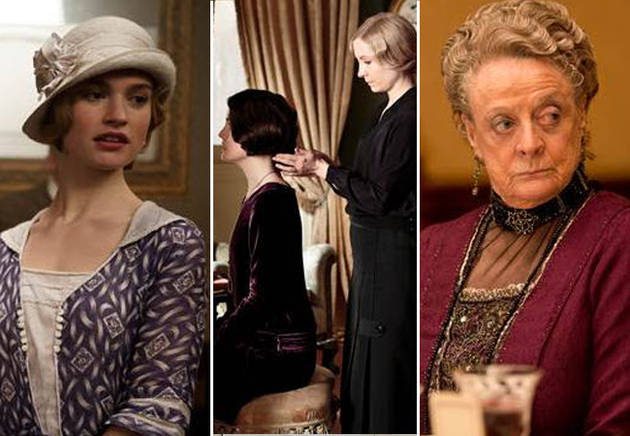
Downton Abbey Season 4 Opening Special

That we use a TV series to mark the beginning of a new year speaks volumes about our contemporary life. However, we are products of our time and culture, and our annual waiting has run its course of patience training. So, let the games begin.

There are so many characters to reintroduce to us that I can understand Julian Fellowes has to write a fast-paced opening. In the first hour, almost all the scenes are like vignettes, spanning 30, 60, or 90 seconds. That means, if you don’t much care for one plot line, like Mrs. Patmore’s ambivalent encounter with an electric mixer, you can just count a few more seconds, you’ll see another character with another dilemma.

Downton Abbey S4  copy

Is it an apt opening? I must say, as with that of Season 3, I am a bit underwhelmed. But I’m sure, as the episodes roll out, I’ll get warmed up real soon. After all, there are so many characters and plot lines, there must be one that I like.

Season 4 opens six months after Matthew Crawley’s very untimely death, 50 years too early according to his widow. Mary’s sorrow has shrouded the first hour of this two-hour special, subtitled ‘House of the Walking Dead.’ So we just hope that Mary will soon take her grandmother’s advice, choose life over death. Violet Crawley remains one of my favourite characters, she beseeches effectively at the right moment, and despite her old age, is more lucid than her son.

We see Robert Crawley’s less than amiable self once again, trying to take charge of grandson George’s share of Downton by sidestepping Mary, all in the cover of protecting her fragile emotions. No malicious intent there but merely convenience over principle. Violet Crawley has once again shown that mother knows best. This has got to be my favourite line of the whole episode, an eighty-something Violet Crawley talking to her sixty-something son Lord Grantham:

When you talk like that I’m tempted to ring for Nanny and have you put to bed with no supper.

So it is a rewarding scene as we see Mary finally decides to come out of the land of the dead, crying over the shoulder of not her parents’ but Mr. Carson’s, who has seen her grow up and always has a soft spot for her. That’s one of the few moving scenes in this special.

Mary could have gotten closer to her mother-in-law Isobel Crawley who on her own has to deal with the loss of an only son. Mrs. Hughes has done a kind act, drawing her out of mourning by appealing to her benevolent spirit, while at the same time helping Charles Grigg, Mr. Carson’s former showbiz partner, to get back on his feet. To kill two birds with one stone, or invasion of privacy? Depends on who you ask. Nevertheless, I’m sure at the end of the day, Mr. Carson would thank Mrs. Hughes for intruding into his past so he can find some reconciliation with Grigg.

A character that seems to have turned into a lively spark of the household, hoisting the flag of modernism, other than the obvious, ever bubbly Rose, is Lady Edith. She has taken hold of her life, venturing out to seek her own fortune, or misfortune, in career and in love, disregarding her father’s safe standards. In the London social scenes we see some fresh, Gatsby-eques fashion and set designs. Her love interest, Michael Gregson, is willing to take up German citizenship in order that he can divorce his lunatic wife and marry Edith. There in the 1920’s turning to Germany? I can expect the plot to thicken quite a bit later.

O’Brien’s midnight move is an efficient way to handle actors not renewing their contracts. Now this one is easier to swallow than killing them off. With no obvious villain left to be his partner or rival, Tom Barrow has to shoulder the whole realm of evil plotting against the innocents. But with Nanny West, he just hits it by luck. So now he’s in favour with Cora Crawley. Who’s going to be his next victim?

Mr. Bates has been quiet, while Anna has some adventure as chaperone of Lady Rose to a working-class dance hall. I have not watched any of the upcoming episodes, but I feel Bates and Anna can be given more story and screen time. Let’s say, their strong relationship can withstand some slings and arrows Julian Fellowes wishes to hurl their way.

So what do you think of Downton Abbey S4 E1? Favourite scene and characters? Quotable quotes?

***

Related Posts:

Downton Abbey Season 4: Episode 2

Downton Abbey Season 3

Quotable Quotes from Downton Abbey Seasons 1 & 2

Quotable Quotes from Downton Abbey Season 3

***