The Best Movies of 2008

It’s that time of the year when film critics choose their ten best.  Here are a few of their lists.  Click on them to see the full content.

Breaking the top 10 tradition,  Roger Ebert has chosen 20 for 2008, because in his opinion, there are just too many good films this year.

A. O. Scott of the New York Times tends to agree, but still managed to pick his top 10 among the 650 films he has seen this year… incredible.

His colleague Manohla Dargis has also done the year-end cut from the hundreds she has seen.  Here’s her take on the ten best.  And while you’re there, click on the podcast where she and Scott discuss this year’s movies.

And finally, a Canadian perspective, represented by Johanna Schneller of the Globe and Mail.  I like how she puts it:  the 10 films “that I feel richer for having seen.”

What draws me to these lists is not so much about which movies get picked as the 10 best, but WHY they are selected, and HOW critics come around to that final decision after, I must suppose is a long, struggling process.  Imagine having had to pick 10 out of 650!

Comparing these lists, there are of course titles that are common among them, but not too many.  A few getting up on three of these lists but not all, like Rachel Getting Married, Milk, and Wendy and Lucy.  Only one film gets the nod from all of them and that’s Happy-Go-Lucky.  But for the rest, it seems like each critic has his or her own personal criteria when it comes to choosing what makes a good movie.  And I’m glad to see it this way.

Of course, there are theories, on film, aesthetics, and criticism, and then there are acting methods and execution criteria in camera works, lighting, sound, cinematography, editing, screenplay… it all boils down to one whole package, the final production.  And then there is also the receptive end of the movie, the viewer, and in this case, the critic, each bringing his or her own experience, sense of self, personal values and point of view.  And I’m relieved to see each critic pick what he or she feels is most affective and meaningful to him or her as an individual.

I’ve particularly enjoyed reading A. O. Scott’s year-end article in the New York Times entitled “In The Face of Loss, Celebrating Ties that Bind“.  Although not intended to answer the question: “What makes a good movie?”  Scott has inadvertently expressed his criteria.  When discussing a few movies that he thinks are well done, namely Doubt, The Reader, Revolutionary Road, and Frost/Nixon, he comments that they :

are impeccably acted, exquisitely production-designed excursions into the recent past.  And each one is a hermetically sealed melodrama of received thinking, feverishly advancing a set of themes that are the very opposite of provocative.

So, one criterion is originality, and not cliché treatment of subject or idea.

In the midst of our unsettling and troubled time, films could be manifestations of a collective predicament, and expressions of our hidden longings.  I’ve particularly appreciated Scott’s comment at the end of his article:

And while I am suspicious of easy affirmation or forced happy endings, I am nonetheless grateful for movies that, in spite of everything, investigate the possibility of hope.

Another criterion: good films are flowing conduit of hope.  I cannot agree with him more.  If you listen to the podcast on his webpage, you will hear him reiterate this point.

And on this note I end my post of 2008.  To all my readers, visitors, and fellow bloggers, may 2009 be a year of hopes abound and dreams fulfilled!

Happy New Year to All!

*****


2009 Golden Globe Nominations

Update January 12:  CLICK HERE for the Golden Globe Winners.

Hollywood Foreign Press Association has just announced the 2009 Golden Globe Awards nominations.  Click here for the full list.

If, as they say, the Golden Globes usually is a good prediction of the Oscars, then I am hopeful that some of those who truly deserve the recognition might just get a nod for next year’s Academy Awards.

I’m thinking in particular of Kristin Scott Thomas for her role in I’ve Loved You So Long (France), nominated for a Golden Globe Best Actress Award (Drama), and the film getting a nod in the Best Foreign Film category.

Anne Hathaway is also a contender in the same category as Scott Thomas, for Rachel Getting Married.  Her performance is a good sign of her versatility.  But my choice is Kristin Scott Thomas, hands down.  She has delivered a superb performance in I’ve Loved You So Long as the deep and tormented Juliette Fontaine.   I wish her all the best all the way to the Oscars.

As to the two nominations Mamma Mia! receives for Best Picture (Comedy or Musical), and Meryl Streep for Best Actress (Comedy or Musical), I admit I am a bit surprised.  But then again, as a musical goes, especially one made up of amateur singers, maybe it does deserve a nomination for its entertainment value.

To read my reviews of the movies mentioned here, just click on their names.  My reviews are also linked by IMDB’s ‘external reviews’.

*****


I’ve Loved You So Long (2008, France) Il y a longtemps que je t’aime

Update: 

March 3:  The DVD has come out.  For those who don’t like to read subtitles, the DVD has an English Version with Kristin Scott Thomas voicing her own part.  But nothing compares to the original of course. 

Feb. 8  I’ve Loved You So Long has just won the BAFTA for Best Film Not In The English Lanugage tonight in London, England.

Dec. 11:  I’ve Loved You So Long has just been nominated for two Golden Globes, Best Foreign Film and Best Actress (Drama) for Kristin Scott Thomas.

Sisters reuniting is the storyline of several movies recently, as in Margot At The Wedding (2007) and Rachel Getting Married (2008 ).  But both Nicole Kidman and Anne Hathaway are just featherweights compared to Kristin Scott Thomas’s powerful performance here in I’ve Loved You So Long.

il-y-a-longtemps-que-je-taime

Winner of the 2008 Berlin International Film Festival, I’ve Loved You So Long is the  directorial debut of Philippe Claudel, French novelist, screenwriter, and professor of literature at The University of Nancy.  It is unfortunate that festival films like this one are rarely shown in North America, except in major selective cities.  I’ve wanted to see the film for a while, but not until my trip to Vancouver last week did I have the chance to watch it in a theatre.

In the film, the reunion of the sisters comes under the most unusual of circumstances.  Kristin Scott Thomas (The English Patient, 1996) plays Juliette, an older sister who has just been released on parole after 15 years in prison.  She rejoins society to the  embrace of her younger sister Léa (Elsa Zylberstein).  Léa was only a young teenager when her much older sister was disowned by their parents.  To them, the crime she had committed was unforgivable.   Léa was told to ostracize Juliette, as the rest of the family did.   Now years later, Léa is teaching literature at a university, and  mature enough to reconnect the tie that binds.   She receives Juliette  into her own home, a warm family with a loving husband, two adopted Vietnamese girls, and her father-in-law Papy Paul (Jean-Claude Arnaud), who has lost his ability to speak after a stroke.  But her husband Luc (Serge Hazanavicius) is apprehensive, and understandably so.

Like the viewers, Léa is kept in the dark as to the details of the act Juliette had done , a secret that is painfully borne by Juliette alone.  The slow unfolding of the facts thus sets the stage for the heart-wrenching performance by Scott Thomas.  The film is an exploration into the nature of good and evil, love and forgiveness.  In our society that excels in labeling people, the writer/director leads us to ponder the questions of what constitutes a crime, who are the victims, likewise, who are the strong, the helpers, and who are those that need help?  How can we truly know each other?  And ultimately, what is love?

ive-loved-you-so-long

I admire that the elegant Oscar nominated actress Scott Thomas was willing to take up a role that would cast her against type, and to work under a first-time director.  Devoid of  make-up, her gaunt and haunted look,  deep set eyes and languid lids, and the high cheek bones that used to speak of beauty in her other films now form the epitome of a soul tormented.  Her icy demeanor reflects a guarded self that is too wounded to risk another blow.  Though released from physical confinement, Juliette is still imprisoned by her own guilt, and has to serve a  life sentence of torments from the ambivalence of her act.  Scott Thomas has poignantly portrayed a believable character and effectively created a tragic heroine.  Juliet is out of prison, has nowhere to go, lost to herself and the world.

Yet love paves the road to redemption, and courage is the building block.  While Léa plays a major part in reaching out to Juliette, her adopted daughters and even the silent Papy Paul have all unknowingly participated  in the healing process. It is his silence and the calming effect of his books that Juliette finds affinity.  In sharing the French children’s song ‘Il y a longtemps que je t’aime’ with Léa’s adopted daughter P’tit Lys (Lise Ségur), she ventures out to reconnect in a meaningful way.

Léa also invites Juliette into her circle of friends, in particular, her colleague Michel (Laurent Grévill).  Michel has spent some time teaching in a prison.  He reaches out to Juliette with his understanding and compassion, and shares with her the enjoyment of art.  Although he does not know the full details of her circumstances, he respects her humanity and offers his friendship, even when Juliette is not ready to receive.  He patiently waits.

Engrossing and intense, the film nonetheless offers a satisfying experience.  Even though I was able to guess the nature of the dark secret underlying the suspense, such that it has lessened the effect of surprise on me at the end, I still find the film thoroughly enjoyable, in particular, the superb acting from both sisters.  For those who associate tears with melodramatic and contrived effects, the film is an apt refutation of such a view.  Tears are most welcome and cathartic as a closure here after almost 90 minutes of elliptical restraint,  for they are  the very expression of reconciliation and redemption.  The climax is one of the most poignant I’ve seen in a long while, and the subsequent ending, a triumph.

I look forward to more of Claudel’s work.  And for Kristin Scott Thomas, I think she deserves no less than an Oscar for her performance.

~ ~ ~ ½ Ripples

****

Slow Blogging and the Long Take

Recently, I’ve been mulling over the notion of slow blogging, a movement that is gradually gaining attention. I first read about it in a blog I frequent.  In her post entitled “Slow, Stefanie has drawn out the essence of what slow blogging is. It’s all about thinking through, reading and studying in depth, chewing and digesting, and finally putting something meaningful down in words. I don’t know who initiated the idea. It may have sprouted up from various bloggers, those who care about the quality of their writing, and the effects of their posts. I urge my readers to visit the Oxford University Press blog post on the subject, and the Slow Blog Manifesto.

Yes, a Slow Blog Manifesto, written by Todd Sieling dated back to September, 2006. But for some uncanny reasons, just as I was working on my draft of this very post, after I’ve linked the SBM to my draft, it has now been taken off the WWW.  Hope this is not an omen of things to come.  Fortunately, before its disappearance, I had the chance to read and mull over his words:

“Slow Blogging is a rejection of immediacy.  It is an affirmation that not all things worth reading are written quickly.”

(It’s back!  Todd Sieling has just re-posted his SBM. He has created a whole new site just for this.  Click here to go there.  You may want to read his comment at the end of this post. I’m just going to leave the following paragraph as is.)

But then, all is not lost.  Barbara Ganley’s BGBLOGGING is still standing.  Ganley had taught writing at Middlebury College in Vermont for some years until quiting her academic job in recent months and ventured into uncharted personal exploration.  She is an advocate of slow blogging, and related the idea to the term meditative blogging, way back in November 2006.  Here’s the link to that post.

After more than two years, the notion has finally reached Arti of Ripple Effects. As my blog name suggests, I thrive on hindsights and delayed resonance. I may not have immediate response to all that I come across, but for those ideas I find stimulating, I would delve into and mull over, research and read about them, sometimes for a long while, before I dare to put thoughts into words. I’m glad I have finally found a name for the kind of writing and thinking with which I feel most comfortable all along.

leaves-on-pavement-webpage2

And that is why I find a recent article in the November issue of ‘The Atlantic’ so disconcerting.  In his article entitled “Why I Blog”, Andrew Sullivan , the prominent political commentator and blogger, describes blogging as postmodern writing that thrives on its immediacy. By nature it is rash and temporal.

“It is the spontaneous expression of instant thought. As a blogger, you have to express yourself now, while your emotions roil, while your temper flares, while your humor lasts.”

What Sullivan is pronouncing is that you may have an instant platform accessible by all in the blogosphere, and with links authenticating your sources, but what you write is as ephemeral as your breath, as unreliable as your mood, and as momentary as your fleeting thoughts. Time is of the essence in the blogging world.

I can understand such a perspective may apply to political and news blogs, where bloggers’ views and comments are almost on a par with professional journalists, or where bloggers are journalists, such as Sullivan himself.

But I’d just like to remind Sullivan that there are also those of us for whom blogging is not about beating to the punch, or channeling rants and angsts, or climbing to a higher ranking and authority. What we write may seem like ramblings at times, but they are thoughts that have gone through regurgitation, pondering, and conscious self-censure. For the writing I read in some of the blogs I visit, their quality is not undermined by the self-publishing nature of blog writing.  Their message is no less important, their style no less eloquent, their impact no less powerful than many conventionally published materials.

pilings-in-astoria-slow-blogging

Around the same time, I came across the post on the long take in Brett McCracken’s blog The Search. Do click on the link there to read the whole essay when you are there.  The long take is a technique where a camera follows its subject for an extended period of time without cutting, capturing life in real time. Viewers looking for instant gratification and fast actions would often find the long take boring, incongruent to the normal pacing of a normal movie. But as blog writer and movie critic Brett McCracken reflects, the long take leads us to confront life in a real sense, in real time:

I go to movies to recapture time—that achingly pervasive burden that keeps us so unceasingly busy in our normal lives. In the movies, time is “free.” We need not worry about our own time; all that is required of us is that we cede our imagination to the screen, where time is footloose and fancy free, dancing to and fro in flashback, flashforward, slow-mo, still, etc.

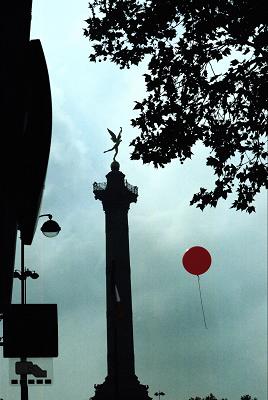
voyage-du-ballon-rougeA vivid example is Hou Hsiao-Hsien’s Flight of the Red Balloon which I reviewed in my last post.  Who would want to sit in a theatre to watch a balloon slowly drifting above the urbanscape, other than those who enjoy the grace of unhurried moments, those who consciously seek for poetics in the mundane, and those who take time to ponder the meaning conveyed by the filmmaker.

Slow blogging and the long take, two powerful ways to glean the indelible essence of life.

*****

Flight of the Red Balloon (2007, France, DVD)

flight-of-the-red-balloon

In celebration of its 20th anniversary, the Musée d’Orsay in Paris has commissioned four notable directors to create a series of commemorative films. One of them is Olivier Assayas with his Summer Hours (l’Heure d’été) which I have reviewed.  Another is the highly acclaimed Taiwanese auteur Hou Hsiao-hsien. Flight of the Red Balloon is a unique piece of film art gently crafted by Hou in homage to Albert Lamorisee’s Oscar winning short Le Ballon Rouge (1956). Hou has long been garnering awards in international film festivals throughout Europe and Asia since the 1980’s, albeit relatively unknown in North America. Flight of the Red Balloon is his first French language film.

The little boy in this 2007 rendition is Simon (Simon Iteanu), a child growing up in the hustle and bustle of Paris. With an absentee father somewhere in Montreal pursuing his writing, and a frantically busy mother Suzanne (Juliette Binoche), Simon is alone in an adult world. Overloaded with her work as a voice-over artist in a puppet production plus other personal matters, Suzanne hires Song (Fang Song), a film student from Beijing, to look after Simon for her.

Suzanne is the embodiment of urban frenzy. As a single mother, she has to shuttle between home and work, deal with the eviction of a bad tenant in her lower apartment, confront her non-committal husband on the phone to Montreal, and connect with her daughter in Brussel, all in a day’s work. Simon is most perplexed.  “Why are you so busy, Mama?”, he asks.

song-and-simon

Song, on the other hand, offers the tranquility that is needed to balance life in the midst of chaos. As a film student, she uses her hand-held camera to record Simon’s activities, and by her quiet demeanor and calm observing, she reflects pleasure in the mundane, everyday trivialities called life. This is reality show without sensationalism.  Hou has ingeniously conveyed his perspective of realism with artistic overtone. No doubt, there is a lack of plot, suspense, or climax, but there is character contrasts, cinematic offerings in sights and sounds, and realistic, natural performance. Juliette Binoche has once again assured me why she is one of my favorite actresses. And no, you are not watching paint dry, you are watching life unplugged.

The red balloon forms the focal point of Hou’s signature long take. The almost God-like omnipresence hovering over buildings in the Paris skyline is a joyful symbol of childhood. Its silent drifting is as elusive as the fleeting memories of happiness. Even little Simon achingly remembers the pleasant days he had shared with his much older sister, who is now living in Brussel. We are all trying to catch and hold on to fond memories and meaningful relationships. Yet as the busyness of urban living numb our senses, we ignore and shove away what we think is a hindrance to our time, just like the people rushing out of the subway station, shoving away the red balloon. Only a child would try to catch and befriend it.

Complementing the cinematic artistry is the equally mesmerizing piano music, meditative, serene and restoring, setting the mood and the preamble of the film.  Other musical numbers are equally soulful. Click here for the official IFC site where you can have a taste of the sights and sounds of the film.

felix-vallotton-le-ballon-1899I particularly enjoy the ending. As Simon goes on a school trip to the art gallery of the Musée d’Orsay, the children gather on the floor to talk about Félix Vallotton’s 1899 painting Le Ballon, he leans back, slightly removes himself from his school mates, and lays on his back. As he looks up to the glass canopy of the museum ceiling, he sees it again, the red balloon, watching over him, removed yet engaged, far away, yet ever so near.

~ ~ ~ Ripples


Mamma Mia! (2008) Movie Reivew

If beach reads is to superficial page-turners, then summer movies is to mindless, senseless, jovial entertainment.  If you allow yourself to devour less than literature under the summer sun, you can have your fill by indulging in Mamma Mia!  Why not, what other times of the year can we immerse ourselves in superficiality, if not in the name of summer fun.

Like the recent re-emergence of past heroes such as Indiana Jones, Rocky Balboa, and the like, I suspect making Mamma Mia! is the mid-life fix for its actors and actresses.  And for stars like Meryl Streep, where else can you, as a 59 year-old, sing and dance like a rock diva, jump up and down on your mattress like it’s a trampoline, dance to you heart’s content on a Greek Island with the whole village backing you, and make a splash, literally, to end a wild number.  Looks like Streep has the time of her life making this movie.  What more, she’s got Pierce Brosnan, Colin Firth, and Stellan Skarsgard swinging and jiving with her.

On the eve of her daughter’s wedding, Donna (Streep) finds herself faced with three of her past lovers who have shown up upon receiving invitation from the bride to be, Sophie (Amanda Seyfried).  Before getting married to her sweetheart Sky (Dominic Cooper), Sophie feels the urgency to find her real father and have him walk her down the isle. Director Phyllida Lloyd did a passable job churning out a simplistic but fun-filled movie adaptation of her Tony Award winning musical.  What captures the audience is not so much the story but the popular songs written by ABBA’s Benny Andersson and Bjorn Ulvaeus.  Titles like “Mamma Mia”, “Take A Chance On Me”, “Dancing Queen”, “Knowing Me, Knowing You”, “The Winner Takes It All”, “SOS”, and “I Have A Dream”… supply the bulk of the movie goers their mid-life fix.

So who cares if it’s a silly, senseless, mindless escape.  At least, it works… well, more or less.  As I sat in the packed theatre, where families had to sit separately to find seats, where teenage boys came with their mothers, where I heard middle-age men laughing out loud, and where I caught myself watching the movie with a smile on my face and tapping my toes to the tunes, it sure worked as a great escape.  Don’t expect in-depth characterization, complexity in plot structures, insightful dialogues, and please don’t mind the miscast (Bond in song?)… it’s summer after all.

Adapted from the successful musical showcasing the songs of the sensational Swedish group ABBA, Mamma Mia! the movie features authentic singing from the movie stars themselves.  Yes, there are LOL moments listening to them singing in their amateurish voices.  Don’t expect professional vocal performance… from Pierce Brosnan?  The fun is hearing him seriously belt out “SOS”, now that’s entertainment.  And all ye fans of Colin Firth, he has definitely smashed the Darcy image, if it still lingers in your Janenite mind.  Here you can see him play the guitar, sing, hang loose, and dance like a rock star.

There seems to be no middle ground in our summer movies this year:  Mamma Mia! is as light and giggly as The Dark Knight is dark and gloomy.  If you can overlook the subliminal implications seeping through Mamma Mia:  The celebration of promiscuity and the appeal of the stereotypical senseless female, then this movie adaptation is a sure escape.  But if you’re expecting more, I’m sure there are other offerings under the lazy summer sun.

Photo Source:  Seattle Times and Universal Pictures


~ ~ ½ Ripples

Update December 11:  Mamma Mia! has just been nominated for a Best Picture Award (Comedy or Musical) at the 2009 Golden Globes, and Meryl Streep nominated for the Best Actress (Comedy 0r Musical) category.

Sydney Pollack: The Passing of a Legend

Even if you’re not mad about movies, you’d probably still have seen some of Sydney Pollack’s works, either with him as a director, an actor, or a producer. 

A good movie is measured not in length, but in depth, and a career, in breadth.  But even if you’d like to use length to evaluate, Pollack’s five decades of contribution to the movie industry can certainly measure up.   

Consider these titles:

  • They Shoot Horses, Don’t They? (1969, director) 
  • The Way We Were (1973, director)
  • Three Days of the Condor (1975, director)
  • Absence of Malice (1981, director, producer)
  • The Firm (1993, director, producer)
  • Sabrina (1995, director, producer)
  • Sense and Sensibility (1995, producer)
  • The Talented Mr. Ripley (1999, executive producer)
  • Up At The Villa (2000, executive producer)
  • The Quiet American (2002, executive producer)
  • Cold Mountain (2003, producer)
  • The Interpreter (2005, actor, director, executive producer)
  • Sketches of Frank Gehry (2005, director)
  • Michael Clayton (2007, actor, producer)
  • Made of Honor (2008, actor)

Not to mention the numerous TV appearances, dating back to “Playhouse 90” (1959), “The Twilight Zone” (1960), “Alfred Hitchcock Presents” (1960), to “Will & Grace” and “The Sopranos”.

And with his directing, he had sent Jane Fonda, Susannah York, Paul Newman, Jessica Lange, Dustin Hoffman, Robert Redford, and Barbra Streisand to the Oscars.  

Yes, you might have noticed…I’ve left out two movies, and they’re classics:  Tootsie (1982) and Out of Africa (1985).  No…how can I have forgotten them? I’m just saving my favorites for last.  Pollack acted in and directed Tootsie.  He demonstrated that he was an incisive social critic who could tactfully embed his provocative commentary in an enjoyable comedy.

And Out of Africa…the movie that brought Pollack his Oscar win as Best Director, and won the Best Picture of 1985… I just want to say, it represents the epitome of a great love story, one that encompasses depth of character, poignancy, meaning and significance.  And the images, the music and cinematography…just astounding.  Why do we only have ‘Chick Flicks’ nowadays?  What happened to the art and depth of storytelling?

Pollack died of cancer in Los Angelas on May 26.  He was 73.  Here are some links covering the passing of Sydney Pollack:

BBC News with video clip

SFGate, San Francisco Chronicle

News.com.au

Yahoo News with ABC news clip

A Room With A View (2007 TV)

It will probably take another Merchant Ivory production to best an earlier version.  The 1985 movie A Room With A View has ingrained in my memory certain images of sight and sound that are difficult to replace, like Lucy opening the window and the camera slowly zooms in the beautiful view of Florence, highlighting the Il Duomo. Or the ending shot of the silhouettes of Lucy and George sitting by the same window… To me, A Room With A View is Kiri Te Kanawa singing Puccini’s aria “O mio babbino caro” (O My Beloved Father), achingly depicting the agony of unrequited love.  Further, it is also the humor that underlies the whole story as Forster has intended, as evidenced by the chapter (or scene) titles.

Nevertheless, I came to watch this newest BBC production with an open mind.  I was eager to see how a 21st Century, Andrew Davis rendition would present this E. M. Forster love story.  Every new adaptation of an old classic should offer us a new vision.  With such endeavors Andrew Davis has proven to be relatively successful in the past with his Austen and Dickens adaptations.  Here, I anticipate another window opening out to a fresh and different view.

For this adaptation, Davis writes the screenplay as Lucy’s flashback.  And, letting his imagination roam, he has Lucy coming back to the same Florentine room in The Bertolini, by herself, as a young widow.  So with this in mind, the overall sepia tone throughout fits well with the context, a memory re-lived, through the eyes of a lonely young woman who has lost her husband in the war.  The colorless overtone might well depict the sombre mood of a very different Lucy.

But there’s the rub. With this new “twist”, Davis has put himself in a difficult position in that, the present might be sombre and sad, but the past is most vibrant and radiant.  He’s got in his hands the difficult task of reconciling the two. What mood should he establish?  The sombre loss of the present or the fantastic journey of self-discovery and the ecstasy of a young heart heeding true love of the past?   umm…alright, let’s just go on with the show…

I have appreciated the fine cinematography and camerawork. The attraction of the Florentine art and architecture as well as Rome’s grandeur are caught with a sense of depth, not just picturesque shots, ironically, thanks to the lack of color.  They are frames from Lucy’s point of view, a well-protected, English young woman’s first encounter with greatness and history outside of her familiar, parochial life.

As for the actors, I have mixed feelings.  In the 1985 movie, Helena Bonham-Carter’s fresh persona of Lucy Honeychurch is sensitively matched by Julian Sand’s poised portrayal of George Emerson, an ideal image of young love.  Somehow, I don’t feel the chemistry here between Elaine Cassidy (When Did You Last See Your Father, 2007) and Rafe Spall.  The film is supported by some excellent acting though by veterans like Sophie Thompson (Emma, 1996) as Charlotte Bartlett, Mark Williams (Sense and Sensibility 2008 TV) as Mr. Beebe, Sinead Cusack as Miss Lavish, and Timothy Spall (Enchanted, 2007) as the elder Emerson.  Tim and Rafe Spall dispaly an authentic father son relationship on screen, naturally.

Timothy and Rafe Spall

A weak link I feel is Laurence Fox as Cecil Vyse.  No, I’m not trying to compare him with Daniel Day Lewis’s performance, which is inimitable.  But I truly feel it’s a miscast here.  Fox as a chap who is no good for anything but books, one who is so physically inapt to avoid a game of tennis?  Not very convincing.  What we have in this TV version is more like an eerie and chain-smoking Wickham or Willoughby.  Speaking of which, the smoke screen connecting to his almost every appearance may well be intentional, visually depicting how marred and distorted Cecil is in his view of himself and of others, particularly, Lucy.

Indeed, as the title well conveys, it is the metaphor of seeing that is the key notion throughout the TV adaptation.  In order to impress into our mind, the director has us see lots of scenes by the window. But of course, it’s not so much of looking out but looking in that is crucial here.  The whole story is built on Lucy’s seeing clearly what is in her heart, and that the one who has drawn her out of her own self-deception is the one who can offer her ultimate bliss, and that is George Emerson.  It is not just about Cecil turning down a tennis match, but it is the last straw, the pivotal turning point where Lucy realizes how egotistic Cecil  is. Lucy to him is but an object of art and music, but not as a woman, definitely not as a lover.  Forster describes it most strikingly, “The scales fell from Lucy’s eyes.”  A Biblical allusion no less than an epiphany.

In this case of course, by following her heart, Lucy is making the moral choice of defying the long tradition of the English class system, smashing the inequalities underneath the civility, and unmasking the snobbishness she has been raised to aspire to.  In her new voice, as Cecil has noticed, Lucy has announced a new-found insight.  As an admirer of Jane Austen along with his fellow Bloomsbury writer Virginia Woolf, Forster might have written lines that Elizabeth Bennet could have uttered, lines like:

I won’t be protected.  I will choose for myself what is ladylike and right.  To shield me is an insult. Can’t I be trusted to face the truth but I must get it second-hand through you?

Or,

If a girl breaks off her engagement, every one says: ‘Oh, she had someone else in her mind;’ … It’s disgusting, brutal!  As if a girl can’t break it off for the sake of freedom.

Unfortunately, these lines find no place in the film.

Forster is not afraid to let us see a very muddled Lucy, being confronted by her own feelings and passions that are contrary to her up-bringing, loving someone from a lower social status.  The open view of Italy has offered her a wider spectrum to what she is accustomed to seeing. Here lies the muddled complexity of characterization…For often in life, we are walking confusion, unsure of our feelings, insecure about our actions, isn’t such muddledness the very commonality of our being human?

But thanks to her humility, Lucy comes to realize what is in her heart, and who she wants to be.  In her recanting of her engagement to Cecil, she admits to be less educated, not as well-versed in the arts and music as Cecil.  Maybe because of that, she is more flexible to explore and to associate with those allegedly seen as socially lower than herself.  Here lies the paradox, It takes the uneducated eye to find understanding. Cecil is an intellectual, expert in things but not people, his highly educated mind has done nothing for him but left him in a room with no view.

Zadie Smith in her brilliant 2003 Orange Word Lecture entitled “Love, Actually”, discussed the writing of E. M. Forster and Jane Austen. Regarding Lucy’s gaining insight, Smith observed incisively:

It is not by knowing more that Lucy comes to understand, but by knowing considerably less.

As for Davis’ new “twist” at the end … I think that has altered the whole story from a light-hearted piece of social satire and endearing love story to a sombre drama with an awkward ending.  And for the last scene, Lucy going on a picnic with the cab-driver, and their final gesture… I think Davis has gone too far with his gratuitous imagination.  If that is the new vision he is offering us,  I’d rather stick with the old view.

~ ~  Ripples

*******

Photo Source of window with a view: StudentsVille

3:10 to Yuma (2007)

How many movies have inspired you to read the original book or story right after you’ve watched it? You might think of films like The Kite Runner, Atonement, or Away From Her. But a cowboy flick?

Yes, it sure did for me. And while I’m still looking for Elmore Leonard’s book Three-Ten to Yuma and other stories to read his short story, the source material for this film, I can’t wait to write the movie review. It’s also timely because of the recent release of the DVD.

This is one film that should have received a lot more attention at the Oscars. It got two nominations, one in Original Score, the other in Sound. Well it did get a nod from the Screen Actors Guild for an Outstanding Performance by a Cast in a Motion Picture nomination. It’s also a nominee for Best Picture and Best Supporting Actor (Ben Foster) Satellite Awards.  But if it’s being touted as the best Western since Unforgiven, then why aren’t there any more commotion? Anyway, I’m here to stir some ripples.

This is a modern remake of the highly acclaimed 1957 movie with Glenn Ford. I missed that one. This new version sees Russell Crowe, Christian Bale, Ben Foster and Peter Fonda join hands to create an action movie with a heart and mind. In a way, it’s one typical western, with gunslinging outlaws, headed by the notorious Ben Wade (Russell Crowe), aided by his despicable right-hand man Charlie Prince (Ben Foster), a defenceless cattleman (Christian Bale) and his family, and a few lawmen pathetically trying to enforce some sort of law and order.

I’m captivated by the riveting sequences and twists of the plot leading to the engrossing climax at the end. Anything typical is only a backdrop for the ultimate moral dilemma it sets up for its main characters. Basically it’s a duel of will and conscience for Crowe and Bale. 15 year-old Logan Lerman is right on a par with these two veteran actors.

The movie surprises me with the intense and deep depiction of psychological battles, internal conflicts, and moral choices one has to make in the face of life and death. Its fast action scenes, effective camera works and great acting from the whole cast mask the deeper issues the story is challenging us to ponder: What makes a man? What is the most important legacy a father can leave to a son? I say mask because you think you’re just watching, but actually you’re thinking. How we need this kind of movies these days. The poignant ending is what makes the film beautiful and rewarding.

From Jane Austen to Elmore Leonard…it’s all about life.

~ ~ ~ Ripples

Austen Regrets Becoming Jane?

After watching last night’s Masterpiece Theatre’s “Miss Austen Regrets”, the fourth installment of The Complete Jane Austen, I feel that something is missing in the title:  a question mark. It should be “Miss Austen Regrets?”  Making it like a statement as it is, the movie rests on the presumption that Jane indeed has regrets before her untimely death at age 41. What would she have regretted?

Would Jane have regretted not marrying for money?  Would she have regretted not trading for a life of comfort in a loveless marriage as Mrs. Bigg-Wither?  Would she have regretted not being a vicar’s wife living with Rev. Bridges and not seeing herself strive to become the writer that she is now? Would Elizabeth Bennet have married Mr. Darcy if he had not gained her total respect and requited love, even though she could have been Mistress of beautiful Pemberley?  Fanny Knight would have regretted not getting married for marriage’s sake, as Jane had so incisively seen through her, but Jane herself?

While the movie Becoming Jane is a fantasy, where the imagination takes flight and the director can have a free hand, more or less, to bring to the screen a creative narrative of ‘what if’,  “Miss Austen Regrets”, on the other hand, is supposed to be a biopic based on facts, from Jane’s correspondences with her niece Fanny.  It is to present an interpretation of Jane’s unmarried predicament derived from what she says in these documents. I have not read these letters. For those who have, is the movie an accurate portrayal of Jane’s internal world?

Even towards the end of the movie, and her life, suffering illness and facing her mother’s scornful accusation, Jane adamantly replies she wouldn’t have sold her soul for wealth. What she has gained she succinctly answered Cassandra in one word, “Freedom”. If she has had any regrets, it would be a life too short to continue the little success she has achieved as a writer, of not earning enough money to support her mother and sister with her writing. In summing up, she feels she has walked the path that God has intended for her.

The title and premise of the film has painted the work with a dark and somber overtone, and Gillian Anderson’s introduction looks like a ghastly announcement of death toll. But the funny thing is: I totally enjoyed it last night!  I was drawn to the movie’s engrossing scenes and intelligent dialogues, its beautiful cinematography and capricious camera work, the fast-paced story and the excellent editing embellished with a powerful score.

Olivia Williams and Imogen Poots as Aunt Jane and niece Fanny make an interesting pair, great contrast in character, and aptly playing out the embedded irony: the idealistic, unmarried Aunt giving practical advice on courtship to her young niece. The blurring of sarcasm and realism also makes the script ever more lively and intriguing.  There may be a miscast in Cassandra, depicting her more like a mother than a sister two years older, but overall the cast is effective in telling the story with depth.

All in all, the movie has succeeded in portraying the complexity of characters and choices Jane has encountered in her short life. It may have come to a different conclusion as some viewers would like to see, but it has presented an aesthetically pleasing and enjoyable work.

And for me, Jane has chosen the road less travelled, and that has made all the difference…


~ ~ ~ Ripples

********

For a comprehensive review of “Miss Austen Regrets” written by Laurel Ann of Austenprose, go to PBS site “Remotely Connected”.

Ms. Place has also posted an interesting review, with lots of pics from the movie, at Jane Austen’s World.

The Diving Bell And The Butterfly (2007)

DivingBellAndTheButterfly

Update Feb. 23: Julian Schnabel just won the Best Director Trophy and Janusz Kaminski the Best Cinematographer at the Independent Spirit Awards in Santa Monica today.

Update Feb. 11: Ronald Harwood just won the Best Adapted Screenplay at the BAFTA (British Academy for Film and Television Arts) Awards in London last night.

Director Julian Schnabel is an established New York artist/painter. Adhering to the ‘neo-expressionist’ style, his work has been exhibited at galleries around the world.  In The Diving Bell And The Butterfly,  Schnabel has turned into a master of realism as he vividly captures the traumatic experience of Jean-Dominique Bauby, not with a paintbrush, but with the potent use of the camera.

Jean-Do Bauby was the Editor-In-Chief of Elle magazine in France. At the age of 43 he suffered a stroke. His whole body was paralyzed except his left eye. He became a sufferer of a rare condition of “locked-in syndrome”: while he was able to comprehend what others were saying to him, he could not communicate with them. As if trapped inside a diving bell deep in the ocean tethered to life by a single chord, he was encased in his own body, completely isolated from the outside world.

With the help of his speech therapist Henriette in the hospital, Bauby learned to use what was left in his ability: the blinking of his left eye. With this minimal movement, he opened up a portal of his inner world. By painstakingly blinking to select the letters of the alphabet, Bauby was able to dictate to his therapist his memoir, completed a few days before his death. This film is the visualization of the book.  To read my review and excerpts of the book, click here.

Imagine watching a movie with blurry camera work, frames cutting off the full head of people, and sometimes camera angle so close-up to a face you feel suffocated, …blurry shots, indefinitive dialogues…This is the realism of Julian Schnabel, the film director. He wants the viewer to look out from the left eye of Jean-Do Bauby.

Fortunately viewers are spared lengthy display of such realism, because in the memory of Bauby’s past experiences and in his imagination, we are able to see sharply focused and beautiful scenes… reality may be blurry and shaky, memories and dreams are clear as crystal.

From the artist eye of Julian Schnabel, to the blinking eye movement of Jean-Do Bauby, the film captures the poignant struggle of a human striving to live every single minute of everyday. It depicts the power of the mind and spirit, the humor that sustains, the painful yearning for love and intimacy, the daily human condition magnified a thousand times due to debilitation, the whole physical being tethered on the blinking of an eye and the inner searching of a soul alive.

Mathieu Amalric has a demanding role to play as the paralyzed Bauby, for his whole acting is confined to his one left eye. I must say he has done a remarkably engrossing and convincing feat.

Marie-Josée Croze (Best Actress at Cannes for The Barbarian Invasions, 2003), by taking up the role as therapist Henriette Durand, has the equally demanding task of looking into the camera and reciting the French alphabets numerous times, and each time, with passion, pathos, and persistence, each time transmitting a new beginning, a new hope.

Max von Sydow (with film credits too numerous to mention), the veteran actor playing the role of Bauby’s 92 year-old father, equally shut-in, yet ever alive in spirit, the only character seeping sentiments, however restrained. It is exactly because of such restraints that pathos gets through.

And Emmanuelle Seigner, the ex-wife of Bauby, the mother of his three children, the keeper of memory, creator of new experiences, and the butterfly for the soul trapped in the diving bell. A marvellous character.

Very poignant acting, a very dynamic and powerful movie, and, despite its subject matter, an uplifting film for every living, breathing, and feeling soul.

The Diving Bell and the Butterfly is nominated for 4 Oscars: Best Cinematography, Best Directing, Best Editing, and Best Adapted Screenplay. For the full list of Oscar Nominees, click here.

~ ~ ~ ½ Ripples

Canadian Content at the Oscars

Ellen Page Ellen Page

sarah-polley-on-the-set-of-away-from-her

Sarah Polley


Update Feb. 25: Diablo Cody won the Best Original Screenplay at the Oscars last night. To read my Oscar Results post, click here.

Update Feb. 23: Juno just won the Best Feature trophy at the Independent Spirit Awards in Santa Monica today. Ellen Page won the Best Actress Award and Diablo Cody won the Best First Screenplay Award. To read my Independent Spirit Awards post, click here.

I’m glad to see some significant Canadian representation in this year’s Oscars Nominations:

  • Toronto’s Sarah Polley, the now 29 year-old director of Away From Her, getting the nod for Best Adapted Screenplay.
  • Ellen Page, the 20 year-old Juno star from Halifax, Nova Scotia, for Best Actress.
  • Jason Reitman, Montreal-born director of Juno for Best Director.
  • The film Juno, directed by a Canadian, starring two young Canadians Ellen Page and Michael Cera, and filmed in B.C. getting a Best Motion Picture nomination. (Even though it isn’t classified as a Canadian film due to its American producer Fox Searchlight)
  • Of course, others like directors David Cronenberg (Eastern Promises) and Paul Haggis (In The Valley of Elah) both have Canadian roots.

To read my review of Juno and Away From Her, just click on the movie title. (Update: To read my review on Ellen Page’s new movie Smart People ( 2008 ), click on the title.)

Also, while some call 2007 “Oscar’s Year of the Man”, it is all the more exhilarating to see the two young Canadian females Ellen Page and Sarah Polley acknowledged in a very male-dominated industry in the U.S.

Who cares what country they’re from, you may ask. Well, I do, because I once had to correct someone who strongly believed that Michael Ondaatje, the writer of The English Patient (1996), was an American author. And for that matter, just for clarification, Sarah Polley’s screenplay of Away from Her is adapted from Canadian writer Alice Munro’s short story “The Bear Came Over The Mountain”. And, watch for another Canadian literary icon Margaret Laurence’s novel now being turned into film, The Stone Angel (2007), also with Ellen Page.

Just a little clarification, Canada is more than just Margaret Atwood.