Snow Cake: Autism and Beyond

Snow Cake

Snow Cake (2006)–For those who wait for a movie to come out on DVD before seeing it, here’s a recommendation. Snow Cake came out a few months ago on DVD but is still on the current release shelf. It opened the 2006 Berlin International Film Festival with a gala screening, and was shown at numerous film festivals last year including the TIFF.

Seems like a long wait, but well worth it. And for those who have already seen it in theatres, the DVD release could well be the second wind. Considering all the special features of interviews with director and cast, as well as the quality deleted scenes, you might want to keep this one.

Filmed in Wawa, northern Ontario, the Canadian and British collaboration is one of those gems that can be found quite readily in the indy batch. Welsh director Marc Evans has won several European film awards. On top of his sensitive handling of the story, the film benefits greatly from an amazing cast.

Alan Rickman is Alex Hughes. While driving through Ontario to Winnepeg,  he picked up a young hitchiker, Vivienne (Emily Hampshire, who was nominated for a Genie for this role).  During the trip they got into an accident and the girl was tragically killed.  Propelled by guilt and responsibility, Alex went to look for Vivienne’s mother Linda, played by Sigourney Weaver, in the town of Wawa.  Upon finding her, it did not take long for him to notice that she had received the news with a very different light. Linda was autistic. From his short stay with her, coming to invovle in Linda’s life and getting to know her mysterious neighbour Maggie (Carrie-Anne Moss), Alex drove on to his destination a few days later with a new perspective on himself and his ordeal.

Even though short-lived, Vivienne’s character is memorable. Her enthusiasm for life and acceptacne of those around her underscores the film.  The sound of Broken Social Scene adds a touch of lively, contemporary flare, like a tribute to the affable character of Vivienne. In contrast, Alan Rickman’s role as Alex is painfully affective. At times it is heartwrenching to watch as he deals with his internal torments as the story reveals itself.

Sigourney Weaver had spent a whole year researching on autism to ready herself for the role of Linda.  And for most parts, she has delivered a convincing performance. But it is the screenwriter Angela Pell that has so poignantly depicted the limitations but also the different views and insights an autistic person can offer those who are considered ‘normal’. Pell has mingled her characters, autistic or not, into a pool of humanity, revealing the indistinguishable, common thread joining them all.  Her script is at times very funny, and at times permeates with pathos. Through the words of Linda, the punchline is delivered ever so aptly at the end. Angela Pell has indeed written from her heart and her own experience.

She is mother to a nine-year-old autistic son.

~~~3 Ripples

Vision not Illustration

Read a post entitled “It’s All About the Story” on the Austenblog relating the controversial remarks the Welsh filmmaker Peter Greenaway made recently in an international film festival.  He criticised modern blockbusters like the Harry Potter and Lord of the Rings series, dismissing them as “not films but illustrated books”.  As for all the Austen movies sprouting up in recent years, Greenaway said:

Cinema is predicated on the 19th-century novel.  We’re still  illustrating Jane Austen novels—there are 41 films of Jane Austen   novels in the world.  What a waste of time.”

This is my response.  I recognize that not all attempts of turning books into films are successful, many far from being effective.  However, a good movie should be the portrayal of a vision, not mere illustration or graphic representation of the written words.  As I have commented in that post, let’s just say a film is the visualization of the novel, not mere illustration.

And there is a major difference between vision and illustration: the former is seeing through an interpretive lens, rather than simply transferring images from one medium to another like the latter.

That’s why we may like a certain adaptation over another of the same Austen novel, and that’s why there can be more than one movie on the same story… Just as Bach had created Theme and Variations, we can have Story and Adaptations. That’s the reason why we still go to the concert hall and listen to different masters playing the same pieces of music, infusing into their performance their own unique persona and interpretation.  As an art-house filmmaker, Mr. Greenaway should have grasped this very fundamental notion.

As for future endeavors to turn Austen novels into films, I say, “All the best!”

Field of Dreams: Baseball for the uninitiated?

Saw Field of Dreams (1989) on AMC last night, and this time, it hit me harder.  Watching the movie again has stirred up some ripples, deeply and belatedly.  To say that Field of Dreams is about baseball is like saying Cinderella Man is about boxing.  Movies like these speak to us not because we are necessarily sport enthusiasts, baseball or boxing fans, but that we, every one of us, belong to a family, or at least in memory, and that we are a part of the human race.

By heeding a voice telling him to build a baseball field in his cornfield, Ray Kinsella unknowingly began a journey of reconciliation.  Using baseball as a springboard, and through the characters and the ingenious twists in the story, the movie leads its viewers, who are as unknowing as Ray, to taste the almost mythical reality of dreams fulfilled, past yearnings realized, and lost relationships redeemed.  The film satisfies by simply portraying the very possibilities that these miracles can happen.

It is because of these universal themes that the film can reach far beyond nationalities and borders.  In fact, the original story is not written by an American.  The movie is based on the book Shoeless Joe, which is written by a Canadian author, W. P. Kinsella.  Born in Edmonton, Alberta, Kinsella used to teach English at the University of Calgary.  (I still remember listening and taping his interview on a CBC radio program…oh, those were the days.)  Among the numerous awards and nominations the movie has garnered including an Oscar Best Picture nomination, it won the 1991 “Best Foreign Film” category in the Awards of the Japanese Academy.

Critics who love to associate Kevin Costner only with Waterworld should at least remember that, he is the man who brought us such American modern classics as Field of Dreams and Dances with Wolves….all other failings are forgiven, easily.

~~~3 Ripples

Becoming Jane (2007)

I’ve delayed watching this movie till now.  I wanted to avoid all that hype about Jane Austen.  Even as a JA fan, I’ve hesitated jumping on the Austen bandwagon of what I suspect to be mere commercialism.  Well, after a few months waiting for the dust to settle, I went into a second-run movie theatre this crisp October day with very little expectation, and was pleasantly surprised…I thoroughly enjoyed the movie!

Becoming Jane

As I mentioned in my reply to a visitor who had left a comment on my WWAW post, like many of life’s simple pleasures, a movie does not have to be ‘deep’ to be enjoyable.  However, simplicity does not mean superficiality.  Becoming Jane is heart-felt story-telling.  It has many witty renderings especially carved out for Austen readers, like the mirror images reminiscent of Pride and Prejudice.  The first part of the movie moves along breezily with its humour; but it is the sombreness in the latter part that makes the story so poignant.

Based on the recorded short-lived courtship between Austen and a young lawyer named Tom Lefroy, the backdrop of the movie has its historical accuracy:  the Austen family, Jane’s close relationship with her sister Cassandra, the inequitable social environment wherein Jane as a female, had to write anonymously, and the torment that one had to face having to choose between marrying to survive and marrying for love, and suffer the social disgrace and financial ruins resulting from it.

Other than the basic background, the movie never intends to be a serious, historically grounded account.  It is pure fiction, and as one of the contemporaries of Jane Austen the Gothic writer Ann Radcliffe says in the movie,  it is the imagination, and not real-life experience, that gives rise to story-telling.  From this spirit evolves the beautiful story of Becoming Jane, purely imaginary, idealistic, noble, and yet painfully poignant.  The movie leads us ever so subtly to realize the bitter taste of love over the sweetness of romance.

The simple script will not work if not for the great acting, or understated acting rather, of all its cast members.  Anne Hathaway has once again robbed the Brits of a coveted role, yes, an American playing one of the best-loved British authors (The other one I’m thinking of is Renée Zellweger playing Bridget Jones). James McAvoy is comparable in his charm as Tom Lefroy.  The supporting roles are all played by excellent veterans like Maggie Smith, Julie Walters, Ian Richardson, and James Cromwell.  Anna Maxwell Martin as Cassandra provides immeasurable support to Hathaway.  I was deeply affected by her lead role as Esther Summerson in the BBC production of Bleak House (2005).  Here once again she has demonstrated that her acting is superb.

I have enjoyed the cinematography, the costume, the music, and yes, even the disheartened twist at the end.  I came out of the movie theatre contented.   So what if the story is pure speculation.  Sometimes it takes the imaginary to lead us to look more directly at love, life, and the choices we make.   Maybe that’s why we are always drawn to stories, fiction … and movies.

~~~3 Ripples

Hollywood loves Astoria


        Astoria, Oregon (1904)


After a nauseating night on rough sea sailing from Vancouver, I was relieved to plant my feet on solid ground the next day in historic Astoria, the oldest city in Oregon.  Lewis and Clark explored this area by the mouth of the Columbia River in 1805, and were impressed by the pristine river valley.  Six years later Fort Astoria was set up by the first American millionaire John Jacob Astor.  Since then, Astoria has been known for its rich fishery resources.  By the late 1800’s, it was basking in the fame of the “salmon-canning capital of the world”.  Today, this town of 10,000 lures tourists from land and sea to its serene setting, unique antiques and arts and crafts stores, character Victorian homes and rolling hills.

So, what does Asotria has to do with movies?  Lots.  Just as its link to the history of the Pacific Northwest and the Lewis and Clark Expedition, Astoria has a long history with Hollywood.  In 1908, the first movie made in Oregon, The Fisherman’s Bride, was shot in Astoria.  Well, that may not ring a bell, but since then, other more well known productions have also selected Asotria as location for filming.  These include: 

The Great Race (1965), The Black Stallion (1978), The Goonies (1984), Kindergarten Cop (1990), Free Willy (1992) & Free Willy II (1994), Teenage Mutant Ninja Turtles III (1992), Ring II (2004), and most recently, Into the Wild (2007)…just to name a few.

But what really caught my attention was the concert that I missed.  During a week in July of this year, there was the Astoria Festival of Music, held in the town’s Liberty Theater.  One of the highlights was the virtuoso violinist Elizabeth Pitcairn, performing John Corigliano’s Red Violin Chaconne, and yes, playing on her 1720 Mendelssohn Stradivarius, the very instrument that inspired the 1999 Academy Award winning film The Red Violin.  

Indeed, lots are happening in this small, serene town of 10,000.        


WWJW: What Would Jane Write?

thejaneaustenbookclub2

The Jane Austen Book Club

Calgary International Film Festival 2007

Some time ago, I was using the phrase “intellectual chick lit” to describe the book Literacy and Longing in L.A. to a friend and was instantly retorted with: “Isn’t that an oxymoron?”  I had no reply.  Maybe to respond to the bad rap “chick lit” and “chick flicks” have been getting, a few writers have infused literary ingredients in their concoction in their attempt to create more intelligent work.  The Jane Austen Book Club falls into this short list.  The book written by Karen Joy Fowler (2002 Pen/Faulkner Award finalist) was turned into sceenplay by Robin Swicord (Screenplay, Memoirs of a Geisha, 2005) who made her directorial debut in the movie.  I had the chance to view it on the first day of the 2007 Calgary International Film Festival.

The book club is established with the original intent of consoling Sylvia, who is recently divorced from her husband Daniel.  It is a plan conceived by her good friend Jocelyn, a never-been-married dog breeder.  Following the theme of Austen’s Emma, Jocelyn has brought along the only male, Grigg, to the club, intended for her friend Sylvia.  What follows is the expected outcomes, Grigg falls for Jocelyn instead of Sylvia, who later reconciles with her estranged husband, while the other members of the group also are either hooked up with new found love or have their relationships mended.  Very neat, very happy, very clean ending.  Is this what Jane would have written if she were around today?

TJABC reminds me of the British movie Love Actually, which was released during the Christmas season in 2003.  Dealing with the love affairs of eight different couples in the midst of the hustle and bustle of the season has got to be a swift and jolly feat.  The movie remains a montage of famous British faces delivering superficial Christmas cheers under the banner of love.  TJABC has just slightly fewer characters, with six members in the group responsible for leading discussion on one of the six Austen novels.  Despite the juxtaposition and parallels of Austenian motifs and plots, I feel that both the movie and the book circumvent the periphery of contemporary life and relationships without offering much depth and insights as Austen’s own work. But of course, who is comparing Fowler with Austen?  Having said that, I must say I’ve enjoyed the acting of some of the characters, especially Prudie (Emily Blunt, The Devil Wears Prada, 2006), and Hugh Dancy (who would have thought he’s a Brit?)

Coming back to my original question:  What would Jane Austen write in this 21st century?  Would she fall for “chick lit” that can be turned into romantic comedies, for good cheers or box office successes?  Would Jane Austen be a mere romance writer, or “chick flicks” producer? Carol Shield noted that Austen’s heroines “exercise real power”, given their disadvantaged social positions.  Martin Amis stated “her fiction effortlessly renews itself in every generation.”  Virginia Woolf said about Austen’s writing: “That was how Shakespeare wrote.” Harold Bloom commented on the somberness of her work.  Thornton Wilder claimed that Austen’s “art is so consummate that the secret is hidden.”   Fay Weldon summed it up well:  “I also think … that the reason no one married her was … It was just all too much.  Something truly frightening rumbled there beneath the bubbling mirth:  something capable of taking the world by its heels, and shaking it.”  Thanks to Fowler for including such commentaries at the back of her book.

Austen is a sharp and incisive social commentator of her time, a progressive thinker holding a sure sense of morality, and a brilliant observer of human nature and relationships.  Her wisdom is well crafted in the disguise of humor and satire, her vision covered under seemingly simple, idealistic fervor.   Her critique of the manner and injustice of society, if transferred into modern day context, might not appeal as “chick” or as “romantic” as many of us would want to see, or can accept.

What would Jane write?  Definitely not “chick lit”.

~~1/2 Ripples for both book and movie

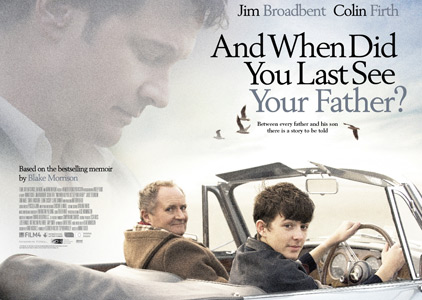
When Did You Last See Your Father?

when-did-you-last-see-your-father

I have the chance to soak in the frenzy of the Toronto International Film Festival (TIFF) these past few days in the big TO. The largest film fest in the world, this year TIFF offers over 300 films from 60 countries from September 6 to 15, a delectable smorgasbord for movie lovers . On Saturday, Sept. 8th at 7:00 pm, while the enthusiastic crowd gathered along the barricades outside the Elgin Theatre on Yonge Street, hoping to get a glimpse of Brad Pitt on the red carpet, I lined up patiently with a less boisterous group of ticket holders outside the same building an hour early to get into the Winter Garden Theatre for the premiere screening of When Did You Last See Your Father?

Based on the award-winning and highly acclaimed memoir written by British author Blake Morrison, WDYLSYF is a fine piece of artistry crafted by some of today’s top British talents. Director Anand Tucker’s work includes the Oscar nominated and BAFTA winning Hilary and Jackie (1998), and co-producing Girl With a Pearl Earring (2003), another Oscar nominee and numerous European film award winner. The stellar cast of WDYLSYF is led by Jim Broadbent and Colin Firth, playing father Arthur and son Blake Morrison, with strong supporting roles from Juliet Stevenson as the mother and newcomer Matthew Beard, who plays the teenage Blake.

When Did You Last See Your Father

The words “A True Story” in the opening credits prepared the audience for something real and meaningful. We were led to explore a multi-layered and poignant story about a fragile father-son relationship that is brought to the forefront at the father’s imminent death from cancer. Jim Broadbrent could well deserve an acting nomination as the ailing father, headstrong, overbearing, and ever the victor in whatever circumstances, even in the face of terminal illness. Colin Firth aptly portrays the middle-aged Blake, already an acclaimed writer and poet, yet still waiting to hear from his father the two precious words he has longed for all his life: “well done”.

Intense but not draining, the director effectively sprinkles enough comic relief at the right moments to move the story along with poignancy but steers the viewers away from sentimentality. I always think that Colin Firth excels in subtle, understated acting, his every gaze speaks volume. Here again he has shown once more that he is a master of this craft.

However, I must admit that Matthew Beard, a first time film actor who plays the teenage Blake shines with his natural and superb performance, bringing out the love/hate sentiments he has harboured towards his father from the various situations he has been pushed into, such as the reluctant camping trip, the impromptu driving lesson, the numerous embarrassment and even public humiliation he has suffered from his father’s brash and insensitive comments…but above all, from the burden he has to bear as a witness to the wrongs of his own parent.

The restrained acting by the stellar cast effectively conveys the pathos and conflicting family relationships as well as the ambivalence of a son trying to come to terms with resentment towards a callous, egotistic, and dying father. Firth’s subtle characterization of the adult Blake poignantly portrays the crux of his torments. It is a painful relief at the end of the movie when he realizes that sometimes one has to resolve anger and disappointment on one’s own, unilaterally, including the most difficult discipline, forgiveness and the letting go. If the victim has forgiven, should the witness keeps on holding grudges? There’s no simple answer, and the film has successfully dealt with such conflicts through the multi-layered characterization and the reflective shots through mirrors in many scenes.

Filmed mostly on location in beautiful Derbyshire, England, the movie’s inspiring cinematography works like a soothing balm, together with the light-hearted and nostalgic childhood scenes, the film is an enjoyable visual treat. Again, such is the real portrayal of the issues we face, natural beauty can sometimes offset the darker side of human nature. Humour and pathos can co-exist.

A bonus in going to film festival screening is the chance to hear the makers of the movie reflect on their work. The audience was pleasantly surprised to see the director Anand Tucker and actor Jim Broadbent come on stage to answer questions after the movie. Listening to them, I felt that I’d only discovered the outer layer of a very complex and pleasurable artifact that I wanted to see the movie all over again.

And so I did two days later.

~ ~ ~ Ripples

______________________


To read my review of the book And When Did You Last See Your Father? Click here.

Memorable Movie Quotes

CLICK HERE to an even more updated post: QUOTABLE QUOTES FROM DOWNTON ABBEY, dated March 23, 2012.

For an update of this post, a newer version on the theme of love, click here.  Again, you’re most welcome to contribute to the list there.

Many movie lovers are fond of collecting, mentally at least, memorable movie quotes.  They might watch a movie a few times, savor their favorite dialogues, might even memorize them and use them in their daily conversation.  For others, certain movie quotes ring so true in their depiction of life, love, loss or lust, that they’d treasure them as commentary of their own experiences, or maybe even adopt them as credo for their life.

What’s interesting is, as these words are quoted out of context, they can still conjure up images from the movies, or elicit the particular sentiments that we had when we were watching the film.  This is the power of story-telling when accompanied by visual images, edging in our minds meaningful thoughts and unforgettable sentiments.

I suppose every movie lover has his/her own favorite movie quotes.  Here are some just to tap into that subconscious, hidden repertoire of your movie quotient. First the easy ones, the more recognizable quotes.  Can you tell which movies they are from:

.
* We’ll always have Paris.

* If you build it, he will come.

* After all, tomorrow is another day.

* Love means never having to say you’re sorry.

* Life’s a box of chocolates…You never know what you’re gonna get.

Easy?  Now try these more obscure ones, but just as memorable nonetheless:

* You look stupid and rich…I’m smart and poor.

* I like you very much…just as you are.

* We read and write poetry because we are members of the human race.

* I gotta keep breathing, because tomorrow the sun will rise.  Who knows what the tide could bring?

* Pain is God’s megaphone to rouse a deaf world.

* My life is made up of units of time. Buying CDs – two units. Eating lunch – three units. Exercising – two units.  All in all, I  had a very full life.  It’s just that it didn’t mean anything.

Hey, I just thought it would be a good idea to hear from movie lovers what their personal favorite quotes are.  Let’s hear from you all. Send in your memorable movie quotes in the “Comment” section.  Let’s have a Memorable Movie Quotes Fair!

Stranger Than Fiction


“Stranger Than Fiction” (2006)–I always believe that the script is probably the most important element in a movie. If you’ve nothing to say, you’ve got nothing to show, and no story to tell. This may well be an oversimplification. However, watching Stranger Than Fiction, I felt my view confirmed.

The excellent writing by Zach Helm handles a serious subject with style and humor. Reminiscence of “The Truman Show”, “Stranger Than Fiction” is a fresh and classy treatment of the existential questions of free will and fate. Will Ferrell is Harold Crick, an IRS agent. He lives by himself, eats by himself, and his favorite word is ‘integer’. Every morning, he counts the same number of strokes as he brushes his teeth, ties his tie in exactly the same number of seconds, takes exactly the same number of steps to catch his bus. His daily routine runs like clockwork…and he thinks he is in control of the minutest item of his life.

His secure, mundane world is turned upside down one day as he finds out that his life is being narrated, written by someone else. He is in fact a character in a novel, and what’s most devastating is, the author (Emma Thompson) is planning his imminent death. Sunddenly faced with his own impending demise, Harold Crick curses his fate, yells at heaven and protests in vain. Poor Harold is certainly not ready to die, for he hasn’t even begun to live. With the help of a literature professor, aptly played by Dustin Hoffman, Harold tries to turn a tragedy into a comedy. He soon finds out that although he cannot change his own fate, he can change himself, and he can become a happier person if he chooses to be, despite his ominous fate. In the baker (Maggie Gyllenhaal) whom he audits, he discovers for the first time in his life, love. Little does he know that this new found sentiment is a powerful force that has altered his myopic view so much that in an act of altruistic bravery, he steps right in the path of death and stares fate in the eye.

The message of the movie and the subject matters of life and death, fate and free will can easily be perceived as didactic and preachy if not being handled properly, but “Stranger Than Fiction” has successfully dealt with these issues with light-hearted humor and intelligent dialogues and characterization. Overall, an entertaining work of fiction, or, is it a whimsical portrayal of real life? … Strange, they’re so similar.

~~~3 Ripples

Summer of Indulgence

In the July 23, 2007 issue of TIME magazine, an article surveyed several prominent writers as to what guilty pleasures they would indulge in if they were to follow their heart’s desire in their summer reading. Jane Smiley chose an erotica/sadist novel, Magaret Drabble would read Jules Verne’s 20,000 Leagues Under the Sea, Alexander McCall Smith selected Dick Francis, and Joyce Carol Oates opted for Mad Magazine.

Just wondering, what movies would they have chosen to watch, if Dick Francis and Jules Verne are considered guilty pleasure? As for me, watching old movies that I missed some time in my past, and there are a lot, became my summer indulgence. Guilty pleasure? Don’t think I need to feel guilty about them, however, they do represent a quirky and offbeat sort. Here they are, with my hindsight critique…now flashback to:

1986  Pretty in Pink


Why I missed out on preppy movies like this one, I haven’t a clue. But, it’s more than just nostalgic viewing them now. Why, because I’m discovering for the first time Andrew McCarthy, Molly Ringwald, and, yes, James Spader in his youthful days. The power of young love driven by hormonal surge and pure fantasy or infactuation could still be no match for societal norms and peer pressure. Rich boy, poor girl, two starcrossed lovers separated by a mere railway track, a demarkation of social inequality in wealth, opportunities, future…Oh, we’ve seen them before, in the classic Love Story, and the like. But it’s always a treat looking at young, fresh faces like McCarthy and Ringwald, and … Spader… who cares he looks like he’s been repeating his senior year in high school a few times. If it’s a miscast, it doesn’t bother me a bit, because watching Pretty in Pink is like licking a strawberry ice cream cone on a hot summer day, it’s indulgence enough.

1987  Less Than Zero


McCarthy and Spader reprised the next year to make this movie, but this time, Robert Downey Jr. stole the show. Less Than Zero probably is one of the classic drug addiction movies. The story takes place again, among the decadent world of rich, young Californian high school grads. McCarthy, a college freshman came home after his first term of college to find his buddy RDJ helplessly hooked on cocaine and deeply in debt. Together with his girlfriend Gertz, who has shifted her attention to RDJ since he left, McCarthy tried to rescue his friend from his pathetic downfall. This time, Spader acted more like his age, as a slick and manipulative drug dealer. Watching a young man self-destruct was not an enjoyable experience. The pleasure in watching this movie though is that one sees the pivotal performance of a superb actor hitting his stride and gaining momentum in his career. As one critic said, this movie put RDJ on the map. Compared to Maggie Cheung in Clean, which I reviewed some time ago, RDJ comes out a much stronger contender.

1996  2 Days in the Valley

This is what I call indulgence, three Spader movies in a row. This one is a much more interesting mix of characters. Watching it reminds me of “Crash” (2004) where a group of seemingly unattached characters would finally be strung together as the story unfolds, coming to a brilliant and climatic ending. But of course, 2DITV is not Crash, it does not convey a serious message like racism, it just…purely…entertains, pure summer fun. What do a mild-mannered hit man, a female Olympic skier, a snobbish art dealer, a cold blooded killer, a loving widow, a down-and-out movie director, and two vice cops have in common? They don’t, and this is exactly what the movie is saying, hauntingly. 48 hours in the San Fernando Valley, CA, could bring about a lot of changes in these lives. We cross paths with people who may have nothing to do with our lives every day, and yet as circumstances unfold, we are entangled into a web of human relations and coincidents. Our best bet is to take the right step, at least that we can have some control. The superb acting and the intricate plot make it a fun and wild ride. As the saying goes, this movie puts Charlize Theron on the map. Spader as a bespectacled, icy, heartless killer? Seeing is believing. Great summer viewing pleasure.

1997  The Ice Storm

I think this is probably my favorite Ang Lee movies, so far.  The Ice Storm, a story about the dysfunctional relationships within two families in 1973 suburban Conneticut, was Ang Lee’s attempt to prove his versatility after making the 19th Century Austen classic Sense and Sensibility. He has painted a sensitive and poignant portrait of suburban living, or anywhere living, of people struggling to deal with the ennui of superficial existence. Adults exchange spouses as a game, the young seek sexual experiences, or experiment with drugs. Like a fly hitting the window again and again as it frantically tries to escape, the characters in this movie spin deeper and deeper into a meaningless blackhole. That is, until the Ice Storm cometh. It takes the elements, something greater than themselves, to shake them up and have them face the futility of their actions, leading them to a stark awakening. Such is the redemptive power of the Ice Storm, a metaphor for divine intervention, marking the turning point in the lives of these characters. A great cast including Joan Allen, Kevin Kline, Sigourney Weaver, and Elijah Wood makes this film an enjoyable treat, despite the serious subject matter.

Curse of the Golden Flower

Curse of the Golden Flower (2006)–The story took place in 928 A.D., during the Tang Dynasty in China; the movie was produced in 2006, released in January, 2007. Over a thousand years have passed, and times sure have changed the art of storytelling. What Zhang Yimou has constructed is a postmodern fusion of literary classics and cinematic productions: King Lear, Hamlet, MacBeth, Caligula, The Lord of the Rings, and yes, even Braveheart, concocted in a Chinese imperial court setting. Those with the appetite for a smorgasboard will not be disappointed to find something that they like, but COTGF is no gourmet cuisine. Zhang has aptly depicted the decadence behind the facade of opulence and glamour with his trademark exaggerated colours in cinematography. Under the skin of gold and jade hides the rotten flesh of incest, treason, deceit, murder, and rebellion; but one begs to ask, so what’s the difference between this story and others throughout history, or even just movie history? Hailed as the most expensive movie ever produced in China, Zhang seemed to have answered with the massive visual effects of a thousand real life, spear wielding actors in armour (plus the additional help of computer-generated images I assume), swarming the palace gates as ants, the elaborate set designs, and the choreography of uniformity, from the female courtiers to the massive foot soldiers. One gets the feeling that the movie is a spectacle made for foreign markets, and with Zhang himself being the chief director of the opening and closing ceremonies of the 2008 Beijing Olympics, COTGF seems like a dry run for the programs. Nevertheless, kudos go to the actors whose intense performances have supported the storytelling, and newcomer singer-turned-actor Jay Chou has held his ground in front of veterans Gong and Chow. The ironic outcome though is that the intimate, authentic art of storytelling has been overshadowed by the sights and sounds of ostentatious movie-making.

~~1/2 Ripples