Let me jump on the bandwagon and join in the discussion of the latest Ang Lee (Crouching Tiger, Hidden Dragon, 2000; Brokeback Mountain, 2005) movie. Lust, Caution has garnered much praise and recently won the Golden Lion at the 64th Venice International Film Festival. Before my review, I’d like to offer some background here relating to the original short story on which the film is based, as well as its translation.
THE ORIGINAL
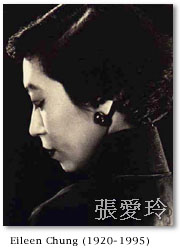 “Lust, Caution” is a short story written by Eileen Chang (Zhang Ailing), a writer born 1920 in Shanghai. Chang attended the University of Hong Kong from 1939 to 1941, majoring in Literature. As the Japanese invasion advanced to Hong Kong, Chang had to cut short her education there and return to the then Japanese occupied Shanghai in 1942, where she began her vigorous writing career. In a few short years she had gained popularity as a novelist, short story writer and essayist.
Eileen Chang had been compared to Eudora Welty and Katherine Mansfield, and was considered one of the few eligible contemporary Chinese writers as a candidate for the Nobel Prize for Literature. In 1952 she went back to Hong Kong and continued to publish, finally moving to the United States in 1955. A year later she married the scriptwriter Ferdinand Rehyer. After Rehyer’s death in 1967, Chang continued to be prolific as a writer and translator of her own works, many of which had been turned into screenplays. The more well known ones include Red Rose White Rose (1994), and Love in a Fallen City (1984), garnering numerous nominations and awards. Apart from writing, Chang had also taught at Radcliffe College and UC Berkeley. She lived reclusively in the latter part of her life and in 1995, died alone in her apartment in Los Angeles.
Chang’s style is crisp and explicit, her choice of words sharp and sensual, her subject matter contemporary. Considered progressive in her days, Chang boldly dealt with the dichotomies of eastern and western cultures, tradition and modernity, and inevitably, male and female power relations, love and betrayal. “Lust, Caution” the short story exemplifies her style and encompasses these subject matters.
In ‘Lust, Caution’, Chang has demonstrated that she is a master of story-telling. Her talent lies in her succinct and incisive descriptions, the economy of words. It is this feature that the 39-page short story is so compelling and memorable. The story moves swiftly, effectively spilling the thrill and suspense, and bringing its reader to an intense and hard-hitting climax and ending.
Following the succinct style of Eileen Chang, here’s a synopsis of the story. Wang Chia-chih, a university student, was recruited by a group of amateur student resistance to play a role in the assassination of Mr. Yee, the head of the secret police in the collaborative government in Japanese occupied Shanghai during the 1940’s. Her mission was to seduce Mr. Yee and gain his trust, setting the stage for her fellow resistance members to strike. Throughout the story, Chang intertwined the elements of love and lust, loyalty and betrayal, mass patriotism and individual desire to effectively move the story to an explosive climax.

The Special Limited Chinese Edition I have is some sort of a movie tie-in edition. It includes the 39 page short story, printed pages of Chang’s orginal handwritten manuscript, an article written by herself in defence of her story against a critic, and another short story published posthumously. It is published by Taiwan’s Crown Publication, just freshly out in September, 2007. If you read Chinese, this is a valuable collector’s item.
THE TRANSLATION
 This movie tie-in English edition (New York: Anchor Books, 2007) is aptly translated by Julia Lovell, professor of Chinese history and literature at the University of Cambridge. True to the style of Chang, Lovell’s translation is succinct and incisive, moving the story swiftly and thus enhancing the suspense and intrigue.
I find her Forward particularly helpful in that she included her own insight on the characterization, furnishing her readers with the essential background to Chang’s own life, which paralleled the protagonist Wang Chia-chi. Her discussion on Chang’s writing style and the political realities during the Japanese occupation of China in WWII is particularly useful for one to appreciate the story.
Lovell’s commentary is lucid: “…[the climax and ending] give the story its arresting originality, transforming a polished espionage narrative into a disturbing meditation on psychological fragility, self-deception, and amoral sexual possession.”
This little book includes as well an Afterword by director Ang Lee, and a provocative essay by screenwriter/producer James Shamus, who also teaches at Columbia University. A good read on its own. If you read English, this is a keeper.
THE MOVIE

I must admit, I had read the story in its original Chinese version twice and the English translation once before I went to see the movie. Whether this could have affected my opinion can well be a possibility. I went into the theatre with high expectations after reading the numerous reviews and comments from LC fans. I was also aware that a movie should be judged on its own merits as a different artistic genre from the literary work. After all, I had written on this topic in my post Vision not Illustration.
As a Chinese film director, Ang Lee has the advantage of visualizing Eileen Chang’s story as an insider, one who is in touch with the language, and the sociocultural and historical background. Armed with these qualifications, Lee has successfully created an appealing atmosphere of nostalgia and exotic visualization through cinematography and symbolism. He has laid out for his viewers a delectable visual feast.
But maybe because of his very attempt at perfecting the mood and setting up in details the scaffold of the story, Lee (or should I say the screenwriters James Schamus and Hui-ling Wang) had taken a bit too much time in the process. I feel the 158 minutes could be shortened to keep alive the element of suspense. Further, being an experienced and talented director as Ang Lee, I’m sure if he so chooses, he can think of different ways to portray passion and possession without explicitly telling so by mere graphic eroticism scene after scene. Ironically, the raw erotic displays may have robbed the viewers of the very emotions the director has intended for them. I long for the swiftness of Eileen Chang and the subtlety of Wong Kar Wai as he did with In the Mood for Love (2000, also with Tony Leung). Especially when one considers the laconic and intense climax bursting out at the end, the earlier part of the movie seems to be disproportionately long and off-balance.
As far as the delectable feast goes, the period costumes and setting, the cinematography, as well as the performance by the highly skilled actors Tony Leung and Joan Chen are all laudable and must be given credits. As a first time actor, Tang Wei is proficient in capturing the ambivalence of conflicting emotions and longings as Wang Chia-chih. American born singer/actor Lee-Hom Wang is adequate as an amateur student resistance leader. Ironically, just because of his lack of experience in acting fits well with his role, depicting the raw naivety of the young patriots of the time.
Despite the concerted efforts of the cast and crew and the well intentions of the director, the film is bogged down by a script that ought to have been shortened by at least a half hour to bring out the element of suspense, and keep the integrity of the spy-thriller genre. In her defence of the brevity of description in her story, Eileen Chang wrote, “I never underestimate the critical thinking skill of my readers.” If the screenwriters had marked her words, the film would have been much more effective and gratifying.
~~2 1/2 Ripples



 Ripple Effects