A New England Fall Foliage Road Trip

Just came back from a ‘Thelma and Louise’ kinda road trip with my cousin to Northeastern United States. Kinda but not exactly, for obvious reason: I’ve come back, bearing photos and a foliage report that says it’s not too late to head out even now.

According to locals, due to the warm, extended summer days, foliage change has delayed by about a week. I started my drive in late September to the first week of October, and I’d say the foliage color change was from 10% to 40%, depending on the locale.

Here’s the itinerary of my travels:

Wayland, MA –> Portland, ME –> Rockport / Camden, ME –> N. Conway, NH –>
Stowe, VT –> Williamstown, MA –> Wayland, MA

I’ll be posting interesting sights I encountered during this trip. Here’s my first entry.

Walden Pond

I started from Wayland, MA, a suburb about 30 mins. drive west of Boston. Walden Pond is just 6.2 miles north of Wayland. In pursuit of solitude, to taste the bare essence and to ‘suck out the marrow of life’, Henry David Thoreau cleared some trees in the woodlands owned by his friend Ralph Waldo Emerson, built a 10′ x 15′ cabin and on July 4, 1845, began to live there by the Pond, an experience that lasted two years, two months and two days.

A stone-throw from the parking lot of the Walden Pond State Reservation is a replica of Thoreau’s cabin. A friendly ranger greeted me:

Thoreau's Cabin

Inside the cabin were the bare necessities, a bed, a table, a desk, three chairs: “one for solitude, two for friendship, three for society.”

Interior

As for the Pond, it was pure serenity. As for fall foliage, I could only see it in my mind’s eye:

Walden Pond

So you could imagine my surprise to see beaches and swimmers. But of course, this is now a National Park, and it’s summer still:

Swimmers at the beach

The day was September 28, the few autumn leaves reminded me that transition of the seasons was indeed happening, however slowly:

Autumn Leaves

As I walked around the lake, a sign pointed me to the actual site of Thoreau’s cabin in the woods:

Actual Site

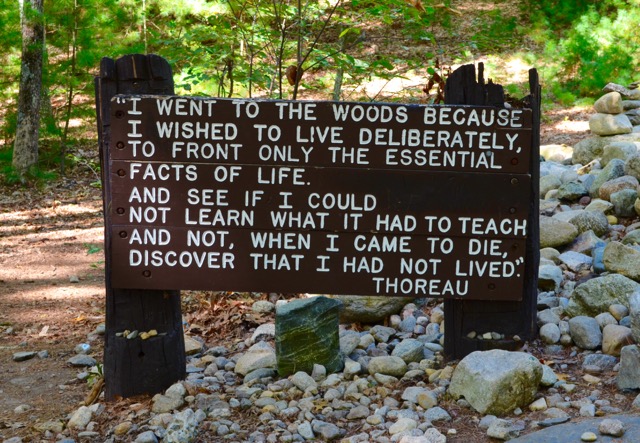
And beside it, these famous words of his:

To live deliberately

But nowhere could I find a sign posting this other quote which I also admire, on the economy of work:

“For more than five years I maintained myself thus solely by the labor of my hands, and I found that, by working about six weeks in a year, I could meet all the expenses of living.”

Don’t you just love his calculations?

***

Follow my New England series:

Notes From The Dark

This post is a little different from my usual Saturday Snapshot.

I’ve been asked how I remember so many details from a movie after just watching it once. Well, of course I can Google for some of the info, but to jot down lines and scenes that I don’t want to forget, I take notes.

How do you take notes inside a dark theatre? I used to bring along a small note book, fold the corner of the page to start with, and just use my pen to write whatever I could on the small pages… usually just a few words a page, for I didn’t want to overlap my writing. When I went home, I often had a hard time deciphering what I’d written.

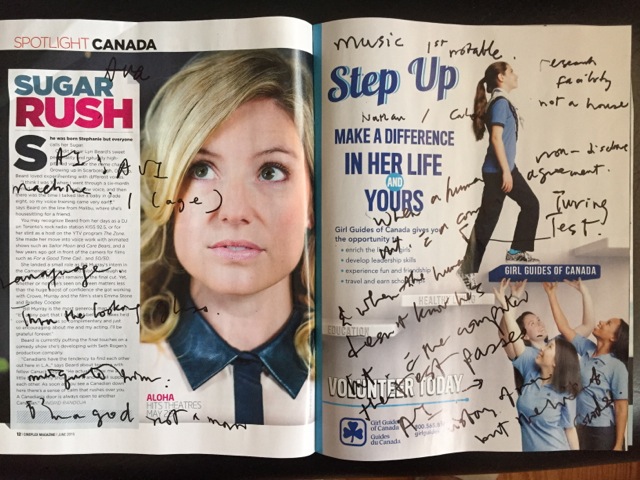
But recently I found a perfect way. Instead of a small notebook, I take with me into the movie a copy of Cineplex magazine, lots of those in the stands at the theatre. Before the movie starts, I fold down the corner of the pages that have some blank or lighter space, take out a permanent black Sharpie marker pen, and I’m all set for note taking in the dark.

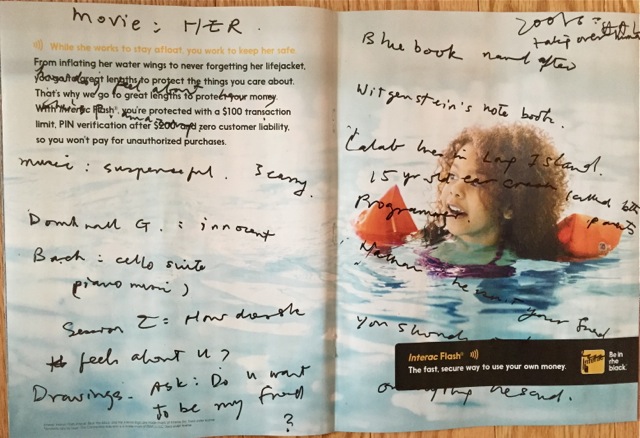
I don’t take my eyes off the screen when I write. So you can say it’s blind writing in the dark. Here are some of the pages of notes I’d taken recently. For interest’s sake, I’ve included the movie I was watching when making these notes. They make fun, altered book pages, don’t you think? And the effects of words on the page are all serendipitous too. And oh, if you suddenly remember some errands you forgot to do, you can jot that down too.

A View from the Bridge, National Theatre Live. I’ve a little drawing of the stage and seating here:

Dark Notes

View from the Bridge 1

**

Here are the pages from watching the movie Ex Machina (Review coming):

Ex Machina

Ex Machina 4

Ex Machina 1

Ex Machina 2

Ex Machina 3

When memory fails, mnemonic devices save the day all the time. Just need to channel a little creativity.

***

Saturday Snapshot is hosted by West Metro Mommy Reads. CLICK HERE to see what others have posted.

From Z to A: How Zweig Inspired Anderson’s Grand Budapest Hotel

The following is the first part of my article in the new Spring Issue of the online review magazine Shiny New Books. In the article, I introduce the Austrian writer Stefan Zweig, whom director Wes Anderson acknowledged as the source of inspiration for his Oscar winning production. To read the whole piece, CLICK HERE. I’m sure you’ll find the SNB site informative and a valuable resource of books and authors.

***

The Grand Budapest Hotel won four Oscars at the 87th Academy Awards this February. In the end of the film leading the credits is the acknowledgement of Stefan Zweig (1881-1942), whose writings had inspired the production. During interviews, director Wes Anderson had joked that he ‘stole’ from the Austrian writer: ‘It’s basically plagiarism,” he said. Anderson is all modesty when making such a remark, for the film has his own signature style. Unlike Zweig’s more serious and darker hue, Anderson has created a colourful fantasy. Rather than an imitation, the film should be regarded as a worthy homage to an author who had been noted as one of the most translated German-language writers during the 1930’s.

the-grand-budapest-hotel movie poster

Anderson came across Zweig by chance when he purchased his 1939 novel Beware of Pity in a Paris bookstore. After two pages, he knew he had discovered a new favorite author. Twenty pages later, he wanted to adapt it into film. Then he read some more Zweig and liked them all. So he made a peculiar endeavour, he transposed the author’s oeuvre, his life and spirit into his own re-imagining, creating a film that eventually would catapult him to the zenith of acclamation.

The Grand Budapest Hotel was nominated for nine Oscars at the 2015 Academy Awards, including Best Picture, Best Directing, and Best Original Screenplay for Anderson himself. Albeit not having won these major categories, the film did capture four wins in Original Score, Production Design, Costume Design, Makeup and Hairstyling. The triumph is shared by the late Zweig, for he has now been introduced to many more readers, especially those of us in North America. New York Review Books has seen Zweig’s popularity rise after the movie, but it is UK’s Pushkin Press that holds the banner of a ‘Zweig revival’ by republishing many of his works in English translation.

Zweig was born 1881 in Vienna to a Jewish family who circulated freely in the upper crust of Austro-Hungarian society. He was versatile and prolific as a poet, translator, biographer, essayist, lyricist, short story writer and novelist. His literary achievement was prodigious. At nineteen, Zweig saw his first publication, a collection of poetry by the respectable publisher Schuster & Löffler. Upon this debut on the literary stage, Zweig was ecstatic to receive a gift from his idol, Rilke, who had read the youngster’s work and sent him a special edition of his own poetry with the inscription addressed to Zweig: “with thanks.” Later, still at the tender age of nineteen, Zweig saw his essays published in the feuilleton, literary supplement, of Vienna’s prestigious newspaper the Neue Freie Presse, sharing the pages with such formidable literary figures as Ibsen, Zola, Strindberg and Shaw.

The World of Yesterday ZweigReaders can find his excitement in recalling these unexpected early successes in his autobiography The World of Yesterday. It was not so much about fame but identity. The glorious world of yesterday included not only the fulfilled dream of a young man, but that of the Jewish people in finding a homeland, free and secure in Vienna. At long last, they could taste the reality of belonging. Jews in Vienna had become respectable, contributing members of society, particularly in the realms of the arts and culture.

As we can see from history, such a triumph would soon be obliterated. In August 1914, Zweig saw the world order and security that he so cherished and thrived on crumble as WWI broke out. If that was the beginning of the end, Nazism in the 1930’s rang in the death toll. Zweig had to escape to England, later the United States, finally landed in Brazil. Exiled and alienated, the Austrian writer was overwhelmed by despair as he saw his homeland and Europe devoured by Hitler. The German language he was born into and had so aptly used in his literary success he now had to apologize for. Such devastation and emptiness was too much to bear. In 1942, just a few days after He sent off his last book Chess Story to his American publisher, Zweig and his second wife committed suicide together in Petrópolis, Brazil.

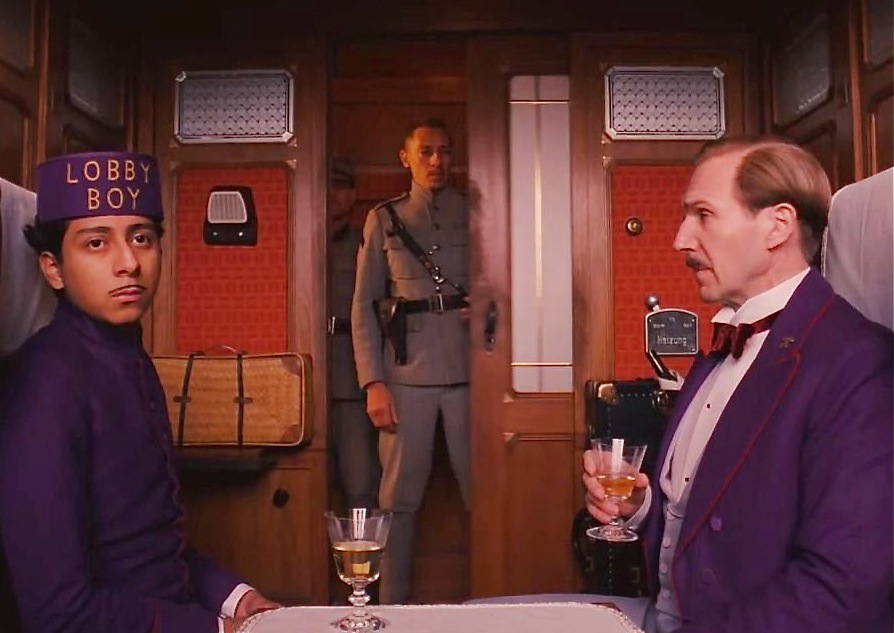
Wes Anderson recreated Zweig’s pre-war world in his fictional Republic of Zubrowka, with The Grand Budapest Hotel itself as a metaphor of that secure microcosm, everything runs smoothly under the supervision of the concierge M. Gustave (Ralph Fiennes), at least in the first half of the film. The boxy Academy Ratio we see on screen evokes the idea of looking into an old photo album in all its nostalgic charm. The exile life of a genocide survivor we can find in Zero the lobby boy (Tony Revolori young, F. Murray Abraham older).

Passport CheckRichard Brody in his New Yorker article “Stefan Zweig, Wes Anderson, And a Longing for the Past” writes that Zweig himself had experienced the ‘practical difficulties’ and ‘psychological trauma’ of having lost his passport while on the run. The passport, Brody notes, “wasn’t even a commonplace document before the First World War.” Without it, one instantly was turned into an outlaw. Zero has M. Gustave to thank for standing up for him twice while travelling on the train without transit papers. The first time, officer Henckels (Edward Norton) recognizes M. Gustave, his parents’ friend, and remembers his kindness to him when he was a boy; human relations win over and Zero is spared. Unfortunately, luck runs out for M. Gustave in the second time, all because of the change in military control, a symbolic reference to the iron fist of the Nazi regime. No societal ties or achievements could save Zweig or the Jews in Europe during the Holocaust.

The following are two titles to which Anderson had made specific reference – Zweig’s only novel Beware of Pity and his novella The Post-Office Girl. The third is Anderson’s own selections, an excellent sampler of Zweig’s works, The Society of the Crossed Keys.

To continue reading my short reviews of these books, CLICK HERE to Shiny New Books. Or, just click anyway to see what an array of book reviews, author interviews and their own articles, book news and tidbits await you.

***

How Proust Can Change Your Life by Alain De Botton

Here’s my second instalment for the blogging event Paris in July 2014.

Paris In July 2014

***

You must have heard of this book by a Swiss-born Brit writing about a French novelist called Proust. You probably have read it, and let me guess, were surprised when reading the first chapters? Well, I was. For before reading this book, my knowledge of Alain de Botton, the popular British writer and media personality, mainly came from an art critic’s thoughtful posts on her blog.

How Proust Can Change Your Life

Is Botton joking? This book reads like a parody.

First we are introduced to Dr. Proust, Marcel’s father, who was a renowned physician and prolific writer. His thirty-four books had helped the French people from defences against the plague to the correct postures and exercises for the ladies. Botton being an image-driven person does not hesitate to include some of Dr. Proust’s instructional illustrations for his female readers such as how to jump off walls, or balance on one foot.

Not your definition of parody? How about this chapter on ‘How to Suffer Successfully’. Proust is well known for his physical ailments, having had to lie in bed most of the time when he wrote the longest novel ever written, In Search of Lost Time. Botton exhaustively lists down the various trials Proust had to live with throughout his life:

  • The Problem of a Jewish Mother
  • Awkward Desires
  • Dating Problems
  • A Lack of Career in the Theatre
  • The Incomprehension of Friends
  • At 31, His Own Assessment
  • Asthma
  • Diet
  • Digestion
  • Underpants
  • Sensitive Skin
  • Mice
  • Cold
  • Coughing
  • Noise from Neighbours

… Should I go on? And oh, he does include Death.

I know, that’s what Botton does, bring the extraordinary into the ordinary realm of common readers, and by so doing, explaining Proust to us lowly creatures. And of course, it would help if you have at least read the first two volumes of In Search of Lost Time, for many of his examples are taken from there, so you would feel a resonance, or disagree with Botton’s interpretation, when he talks about Francoise, Swann, Albertine, Combray, or Balbec.

Do I get anything out of it? Plenty. I’ve lots of highlighted passages and my own handwritten notes on the margins. When Botton gets serious between the lines, he leaves me with some useful tips:

So if speaking in clichés is problematic, it is because the world itself contains a far broader range of rainfalls, moons, sunshines, and emotions than stock expressions either capture or teach us to expect. (p.106)

For one thing, express your own feelings and ideas instead of saying ‘nice’, or describing the setting sun as ‘a ball of fire’. I love this little passage Botton quotes from Proust about the novelist’s description of his ‘lunar experience’:

Sometimes in the afternoon sky a white moon would creep up like a little cloud, furtive, stout display, suggesting an actress who does not have to ‘come on’ for a while, and so goes ‘in front’ in her ordinary clothes to watch the rest of the company for a moment, but keeps in the background, not wishing to attract attention to herself. (p.98 of Botton’s, but no mention of where this is from Proust’s)

The key of course is not so much of trying to use a new language to describe a common scene or object, but to be able to look at them from a distinctively new perspective to begin with. How can we invent new lenses to see the world? Towards this end, Botton has failed to go further. So we’re told to avoid clichés, but not how. If you sense my ambivalence, you’re right.

In order to avoid clichés himself, Botton has resorted to hyperboles. The title of the book is a ready example. The 200 page book comprises of nine short chapters, each can be a book in itself. So you can expect the oversimplification of the ideas. Further, with no citing of sources for the Proust quotes, the critical reader could be left unsatisfied; it feels like Botton has jumped to generalizations and found expressions of his own thoughts from one or two excerpts of Proust’s. Makes one feel that Proust could just be a selling point.

However, this is an entertaining read, like a self-help manual with instructional tidbits and amusing images. The book is a mixed bag of common-sense wisdom, with a ‘moral’ at the end of each chapter. Throughout, it is obvious that Botton could well find it not as easy as he tells his readers to do… to be original and not say what others have said before. Here are some of his main points:

  • Live life today
  • Read books to form your own ideas
  • Suffering makes you strong
  • Find art and beauty in the ordinary
  • Avoid clichés like the plague
  • A time to pick up a book, a time to put it down
  • Win friends by your praises
  • but pour your honest criticisms of them into a work of fiction (now that’s a novel idea).

Is there anything new under the sun?

Speaking of the sun, take this to the beach. It would make one breezy read.

Lastly, following Botton’s (actually Proust’s) advice on reading:

We should read other people’s books in order to learn what we feel, it is our own thoughts we should be developing even if it is another writer’s thoughts which help us do so. (P. 195) Reading… is only an incitement…


So I’d say the moral is: read Proust yourself. Don’t let Botton tell you what Proust can do for you.

That’s just the prodding I need to press on to In Search of Lost Time, Vol. III.

***

Paris in July 2014 on Ripple Effects:

Haute Cuisine Movie Review

CLICK HERE, HERE and HERE to see what others have posted.

***

Related (Proust) Posts on Ripple Effects:

Proust Read-Along: Swann’s Way Part 1, Combray

The Swann and Gatsby Foil

Half Way Through a Budding Grove

Out of the Budding Grove

***

Screenwriters Talk and Bloggers Blog

Thanks to blogger Sim at Chapter 1-Take 1 for the heads-up, I watched the whole 54 mins. of The Writers Roundtable via Hollywood Reporter. Gearing up for the upcoming Awards Season, these Roundtable talks give us a chance to hear some possible award contenders talk about their craft. I’m particularly drawn to the writers.

“No great film would have been possible without a great screenplay.” That’s how the clip begins. Sitting around a table to discuss their experience are some of this year’s acclaimed screenwriters.

The panel includes (In alphabetical order of the movie title):

John Ridley: 12 Years a Slave
Julie Delpy: Before Midnight
Nicole Holofcener: Enough Said
Jonas Cuaron: Gravity
Danny Strong: Lee Daniel’s The Butler
George Clooney and Grant Heslov: The Monuments Men (release date has since been delayed till next Feb.)

There are lots of interesting exchanges, and it’s refreshing to hear them talk uncensored and unscripted. Take for example the following dialogue relating to independent writing vs. writing for studio:

HR (Hollywood Reporter): Have you written any studio films?
Holofcener: Only for money (chuckle from somewhere). I mean like, not for myself.

*

HR (to all): Do you like writing?
Strong: I do. I really enjoy it. I spent years as an actor. You just can’t go do it. You get hired to do it, so I started writing, to get my mind off the auditions…
Holofcenter: What if you can’t act, and you can’t write?
Clooney: You direct.

*

There are lengthy discussions on the issue of historical accuracy, the truths vs. dramatization. I feel this is the hot topic lately, with The King’s Speech a couple years ago, to last year’s torture scenes in Zero Dark Thirty, the accuracy of Argo, and this year’s Captain Philips, and Lee Daniel’s The Butler.

Here’s The Butler‘s screenwriter Danny Strong’s defence:

Strong: Well, in the case of The Butler, I made very clear that this was a fictionalization. So much so that I changed the character’s name to Cecil Gaines in the hope of saying: “This isn’t Eugene Allen. This is something else.” But the history in the film is all true…”

And then comes Clooney’s allegation unplugged.

Clooney: This is a new thing, by the way. This is all, like, bloggers — if that existed when Lawrence of Arabia came out, believe me, Lawrence’s own autobiography would not hold water. Patton wouldn’t. You can go down the list of movies — Gandhi — these movies are entertainment… These are not documentaries. You’re responsible for basic facts. But who the hell knows what Patton said to his guys in the tent?

*

Whoa… bloggers? Thank goodness, bloggers get a chance to prod screenwriters to dig deeper into their facts, even if fiction is to be made from them. Because of bloggers, viewers can sharpen their senses to not just accept the dramatization as facts. Because of bloggers posting about movies, people are made more aware of historical events and background info. I see not all sites do, but the ones I frequent can have the effect of honing one’s judgement and critical thinking, even (maybe more so) when opinions differ. How we need these skills as we watch movies nowadays instead of just being passively entertained (or not).

Thanks George, for spelling out the importance of the work bloggers do.

You’re right too, George, because of the blogosphere, filmmakers now have to deal more rigorously (or, don’t they?) with the dichotomy between truth and fiction, historical accuracy and dramatization. Yes, the butler Cecil Gaines is a fictional character, but there are many real historical figures in that story context… like, say… Ronald Reagan, whose son Michael Reagan had protested against the film for painting his father with a racist brush.

As someone with a half-baked screenplay in the closet, I know how hard it is to even get to finish the first draft, and after that, hopefully, find someone qualified and experienced enough to read it and advise on rewrite. Then you go and rewrite, and rewrite some more. So I’m all respectful for all who can not only sell their spec script but actually see it produced, and not only produced, but distributed and shown on our theater screens. That’s why I attempt at every review with appreciation and humility.

At the same time, I’m also glad to see that the blogosphere has leveled the playing field for opinions and critiques, for accountability, and for creative expressions with checks and balances. I don’t see an end to the dichotomy between fact and dramatization, accuracy and entertainment, but at least we are free to challenge and critique. Don’t forget, George, bloggers are also the ones ready to defend and promote worthy productions. All for the better.

***

Related Posts on Ripple Effects:

Before Midnight: Reality Check

The King’s Speech: Fact and Fiction

Zero Dark Thirty and Argo

***

Half Way Through a Budding Grove

Half way through reading In Search of Lost Time, Vol. II, Within A Budding Grove, I’ve discovered a key to enjoying Proust. Just as it’s best to eat madeleines by dipping them in tea before putting the moistened petite cakes in your mouth, the most enjoyable way to read Proust is lying in bed with an unhindered mind. In this most relaxed state, I’m at ease to stroll leisurely through a budding grove, or the thickets of a genius’s mind.

Within A Budding Grove Modern Library

So far, I’ve gone passed the narrator Marcel’s painful struggles with adolescent, unrequited love for M. Swann’s daughter Gilberte. In contrast, his crush for Mme Swann has been appreciated and normalized. Unlike the cool and aloof Gilberte, Mme Swann welcomes Marcel into their home warmly, including him in their family outings, and their home gatherings with their friends, thus allowing him an opportunity to meet his literary hero, the writer Bergotte.

And here’s the passage I’m most impressed by, so far. The man Bergotte is very different from the writer Marcel has encountered in his ‘divine writing’. The man appears to be very common, inarticulate even, and devoid of eloquence, a man who spent his childhood in a ‘tasteless household’. Marcel is shocked by this discovery, and scrambles to come to terms with such dissonance. In a most ingenious analysis, the young Marcel comes to this conclusion:

But genius, and even great talent, springs less from seeds of intellect and social refinement superior to those of other people than from the faculty of transforming and transposing them… To mount the skies it is not necessary to have the most powerful of motors, one must have a motor which, instead of continuing to run along the earth’s surface… is capable of converting its speed into lifting power. (p. 175)

As I read these few pages, Jane Austen came to mind. A writer who had lived her short life mainly in a rural setting, her associations parochial and far from ‘high society’, and yet could transport herself and thus her readers to a different world from her mundane social environs. Her imagination soared as it took flight with her incisive observations of human nature.

… the men who produce works of genius are not those who live in the most delicate atmosphere, whose conversation is the most brilliant or their culture the most extensive, but those who have had the power, ceasing suddenly to live only for themselves, to transform their personality into a sort of mirror… genius consisting in reflecting power and not in the intrinsic quality of the scene reflected. (p. 175-176)

The adolescent Marcel’s disillusionment with the discrepancy between the man and writer Bergotte leads him to an uplifting insight:

The day on which the young Bergotte succeeded in showing to the world of his readers the tasteless household in which he had spent his childhood, and the not very amusing conversations between himself and his brothers, was the day on which he rose above the friends of his family, more intellectual and more distinguished than himself; they in their fine Rolls-Royces might return home expressing due contempt for the vulgarity of the Bergottes; but he, in his modest machine which had at last ‘taken off,’ soared above their heads. (p. 176)

Yes, more Proust’s words than mine on this post. Many other highlighted passages and surprising delights, but will have to wait till I’ve come out of the budding grove the end of November. If you’re interested, you’re welcome to join me in a read-along of In Search of Lost Time, Vol. II: Within A Budding Grove.

CLICK HERE to my wrap-up post: Out of the Budding Grove

***

Related Posts:

Proust Read-along Swann’s Way Part I: Combray (Featured in ‘Freshly Pressed’)

The Swann and Gatsby Foil

What Was Jane Austen Really Like? Reading Tomalin and Shields

In Praise of Austen: Virginia Woolf’s A Room of One’s Own

***

Downton Abbey, The Complete Scripts: Season One

I had once talked with someone who avoided watching the ‘making of’ special feature that comes with a DVD. His reason? He did not want to see his favorite movies demythicized. Well, if you’re that sort of a viewer, then this book is not for you.

Downton Abbey The Complete Scripts Season One

But, if you’ve enjoyed the phenomenon called Downton Abbey, and are curious to learn about the creative writing process that kicked it off, then I’d say, this is an absolute must-read. And for those who keep going online to find quotable quotes from the series, here you have them all, and some more.

As someone interested in screenwriting, I would look for the scripts of movies I like, usually online. So it’s a wonderful discovery for me to see this book at the bookstore. Julian Fellowes has dispelled the magic and shared with us the scripts of all episodes for Seasons One and Two, most importantly, with his own annotations. Consider this the literary version of the ‘making of’ in your special features, more accurately, the screenwriter’s commentary.

In his Foreword, Fellowes introduces the book as ‘the complete scripts of the first series as they were when they went forward into production.’ So here we have the whole idea before cutting and editing, including deleted scenes and dialogues, plus Fellowes’ own explanations for the deletions. He walks us through the whole series, literally, and offers helpful background on the social history of the time, and many more tidbits.

You can also see why the collection is such a useful tool as an exemplar of a successful writing process, in particular, the editing phase. The main reasons for deletion is redundancy, and with a TV production, time. Another is for keeping the integrity and consistency of the characterization and the story. It’s intriguing to see the final version is the outcome of well-pruned and collaborated efforts.

An example of a deleted scene where Matthew answers Robert’s bewildered query about how he would manage to commute and continue to work as a lawyer while being heir of Downton.

Robert: How will you manage it?
Matthew: Like many others, I shall bicycle to the station, take a train there and back, and bicycle home.

Here’s the screenwriter’s commentary:

Here we have Matthew talking about bicycling to the station which is quite unnecessary as we see him do it. When you’re writing something you often forget that it’s going to be told visually, and so there are things that don’t need to be said.

With eighteen characters in the story, the writer has done a superb job in keeping them well developed, and eliciting our interest in each one of them. First I notice how short each scene is, something that just flashed by when watching, but reading it can even be more obvious. I’ve counted most of the scenes to be less than 60 sec. on screen. Each therefore needs to be succinct to make the most of the time. Makes me think of another way to apply that famous Hemingway quest, always aim for that one true scene.

To manage the long list of characters, here’s the brilliant way, something that’s so obvious when Fellowes explains, but then so subliminal while we’re watching them on screen, foils and parallels:

I love Mrs. Patmore. I think Lesley Nicol’s performance is fantastic. She is the kitchen Violet. Maggie Smith delivers the cryptic comments upstairs, Lesley has the barbed tongue downstairs. In a sense they balance each other, as Robert and Bates, or Anna and Mary, balance each other.

And here I add, other pairs we can see upstairs Violet and Isobel, or down, Mr. Carson and Mrs. Hughes. Great performance comes when an actor is given the chance to play against an equal, in character and caliber.

Further, Fellowes reminds us that it’s the actors that give life to mere words on the page. As the actors interpret, take off with and develop the characters on their own, the screenwriter continues with that development and write accordingly in the upcoming episodes. Isn’t this a most fascinating creative process? Writer and actors inspiring each other.

It’s always interesting to see what the screenwriter thinks of the final production. And Fellowes is candid in sharing his views, which reminds me of the fact that it’s all a collaboration, team work, and not just one person’s monopolized brainchild. The writer writes, the actors interpret and live out the words, the director sets the tone, the direction, the cuts, plus numerous others who work on the sets to play their roles.

I most appreciate and am somewhat surprised to find Fellowes uses many of his own experiences, stories he has heard, or memories of his own family, to create the scenes. Some interesting tidbits he shares include the scene in the kitchen rescuing the chicken from the cat before taking it upstairs, that comes from an embarrassing real life episode. Or Violet Crawley’s subtle dominance in the annual flower show, which he adapts from memories of his mother. Or his commentary on Sybil’s covering up of her political expeditions to Ripon, a parenting point:

Once children conceal their purposes or their social engagements or their plans for the weekend, that is the beginning of their move away from the parental set of values. Before that, God knows they may be rude or challenging, but they don’t usually have a private life, a secret agenda. And this is where it begins for Sybil.

It’s commentaries like this that you’d feel Fellowes is candid and open, just talking to you in a down-to-earth manner. Like everyone of us, he’d go online to do his research when he writes, such as the history of cataract surgery when writing about Mrs. Patmore’s.  Or admitting faults in certain scenes, and sharing about his own childhood experience and family dynamics, enlightening us with the norms and etiquettes of the time and the social history behind the scenes.

Demythicize? Definitely, with the effect that you’ll appreciate the production and the writing even more.

~ ~ ~ ~ Ripples

Downton Abbey The Complete Scripts Season One by Julian Fellowes, Harper Collins Publishers, 2012, 396 pages.

***

Related Posts You May Like:

Lady Almina and the Real Downton Abbey: Facts that give rise to Fiction

Quotable Quotes from Downton Abbey

Downton Abbey Season 3: Episodes 1

Season 3: Episodes 2 & 3

Season 3: Episodes 4 & 5

Season 3: Episodes 6 & 7 Finale

***

Quotable Quotes from Downton Abbey Season 3

These are some of my favourite lines from Season 3. They remind me of why I enjoy Downton Abbey in the first place, the humor and subtext, and the superb cast that delivers every time.

Episode 1

The family must never be a topic of conversation. – Violet Crawley

Miss O’Brien, we are about to host a society wedding. I have no time for training young hobbledehoys. – Mr. Carson

Daisy: You’ve still kept me here with a dishonest representation.
Mrs. Patmore: Oh dear. Have you swallowed a dictionary?

Don’t worry about me. I’m an American. Have gun, will travel.  – Cora

Have gun will travel

Forgive, perhaps. Forget, never. – Violet

Come war and peace, Downton still stands and the Crawleys are still in it. – Martha Levinson

Mary, dearest Mary. Now, you tell me all of your wedding plans. I’ll see what I can do to improve them.  – Martha

Edith: There you are. I see you’ve said hello to Grandmama.
Violet: She is like a homing pigeon. She finds our underbelly every time.

I should hate to be predictable. – Mary to Matthew, at her wedding altar

Episode 2
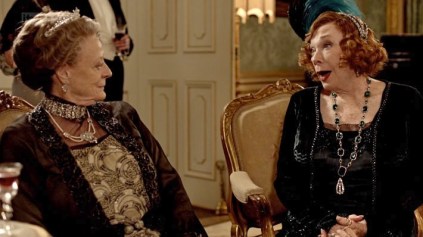
Let me call you sweetheart...

Nothing succeeds like excess. – Violet

Are you not popular downstairs? – Robert to Thomas

Some animals adapt to new surroundings. It seems a better choice than extinction. – Martha to Robert

Well, in my opinion, to misquote Dr. Johnson, if you’re tired of style, you are tired of life. – Mr. Carson

Episode 3

At my age, one must ration one’s excitement.  – Violet

Let him go, let him go. You know he’s right. Don’t stop him doing the only sensible thing he’s come up with in months. – Violet to Edith at the altar

Being tested only makes you stronger. – Cora to Edith

If the poor don’t want it, you can bring it over to me. – Violet to Carson re. the wedding food.

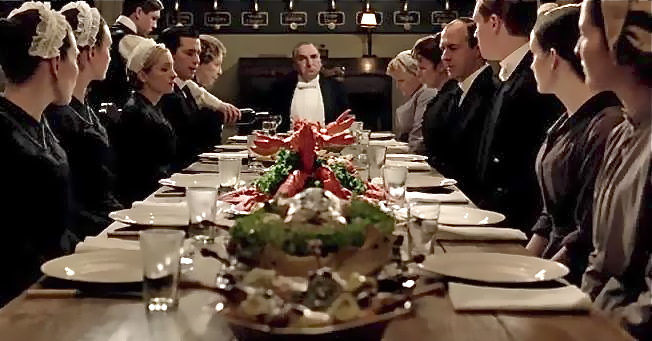
Wedding gourmet for downstairs

And the food? Here it is… probably the best quote of the Episode. In answering Alfred’s remark of: Is this all we’re getting? Just these picketty bits:

These are canapés, Alfred. For your first course, some truffled egg on toast, perhaps? Some oysters a la Russe? There’s lobster rissoles in Mousseline sauce or Calvados-glazed duckling, or do you fancy a little asparagus salad with Champagne-saffron vinaigrette? – Thomas and Mrs. Patmore

Episode 4

Robert: What a harsh world you live in.
Tom: We all live in a harsh world. But at least I know I do.

Carson: But Alfred is very good, you know. He’s very willing. Even if he is Miss O’Brien’s nephew.
Matthew: Clearly, nothing worse could be said of any man.
 

Episode 5

Cora: Sir Philip mustn’t bully him into silence.
Robert: My dear, this is just Clarkson’s professional pride like barbers asking, “Who last cut your hair?”

A woman of my age can face reality far better than most men. – Violet
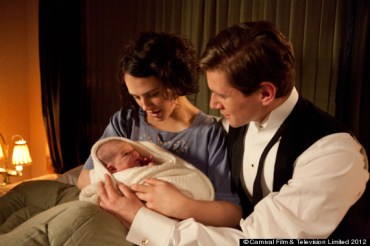
Sybil, Tom & baby

Edith: She was the only person living who always thought you and I were such nice people. Oh Mary… Do you think we might get along a little better in the future?
Mary: I doubt it. But since this is the last time we three will all be together in this life, let’s love each other now, as sisters should.

Episode 6

There hasn’t been a Catholic Crawley since the Reformation. – Robert

Anyone who has use of their limbs can make a salmon mousse. – Mrs. Patmore

You know the trouble with you lot? You’re all in love with the wrong people. Now take those upstairs! – Mrs. Patmore

Robert: I’m flabbergasted.
Cora: You’re always flabbergasted by the unconventional.

Dr. Clarkson: So you want me to lie to them and say there was no chance at all?
Violet: Lie… is so unmusical a word. I want you to review the evidence honestly and without bias.
Clarkson: Even to ease suffering, I could never justify telling an outright lie.
Violet: Have we nothing in common?

Episode 7
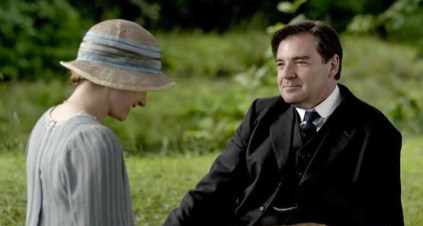
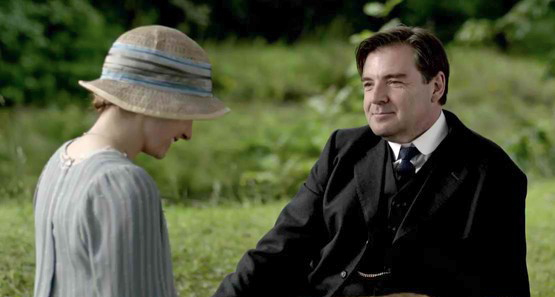
Bates and Anna

But in the meantime, you just rest. Stay in bed, read books. – Robert to Bates

Convince me again. – Matthew to Mary

I do think a woman’s place is eventually in the home, but I see no harm in her having some fun before she gets there. – Violet

What is The Scarlet Letter? – Violet

Robert: Second [condition], you will both admit it when you realize you were wrong.
Violet: Oh, well that is an easy caveat to accept because I’m never wrong.

What’s the matter, Robert? Are you afraid you’ll be converted while you’re not looking? – Cora

Episode 8

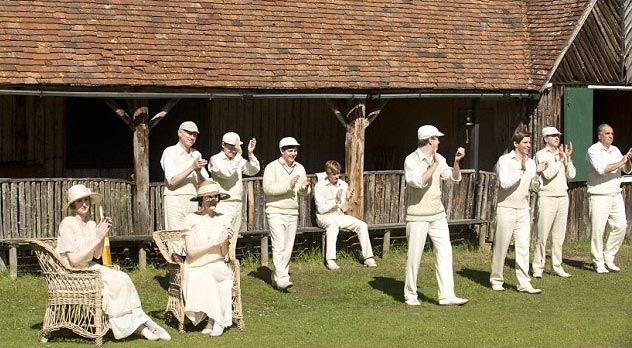
Cricket Match

Matthew: Bates must count himself lucky to be out of it [cricket match].
Anna: I think he’d like to walk normally, sir, even if playing cricket was the price he had to pay.

She hates London, so she’s coming to a great-aunt in Yorkshire to have a good time. How original. –Isobel to Violet re. Rose

Isobel: Of course, if you had had to sell Charlie to the butcher to be chopped up as stew to achieve the same ends, you would have done so.
Violet: Happily, it was not needed.

Episode 9 Finale

Edna: He’s nice looking, I give him that.
Mrs. Hughes: I don’t think you’re required to give him anything.

Don’t dislike him before you know him. That’s the hallmark of our parents’ generation, and I forbid it.  – Matthew to Mary, re. Gregson.

What I want is for her [Rose] to know that family can be a loving thing… Love is like riding or speaking French. If you don’t learn it young, it’s hard to get the trick of it later.  – Shrimpie

Matthew: I fall more in love with you every day that passes.
Mary: I’ll remind you of that next time I scratch the car.
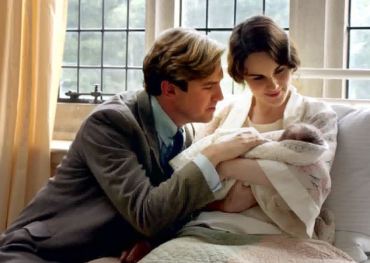
Downton Abbey Christmas Special

*

Oh, but it’s more than just a scratch in the car. We’ll forgive, but not forget. – Arti

*

CLICK HERE to Quotable Quotes from Downton Abbey Season 1 and 2

***

Saturday Snapshot Nov.10: A New Gravatar

After a few years of using the blue ripples as my Gravatar, recently I’ve created a new one. It combines several of my interests… at present. I designed the set and took the photo in a mini makeshift ‘studio’, a little corner on a desk.

This Gravatar depicts pages rippling in fight, the soaring power of words. From the symbolic to the actual, most noticeable in the background is my bird book, guide to a new-found passion.

Underneath the pages in flight is Hemingway’s A Moveable Feast. While Hemingway may not be my favorite writer, the title of this book is significant, albeit you can’t see it here. Less noticeable is the screenplay I’m writing at the base of the pile. Can you see the brad? And oh, the title of the open book? Roger Ebert’s memoir Life Itself.

Books, films, birds and screenplay in progress… a moveable feast.

***
Thanks to Alyce of At Home With Books for hosting Saturday Snapshot.

Posts you may like:

A Moveable Feast by Earnest Hemingway 

Roger Ebert in Toronto: A Close Encounter

Molly Fox’s Birthday by Deirdre Madden

This is my first selection for the 2012 Ireland Challenge at Books and Movies. Thanks to Litlove and Rebecca for the recommendation.

Molly Fox’s Birthday was on the long list of the 2009 Orange Prize. Despite the title and the look of the book cover, it’s not chic lit. It’s not about celebrating a birthday either.

The book is set on a single day, Molly Fox’s birthday, June 21st, the summer solstice. Molly Fox is a popular and gifted theatre actor. On that day, the narrator of the book is staying at Molly’s home in Dublin while Molly has gone on a trip to New York. Nothing much happens really on Molly’s birthday, a day that she doesn’t even celebrate.

The narrator is a playwright who has enjoyed acclaims at one time but is now going through a low period in her career. On this day, she is struggling with writer’s block. While she is staying in Molly’s home trying to start a new play, she is preoccupied with memories and pondering. She reminisces on her longtime friendship with Molly, who was initially propelled to fame when she performed  in the narrator’s debut play.

Gaiety Theatre, Dublin

Through her quiet recollections, the narrator describes how their lives intertwine with two other significant characters, Molly’s brother Fergus and their mutual friend Andrew, who is from Northern Ireland. The political events that happend during the past decades had shattered his family. A successful art historian living in London now,  Andrew is still haunted by disturbing memories. And Fergus is another personality which the narrator finds intriguing to discover slowly.

Sometimes it’s just a gut feeling that you like a book. As you’re reading, there’s a gentle push that prompts you forward, reinforcing your favor as you slowly go along… even though ‘nothing much happens’. To go beyond feeling is what I need to do now. Let me try to organise my thoughts:

First it’s the voice. Often that’s the first thing that draws me into the story. Throughout the book, the narrator is unnamed. Her voice is casual, understated, and her tone is occasionally self-deprecating: “… I was in the supporting role: ever the stooge…” For some reason, I’m instantly drawn to such remarks.

But the self-deprecation only hides a genuine search for self-worth, and a deep longing for what is true in relationships and in life. I admire her sincere quest for that which is authentic in herself and others. Like a close friend relating to you her deepest thoughts, you want to listen attentively.

Author Madden’s strategy of keeping the narrator anonymous is most apt, for we are led to discover her inner world, and appreciate the substance that makes up who she is. A name only identifies the surface, the content within is what makes it worthwhile for readers to know in a character.

Intriguingly, this is exactly what the narrator tries to do. As she struggles with writer’s block, she is also sorting out the blockages of veiled personas of those whom she thinks she has come to know, to find out what they are beneath the surface.

What appeals to me is the narrator’s insightful point of view disguised as casual remarks. Like how she recalls the first time she recognized Molly in a café, sitting nearby her and reading a book:

I did not approach Molly — what could I possibly have said? I really liked you in ‘The Importance of Being Ernest’. And what could she have replied? Why thank you very much. What would that have amounted to? Less than nothing. There are forms of communication that drive people apart, that do nothing other than confirm distance. But there are also instances when no connection seems to be made and yet something profound takes place, and this was just such a moment.

Café in Dublin

On Molly’s birthday, the narrator talks to three people who come by Molly’s home, Andrew, whom the narrative has not seen for a while, Molly’s brother Fergus and a well-wisher. From interactions with them, the narrator is surprised to learn that people’s outward image may well be a front hiding a very different self or intent.

From reading the quiet ruminations, I’m delighted to discover gems along the way. Like the rest of the narratives, it seems that the author has strewn them about casually. We’re free to notice and pick up. Here are a few of them:

From the narrator’s oldest brother Tom, a Catholic priest —

Eternity is a priest’s business. But we all live in time. And what I’m doing is trying to make people aware of how the two coexist… keeping that sense of eternity while being in time; and trying to live accordingly…

How the narrator describes Molly’s acting —

There was always something unmediated and supremely natural about her acting, it was the thing itself. Becoming, not pretending.

About the self on and off stage —

Is the self really such a fluid thing, something we invent as we go along, almost as a social reflex?… so much social interchange is inherently false, and real communication can only be achieved in ways that seem strange and artificial.

And this —

Sometimes, on stage, not showing something can be more powerful than showing it.

Seems like this might well be the style Madden follows in writing her book. Subtle prompting, slow revealing… and we’re led to surprising discovery alongside the narrator.

Molly Fox’s Birthday reminds me of Somerset Maugham’s novel Theatre. But this is quieter. And after I’ve finished I wonder… what have I missed now… for there are so many layers, I haven’t explored them all. First off, what’s the significance of a birthday on the summer solstice…

~ ~ ~  Ripples

***

Post of similar subject:

THEATRE by W. Somerset Maugham: In Search of Reality

***

A Good Man is Hard to Find and Other Stories by Flannery O’Connor

“The heart is deceitful above all things, and desperately wicked: Who can know it?”  Jeremiah 17: 9, The King James Bible

I’m delving into Flannery O’Connor like mad, looking for violence. It all started with my stumbling upon this YouTube clip of Father Robert Barron’s movie review of Coen Brothers’ acclaimed movie “Fargo.”

I was bemused to hear him compare Joel and Ethan Coen’s films to Flannery O’Connor’s stories, for in them we can find violence juxtaposed closely with humor. It has been years since I read O’Connor’s stories. After watching “Fargo” again the other night, I thought, I must read more of Flannery O’Connor, this time in a different light. I want to experience how this is true. I’m curious to find out how and why a deeply religious female author would instil violence in her stories. A Good Man is Hard to Find and Other Stories is a good source for my purpose.

Within the ten stories in this collection, I’ve encountered shocking and disturbing scenes that if being shown in cinematic light today could match what’s on screen, not only physical violence, but malicious deceits, verbal abuse, nasty and mean motives leading to disturbing actions.

Here are some of the scenes: Leading the pack is “A Good Man Is Hard To Find”, where a family of six from baby to Grandma is killed by an escaped convict The Misfit and his men. In “Good Country People”, a deceitful young man posing as a Bible salesman outsmarts a woman aiming to seduce him, overpowering her and robbing her prosthetic leg.

Or how about these scenes: A grandfather denies knowing his young grandson in the face of danger in an unfamiliar city in “The Artificial Nigger”. A stranger gaining the trust of an old woman and later marrying her deaf-mute daughter but ends up abandoning her and driving off with her mother’s car and money after the wedding in “The Life You Save May Be Your Own”. Children setting off a wild-fire and endangering a home and its occupants out of revenge, jealousy, or plain malice in “A Circle in the Fire”. Almost all the stories depict human depravity in a shocking way, albeit intermingled with humor. But often, for me, the humor does not compensate for the disturbing and grotesque. From what I’ve read in this collection, O’Connor could well have written the movie “No Country for Old Men”, except she would have sprinkled with a dash of sardonic fun.

But why? If for anything but to show the depravity and the hypocrisy among supposedly ‘good country folks’, and by extension, all humanity, O’Connor is most successful. Like the choir boys turned savages in The Lord of the Flies, what we are is largely circumstantial, the author seems to point out. O’Connor is very bold and direct in conveying this message. She does not cover up the dark side of human nature but exposes it. By so doing, she points to the need for redemptive grace.

In “A Good Man Is Hard To Find”, we see at the moment of imminent death, the grumpy Grandma looks at The Misfit in a new light, realizing that her existential predicament is not much different from the criminal’s. She says to The Misfit:

Why you’re one of my babies. You’re one of my own children! She reached out and touched him on the shoulder.

But her epiphany comes too late for herself.

The Misfit sprang back as if a snake had bitten him and shot her three times through the chest.

While we see the murder of a seemingly innocent old woman, albeit hypocritical, O’Connor delivers the verdict of our human condition ironically by the words of The Misfit:

She would of been a good woman,” The Misfit said, “if it had been somebody there to shoot her every minute of her life.

I find too, that violence in O’Connor’s stories are not gratuitous. It’s a situation, an action that comes as unexpected, and with that, O’Connor deftly tips the balance. These shocking acts usually serves to shatter the status quo of her characters, challenge their world view and convictions. O’Connor does not go about describing the grotesque in gory images, rather, in a matter-of-fact way. We only hear gun shots from afar when the other members of the family are killed. And for the Grandma, The Misfit “shot her three times through the chest.” These mere seven words send out the eerie and shocking effect of cold-blooded murder without having to dwell on the explicit.

Likewise, in “A Circle in the Fire”, it’s a few sardonic words from the disgruntled kid Powell that send chill down our spine as he lights up a match to set fire to the dry wooded area outside Mrs. Cope’s farm home:

Do you know what I would do with this place if I had the chance?… I’d build a big parking lot on it…

Powell told his two companions. Seeing this, the slow-witted daughter of Mrs. Cope’s runs home excited, shouting:

Mama, Mama, they’re going to build a parking lot here!

Yes, a likely scene and dialogue from a Coen Brothers movie.

But it is O’Connor’s own words that is most revealing in pointing out the reasons behind the violence:

In my own stories I have found that violence is strangely capable of returning my characters to reality and preparing them to accept their moment of grace.  Their heads are so hard that almost nothing else will do the work.

And violence is never an end in itself:

We hear many complaints about the prevalence of violence in modern fiction, and it is always assumed that this violence is bad thing and meant to be an end in itself.  With the serious writer, violence is never an end in itself.  It is the extreme situation that best reveals what we are essentially…

In reading (and movie watching, for that matter) we need to find and catch that glimpse of grace. With this, O’Connor had also set a standard for a good screenplay:

Our age not only does not have a very sharp eye for the almost imperceptible intrusions of grace, it no longer has much feeling for the nature of the violence which precede and follow them.

It is the “intrusion of grace” that the violent act is set up for. Without the Grandma’s final epiphany and the gesture of reaching out to The Misfit, O’Connor had said, “I would have no story.”

The writer sure knew a bit about the human heart.

***

The Letters of Vincent van Gogh

While reading van Gogh’s letters is a fascinating journey into the mind of the artist, it is also poignantly heartbreaking. This is an abridged version of van Gogh’s letters, almost all written to his brother Theo from the various places he had stayed from 1872-1890, Holland, Belgium, England and France.

A few decades separate his life from Hemingway’s, but I think he too had his “moveable feast”.  To the painter, it’s not Paris, but the open country of southern France, in particular, Arles and St. Remy’s, Provence.

(A corner store in Arles, named after the famous ‘Yellow House’ Van Gogh once lived in)

Unlike Hemingway, van Gogh felt Paris only ‘distracts’. He wrote to his brother Theo after moving to Arles from Paris in February, 1888:

It seems to me almost impossible to be able to work in Paris, unless you have a refuge in which to recover and regain your peace of mind and self-composure. Without that, you’d be bound to get utterly numbed.

While Hemingway sought to “write one true sentence”, van Gogh yearned to reflect what was true through his paintings:

… giving a true impression of what I see. Not always literally exact, rather never exact, for one sees nature through one’s own temperament.

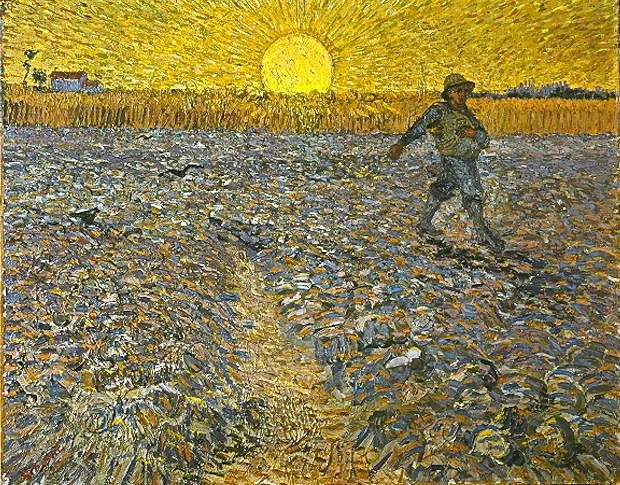
And colours were his tools. Van Gogh began to use a new palette that he did not see in his native Holland. Under the bright Provence sun, the artist excitedly indulged in a myriads of brilliant colours he had not experienced before…”There is that sulphur yellow everywhere the sun lights on.” He eagerly ushered in a new style.

Instead of trying to reproduce exactly what I have before my eyes, I use colour more arbitrarily so as to express myself forcibly… — To Theo from Arles, August 1888

(The Sower)

I believe in the absolute necessity for a new art of colour, of design, and — of the artistic life.”

“But the painter of the future will be such a colourist as has never yet been [emphasis his].

Through the artist’s colourful lens, the view that van Gogh saw was one that I could never imagine. Here he described to his brother Theo a painting he’d finished, in a letter dated September, 1888:

 … the starry sky painted actually at night under a gas jet. The sky is greenish blue, the water royal blue, the ground mauve. The town is blue and violet, the gas is yellow and the reflections are russet gold down to greenish bronze. On the blue-green field of the sky the Great Bear sparkles green and rose, its discreet pallor contrasts with the brutal gold of the gas.

(Starry Night)

Many of the letters are descriptions like this to Theo in Paris. Reading them, I can sense the artist’s excitement and joy in capturing everything he saw in Arles:

At the moment I am working on some plum trees, yellowish white, with thousands of black branches. I am using a tremendous lot of colours and canvases…

… it will be to our advantage to make the most we can of the orchards in bloom. I am well started now, and I think I must have ten more, the same subject. You know, I am changeable in my work, and this craze for painting orchards will not last for ever. After this may be the arenas…

His letters alas are also pleas for funds, as he was “literally starving”. With the last fr.5 he had, he’d spend it on canvases. He lived in dire poverty most of his career, damaging his physical and mental health.

I can’t do without colours, and colours are expensive… I cannot get more on credit. And yet I love painting so…

Worse still, his letters are also accounts of anguish, depression, and “unbearable hallucinations.” He desperately sought cures, admitting himself into the asylum in St. Remy’s. Ironically, it was there that he experienced the most prolific period of his life.

                    (St. Paul’s Hospital at St. Remy’s)

Throughout van Gogh’s numerous letters, there are many beautiful lines, insight into love, art, books, and life. Here are a few:

  • “Since I really love there is more reality in my drawings.” — Autumn 1881
  • “I would not give a farthing for life, if there were not something infinite, something deep, something real.” — December 1881
  • “It is the painter’s duty to be entirely absorbed by nature and to use all his intelligence to express sentiment in his work so that it becomes intelligible to other people. To work for the market is in my opinion not exactly the right way…” — July 1882
  • “I assure you that some days at the hospital were very interesting, and perhaps it is from the sick that one learns how to live.”  — January 1889
  • “I took advantage of my outing to buy a  book… I have devoured two chapters of it… This is the first time for several months that I have had a book in my hand. That means a lot to me and does a good deal towards my cure.” — March 1889
  • “What I should very much like to have to read here now and then, would be a Shakespeare… What touches me, as in some novelists of our day, is that the voices of these people, which in Shakespeare’s case reach us from a distance of several centuries, do not seem unfamiliar to us. — From St. Remy’s Hospital, June 1889.

But tragically, van Gogh succumbed to his mental illness. In July, 1890 two months after moving back to Auvers, north of Paris, he went out to the open fields and shot himself. Two days later he died from his gunshot wound. He was 37.

The Letters of Vincent van Gogh to his Brother and Others. Introduction by his sister-in-law Johanna van Gogh-Bonger, abridged by Elfreda Powell, Published by Constable & Robinson Ltd., 2003, 324 pages.

***

The is my last post for the blogging event Paris in July hosted by Karen of BookBath, and Tamara of Thyme for Tea. My other post is “A Moveable Feast (Restored Edition) by Ernest Hemingway.”

To read my travel post from last August “Arles: In The Steps of Van Gogh” CLICK HERE.

Photos: Van Gogh’s paintings, from Wikimedia Commons, Public Domain. Arles and St. Remy’s by Arti of Ripple Effects, August, 2010.

To read all the 900 letters of van Gogh online, go to this excellent site of the Van Gogh Museum, Amsterdam.