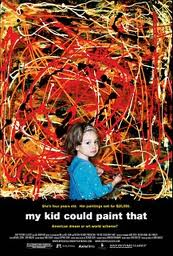
My Kid Could Paint That

If you type in “Marla Olmstead” in your Google search, 37 pages of information will come up. From these pages, you’ll know that she is a painter, born in Binghamton, New York. Her paintings have been compared to Wassily Kandinsky (the pioneer of modern art) and Jackson Pollock (the legendary drip artist). You’ll also learn that her works have been sold for tens of thousands of dollars. And soon enough, you’ll learn that Marla Olmstead is 7 years-old.

Nominated for a Grand Jury Prize at Sundance this year, My Kid Could Paint That is director Amir Bar-Lev’s quest to find out the true story behind this little girl who has been hailed as a “pint-size Picasso”. In the film, we see her using professional paintbrushes and other art accessories to work on canvases over 5 feet tall.

The first half of the documentary we see Marla Olmstead having her first showing in a NY Gallery, she was only 4 then. Her paintings sold like hot cakes, with a waiting list of more than 200 buyers, ready to snatch up anything she would produce. No need to worry about getting work for the next few years. As a 4 year-old, Marla had already earned more than $300,000, which her parents said had been put aside in a college fund. (Would she be going to college?)

Marla Olmstead Marla’s Burning Blue Ball

Then came the bombshell half way into the film. In a February, 2005, CBS’s 60 Minutes reporting, Marla and her parents were painted in a very different light. In the program, Charlie Rose interviewed Ellen Winner, a psychologist who has studied gifted children and specializes in visual arts. She saw a video tape taken by a hidden camera in the home of the Olmstead’s, unobtrusively recording Marla at work. What she suspected was a coach behind the child, someone prodding her on, even directing her moves. After the airing of the CBS program, a once beautiful art prodigy was overnight turned into an ordinary child with manipulative parents in the background steering her purposefully towards financial gain.

Sales began to drop, and warm praises turned into damning accusations. Loving parents are now seen as manipulative frauds. The Olmsteads have since made their own DVD to disprove the detrimental claims. You can see some of the clips showing Marla painting at home in the website http://www.marlaolmstead.com/

Director Amir Bar-Lev has successfully captured the emotional reactions Marla’s parents had in response to the 60 Minutes interview, and their attempt to defend their name in denying their invovlement in Marla’s artistic productions. Interestingly, the film does not take a stand. Rather, it has raised more questions than provided answers:

For those of us who are parents, what are our motives in raising our children? How can we decide what’s ‘best’ for them? How much influence should we or do we have over our children’s development? Where is the line between nature and nurture, pleasure and porfit? What’s more, what is art anyway? And the definition of modern art? Or, talent, for that matter? Does talent has to be associated with a monetary value or fame before it can be recognized?

Every one would have very different view of this story, and his/her own personal set of queries. I went to see this movie with a painter friend of mine. Not surprisingly, as we came out of the theatre, we had very different reactions to the film. Well one question I know I have, and it’s for my mom. Mom, if you’re reading…why wasn’t I given the big canvases and professional paintbrushes and those huge tubes of paints when I was a kid? How come I only got pencil crayons?

~~~3 Ripples

Lust, Caution: The Original, The Translation, The Movie

Let me jump on the bandwagon and join in the discussion of the latest Ang Lee (Crouching Tiger, Hidden Dragon, 2000; Brokeback Mountain, 2005) movie. Lust, Caution has garnered much praise and recently won the Golden Lion at the 64th Venice International Film Festival.  Before my review, I’d like to offer some background here relating to the original short story on which the film is based, as well as its translation.

THE ORIGINAL
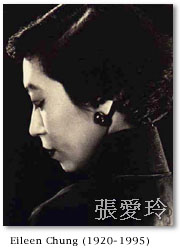
Eileen Chang 1920 - 1995“Lust, Caution” is a short story written by Eileen Chang (Zhang Ailing), a writer born 1920 in Shanghai. Chang attended the University of Hong Kong from 1939 to 1941, majoring in Literature.  As the Japanese invasion advanced to Hong Kong, Chang had to cut short her education there and return to the then Japanese occupied Shanghai in 1942, where she began her vigorous writing career.  In a few short years she had gained popularity as a novelist, short story writer and essayist.

Eileen Chang had been compared to Eudora Welty and Katherine Mansfield, and was considered one of the few eligible contemporary Chinese writers as a candidate for the Nobel Prize for Literature.  In 1952 she went back to Hong Kong and continued to publish, finally moving to the United States in 1955. A year later she married the scriptwriter Ferdinand Rehyer.  After Rehyer’s death in 1967, Chang continued to be prolific as a writer and translator of her own works, many of which had been turned into screenplays.  The more well known ones include Red Rose White Rose (1994), and Love in a Fallen City (1984), garnering numerous nominations and awards.  Apart from writing, Chang had also taught at Radcliffe College and UC Berkeley.  She lived reclusively in the latter part of her life and in 1995, died alone in her apartment in Los Angeles.

Chang’s style is crisp and explicit, her choice of words sharp and sensual, her subject matter contemporary.  Considered progressive in her days, Chang boldly dealt with the dichotomies of eastern and western cultures, tradition and modernity, and inevitably, male and female power relations, love and betrayal.  “Lust, Caution” the short story exemplifies her style and encompasses these subject matters.

In ‘Lust, Caution’, Chang has demonstrated that she is a master of story-telling.  Her talent lies in her succinct and incisive descriptions, the economy of words.  It is this feature that the 39-page short story is so compelling and memorable.  The story moves swiftly, effectively spilling the thrill and suspense, and bringing its reader to an intense and hard-hitting climax and ending.

Following the succinct style of Eileen Chang, here’s a synopsis of the story.  Wang Chia-chih, a university student, was recruited by a group of amateur student resistance to play a role in the assassination of Mr. Yee, the head of the secret police in the collaborative government in Japanese occupied Shanghai during the 1940’s.  Her mission was to seduce Mr. Yee and gain his trust, setting the stage for her fellow resistance members to strike.  Throughout the story, Chang intertwined the elements of love and lust, loyalty and betrayal, mass patriotism and individual desire to effectively move the story to an explosive climax.

lust-caution-chinese-book-cover-larger-size.jpg

The Special Limited Chinese Edition I have is some sort of a movie tie-in edition.  It includes the 39 page short story, printed pages of Chang’s orginal handwritten manuscript, an article written by herself in defence of her story against a critic, and another short story published posthumously.  It is published by Taiwan’s Crown Publication, just freshly out in September, 2007.  If you read Chinese, this is a valuable collector’s item.

THE TRANSLATION

Lust Caution English TranslationThis movie tie-in English edition (New York: Anchor Books, 2007) is aptly translated by Julia Lovell, professor of Chinese history and literature at the University of Cambridge.  True to the style of Chang, Lovell’s translation is succinct and incisive, moving the story swiftly and thus enhancing the suspense and intrigue.

I find her Forward particularly helpful in that she included her own insight on the characterization, furnishing her readers with the essential background to Chang’s own life, which paralleled the protagonist Wang Chia-chi.  Her discussion on Chang’s writing style and the political realities during the Japanese occupation of China in WWII is particularly useful for one to appreciate the story.

Lovell’s commentary is lucid: “…[the climax and ending] give the story its arresting originality, transforming a polished espionage narrative into a disturbing meditation on psychological fragility, self-deception, and amoral sexual possession.”

This little book includes as well an Afterword by director Ang Lee, and a provocative essay by screenwriter/producer James Shamus, who also teaches at Columbia University.  A good read on its own.  If you read English, this is a keeper.

THE MOVIE

Lust Caution

I must admit, I had read the story in its original Chinese version twice and the English translation once before I went to see the movie.  Whether this could have affected my opinion can well be a possibility.  I went into the theatre with high expectations after reading the numerous reviews and comments from LC fans.  I was also aware that a movie should be judged on its own merits as a different artistic genre from the literary work.  After all, I had written on this topic in my post Vision not Illustration.

As a Chinese film director, Ang Lee has the advantage of visualizing Eileen Chang’s story as an insider, one who is in touch with the language, and the sociocultural and historical background.  Armed with these qualifications, Lee has successfully created an appealing atmosphere of nostalgia and exotic visualization through cinematography and symbolism.  He has laid out for his viewers a delectable visual feast.

But maybe because of his very attempt at perfecting the mood and setting up in details the scaffold of the story, Lee (or should I say the screenwriters James Schamus and Hui-ling Wang) had taken a bit too much time in the process.  I feel the 158 minutes could be shortened to keep alive the element of suspense. Further, being an experienced and talented director as Ang Lee, I’m sure if he so chooses, he can think of different ways to portray passion and possession without explicitly telling so by mere graphic eroticism scene after scene.  Ironically, the raw erotic displays may have robbed the viewers of the very emotions the director has intended for them.  I long for the swiftness of Eileen Chang and the subtlety of Wong Kar Wai as he did with In the Mood for Love (2000, also with Tony Leung).  Especially when one considers the laconic and intense climax bursting out at the end, the earlier part of the movie seems to be disproportionately long and off-balance.

As far as the delectable feast goes, the period costumes and setting, the cinematography, as well as the performance by the highly skilled actors Tony Leung and Joan Chen are all laudable and must be given credits.  As a first time actor, Tang Wei is proficient in capturing the ambivalence of conflicting emotions and longings as Wang Chia-chih.  American born singer/actor Lee-Hom Wang is adequate as an amateur student resistance leader.  Ironically, just because of his lack of experience in acting fits well with his role, depicting the raw naivety of the young patriots of the time.

Despite the concerted efforts of the cast and crew and the well intentions of the director, the film is bogged down by a script that ought to have been shortened by at least a half hour to bring out the element of suspense, and keep the integrity of the spy-thriller genre.  In her defence of the brevity of description in her story, Eileen Chang wrote, “I never underestimate the critical thinking skill of my readers.”  If the screenwriters had marked her words, the film would have been much more effective and gratifying.

~~2 1/2 Ripples
Snow Cake: Autism and Beyond

Snow Cake

Snow Cake (2006)–For those who wait for a movie to come out on DVD before seeing it, here’s a recommendation. Snow Cake came out a few months ago on DVD but is still on the current release shelf. It opened the 2006 Berlin International Film Festival with a gala screening, and was shown at numerous film festivals last year including the TIFF.

Seems like a long wait, but well worth it. And for those who have already seen it in theatres, the DVD release could well be the second wind. Considering all the special features of interviews with director and cast, as well as the quality deleted scenes, you might want to keep this one.

Filmed in Wawa, northern Ontario, the Canadian and British collaboration is one of those gems that can be found quite readily in the indy batch. Welsh director Marc Evans has won several European film awards. On top of his sensitive handling of the story, the film benefits greatly from an amazing cast.

Alan Rickman is Alex Hughes. While driving through Ontario to Winnepeg,  he picked up a young hitchiker, Vivienne (Emily Hampshire, who was nominated for a Genie for this role).  During the trip they got into an accident and the girl was tragically killed.  Propelled by guilt and responsibility, Alex went to look for Vivienne’s mother Linda, played by Sigourney Weaver, in the town of Wawa.  Upon finding her, it did not take long for him to notice that she had received the news with a very different light. Linda was autistic. From his short stay with her, coming to invovle in Linda’s life and getting to know her mysterious neighbour Maggie (Carrie-Anne Moss), Alex drove on to his destination a few days later with a new perspective on himself and his ordeal.

Even though short-lived, Vivienne’s character is memorable. Her enthusiasm for life and acceptacne of those around her underscores the film.  The sound of Broken Social Scene adds a touch of lively, contemporary flare, like a tribute to the affable character of Vivienne. In contrast, Alan Rickman’s role as Alex is painfully affective. At times it is heartwrenching to watch as he deals with his internal torments as the story reveals itself.

Sigourney Weaver had spent a whole year researching on autism to ready herself for the role of Linda.  And for most parts, she has delivered a convincing performance. But it is the screenwriter Angela Pell that has so poignantly depicted the limitations but also the different views and insights an autistic person can offer those who are considered ‘normal’. Pell has mingled her characters, autistic or not, into a pool of humanity, revealing the indistinguishable, common thread joining them all.  Her script is at times very funny, and at times permeates with pathos. Through the words of Linda, the punchline is delivered ever so aptly at the end. Angela Pell has indeed written from her heart and her own experience.

She is mother to a nine-year-old autistic son.

~~~3 Ripples

Vision not Illustration

Read a post entitled “It’s All About the Story” on the Austenblog relating the controversial remarks the Welsh filmmaker Peter Greenaway made recently in an international film festival.  He criticised modern blockbusters like the Harry Potter and Lord of the Rings series, dismissing them as “not films but illustrated books”.  As for all the Austen movies sprouting up in recent years, Greenaway said:

Cinema is predicated on the 19th-century novel.  We’re still  illustrating Jane Austen novels—there are 41 films of Jane Austen   novels in the world.  What a waste of time.”

This is my response.  I recognize that not all attempts of turning books into films are successful, many far from being effective.  However, a good movie should be the portrayal of a vision, not mere illustration or graphic representation of the written words.  As I have commented in that post, let’s just say a film is the visualization of the novel, not mere illustration.

And there is a major difference between vision and illustration: the former is seeing through an interpretive lens, rather than simply transferring images from one medium to another like the latter.

That’s why we may like a certain adaptation over another of the same Austen novel, and that’s why there can be more than one movie on the same story… Just as Bach had created Theme and Variations, we can have Story and Adaptations. That’s the reason why we still go to the concert hall and listen to different masters playing the same pieces of music, infusing into their performance their own unique persona and interpretation.  As an art-house filmmaker, Mr. Greenaway should have grasped this very fundamental notion.

As for future endeavors to turn Austen novels into films, I say, “All the best!”

Field of Dreams: Baseball for the uninitiated?

Saw Field of Dreams (1989) on AMC last night, and this time, it hit me harder.  Watching the movie again has stirred up some ripples, deeply and belatedly.  To say that Field of Dreams is about baseball is like saying Cinderella Man is about boxing.  Movies like these speak to us not because we are necessarily sport enthusiasts, baseball or boxing fans, but that we, every one of us, belong to a family, or at least in memory, and that we are a part of the human race.

By heeding a voice telling him to build a baseball field in his cornfield, Ray Kinsella unknowingly began a journey of reconciliation.  Using baseball as a springboard, and through the characters and the ingenious twists in the story, the movie leads its viewers, who are as unknowing as Ray, to taste the almost mythical reality of dreams fulfilled, past yearnings realized, and lost relationships redeemed.  The film satisfies by simply portraying the very possibilities that these miracles can happen.

It is because of these universal themes that the film can reach far beyond nationalities and borders.  In fact, the original story is not written by an American.  The movie is based on the book Shoeless Joe, which is written by a Canadian author, W. P. Kinsella.  Born in Edmonton, Alberta, Kinsella used to teach English at the University of Calgary.  (I still remember listening and taping his interview on a CBC radio program…oh, those were the days.)  Among the numerous awards and nominations the movie has garnered including an Oscar Best Picture nomination, it won the 1991 “Best Foreign Film” category in the Awards of the Japanese Academy.

Critics who love to associate Kevin Costner only with Waterworld should at least remember that, he is the man who brought us such American modern classics as Field of Dreams and Dances with Wolves….all other failings are forgiven, easily.

~~~3 Ripples

Landscape, Seascape, and Mindscape

“For oft when on my couch I lie
In vacant or in pensive mood,
They flash upon that inward eye
Which is the bliss of solitude;
And then my heart with pleasure fills,
And dances with the daffodils.”

– William Wordsworth

What can be retained in travels are the images etched in the mind…the thoughts and feelings they had evoked.  As time passes, we can still relive those moments as we extract the gems from our mindscape.

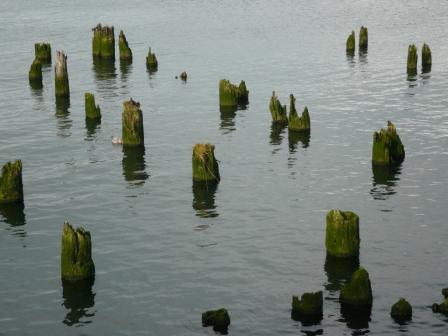
blog-pilings-in-astoria.jpg

These pilings once formed the foundations of houses built on the waters of Astoria. They are now resting posts for cormorants and gulls. Once useful for human settlement, they now blend in the natural seascape like mazes for the birds…still offering a haven of rest despite their weathered and beaten forms.

pilings-in-astoria-ii.JPG

The old and the new can co-exist in the elasticity of the mind.  The human imagination and creativity can reach boundless horizons, and connect timeless landscapes in the mind’s eye.

blog-trolley-in-astoria.jpg

Trolley in Astoria, Oregon

.

blog-disney-concert-hall.jpg

Frank Gehry’s Disney Concert Hall in L.A.

Disney Concert Hall, L.A.

Photos taken by Arti of www.rippleeffects.wordpress.com,

October, 2007. All rights reserved.

To read more about Frank Gehry, the architect who designed the Disney Concert Hall, Click Here.

Becoming Jane (2007)

I’ve delayed watching this movie till now.  I wanted to avoid all that hype about Jane Austen.  Even as a JA fan, I’ve hesitated jumping on the Austen bandwagon of what I suspect to be mere commercialism.  Well, after a few months waiting for the dust to settle, I went into a second-run movie theatre this crisp October day with very little expectation, and was pleasantly surprised…I thoroughly enjoyed the movie!

Becoming Jane

As I mentioned in my reply to a visitor who had left a comment on my WWAW post, like many of life’s simple pleasures, a movie does not have to be ‘deep’ to be enjoyable.  However, simplicity does not mean superficiality.  Becoming Jane is heart-felt story-telling.  It has many witty renderings especially carved out for Austen readers, like the mirror images reminiscent of Pride and Prejudice.  The first part of the movie moves along breezily with its humour; but it is the sombreness in the latter part that makes the story so poignant.

Based on the recorded short-lived courtship between Austen and a young lawyer named Tom Lefroy, the backdrop of the movie has its historical accuracy:  the Austen family, Jane’s close relationship with her sister Cassandra, the inequitable social environment wherein Jane as a female, had to write anonymously, and the torment that one had to face having to choose between marrying to survive and marrying for love, and suffer the social disgrace and financial ruins resulting from it.

Other than the basic background, the movie never intends to be a serious, historically grounded account.  It is pure fiction, and as one of the contemporaries of Jane Austen the Gothic writer Ann Radcliffe says in the movie,  it is the imagination, and not real-life experience, that gives rise to story-telling.  From this spirit evolves the beautiful story of Becoming Jane, purely imaginary, idealistic, noble, and yet painfully poignant.  The movie leads us ever so subtly to realize the bitter taste of love over the sweetness of romance.

The simple script will not work if not for the great acting, or understated acting rather, of all its cast members.  Anne Hathaway has once again robbed the Brits of a coveted role, yes, an American playing one of the best-loved British authors (The other one I’m thinking of is Renée Zellweger playing Bridget Jones). James McAvoy is comparable in his charm as Tom Lefroy.  The supporting roles are all played by excellent veterans like Maggie Smith, Julie Walters, Ian Richardson, and James Cromwell.  Anna Maxwell Martin as Cassandra provides immeasurable support to Hathaway.  I was deeply affected by her lead role as Esther Summerson in the BBC production of Bleak House (2005).  Here once again she has demonstrated that her acting is superb.

I have enjoyed the cinematography, the costume, the music, and yes, even the disheartened twist at the end.  I came out of the movie theatre contented.   So what if the story is pure speculation.  Sometimes it takes the imaginary to lead us to look more directly at love, life, and the choices we make.   Maybe that’s why we are always drawn to stories, fiction … and movies.

~~~3 Ripples

Hollywood loves Astoria


        Astoria, Oregon (1904)


After a nauseating night on rough sea sailing from Vancouver, I was relieved to plant my feet on solid ground the next day in historic Astoria, the oldest city in Oregon.  Lewis and Clark explored this area by the mouth of the Columbia River in 1805, and were impressed by the pristine river valley.  Six years later Fort Astoria was set up by the first American millionaire John Jacob Astor.  Since then, Astoria has been known for its rich fishery resources.  By the late 1800’s, it was basking in the fame of the “salmon-canning capital of the world”.  Today, this town of 10,000 lures tourists from land and sea to its serene setting, unique antiques and arts and crafts stores, character Victorian homes and rolling hills.

So, what does Asotria has to do with movies?  Lots.  Just as its link to the history of the Pacific Northwest and the Lewis and Clark Expedition, Astoria has a long history with Hollywood.  In 1908, the first movie made in Oregon, The Fisherman’s Bride, was shot in Astoria.  Well, that may not ring a bell, but since then, other more well known productions have also selected Asotria as location for filming.  These include: 

The Great Race (1965), The Black Stallion (1978), The Goonies (1984), Kindergarten Cop (1990), Free Willy (1992) & Free Willy II (1994), Teenage Mutant Ninja Turtles III (1992), Ring II (2004), and most recently, Into the Wild (2007)…just to name a few.

But what really caught my attention was the concert that I missed.  During a week in July of this year, there was the Astoria Festival of Music, held in the town’s Liberty Theater.  One of the highlights was the virtuoso violinist Elizabeth Pitcairn, performing John Corigliano’s Red Violin Chaconne, and yes, playing on her 1720 Mendelssohn Stradivarius, the very instrument that inspired the 1999 Academy Award winning film The Red Violin.  

Indeed, lots are happening in this small, serene town of 10,000.        


Pride and Prejudice on my BlackBerry

For a more updated post on eReading, CLICK HERE to go to “The Great Gatsby On My iPhone”.


pride and prejudice book cover

How do you keep in touch with the Classics in this techno-postmodern age?  Just like you can listen to Bach’s Goldberg Variations on your iPod, you can also read up on the Bennet vs. Darcy saga on your BlackBerry.  That’s what I’ve been doing this past month.  Everyday, I receive through my email in serial, one of the total 149 parts of Jane Austen’s Pride and Prejudice sent to me by Daily Lit, an on-line elibrary… So, wherever I may be, whenever I can grab a moment, I’m accessible to news from Longbourn and Pemberley just by pressing a couple of buttons on my cellphone…oh the conveniences of modern technology, making time-travel easy.

But of course, if you’re reading the book the first couple of times, I don’t recommend you do it this way.  Nothing can replace holding a real book in your hands, lying in the couch or in bed, turning the actual pages of an Austen classic as you savor every word Elizabeth has to say in response to Darcy’s marriage proposal.  But if it’s your fourth or fifth reading, there’s no harm getting it electronically just to touch base.  It’s pure convenience…no books to carry with me; actually, I’ve more than one book sent to me this way.  Daily Lit carries most of the well known classics, including works by Austen, Balzac, Conrad, Dostoyevsky, Eliot, Flaubert,…oh, you name it.

Exciting?  Just imagine reading a section of Moby Dick while waiting for your favorite sushi in a restaurant.  Or, catching up on War and Peace during half-time between the Oilers and the Flames (I’m writing from Alberta after all).  Or how about Taming of the Shrew while anticipating the bride to walk down the aisle in a wedding?  Wouldn’t it be a great use of your idling time in the frenzy of urban living?

…Oh yes, the other book I’m reading on my BlackBerry?  … The First Book of the Bible, Genesis.


CLICK HERE to go to my three-part review of Pride and Prejudice (1995, BBC Production).

WWJW: What Would Jane Write?

thejaneaustenbookclub2

The Jane Austen Book Club

Calgary International Film Festival 2007

Some time ago, I was using the phrase “intellectual chick lit” to describe the book Literacy and Longing in L.A. to a friend and was instantly retorted with: “Isn’t that an oxymoron?”  I had no reply.  Maybe to respond to the bad rap “chick lit” and “chick flicks” have been getting, a few writers have infused literary ingredients in their concoction in their attempt to create more intelligent work.  The Jane Austen Book Club falls into this short list.  The book written by Karen Joy Fowler (2002 Pen/Faulkner Award finalist) was turned into sceenplay by Robin Swicord (Screenplay, Memoirs of a Geisha, 2005) who made her directorial debut in the movie.  I had the chance to view it on the first day of the 2007 Calgary International Film Festival.

The book club is established with the original intent of consoling Sylvia, who is recently divorced from her husband Daniel.  It is a plan conceived by her good friend Jocelyn, a never-been-married dog breeder.  Following the theme of Austen’s Emma, Jocelyn has brought along the only male, Grigg, to the club, intended for her friend Sylvia.  What follows is the expected outcomes, Grigg falls for Jocelyn instead of Sylvia, who later reconciles with her estranged husband, while the other members of the group also are either hooked up with new found love or have their relationships mended.  Very neat, very happy, very clean ending.  Is this what Jane would have written if she were around today?

TJABC reminds me of the British movie Love Actually, which was released during the Christmas season in 2003.  Dealing with the love affairs of eight different couples in the midst of the hustle and bustle of the season has got to be a swift and jolly feat.  The movie remains a montage of famous British faces delivering superficial Christmas cheers under the banner of love.  TJABC has just slightly fewer characters, with six members in the group responsible for leading discussion on one of the six Austen novels.  Despite the juxtaposition and parallels of Austenian motifs and plots, I feel that both the movie and the book circumvent the periphery of contemporary life and relationships without offering much depth and insights as Austen’s own work. But of course, who is comparing Fowler with Austen?  Having said that, I must say I’ve enjoyed the acting of some of the characters, especially Prudie (Emily Blunt, The Devil Wears Prada, 2006), and Hugh Dancy (who would have thought he’s a Brit?)

Coming back to my original question:  What would Jane Austen write in this 21st century?  Would she fall for “chick lit” that can be turned into romantic comedies, for good cheers or box office successes?  Would Jane Austen be a mere romance writer, or “chick flicks” producer? Carol Shield noted that Austen’s heroines “exercise real power”, given their disadvantaged social positions.  Martin Amis stated “her fiction effortlessly renews itself in every generation.”  Virginia Woolf said about Austen’s writing: “That was how Shakespeare wrote.” Harold Bloom commented on the somberness of her work.  Thornton Wilder claimed that Austen’s “art is so consummate that the secret is hidden.”   Fay Weldon summed it up well:  “I also think … that the reason no one married her was … It was just all too much.  Something truly frightening rumbled there beneath the bubbling mirth:  something capable of taking the world by its heels, and shaking it.”  Thanks to Fowler for including such commentaries at the back of her book.

Austen is a sharp and incisive social commentator of her time, a progressive thinker holding a sure sense of morality, and a brilliant observer of human nature and relationships.  Her wisdom is well crafted in the disguise of humor and satire, her vision covered under seemingly simple, idealistic fervor.   Her critique of the manner and injustice of society, if transferred into modern day context, might not appeal as “chick” or as “romantic” as many of us would want to see, or can accept.

What would Jane write?  Definitely not “chick lit”.

~~1/2 Ripples for both book and movie

Garfunkel In Calgary

The frizzy blond hair was still there, but the face belonged to a 65 year-old man.  What was gripping though, was the same soft, angelic, tenor voice that was unmistakenly … Garfunkel.  No, we didn’t buy a ticket to listen to the youthful folk singer we once knew, but what we’d purchased was an encounter, an experience, probably once in a lifetime, to see the iconic Art Garfunkel, the voice of our youthful past.

“Many a times I’ve been mistaken, and many times confused…” The haunting melody and the captivating lyrics of American Tune opened the concert.  The face might have changed, yes, a great deal, but the sound remained, and along with it, the soul-searching quietness once again overcame me.

The circumstances might have changed, but the sentiments linger…”After changes and changes, we’re more or less the same…after changes, we’re more or less the same.”

What followed were the satisfaction of listening to the original voice singing the familiar tunes of Homeward Bound, Scarborough Fair, and The Boxer.  What was regrettable, of course, was that we missed the harmonizing singing of the song creator, Paul Simon.

Backed by four talented band members, many of the familiar Simon and Garfunkel numbers had been re-arranged and improvisations added to make  new renditions of old tunes, allowing Garfunkel to perform as a soloist. The singer had stepped aside many times to let the band and each musician shine in the limelight.  Well, no matter how much it was altered, as soon as the audience recognized the introductory bars to such great classics as Mrs. Robinson, Bridge Over Troubled Water, and The Sound of Silence, unbridled excitement, cheers and applause would break out.  I’d noticed that for many in the Jubilee Auditorium tonight, the concert could well be a chance to savor a piece of their past, awaking them to some long forgotten youthful longings, idealism, and the yearning of a better world.  But what I didn’t understand was, why did those relatively young females in the audience jump to their feet, swaying, dancing and clapping to the tune of Cecilia?  How old were they when Simon and Garfunkel first sang that song?  I then realized that the work of the iconic duo transcends generations, their lyrics and melodies mesmerize audience of all ages.

Garfunkel also sang several of his newer titles, changing the mood of the concert hall with jazzy overtone, or moving into a more contemporary number written by Randy Newman.  But it was the Simon and Garfunkel songs that elicited the most applause, bringing the audience to a standing ovation several times.

At one point, the singer introduced a song by reading a prose poem from a collection of his own writing.  Here, I see Garfunkel the reader transformed into Garfunkel the writer.  The singer is known for his wide reading interest, which is impressively chronicled in the Garfunkel Library, a site that records the books he has read since 1968 up till 2006, almost a thousand titles in all.  Here in the concert, the singer shared his own writing with the audience, reading a prose poem from a collection of his published work, as an introduction to a song written also by himself.

The concert is part of a Green Planet Concert Series presented by the Pembina Institute, a national enviornmental organization.  The displays in the foyer outside the auditorium had raised awareness of wind power and other safe and sustainable energy solutions.  The sound and atmosphere inside had evoked reminiscence of mindscapes sustained by soul-searching melodies and lyrics.  A powerful evening inside out.

~ ~ ~ 3 Ripples

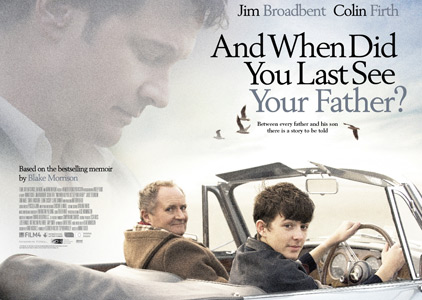
When Did You Last See Your Father?

when-did-you-last-see-your-father

I have the chance to soak in the frenzy of the Toronto International Film Festival (TIFF) these past few days in the big TO. The largest film fest in the world, this year TIFF offers over 300 films from 60 countries from September 6 to 15, a delectable smorgasbord for movie lovers . On Saturday, Sept. 8th at 7:00 pm, while the enthusiastic crowd gathered along the barricades outside the Elgin Theatre on Yonge Street, hoping to get a glimpse of Brad Pitt on the red carpet, I lined up patiently with a less boisterous group of ticket holders outside the same building an hour early to get into the Winter Garden Theatre for the premiere screening of When Did You Last See Your Father?

Based on the award-winning and highly acclaimed memoir written by British author Blake Morrison, WDYLSYF is a fine piece of artistry crafted by some of today’s top British talents. Director Anand Tucker’s work includes the Oscar nominated and BAFTA winning Hilary and Jackie (1998), and co-producing Girl With a Pearl Earring (2003), another Oscar nominee and numerous European film award winner. The stellar cast of WDYLSYF is led by Jim Broadbent and Colin Firth, playing father Arthur and son Blake Morrison, with strong supporting roles from Juliet Stevenson as the mother and newcomer Matthew Beard, who plays the teenage Blake.

When Did You Last See Your Father

The words “A True Story” in the opening credits prepared the audience for something real and meaningful. We were led to explore a multi-layered and poignant story about a fragile father-son relationship that is brought to the forefront at the father’s imminent death from cancer. Jim Broadbrent could well deserve an acting nomination as the ailing father, headstrong, overbearing, and ever the victor in whatever circumstances, even in the face of terminal illness. Colin Firth aptly portrays the middle-aged Blake, already an acclaimed writer and poet, yet still waiting to hear from his father the two precious words he has longed for all his life: “well done”.

Intense but not draining, the director effectively sprinkles enough comic relief at the right moments to move the story along with poignancy but steers the viewers away from sentimentality. I always think that Colin Firth excels in subtle, understated acting, his every gaze speaks volume. Here again he has shown once more that he is a master of this craft.

However, I must admit that Matthew Beard, a first time film actor who plays the teenage Blake shines with his natural and superb performance, bringing out the love/hate sentiments he has harboured towards his father from the various situations he has been pushed into, such as the reluctant camping trip, the impromptu driving lesson, the numerous embarrassment and even public humiliation he has suffered from his father’s brash and insensitive comments…but above all, from the burden he has to bear as a witness to the wrongs of his own parent.

The restrained acting by the stellar cast effectively conveys the pathos and conflicting family relationships as well as the ambivalence of a son trying to come to terms with resentment towards a callous, egotistic, and dying father. Firth’s subtle characterization of the adult Blake poignantly portrays the crux of his torments. It is a painful relief at the end of the movie when he realizes that sometimes one has to resolve anger and disappointment on one’s own, unilaterally, including the most difficult discipline, forgiveness and the letting go. If the victim has forgiven, should the witness keeps on holding grudges? There’s no simple answer, and the film has successfully dealt with such conflicts through the multi-layered characterization and the reflective shots through mirrors in many scenes.

Filmed mostly on location in beautiful Derbyshire, England, the movie’s inspiring cinematography works like a soothing balm, together with the light-hearted and nostalgic childhood scenes, the film is an enjoyable visual treat. Again, such is the real portrayal of the issues we face, natural beauty can sometimes offset the darker side of human nature. Humour and pathos can co-exist.

A bonus in going to film festival screening is the chance to hear the makers of the movie reflect on their work. The audience was pleasantly surprised to see the director Anand Tucker and actor Jim Broadbent come on stage to answer questions after the movie. Listening to them, I felt that I’d only discovered the outer layer of a very complex and pleasurable artifact that I wanted to see the movie all over again.

And so I did two days later.

~ ~ ~ Ripples

______________________


To read my review of the book And When Did You Last See Your Father? Click here.