Paris in July 2025 – Delightful reads by Antoine Laurain

For Paris in July this year, I want to read an actual Parisian author writing Parisian stories. I did some digging and found Antoine Laurain. I’m late to the party, for Laurain has written more than a dozen books, which have been translated into twenty languages, an award-winning novelist whose talents are multi-faceted: author, journalist, screenwriter, film director, antique collector and dealer.

I’ve read or listened to four of Laurain’s novels in the past weeks: The Red Notebook (2014), The President’s Hat (2012), The Readers’ Room (2020), and The French Windows (2024). I still have many more to savour. These ones I’ve read are all like novellas, less than 200 pages, each unique in its storyline, very entertaining, easily accessible but not shallow. Laurain’s writing is a fusion of the literary and the popular, weaving suspense and romance, or adding a dash of magical realism as in The President’s Hat. Among these four, The Red Notebook is my favourite.
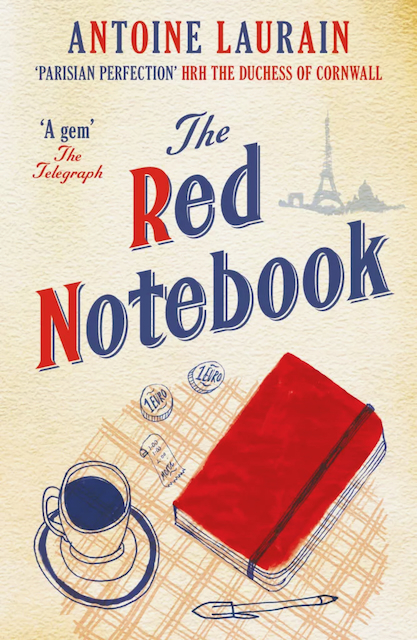
The Red Notebook by Antoine Laurain, Gallic Books (English edition), 2015,
159 pages.

Ahh… The contentment of being sought and found… and to be known.

Laurent, a bookstore owner, finds a woman’s leather handbag in good condition on top of a garbage bin on the street one morning, obviously stolen and discarded there. He takes it to the police station, but is told to wait. Doesn’t have time to spare, Laurent decides to leave it till the next day to hand it in. The mauve handbag is just too much of a lure for Laurent to keep his curiosity in check. That night at home, he opens it gingerly and explores the personal effects inside, hoping to find a name and address so he can return it to its owner.

Among the perfume, hair clip, keys, and numerous other items, there’s a red Moleskin notebook. Just too tempting, how can he not open it? The elegant and fluid handwriting records the owner’s self-reflections, her likes, her fears, her dream.

He had opened a door into the soul of the woman with the mauve bag and even though he felt what he was doing was inappropriate, he couldn’t stop himself from reading on.

It could sound creepy, but Laurain lets his readers empathize with this curious middle-age bookseller, for he is now a detective of the soul. And Laurain knows how to tell his story with humour. As he searches the bag, his girlfriend shows up, complicating matters. Later, adding zest to his quest, his daughter joins in his detective work readily and offers invaluable assistance.

Augmenting Laurent’s eagerness to find the owner of the bag himself instead of letting it go to the police is another object in the handbag, the book Accident Nocturne signed and with a line of dedication handwritten by the French author and Nobel laureate Patrick Modiano. The bookseller is overcome by a surge of passion, for Modiano is his favourite writer. Herein lies the clue to someone who shares the same mind as his. From the line of inscription, Laurent knows the first name of the owner of the bag, Laure.

While ordinary love stories might focus on a person looking for the right one to love, here in The Red Notebook, it describes the complementary side of the search as well, by revealing the one aspect which might be the most gratifying of true love: being sought and found… and to be known.

I like the idea of a man going to so much trouble to find me (no one has ever gone to so much trouble for me before)

While Laure has had men in her life before, but there has never been one who had really stepped inside her mind. Yet here is one stranger who has known and admired her inner being, and is passionate enough to go the distance to find her, and yet…

The ‘and yet…’ is purposely unwritten as I don’t want to give any spoilers. I highly recommend The Red Notebook as a light and entertaining read, one that touches that soft spot of the human heart, to be sought and found… and deeply known.

I await a filmmaker to take this up, write an English screen adaptation and set in New York City, find a perfect cast, and I’m sure it will make one marvellous rom com, or a little more serious but equally heartwarming rom dramedy.

Ah… Celine Song, would you be interested?

***

Paris in July 2025 is hosted by Words and Peace and France Book Tours
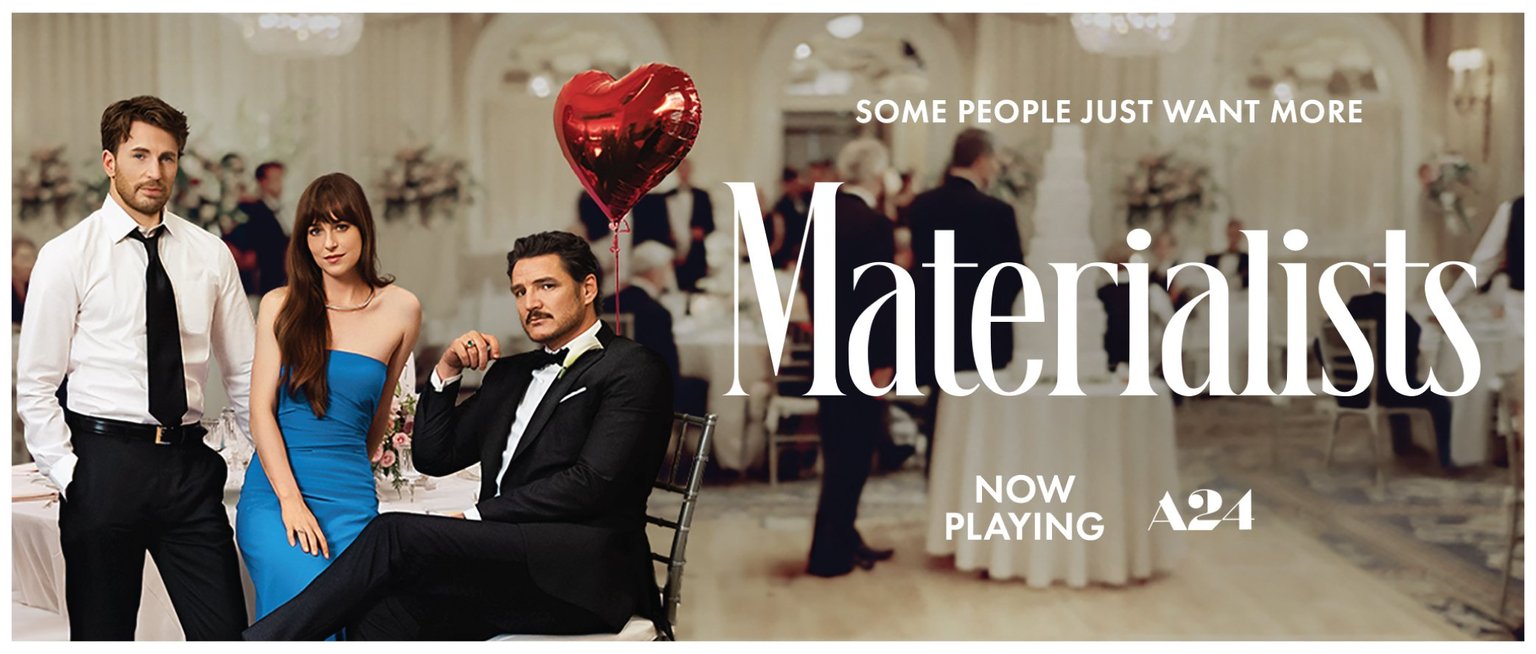
‘Materialists’ is a film Jane Austen would like

Marketed as a romantic comedy, Materialists, Celine Song’s (Past Lives, 2023) second film  defies categorization. Released by A24 just in time to greet summer viewers, the film isn’t quite like your traditional rom-coms. There are no LOL moments, but there’s humour throughout that elicits knowing chuckles. No slapstick acts, but movement made by the actors are often subtle but notable.  

The opening scene is a fitting prelude. A caveman courting his sweetheart, slipping onto her finger a ring made from the delicate stem of a tiny flower. Right after that, a stark change of scenery with a busy New York streetscape accompanied by the beat of Cat Power’s ‘Manhattan’, and the title credits begin to flash on screen. Tale as old as time… from prehistoric to modern day.

We see Lucy (Dakota Johnson) walk on in New York City with perky confidence, a successful matchmaker who has seen nine pairs of her clients tie the knot, so far. Lucy exudes such upbeat positivity that she can stop a man on the street and ask outright if he’s single, then hands him her business card. She possesses ‘an eagle eye for chemistry’, an expert in linking her clients by checking all the boxes for the right match: looks, age, height, weight, family background, education, income. Like transactions in the financial market, in Lucy’s business, people are the commodity, numbers on a spreadsheet. Materialistic measures reign supreme in a dating service. 

The satirical vibe is obvious. Isn’t that a modern-day parallel of Jane Austen’s time, where successful matrimony is dependent on financial compatibility. Pride and Prejudice (1813) is a prime example. Such is the view held by Mr. Darcy at first, and the reason why Lady Catherine de Bourgh is so furious when she sees an inferior nobody dares to compete with her own daughter. As for Mrs. Bennet, marrying up for money is what she dreams of for her five daughters. Only the heroic Elizabeth Bennet is brave enough to challenge the social norm and insists on her own criterion for marriage: love. 

Soon after the opening of Materialists, we come to the inciting incident. In her client’s wedding banquet Lucy meets Harry (Pedro Pascal), the brother of the groom. He checks every box: handsome, dripping rich, living in a $12 million Manhattan suite, 6 ft. tall, working in a family-owned private equity firm (is it still considered ‘work’?) a perfect 10 as a potential client. But Harry is not interested in Lucy as a matchmaker, but a date. 

As fate has it, in that same event, Lucy’s ex, John (Chris Evans), reappears in her life as a catering waiter. John is a struggling actor, trying to make ends meet, still sharing an apartment with roommates. Past memories flood back to them. Here we see a relational triangle similar to Song’s debut work, Past Lives. Thus kicks off the storyline, who does Lucy choose? A question as old as time. And for Lucy, the modern-day career woman who handles transactions that deal with external measures only, does love have a place? 

Song writes about what she knows, as Past Lives is autobiographical, Materialists is, interestingly, based on her stint as a matchmaker in NYC some years ago. As a director whose debut film was nominated for two Oscars, Best Picture and Best Original Screenplay, Song has proven herself to be a versatile filmmaker who can break out of the indie mode into the limelight of popular features.

The camera is a definite asset. Cinematographer Shabier Kirchner used 35mm film to shoot, bringing out cinematic aesthetics of old. Most notable is his camera work, many shots letting a still camera capture the nuances of two characters facing each other talking, maintaining a slower pace to allow the characters, and the viewers, to soak up the atmosphere and the deeper meaning of the conversations, an obvious digression from the breezy, traditional rom-coms. 

When viewers drop their own preconception of the actors’ previous roles, Evans as Captain America, Johnson her Fifty Shades sequences, and Pascal the apocalyptic survivor, the trio works well each in their own way. But the one that deserves mention is the supporting actress Zoe Winters who plays Sophie. The twists and turns of the storyline switch the second half of the movie to a different drive, one that feels like a suspense drama, and Winters delivers with heart-stirring effects.

My main issue with the movie, however, is probably related to Song being such a brilliant wordsmith in creating dialogues. In writing and especially now in a visual medium, the ‘show not tell’ axiom is all the more crucial. This is even more true when the subject matter is love. Other than hearing the word uttered, the film isn’t convincing enough to show the presence of that affective bond of passion which is so crucial in the ultimate outcome. ‘Love is a mystery,’ Song has said in her interviews. Such a mystery through the ages needs to be represented on screen by actions instead of just being mouthed in words.  

Nevertheless, overall, Song needs to be congratulated on transitioning from the indie to the mainstream arena with popular stars, and helming a production with her own style of cinematic artistry.

So what if Materialists doesn’t fit the mold of a rom-com? Why need to box it into a genre? As the opening credits state, and it’s a good description: ‘A Celine Song Film’. Let it be its own genre, the writer-director is in a class of her own. A very pleasant movie not just for the summer season, and one I’m sure Jane Austen herself would like to watch.

~ ~ ~ Ripples

***

Click here to read my Ripple Review of Past Lives

‘Past Lives’ and the Road not Taken

Hae Sung (Teo Yoo) visits Nora (Greta Lee) in New York, a scene from “Past Lives”. Photo courtesy of Elevation Pictures

“Past Lives” is a meticulously crafted feature that is autobiographical in nature, naturalistic in style, and far-reaching in its resonance. The directorial debut of Korean-Canadian playwright Celine Song who is now based in the US, it premiered at Sundance early this year and subsequently was nominated for a Golden Berlin Bear at the 73rd Berlinale. Most recently on July 2, its accolades continued at the Hollywood Critics Association Midseason Awards winning Best Indie Film, Best Actress for Greta Lee and Best Screenplay for Song.

Nora (Greta Lee), immigrated to Canada from South Korea when she was twelve, following her parents’ decision. As a child, she has always been Na Young (Moon Seung-ah), now given a new name, Nora, by her father as they prepare to leave. Her departure severs a close tie with her childhood sweetheart Hae Sung (Seung Min Yim).

Twelve years later, Nora makes a move to New York City from Canada in pursuit of a career in writing, a decision this time of her own choosing. While there, she happens to come into contact with Hae Sung (Teo Too) online. The two meet again via texts and Skype but that connection is short-lived as Nora initiates a termination, for she wants to focus on her writing career and setting roots in her newly adopted home. Fast forward some more years, Hae Sung comes to New York in person to seek her out. Nora’s past thus re-emerges. 

In a writer’s retreat, Nora meets Arthur (John Magaro) and they soon fall in love. When Hae Sung comes to New York, Nora has been married to Arthur for seven years. Despite being in a secure and loving marriage, Nora feels the conflicts of navigating between two men from the present and the past, as well as choosing a path for the future. ‘Yet knowing how way leads on to way’ as the poet Robert Frost poignantly utters, she laments the loss that comes with only one path to tread, one road to take. 

While it may sound like a typical immigrant story–the ambivalence of losing and gaining as one makes decisions about leaving one’s homeland to start a new life in a foreign country–Nora’s narrative ripples out beyond the immigrant experience. We are all constrained by time and space. Somewhere in our life, we are bound to have left behind a part of ourselves, our childhood, our roots as we move forward to another stage of life.

In the opening bar scene where Nora sits in between her husband and her childhood sweetheart, she is the interpreter of two languages, navigating between cultures, and juggling two identities of self. Nora finds herself acting as an intermediary between two men who love her but in different ways and as a different persona, Nora and Na Young. This is a real-life scenario Song had once found herself in and which became the initial spark of the making of “Past Lives.”

Arthur is in an awkward situation. In one of the pivotal scenes, an intimate husband and wife conversation in bed, he tells Nora that she speaks Korean in her dreams, “there’s a part in you that I won’t be able to know.” That part is the first twelve years of Nora’s life where Arthur was absent and which Hae Sung longs to recapture. Arthur admits, “I can’t compete.” However, instead of handling the conflict as a clichéd love triangle, Song has turned it into a cinematic pondering of life choices, what one leaves behind and what one gains in a new chapter of life. 

Magaro delivers a superb portrayal of the ambivalence in Arthur’s predicament. His screen presence and dialogues with Nora offer much clarity. As well, his is a character that has the power to elicit deep empathy from viewers, on top of adding some subtly humorous moments. I wish there is more of such screen time for this admirable role. Arthur’s mature love for Nora overrides any jealousy or traces of inferiority complex when Nora casually compares the two men, effectively shifting viewers’ attention from the reunion of childhood sweethearts to this third party, the loving and silent husband stepping aside to let his wife dwell on her past. 

And Nora appreciates Arthur’s love, albeit it doesn’t eliminate the lament she feels about the loss of a former self. Having transplanted in New York City, she has gained a new cultural identity as a ‘Korean-American.’ After meeting Hae Sung again, she finds him firmly rooted as a ‘Korean-Korean.’ Song’s dialogues are astute. Lee’s screen presence is affable and nuanced, a pleasant character with whom viewers can readily empathize. Hae Sung seems to subscribe firmly in In-Yun, the Korean concept of predestined fate.

Young Hae Sung (Seung Min Yim) and young Nora (Moon Seung-ah) part ways. Photo courtesy of Elevation Pictures

There is a recurring shot which speaks volume. A fork in the alley where young Hae Sung and Na Young walk home after school in Seoul. Two roads diverge. On the left is the boy continuing his way, on the right is his sweetheart, walking up the steps, two separate paths, two life trajectories. It’s not about taking the road less travelled as Frost would tell with a sigh, but the road not taken that keeps the traveller thinking what could have been. While such is a typical existential pondering of the immigrant experience as one leaves one’s homeland to start another life, it is also a universal question as we concede our limitation as humans, feeling the loss of opportunities or the what if’s with the road not taken. Song’s feature is like a visual depiction of Frost’s poem, illustrating a real life scenario. 

Song excels here in elliptical storytelling. Some sequences are almost dreamlike with blocked-out dialogues, or a still camera pointing at Hae Sung and Nora gazing at each other in silence; viewers are free to imagine what’s going through their minds.

However, with the short 105 minutes film duration, I feel more time could have been spent on a deeper characterization of Hae Sung in Korea. What kind of a man has he grown into other than merely the soju drinking young man or later just the outward changes in appearance; and how he still clings to a childhood image of Na Young now that they are adults. If Hae Sung can be developed into a more solid, three-dimensional character instead of like a ghost of Nora Past, the conflicts could have a more powerful impact. 

Surely, this is Nora’s story, and Lee has delivered effectively with pathos and realism. Further, Song has proven herself to be a filmmaker to watch in the future. 

~ ~ ~ Ripples

___________________________

I thank Asian American Press for the permission to repost my review here in full.