Small Things Like These: from Novella to Screen

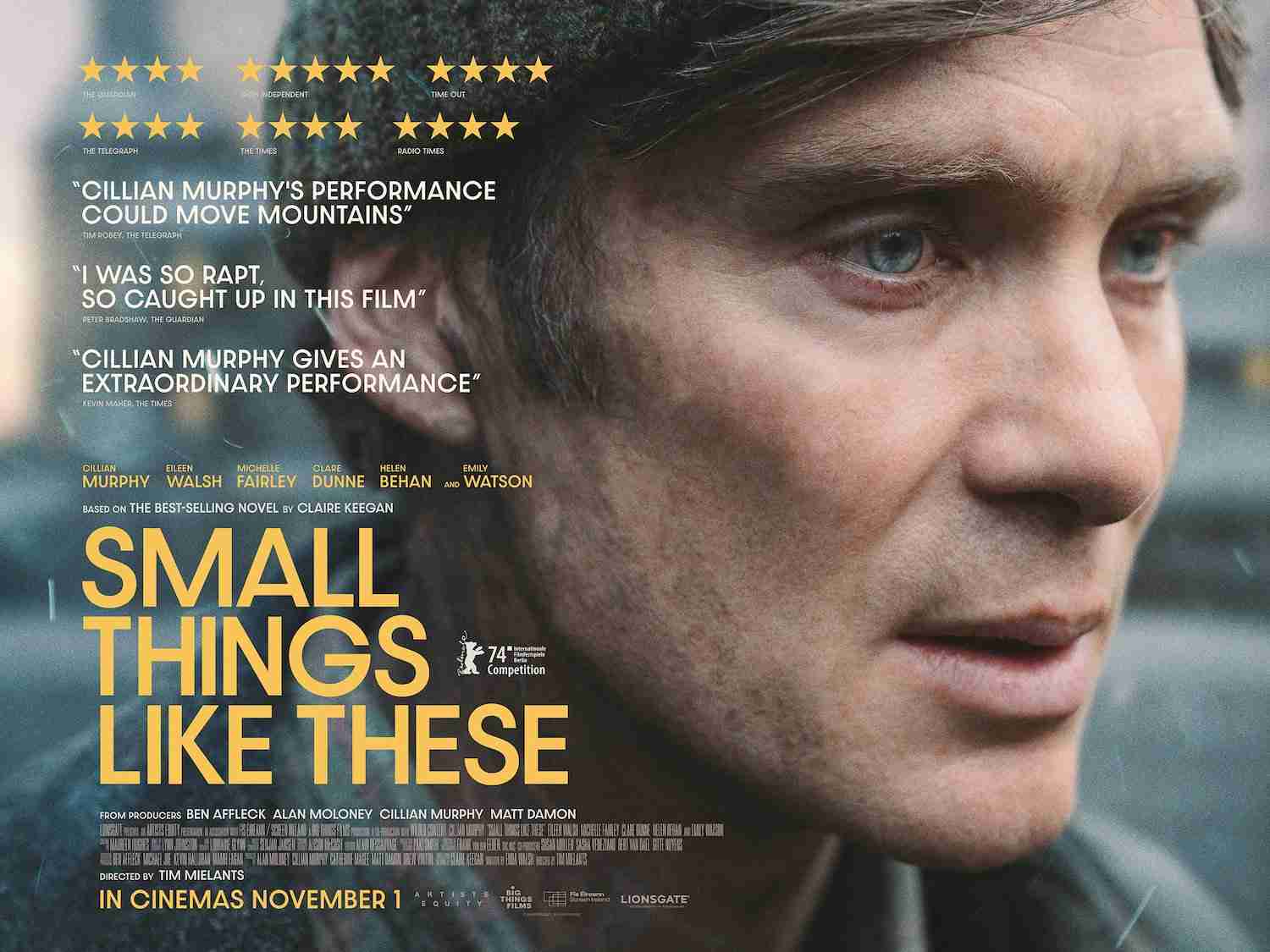
Here’s an interesting fact. Claire Keegan’s books Foster (2010) and Small Things Like These (2020), both have 128 pages. While short as a standalone book, both novellas exemplify Keegan’s style of writing: sparse descriptions that carry powerful punches. I’m glad to note that their film adaptations are worthy productions akin to her style, quiet, nuanced, and poignant. Foster is made into the film The Quiet Girl in 2022. (My review here) Small Things Like These is newly released, directed by Tim Mielants and starring Cillian Murphy, following his Oscar role as Oppenheimer.

Bill Furlong (Cillian Murphy, Oppenheimer) is a coal merchant in an Irish town. It’s Christmas time, cold and snowy, after the dirty lifting of heavy bags of coal, the devoted husband and father comes back to a warm household, wife Eileen (Eileen Walsh) has supper ready and his five girls make up the chirpy harmony of home. The uneventful routine is disrupted one day when Bill makes his delivery to the local convent, witnessing a rough handling of a teenage girl being shoved into the entrance of the Catholic institution. Another time, when he stepped into the building to deliver his invoice, a girl scrubbing the floor comes up to him begging him to take her away. The next time he makes his delivery, he finds the girl locked inside the coal storage, dirty and shivering in cold.
The Magdalene Laundries are institutions operated by the Roman Catholic orders to house ‘fallen women’, asylums notorious for their abuse of the young women there, unpaid workhouses doing laundries for profit, unwed mothers having their babies forcibly taken away to be adopted. There have been features and TV series on this subject but the most exposure for viewers outside the UK is probably the movie Philomena (2013) starring Judi Dench and Steve Coogan. The note at the end of Small Things Like These explains the historic context, dedicating it to the more than 56,000 young women who were sent to the institutions between 1922 and 1998 for purpose of “penance and rehabilitation.”

Following his Best Actor Oscar win as physicist J. Robert Oppenheimer whose work, albeit not fully within his control, had affected the result of World War II, here in Small Things, Murphy is equally effective in his portrayal of a coal deliverer, fighting an internal war of conflict, a moral dilemma, to act upon his conscience thereby counteracting an institution that is all powerful in his town, or just to keep silent and do nothing to safeguard the wellbeing of his family. His wife says to him clearly like a warning, considering his soft heart: “If you want to get on in life, there are things you have to ignore.”

Bill’s past is interposed with his present throughout the film, for he was orphaned as a child but was raised by a loving woman. The compassionate upbringing he received could well had formed his sensitivity towards others’ suffering. Murphy’s performance of a troubling soul is heart wrenching, nuances captured aptly by closeups. Another frequent closeup shot is his handwashing after coming home from work, cleaning with soap and brushing out the black coal soots in his hands almost obsessively, a visual telling of his reluctance to join in the darkness of the world.

It’s small things like these, courageous acts by a common man despite social pressures and the negative consequences for his own family that make Bill a heroic figure. All five of his daughters need to get a good education in the Catholic-run system in town. To be at odds with Sister Mary (Emily Watson) is to have the door shut on his girls in terms of education and a good future. All these details are readily available as one reads Keegan’s book, but for those who have no contextual background before watching the film, such consequences of Bill’s moral dilemma may not be so easily grasped by the viewer. The film does drop hints in a few dialogues and subtly in certain scenes. For a 98-minute feature, more elaboration to denote these issues could be helpful in terms of the congruence of the storytelling and especially in magnifying the price Bill has to pay for his courageous act of compassion.

Overall, a worthy adaptation of Keegan’s novella. Come awards time later this year, I hope to see Murphy being acknowledged for his performance here. It’s small films like this that make cinema arts gratifying aesthetically and meaningful socially in our world that needs constant critique and reflection.

~ ~ ~ 1/2 Ripples

Related Posts on Ripple Effects:

The Quiet Girl Movie Review: From the Literary to the Visual

Passing by Nella Larsen: from Novella to Screen

Novellas to Screen

***

Novellas in November is hosted by 746 Books and Bookish Beck
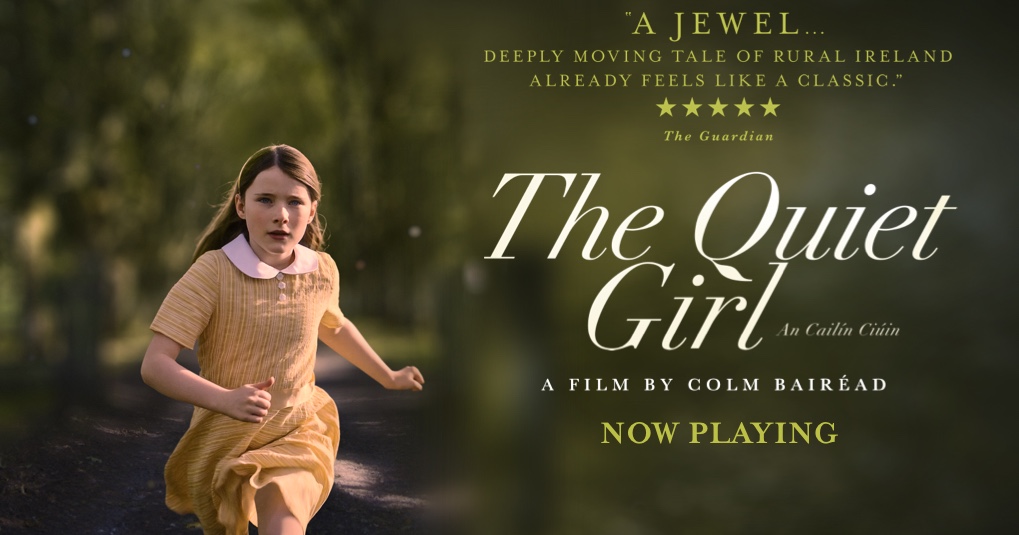
‘The Quiet Girl’ Movie Review: From the literary to the visual

The Quiet Girl (An Cailín Ciúin) is the first Irish-language film to be nominated for an Oscar, representing Ireland in the Best International Feature category in this year’s 95th Academy Awards held on March 12th.

In this his debut feature, Irish director Colm Bairéad adapts Claire Keegan’s short story “Foster” in a style that’s akin to the literary source. Together with director of photography Kate McCullough (Normal People, 2020), Bairéad has created on screen a sparse and sensitive rendering of Keegan’s story, camera shots that are calm storytelling and restraints that convey emotional depth. The choice of the 4:3 Academy aspect ratio gives the feeling of a time past, like an old home video preserving a young girl’s memorable experience.

Cáit (Catherine Clinch) is sent away to spend the summer with her mother’s relatives, Eibhlín (Carrie Crowley) and Seán Cinnsealach (Andrew Bennett). Having lived in an impoverished household full of siblings and one more expecting, with a father who takes ‘liquid supper’ before coming home and an overburdened mother, Cáit experiences for the first time in her short stay at the Cinnsealach’s quiet and childless farm home what it means to be cared for, and towards the end, learns that keeping silent can be an act of love.

Just like Keegan’s style of using the minimal to convey much, The Quiet Girl is sparse and sensitive in its visual storytelling. Eibhlín is shown to be kind right from the beginning, Seán less so, hardly acknowledges Cáit. His reticence is nuanced though, a slight turn of his head even when he’s facing the TV and with his back to the child betrays a moment of thought, of self-reflection. Seán’s coming around is endearing, like the moment he leaves a single cookie on the table as he walks by Cáit in the kitchen. Actions speak louder than words.

In the bedroom she’s in, Cáit observes the wallpaper with train images and the boy’s clothing she now wears, as her own suitcase is still in her Da’s car trunk as he has forgotten to leave it with her in his rush to leave. She observes her new environment and the people she’s with, and gets some shocking information when a nosy neighbor spills out the Cinnsealachs’ tragic past to her.

As one who has just read Keegan’s short story and been deeply moved by her writing, I come to this review not to compare how ‘faithful’ the film adaptation is, which it is, but that how some of the ‘cinematic moments’ in the book are transposed on screen.

Writer director Bairéad has added some scenes of Cáit in school and at home at the beginning of the film, enhancing the characterization of the girl, quiet and alone, even at home. While the ponderous visual storytelling deserves praise, I do find in certain moments, Bairéad could have added just a bit more dramatic effects, not for gratuitous purpose, but to elicit a more powerful punch towards the cathartic end.

[The following contains spoiler]

Two examples I have in mind. First is when Seán decides they should stop letting the girl wear the boy’s clothes and that he’ll drive them to town to buy Cáit new clothes for herself. That’s a defining moment bringing up a painful, unspoken past, and stopping their substituting Cáit for the one they had lost. Eibhlín is picking gooseberry at the kitchen table with Cáit. Here’s the excerpt from Keegan’s story about the very moment her husband tells them to go change and get ready to go into town to buy clothes for Cáit:

The woman keeps on picking the gooseberries from the colander, stretching her hand out, but a little more slowly each time, for the next. At one point I think she will stop but she keeps on until she is finished and then she gets up and places the colander on the sink and lets out a sound I’ve never heard anyone make, and slowly goes upstairs.

That sound that the girl has ‘never heard anyone make’ is bone chilling even when I was just reading the words, and would have been a most effective cinematic moment to convey pain and grief. Unfortunately what could have been a stirring moment for viewers did not materialize in that scene.

The second is more crucial, a scene that I take as the climax of the story, the girl’s accident at the well. More intensity in visual storytelling, or even just sound instead of the subtle handling of the incident––not for the sake of mere dramatic effects but to show the gravity of the mishap and its implications–– is needed to elicit more potently the poignant act of silence later when Cáit is determined not to mention the accident to her mother who has sensed something must have happened when the girl comes home sneezing.

The cathartic ending of the film is to be applauded for it has brought out Keegan’s powerful writing most vividly. What’s more heartrending than just reading is that we can see the face of the girl running and hear the final word she utters to Seán as she flies into his embrace. That is the power of film.

~ ~ ~ Ripples

__________________________

This is my third post participating in the Reading Ireland Month hosted by Cathy 746 Books.

Previous posts:

“Foster” by Claire Keegan: Short story review

The Banshees of Inisherin: Movie review

‘Foster’ by Claire Keegan

Reading Ireland Month 2023 has led me to the short stories by Claire Keegan. I’m excited for this ‘new discovery’. Keegan’s is the kind of writing I admire, sparse but telling, simple prose revealing deep emotional undercurrents. 

“Foster” the short story written by Keegan first appeared in The New Yorker. It was later published as a standalone work in book form in 2010. Keegan in an interview had stressed that it was not a novella but a long short story. The book cover in the photo is a new edition that came out in 2022.

The story is written from the point of view of a young girl from an impoverished family, both materially and emotionally. She is sent far away to stay with her mother’s sister Edna and her husband John Kinsella for the summer to lift the burden off her busy mother who has a house full of children and one more expecting. The Kinsellas are childless and live in a farm house in rural Wexford county.

The age of the girl isn’t mentioned, most probably around eight or nine. Interesting too that her name isn’t mentioned except just a few times, Petal, maybe giving a sense of the neglect she has been having all her young life. The title is ironic, I find, for the word foster often comes in contradiction in a lesser sense, or secondary, to natural birth parents. But here during her short stay at the Kinsellas, the girl has made new discoveries she has not experienced before, what it means to be loved and cared for, and begins to learn kindness and self-worth. Moreover, she is also exposed to the complexity and the dark range in the adult world, the loss and pain that come with life.

Foster has been adapted into film with the new title The Quiet Girl. It is Ireland’s official entry to the 95thAcademy Awards held this past Sunday, a nominee in the Best International Feature category, with its language being Irish (Gaelic). I still haven’t the chance to watch it, now a must-see movie for me. Hopefully I can watch it soon before the Reading Ireland event ends.

When I read “Foster”, I noticed that Keegan’s style is an exemplar of that writing advice we hear often: show, not tell. In some passages, Keegan instills in my mind visuals like watching a scene in a good film, actions and nuanced expressions speak clearly in depicting the characters with no need for dialogues. A couple of examples:

Here’s when the girl and his father whom she calls Da have a meal with the Kinsellas after he has dropped her off before heading right back home:

When we sit in at the table, Da reaches for the beetroot. He doesn’t use the little serving fork but pitches it onto the plate with his own. It stains the pink ham, bleeds.

Here’s another example, when Edna brings into her house some fresh rhubarb stalks from her garden for the girl’s father to bring home:

My father takes the rhubarb from her, but it is awkward as a baby in his arms. A stalk falls to the floor and then another. He waits for her to pick it up, to hand it to him. She waits for him to do it. Neither one of them will budge. In the end, it’s Kinsella who stoops to lift it.

‘There now,’ he says.

Just this short description has revealed the character and the relational dynamics among the three adults. Furthermore, these two passages also tell much about the girl, deep within her reticence, she is observant, precocious, and the reader can assume too that she must be eager to experience what’s waiting for her in the days ahead living with these two ‘foster parents’ for the summer.

The Kinsellas hold a family secret, one that’s heavy in their heart and mind, albeit unspoken. Again, Keegan’s writing comes through with subtle yet powerful revealing. The girl learns of their past from a nosy neighbour, and that is a moment of awakening for her. What happens later in the climax I will not spoil anyone’s reading pleasure. However, John Kinsella’s kind words to her observing her quiet demeanour earlier in the story, we know the girl will keep close to her heart for a long time:

‘You don’t ever have to say anything,’ he says. ‘Always remember that as a thing you need never do. Many’s the man lost much just because he missed a perfect opportunity to say nothing.

As she mulls over the Kinsella’s hidden past, and her own experience while staying with them, she is now empowered by love and loyalty to keep silent that which needs to be kept in confidence. The girl might be reticent, but the single word she utters ending the story is most poignant and heart-wrenching. Again, Keegan has used the minimal to bring her readers to the depths of pathos and meaning.

~ ~ ~ ~ Ripples

This is my second post in participation in the Reading Ireland Month hosted by Cathy 746 Books.

Previous post: The Banshees of Inisherin Movie Review

***