Two things I always do whenever I go to Vancouver: Check out the indie movies and visit the Regent College Bookstore on the UBC campus. I admit before that gloomy December day when I entered the Regent Bookstore, I had not heard of the name Fleming Rutledge. Thanks to Regent’s gigantic book sale, I came out with, among others, two of Rutledge’s titles: The Bible and The New York Times and The Battle for Middle-earth, a commentary on Tolkein’s writing. For the purpose of basking in the Christmas Season in a more meaningful way, I delved right into The Bible and The New York Times.
The theologian Karl Barth has a famous axiom that says sermons should be written with the Bible in one hand and the newspaper in the other. This book is evidence that Fleming Rutledge has taken this motto to heart in her over twenty years of preaching and teaching ministry. The book is a compilation of her sermons delivered in the 80’s and 90’s from the pulpit of Manhattan’s Grace (Episcopal) Church where she has served for 14 years, as well as from her visits to other churches in Eastern U.S. As for her writing, Annie Dillard has commented that, “this is beautiful, powerful, literary writing.”
The 34 sermons are arranged according to the liturgical calendar, all eloquent reflections on the meaning of the occasion, from Thanksgiving to Advent, Christmas to Lent. I’ve heard numerous sermons in my life, countless I dare say, but I admit this is the first time that I read through a compilation of sermons and thoroughly enjoy them all like a page-turner. They throw light on events of our world, from politics to popular culture, addressing them as springboard to a spiritual perspective albeit not without practical wisdom; her commentaries on the human condition are incisive and spot-on. I’ve come out heartily admiring Rutledge’s intellectual prowess and literary repertoire, but above all, her boldness in proclaiming what may not be politically correct in this day.
The four Advent Sundays are preparatory for the main event of Christmas. Rutledge reminds us that without recognizing the darkness we are in, there is no need for the Light. Oblivious to unresolvable conflicts and the depravity of our human condition, we would not be desperate enough to search for truth and redemption. Without being shattered by tragedies and wounded by sorrow and grief, we would not be genuinely seeking solace and healing. And, not until we see the absurdity of our human world, we would not humbly seek meaning in the transcendent.
In one of her Advent sermons, actually exactly today, the last Sunday of Advent, Rutledge relates the spiritual experience of John Updike one time when he was alone in a hotel room in Finland. He was besieged by a sense of awareness that pulled him to confront what he called a “deeper, less comfortable self.” She quotes Updike’s own words:
“The precariousness of being alive and human was no longer hidden from me by familiar surroundings and the rhythm of habit. I was fifty-five, ignorant, dying, and filling this bit of Finland with the smell of my stale sweat and insomniac fury.”
Rutledge notes that at the time:
Updike is in the prime of his life, at the peak of his powers and the pinnacle of his fame. Yet even a celebrity has to be alone with himself at three o’clock in the morning, even as you and I.
If we approach Christmas in such a state of “deeper, less comfortable selves”, then we might come closer to appreciate the magnitude of its significance and meaning.
Annie Dillard has commented that Rutledge “writes as a person who knows she is dying, speaking to other dying people, determined not to enrage by triviality.” The world situation today is grave, our hope lies not within but beyond ourselves. For this reason the Word became flesh and dwelt among us.
Emmanuel, God with us …
This is the meaning of the Virgin Birth: God has moved. God has moved, not we to him in our impotence, but he to us.
This is not the Season to be merely festive and jolly. Christmas is the celebration of the Grand Entrance into humanity, thus reason for deep rejoicing.
“All hopes and fears of all the years,
Are met in Thee tonight.”
******
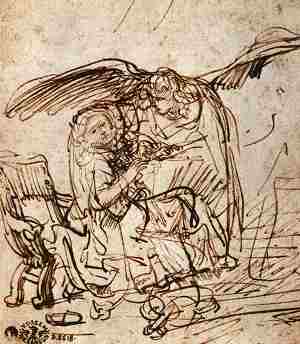
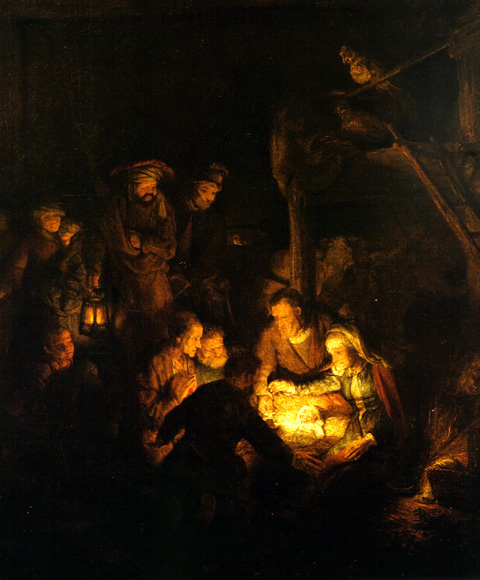
Art images: Rembrandt’s Annunciation of the Angel Gabriel to Mary and Adoration of the Shepherds
‘Reading The Season’ Posts over a Decade:
2020: Jack by Marilynne Robinson
2019: ‘A Hidden Life’ – A Film for the Season
2018: A Verse from Madeleine L’Engle’s The Irrational Season
2017: A Wrinkle in Time by Madeleine L’Engle
2014: Lila by Marilynne Robinson
2012: Surprised by Joy by C. S. Lewis
2011: Walking on Water by Madeleine L’Engle
2010: A Widening Light by Luci Shaw
2009: The Irrational Season by Madeleine L’Engle
2008: The Bible and the New York Times by Fleming Rutledge
2008: A Grief Observed by C. S. Lewis
 To embrace the Christmas season in a more meaningful way, I’ve been trying to stay close to the heart of the matter by reading.
 Ripple Effects