The Savages (2007, DVD)

the-savages-linney-hoffman

After my last post I had to take some time to withdraw. That’s when solitude can work as a soothing balm, allowing the personal space for reflection. Whether sudden or expected, young or old, death affects us all. And some strike a deeper chord.

A couple of days ago I got hold of The Savages on DVD. I thought I was late in watching this highly acclaimed indie film, and writing a review two years after its release. But watching it, I was surprised by the coincidence; for alas, it’s about death and aging. It’s ever timely now. I wouldn’t have appreciated it as much if I’d seen it then. For now, I’ve the first-hand experience of caring for two aging parents, and with my mother being in the early stage of Alzheimer. Two years ago I would not have imagined this scenario. But as those who have cared for the old can attest, two months can make a lot of difference.

As baby boomers begin to pass the turnstile into midlife, they now have to face the hard fact about their parents, and preparing for the ultimate to befall. Herein lies the story of The Savages.

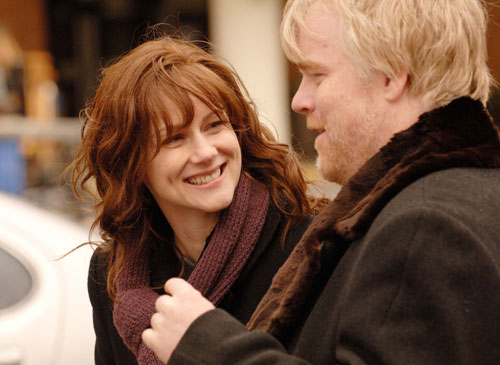
Wendy Savage (Laura Linney, Best Actress Emmy for John Adams, 2008; Love Actually, 2003) and her brother Jon (Philip Seymour Hoffman, Oscar Best Actor for Capote, 2005) live miles apart. Their childhood home had been dysfunctional. Their mother left them when they were still young, their father was neglectful and abusive.  Now as adults, they both have trouble committing to intimate relationships. Jon teaches theater at the University of Buffalo, while Wendy is a struggling playwright, working as a temp to make ends meet in NYC. Living apart from each other and their father, both strive to carve out some sort of meaningful existence with their life. Now they are brought back together by the tie of responsibility, reluctantly, in the caring for their ailing father (Philip Bosco). An old man who is afflicted with Parkinson’s related dementia, Lenny Savage is still fiery and intimidating.

Among the acclaims the film has garnered (AFI movie of the year, Golden Globes, Independent Spirit Awards…) are two Oscar nominations, one for Laura Linney for Best Actress, the other for Tamara Jenkins’s  Original Screenplay.  Both deserve the recognition hands down.  Unlike Sarah Polley’s impressive film Away From Her (2006) with Julie Christie as an Alzheimer stricken wife, The Savages looks at dementia and death from the point of view of the son and daughter, and delicately explores their conflicting emotions of having to care for an estranged father. The rebuilding of sibling relationship has also proven to be difficult, yet through the process, both find the experience to be worthwhile.

The Savages is classified as a comedy. The script is smart and funny. But it is dark and deadpan humor that marks its appeal. The reality of human failings is handled with care and sensitivity. Linney, Hoffman, and Bosco form a dynamic trio in portraying the tension of love hate emotions among family members.  Despite the past failings of their father and their present perplexities of how best to care for him, the siblings know where their duty lies. Screenwriter and director Tamara Jenkins has effectively explored the issues without sentimentality and imbued humor at the appropriate moments. As with all of life’s predicaments, a little dash of humor can offer the most direct perspective into our shared humanity.

The special features offer insights into the making of the film and into the mind of the screenwriter and director Tamara Jenkins. Of all the subject matters, she chose the caring of our aging parents. I’ve appreciated her intent: “The idea was to make you realize that you’re not alone, that you’re part of the human race, that we’re all going through this together.” She’s done a great job in doing just that.

~ ~ ~ Ripples

(photo source:  mtv.com)


Gran Torino (2008)

gran-torino

Still planning for this Valentine’s weekend?  How about a date movie?  Wait, guys, don’t run away.  This one’s for you.

I hate to read movie reviews with the tag line “Bring tissues”.   Half of our demographics would clearly stay away.  But what with a movie entitled “Gran Torino” starring Clint Eastwood?  Will it scare away the other half?  I’m here to ensure you all girlfriends, wives and future wives, it’s safe.  You won’t be bombarded with ear-piercing explosions and car crashes, or gratuitous adrenalin pumping violence, but there are engrossing moments that both of you will find meaningful.

Clint Eastwood is Walt Kowalski, a hardened and critical old man who has just lost his wife.   Walt Kowalski is Dirty Harry in his 70’s.  He hasn’t lost any of his macho madness.  Adding oil to the fire, he is one growling racist, and he makes his feelings known to all who cross his path, specifically, his new neighbors, a Hmong family originally from Laos.

The 1972 Gran Torino Walt owns and treats with great care is what the teenager next door has to steal under coercion as an act of gang initiation.  That night begins the series of events  that change the lives of these two households.

What’s interesting to watch is how Walt Kowalski’s antagonistic fervor is diverted into a protective mode, when the teenagers next door are bullied by gangs.  Here the spirit of Dirty Harry rises to the occasion.  Taking the teenage boy Thao (Bee Vang) under his wings, he begins to connect and even come to treasure a bond that he subtly strives to build up.

Contributing to the otherwise simple storyline is the  internal exploration of Walt’s tormented inner world.  He encounters his nemesis in the young Catholic priest Father Janovich (Christopher Carley), who has promised Walt’s wife that he would come check on him after she’s gone.  The movie efficiently makes the best use of these two character foils.  The innocent and naive versus the disgruntled skeptic.  It’s gratifying to see how both of them change over the course of events.  And it’s utterly moving to watch the slow process of one man’s ultimate search for redemption in the context of a beleaguered society riddled with hatred and racism.

Eastwood is by far the most experienced actor here.  In contrast, the young ones pale in their performance.  However, this is in a way realistic, for who wouldn’t be intimidated by such a formidable neighbor.  And yet, the movie excels in its delivery of a message, or two, so poignantly, it catches you off guard.

The multi-talented Eastwood here directs, acts, and composes the music.  He has crafted a powerful and moving piece of entertainment.  If you’re not too critical about the language, or a few simplistic stereotyping, this is one movie that can certainly make your day.

~ ~ ~ Ripples


Slumdog Millionaire (2008)

slumdogposter

Updates:

Feb. 22:  Slumdog Millionaire just won 8 Academy Awards. CLICK HERE for the Oscar Results 2009.

Feb. 8:  Slumdog Millionaire has just won 7 BAFTA Awards including Best Picture and Best Director tonight in London, England.

Jan. 25:  Slumdog Millionaire has just won the Screen Actors Guild Award for Outstanding Performance by a Cast in a Motion Picture.

Jan. 22:  Slumdog Millionaire just nominated for 10 Oscars including Best Picture. Click here to go to my Oscar Nominations Post.

Jan. 12:  Slumdog Millionaire just won 4 Golden Globes for Best Original Score, Best Screenplay, Best Director, and Best Motion Picture – Drama.

***

A. O. Scott in his 2008 year-end article and podcast on the New York Times website gives credits to movies that explore the element of hope. How fitting it is to start the new year by watching ‘hopeful movies’. In this turbulent time of ours, ‘Hope’ might just be the word of the year for us all.

Slumdog Millionaire not only explores the idea of hope, it builds its whole momentum on this element, and its fuel is none other than ‘love’.  The movie is a modern day fairy tale, an exciting concoction bubbling with fantastic visuals and sounds, a post-modern alchemy of culture, language, and place. But what unifies is the aspiration of requited love and shattered souls redeemed.

Directed by Danny Boyle (28 Days Later, 2002, Trainspotting, 1996) and based on Vikas Swarup’s award winning novel Q & A, which has been translated into 36 languages, the film has garnered high acclaims in film festivals. Just four months into its limited release, Slumdog Millionaire has already won 20 awards, and is nominated for 4 Golden Globes including Best Picture, and 2  SAG Awards, and is a possible contender for the Oscars.

Jamal Malik (Dev Patel) grows up in the slums of Mumbai, India. He and his brother Salim watch their mother killed by mobs. The two boys have to fend for themselves living on the streets. They survive the deplorable conditions with tact, style and grace, until Salim falls for the gang. Jamal has a childhood sweetheart Latika (Freida Pinto). In a heart wrenching episode, she gets separated from the brothers. Her fate seems to be sealed as a young girl on the street.

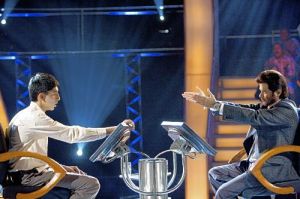
Years pass but Jamal’s heart still yearns for Latika. One thing that unites all Indians seems to be the popular quiz show “Who Wants To Be A Millionaire”. With his heart firmly fixed on reaching out to his long lost love  somewhere out there in the mass populace of India, Jamal gets on the show, hoping Latika would see him. Latika at this time is in the firm grip of a gang lord, her hope of freedom is dismal.

slumdog-millionaire-2

Yet, screenwriter Simon Beaufoy (Miss Pettigrew Lives for a Day, 2008 ) and director Danny Boyle gratify their viewers with some unexpected twists and turns, allowing us to savour an exhilarating end to the story. With their seamless, non-linear way of storytelling, framed by an upbeat musical score, they have turned what could be just another love story into a fresh and engrossing tale.

While the film features all Indian actors and some Bollywood stars, shot in Mumbai, many dialogues in Hindi with English subtitles, I don’t feel the cultural elements particularly stand out, drawing attention to themselves. Herein lies the success of the film. It has not led me to feel like I am watching something ‘foreign’ or ‘ethnic’, like some National Geographic features. The sense of place and subject matter, plus the amiable cast have all worked together effectively to transmit a universal appeal. The only Bollywood moment is when the end credits roll. Do stay for that.

Slumdog Millionaire evokes reminiscence of similar successful though lesser known titles like ‘Chop Shop’ (2007) and ‘Born into Brothels’ (2004), but on a grander scale, with an explicit message of hope and an unabashed resolution of requited love.

How satisfying! You’ll come out rejuvenated. The skeptic in you might say it’s only a movie, a fantasy too…  Mind you, not all fantasies end well. With some, the darkness can loom for days. Be good to yourself, start the year on a cheery note. Watch a ‘hopeful movie’. Love and Hope can sustain and triumph. As simple as that.

~ ~ ~½ Ripples


*****


The Best Movies of 2008

It’s that time of the year when film critics choose their ten best.  Here are a few of their lists.  Click on them to see the full content.

Breaking the top 10 tradition,  Roger Ebert has chosen 20 for 2008, because in his opinion, there are just too many good films this year.

A. O. Scott of the New York Times tends to agree, but still managed to pick his top 10 among the 650 films he has seen this year… incredible.

His colleague Manohla Dargis has also done the year-end cut from the hundreds she has seen.  Here’s her take on the ten best.  And while you’re there, click on the podcast where she and Scott discuss this year’s movies.

And finally, a Canadian perspective, represented by Johanna Schneller of the Globe and Mail.  I like how she puts it:  the 10 films “that I feel richer for having seen.”

What draws me to these lists is not so much about which movies get picked as the 10 best, but WHY they are selected, and HOW critics come around to that final decision after, I must suppose is a long, struggling process.  Imagine having had to pick 10 out of 650!

Comparing these lists, there are of course titles that are common among them, but not too many.  A few getting up on three of these lists but not all, like Rachel Getting Married, Milk, and Wendy and Lucy.  Only one film gets the nod from all of them and that’s Happy-Go-Lucky.  But for the rest, it seems like each critic has his or her own personal criteria when it comes to choosing what makes a good movie.  And I’m glad to see it this way.

Of course, there are theories, on film, aesthetics, and criticism, and then there are acting methods and execution criteria in camera works, lighting, sound, cinematography, editing, screenplay… it all boils down to one whole package, the final production.  And then there is also the receptive end of the movie, the viewer, and in this case, the critic, each bringing his or her own experience, sense of self, personal values and point of view.  And I’m relieved to see each critic pick what he or she feels is most affective and meaningful to him or her as an individual.

I’ve particularly enjoyed reading A. O. Scott’s year-end article in the New York Times entitled “In The Face of Loss, Celebrating Ties that Bind“.  Although not intended to answer the question: “What makes a good movie?”  Scott has inadvertently expressed his criteria.  When discussing a few movies that he thinks are well done, namely Doubt, The Reader, Revolutionary Road, and Frost/Nixon, he comments that they :

are impeccably acted, exquisitely production-designed excursions into the recent past.  And each one is a hermetically sealed melodrama of received thinking, feverishly advancing a set of themes that are the very opposite of provocative.

So, one criterion is originality, and not cliché treatment of subject or idea.

In the midst of our unsettling and troubled time, films could be manifestations of a collective predicament, and expressions of our hidden longings.  I’ve particularly appreciated Scott’s comment at the end of his article:

And while I am suspicious of easy affirmation or forced happy endings, I am nonetheless grateful for movies that, in spite of everything, investigate the possibility of hope.

Another criterion: good films are flowing conduit of hope.  I cannot agree with him more.  If you listen to the podcast on his webpage, you will hear him reiterate this point.

And on this note I end my post of 2008.  To all my readers, visitors, and fellow bloggers, may 2009 be a year of hopes abound and dreams fulfilled!

Happy New Year to All!

*****


Appaloosa (2008)

Yes, they’re still making westerns. The plots are still generic. Lawmen upholding the law in a lawless land. So what’s new?

What’s new is the fine tuning of characterization, the focus on internal conflicts and dilemmas, and the more stylistic and agile camera works, the music, and the slower, almost meditative pace of story development. I have in mind Open Range (2003), and the recent 3:10 to Yuma (2007).

… And at the Globe where the movie was screened, among the full house attendance at the Calgary International Film Festival, some enthusiasts even dressed western for the occasion.

Ed Harris has proved that he is versatile as an actor and director (Pollack, 2000), and now as a screenwriter. He is all three in Appaloosa. Based on the book by Robert B. Parker, Appaloosa is a typical western buddy movie.  Virgil Cole (Ed Harris) and his sidekick Everett Hitch (Viggo Mortensen, with Harris in A History of Violence, 2005) are two “itinerant lawmen”.  They are hired this time by the town of Appaloosa, as marshal and deputy, to get rid of the lawless rancher Randall Bragg (Jeremy Irons) and his gang.  The twists begin to emerge when a young widow shows up in town.  Allie French (Renée Zellweger) is so alone, so vulnerable, that she has her eye on the tough marshal Cole as soon as she enters town.

The buddy duo has some adjustment to make with this sudden appearance of a third party.  With a woman in his life, Cole himself has become vulnerable and is soon confronted with the dilemma: woman or duty.  Well that’s just one of the several twists of the story, a plot that takes its time to unfold.

As much as I like Renée Zellweger, I find her portrayal of Allie French less than satisfactory. There is definitely a miscast here. It takes more than just acting to bring out the sly femme fatale persona… her look and demeanour just do not reflect the menacing shrewdness and seductive lure needed here. It is unfortunate that Zellweger is cast into a role that she simply does not look the part.

But the movie is still enjoyable just the same. It is slick, funny, clever, and entertaining. Overall the acting is superb, but it is Viggo Mortensen who steals the show. As the quiet, and very intelligent sidekick of Virgil Cole, Everett Hitch has been more than supportive of his buddy. He is Cole’s vocabulary teacher, attentive listener and counsellor, and at the end, fulfills what justice and honor require a man to do, something which Cole himself has neglected. Mortensen has delivered a most gratifying performance which I think deserves an Oscar nomination.

At the end, after twists and turns, the hero rides off into the sunset, a typical conclusion. But this time, we are reminded why we come to see a western to begin with.  Such is the kind of movies where honor and nobility of character is expected of the protagonist, and that the good still wins, and justice served.  How satisfying.  Maybe that is why they are still making westerns, knowing there is an insatiable yearning for such ideals which are beyond time and genre.

~ ~ ~ Ripples

Summer Hours (l’Heure d’été, France 2008)

September is International Film Fest month in several Canadian cities.  Kicking off was the prominent TIFF (Toronto, world’s largest FF), now’s the CIFF (Calgary), and later on in the month, the VIFF (Vancouver).  Last year I was able to catch a glimpse from each one of these events.  But this year I’ll just stick with Calgary.

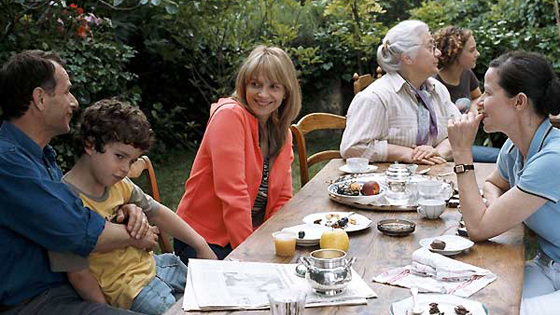
Went to see French director Olivier Assayas’ (Paris, je t’aime, 2006; Clean, 2004)  Summer Hours last night, the only screening in Calgary.  Writing the script himself, Assayas has created a film so realistic that it seems like a docudrama.  The story is about three adult siblings dealing with the estate of their mother (Edith Scob), a treasure house filled with objets d’arts, from furniture to vases, paintings to artist notebooks.  It’s a visual delight for the art lovers in the audience, albeit the camera doesn’t stay long enough for us to savor… I’d love to see more close-up lingering shots of the notebooks.

What’s realistic of course is, while the objects can easily be passed on from one generation to the next, the emotions and sentiments associated with them cannot.  The eldest son Frédéric (Charles Berling) wishes to leave the house as is so everyone in the family can still stop by and cherish the memories, but his other two siblings think otherwise.  Adrienne (Juliette Binoche) works as a designer in New York and is soon getting married.  Jérémie (Jérémie Renier) works with a sports manufacturing company in China and is settled there with his family.  Though all appreciate the memories of their childhood home in France and the artifacts within, they have their own life to live and family to raise elsewhere.  Their decision of how to deal with their mother’s estate is a practical one, sell it.

The Musée d’Orsay in Paris is the honorable recipient of these personal treasures.  Actually, Assayas was commissioned by the Museum to create the film in celebration of its 20th anniversary.  Here we see the pathos of turning family heirloom into museum pieces, albeit handled gently and meticulously by the staff.  Herein lies the crux of the film.  Assayas has depicted the human side of objets d’arts that we see in museums, how they could have been everyday household items, a table on which notes have been scribbled and letters written, a vase that has held many cut flowers from the garden.  These have been objects used and enjoyed privately by families, but are now desensitized, hung or displayed in a public arena.  The personal and subjective experiences could never be captured by the public eye.

The last scene is a closure for the pain of letting go.  The teenage grandchildren have one last chance to enjoy the house and its idyllic setting as they hold a large party for their friends.  The young immerse themselves in loud music, dancing, doping, and dipping in the pond, unaware of the passing of one era to the next.  A brief moment of sadness takes hold of the oldest granddaughter, as she savors a lingering memory in the garden.  She is joined by her boyfriend for a brief reminiscence and the next moment, they quickly dash back to the house to rejoin the party.  Assayas has painted the poignant in a most subtle manner.

~ ~ ~ Ripples

The Ripple Rating System

At long last, a clarification on the Ripple Rating System.

First, some FAQ.

Q:  Why do the movies you review on your blog mostly get 3 Ripples, only a few 2.5 Ripples, and very few 4 Ripples?

A:  I love films, but my time is also precious.  So I usually pick those which I think I’ll enjoy, or which I’m curious about before I go see them.  I’m a selective movie goer, as most people are.  The same is true for readers picking which books they’ll read, or music lovers which song to buy…The ratings reflect whether I’ve made the right choice, in a way.  So far, I haven’t come across many that compel me to give 4 Ripples… but there are a few…

Q: How do you know which movies you’ll enjoy?

A:  I read about them, know the background first…sometimes, I go to the source material and read the book on which a movie is based.  I particualrly like to do this because I’m interested in the process of turning Book Into Film … Other times, I go to see the movie first, and then read the book if I am particularly moved.

Of course, the Ripples reflect personal resonances.  Nevertheless, they are given after considerable critical analysis and evaluation, and hopefully do not come out as mere impulse.  They might stir up ripples among my readers too, and that’s what the comment box is for.

I like NY Times movie critic A. O. Scott’s statement in his introduction to the book The New York Times Guide to the Best 1,000 Movies Ever Made:

This collection is more likely to start arguments than to settle them, argument being one of the solemn duties of criticism and, more importantly, one of the great pleasures of movie-going.”

You are welcome to express your opinion. But please comment in a way that shows your respect for other readers and yourself.

So here it is, Arti’s Ripple Rating System explained:

~ Ripple               = Stay away, I did

~ ~ Ripples         = Manage your time better

~ ~ ½ Ripples     = Average, Okay

~ ~ ~ Ripples     = Good, worth seeing

~ ~ ~ ½ Ripples  = Superior, must-see

~ ~ ~ ~ Ripples  = Almost Perfect