‘His Three Daughters’ is a Rare Gem

In the midst of spectacles and action thrillers coming out nowadays, it’s refreshing to see a quiet gem has arrived on Netflix. His Three Daughters focuses on a topic common in real life and in movies, siblings coming back to their ailing parents’ home to prepare for their final parting. Maybe to offset such a heavy subject matter some of these movies are handled in a comedic or even farcical way, This is Where I Leave You (2014) and August: Osage County (2013) come to mind. In contrast, writer director Azazel Jacobs in His Three Daughters (2023) confronts the subject in a realistic and mindful way, eliciting from his three main actors honest and powerful performance. Jacobs is apt too in infusing witty dialogues and subtle humour. What a gratifying turn from his previous film French Exit (2020).

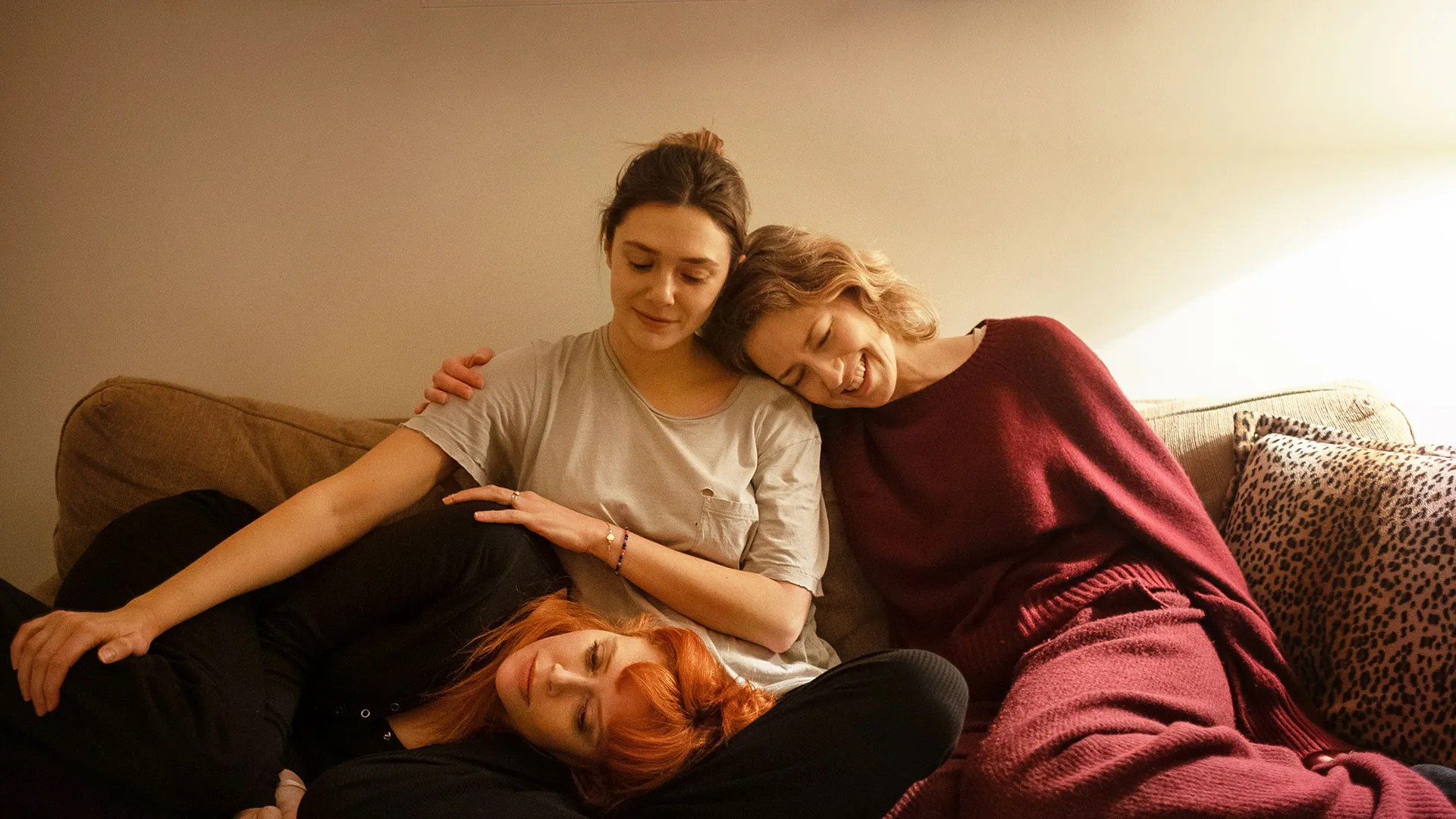
Under one roof in their father’s NYC apartment, three estranged sisters learn to live with each other once again. Carrie Coon (The Gilded Age) is the eldest daughter Katie, the take-charge type, from cooking, dealing with palliative nurses, getting a DNR (do-not-resuscitate) form signed by the father before he slips away, to writing his obituary while micro managing her teenage daughter at home in Brooklyn. Her intolerance of her stepsister Rachel (Natasha Lyonne, Orange is the New Black) who smokes weed and bets on sport games constitutes the main conflict in the sibling relationships. Trying to mediate between the two is Christina (Elizabeth Olsen, Sorry for your Loss) who is always reconciliatory. She’s preoccupied with her young daughter and husband at home far away across the country.

As for the father, he remains unseen behind closed or slightly opened door in his bedroom, his presence only denoted by the rhythmic beeping of the monitor to which he’s hooked up. Such concealing allows the viewers to focus on the trio, for what’s equally pressing is the rebuilding of sisterhood and the way to move forward after their father is gone. Dying relationships among the living are crying out to be heard and reconciled.

Rachel has been living in the apartment with their father all along, while the other two sisters just recently arrive to take care of things at this final stage of their father’s life. New house rules are set up. A pivotal scene comes when Rachel’s friend Benjy (Jovan Adepo) confronts the other two sisters as he points out the reality of their family dynamics. A new perspective begins to sink in as they come to realize their own shortfalls, a reality check that doesn’t go down easy for anyone.

In this chamber piece rich in dialogues, Coon, Lyonne, and Olsen are impeccable in displaying the raw and honest emotions of sibling love, hate, overt and hidden sentiments they hold against each other. But the overall mood is not all serious and somber. There’s underlying humour throughout, especially the opening scene, which reminds me of early Woody Allen works. Music is minimal to amplify the conversations, silence to enhance tension and ambivalence. Despite being shot inside an apartment with minimal exterior scenes, the camera is effective in conveying suspense, loss, and love.

As for the twist towards the end, it’s open to interpretations; however, it does seem incongruent with the earlier part. To avoid spoilers, I won’t be discussing it here. No matter, it’s the process reaching to the end that’s what the film so powerfully depicts. I hope to see more of this kind of cinematic gems to appear in theatres and on streaming platforms.

~ ~ ~ 1/2 Ripples

***

Related posts on Ripple Effects:

August: Osage County, Play and Movie Review

The Savages, with Philip Seymour Hoffman and Laura Linney

The Netflix Diversion

As two of my highly anticipated movies (see my list here) coming out in the fall will be on Netflix: Maestro and NYAD, I just can’t resist anymore. Three days ago I decided to subscribe to Netflix. While waiting for these two movies to show up, I’ve got plenty of others to watch. These past few days, I’ve finished a few. Yes… daily life has been a bit diverted. My capsule reviews in the following. All three TV series are worth watching and the doc on Joan Didion, a must-see.

BEEF –– A road rage incident pushes two lives down the abyss of rage and revenge which ultimately torpedoes into an explosive meltdown. The fight between Amy Lau (Ali Wong), an entrepreneur, wife and mother living in an upper middle class neighborhood and her adversary Danny Cho (Steven Yeun), a handyman striving to make ends meet as a dutiful son and watchful older brother is not only a satire of the disparity between the rich and the poor, but a realistic depiction of the existential angsts shared by all regardless of social and economic status, or, as the series has effectively shown, racial background. Highly addictive, cleverly written and first-rate acting. 13 Primetime Emmy Awards nominations.

The Diplomat –– Kate Wyler (Keri Russell) is appointed by the POTUS (Michael McKean) as the new ambassador to the United Kingdom, a post she reluctantly takes up. With her previous experience in war-torn countries and Afghanistan which she expects to return, her new post in London is a major cultural clash, hence resulting in some mismatched decorum and humorous moments. Adding to her maladjustment and complicating matters when dealing with volatile, international crises is her husband Hal (Rufus Sewell), himself the former ambassador to the UK. The once political influencer now has to take up the role as a diplomat’s wife in a precarious marriage. Interesting play on gender politics, marital/power relationships, on top of intense, political chess play. Russell is nominated for Outstanding Lead Actress in a Drama Series in the upcoming Emmy Awards, deservedly. Interesting to note some of the language used here is quite similar to the rage-filled one in BEEF.

The Lincoln Lawyer –– I pick up from the current Season 3. While I like Michael Connelly’s character, former LAPD detective Harry Bosch, more than his Mickey Haller, a lawyer who works out of a Lincoln dealing with seedy clients, I’ve enjoyed the TV adaptation. Haller, aptly played by Manuel Garcia-Rulfo, is a pleasing yet complex character, resourceful, smart, an upholder of the law but has his blind spots. As a recovering addict, vulnerability coexists with his assets. Other characters are also well cast, jumping out of Connelly’s novels to become well fleshed-out and likable human beings (we just might be using this term more now to distinguish between the real and the fake), making up a lively supporting cast. Interesting to note that in the 10 episodes of S3, despite dealing with crimes and criminals, the language used is relatively free of foul play.

________________

Joan Didion: The Center Will Not Hold

Directed by Griffin Dunne, actor/director and Joan Didion’s nephew, this brief, biographical documentary of Didion follows her career and life during some of America’s tumultuous decades. Dunne’s interviews with her aunt elicit some intimate conversation and poignant memories from Didion, by now frail and with apparent impediment. An astute observer of society, Didion had given us some monumental commentaries of her times with her writings. Listening to the narration in the documentary and seeing the iconic photos and footage of significant turns of history, Didion’s analyses just as well could have applied to our world today, just as she has quoted in her Slouching Towards Bethlehem the line in Yeats’s poem: “Things fall apart; the centre cannot hold.”

The latter part of the documentary is about Didion’s own personal tragedy, chronicling the sudden death of her husband John Gregory Dunne and just months later, her daughter Quintana, her grief poured out in The Year of Magical Thinking and Blue Nights. English playwright David Hare had been her anchor in transforming mourning and loss into artistic expression on stage, giving her some sort of a closure. Hare directs the Broadway play adaptation of The Year of Magical Thinking with Vanessa Redgrave as the sole performer. Redgrave shared a similar experience as her daughter Natasha Richardson died suddenly after a ski accident. The documentary has kept a short clip from the play and presented personal recollections from Hare and those close to her life, friends and colleagues. A poignant and moving feature.

~ ~ ~ 1/2 Ripples

***

Related Posts on Ripple Effects:

Blue Nights: A Book Review

Voice of the Poet: Things Fall Apart