‘Living’: The Old Becomes New

Living is based on the Japanese auteur Akira Kurosawa’s classic Ikiru (1952, meaning of title: ‘to live’). Nobel laureate Kazuo Ishiguro adapted it to make an English version with Bill Nighy in mind when he wrote the screenplay, creating a setting in 1950’s London. Interestingly, Kurosawa himself was inspired by Leo Tolstoy’s The Death of Ivan Ilyich when he made Ikiru, and with his eloquent camera, transposed the Russian master’s novella into a Japanese story on screen.

With Living, the Japanese-British novelist Ishiguro has succinctly condensed Kurosawa’s 142 minute film into a shorter feature of 102 minutes, helmed by South African director Oliver Hermanus. It’s interesting to note the cross-cultural transferral, for the film is about the universal theme that we all share as a humanity, living a meaningful life in the face of death.

This is one of the less-hyped movies during the 2022 Awards Season, despite the film getting two Oscar nominations: Best Adapted Screenplay for Ishiguro, and Best Actor for Bill Nighy, his first and long due Oscar nod.

It’s timely that I finally get the chance to watch Living now in April, a month that signifies new births. Considering the change in the main character Mr. Williams (Bill Nighy), even the idea of resurrection is apt when taken metaphorically, from death to life, ironically, for a man who has just been diagnosed with terminal illness.

As the head of the public works department at County Hall for numerous years, Williams is contented with following the bureaucratic daily routine by the clock, pushing papers to other departments, or, if the file has to stay in his, stalling it till it becomes extinct.

The camera angles give us a vivid perspective. From the overhead shot above the train station, we see a mass of uniformity, men in dark suit and bowler hat heading to work. Looking down from above, they are small and insignificant. And from the slow motion of them walking, we see the wheel of work turning, ever so slowly, in mundane routine heading to the office and the same vehicle bringing them home at the end of the day.

After Williams gets the confirmed diagnosis of cancer and that he will have just six months to live, there appears the audio motif of a clock ticking; this time, it’s not to remind him of work routine but the limited time of life remaining.

In the wake of the ominous news, Williams’ reactions change from stoically bearing the shock to actively seeking a meaningful existence, and ultimately finding a purpose that he feels can fulfill his life. Nighy’s performance is immersive, reserved, and nuanced, and at times, allowing a ray of deadpan humour to seep through. If the restrained ‘Englishness’ is what the actor naturally possesses, or one that he has fully grasped in his cultural milieu, then it has served him perfectly in this role.

In an online interview, Ishiguro explains this ‘Englishness’ as a metaphor:

A certain type of Englishness becomes a universal metaphor for something that is inside all human beings, the need to conform, perhaps a fear of emotions, the frustration of wanting to express yourself but not being able to break out of your professional role, or the role that society has given you. There were many things I thought we could talk about of the whole human condition by looking at this type of figure.

Many scenes in Living are direct parallels of Kurosawa’s Ikiru with his protagonist Kanji Watanabe (Takashi Shimura). Both men confide their terminal illness not to their son who lives with them, but to a stranger in a restaurant, sharing their last wish, that is, to live life, for a change. The sympathetic listener brings the despondent man to various places for him to ‘live it up’. In both films, we see the same places but in different cultural context, amusement parks, bars, dance hall, strip club, but what Williams and Watanabe find are but superficial, ephemeral flares.

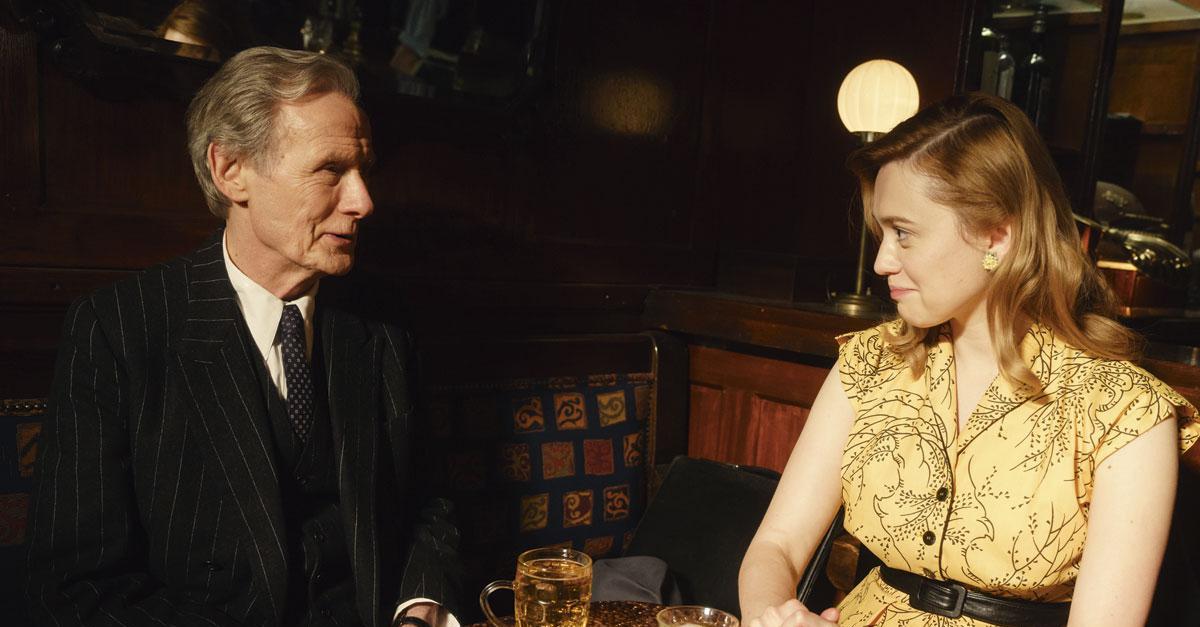
The ultimate change in Williams is sparked by a young, female staff Margaret Harris (Aimee Lou Wood), who needs his reference as she has found a new job. Meeting her by chance on the street, Williams invites her to have a ‘simple’ lunch with him at the Fortnum, where he can write her reference letter. It’s there that we see Williams break out with a genuine smile for the first time, forty-one minutes into the movie. Harris’s youthful and vivacious spirit later inspires Williams to go back to the office as a new man after his few days of escapade, to get down to work and this time, doing something that’s meaningful and benevolent.
A crucial addition in Living, and kudos to Ishiguro, is bringing in a young, new worker, Peter Wakeling (Alex Sharp), to the public works department, first day on his job. From his fresh, untainted eyes, we see the novice civil servant being open and ready to accept whatever the bureaucratic system requires of him. His boss Williams’ new-found purpose and subsequent change at work has left him with an indelible impression. And with co-worker Miss Harris, a warm storyline of budding romance adds flavour to the film, albeit introduced a bit late towards the end.

One poignant scene in both films is the protagonist singing in a bar. For Nighy, this is probably the best cinematic moment for him to leave his mark as a soulful singer, a deep and heartfelt performance in contrast to his farcical ‘Christmas is all around’ in Love Actually (2003). The scene here in Living is when a slightly drunk Williams asks the pianist at a pub to play as he sings ‘The Rowan Tree,’ a Scottish folk song that evokes longing for the past and loved ones gone.

Later, in the remake of Kurosawa’s iconic scene from Ikiru, we see Williams sitting on a swing and hearing his moving reprise of the song, this time sober and clear of what’s waiting for him. As the final credits roll, the mesmerizing voice of Lisa Knapp stirs ripples in my heart long after the visuals end.

‘The Rowan Tree’ sung by Lisa Knapp

________________

~ ~ ~ 1/2 Ripples

‘The Quiet Girl’ Movie Review: From the literary to the visual

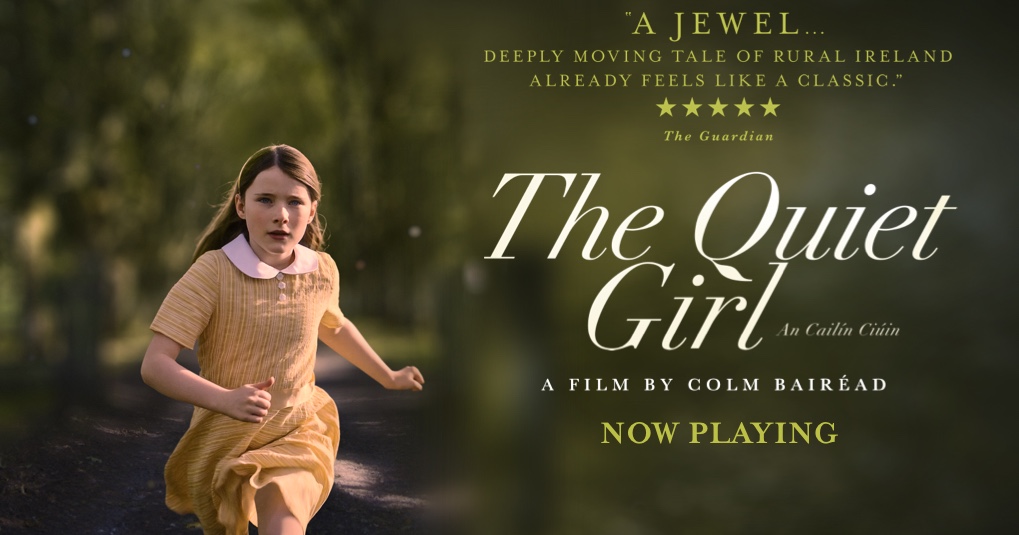
The Quiet Girl (An Cailín Ciúin) is the first Irish-language film to be nominated for an Oscar, representing Ireland in the Best International Feature category in this year’s 95th Academy Awards held on March 12th.

In this his debut feature, Irish director Colm Bairéad adapts Claire Keegan’s short story “Foster” in a style that’s akin to the literary source. Together with director of photography Kate McCullough (Normal People, 2020), Bairéad has created on screen a sparse and sensitive rendering of Keegan’s story, camera shots that are calm storytelling and restraints that convey emotional depth. The choice of the 4:3 Academy aspect ratio gives the feeling of a time past, like an old home video preserving a young girl’s memorable experience.

Cáit (Catherine Clinch) is sent away to spend the summer with her mother’s relatives, Eibhlín (Carrie Crowley) and Seán Cinnsealach (Andrew Bennett). Having lived in an impoverished household full of siblings and one more expecting, with a father who takes ‘liquid supper’ before coming home and an overburdened mother, Cáit experiences for the first time in her short stay at the Cinnsealach’s quiet and childless farm home what it means to be cared for, and towards the end, learns that keeping silent can be an act of love.

Just like Keegan’s style of using the minimal to convey much, The Quiet Girl is sparse and sensitive in its visual storytelling. Eibhlín is shown to be kind right from the beginning, Seán less so, hardly acknowledges Cáit. His reticence is nuanced though, a slight turn of his head even when he’s facing the TV and with his back to the child betrays a moment of thought, of self-reflection. Seán’s coming around is endearing, like the moment he leaves a single cookie on the table as he walks by Cáit in the kitchen. Actions speak louder than words.

In the bedroom she’s in, Cáit observes the wallpaper with train images and the boy’s clothing she now wears, as her own suitcase is still in her Da’s car trunk as he has forgotten to leave it with her in his rush to leave. She observes her new environment and the people she’s with, and gets some shocking information when a nosy neighbor spills out the Cinnsealachs’ tragic past to her.

As one who has just read Keegan’s short story and been deeply moved by her writing, I come to this review not to compare how ‘faithful’ the film adaptation is, which it is, but that how some of the ‘cinematic moments’ in the book are transposed on screen.

Writer director Bairéad has added some scenes of Cáit in school and at home at the beginning of the film, enhancing the characterization of the girl, quiet and alone, even at home. While the ponderous visual storytelling deserves praise, I do find in certain moments, Bairéad could have added just a bit more dramatic effects, not for gratuitous purpose, but to elicit a more powerful punch towards the cathartic end.

[The following contains spoiler]

Two examples I have in mind. First is when Seán decides they should stop letting the girl wear the boy’s clothes and that he’ll drive them to town to buy Cáit new clothes for herself. That’s a defining moment bringing up a painful, unspoken past, and stopping their substituting Cáit for the one they had lost. Eibhlín is picking gooseberry at the kitchen table with Cáit. Here’s the excerpt from Keegan’s story about the very moment her husband tells them to go change and get ready to go into town to buy clothes for Cáit:

The woman keeps on picking the gooseberries from the colander, stretching her hand out, but a little more slowly each time, for the next. At one point I think she will stop but she keeps on until she is finished and then she gets up and places the colander on the sink and lets out a sound I’ve never heard anyone make, and slowly goes upstairs.

That sound that the girl has ‘never heard anyone make’ is bone chilling even when I was just reading the words, and would have been a most effective cinematic moment to convey pain and grief. Unfortunately what could have been a stirring moment for viewers did not materialize in that scene.

The second is more crucial, a scene that I take as the climax of the story, the girl’s accident at the well. More intensity in visual storytelling, or even just sound instead of the subtle handling of the incident––not for the sake of mere dramatic effects but to show the gravity of the mishap and its implications–– is needed to elicit more potently the poignant act of silence later when Cáit is determined not to mention the accident to her mother who has sensed something must have happened when the girl comes home sneezing.

The cathartic ending of the film is to be applauded for it has brought out Keegan’s powerful writing most vividly. What’s more heartrending than just reading is that we can see the face of the girl running and hear the final word she utters to Seán as she flies into his embrace. That is the power of film.

~ ~ ~ Ripples

__________________________

This is my third post participating in the Reading Ireland Month hosted by Cathy 746 Books.

Previous posts:

“Foster” by Claire Keegan: Short story review

The Banshees of Inisherin: Movie review

The Banshees of Inisherin: To be friend or not to be friend

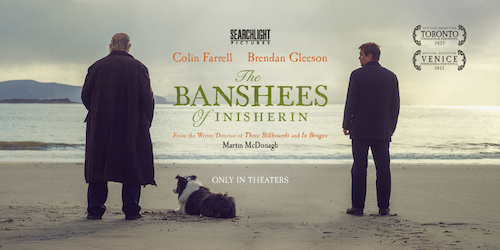
Like his previous movie Three Billboards Outside Ebbing, Missouri (2017), writer director Martin McDonagh opens The Banshees of Inisherin with a quiet and peaceful song. The lush green landscape of the island of Inisherin merging with the calm and harmonious chorus pulls us into this cinematic fable right away. McDonagh loses no time to bring out the heart of the matter, the sudden fallout of a lifelong friendship between Pádraic (Colin Farrell) and Colm (Brendan Gleeson). In parallel, across the island on the mainland, the Irish civil war rages. The year is 1923. 

The juxtaposition of mellow, ponderous music with outward conflicts always makes interesting contrasts, just like mixing comedy with drama, humour and sadness, which McDonagh is so apt in doing. An acclaimed British-Irish playwright whose plays have been performed in the West End and on Broadway, McDonagh is astute in his dialogues, embedding them with humour and poignancy to reveal the nature of the characters:

Pádraic’s sister Siobhán (Kerry Condon) likes to read and is the most sensible character in the movie. In one scene, Siobhán is reading.

Pádraic: How’s the book?
Siobhán: Sad.
Pádraic: Sad? You should read a not sad one, Siobhán, else you might get sad.
Siobhán: Mm.
(pause)
Siobhán: Do you never get lonely, Pádraic? 
Pádraic: Never get wha?
Siobhán: Lonely.
Pádraic: (mutter in annoyance) No. “Do I never get lonely?” What’s the matter with everybody? 

That could give a hint why Colm stops being friends with Pádraic because “he’s dull”. Colm is older and he now thinks more about how he will be remembered when he’s gone. A fiddle player, Colm spends his time playing and composing music. “I just don’t have a place for dullness in my life anymore,” he tells Siobhán. So, when Pádraic, baffled and hurt, confronts his old friend, “you used to be nice,” Colm engages with him about the value of being nice versus being remembered. Mozart, though living in the 17th century, he says, is still being remembered today for his musical legacy. Paintings last; poetry lasts. Who’s going to remember your niceness?

Even though happy go lucky, Pádraic is now saddened by the sudden termination of friendship. He doesn’t care about Mozart, or whatsisname Borvoven, but he remembers his Mammy and Daddy, they were nice, and his sister, “she’s nice. I’ll remember her, forever.” But Colm counters, no one else would remember them other than you. Colm may be facing an existential crisis, seeking for something more permanent or trying to leave a legacy, but McDonagh’s humour seeps through simple dialogues and not let the high ideals of his character be taken too seriously by movie viewers. In this scene, Siobhán has the last word. She corrects Colm, “it was the 18th century, anyway. Mozart. Not the 17th.” Then turns and walks away. This is a dark comedy, after all. 

The superb cast brings out McDonagh’s writing perfectly. Farrell and Gleeson reunite after In Bruges (2008, Oscar nom for McDonagh’s original screenplay). It’s fun watching the pair engage, a simple, usually happy Pádraic stonewalled by his best friend’s sudden withdrawal of friendship, not only that, but shocked by his drastic action to cut off one of his own fiddler finger every time Pádraic talks to him.

Condon as Siobhán is most apt in representing the rational mind amidst this absurd development. Her later decision to seek a saner and more meaningful existence is poignant. The yellow coat she wears is a bright symbol of hope. The fourth character that makes up this outstanding ensemble of actors is Barry Keoghan as Dominic, the jester who is probably the saddest of them all and one who sees more clearly than he appears.

One more crucial character must be credited, and that’s Jenny the miniature donkey (Jenny), which plays a pivotal role in the final act, inciting a drastic action from Pádraic. Friendship between man and animal just might be more steadfast than between humans. And that last vengeful resort by Pádraic brings back a similar scene in Three Billboards.

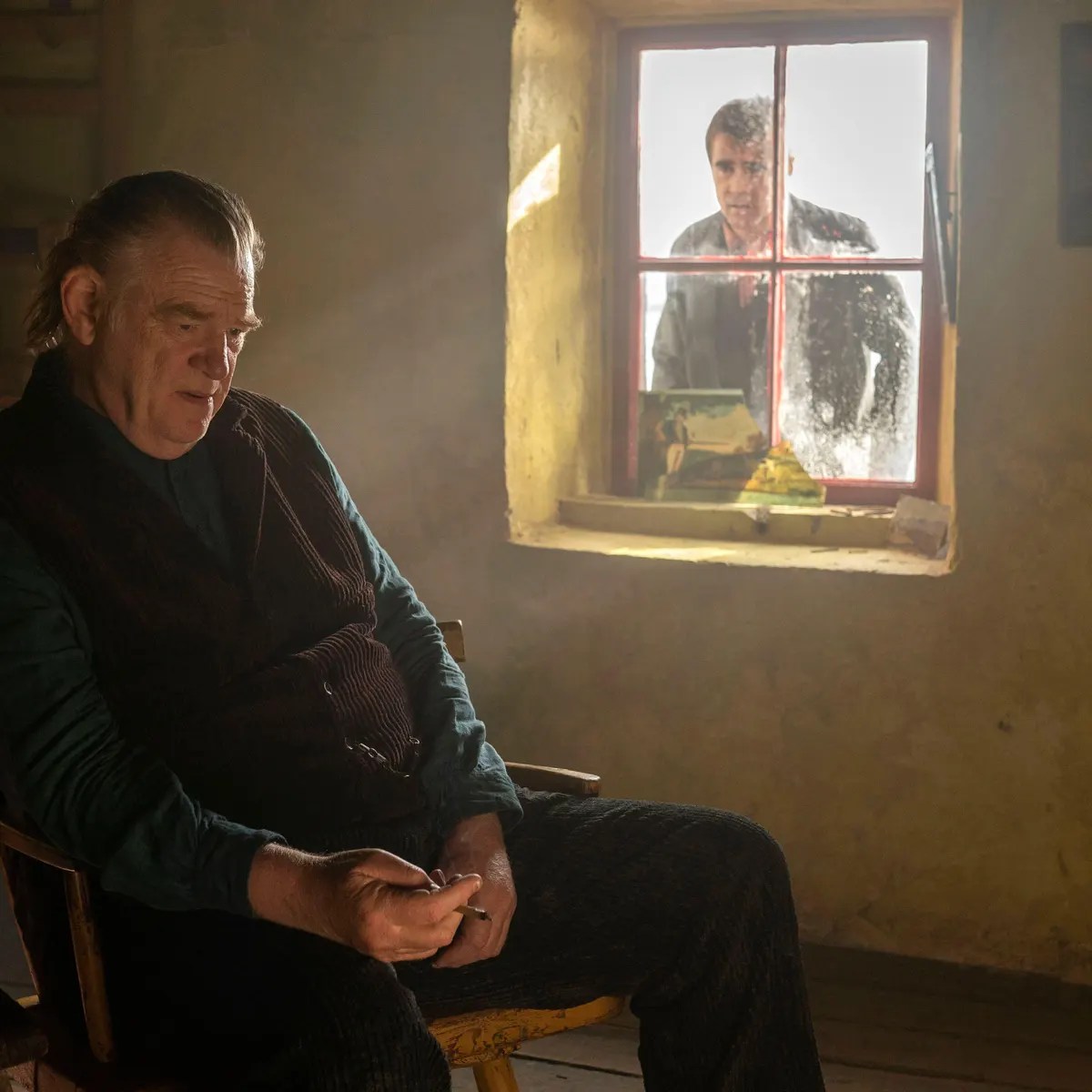
Director of photography Ben Davis’s camera is crucial in revealing the deeper meaning of McDonagh’s fable. Often we see Pádraic on the outside peering through the window into Colm’s home, or into the pub looking for Colm. Poor Pádraic now is an unwanted outsider, rejected and isolated, reminiscence of similar shots in Bresson’s Diary of a Country Priest. Or, the metaphor of the Banshee, the omen of death, represented by Mrs. McCormick (Sheila Flitton), her creepy appearance exemplifies the ever-present threat of mortality, just like the Grim Reaper in Ingmar Bergman’s The Seventh Seal (1957). They don similar costume too. And the ubiquitous religious symbols and activities––the statue of the Virgin Mary on the island, the cross, the Latin mass––just make one question how their faith is relevant in the actions of these islanders.

The Banshees of Inisherin is nominated for nine Oscars in the coming awards night to be held on March 12: Best Picture, Martin McDonagh for Directing and Original Screenplay, Colin Farrell for Best Actor, Kerry Condon Supporting Actress, Brendan Gleeson and Barry Keoghan both for Supporting Actors, Film Editing, and Music (Original Score).

~ ~ ~ 1/2 Ripples

***

Related posts mentioned in this review:

Don’t Just Drive Past Three Billboards

Diary of a Country Priest: Film Adaptation (1951)

***

March is Read Ireland Month 2023 at Cathy 746 Books. You can read the screenplay of The Banshees of Inisherin online here.  Upcoming posts will include books by Irish writers and possible book to screen adaptations. 

***

Tár: To Catch a Falling Star

There are movies that you admire especially upon rewatching but still leave you emotionally detached. The overall tone is artistic and elegant, the camera clever, editing seamless, fantasy sequences enhance the tension, and needless to say, superb acting delivered by the cast. You admire and appreciate the director’s execution, yet you’re not emotionally engaged. Tár is one such movies for me.

Writer director Todd Field’s masterpiece is a film packed with ideas and layered with symbolism conveyed through technical brilliance. It explores power and ambition, identity politics, the separation of the art from the artist, and cancel culture in our contemporary society. Using a phrase ubiquitous in this awards season, it is everything, everywhere, all at once.

At the beginning of the film, New Yorker writer Adam Gopnik (playing himself) introduces conductor and composer Lydia Tár (Cate Blanchett) by reading out a list of her accolades for his live audience and us, movie viewers who would see, in the next two and a half hours, how a radiant star fall from grace. As the film opens, Tár is at the summit of the classical music world, helming the prestigious Berlin Philharmonic. A Harvard PhD, she was mentored by Leonard Bernstein in the emergence of her career, and is currently one of only 15 EGOT winners (Emmy, Grammy, Oscar, Tony); her upcoming book Tár on Tár will no doubt be a bestseller.

Field’s feature is nominated for six Oscars in this awards season. It is a forceful narrative and an astute study of power set within an artistic and cultured realm. Blanchett’s Tár embodied success driven by ambition and sustained by ruthless arrogance. She may appear courteous and mild mannered, and that’s where the danger lies. She doesn’t need to raise her voice to be heard.

From the beginning of the movie, the sequence of the custom tailoring of her suit––a symbol of power––sets the premise. The film is not about gender politics, for Tár’s position is a given; she is already at the podium leading a world renown orchestra and is hailed as one of the best living composers.

There are, of course, higher mountains to scale. The self-propelled driving force soon turns Tár into a delusional egotist, her self-will overriding all that comes in her way, destroying not just her career but her relationship with her spouse Sharon (Nina Hoss), concert-master in the orchestra. Field wrote the screenplay with Blanchett in mind. He had mentioned in an interview that if she declined the role, he would not go ahead with the movie. Blanchett delivers with convincing mastery. 

While being a fictional character, Tár embodies some real-life issues with much relevance in contemporary society. Her being in a lesbian marriage exemplifies the fact that power can corrupt regardless of gender and sexual orientation. She has the power to endow opportunities and thereby raising the career of young musicians to new heights, or, destroy them. Her obsession with success soon becomes unmanageable, distorting her view of reality, pulling her into the abyss of delusion and even madness. 

Among the various issues the film touches on, the Juilliard teaching scene is particularly telling. Tár is teaching a conducting class in a lecture theatre. The camera expertly captures the ten-minute scene with one long take (no cutting). The blocking of the two main characters––Tár and the student Max (Zethphan Smith-Gneist)––speaks volumes.

Max chooses a contemporary piece by the Icelandic composer Anna Thorvaldsdottir to conduct. Stopping him midway, Tár brings up the importance of Bach’s work, sitting down beside him as equal to discuss and ask if he would consider conducting a Bach piece. Here’s Max’s response:

“Honestly, as a BIPOC, pangender person, I’d say Bach’s misogenystic life makes it kind of impossible for me to take his music seriously.” He’s referring to the composer having had fathered 21 offsprings. 

Boycotting Bach for his brood of children?

Here’s Tár’s restrained response: “I’m unclear as to what his prodigious skill on the marital bed has to do with [his Mass in] B minor.” Pointing out the issue of separating the art from the artist.

Drawing out the thought in Max, she says: “Can classical music written by a bunch of straight Austro-German church going white guys exalt us?” To answer that, she invites Max to sit by her side at the piano, going through with him some Bach pieces. To her credit, in both instances, her persuasion is gentle and egalitarian as the camera captures teacher and student sitting at the same level.

Max’s viewpoint is a biting issue today: can a BIPOC (Black, Indigenous, People of Colour), pangender person acknowledge the contribution of straight, ancient white guys? Tár’s response is obvious. The artists’ works override their nationality, colour and gender. Likewise, she challenges Max to look at the composer of his own choice, Icelandic, female composer Anna Thorvaldsdottir. What is the resemblance that Max has to identify with her?

Brilliant question. To which Max responds by picking up his stuff and walks out, with a verbal swipe of expletive for his teacher. Tár replies: “And you’re a robot. The architect of your soul appears to be social media.”

Who wins this debate? Field leaves it to his viewers to decide. As with the other issues laid out in the film as well as the ending, there are more questions than answers. Yes, Blanchett’s performance is top-notch, but I come out having a higher appreciation of Field’s writing.

~ ~ ~ Ripples