Proust Read-Along: The Swann and Gatsby Foil

“He knew perfectly well as a general truth that human life is full of contrasts…” Swann’s Way, P. 510

While plowing through Part 2, ‘Swann In Love’, I happened to reread The Great Gatsby. Thanks to Baz Luhrmann’s new movie adaptation, I’m sure many more are doing the same. And oh what interesting contrasts Swann and Gatsby make.

Both are deeply in love, yearning for a woman who seems to be utterly elusive. Gatsby frantically maximizes to attract Daisy; Swann willingly minimizes to reach Odette. From a poor background, Gatsby grabs whatever means he can to build his wealth; Swann whose niche belongs to high society, has to pretend that he is nobody special, stooping to ‘a lower social sphere’ (P. 285) to be near Odette.

That distance is more than social. Swann is willing to forsake his cultured tastes of art and music, to lay aside even his own research and writing on Vermeer (Odette: I’ve never heard of him, is he alive still? P. 279). Swann is willing to lay down his interests and privileges for a woman who is uncouth in the sophistication of high society, who has superficial views and flashy tastes, and alas, even promiscuous.

However, love transforms all deficiencies and blemishes into ethereal beauty. Here’s how Swann visualizes Odette. To him, she is like Sipporah, Jethro’s daughter, Botticelli’s fresco in the Vatican’s Sistine Chapel:
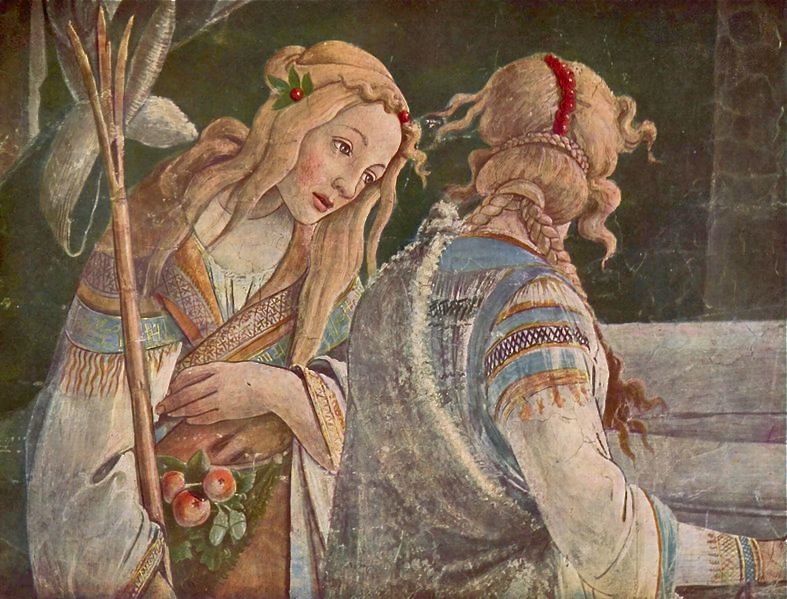
Zipporah, Jethro's Daughter by Botticelli

Following Odette to her ‘little nucleus’ at the Verdurins, Swann downplays his association with prominent people and tries not to be so outspoken with his knowledge and opinion about art and music.

When he is alone with Odette, he has taken her values and interests:

he tried at least to ensure that she should be happy in his company, tried not to counteract those vulgar ideas, that bad taste which she displayed on every possible occasion, and which in fact he loved, as he could not help loving everything that came from her, which enchanted him even. (P. 348)

Is this measurement of incompatibility in tastes inherently snobbish? Yes, Swann (or Proust) is sensitive enough to analyze this in depth. What is ‘taste’ anyway, or the intellectual beliefs with which he has been raised from the days of his youth?

… the objects we admire have no absolute value in themselves, that the whole thing is a matter of period and class, is no more than a series of fashions, the most vulgar of which are worth just as much as those which are regarded as the most refined. (P. 350)

So, all for love of Odette, Swann is willing to give up going to the Jockey Club, lunching with the Prince of Wales, or his love of Holland, or a visit to the Versailles (‘which bored her to tears’):

And so he denied himself the pleasure of visiting those places, delighted to tell himself that it was for her sake, that he wished only to feel, to enjoy things with her. (p. 350)

Those colorful shirts Gatsby has hoarded, Odette would have loved them, just like Daisy, and his mansion too… if only Swann had resided in a more prestigious address, somewhere ‘more worthy of him’ instead of his house on the Quai d’Orleans. (P. 346)

Odette’s fondness of Swann begins to wane as Forcheville enters into the picture. She becomes even harder to get. Swann is burned with jealousy, anger and bitterness. Yet he cannot forget her. His love even grows stronger for her, despite receiving an anonymous letter defaming her. Why,

People often say that, by point out to a man the faults of his mistress, you succeed only in strengthening his attachment to her… he had begun to desire the possession — as if that were ever possible — of another person. (P. 517)

Perhaps that is a mark of love: the demand for exclusivity. This is exactly what Gatsby wants Daisy to admit, that she has never loved Tom, that she has always loved him. “Oh, you want too much,” she cried to Gatsby.

But Swann is more fortunate. He knows he must gain back Odette’s full and exclusive devotion and somehow he does. I’m glad to read in Part 3 that eventually Odette does become Mme Swann. I’d be curious to know how that comes about. (Proust’s strategy to get us go on reading the next volumes?)

**

Part 3 is an enjoyable and much swifter read as the narrator remembers his childhood in Paris drown in unrequited love (so far, not sure about how this unfolds later) for Swann and Odette’s daughter Gilberte. Because of his love for Gilberte, the boy is infatuated with M and Mme Swann as well. His crush on the elusive Gilberte parallels Swann’s love for Odette in their earlier days.

The last sentence in Volume 1 of In Search of Lost Time, like that in The Great Gatsby, ends with a haunting remark on memory and the past:

The places we have known… were only a thin slice, held between the contiguous impressions that composed our life at that time; the memory of a particular image is but regret for a particular moment; and houses, roads, avenues are as fugitive, alas, as the years.

There are much more to be said, but nothing can replace the actual experience of reading Proust first hand. From March to May as I plowed through Swann’s Way, there had been up’s and down’s. Numerous times long sentences entangled, yet the very next moment could be so beautiful and lucid it dissipated all frustrations. I now look forward to Volume II.

**

Thanks for joining me in this Read-Along. Finish or not, you’re welcome to share your thoughts. Throw your two pebbles into the pond and make some ripples. If you have written a post, do let me know so I can link it here.

Bellezza of Dolce Bellezza

**

CLICK HERE to my post on Part 1 of Swann’s Way: Combray

***

Midnight’s Children: Book Three

Click on the following links to the different sections of the book:
Midnight’s Children Book One
Midnight’s Children Book Two, Part A
Midnight’s Children Book Two, Part B

CLICK HERE to read my Movie Review of Midnight’s Children

***

Finally, we’ve come to the last section, the most eventful and catastrophic in our protagonist Saleem Sinai’s life. I must admit, my enthusiasm sagged a little at the end of Book Two, through no faults of Mr. Rushdie’s. Book Three sent me to some major Googling to be informed. After reading what I found on the Internet, I was fully awake.

The tumultuous waves of history swept Saleem along like an open dinghy. The 1965 Indo-Pakistani War over Kashmir ‘wiped out’ his family in a bomb blast. Saleem was ‘wiped clean’ with no memories of his own identity. He subsequently joined an intelligence gathering unit in the Pakistani military, his super sensitive nose being the major asset. In 1971, another war awaited him as he headed from West Pakistan into East to counter the revolutionary Mukti Bahini in their fight for an independent Bangladesh.

Perhaps fate had a gentler hand than humans. Saleem, now ‘buddha’ as he was ‘purified’ of all his past, got lost in the Sundarbans jungle. For seven months, he escaped the war between the two Pakistans. When he reemerged he witnessed atrocities done by his own Pakistan army he could not believe. Ten million refugees from East Pakistan walked across the border into India. As a result, the mightier Indian army led by Sam Manekshaw intervened and soon ended the war, with Pakistan’s Tiger Niazi surrendering with his 93,000 men. Buddha shed his uniform and became a deserter in Dacca, independent Bangladesh.

Tossed amidst the raging sea of national and personal upheavals, our protagonist, though a drop in a sea of six hundred millions, felt the burden of history and came to a self-realization. Rushdie’s description is powerful:

Who what am I? My answer: I am the sum total of everything that went before me, of all I have been seen done, of everything done-to-me… I repeat for the last time: to understand me, you’ll have to swallow a world.

With the Bangladesh Independence victory parade came a band of magicians from India, among them was Parvati-the-witch, one of the Midnight’s Children. Seeing Saleem again and calling his name out loud in excitement, Parvati cured his amnesia. She smuggled him in her basket back to India. Subsequently, Saleem stayed with Parvati and the magicians in the slum of Delhi. The silver spittoon he carries all these years is a perfect metaphor of his life… once born with a silver spoon in his mouth as a changeling, Saleem now comes back to where he would have been if he had not been switched at birth, the spittoon.

Saleem met his changeling rival, Major Shiva now. A loyal supporter of PM Indira Gandhi, Shiva had risen as Saleem fell. A national hero and a womanizer, Shiva went to the magician ghetto and took Parvita away. Months later she was sent back to the slum when he learned that she was pregnant. At the end, it was Saleem who married Parvita, knowing that she would give birth to Shiva’s son.

Baby Aadam Sinai was born at midnight, June 25, 1975, on the brink of Indira Gandhi’s Emergency measure in gripping absolute power, another fateful night of the nation’s history. But Saleem knows his son who is not his son will have a different path:

Aadam was a member of a second generation of magical children who would grow up far tougher than the first, not looking at their fate in prophecy or the stars, but forging it in the implacable furnaces of their wills.

With Shiva as the biological father, baby Aadam once again flowed back to the blood line of his grandfather Ahmed Sinai, the offspring of a changeling comes full circle back to his rightful lineage.

Indira Gandhi’s son Sanjay conducted an anti-poverty operation to eradicate the slums. Parvati was killed in the clean-up. After her death, Saleem had a chance to go back to his birth city Bombay with his son. There he reunited with Mary Pereira. She was now Mrs. Braganza, manager of a pickle factory. Her changeling crime forgiven, Saleem now worked in her factory, paralleled his work as a writer preserving history:

… in words and pickles, I have immortalized my memories, although distortions are inevitable in both methods. We must live, I’m afraid, with the shadows of imperfection.

Is an author liable for what he writes in a work of fiction? The line delineating reality and fiction in Midnight’s Children is often blurry. Do Saleem’s views parallel Rushdie’s? Like Saleem telling his life story to Padma, Rushdie in Midnight’s Children could well have gone all out to unleash his sentiments towards the historical progression and political turmoil of India, the Partition, Pakistan and later Bangladesh.

In Book Three, Rushdie was particularly critical of the suspension of civil rights, censorship of the press and arrests of subversive elements during the Emergency as Indira Gandhi seized absolute power. But it was for a more personal description, a single sentence about Indira in this section of the book that brought Rushdie a defamation suit in 1984 by Mrs. Gandhi when she was PM again. In context, the sentence is Saleem’s account, but has to be removed from publication after that year. Rushdie mentions it in his introduction to the 25th Anniversary edition.*  The author still has the last word.

Midnight’s Children is an epic chronicle that carries multi-layered meaning and parallels, a feast of stylistic literary offerings. As an outsider, I feel I have only scratched the surface. But with just this outer core, I’ve been much entertained and informed. I will be back for more.

***

A note of appreciation to Mrs. B of The Literary Stew who planted the seed of this read-along, and Bellezza of Dolce Bellezza who supported the start-up. My hearty thanks to all who have shown interest, participated at one time or another exchanging thoughts and insights in your reviews and comments, as well as those who are silent readers. All your contributions have made this four-month endeavour gratifying and worthwhile.

Review posts for Midnight’s Children Finale:

Janell of An Everyday Life

Gavin of Page247

To read my reviews of previous sections of Midnight’s Children, please click the links on the sidebar.

We must do this again some other time. Book suggestions?

* Midnight’s Children by Salman Rushdie, 25th Anniversary Edition, Random House Trade Paperbacks, New York, 2006, 533 pages. (Book cover as image above)

***

Midnight’s Children is one of my most anticipated films for 2012. Here are the actors playing young (Darsheel Safary) and adult Saleem Sinai (Satya Bhabha):

Here’s @SalmanRushdie’s Tweet regarding the release dates of the film: ‘Canada, October 26th; UK, November 9th; USA, being finalized, should be around the same time.’

***