When I first knew that The Sense of an Ending was being adapted into a movie, I thought whoever that took up the project had a tall order. That it’s a Booker Prize winner automatically adds pressure and expectations, but the more important consideration is the nature of the book, introspection saturated with internal dialogues.
The novel is powerful and intense in that, in merely 150 pages, Barnes has dismantled the scaffold of self-knowledge in his protagonist by challenging the accuracy of his memories. The eerie effect is, that can happen to us too. How accurate are our memories of ourselves, of others, of events in our life? It’s crucial because what we remember about them build up the person who we think we are today.
So, who had taken up this difficult task to helm the movie? It’s Ritesh Batra, the Mumbai born, Indian director who brought us the interesting film The Lunchbox (2013). Batra has an excellent cast to work with, that should have made his job a bit easier. But one can see he follow the script pretty closely and that’s what made me wish there could be more stylistic touch. Similarly, the screenplay by Nick Payne could have been spiced up a bit. However, its being overall loyal to Barnes’s novel, except a few addons, may have cleared up some ambiguity for the reader.
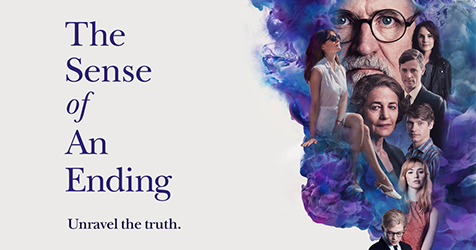
In his old age, Tony Webster (Jim Broadbent) received a registered letter notifying him of a small inheritance from someone he had known way back in his university days. The money isn’t the important thing, it’s the diary that is supposed to go with it that opens up a door to his past. And so begins the story. Tony has to rethink everything about himself (younger played by Billy Howle), his first love Veronica Ford (younger played by Freya Mavor), Veronica’s family, in particular his mother Sarah (Emily Mortimer), and his school friends Adrian Finn (Joe Alwyn, who plays Billy Lyn in Ang Lee’s 2016 movie).
There are hits and misses in this adaptation. Broadbent delivers a solid performance as the clueless Tony Webster, a man who has lived all his life lacking the lucidity of seeing himself and others in the proper light, or is it selective memory? The little bit of addon is good, letting Tony set up an old camera shop to get him out of bed everyday. It’s also a good link because when he first met Veronica, she was toying with one, and he had received one from her as a gift as well. Herein lies the linkage of the object with the distant past.
Tony has his ex-wife Margaret (Harriet Walters) to thank, for she humours him by meeting him time and again just to listen. She may be doubting what Tony is telling her, but she is patient and wait for him to slowly rediscover himself. That’s what a good listener does, isn’t it, she helps you question yourself.
Adding the plotline of Tony’s daughter Susie (Michelle Dockery) giving birth to a baby is effective. Those who miss Downton Abbey would be glad to see Mary Crawley again, in a new role. But the real effect here is that her giving birth to a newborn son leads me to appreciate the title of the book, something that I did not quite get when I was reading. I wondered about the relevance of the book title when I was reading it. The movie’s last scene clears this up for me. After all these years of misinformed self-knowledge, Tony finally comes to the end of a chapter in his old age, still not too late. With the renewed relationship with his ex Margaret, and a new grandchild, Tony is ready to call an end to a clueless life and start anew. Once more, with feeling.
The weakest link I feel is with the elderly Veronica character played by Charlotte Rampling. It’s a missed opportunity for the director to draw out more from this veteran actor. Unlike in the book, which depicts an absolutely frustated Veronica, possibly traumatized by what had happened to her in life, finding Tony not understanding a bit about the past. “You just don’t get it, do you?” Exasperated, she has said this several times in the book, if my memory serves me correctly.
So here in the movie, the most crucial scenes ought to be Tony’s meeting with the older Veronica for the first time after all those decades and Veronica seeing Tony still oblivious to what had happened. But no, we see an utterly aloof Veronica, too calm for those tense cinematic moments. “You just don’t get it, do you?” has not been said even once, if my memory serves me correctly.
And the most crucial line in the pub when Tony finds out the truth, it ought to be the climax but the scene is so understated that any built up has been eroded. Now he gets it, and what reaction does he show at the moment and afterwards? I feel it’s the director’s job to augment the moment, and let it ripple into the next sequences. I’m sure the cast can easily oblige. Just for the sake of eliciting more emotional engagement from the viewers. I remember how sensational it felt when I came to that part in the book.
Overall, it’s a pleasure watching these veteran actors in the same production. Together with the above-mentioned cast members, there are also Matthew Goode, the history teacher, but not in a scene with Michelle Docerty, and Merchant Ivory star James Wilby playing the small role of Veronica’s father.
That it is shot on location in London, especially watching Tony meet Veronica again on “the wobbly bridge” leading to Tate Modern is particularly poignant in light of recent events. Overall, a watchable adaptation to go with the book.
~ ~ ~ Ripples
***
Related Posts on Ripple Effects:
 Ripple Effects