2010: Another Year of Books and Films

The discussion of movies is frequently more interesting than the movies themselves.

——   A. O Scott, NYT Movie Critic

Thanks to A. O. Scott, in his recent article on Films, Themes, and Trends, he has spelt out for me the raison d’etre of Ripple Effects.  As I always say, I’m just throwing a pebble into the pond.  It’s watching the splash and the out-reaching ripples that makes it so gratifying.  Thanks to all your responses, the discussions following the posts have made it all worthwhile.

2010 is my record year for movies watched. As a previewer for an international film festival, I’ve had the experience of viewing over 50 features, docs, and shorts in one month.  As a film lover, I’ve seen another 50 more of my own choice in the other months.  They are not all 2010 productions.  The oldest film for me this year is a silent black and white Ozu work, A Story of Floating Weeds (1934).  I’ve also discovered Robert Bresson.  His Diary of a Country Priest (1950) is probably one of the best Book Into Film adaptations I have encountered.

But, to remain timely, and we all like lists, here are Arti’s favourite movies released in 2010 (in no particular order).  Click on link to read my review:

  1. The King’s Speech (review coming up)
  2. The Secret In Their Eyes
  3. Another Year
  4. Nowhere Boy
  5. Never Let Me Go

Is it coincidental that all of the above except one are from the UK?  The Secret In Their Eyes is Argentinian.  It won the Best Foreign Language Film Oscar for 2010.

**

Favourite books read in 2010 (again, in no particular order):

  1. Snow Country by Yasunari Kawabata
  2. Diary of a Country Priest by Georges Bernanos
  3. The Music of Chance by Paul Auster
  4. Never Let Me Go by Kazuo Ishiguro
  5. Theatre by William Somerset Maugham

**

Favourite Interesting Search Engine Terms (words people use to arrive at Ripple Effects this year):

  • elegance of the hedghog movie restroom music
  • banksy telephone booth
  • bird front view
  • darcy wet shirt
  • colin firth wet darcy
  • wet colin firth
  • colin fith
  • darcy kiss amanda in lost austen
  • little miss sunshine van
  • free great gatsby iphone
  • imprisonment in snow country
  • revolutionary road insane son controlling mother
  • to see the lost cattails soft winds and roses
  • what color are pussy willows?
  • virginia woolf’s crusading novel a room of one’s own
  • pregnant man giving birth
  • giving birth naturally
  • noomi rapace piercings
  • vw van
  • flotsam? i’ve gotsam
  • funny things inside mad magazine
  • the girl with the dragon typo
  • stranger
  • lust

Just a sampler showing you how eclectic Ripple Effects can be.

I look forward to throwing more pebbles in the coming year.  Again, a hearty thank-you to all my regular readers and occasional visitors.  Thank you for taking the time to comment.  You are the fuel for this journey called blogging, and without your responses and discussions, there’s simply no raison d’etre for Arti to press forward another year.


To All, A Happy New Year!

Dive in, make waves… it’s warmer than you think.

***

Winter Wonderland

I caught this lone cross-country skier on a frozen creek in snow country.  Let this be my Christmas card to all:

May your Christmas be as serene and exhilarating as this magical moment.


***

And, thanks to a reader’s suggestion, may the following carol warm the winter chills and quiet the holiday frenzy.

‘In The Bleak Midwinter’


A Merry Christmas To All!

***

Photo taken by Arti of Ripple Effects, December 2010, All Rights Reserved.

Reading Snow Country in Snow Country

The first ‘Snow Country’ in the title refers to the 1968 Japanese Nobel Laureate Yasunari Kawabata’s (川端 康成 1899-1972) seminal novel Snow Country (雪鄉); the second refers to Arti’s neck of the woods here north of the 49th parallel in mid December.

Written in the 1930’s through to the 1940’s, Snow Country was later translated into English and published in 1956.  It is probably Kawabata’s most well-known work.  Translator Edward G. Seidensticker had been credited for leading Kawabata’s work to the ultimate accolade, the Nobel Prize of Literature in 1968, a first for a Japanese writer.

The haiku-like simplicity so pervasive in the book is most apt for the Season. Firstly, its meditative descriptions and imagery offer a respite in the midst of our frantic pace.  And secondly, it points to certain relevance during this Christmas time, which I find surprising.

Translator Seidensticker writes in the introduction that the haiku is a juxtaposition of incongruous terms, such as motion and stillness. Within such contradictions sparks “a sudden awareness of beauty.”  Relax in the following poetic imageries:

They came out of the cedar grove, where the quiet seemed to fall in chilly drops.

or this:

[Her voice] seemed to come back like an echo of distilled love.

or this:

The field of white flowers on red stems was quietness itself.

Or savor the interplay of light and shadow, which evokes the poignancy of decayed beauty. This could well be the summing up of the human condition in Kawabata’s novel.

The sky was clouding over.  Mountains still in the sunlight stood out against shadowed mountains.  The play of light and shade changed from moment to moment, sketching a chilly landscape.  Presently the ski grounds too were in shadow.  Below the window Shimamura could see little needles of frost like ising-glass among the withered chrysanthemums, though water was still dripping from the snow on the roof.

The protagonist Shimamura, ‘who lived a life of idleness’ from inherited wealth, would leave his wife and children in Tokyo and go alone to the snow country every year, the mountain region of central Japan, to meet Komako, a young geisha at a hot spring village.  The love affair between the two is starkly off-balanced.  Despite her work in the pleasure quarters, entertaining parties of men, Komako is deeply devoted to Shimamura. Like her meager dwelling in the shabbiness of all, her room is spotlessly clean: “I want to be as clean and neat as the place will let me…”

Sadly, Komako realizes it is but a doomed unrequited love that she has invested in.  Shimamura too is aware of his own coldness.  Even though he is drawn back to Komako by making these trips to the snow country, he feels no obligation at all:

All of Komako came to him, but it seemed that nothing went out from him to her.

Of course, it could well be guilt and a sense of moral ground, albeit his loyalty to his wife and children rarely comes to mind.

Shimamura does not understand the purity Komako seeks in her love for him, and her desire not to be treated as a geisha.  And that is why his nonchalant statement hits Komako so hard. In the climatic scene of the story, he utters, though not without affection: “You are a good woman.”

Instead of taking his words as an endearment, Komako is deeply hurt. Despite having to work as a geisha due to her circumstance, thus selling herself as an outcast, she longs to be removed from her predicament and be transported to a new life. Shimamura’s repeated words “You are a good woman” fall upon her like the gavel of final judgement laden with biting sarcasm.

Kawabata’s characters cry out for redemption, to be delivered from their precarious state. Komako is seeking saving grace in Shimamura, and desperately hoping for a way out of the “indefinable air of loneliness” shrouding her.  But her search is in vain for the man is incapable of love:

He was conscious of an emptiness that made him see Komako’s life as beautiful but wasted, even though he himself was the object of her love; and yet the woman’s existence, her straining to live, came touching him like naked skin.  He pitied her, and he pitied himself.

Shimamura knows deep down that he needs cleansing as much as or even more than Komako.

The snow country of Japan is also the land of the Chijimi.  It is an old folk art of weaving where a certain kind of long grass is cut and treated, finally transformed into pure white thread.  The whole process of spinning, weaving, washing and bleaching is done in the snow.  As the saying goes, “There is Chijimi linen because there is snow.”  After the linen is made into kimonos, people still send them back to the mountain regions to have the maidens who made them rebleach them each year.  And this is where the universal appeal of snow as a metaphor for purity and cleansing so powerfully depicted by Kawabata, as Shimamura ponders:

The thought of the white linen, spread out on the deep snow, the cloth and the snow glowing scarlet in the rising sun, was enough to make him feel that the dirt of the summer had been washed away, even that he himself had been bleached clean.

When I came to this description towards the end of the book, a starkly similar image conjured up in my mind:

Though your sins are like scarlet, they shall be as white as snow; though they are red as crimson, they shall be like wool.”              —- Isaiah 1:18

And like the doomed ending of their love affair, death comes as a certainty to all, insects or humans alike.  Shimamura has observed how a moth “fell like a leaf from a tree… dragonflies bobbing about in countless swarms, like dandelion floss in the wind.”  The poetic descriptions do not make death any more appealing.  Kawabata uses insects as a metaphor for the frailty of life and the chilling finality awaiting:

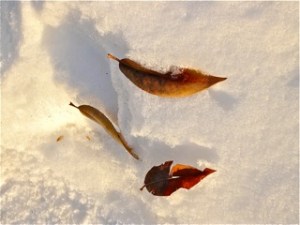
Each day, as the autumn grew colder, insects died on the floor of his room.  Stiff-winged insects fell on their backs and were unable to get to their feet again.  A bee walked a little and collapsed, walked a little and collapsed.  It was a quiet death that came with the change of seasons.  Looking closely, however, Shimamura could see that the legs and feelers were trembling in the struggle to live.
It is pure serendipity that I picked up this book to read at this time of the year.  The Christmas story too has also cast a vivid interplay between darkness and light.  I was reminded of this reference:

The people walking in darkness have seen a great light; on those living in the land of the shadow of death a light has dawned.”            — Isaiah 9:2

There is reason to rejoice, for the Able Deliverer had come… He too had lived a life of paradoxes and contradictions: born to die, life through death, strength through weakness.  And beneath the surface of jollity of the Season and the superficial exchanges of good will, there lies deep and quiet, the source of joy and inner fulfillment, and Life’s ultimate triumph over death.

I heard a small voice echo as I treaded on the snowy path alone in my snow country.

It said: “For this reason I came.”

***

Snow Country by Yasunari Kawabata, translated by Edward G. Seidensticker. Published by Vintage International, 1996. 175 pages.

This concludes my final entry to meet Dolce Bellezza’s Japanese Literature Challenge 4 before the end of 2010.

My other JLC posts:

Never Let Me Go by Kazuo Ishiguro

Rouse Up O Young Men of the New Age! by Kenzaburo Oe

Reading the Season: Luci Shaw

Every year around this time, I try to stay afloat in the sea of chaos and consumerism.  My method of survival has been to seek a quiet haven where I can dwell upon the meaning of the Season.  I entitled my annual December post on this theme ‘Reading the Season’.

This year, watching the daring flash mob singing of Hallelujah Chorus in a shopping mall food court has jump started my quest for a spiritual respite.  In a time where the legitimate word is Jollity over Jesus, where Christ has been declared politically incorrect at Christmas, and where God is denounced together with Bigfoot and the tooth fairy in ads on buses, I want to mull on some subversive counter-reflections.

This time, I’ve steered my search towards poetry and found this collection edited by Luci Shaw.  It is the 1984 Regent College Publication of  A Widening Light: Poems of the Incarnation. (Click on link to read excerpts from Google Books.)


Luci Shaw has partnered with Madeleine L’Engle on her literary journey, including being her publisher, co-author, fellow poet and close writer-friend.  For years, I have enjoyed Luci Shaw’s poetry and her other works, and one time, had sat in her workshop learning the art and craft of journal writing.

A Widening Light is a collection of poetry by some of twentieth century prominent Christian writers and scholars, including C. S. Lewis, Eugene Peterson, Mark Noll, as well as lesser known but just as inspiring contributors.  My favourite in the collection are those from Madeleine L’Engle and Luci Shaw.

As a meager attempt to stoke the flame of faith and keep the Reason in the Season,  I’d like to share some excerpts from this collection here.

Made flesh
After the bright beam of hot annunciation
Fused heaven with dark earth
His searing sharply-focused light
Went out for a while
Eclipsed in amniotic gloom:
His cool immensity of splendor
His universal grace
Small-folded in a warm dim
Female space—
The Word stern-sentenced to be nine months dumb—
Infinity walled in a womb
Until the next enormity—the Mighty,
After submission to a woman’s pains
Helpless on a barn-bare floor
First-tasting bitter earth.

Now, I in him surrender
To the crush and cry of birth.
Because eternity
Was closeted in time
He is my open door
To forever.
From his imprisonment my freedoms grow,
Find wings.
Part of his body, I transcend this flesh.
From his sweet silence my mouth sings.
Out of his dark I glow.
My life, as his,
Slips through death’s mesh,
Time’s bars,
Joins hands with heaven,
Speaks with stars.

Luci Shaw


Some Christmas stars
Blazes the star behind the hill.
Snow stars glint from the wooden sill.
A spider spins her silver still

within Your darkened stable shed:
in asterisks her webs are spread
to ornament your manger bed.

Where does a spider find the skill
to sew a star?  Invisible,
obedient, she works Your will

with her swift silences of thread.
I weave star-poems in my head;
the spider, wordless, spins instead.

Luci Shaw


After annunciation

This is the irrational season
When love blooms bright and wild.
Had Mary been filled with reason
There’d been no room for the child.

Madeleine L’Engle

.

.

The risk of birth

This is no time for a child to be born.
With the earth betrayed by war and hate
And a nova lighting the sky to warn
That time runs out and the sun burns late.

That was no time for a child to be born.
In a land in the crushing grip of Rome;
Honour and truth were trampled by scorn—
Yet here did the Saviour make his home.

When is the time for love to be born?
The inn is full on the planet earth,
And by greed and pride the sky is torn—
Yet Love still takes the risk of birth.

Madeleine L’Engle


‘Reading The Season’ Posts over a Decade:

2020: Jack by Marilynne Robinson

2019: ‘A Hidden Life’ – A Film for the Season

2018: A Verse from Madeleine L’Engle’s The Irrational Season

2017: A Wrinkle in Time by Madeleine L’Engle

2016: Silence by Shusaku Endo

2015: The Book of Ruth

2014: Lila by Marilynne Robinson

2012: Surprised by Joy by C. S. Lewis

2011: Walking on Water by Madeleine L’Engle 

2010: A Widening Light by Luci Shaw

2009: The Irrational Season by Madeleine L’Engle

2008: The Bible and the New York Times by Fleming Rutledge 

2008: A Grief Observed by C. S. Lewis

***

Photos:  All photos in this post except “Water drops on spider web” are taken by Arti of Ripple Effects, All Rights Reserved.

‘Water drops on spider web’ is in the public domain, please refer to Wikimedia Commons for further  details.  CLICK HERE to go there.

Upcoming Books Into Films

Looking for book suggestions for yourself or your book group in the coming year? The following is a list of books being planned for a movie adaptation. Books turning into movies always generate a lot of debates and discussions.  Better still, read the book then watch the movie together… I’m sure more debates will ensue.

Hope the following list can furnish you or your group with some ideas. Do note that these titles are in various stages of development, meaning some may come out in the next year or two, some may take longer if they get started at all.  Click on titles (links) for more details.

***

1984 by George Orwell

A Thousand Splendid Suns by Khaled Hosseini

The Adjustment Team (short story) by Philip K. Dick (Film: The Adjustment Bureau)

The Adventures of Tintin: The Secret of the Unicorn by Hergé

All Quiet on the Western Front by Erich Maria Remarque (Daniel Radcliffe)

American Pastoral by Philip Roth

Anna Karenina by Leo Tolstoy (Keira Knightly)

Atlas Shrugged by Ayn Rand

Bel Ami by Guy de Maupassant (short story)

The Bell Jar by Sylvia Plath

Blink by Malcolm Gladwell

The Book Thief by Markus Zusak

Brave New World by Aldous Huxley

The Chronicles of Narnia: The Silver Chair by C. S. Lewis

The Corrections by Jonathan Franzen

Don Quixote by Miguel de Cervantes

East of Eden by John Steinbeck

Extremely Loud and Incredibly Close by Jonathan Safran Foer (Tom Hanks, Sandra Bullock)

Fahrenheit 451 by Ray Bradbury

Flowers for Algernon by Daniel Keyes

The Giver by Lois Lowry

The Great Gatsby by F. Scott Fitzgerald (Carey Mulligan, Leonardo DiCaprio)

Hamlet by William Shakespeare

The Help by Kathryn Stockett

The Historian by Elizabeth Kostova

The History of Love by Nicole Krauss

The Hobbit by J. R. R. Tolkien

The Invention of Hugo Cabret by Brian Selznick

Ivan the Fool by Leo Tolstoy

Jane Eyre by Charlotte Brontë

Life of Pi by Yann Martel

The Lincoln Lawyer by Michael Connelly

Middlemarch by George Eliot

On Chesil Beach by Ian McEwan

On the Road by Jack Kerouac

One Day by David Nicholls

One for the Money by Janet Evanovich

Paradise Lost by John Milton

The Piano Tuner by Daniel Mason

Pride and Prejudice by Jane Austen (A new take: Jane Austen Handheld)

Pride and Prejudice and Zombies by Seth Grahame-Smith

Pygmalion by Bernard Shaw (My Fair Lady, Carey Mulligan, Emma Thompson script)

The Screwtape Letters by C. S. Lewis

Sense and Sensibility by Jane Austen (A Latina spin: From Prada to Nada)

Tender is the Night by F. Scott Fitzgerald (Matt Damon, Keira Knightly)

The Three Musketeers by Alexandre Dumas

The Tiger by John Vaillant

Tinker Tailor Soldier Spy by John Le Carré (Colin Firth)

Water for Elephant by Sara Gruen

Wuthering Heights by Emily Brontë

***

For a more updated list, click here to “More Upcoming Books Into Movies”.

If you know of any other titles, you are welcome to add to this list by leaving the info in the comment section.

CLICK HERE for WordPress Tag: Book Into Film.