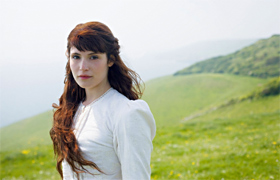
The Merchant Ivory Dialogues

Re-watching The White Countess (2005) has prompted me to savor other Merchant Ivory films .  I love their sumptuous period set design, stunning cinematography and exceptional acting.  Some of them have garnered Oscar accolades, and since become classics, creating a genre of their own.

Long before Bollywood and Slumdog Millionaire, there was Ismail Merchant, born in Mumbai (formerly Bombay), India, in 1936.  He later went to New York to further his education, and started making movies in 1960.  On his way to the Cannes Film Festival in 1961 representing the U.S. with his nominated short, he met American director James Ivory.  The two formed a production company that same year, and the rest is history.

Before producer Ismail Merchant passed away in 2005, the Merchant Ivory Productions had created timeless masterpieces, most notably, adaptations from the work of E. M. Forster, Henry James, and Kazuo Ishiguro.  Together with German/Polish screenwriter Ruth Prawer Jhabvala, they have turned literary satires and portrayal of class-conscious Edwardian and Victorian English society into accessible popular movies, interpreting the humor and wit with a mark of their own.  Ironically, none of the three are English.  Maybe it does take an outsider to see clearly.   A short list of their impressive productions includes  A Room With A View (1985),  Howards End (1992),  The Remains of the Day (1993),  and The Golden Bowl (2000).

james-ruth-and-ismail


But here in this post, I must present to you The Merchant Ivory Dialogues.  Oh that’s not how it’s titled.  But Arti just named it so.  In the 2005 Criterion Merchant Ivory Collection DVD of Howards End (1992, 9 Oscar nominations, 3 wins) I found in the Special Features this amusing interview with producer Ismail Merchant and director James Ivory.  The conversation between the two are so whimsical that they could almost form a comedic duo.
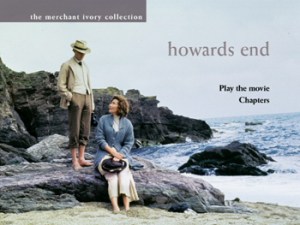
 

howards-end


Here are some excerpts:

On the idea of creating Howards End the movie:

 M: Howards End started with Ruth (screenwriter) telling me and I think gave Jim the novel to read.                                     


I: Well hold on. I’d read it.

M:    Oh, You’ve read it.  I see.

I: I’d read it in fact twice.   Ruth always sort of not exactly dangled the book in front of us after A Room with a View and Maurice.  But she saw it  as a really ambitious, and to her would be most, most rewarding project for us and for her.

M: Anyway, it was slow going for me.


***


On Jim Ivory’s favorite scene

I: For me … from the first time, if I remember anything about it, except this scene where Margaret jumps out of the car when they run over a cat.  Charles Wilcox doesn’t want to go back and a little girl runs into the road and starts crying and Margaret leaps out of the car…

M: We had to go to this incredible preparation, real cat and the artificial cat and the dead cat…

 I: There’s no real cat.

M: And so I said no I don’t want to do it, you know.  But he insisted because it was his favorite scene, and it is not in the film.  So you should listen to the producer first.

 I: That’s all I can really remember about the book the first time I read it was that scene,  which I thought is incredibly dramatic…

M: That’s your favorite scene which is not in the film.

I: Which we shot and cut out of the film. Anyway…


***


On Forster the Social Critic:

M: Howards End is about the class system, and what Forster said about the inheritance of England. This beautiful house, a metaphor for England,  will be inherited by the lower class. That is what happens here. This beautiful house is inherited by the clerk’s illegitimate son. Well anyway, this is an interpretation of mine.

I: I don’t think Forster had all that great love for the working classes …

M: Not love for the working class but…

I (voice covering M): He had an ideal, which was, people should be able to mingle from whatever their background, whatever their class, they all ought to be able to in a civilized and happy world. And in the good England everyone ought to be able to mix together if only the different kinds and types of people could make a connection. Then it would be for the betterment of all.


***


On American Funding (or the lack of)

M: Howards End was an ambitious film at that time, eight million dollars, the budget. We could not get eight million dollars from anybody, you know, it’s just not possible because Americans never saw the possibility of this film being successful as they never see anything of consequence or civilized film to be successful. They have blinkers on their eyes, they never see anything beyond, you know, the form …

I (moving about in his seat, almost rolling his eyes): All Americans?

M: All Americans

I (raises his eyebrows just enough to show his disagreement):   All Americans.

M: All American film companies… with the exception… there are some sensible people like Sony Classics, they were at that time with Orion pictures….they were very excited but they only gave us a very small sum of money…of course, their enthusiasm and support were greatly appreciated but we had to raise 85% of the money outside…


***

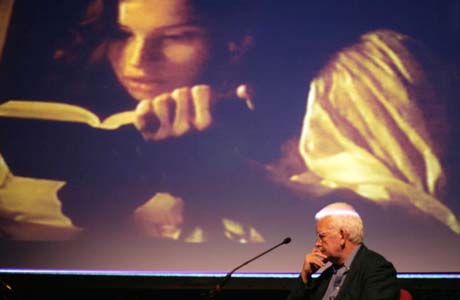
emma-thompson-vanessa-redgrave


On Getting Vanessa Redgrave on Board

I: And then there was the casting of Vanessa Redgrave, who all along, from the very beginning I had wanted in that part. I thought she was the actress to play the first Mrs. Wilcox. And we kept sending her scripts, and this is the way it’s always is with Vanessa… You’re not sure she’s got the script, you’re not quite sure she’s read it, whether she likes it, whether she’ll do it…

M: I’ll tell you the story. Jim’s heart was set on Vanessa, and so was mine. So we sent this script and then we went to tea at Waldorf  Hotel. And so we were sitting there and she said she had four, five months all planned… and the money you offer is not enough. So I said what would you like.  She said if you could double that amount, I would do it. So I said ok, that’s it, you said it, now it’s double your salary. She couldn’t believe it was instantly, spontaneously done, because knowing that we had a small budget and we had to struggle for every penny. This was like giving whatever you want.

I: A very bad precedent.

M: Sorry?

I: A very bad precedent.

M: No it’s not a bad precedent at all. And for her I would do anything, you know. If she said get me the moon, I would get the moon for her. And it’s not possible for people to get the moon, but I would do it.

***


Ah… the creative process, the self and the collaboration, the art and the business, the part and the whole… just fascinating.

~~~~~


Photos:  James Ivory, Ruth Prawer Jhabvala, and Ismail Merchant received BAFTA Fellowship Award (2002)  news.bbc.co.uk;  Emma Thompson and Vanessa Redgrave in Howards End, toutlecine.com


The Reader: Book Into Film

the-reader1

The Reader is the highly acclaimed novel by German writer Bernhard Schlink.  It was first published in 1995 in Europe and the English translation came out two years later.  Anthony Minghella (Cold Mountain, 2003) was said to be the original director of the film adaptation, with his friend Sydney Pollack (Sketches of Frank Gehry, 2005) producing.   Their untimely death sadly altered the scene somewhat, even though they were still named as producers when the Awards Season arrived.  Thus the poignant acknowledgement from Kate Winslet as she received her Oscar Best Actress Award.

Selected as a New York Times Notable Book and a Los Angeles Times Book of the Year, the novel’s 218 pages are packed densely with poignant images and thought-provoking moral questions.  The first part takes place in the 1950’s. 15 year-old Michael Berg gets sick on his way home from school and is helped by a woman, Hanna Schmitz.  Thus sparks the sexual encounter and later love affair between the two.  Every time they meet, Hanna makes sure Michael reads to her literature from Homer to Chekhov.

After a while, Hanna disappears, and not until Michael becomes a law student does he see her again, this time in a post-war trial of Nazi criminals.  Hanna turns out to be a guard at a concentration camp during the Holocaust.  As Michael is awash by torrents of conflicting emotions while watching the trial, he is aghast at a personal secret Hanna refuses to reveal, one which could have saved her from a lengthy prison term.  Her only statement of defence is wrapped in one sentence:  “What would you have done?”  She asked the judge.

The last part of the book is in the present day.  Michael, now a lawyer, is still haunted by his past and the residual emotional ambivalence upon the release of Hanna from prison.  The story wraps up with a heart-wrenching ending.

Hidden behind the romantic facade is a story that deals with a deeply complex set of moral issues; the love affair between a 30 some year-old woman and a 15 year-old boy is only the initial spark.  This is not a Holocaust novel, but rather, an incisive depiction of psychological dilemma confronting a new, post-war generation in Germany.  The moral burden that Michael faces is heavy, seemingly unresolvable and yet born by the collective psyche:

“I wanted simultaneously to understand Hanna’s crime and to condemn it… When I tried to understand it, I had the feeling I was failing to condemn it as it must be condemned.  When I condemned it as it must be condemned, there was no room for understanding… it was impossible to do both.”

I read the book  a while back but have delayed seeing the movie, directed by Stephen Daldry and screenplay by David Hare (both of The Hours, 2002).  First off, I could imagine the film, having the advantage of transporting the literary into visual realism, can go all out gratuitously to depict the love affair between Michael and Hanna.  Further, the very complex moral issues the book deals with would be a challenge to transfer into film, making it less effective and maybe even trivializing the crux of the matter.

Well, I was both right and wrong.  The first part of the movie depicting the seduction of Michael (18 year-old David Kross) by Hanna (Kate Winslet) and which gradually grows into a full-fledged love affair does carry some gratuitous erotic sequences.  However, having watched the movie I have also come to appreciate the necessity of this relationship.  The love affair between Michael and Hanna is the very analogy of a younger generation having had to deal with the conflicting emotions of loving their own parents, many of whom were involved in the atrocities of the Nazi regime.

Both Winslet and Kross have delivered a most affective cinematic rendering of an otherwise despicable affair.  Winslet has brought out an exceptional performance, from a simple and passionate young woman to a grey-haired, seemingly amoral and yet deeply tormented prisoner.   The irony of the movie is that, by crafting a visually appealing cinematic offering, it has won over its viewers’ heart (especially Winslet fans), resulting in a much more sympathetic rendition of someone who has a hand in the death of hundreds of Jews under her guard.

Likewise, the portrayal of the older Michael (Ralph Fiennes) is less effective than it deserves.  Maybe due to his limited scenes, it appears that Fiennes lacks the time to dwell himself fully in the character to elicit the spectrum of conflicting emotions.  It may also be the weaker script, compared to the book, that has shrouded some critical issues with ambiguity.

But I did appreciate the scene where a distressed Michael consults with his professor (Bruno Ganz), who  distinguishes between law and morality.   The law has nothing to do with right or wrong, he tells Michael.  What’s legal doesn’t make it right.  Implication follows that duty and legality do not excuse wrongdoings.  While the  law regulates the behavior, it is morality that constrains the heart.

While the movie is appealing visually and offers some riveting performance, I urge viewers to be the reader.  That’s what I did, re-read the book as soon as I got home, and appreciated the written words even more.

Book and Movie

~ ~ ~ Ripples

The Reader by Bernhard Schlink, translated by Carol Brown Janeway, published by Vintage International, 2008,  218 pages.

Photo Source:  usatoday.com

****

Man On Wire (2008, DVD): Romancing the Towers

man-on-wire1When the idea of building the World Trade Center Twin Towers began to germinate in NYC, on the other side of the globe, a young man in France started to weave a dream.  He wanted to walk across the top of the Towers on a wire after they were built.  Six years later, with the Towers nearing completion, Philippe Petit fulfilled his dream a few days short of his 25th birthday.  On August 7, 1974, he stepped on a wire strung across the roof top of the then tallest buildings in the world.  Hailed as ‘The Artistic Crime of the Century’, Philippe Petit’s breathtaking, and illegal, high wire act is the ultimate test of the human spirit, pushing the limit of audacity and strength.
Based on Philippe Petit’s book To Reach The Clouds,  Man On Wire has won over 20 film awards only a few short months after its release, ultimately receiving the Oscar Best Documentary for 2008.  Director James Marsh chronicles the extraordinary endeavor of Philippe Petit by means of interviews, dramatic re-creation, and archival footage.  Before the WTC, Petit had walked across the two steeples of the Nortre Dame Cathedral in Paris, and the Sydney Harbour Bridge.  The WTC Towers meant the summit of his aspirations.  In a Sundance Film Festival interview, he described his act as ‘marrying the Towers’.

 Director James Marsh has chosen a very human angle to present his subject, such that we’re not just watching an extraordinary circus feat.  The documentary reveals a child growing up with unusual physical talents.  It vividly depicts the fearlessness of youth, the weaving of a fairy tale, the bond of friendship without which Philippe could not have achieved, and finally the euphoria of a dream fulfilled.  The smile on Philippe’s face while on the wire says it all.

The interviews in the film have also brought some very personal elements into this enthralling event.  We see Philippe’s childhood friend and accomplice Jean-Louis overcome with emotion, now more than 30 years later, as he recalls and is still moved by the immensity of the experience.

It’s a crime, no doubt, but it’s team work of the highest level of difficulty.  That they had to haul hundreds of pounds of wire and equipment up to the roof top, shoot the wire across, anchor it safe, all without detection was itself an incredible feat.  Once that was done, the rest was easy for Philippe, he just needed to walk on the wire suspended 1,350 feet above ground.

And that is when the artful part comes in.  Philippe had not just walked on tightrope, but performed with grace and serenity, movements conjuring up images of ballet on air.  For 45 minutes, he slow-danced across the Towers eight times, lay, knelt, and sat on the wire to the amazement of the awestruck crowd on the ground.  There was unspeakable beauty in his magnificent boldness.

Police had to threaten him with a helicopter to get him off.  He and his friends were immediately handcuffed, taken to jail, and Phillipe undergone a psychiatric examination.  He was later released and given a life-time pass to the Towers.  When asked why he did it, he answered:

“There’s no why… Life should be lived on the edge.”

Excellent special features that come with the DVD include Philippe Petit’s 1973 Sydney Harbour Bridge Crossing, exclusive interview with Philippe Petit, and an animated short film based on the children book by Mordicai Gerstein “The Man Who Walked Between the Towers”, narrated by Jake Gyllenhaal.  Further,  in this post 9/11 world, the DVD is even more significant in that it chronicles someone who had taken the arduous steps to appreciate and to relate to the Towers in a most memorable way.

And then there’s the music.  I admit it’s the music that has enthralled me from the start, yes, even with just the menu.  While Michael Nyman has written some fantastic original score for the documentary, it’s French composer Eric Satie’s pieces that so captivate me.   Satie’s Gymnopedie No. 1 is the music that augments the beauty of Philippe’s poetic walk on wire.

While most of us would rather watch life being lived on the edge from the comfort of our living room, we would be inspired nonetheless to venture out of our couch for a little more excitement, and motivated to take just a bit more risks with our life.  For us ordinary folks, maybe living life to the fullest is an aspiration challenging enough.

~ ~ ~ ½ Ripples

  “If no one ever took risks, Michaelangelo would have painted the Sistine floor.”      — Neil Simon 


Philippe Petit and James Marsh Interviews:

Click here for the  NPR’s Studio 360 Interview

Click here for the Sundance Film Festival Interview on YouTube


Confessions of a Shopaholic: Book and Movie

confessions-of-a-shopaholic-book-cover

‘Are you serious?’ my son exclaimed as he pried open my Amazon package.

‘It’s just a filler to make up the amount for free shipping,’  I said.  (Didn’t he know it was for his CD that I had to make this purchase in the first place?)

Ok, after reading Thomas Hardy, Jhumpa Lahiri, Philip Roth, not to mention the very hard-to-get-through Amy Bloom, all in a month’s time, I needed a break.  A break it is.

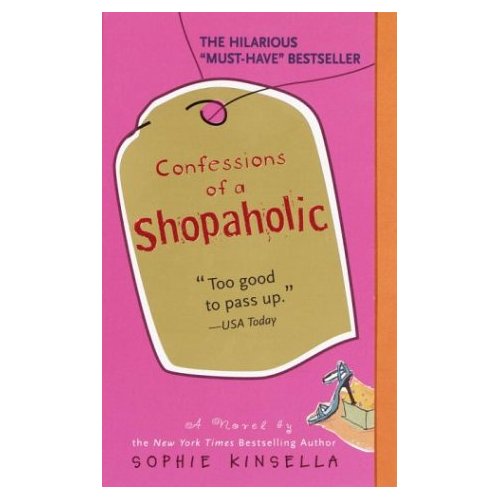
The book Confessions of a Shopaholic is like a commercial break:  it gives you a chance to relax in between tense moments, a filler, but unlike most commercials, it’s entertaining, very funny, and not as dismissible as it looks.  (To my copy-writer friend: Nothing personal,  it’s just the genre.)

I’d many LOL moments, and several times I caught myself reading with a smile on my face.  How many books have you read that can elicit that facial response? Not that I looked at the mirror while I read, but I just noticed.

I learned a long time ago that the best kind of humor is the self-deprecating kind.  Kinsella’s Shopaholic series just might have extended that axiom to include her own gender.  But why not, Jane Austen did that too, plus the other gender along the way.  And that reminds me, reading Shopaholic conjures up images of Bridget Jone’s Diary,  which in turn,  and remotely, suggests certain Austen-esque styling.

Rebecca Bloomwood is a twenty-five year old college grad lucky enough to have launched a job as a financial journalist at Successful Saving.  A whole new world opens up to her as she gets her VISA card and automatically given an overdraft limit at her bank.  Loaded with such financial ammunition, Becky plunges right into the swirl of brandname fashion and all other fancy stuff a gal just got to have.  After all, they’re all an investment to her, and shopping just seems to be the ideal workout. How can she keep fit just sitting at home?

“They should list shopping as a cardiovascular activity.  My heart never beats as fast as it does when I see a ‘reduced by 50%’ sign.”

In no time, Becky Bloomwood the financial journalist has sunk deep in debt.  The irony becomes more acute when she is invited to appear on TV as an adviser on personal finance management.

Kinsella has crafted a modern day satire on the female psyche vis-a-vis consumerism.  Ok, some female psyche… not all.  Her sharp observation of human nature, and spot-on nuances on both genders, together with the generous unleashing of self-deprecating humor, effectively mask the didactic end of  Shopaholic.  The book might have delivered the message for us all in today’s slumping economy.  It has unwittingly (or perhaps wittingly) depicted some of the causes of such a major breakdown in our financial system:  the allure of credits, the insatiable quest for posession, the deception of desire over need, and the tyranny of brandname consumerism.

The author has effectively created a comic caricature.   Rebecca is an addict in denial, but she’s amiable nonetheless.  We laugh at her flaws and errors because we can sympathize with her predicament, or maybe even identify with some of her weaknesses.  The book is almost script-ready, it has the funny dialogues, the colorful characters, the dramatic elements.  Although the story doesn’t get fired up until the last hundred pages, it’s an enjoyable read overall.

~ ~ ½ Ripples

confessions_of_a_shopaholic_movie_poster

And for the movie, well, the movie is a different matter.

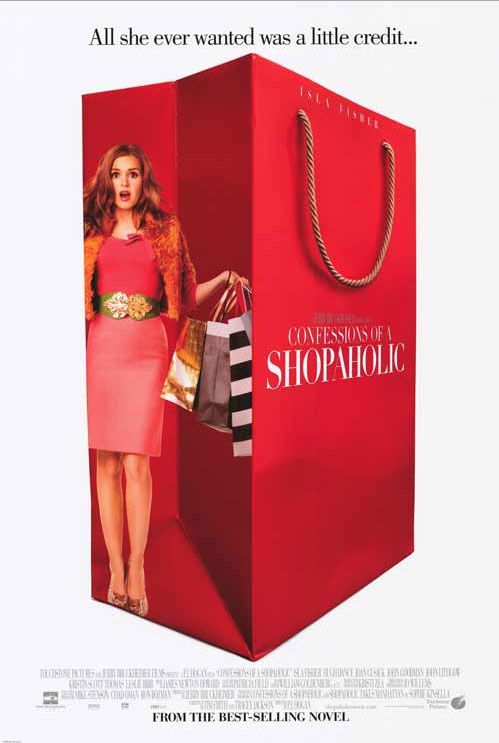
Australian director P.J. Hogan (My Best Friend’s Wedding, 1997) has wasted some highly workable comedic materials, and a talented supporting cast like Kristin Scott Thomas, Joan Cusack, John Lithgow, and John Goodman.  He has reduced a pleasing, humorous, and relatively intelligent book into a slapstick, patchy, and mindless farce.  LOL response in the theatre was almost nil, because the script is simply flat and not funny, despite the earnest attempt of the cast.  Isla Fisher (Definitely Maybe, 2008) has downgraded Becky Bloomwood into a stereotypical, silly female wrapped in pink;  Hugh Dancy (The Jane Austen Book Club, 2007), who plays her boss and later love interest, seems too constrained to be effective.  The movie simply epitomizes and confirms the bad rap ‘chick flicks’ are getting.

Throughout, I’ve the feeling that I’m watching the sequel of The Devil Wears Prada (2006) but without its depth of characterization, and Becky Bloomwood is the dumbed down version of Elle Woods in Legally Blonde (2001)… alas, a pitiful rendition of Pretty In Pink (1986).   What it lacks in brain it rescues itself with a little heart in the latter part.  But the fond feeling comes too little too late.

And I can’t help myself but to ask if the movie was directed by a female, would it be quite different.  But then I’d be stereotyping.

~ ½ Ripples

*****

Too Much Jane?

davies460

Andrew Davis pondering

The Welsh filmmaker Peter Greenaway once made a controversial remark criticising film versions of literary work as mere “illustrated books”.  Regarding Jane Austen’s work, he said:

Cinema is predicated on the 19th century novel.  We’re still illustrating Jane Austen novels–there are 41 films of Jane Austen novels in the world.

What a waste of time.

Click here for the Wales news article containing the above quote.

To the discomfort of Mr. Greenaway, there have been more Austen adaptations made since he spoke.  As recent as just two weeks ago, BBC has announced that a four-episode production of Emma will be launched this fall.  The award-winning writer Sandy Welch (Jane Eyre, 2006, TV; Our Mutual Friend, 1998, TV) is working on the new script, with actors pending.

Why do we need another Austen adaptation?  Do we need another “illustrated book” as Greenaway has argued?

I was surprised to hear such remarks from Mr. Greenaway, himself an art house filmmaker.  He certainly doesn’t need to be reminded of the power of the visual.  I have expressed my stance against his argument in a previous post entitled ‘Vision not Illustration’.  But as more Austen adaptations appear, laying ratings and profits aside, I still believe there is an artistic merit in turning book into film.

The visual has an immense power in bringing out the essence of the literary.  An image can elicit deep and hidden thoughts, stir up emotions of past experiences, point to new insights, and unleash multiple responses in just a short lapse of time.  The cliché  “A picture speaks a thousand words” has its application in this visually driven generation.  Not that I do not treasure the classics, or the literary tradition.  Far from it.  I think a good film adaptation can, at best, enhance our enjoyment of the literary, and if it fails, can only help us appreciate the original genius even more.

If Bach, over 300 years ago, could invent Theme and Variations, why can’t we in this post-modern age, where multiple narratives are cherished, create adaptations to a recognized original?  Of course, the key is held by the filmmakers. It takes the insightful and  interpretive lens of a good writer, director, and cinematographer to craft a fresh perspective, one that can evoke a new vision and yet still remain true to the spirit of the original.

Kate Harwood of BBC explains why another adaptation of Emma is ensued:

In Emma, Austen has created an intriguing heroine, and our four-hour canvas allows us to explore this multi-faceted character in detail.  Emma was Austen’s last novel, written when she was at the height of her craft, and we are delighted that such an esteemed writer as Sandy Welch is bringing her vision to this appealing story.

How appropriate it is for Harwood to see film as a canvas for visual exploration, and the writer’s vision as a crucial element in the creative process.

I say, bring on more Austen adaptations.  Jane would be most pleased… belatedly.

*****

The above posted article has since been published in the Jane Austen Centre Online Magazine, where you can read more about Jane and her world.  Click here to go there.   

Click here to read my review of Part 1 and Part 2 of Sense and Sensibility, broadcast on PBS Masterpiece Classic Feb. 1 and 8.

Jane Austen: Sense Or Sensibility?

With PBS Masterpiece Classic broadcsting Sense and Sensibility (2008 ) again on Feb 1 and 8, it’s good time to muse on the question:  Which Austen heroine was Jane herself most like?  You can see the poll on my side bar, and the results so far. 

As you watch Sense and Sensibility once again, look closer at Elinor and Marianne.  Mind you, if you have a chance, watch the 1995 movie too, then you’d appreciate Emma Thompson and Kate Winslet in bringing out the differences between sense and sensibility even more clearly I think.

No doubt, we all like to perceive Jane herself as the very source that had inspired the creation of our all time heroine, Elizabeth Bennet of Pride and Prejudice, intelligent, witty, self-assured, sharp in her critique of social norms, and brave enough to challenge, and diverge.  She dominates our popular votes here with a 44% lead… so far.

But Anne Elliot of Persuasion is also a popular choice, mature, patient and wise.  The silent lover is a strong second with 23%.

magrittes-le-blanc-seing

After reading the biographies of Jane, knowing how she had loved the burlesque and to play a part in the family’s performances, how openly she had engaged in activities with her brothers and the student boarders in her home, how she had  written satires while still a youngster, how critical she could be, and above all, upon my reading Claire Tomalin’s incisive analysis of Jane’s relationship with her older sister Cassandra, I tend to lean toward a very unpopular choice. 

I think Jane by nature was more like Marianne Dashwood, passionate, spontaneous, expressive and bold.  It’s Cassandra, like Elinor, who reminded her to rein in her emotions, to keep her skepticism in check, and to help her fit into a world that was not ready for a female like her.  Have you wondered why Cassandra needed to burn so many of Jane’s letters to her after Jane’s death?

Is it sense and sensibility we’re talking about here, or rather nature and nurture? 

No matter.  It’s best that our favorite writer remains an enigma.  But, if you have to choose, thinking back to all the Austen heroines in her six novels, who do you think Jane resembled the most?

Cast your vote and let Janeites decide.

To read my review of Sense and Sensibility (2008, TV), Part 1, Click here.

Click here for Part 2.


*****  

81st Academy Awards Nominations (2009)

oscars

CLICK HERE to read The 2009 Oscar Results.

So, the news is out. For a complete list of the 2009 Oscar nominees, click here to go to the official Oscars website. For those who didn’t bother getting up at 5:30 am PT to watch the announcement live, here’s the video clip.

The clear front runner is The Curious Case of Benjamin Button, grabbing 13 nominations, just one short of the record shared by All About Eve (1950) and Titanic (1997).

Slumdog Millionaire is not far behind, a fantastic rags to riches exemplar in itself, garnering 10 nominations.

When I look at the Best Picture categories, I notice that four of the five nominees are produced from an adapted screenplay.  Here are the origin of these now famous movies, the source materials that first spark and channel the creative energy of screenwriters,  causing them to propel a much lesser known work into the orbit of box office profits:

  • The Curious Case of Benjamin Button:  Loosely based on a short story of the same name by F. Scott Fitzgerald.  The imdb site does not even mention this source material.  But for those of you who want to acknowledge the original writer’s work, click here to read the short story online.
  • Frost/Nixon:  Based on a play by Peter Morgan.  To read the NY Times review of this theatre production, click here.
  • The Reader:  Based on the novel by the German writer Bernhard Schlink.  To read the discussion of book into film at guardian.co.uk, click here.
  • Slumdog Millionaire:  Based on the novel Q & A by the Indian novelist Vikas Swarup.  To read his interview on guardian.co.uk, click here.

So I say, kudos to all the original writers out there, without getting as much notice, not in this part of the world anyway, until their work is chosen to be made over into a movie, or picked by Oprah (The Reader).  It says a lot about our consumer and celebrity driven culture, that a piece of writing gains recognition only when it is released in a movie tie-in edition, or favored by a TV icon.

Well,  the message of Wall-E is relevant here.  I’m glad to see it getting 6 Oscar nods including Best Original Screenplay.  The last time an animated feature received 6 nominations was Beauty and the Beast (1991), itself a case in point with the hype of commercialism boosting the literary form.

And then on another note, I read about the first edition of Emma that Jane Austen signed and gave to her friend Anne Sharp (thought to be the inspiration for the character of Mrs. Weston in Emma) was on sale at the Antiquarian Book Fair in Hong Kong last week, asking price HK$3.95 million (approx. US $500,000).  I wonder also how much all those movies profited from adapting her novels.  I lament Jane who died impoverished.

Photo Source: guardian.co.uk

*****


Tess of the D’Urbervilles (2008, TV): Part 2

tessThe “lite version” of Part 1 has turned into a heavy and somber continuation on PBS Masterpiece.  In this second and final part, screenwriter David Nicholls and director David Blair unleash the gloomy Hardy worldview unreservedly,  releasing the bleak and dismal elements that are almost too much for new year viewing.  The music has played a major and dramatic role in setting the tone and mood of the movie.  The cinematography too, in contrast to the lush green opening in the first part, has drawn us into a slough of mud, grey and black.  Hardy’s view of nature lamenting the tragic condition of his heroine is effectively conveyed, engrossing albeit a tad too melodramatic.

Kudos to David Nicholls for a meticulous job in adaptation.  He has kept the plot intact, for the most part faithful to Hardy’s book.  While a couple of incidents are left out, quite meaningful and symbolic too, but not to diminishing effects.  These include the sleepwalking episode, the Freudian slip of Angel’s innermost longing to love Tess despite all restraints.  The second being Tess’ mercy-killing of pheasants wounded by hunters, a sensitive portrayal of her own predicament.  However, Hardy would not have her killed off so easily.  Like the sadistic “President of the Immortals” in his view, Hardy the author wreaks havoc on his heroine, leading her into scenes after scenes of tragic events beyond her control.

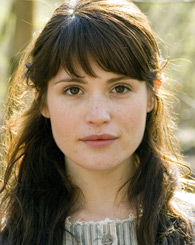
tess-part-23

Tess can forgive Angel for his sexual sin, but he refuses to forgive her.  Actually, what sin has she committed if she was innocently violated by Alec D’Urberville when she was a young girl.  She loves Angel unconditionally, but his love for her is marred by constraints.  Later, she cannot avoid stalking by Alec, who keeps preying on her, and in her most needy and vulnerable, takes advantage of her again by manipulating her love for her family.  Whatever dignity she may have Tess ultimately sacrifices it for her beloved family.  But I admire Tess’  integrity, yes I like to see it as integrity, and not pride, that has sustained her until that very end when she finally has no choice but to yield to Alec’s sinister scheme.

It is for this reason that I find Gemma Arterton’s portrayal of Tess as just a proud and feisty gal to suit modern viewers incongruent with the book.  She may look innocent enough, but her performance at times is contrived and lacks the striving complexity required.  But her tears are effective and moving, I must say.  While Hans Metheson has delivered his diabolic role adequately, Eddie Redmayne as the losing lover at the end is a bit lacking.

And Angel, oh, what a tragic character.  The seemingly altruistic lover cannot stand the test against social mores.  In the book, the chapter describing the mutual confession of sins between the newlyweds is aptly entitled:  “The Woman Pays”.  What an irony of double standard!  This might well be the name of the novel.  While Hardy may have held an entangled and agnostic view of the transcendent, his social critique is incisive and spot-on.

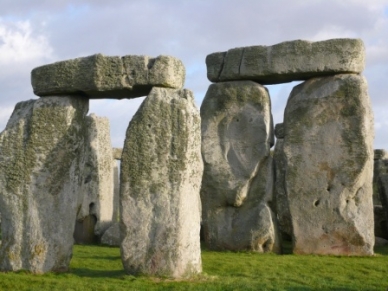
the-stonehenge-1

At long last, Tess and Angel can enjoy marital bliss, but only for a painful, fleeting moment.  Tess says in her anguish:  “It is too late”,  the four words that define the tragedy of her life.  As a young girl, she did not understand the meaning of Alec’s sinister advances until too late.  And now as a married woman, her husband has come to her rescue too late.  I learn from the end notes of my Penguin edition that the original title of the book was Too Late, Beloved! What a heart-wrenching story.

PBS has a link to an online interactive Q & A with screenwriter David Nicholls.  In there he  answers the many questions viewers have regarding the process of turning book into film. I have enjoyed Nicholls’ previous adaptation of Blake Morrison’s memoir into the movie “And When Did You Last See Your Father”, starring Colin Firth and Jim Broadbent, an excellent and sensitive film.  I look forward to seeing more of Nicholls’ work in the future.

~ ~ ½ Ripples

Click here to go back to Tess of the D’Urbervilles, Part 1.

*****

Tess of the D’Urbervilles (2008, TV): The Lite Version

tess-of-the-durbervilles-movie

After reading Thomas Hardy’s Tess of the D’Urbervilles just shortly before watching the new re-make on PBS Masterpiece, I can fully understand why screenwriter David Nicholls has done what he did.  He has turned a heavyweight into a light classic.  For if Hardy’s book is to be adapted in spirit and letter, it would certainly be less appealing and just too heavy a burden to cast upon our collective psyche.

As an author, Hardy himself personifies the sadistic ‘President of the Immortal’ he perceives.  Humans are just the playthings for The Immortal’s jest.  As an agnostic, he can’t just outright blame it all on God, since he isn’t sure even if God exists.  But in the book, he makes his readers know clearly the cosmic tragedy his characters are caught in, by turning Browning’s lines into:

God’s not in his heaven:  all’s wrong with the world!

If we can see Hardy on the streets today, I’m sure he’s the guy who takes Murphy’s Law to heart:  Anything bad that can happen will happen.  That’s what he makes of his heroine Tess in the story.  A pure, beautiful and innocent country girl, fresh and untouched for life, is being caught in all sorts of circumstances that will bring only heart-wrenching consequences, one after the other all the way to the end.

David Nicholls has spared us the looming Hardy worldview and lightened it up for us, and I don’t blame him for that.  For who needs more tragedies of cosmic proportion in this very tumultuous time in our human history.   Mind you, he has presented the plot faithfully.  In this first part at least, you see the sequence of events in the book adapted to the dot, albeit in a much more condensed and hurried pace.  Considering the full length of the book is about 400 pages, and the made-for-TV movie is four hours long, that means for every hour he has to cover 100 pages.  From this first part, I’d say he has done an admirable job.

tess-and-alec

Now to Gemma Arterton.  I’ve enjoyed her role as Elizabeth Bennet in ITV’s Lost In Austen.  So it is with high expectation that I come to watch Tess.  If the screenplay is a light version, then Arterton’s Tess is aptly portrayed, for I have a feeling that she has turned it into a comic character at the beginning of the movie.  But maybe that is to contrast her later portrait of lost innocence.  Nevertheless, I feel there is something lacking, maybe the almost god-like purity and depth of love in Tess are qualities just too demanding for so young an actress to depict.

Hans Matheson’s Alec D’Urberville is much more attractive than the detestable Alec described in the book.  Though the obvious villain, his dark and sensual appearance is symptomatic of a soul in turmoil. He has added complexity to his character that even sheds a bit of appeal. I look forward to his crucial role in the latter part of the story.

angel-clareIn contrast, Angel Clare is the innocent lover.  His willing to challenge his strict Victorian upbringing in a clergy family for love of a milkmaid indicates his bold rejection of social norms and family expectations… up to this stage.   Eddie Redmayne has delivered a convincing performance.
The character that really draws my attention, surprisingly, is Tess’ younger sister Liza-Lu, played by Jo Woodcock.  For some reason that face has the look and intensity that’s so fitting in a film like this.  And the three milkmaids that offer the much needed relief to the story, Marion, Retty and Izz, are well cast and portrayed.  They play no minor roles in Tess’ life.

Finally, I must also mention the new host of Masterpiece Laura Linney.  I admit, she’s more what I had in mind for the character of Tess while reading the book.  Unfortunately that part is taken.  Oh well, I’ll see her again next week, and in future Masterpiece presentations.

So, for a lighter and entertaining take on the tragic story of Tess,  and to browse through the plot in a few visually appealing hours while sidestepping the somber philosophical view of Hardy’s, this BBC production offers a viable choice.

(Photos Source: bbc.co.uk)

~ ~ ½ Ripples (so far)

Click here to go to Tess of the D’Urbervilles, Part 2

*****


Lost in Austen Episode 4 (2008, TV): Lost and Found

After trudging through a slow and a tad too serious Episode 3, the production has redeemed itself by finishing up with a grand finale. Episode 4 has found its original pace with its fast sequences to wrap things up, offering unexpected and entertaining twists and turns.

One thing that screenwriter Guy Andrews remains consistent with is his attempt to mix things up as much as he can, like Lydia eloping with Bingley, Wickham turning wicked schemes into timely rescues, Mrs. Bennet coming to her senses and confronts Lady Catherine de Bourg, and ultimately, the big ultimate, Elizabeth Bennet swaps places with Amanda Price not for a moment, but for good. The laughs and fun derived from these “post-modern moments” are all based on juxtaposing time and mixing up of characters and story lines. The whole production is an effective deconstruction of an all-time classic and its adaptations.

gemma-arterton-as-elizabeth-bennet

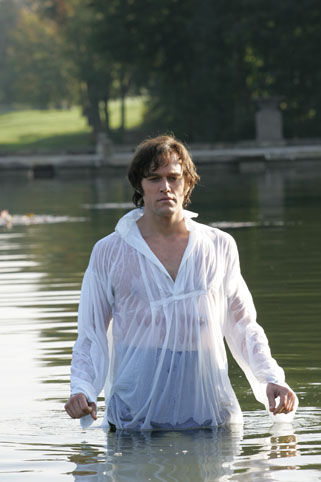
The most fun of them all, of course, is Amanda coming back through the portal and see Elizabeth Bennet in 21st Century London, with a new pixie hairdo, working as a nanny, computer savvy, environmentally conscious, and fully liberated. What more, she enjoys modern, post-modern rather, life so much that she intends to stay for good. And once she sees Darcy, who follows Amanda to the modern world, Lizzy right away knows who he is, thanks, as we all do nowadays, to all the webpages about Colin Firth’s wet shirt scene.

Darcy on the other hand is totally lost in the future. Here the scene is almost a replication of the one from Kate and Leopold (2001), where Hugh Jackman portrays a late 19th Century English nobleman travelling through a time portal and lands in modern day NYC. Darcy is even wearing a similar long, blue coat like Leopold, mesmerized by the tele and the busy urban traffic. And the ending too, a similar twist as Meg Ryan’s ultimate choice at the end of the movie.

What would Jane Austen think? “Turns in her grave” as Amanda puts it? As a satirist and a fan of the burlesque, Jane might have a good laugh too I think. I’m sure she was confident and self-assured enough to know that parodies of her work, at best, remain only as they are, spin-offs and re-makes of something that is inimitable. No matter how you deconstruct Jane Austen, you would always come out admiring the ingenuity of the brilliant mind behind that original creation.

*****

Episode 1

Episode 2

Episode 3


Lost In Austen: Episode 3 (2008, TV)

Japanese man petitions to marry comic-book character“, thus says the headline. Taichi Takashita has launched an online petition to the Japanese government for the legalizing of marriages between human and cartoon characters. He’s aiming for a million signatures, as of the end of October, he’s got a thousand. In this day and age, I’ve more or less braced myself for any type of shocking news.

Now, back to fiction. I’m not surprised to see Amanda Price falling in love with a fictional character, especially one like Fitzwilliam Darcy, but I am quite unwilling to accept Darcy to be ardently in love with her. But of course, this is a parody, albeit in this episode, the humor has gone from LOL to subtle satire.

wet-shirt-scene-in-lost-in-austenI suppose the wet shirt scene in which Darcy heeding Amanda’s request to dip into the pool is meant to be the most notable moment, or maybe even the climax, of the whole production. This scene just confirms my view that Lost In Austen is more a parody on Pride and Prejudice adaptations, rather than the novel of Jane Austen’s. There never is a wet shirt scene in the book. The parody could well be on Andrew Davis’ imaginary take on wooing modern female viewers, or a satire on the cult following of Colin Firth’s role as Darcy since the 1995 BBC production.

The scene also offers another Firth moment when Amanda asks Darcy whether he loves her because of her change from the spikey and vulgar modern female to the simpering klutz trying to fit into the Regency mold. Well, truth be told, Darcy finds her character, both before and after, equally disagreeable, but he still loves her with all his heart. Isn’t that the Mark Darcy line to Bridget Jones, “I like you very much, just as you are.”

Anyway, there really isn’t much else to be excited about in this episode. The director seems to be indecisive as to where he wants to take us, and in what form. The lively and fresh beginning of Episode 1 has subsided and the production has turned into another TV drama, one that has taken itself a little too seriously.

So now, another week, another episode…oh, the ennui and the ambivalence.

Yet, I shall conquer this, I shall.

Episode 1

Episode 2

Episode 4

Lost in Austen: Episode 2 (2008, TV)

For all of us Canadian viewers, who have patiently and faithfully waited VIVA to show us one episode at a time of Lost In Austen two months after its premiere in the UK, we have been short-changed last night! I knew Amanda Price would have to face some musical challenge in this episode. But I purposely did not try to find out what it is by reading others’ reviews. I want to see it first hand. But I was not given that opportunity. Why would VIVA cut out the most hilarious part of this second installment?

For those who don’t know what they have missed last night, here is the clip from YouTube:

Darcy’s “All ladies can sing.” is such a funny parallel to his statement in P & P: “Every savage can dance.”

I’m afraid though, the above may well be the few funny parts in this episode. And with VIVA cutting it out, we’re left with not much commotion. I admit that my earlier excitement from last week has died down. Without the Petula-Clark-inspired parody, this episode seems to have lost some of the initial lustre. There are still funny moments, and humorous lines, but the overall appeal seems to have waned.

I hope I’m not experiencing another version of lost in Austen. I find in this episode the screenwriter has taken us as far away as possible from the original P & P story just for the sake of gratuitous divergence. I was looking froward to seeing more of the LOL parody it has set up in Episode 1, more wild rides from the free-wheeling imaginary scenario. I was a bit disappointed to see its freshness replaced by banality. The slapstick humor makes me wonder what’s left in the bag of creative antics.

One more thing: I was most perplexed as to why the dress with the lowest neckline was being worn by none other than Mrs. Bennet, the mother of five daughters. Lady de Bourg would definitely have exclaimed: “Is she still out?”

However, all is not lost. I’m still eager to see how Amanda can right the wrongs and get out of the mess from her intrusion into the Bennet family. And if nothing else, this episode has at least achieved in making me love the original even more, not just JA’s ingenious creation, but the 1995 BBC production as well, yes, even Mr. Collins there. Further, last night’s episode just confirmed my view that nobody can do Darcy better than Colin Firth.

Episode 1

Episode 3

Episode 4