12 Years A Slave, Narrative of Solomon Northup: A Voice That Must Be Heard

“Is everything right because the law allows it?” — Solomon Northup

This is one of those cases where after watching the movie, I knew I must read the original source material, especially that it was written by Solomon Northup himself. If the movie is an artistic, cinematic account of a dark page in history, Solomon’s narrative is the quintessential eyewitness report, a first-person, authentic voice that is both a victim and a legitimate accuser of an inhumane and unjust system.
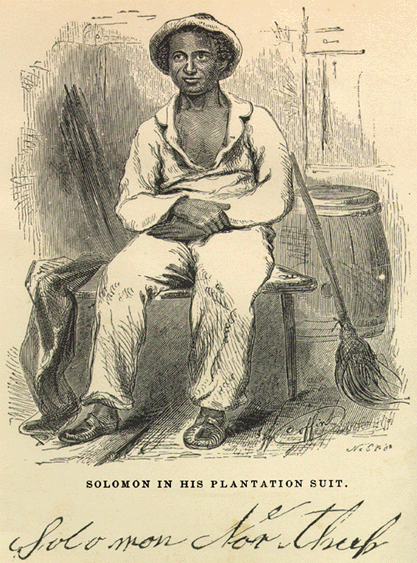
Solomon Northup copy

Born a free man in the State of New York, Solomon was happily living in Saratoga Springs, married to Anne and enjoying a loving family life as father to Elizabeth, 10, Margaret, 8, and Alonzo, 5. In March, 1841, his life was tragically altered when he was deceived by two men, Brown and Hamilton, and followed them to Washington, believing that he was to be hired to play the violin in a circus. Solomon was later drugged, kidnapped, chained and beaten. Together with other captured victims, he was smuggled to New Orleans and sold as a slave, his name changed to Platt, erasing any evidence of a previous life.

Having no free papers to prove his identity, transported and sold like a chattel to the Bayou in Louisiana, Solomon’s fate was sealed hundreds of miles away from home. His agony was heart-wrenching:

Were the events of the last few weeks realities indeed? — or was I passing only through the dismal phases of a long, protracted dream? It was no illusion. My cup of sorrow was full to overflowing … To the Almighty Father of us all — the freeman and the slave — I poured forth the supplications of a broken spirit, imploring strength from on high to bear up against the burden of my troubles, until the morning light aroused the slumberers, ushering in another day of bondage. (p. 77)

Solomon Northup’s eloquent writing immediately draws me in. It has a traditional and formal ring to the ear, but not archaic; it exudes clarity, finesse and grace. I’m struck by his stylish narrative even when he is describing depravity and injustice. After reading, I can see how the book had inspired director Steve McQueen’s beautifully rendered, artistic cinematic work on such an ugly subject matter. 

The movie follows the memoir closely, albeit leaving out a lot of details. Reading the source material after the movie can fill those in, making it so gratifying.

It was strictly forbidden of slaves to learn to read or write; pen and paper were prohibited. Any slave found to have even minimal education would be severely punished. Solomon had to feign ignorance all the years as a slave to survive. His memoir was written after he gained back his freedom in 1853.

I was most impressed that while Solomon yearned for deliverance and justice, he harboured no traces of personal vengeance against his tormenters. He had proven himself a man of integrity. Often he was sought after for his resourcefulness and his skills in playing the violin. He had entertained masters, and offered momentary relief to fellow slaves.

For two years Solomon was under the kind master William Ford, but had to be sold to the ‘slave breaker’ Edwin Epps to escape from Ford’s jealous and murderous slave driver Tibeats. The subsequent ten years with Epps became an extended living nightmare.

While the movie adaptation is an excellent production which I gave 4/4 Ripples, I find  Solomon Northup’s memoir even more engrossing. I’m particularly impressed by the fact that the book is not a self-absorbed account of sufferings, but as a careful memoirist, he records many details that are informative and even interesting, such as the natural vegetation of the Bayou environment, the cotton and sugar cane crops growing from seeding to harvesting, and the geography of the locales.

Like a perceptive ethnographer, he chronicles plantation life as a slave, the dwellings, diet, work load, daily chores, maltreatments. From his candid revealing, we are led into the subjective world of slavery, being sensitized to what it is like living in bondage and helplessness, constantly fearful of severe whipping and even death. Like a suspense writer, Solomon leads us to follow his risky attempts to seek help, and await in bated breath the day of his rescue. 

An incisive observer of human nature, Solomon sharply describes the psychological makeup of the alcoholic psychopath Epps, and the conflicting power relation binding Epps and his wife, complicated by his gratuitous fondness of the slave girl Patsey. We see in the movie Patsey suffers the brunt of her Mistress’ jealousy, and the maltreatment under her Master who tries to please his wife. The traumatic scene in the movie where Solomon is ordered by Epps to whip Patsey is described even more poignantly in the book. I’m surprised that the literary narrative has a more powerful hold on me than the visual rendition in this scene.
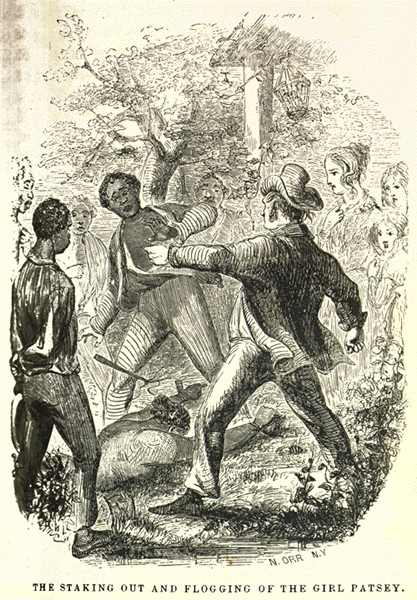
Flogging of Patsey copy

The memoir serves its purpose as a piece of personal narrative that’s poignant and deeply moving. The resilience and faith of Solomon Northup is crucial in his later being rescued. His longing for freedom and justice that is devoid of personal vengeance is most admirable and inspiring.

The rescue is a long and testing process, not so short as in the movie which I feel is a bit off balance. The adaptation should have given viewers a sense of the actual attempt especially in his home state of New York among those who try to find and rescue him. Thanks to the free-thinking, itinerant carpenter Bass from Canada who came to work for Epps for a short time, Solomon saw a crack opened for a chance to relay news back to the North by way of Bass.

Solomon had disappeared from the lives of his wife and three children for twelve years. Thankfully they were all well. When he reunited with them, he had the pleasure of seeing his newborn grandson, named after him by a devoted daughter. His youngest son Alonzo had the plan to make enough money to buy back his freedom if he could be located. It was indeed a moving scene as depicted in the following sketch from the book:

Family Reunion copy

After he had regained freedom, the slave trader Burch, ‘a speculator in human flesh’, was arrested and brought to trial in Washington, where he kidnapped and sold Solomon into slavery. However, Solomon was denied the right to be a witness against Burch for he was a black man. Burch was later found not guilty and discharged. Solomon wrote in his memoir:

A human tribunal has permitted him to escape, but there is another and a higher tribunal, where false testimony will not prevail, and where I am willing, so far at least as these statements are concerned, to be judged at last. (p. 319)

His faith in that ‘higher tribunal’ and an ultimate judge had carried Solomon Northup through the twelve years of slavery. His narrative not only is a voice that testifies against the injustice of man, but poignantly declares that freedom transcends physical bondage. Amidst inhumanity and despair, he had chosen to remain human, and to value integrity and faith. Solomon Northups’ ordeal is a glimmer of light in a dark page of history.

The Oscars dim by comparison.

~ ~ ~ ~ Ripples

CLICK HERE to read my movie review of 12 Years A Slave

***

Free Download:

Twelve Years A Slave, Narrative of Solomon Northup, NY, Miller, Orton & Mulligan, 1855, 336 pages, with appendix of legal documents and papers. You can download the PDF version of the original 1855 publication free here.

***

Top Ripples of 2013

It’s not easy to rate a whole year’s experience by Ripples, unlike a two-hour movie. However, here are some stats I’ve compiled for my own records.

Ripple Effects is all about books and movies. For me, watching a movie definitely is a much easier activity than finishing a book. So far this year, my movie number is around 100, almost three times as many as books I’ve read. They include movies I’ve watched on the big screen in theatres, at TIFF, and on DVD and Blu-ray formats at home. But I’m sure there are still a few I’d forgotten to jot down.

I’ve written 16 movie reviews on Ripple Effects this year, and they are not all 2013 releases. This number represents only a dearth of my film experience. From this small collection, there are two that I’ve given 4/4 Ripples (I’m sure I’ll add some more in this Award Season):

Nebraska 
12 Years A Slave

These two came close, with 3½ Ripples:

Before Midnight
The Disappearance of Eleanor Rigby: Her (TIFF 13)

And several more with 3 Ripples. Click here to my review list.

For my trip to Toronto to attend TIFF in September, definitely a 4-Ripple experience.

Many of the movies I watched this year are “catch-up’s”. They are cinema classics I’d missed over the past decades. These are films that I’d long wanted to see but had not the time or the chance to. Yes, this ‘catching-up’ activity is a most enjoyable time for me. They don’t make movies like these anymore. No CGI, no colours even, yet we can see a kaleidoscope of characters, fantastic scenes and poignant human conditions. So, Top Ripples go to:

Federico Fellini’s I Vitelloni (1953), La Dolce Vita (1960), 8½ (1963)
Victorio De Sica’s Bicycle Thieves (1948)
Robert Bresson’s Au Hasard Balthazar (1966)
Akira Kurosawa’s Ikiru (1952), Rashomon (1950)
Sidney Lumet’s 12 Angry Men (1957)

Some others are book-related. Before the newest remakes come into being, I’d like to experience the original version, like:

Hitchcock’s Rebecca (1940)
Elia Kazan’s East of Eden (1955)
John Ford’s The Grapes of Wrath (1940)

Still other films I watched and/or rewatched to prepare for or just to go together with what looks like is their latest version, or homage, if you will, like the following to coincide with Before Midnight (2013):

Ingmar Bergman’s Scenes from a Marriage (1973)
Woody Allen’s Husbands and Wives (1992)

Or Elia Kazan’s A Streetcar Named Desire (1951) to go with Woody Allen’s Blue Jasmine (2013)

Along the way during this rewarding movie-watching year, I’ve discovered some foreign language films, two in particular stand out: Korean director Chang-dong Lee’s Poetry (2010) and Secret Sunshine (2007)

As a freelance reviewer, I continue to be a contributor to Asian American Press as their film and arts guest columnist. Further, and this I’m really excited about, my feature article on the Canadian-Korean playwright/actor Ins Choi was published on the December 4th issue of Curator Magazine.

**

Even though I’ve only read a small number of books compared to movies watched, I’m glad I’d completed a major challenge, and that’s reading Proust. It’s definitely a 4-Ripple experience for me, despite having had to slash my way through thickets and at times, find my way out of a literary labyrinth. My post on this first taste of Proust was featured on WordPress’s ‘Freshly Pressed’. Now that’s the bonus madeleines on top of an already savory meal.

Another book I hold high esteem is Eric Metaxas’s Bonhoeffer, a Read-Along I hosted earlier in 2013. I’d enjoyed the camaraderie of reading the same book with others, and the discussion of ideas. Finishing a book or not is not as important as taking part in the journey, even for a little while, as we share our thoughts. 4 Ripples.

For old acquaintances and new friends I’ve made in the blogging world this year, I must give another 4 Ripples. This is the major reward of blogging. To all the new blogs and sites I’ve discovered, I’ve thoroughly enjoyed our mutual visits.

**

As for posts, looks like my “Quotable Quotes from Downton Abbey” has taken over “Memorable Movie Love Quotes” as the most popular these days. And I can understand why. Let’s get ready for Downton Season 4, coming up in just a few days.

And for my adventures as a nature paparazzo and bird-stalker, I give them nothing less than Top Ripples.

To 2014, I have a few ideas. This may involve a bit more individual studies, and researching into topics that have interested me for some time. Yes, films and their influence in our postmodern culture, into that topic I will continue to delve. So there you have it, more books and movies to share with you all. As always, I invite you to come by the pond and throw in your two pebbles. I cling on to my motto: “Serenity is golden, but sometimes a few ripples are needed as proof of life.”

To All, a Four-Ripple 2014!

***

And The Word Was Made Homeless

Awesome Sky

The House of Christmas

by G. K. Chesterton (1874–1936)

There fared a mother driven forth
Out of an inn to roam;
In the place where she was homeless
All men are at home.
The crazy stable close at hand,
With shaking timber and shifting sand,
Grew a stronger thing to abide and stand
Than the square stones of Rome.

For men are homesick in their homes,
And strangers under the sun,
And they lay on their heads in a foreign land
Whenever the day is done.
Here we have battle and blazing eyes,
And chance and honour and high surprise,
But our homes are under miraculous skies
Where the yule tale was begun.

A Child in a foul stable,
Where the beasts feed and foam;
Only where He was homeless
Are you and I at home;
We have hands that fashion and heads that know,
But our hearts we lost – how long ago!
In a place no chart nor ship can show
Under the sky’s dome.

This world is wild as an old wives’ tale,
And strange the plain things are,
The earth is enough and the air is enough
For our wonder and our war;
But our rest is as far as the fire-drake swings
And our peace is put in impossible things
Where clashed and thundered unthinkable wings
Round an incredible star.

To an open house in the evening
Home shall men come,
To an older place than Eden
And a taller town than Rome.
To the end of the way of the wandering star,
To the things that cannot be and that are,
To the place where God was homeless
And all men are at home.

*****

“And the Word was made flesh, and dwelt among us.” John 1:14

**

(Photo taken by Arti of Ripple Effects, Sept. 2010. All Rights Reserved.)

***

 MERRY CHRISTMAS EVERYONE!

 
***


Reading the Season: Poetry by Madeleine L’Engle

The brilliance of A Wrinkle in Time is that its author Madeleine L’Engle can convey scientific and spiritual concepts at the same time and in a way that young readers can enjoy. There’s no conflict between the cerebral and the spiritual; they co-exist comfortably in L’Engle’s work. Not only that, they fuse together and from that alchemy rises a whole new, inexplicable entity: Faith.

It’s that time of the year when I try to tune out distractions to dwell on the meaning of the Season, the reason why we have Christmas in the first place. I call these posts ‘Reading the Season’.

This time, I’ve selected four of Madeleine L’Engle’s poetry. ‘After Annunciation’ I have posted before. But I’d like to share it again here because the deceptively simple lines carry much depth and wisdom. Same with ‘The Risk of Birth, Christmas, 1973’. These two remain my favourite thoughts during Advent. 1973 or now? Ever timely. The poems are taken from The Ordering of Love: The New & Collected Poems of Madeleine L’Engle, published by Shaw Books, 2008.

The Ordering of Love

**

After Annunciation

This is the irrational season
When love blooms bright and wild.
Had Mary been filled with reason
There’d have been no room for the child.

**

Sonnet, Trinity 18

Peace is the centre of the atom, the core
Of quiet within the storm. It is not
A cessation, a nothingness; more
The lightning in reverse is what
Reveals the light. It is the law that binds
The atom’s structure, ordering the dance
Of proton and electron, and that finds
Within the midst of flame and wind, the glance
In the still eye of the vast hurricane.
Peace is not placidity: peace is
The power to endure the megatron of pain
With joy, the silent thunder of release,
The ordering of Love. Peace is the atom’s start,
The primal image: God within the heart.

**

Instruments (I)

The sky is strung with glory.
Light threads from star to star
from sun to sun
a liv­ing harp.
I rejoice, I sing, I leap upwards to play.
The music is in light.
My fin­gers pluck the vibrant strings;
the notes pulse, throb, in exul­tant harmony;
I beat my wings against the strands
that reach across the galaxies
I play

NO

It is not I who play
it is the music
the music plays itself
is played
plays me
small part of an innumerable
innum­ber­able
orches­tra.
I am flung from note to note
impaled on melody
my wings are caught on throb­bing fil­a­ments of light
the wild cords cut my pinions
my arms are outstretched
are bound by ropes of counterpoint
I am cross-eagled on the singing that is strung
from puls­ing star
to flam­ing sun
to

I burn in a blaze of song.

**

The Risk of Birth, Christmas, 1973

This is no time for a child to be born,
With the earth betrayed by war & hate
And a comet slashing the sky to warn
That time runs out & the sun burns late.
That was no time for a child to be born,
In a land in the crushing grip of Rome;
Honour & truth were trampled by scorn–
Yet here did the Saviour make his home.
When is the time for love to be born?
The inn is full on the planet earth,
And by a comet the sky is torn–
Yet Love still takes the risk of birth.

***

‘Reading The Season’ Posts over a Decade:

2020: Jack by Marilynne Robinson

2019: ‘A Hidden Life’ – A Film for the Season

2018: A Verse from Madeleine L’Engle’s The Irrational Season

2017: A Wrinkle in Time by Madeleine L’Engle

2016: Silence by Shusaku Endo

2015: The Book of Ruth

2014: Lila by Marilynne Robinson

2012: Surprised by Joy by C. S. Lewis

2011: Walking on Water by Madeleine L’Engle 

2010: A Widening Light by Luci Shaw

2009: The Irrational Season by Madeleine L’Engle

2008: The Bible and the New York Times by Fleming Rutledge 

2008: A Grief Observed by C. S. Lewis

***

The Book Thief (2013): From Book to Film

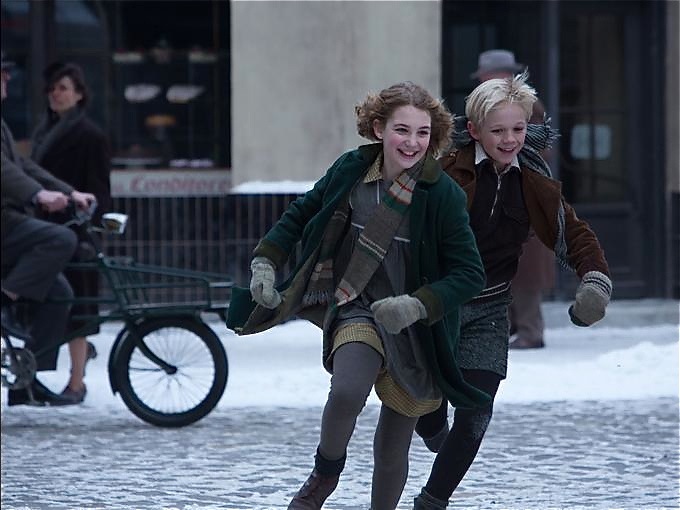
It’s been a week since I watched The Book Thief, but the face of Geoffrey Rush still creeps into my mind every now and then. We were talking about famous faces on a previous post. A good actor draws you right into his character without distractions from his previous roles, and here’s a good example. Regardless of Rush’s successful roles in the past, here in The Book Thief, I only see Hans, the nondescript yet loving step-father to Liesel.

The Book Thief

The movie is an adaptation of the popular 2005 YA novel of the same name by Markus Zusak. The book had appeared on the New York Times Bestseller list for 375 weeks. It had since been translated into more than forty languages. Congruent with the age target of the book, this is an appropriate adaptation. It is a PG movie, so we won’t see the violence and horror as intense and explicit as in Schindler’s List.

Before anyone jumps to shoot it down as a ‘sanitized’ version of the Holocaust, let me just say it pertains to the spirit of the novel in quietly depicting life in a small German town under the pressure of Nazi warmongering. It shows a side of the usual WWII movies we seldom see, the ordinary German folks. Zooming in on a street in a small town, it shows the effects of a fierce political regime have on its grass-root citizens: husbands and wives, children, friends, neighbors and acquaintances like the neighborhood tailor or accountant, some of whom suddenly taken away and labelled as the Enemy: Jews.

The focus of the story is on the humanity. No doubt, the majority of the town folks are swayed by and immersed in Nazi ideology, yet there are still a few who stand silently against the ferocious regime, but can do nothing. Even a feeble voice of dissent will send them to conscription regardless of age. That’s what happens to Hans.

As in the book, we have Death as the voice-over narrator, quietly looming over the fictional town Molching, busy at work. Liesel (Sophie Nélisse) arriving at her new home to her adopted parents on Heaven Street. Yes, ironic, since her little brother has died during the trip. The girl soon finds her new home a comfort, and makes a new friend with Rudy (Nico Liersch) next door. Her step-mother is Rosa, played by Emily Watson who reprises her role as in The War Horse as the seemingly tough and bossy wife and overseer of the home. Her husband is Hans, played by Geoffrey Rush with affective charisma, who shows himself from the beginning that he is the emotion powerhouse, the engine that runs the movie.

Directed by Brian Percival (who helms episodes of Downton Abbey), the movie is unabashedly explicit in its emotional channeling. By that, I don’t mean it’s overtly sentimental and melodramatic. The fine line that separates the two may be the word ‘restraint’. Rush and Watson have depicted this quality memorably. He may look oblivious in appearance, but is ever wise and compassionate in spirit; she conversely holds a feisty facade only to hide a tender and caring heart. It is a delight watching them relate to each other.

Liesel and Rudy 1

For a YA novel turned into film, the spotlight has to be on the young protagonist Liesel. Sophie Nélisse is a precocious rising star who has won a Genie in the acclaimed French Canadian film Monsieur Lazhar (2011). She has already won a Spotlight Award at the Hollywood Film Festival for The Book Thief. Nico Liersch playing Rudy looks to be a few years too young, but being a good actor, the two loyal friends ultimately shine through as the movie picks up its momentum.

The plot line of hiding the Jewish young man Max, son of Han’s wartime comrade to whom he owes his life, adds texture to the story. Max inspires Liesel to love words even more, igniting that spark in her later to write down her story. To Max, the hiding place is more than a shelter from the storm. It is his connection to the decency and dignity of being human. The snowball fight in his hideout in the basement is one of my favorite scenes.

As for books, reading, and words, looks like they just work as a cover, in both the book and the movie. That Liesel comes as an illiterate ten year-old in Germany may not be quite plausible. The few episodes where she steals a book are incidental, lacking potent effects. The movie nevertheless is persuasive in its subtle way by turning mere book characters into flesh and blood human beings. The Book Thief is about humans. It shows their ugly face that haunts even Death, and their triumphant side that makes Death envious, the power to love, to hope, and to live despite tragedy and loss.

This is not a great film, but one that quietly touches, and subversively moves one to tears. It will not make any major award list, and would likely be dismissed by some critics. But this is the kind of films that, years later, one would discover serendipitously and exclaim, “Why have I missed this little gem?”

~ ~ ~ Ripples

Out of the Budding Grove

When I picked up Swann’s Way earlier in March, I had no idea that 2013 is the 100th Anniversary of its publication. Now in hindsight, I’m all the more excited with this serendipitous selection for a Read-Along. And what discoveries I’ve made reading Proust!

Six months later in September, I started Vol. II Within A Budding Grove, allowing myself and any fellow reader two months to finish this 730 page volume.

Within A Budding Grove Modern Library

I reiterate, I’ve encountered thickets blocking the way through the budding grove, but I must say, the enjoyment I’ve reaped from slashing and plowing through it is greater than my frustration. All in all, coming out of it feels like finding my way through a corn maze. Out I come dazed but gratified.

I’ve posted some thoughts on Part One of Within A Budding Grove here. This latter part is about Balbec, a seaside resort the adolescent narrator travels with his Grandmother to stay for the summer to recuperate his health. Like his memories of Combray, Proust’s description of Balbec is detailed and colourful. He relays to his reader his journey, the scenery, the Grand Hotel they stay in, its guests and their social hierarchical interactions, his new-formed friendship with the painter Elstir who introduces him to the band of girls the young narrator admires but is too shy to greet on his own, Albertine, Andrée, Rosemonde, Gisele…

The original title of this volume is In the Shadow of Young Girls in Flower (À l’ombre des jeunes filles en fleurs) which I think is spot on. But, the budding grove is an apt metaphor too for his adolescent self discoveries of love and passion. And in one hilarious scene with Albertine, Proust has shown he can be a writer for Saturday Night Live any time. Too long to quote here but well worth the read. (p. 700-701 in case you want to skip the first 699 pages.)

And young Marcel is ever in-touch with his own feelings for these girls, especially Albertine. Here is his honest analysis:

At the start of a new love as at its ending, we are not exclusively attached to the object of that love, but rather the desire to love from which it well presently arise (and, later on, the memory it leaves behind)… (p. 676)

Ahh… romancing a desire and a future memory.

What about Gilberte, Swann’s daughter, with whom the young narrator is so obsessed earlier? To his credit, young Marcel has a full grasp of his own psyche. Why? It’s all a matter of Habit, he reasons. Since Gilberte has snubbed him, he needs to forget her and let go of any form of Habit reminding him of his previous life in pursuing her. This trip to Balbec takes him away from the familiar and replaces his memories of Gilberte, and a static existence, with fresh experiences and revitalized senses. Getting out of his home in Paris and going away might just be the best medicine:

… one’s days being paralysed by a sedentary life, the best way to gain time is to change one’s place of residence. My journey to Balbec was like the first outing of a convalescent who needed only that to convince him that he was cured. (p. 301)

Even before he gets to Balbec, while on the train stopping at a station, the sensitive and observant narrator is already filled with delight as he sees a young milk-girl carrying a jar of milk walking to the train at the break of dawn:

She passed down the line of windows, offering coffee and milk to a few awakened passengers. Flushed with the glow of morning, her face was rosier than the sky. I felt on seeing her that desire to live which is reborn in us whenever we become conscious anew of beauty and of happiness. (P. 318)

My own memories of the changing hue on those Bohemian Waxwings come to mind. Proust has effectively conveyed the power of association, the linking of words on a page to the reader’s own memory and the joy it had once elicited.

**

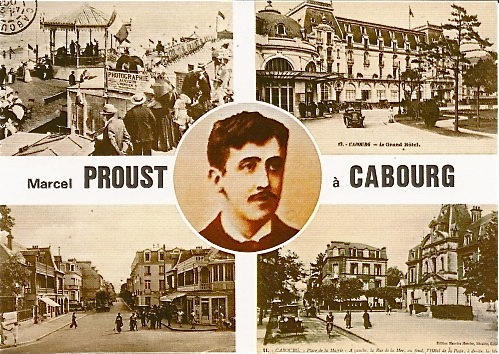
Proust in Cabourg copy 1
Photo Source: franceculture.fr

Proust insists that In Search of Lost Time is not autobiographical, but said “The pleasure that an artist gives us, is to introduce us to another universe.” No matter, his writing relates closely to his life experiences, parallel universe if you will.

Balbec is the fictitious reconstruction of Cabourg, a seaside resort town in the Basse-Normandie region of France where Proust frequented between 1907-1914. While Proust explores voluntary and involuntary memories in his long work, he could well be weaving memories with imagination, fusing fiction with real life experiences, creating an intricate tapestry.

Lydia Davis, translator of the most recent edition of Swann’s Way (The Way by Swann’s), offers this insight: “this novel is not autobiography wearing a thin disguise of fiction but . . . fiction in the guise of autobiography.”

Right.

Whichever way you slice it, it’s still as delicious as madeleines dipped in tea.

***

Some Relevant Links:

The TLS blog: French literary anniversaries, part 4 – Du côté de chez Swann

CLICK HERE to a webpage on Cabourg where you can see the video of The Grand Hotel, with Proust’s room still being kept there.

Proust in Cabourg

In The Shadow of Young Girls in Flowers, from The Modernism Lab at Yale University

Photo Source: franceculture.fr

***

Related Posts on Ripple Effects:

Half Way Through a Budding Grove

Swann’s Way Part I: Combray

Parts 2 & 3: Swann In Love

***

Half Way Through a Budding Grove

Half way through reading In Search of Lost Time, Vol. II, Within A Budding Grove, I’ve discovered a key to enjoying Proust. Just as it’s best to eat madeleines by dipping them in tea before putting the moistened petite cakes in your mouth, the most enjoyable way to read Proust is lying in bed with an unhindered mind. In this most relaxed state, I’m at ease to stroll leisurely through a budding grove, or the thickets of a genius’s mind.

Within A Budding Grove Modern Library

So far, I’ve gone passed the narrator Marcel’s painful struggles with adolescent, unrequited love for M. Swann’s daughter Gilberte. In contrast, his crush for Mme Swann has been appreciated and normalized. Unlike the cool and aloof Gilberte, Mme Swann welcomes Marcel into their home warmly, including him in their family outings, and their home gatherings with their friends, thus allowing him an opportunity to meet his literary hero, the writer Bergotte.

And here’s the passage I’m most impressed by, so far. The man Bergotte is very different from the writer Marcel has encountered in his ‘divine writing’. The man appears to be very common, inarticulate even, and devoid of eloquence, a man who spent his childhood in a ‘tasteless household’. Marcel is shocked by this discovery, and scrambles to come to terms with such dissonance. In a most ingenious analysis, the young Marcel comes to this conclusion:

But genius, and even great talent, springs less from seeds of intellect and social refinement superior to those of other people than from the faculty of transforming and transposing them… To mount the skies it is not necessary to have the most powerful of motors, one must have a motor which, instead of continuing to run along the earth’s surface… is capable of converting its speed into lifting power. (p. 175)

As I read these few pages, Jane Austen came to mind. A writer who had lived her short life mainly in a rural setting, her associations parochial and far from ‘high society’, and yet could transport herself and thus her readers to a different world from her mundane social environs. Her imagination soared as it took flight with her incisive observations of human nature.

… the men who produce works of genius are not those who live in the most delicate atmosphere, whose conversation is the most brilliant or their culture the most extensive, but those who have had the power, ceasing suddenly to live only for themselves, to transform their personality into a sort of mirror… genius consisting in reflecting power and not in the intrinsic quality of the scene reflected. (p. 175-176)

The adolescent Marcel’s disillusionment with the discrepancy between the man and writer Bergotte leads him to an uplifting insight:

The day on which the young Bergotte succeeded in showing to the world of his readers the tasteless household in which he had spent his childhood, and the not very amusing conversations between himself and his brothers, was the day on which he rose above the friends of his family, more intellectual and more distinguished than himself; they in their fine Rolls-Royces might return home expressing due contempt for the vulgarity of the Bergottes; but he, in his modest machine which had at last ‘taken off,’ soared above their heads. (p. 176)

Yes, more Proust’s words than mine on this post. Many other highlighted passages and surprising delights, but will have to wait till I’ve come out of the budding grove the end of November. If you’re interested, you’re welcome to join me in a read-along of In Search of Lost Time, Vol. II: Within A Budding Grove.

CLICK HERE to my wrap-up post: Out of the Budding Grove

***

Related Posts:

Proust Read-along Swann’s Way Part I: Combray (Featured in ‘Freshly Pressed’)

The Swann and Gatsby Foil

What Was Jane Austen Really Like? Reading Tomalin and Shields

In Praise of Austen: Virginia Woolf’s A Room of One’s Own

***

Read Some Possible Oscar Contenders

Emphasis on the ‘possible’. At this point of the race, some films have not been released other than screened in Film Festivals. The frontrunner so far is 12 Years A Slave. And then there are the rest, some long shots, some longer. But I’d like to include them on this list because I want to draw your attention to the books which inspire these film adaptations.

How come Gravity isn’t here? You ask. It’s a frontrunner too. Yes. But, ah… find me the book first. No book? Maybe because it’s much easier to pass you the 3D glasses.

Here’s a list of fall/winter reading to gear up for the upcoming Awards Season.

12 Years A Slave by Solomon Northup

12 Years a Slave copyThe movie adaptation directed by Steve McQueen is TIFF13 People’s Choice Award winner. From past years, this accolade is a good predictor of Oscar wins. Based on the real life story of Solomon Northup, a free black man in Upstate New York who was kidnapped into slavery in Louisiana. For twelve years he suffered in the hands of several masters. First published in 1853, the book is Northup’s first-person accounts of slavery in 19th C. America, noteworthy for its historical value and poignancy. The actor Chiwetel Ejiofor a likely Oscar Best Actor nom for his role as Solomon Northup. You can download the whole book in its original form here.

August: Osage County by Tracy Letts

August Osage CountyThe play won the 2008 Pulitzer Prize for Drama. Members of a dysfunctional family inevitably come together after tragedy strikes. The stage production was described by the NYT as ‘a fraught, densely plotted saga of an Oklahoma clan in a state of near-apocalyptic meltdown’. Before you see how the A-list cast interpret their roles on screen, maybe reading the play is rewarding since you get to experience the story first hand before being influenced by Meryl Streep, Julia Roberts, Benedict Cumberbatch, Ewan McGregor…

The Monuments Men by Robert Edsel

The Monuments MenI’ve mentioned this title in a previous post. Now I’ve got the book in my hands. The true but untold story of how a group of rescuers called the Monuments Men in war-torn Europe saved  art and artifacts from the Nazi’s. In the introduction of the book, the author writes: “Hitler and the Nazis pulled off the ‘greatest theft in history’, seizing and transporting more than five million cultural objects to the Third Reich.” George Clooney, Matt Damon, Cate Blanchett, Jean Dujardin (The Artist), Hugh Bonneville (so Lord Grantham finally gets the chance to go into the battlefield).

A Captain’s Duty: Somali Pirates, Navy SEALS, and Dangerous Days at Sea by Richard Philips

A Captain's Duty..Another likely contender that has been getting a lot of buzz is this thriller starring Tom Hanks, based on Captain Richard Phillips’ real life ordeal in the hands of Somali pirates. A lawsuit will begin in a few weeks filed by the crew of the ship Maersk Alabama against the shipping company for sending them to pirate-infested waters unprepared. They also claim the Captain was at fault in the case. Their attorneys had set up a Webpage to clarify the truths from the fiction. A turbulent epilogue to the real life adventure on high seas.

The Lost Child of Philomena Lee by Martin Sixsmith

The Lost Child of Philomena Lee copyJudi Dench could get a possible Best Actress Oscar nomination with her role as Philomena Lee. In her youth as an unwed mother, Philomena was sent to the convent of Roscrea, Limerick, her baby taken away and ‘sold’ to America for adoption. As she became an adult, Philomena was determined to search for her lost child. I missed this at TIFF13. Maybe an Oscar nomination for Dench could raise the prospect of it being screened in our theatres.

.

‘Hateship, Friendship, Courtship, Loveship, Marriage’ by Alice Munro

Hateship-Friendship-Courtship-Loveship-Marriage-book-cover copyWith Alice Munro garnering the newest top honor as Nobel Laureate, hopefully the film adaption of this short story with a shorter title Hateship, Loveship will receive a wider release. It has been a long while since Away From Her (2006). The film receives positive feedbacks at TIFF13. A good cast with Kristen Wiig (Best Actress and Best Original Screenwriting Oscar noms for Bridesmaids), Guy Pearce (The King’s Speech), Hailee Seinfeld (True Grit), Nick Nolte (too many to name).

The Secret Life of Walter Mitty by James Thurber (Click on link to read the story online.)

The Secret Life of Walter MittyInteresting to see another film adaptation of a short story. This one I have a feeling that it’s very loosely based on Thurber’s character Walter Mitty, considering it’s a Ben Stiller movie. I’m sure many have read this story in school, time to reread just to get the Walter Mitty psyche, then go and check out the Ben Stiller ride. Other than Stiller, there are Kristen Wiig (again, in two short story film adaptations the same year), Sean Penn (can you imagine?), Shirley MacLaine.

The Wolf of Wall Street by Jordan Belfort

The Wolf of Wall Street copyCoincidence that Leonardo DiCaprio jumps from being Jay Gatsby to Jordan Belfort, the real life fraud on Wall Street, notorious for his highflying lifestyle and his operating a boiler room brokerage firm Stratton Oakmont. A multimillionaire at 26, he was later indicted in 1998 for securities fraud and money laundering but only served 22 months in federal prison. The Wolf of Wall Street is his unabashedly candid memoir. Martin Scorsese directs with DiCaprio touted as a likely contender in the Best Actor Oscar category.

The Book Thief by Markus Zusak

The Book Thief copyNo Oscar buzz around this one, but a look at the movie trailer, I know I want to see it. Yes, mainly because of Geoffrey Rush I admit. And also, Brian Percival… ring a bell? Director of Downton Abbey. The film will be released in November, a time slot where contenders are placed. So, you can say it’s a long, long shot for, who knows, maybe Geoffrey Rush, or Emily Watson? I admit I still haven’t read this very popular YA title. I’d like to do that before watching the film. Is this one on your movie viewing radar?

***

Munro and Movies

Thanks to the Swedish Academy, Alice Munro doesn’t need a blockbuster movie to raise awareness of her works. Described by The New York Times as ‘Master of the Intricacies of the Human Heart’, and with her story settings mostly in rural counties and small towns, the 82 year-old writer must have known how the small and intimate can have far-reaching effects.

The short story as a literary form too must have gained importance and legitimation overnight now that Munro is honored as Nobel Laureate. The novel isn’t the only peak of the mountain of literary pursuits. Readers too, can now be totally comfortable with reading ‘just a short story’.

Back to movies, with our contemporary mega, blockbuster culture, it sure looks like the general public need to see a movie before knowing about a literary work. While I don’t like the idea, I’ve to admit that could well be the case nowadays. But for Munro, can anyone name a full feature movie that’s based on her short stories?

Right. Actually there are four. Edge of Madness (2002) is relatively unknown. Another one interestingly is an Iranian film, Canaan, which won the Audience Awards–Best Film at the Fajr International Film Festival in 2008. A better known adaptation is Away From Her (2006). It remains one of my all time favorite films. The most recent completed production is Hateship Loveship which premiered at TIFF13. I regret missing it when I was there in September. A film based on her story ‘Runaway’ is currently in development.

With Munro winning the Nobel, hopefully we’ll have the chance to see a general release of Hateship Loveship. So there you go, Munro could well be helping to reverse the trend: the writer promoting the film.

To celebrate Munro’s Nobel win, I’d like to repost in the following a review of Away From Her which I wrote in 2008. The film was directed by the young and talented Canadian actor/director Sarah Polley, who was nominated for an Oscar for her adapted screenplay based on Munro’s short story ‘The Bear Came Over the Mountain’. Julie Christie received an Oscar nomination for her role as Alzheimer’s afflicted Fiona.

You can read Munro’s story ‘The Bear Came Over the Mountain’ now online, thanks to a timely reprint by The New Yorker.

**

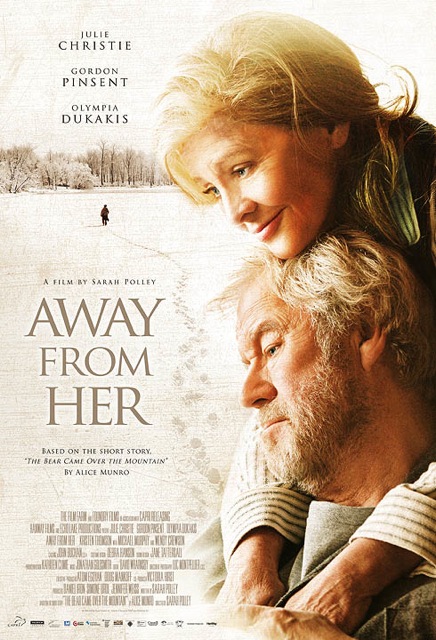
Capri_AwayFromHer_PosterB

AWAY FROM HER: A Short Review

How can you turn a good short story into a full length movie without compromising its quality? By turning it into a screenplay written by an equally sensitive and passionate writer, and then, through her own talented, interpretive eye, re-creates it into a visual narrative. Along the way, throw in a few veteran actors who are so passionate about what the script is trying to convey that they themselves embody the message.

Sarah Polley has made her directorial debut with a most impressive and memorable feat that I’m sure things will go even better down her career path. What she has composed on screen speaks much more poignantly than words on a page, calling forth sentiments that we didn’t even know we had. As Alzheimer’s begins to take control over Fiona, what can a loving husband do? Julie Christie and Gordon Pinsent stir up thoughts in us that we’d rather bury: how much are we willing to give up for love? Or, how would we face the imminence of our loved ones’ and our own mental and physical demise?

Based on the story by Alice Munro, ‘The Bear Came Over the Mountain’, Polley brings out the theme of unconditional love not with your typical Hollywood’s hot, young, and sexy on screen, but aging actors in their 60’s and 70’s. It may not be as pleasurable to watch wrinkled faces hugging and kissing, or a man and a woman in bed, bearing age spots and all, but such scenes effectively beg the question: why feel uncomfortable?

Why does love has to be synonymous with youth, beauty, and romance? It is even more agonizing to watch how far Grant is willing to go solely for love of Fiona. Lucky for us, both writers spare us the truly painful at the end. It is through persistent, selfless giving that one ultimately receives; however meager and fleeting that reward may seem, it is permanence in the eyes of love. And it is through the lucid vision of a youthful 28-year-old writer/director that such ageless love is vividly portrayed…. Oh, the paradoxes in life.

~ ~ ~ Ripples

***

Another Proust Read-Along

… as if we’re not busy enough?

Truth is, reading Proust calms me down. Maybe because I’ve to slow down, really slow down, to savor, and decipher. These two have become a fused enjoyment for me while reading Vol. 1 of In Search of Lost Time, Swann’s Way.

After finishing that, I quickly ordered the next volume Within a Budding Grove, but have since put it aside… until now, thanks to Bellezza of Dolce Bellezza, who read Vol. I with me. She’s right, of course, as she wrote on her invitation post for Vol. II:

‘No one should read Proust alone.”

So here we are, embarking on another Proust Read-Along, In Search of Lost Time Vol. II, Within A Budding Grove.

Within A Budding Grove Modern Library

Yes, this is a slow read, as always on Ripple Effects. We plan to finish and post our thoughts on November 30. I just might add in a mid-way post around end of October.

You are invited to join us for another slow and enjoyable ride.

If quantifying makes it easier to grasp, counting the days in October and November, and the 730 pages in my Modern Library Classic edition, you only need to read about 12 pages every day. A very doable plan.

Those of you who have read it all… how about a re-read now?

***

First Post for Vol. II:

Half Way Through A Budding Grove

My posts on Vol. I, Swann’s Way:

Part 1: Combray (my ‘Freshly Pressed’ post)

Wrap-up: The Swann and Gatsby Foil

***

TIFF 2013: Books into Films

Have been in Toronto all week for the Toronto International Film Festival. Taken a lot of photos but these few I’m going to share with you first for Saturday Snapshot Sept. 14, for they are what Ripple Effects is all about: Books and Films.

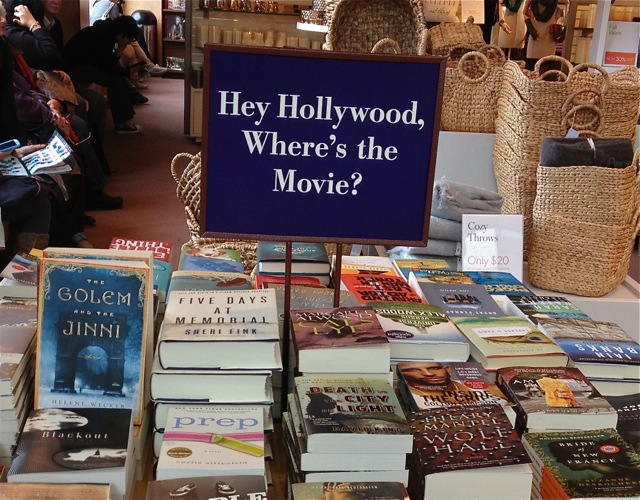
Saw this sign in a major bookstore beside a TIFF screening venue:

Hey Hollywood

The movie is in the book.

Indeed, many of this year’s TIFF selections are based on literary sources.

Film Adaptations at TIFF 2013

Books to filmsFrom biographies to biopics:

Biographies into BiopicsIf you or your book group are starting a new season of reading, you may find some interesting titles in the following list of films screened at TIFF this year (click on link to the film adaptation):

12 Years a Slave by Solomon Northup

August: Osage County by Tracy Letts (Pulitzer Prize-winning play)

Child of God by Cormac McCarthy

The Dinner by Herman Koch

The Double by Fyodor Dostoevsky

The Double by Nobel Prize-winning author José Saramago (Film: Enemy)

Half of a Yellow Sun by Chimamanda Ngozi Adichie

Hateship, Friendship, Courtship, Loveship, Marriage by Alice Munro (Film: Hateship, Friendship)

Horns by Joe Hill

How I Live Now by Meg Rosoff

The Invisible Woman by Claire Tomalin

Known and Unknown by Donald Rumsfeld (Film: The Unknown Known)

Labor Day by Joyce Maynard

Long Walk to Freedom by Nelson Mandela

Mary Queen of Scotland by Stefan Zweig (Film: Mary Queen of Scots)

The Railway Man by Eric Lomax

Salinger by David Shields and Shane Salemo

The Sea by John Banville

The Switch by Elmore Leonard (Film: Life of Crime)

Under the Skin by Michel Faber

***

Saturday Snapshot is hosted by Melinda of West Metro Mommy Reads. Click here to see what others have posted.

***

Do We Need A Rebecca Remake? Another Grapes of Wrath?

In a previous post Summer Reading and Future Viewing I listed some upcoming movie adaptations of literary works, among them are Daphne du Maurier’s Rebecca and John Steinbeck’s The Grapes of Wrath, incidentally both are Steven Spielberg’s projects.

The earlier adaptations of these two titles had since become classics. Released in 1940, both films shared the limelight in the 1941 Academy Awards. Rebecca won Best Picture and Best Cinematography while John Ford won Best Director for The Grapes of Wrath, and Best Supporting Actress went to Jane Darwell as Ma Joad.

From the comments in that post, it’s interesting to see the ripples from loyal fans of these two classic films. They want to say no thank-you to Mr. Spielberg. Laurence Olivier and Joan Fontaine as Maxim and the new Mrs. de Winter had left an indelible mark in their movie memories which no one else can replace, nor the stern and creepy Mrs. Denvar. Alfred Hitchcock would have been most pleased.

Joan Fontaine & Laurence OlivierLikewise, Henry Fonda owned the role of Tom Joad in The Grapes of Wrath. And, who can match Jane Darwell as the Joad family pillar, Ma, who won an Oscar Best Supporting Actress for her performance.

Family Joad in The Grapes of Wrath

Fond memories aside, a remake could reap some benefits if placed in the right hands. The Great Gatsby is a good example, and it’s not even in perfect hands. But we’ve all witnessed the fanfare, just the buzz of a major movie production can do much to turn a school text into a bestseller.

With the first trailer of Baz Luhrmann’s adaptation released in April, The Great Gatsby had sold more copies than Fitzgerald could ever have imagined. The hype had sent it to the top of Amazon and Barnes and Noble’s sales in both print and eBooks. The title on Kindle had outsold all its paperback. And this even before the movie was released in May. BTW, The book sold less than 25,000 in Fitzgerald’s life time, and he considered himself a failure. If he had known of the Gatsby ripples and splashes half a century later, he would have died a happier man.

A movie adaptation today can be the best promotion for a literary work. If the movie is done well, so much the better. If it’s not, viewers would at least be driven to seek the truth. Is the book that bad? Hopefully they would read to find out. These two new adaptations being produced by Steven Spielberg’s Dreamworks could mean a certain level of standard.

Rebecca Movie PosterThe Grapes of Wrath PosterFor both Rebecca and The Grapes of Wrath, no big screen adaptations had been done since their 1940 productions, so a contemporary remake can be an appealing venture. A modern day take on an old story can refresh it for a new generation of viewers. Come to think of it, how many of today’s Twilight audience have seen Laurence Olivier and Joan Fontaine on screen, big or small? Or even heard of them? Alfred Hitchcock would be more well known among viewers today, but probably because of Psycho rather than Rebecca.

A genre like Rebecca is popular nowadays… Suspense à la romance with a touch of Gothic noir. Manderley can be an interesting set to view with modern cinematic rendering and technology. What more, the latest is that Dreamworks has hired Danish writer/director Nikolaj Arcel to helm the new version. If the name doesn’t ring a bell, then think of The Girl with the Dragon Tattoo (2009). Arcel is co-writer of that original Danish screenplay. You see, he doesn’t need to walk in Hitchcock’s shadow. He only needs to stalk to his own tune. It will be interesting to see his interpretation of du Maurier’s book.

As for The Grapes of Wrath, with its depictions of poverty, the plight of the migrant workers, social and economic disparity, Steinbeck’s 1939 Depression era classic can be a timely and relevant film today. We won’t get back the authentic view of the drought-cracked landscape from Oklahoma (the film was made just one year after the book was published) and follow the Joad family’s beat-up truck sputtering on Route 66, leaving deprivation behind to press on towards a land of elusive dreams, California. I can see the new version inundated with CGI’s fabricating the exact opposite of what we see in The Great Gatsby. But Steinbeck’s story can and should remain intact, regardless of the styling, for its timelessness.

Further, remakes don’t have to be exact modern replicas of their older cinematic versions. Actually, better that they break away from previous adaptations to offer a fresh look, a relevant take for today’s viewers, and entertain with some present-day nuances and humor. An excellent example is the recent Shakespearean remake of Much Ado About Nothing by Joss Whedon, shot in his own Santa Monica home with swimming pool, stuffed toys, wine glasses and smart phones.

Let’s release our hold on these two classic films and come back to the future. I’m most curious to see the new adaptations. Who do you think are the best pair to play Maxim and the young and innocent Mrs. De Winter? My choice would be Michael Fassbender and Carey Mulligan. What about Tom and Ma Joad for The Grapes of Wrath?

***

Some updates on book to film:

Ben Stiller directs and stars in The Secret Life of Walter Mitty based on the famous short story by James Thurber. The film will be the Centerpiece Gala at the NYFF later this fall and with that, Oscar buzz.

Another classic to be adapted will be Madame Bovary by Gustave Flaubert. Mia Wasikowska will transform from Jane Eyre to Emma Bovary. Paul Giamatti also in. Here’s the link to IMDb’s page.

***