‘Materialists’ is a film Jane Austen would like

Marketed as a romantic comedy, Materialists, Celine Song’s (Past Lives, 2023) second film  defies categorization. Released by A24 just in time to greet summer viewers, the film isn’t quite like your traditional rom-coms. There are no LOL moments, but there’s humour throughout that elicits knowing chuckles. No slapstick acts, but movement made by the actors are often subtle but notable.  

The opening scene is a fitting prelude. A caveman courting his sweetheart, slipping onto her finger a ring made from the delicate stem of a tiny flower. Right after that, a stark change of scenery with a busy New York streetscape accompanied by the beat of Cat Power’s ‘Manhattan’, and the title credits begin to flash on screen. Tale as old as time… from prehistoric to modern day.

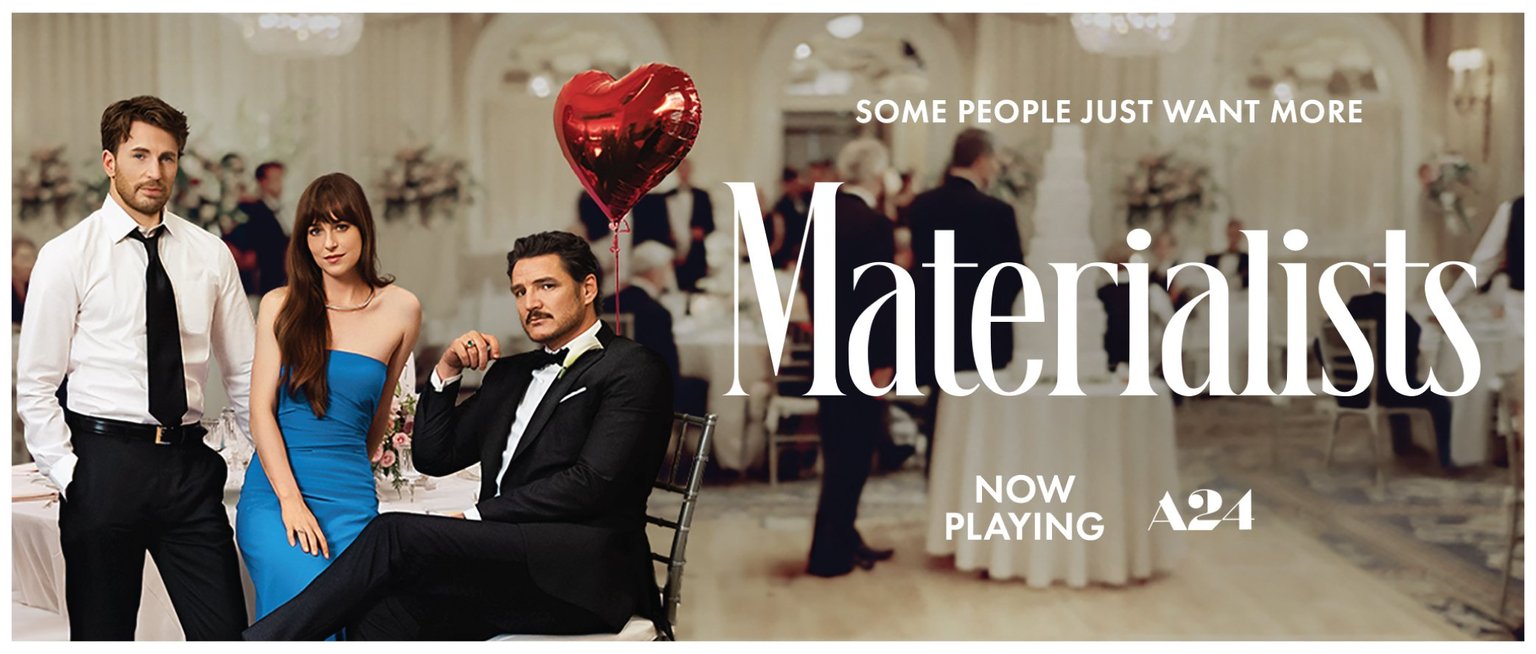
We see Lucy (Dakota Johnson) walk on in New York City with perky confidence, a successful matchmaker who has seen nine pairs of her clients tie the knot, so far. Lucy exudes such upbeat positivity that she can stop a man on the street and ask outright if he’s single, then hands him her business card. She possesses ‘an eagle eye for chemistry’, an expert in linking her clients by checking all the boxes for the right match: looks, age, height, weight, family background, education, income. Like transactions in the financial market, in Lucy’s business, people are the commodity, numbers on a spreadsheet. Materialistic measures reign supreme in a dating service. 
The satirical vibe is obvious. Isn’t that a modern-day parallel of Jane Austen’s time, where successful matrimony is dependent on financial compatibility. Pride and Prejudice (1813) is a prime example. Such is the view held by Mr. Darcy at first, and the reason why Lady Catherine de Bourgh is so furious when she sees an inferior nobody dares to compete with her own daughter. As for Mrs. Bennet, marrying up for money is what she dreams of for her five daughters. Only the heroic Elizabeth Bennet is brave enough to challenge the social norm and insists on her own criterion for marriage: love. 

Soon after the opening of Materialists, we come to the inciting incident. In her client’s wedding banquet Lucy meets Harry (Pedro Pascal), the brother of the groom. He checks every box: handsome, dripping rich, living in a $12 million Manhattan suite, 6 ft. tall, working in a family-owned private equity firm (is it still considered ‘work’?) a perfect 10 as a potential client. But Harry is not interested in Lucy as a matchmaker, but a date. 

As fate has it, in that same event, Lucy’s ex, John (Chris Evans), reappears in her life as a catering waiter. John is a struggling actor, trying to make ends meet, still sharing an apartment with roommates. Past memories flood back to them. Here we see a relational triangle similar to Song’s debut work, Past Lives. Thus kicks off the storyline, who does Lucy choose? A question as old as time. And for Lucy, the modern-day career woman who handles transactions that deal with external measures only, does love have a place? 

Song writes about what she knows, as Past Lives is autobiographical, Materialists is, interestingly, based on her stint as a matchmaker in NYC some years ago. As a director whose debut film was nominated for two Oscars, Best Picture and Best Original Screenplay, Song has proven herself to be a versatile filmmaker who can break out of the indie mode into the limelight of popular features.

The camera is a definite asset. Cinematographer Shabier Kirchner used 35mm film to shoot, bringing out cinematic aesthetics of old. Most notable is his camera work, many shots letting a still camera capture the nuances of two characters facing each other talking, maintaining a slower pace to allow the characters, and the viewers, to soak up the atmosphere and the deeper meaning of the conversations, an obvious digression from the breezy, traditional rom-coms. 

When viewers drop their own preconception of the actors’ previous roles, Evans as Captain America, Johnson her Fifty Shades sequences, and Pascal the apocalyptic survivor, the trio works well each in their own way. But the one that deserves mention is the supporting actress Zoe Winters who plays Sophie. The twists and turns of the storyline switch the second half of the movie to a different drive, one that feels like a suspense drama, and Winters delivers with heart-stirring effects.

My main issue with the movie, however, is probably related to Song being such a brilliant wordsmith in creating dialogues. In writing and especially now in a visual medium, the ‘show not tell’ axiom is all the more crucial. This is even more true when the subject matter is love. Other than hearing the word uttered, the film isn’t convincing enough to show the presence of that affective bond of passion which is so crucial in the ultimate outcome. ‘Love is a mystery,’ Song has said in her interviews. Such a mystery through the ages needs to be represented on screen by actions instead of just being mouthed in words.  

Nevertheless, overall, Song needs to be congratulated on transitioning from the indie to the mainstream arena with popular stars, and helming a production with her own style of cinematic artistry.

So what if Materialists doesn’t fit the mold of a rom-com? Why need to box it into a genre? As the opening credits state, and it’s a good description: ‘A Celine Song Film’. Let it be its own genre, the writer-director is in a class of her own. A very pleasant movie not just for the summer season, and one I’m sure Jane Austen herself would like to watch.

~ ~ ~ Ripples

***

Click here to read my Ripple Review of Past Lives

Heading to Cannes… in my mind 

I’m watching closely the Cannes Film Festival taking place right now. While my tour is virtual and imaginary, I look forward to TIFF in September when I go to Toronto, as some of these Cannes selections might reprise there.

So, if I were in Cannes now, this would be my list of films to watch (links for related films in the list below are to my Ripple reviews):

TÔI YAMANAMINO HIKARI (A PALE VIEW OF HILLS) directed by Ishikawa Kei 

The English translation quickly draws me in: A PALE VIEW OF HILLS is the first novel (1982) by Nobel Laureate Kazuo Ishiguro. An introspection of a Japanese woman living alone in England, spanning decades of life from post-WWII Japan to her resettling in a foreign country. Past memories intermingle with present day reality. Ishiguro is adroit in psychological narratives. I’m curious to see if the film lives up to his credit. Time to reread.

ELEANOR THE GREAT directed by Scarlett Johansson 

Scarlett Johansson’s directorial debut. Eleanor moves to New York City at age 90 for a fresh start and befriends a 19-year-old student. What an idea: A fresh start at 90. Even more amazing in real life, for 95 year-old June Squibb could well be the oldest actor still working, and just recently acclaimed for her performance in Thelma (2025). For those with a longer memory, Squibb was an Oscar nominee for best supporting actress playing Kate Grant in Alexander Payne’s Nebraska (2013). 

THE MASTERMIND directed by Kelly Reichardt

Kelly Reichardt is one of my all-time favourite directors. A look back at her works Wendy and Lucy (2008), Certain Women (2016)First Cow (2019), has piqued my curiosity in how she’d handle this art heist movie, Reichardt’s sensitive rendering of a more popular themed, mainstream subject. And the cast here is a huge attraction: Gaby Hoffman (Field of Dreams, 1989), Josh O’Connor (The Crown, 2020; Emma, 2020), and John Magaro (First Cow, 2019; Past Lives, 2023). 

Nouvelle Vague (NEW WAVE) directed by Richard Linklater

I was captivated by Linklater’s Before trilogy back in the days… Before Sunrise (1995), Before Sunset (2004), and Before Midnight (2013). But he’d shown his versatility by other more subsequent titles such as Boyhood (2014), and Hit Man (2023). Now in 2025, he dives into the French New Waves, his first French language film, creating a making-of feature in black and white to chronicle the shooting of Jean-Luc Godard’s classic Breathless (À Bout De Souffle), which premiered at Cannes in 1960. I anticipate an articulate and adroit handling of this homage to the French cinematic legacy. 

VIE PRIVEE (A PRIVATE LIFE) directed by Rebecca Zlotowski

We know Jodie Foster can speak French, but can she master the language in a full feature film showcased in Cannes, France. I sure hope so because the audience there can be very direct and umm… expressive in showing their love or disapproval. Foster plays a renowned psychiatrist investigating the death of one of her patients. The French cast includes Mathieu Amalric (The Diving Bell and the Butterfly, 2007; The Grand Budapest Hotel, 2014) and Virginie Efira (2023 César Awards Best Actress winner for Revoir Paris

Sentimental Value directed by Joachim Trier

Four years after The Worst Person in the World with which his star Renate Reinsve won Best Actress at Cannes and Trier went on to be nominated at the Oscars for his screenplay and his film representing Norway for Best International Feature Film, now director and star reunite to bring us a story exploring family, memories, and the power of art. Cast includes Stellan Skarsgard and Elle Fanning. 

Left-Handed Girl directed by Shi-Ching Tsou

What attracts me to this film, first is the title, then is the face of the little girl. What’s more intriguing is that Tsou’s directorial debut is produced, edited and co-written by Sean Baker, the US director who won the Palme d’Or last year with Anora, a feature that later went on to win five Oscars. The Left-handed Girl follows a single mother and her two daughters striving to adapt to a new environment in bustling Taipei as they open a stall at a night market.

Renoir directed by Chie Hayakawa

Hayakawa’s first feature film Plan 75 (2022) premiered at Cannes and won the Golden Camera award. It was Japan’s official entry to the Best International Feature Film at the Oscars in 2023. Renoir is Hayakawa’s second film, a coming-of-age story of a sensitive eleven year-old girl growing up in 1980’s Tokyo, living with a stressed-out mother and a terminally ill father. Cast includes Hirokazu Koreeda’s favourite actor Lily Franky (2018 Palme d’Or winner Shoplifters, Like Father, Like Son, 2013)

***

‘The Only Girl in the Orchestra’ is a Passionate Production

This 34 minute documentary short is a tribute to Orin O’Brien, the first female musician hired full time by the New York Philharmonic in 1966 under the directorship of Leonard Bernstein. The trailblazing, unsung hero is spotlighted, albeit reluctantly, by her niece, filmmaker Molly O’Brien, who had looked up to her aunt as someone to emulate ever since she was a child. The 34 minute screen time, however, reveals a humble character who refuses to be called ‘an artist’, and looks at her achievements as ‘accidental,’ rather, seeing her life as one who has simply enjoyed the experience of playing her beloved double bass and making music together with other musicians.

I find what’s inspiring throughout the documentary is Orin’s humility. She could have boasted about many things, including her parental heritage of early Hollywood, the old-time movie stars George O’Brien (the classic Sunrise, 1927) and Marguerite Churchill, or her own self-propelled motivation to reach her musical goal. It was her deep desire to play in an orchestra that led her to learn the double bass in high school, read all she could get her hands on about the subject, later entering Juilliard and becoming not just a female trailblazer in a male dominated arena but further expanding her influence as an acclaimed teacher mentoring numerous young musicians. Yet she offers these words that impress me the most:

This is my theory of how to enjoy your life incredibly. You don’t mind playing second fiddle… I think it’s better to love something so much you do it for its own sake and also for the wonderful people that you’re playing with. You’re creating something together, which is better than something alone.

After 55 years in the New York Philharmonic, Orin retired at age 86 in 2021. She keeps on going with her passion in teaching and mentoring. The documentary follows her as she turns a new page in her life. Retirement doesn’t mean ending a musical career.

The other prominent character in this short feature is Orin’s instrument, the double base. Positioned at the back of the orchestra, often unnoticed, the double base plays a supporting role in the background, nonetheless is essential for producing the foundational rhythm and creating the deepest resonance in a piece of music. The score throughout the film is a case in point. Orin’s double basses are like pets to her. The ‘Orin’s Duke’ is a double bass made in the 1750’s, with a history of playing for George III.

A trailblazer that deserves more than 34 minutes of tribute to her life and career, this gem of a documentary could well reflect what Orin stands for, a pure joy, passionate in its production, unassuming but inspiring in essence.

The 95th Academy Awards nominations were announced a few days ago. The Only Girl in the Orchestra is given the nod deservedly as a nominee in the Best Documentary Short Film category. Before the March 2 awards show, don’t miss Orin’s documentary now streaming on Netflix.

~ ~ ~ ~ Ripples

***

Top Ripples 2024

A list of books and movies I’ve rated highly in 2024, not necessarily current year releases. Links are to my reviews. The last section lists several books that I bought which I must mention.

MOVIES

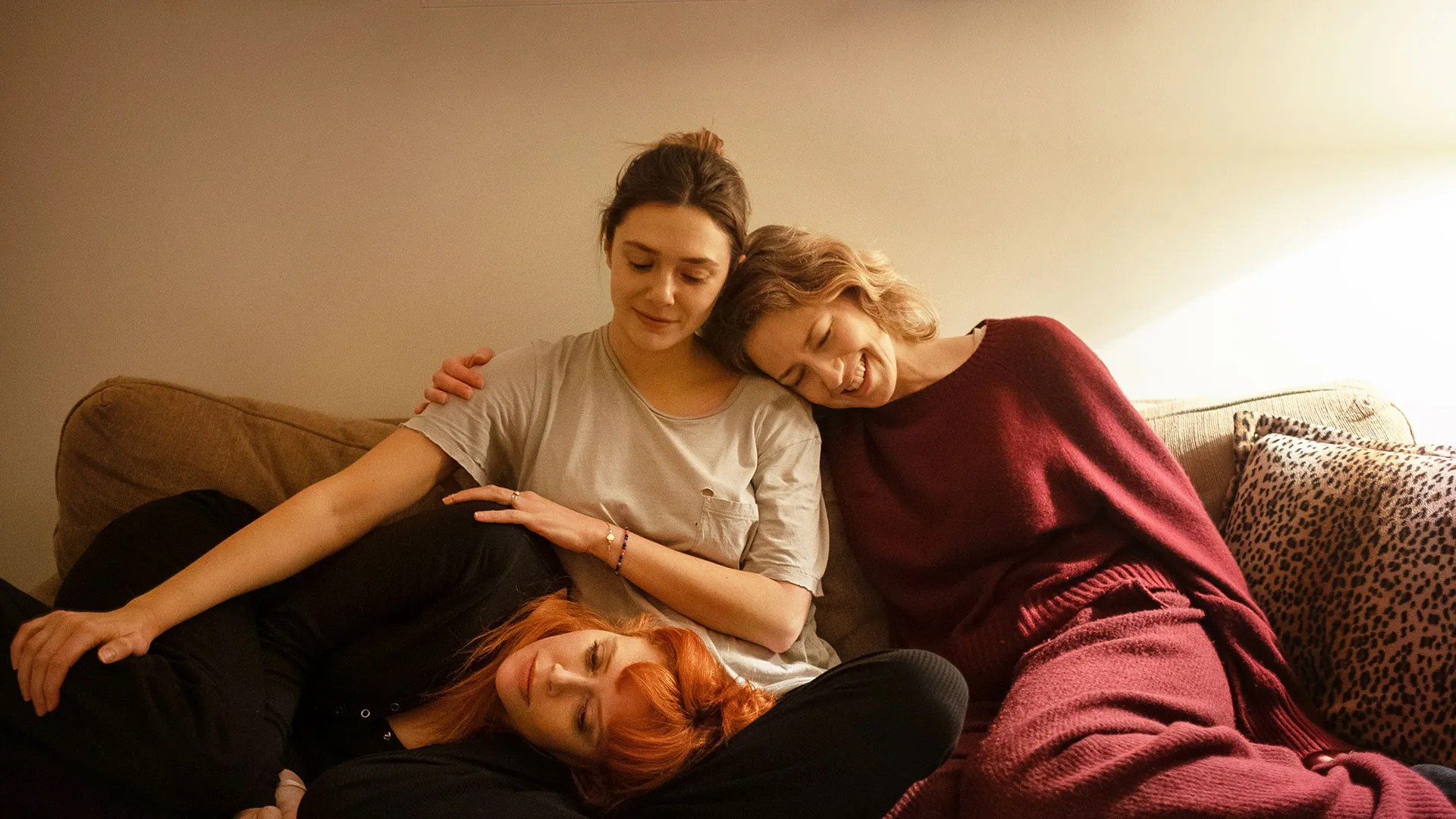
His Three Daughters
director Azazel Jacobs, starring Carrie Coon, Natasha Lyonne, Elizabeth Olsen

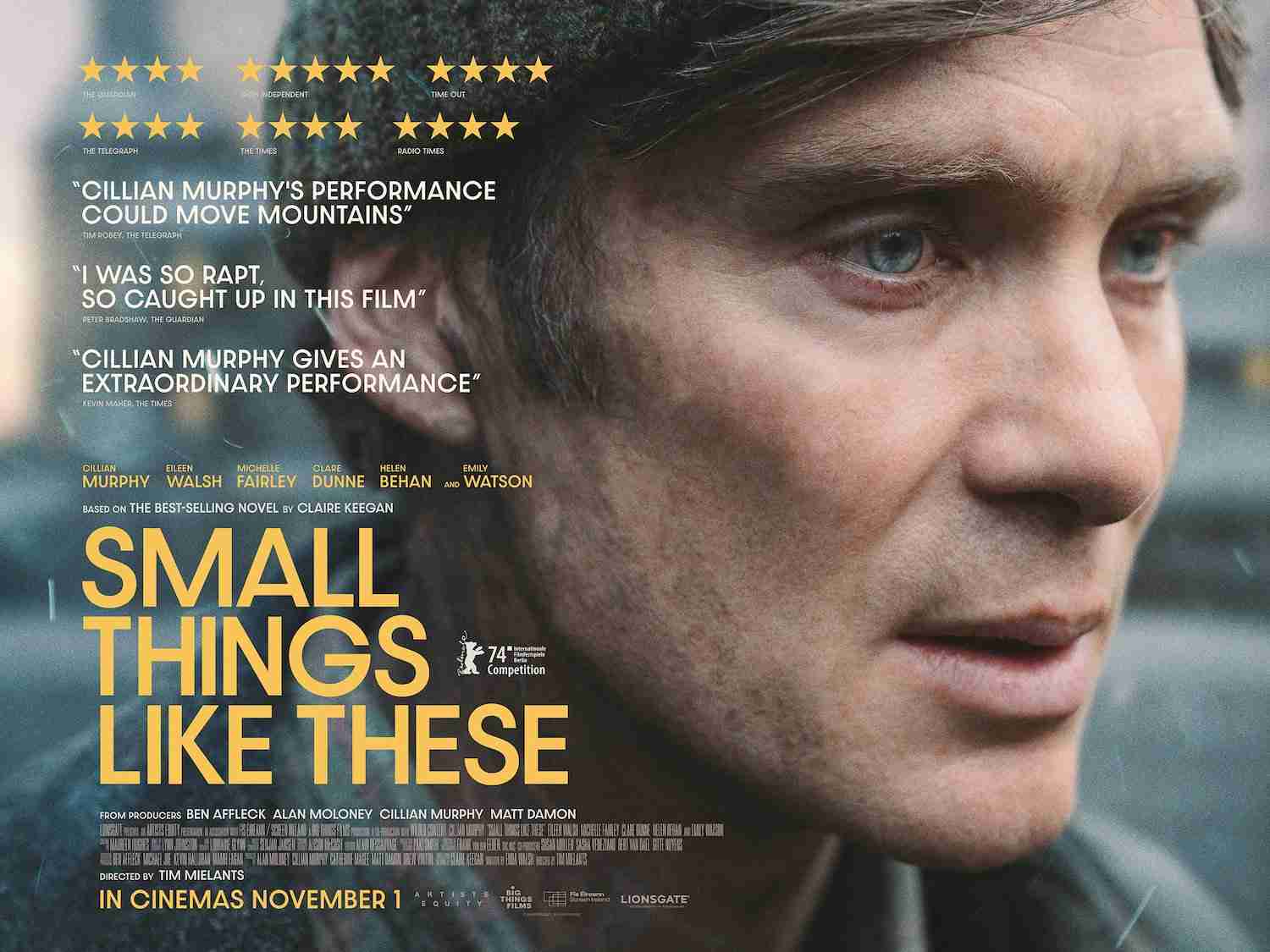
Small Things Like These
director Tim Mielants, starring Cillian Murphy, Eileen Walsh, Emily Watson

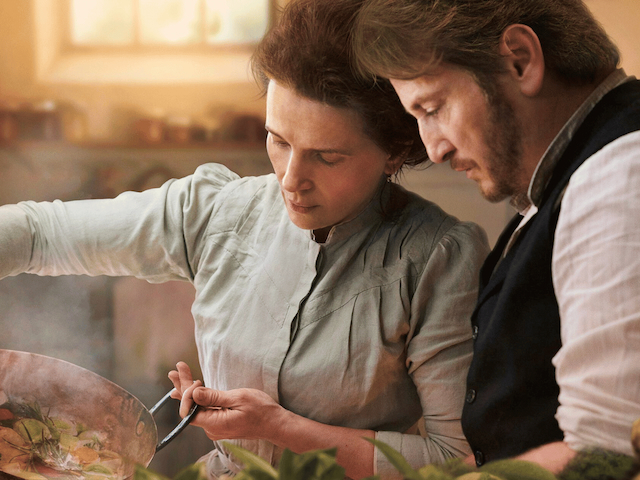
The Taste of Things
director Anh Hung Tran, starring Juliette Binoche, Benoit Magimel, Emmanuel Salinger

BOOKS

James by Percival Everett

This Strange Eventful History by Claire Messud

The Hunters: Two Novellas by Claire Messud

Table for Two by Amor Towles

The Lincoln Highway by Amor Towles

Knife: Meditations after an Attempted Murder by Salman Rushdie

Greek Lessons by Han Kang

The Final Curtain by Keigo Higashino

MY BEST BOOK BUYS
My favourite book purchases of the year, three at bargain prices, i.e. below $10. I was delighted to have found them, all brand new. What attracted me was first their appealing covers and one with marvellous colour art illustrations. These are examples and reasons why I’m not a Kindle user but still very much into tangible reading materials which I can hold in my hands, flip the pages, savour their content and visuals. I’ve started all of them, don’t intend to read like a page-turner, but for slow reading, or even just for looking up as reference with no pressure to read through from cover to cover. Additions to my long TBR list… come 2025.

A Writer’s Britain by Margaret Drabble, first attracted by the front photo, the feel of the special dust cover in my hands and yes, surprised to find there’s a bookmark ribbon that matched the greenery of the front design. British writers and poets and the landscape that inspired them.

The Autobiography of Alice B. Toklas by Gertrude Stein, illustrations by Maira Kalman, who contributed numerous full-page colour art illustrations that remind me of the scenes from the movie Midnight in Paris, especially the scenes inside Gertrude Stein’s home. I’ve a feeling that the set designer Hélène Dubreuil must have used this book in her research, for the movie had made these pictures come to life.

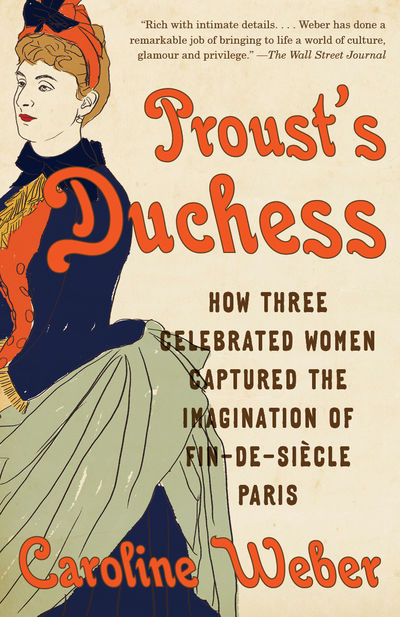
Proust’s Duchess by Caroline Weber, the times of Proust’s Paris, and the three women who inspired him to create the Duchesse de Guermantes from his In Search of Lost Time. Extensive research with numerous notes and references.

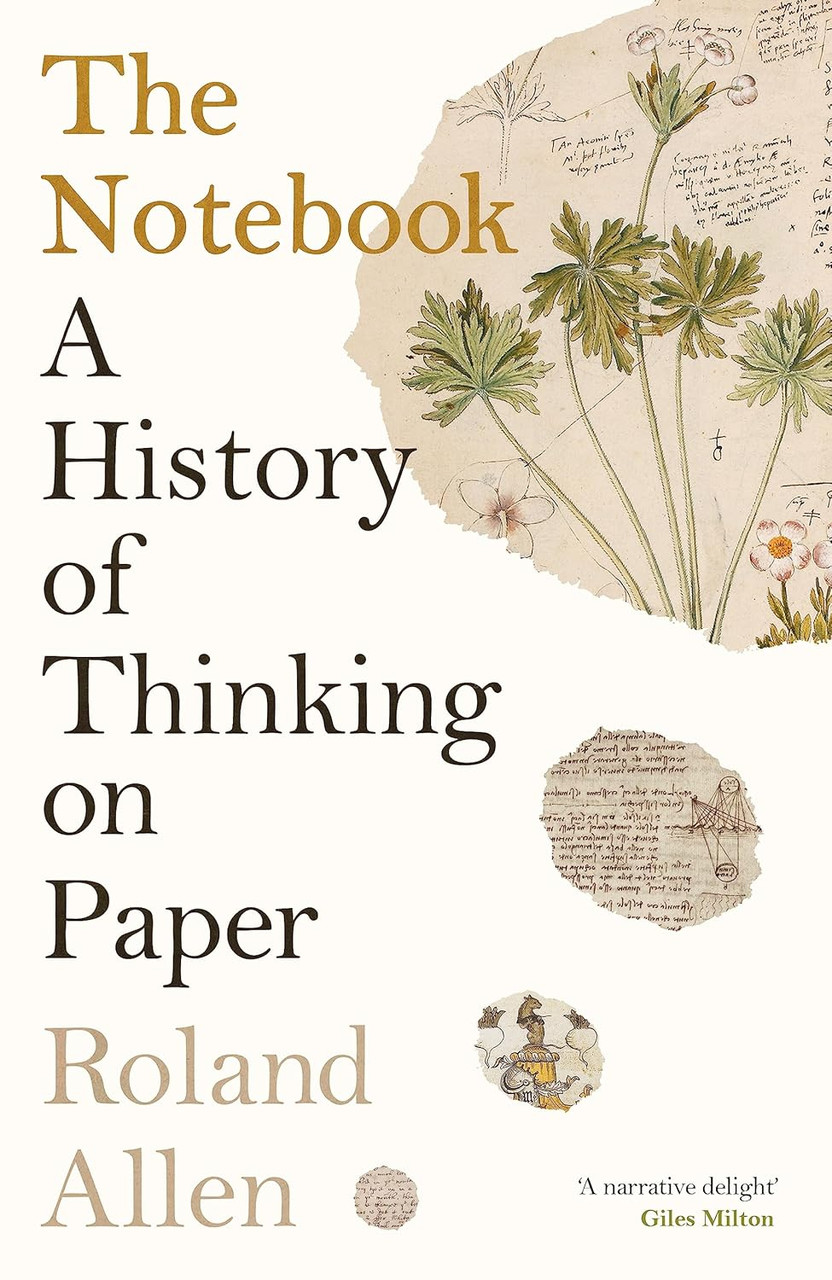
The Notebook: A History of Thinking on Paper by Roland Allen, a look into the history of the notebook, including journals, field notes, commonplace book… and exploration of those belonging to geniuses and the legendary throughout time. Extensive research by the author. What attracted me was the title. No, didn’t find this on the bargain table, as this is a current year publication, a notable best book of 2024 by The New Yorker and other acclaims.

***

A Happy 2025 to all!

‘His Three Daughters’ is a Rare Gem

In the midst of spectacles and action thrillers coming out nowadays, it’s refreshing to see a quiet gem has arrived on Netflix. His Three Daughters focuses on a topic common in real life and in movies, siblings coming back to their ailing parents’ home to prepare for their final parting. Maybe to offset such a heavy subject matter some of these movies are handled in a comedic or even farcical way, This is Where I Leave You (2014) and August: Osage County (2013) come to mind. In contrast, writer director Azazel Jacobs in His Three Daughters (2023) confronts the subject in a realistic and mindful way, eliciting from his three main actors honest and powerful performance. Jacobs is apt too in infusing witty dialogues and subtle humour. What a gratifying turn from his previous film French Exit (2020).

Under one roof in their father’s NYC apartment, three estranged sisters learn to live with each other once again. Carrie Coon (The Gilded Age) is the eldest daughter Katie, the take-charge type, from cooking, dealing with palliative nurses, getting a DNR (do-not-resuscitate) form signed by the father before he slips away, to writing his obituary while micro managing her teenage daughter at home in Brooklyn. Her intolerance of her stepsister Rachel (Natasha Lyonne, Orange is the New Black) who smokes weed and bets on sport games constitutes the main conflict in the sibling relationships. Trying to mediate between the two is Christina (Elizabeth Olsen, Sorry for your Loss) who is always reconciliatory. She’s preoccupied with her young daughter and husband at home far away across the country.

As for the father, he remains unseen behind closed or slightly opened door in his bedroom, his presence only denoted by the rhythmic beeping of the monitor to which he’s hooked up. Such concealing allows the viewers to focus on the trio, for what’s equally pressing is the rebuilding of sisterhood and the way to move forward after their father is gone. Dying relationships among the living are crying out to be heard and reconciled.

Rachel has been living in the apartment with their father all along, while the other two sisters just recently arrive to take care of things at this final stage of their father’s life. New house rules are set up. A pivotal scene comes when Rachel’s friend Benjy (Jovan Adepo) confronts the other two sisters as he points out the reality of their family dynamics. A new perspective begins to sink in as they come to realize their own shortfalls, a reality check that doesn’t go down easy for anyone.

In this chamber piece rich in dialogues, Coon, Lyonne, and Olsen are impeccable in displaying the raw and honest emotions of sibling love, hate, overt and hidden sentiments they hold against each other. But the overall mood is not all serious and somber. There’s underlying humour throughout, especially the opening scene, which reminds me of early Woody Allen works. Music is minimal to amplify the conversations, silence to enhance tension and ambivalence. Despite being shot inside an apartment with minimal exterior scenes, the camera is effective in conveying suspense, loss, and love.

As for the twist towards the end, it’s open to interpretations; however, it does seem incongruent with the earlier part. To avoid spoilers, I won’t be discussing it here. No matter, it’s the process reaching to the end that’s what the film so powerfully depicts. I hope to see more of this kind of cinematic gems to appear in theatres and on streaming platforms.

~ ~ ~ 1/2 Ripples

***

Related posts on Ripple Effects:

August: Osage County, Play and Movie Review

The Savages, with Philip Seymour Hoffman and Laura Linney

Book to Screen in Development 2024 and Beyond

Last post I listed some adaptations from books to the big and small screens coming out this fall in the festival circuit or via streaming platforms. Here are more titles currently in development or in production.

James (2024) by Percival Everett

Stephen Spielberg executive producer, in pre-production, to be directed by Taika Waititi (Jojo Rabbit, 2019) James is Percival Everett’s re-imagination of The Adventure of Huckleberry Finn from the perspective of escaped slave Jim. Currently, the highly acclaimed novel is long-listed for this year’s Booker Prize. Short list will come out Sept. 16 and James is expected to be on there. This is the second movie adaptation of Everett’s novels. After the success last year of his Erasure being turned into the Oscar winning American Fiction–for Best Adapted Screenplay–James is a highly anticipated encore. 

Hamnet (2020) by Maggie O’Farrell

Another one on Stephen Spielberg’s list as producer, now in production. The adaptation of O’Farrell’s novel is directed by Nomadland’s Oscar winning Chloé Zhao, with a talented British cast: Jessie Buckley, Emily Watson, Paul Mescal, and Joe Alwyn. The book is a fictional account of Shakespeare and his wife’s loving relationship with their son Hamnet and their coping with his tragic death at the age of eleven. Zhao’s previous films (before Marvel’s The Eternals) are nuanced and soulful cinematic works. I look forward to her helming this adaptation about love and grief.

Knife: Meditations after an Attempted Murder (2024) by Salman Rushdie

Rushdie’s personal account of the traumatic, life altering event of being stabbed multiple times while on stage in upstate New York, August 2022, and his slow and painful recuperation. Ironically, he was speaking on the topic of keeping writers safe. His memoir will be adapted to the screen by the Oscar winning documentarian Alex Gibney. I’ve given this book 4 stars on Goodreads, was totally riveted by Rushdie’s writing. Hope Gibney’s is an effective documentation and a cautionary testimonial to safeguard artists from harm.

The Chronicles of Narnia (1950’s) by C. S. Lewis

After crashing the glass ceiling, catapulting Barbie to a record $1.4 billion box office sale by a sole woman director, Greta Gerwig is tasked to write and helm at least two of C. S. Lewis’s beloved children series as Netflix films. In a BBC interview, Gerwig said: “I’m slightly in the place of terror because I really do have such reverence for Narnia… I’m intimidated by doing this. It’s something that feels like a worthy thing to be intimidated by.” Let’s hope her fear is a driving force to push her towards excellence in adapting this meaningful book series.

Crying in H Mart (2021) by Michelle Zauner

Poignant memoir of Zauner’s, singer songwriter of the band Japanese Breakfast, about her rediscovery of her Korean heritage and reestablishing a deeper mother-daughter relationship through food and cooking… alas, after her mother’s terminal cancer diagnosis. As an Asian American, her father is Caucasian of Jewish heritage, Zauner’s book is a new and significant voice. She is writing the script herself, Will Sharpe (The White Lotus) directing. Zauner will create the soundtrack with her group Japanese Breakfast. The memoir is an American Book Award winner (2022) and the 2021 Goodreads Choice Award for Memoir & Autobiography, 55 weeks in the NYT Bestseller list.

Tomorrow and Tomorrow and Tomorrow (2022) by Gabrielle Zevin

Here’s another contemporary, literary voice from a biracial American writer. Like H Mart author Zauner, Zevin’s father is of Jewish and mother Korean heritage. Its title alluding to Shakespeare’s Macbeth, Tomorrow and Tomorrow and Tomorrow is a unique and original story about self, love, and video games. Goodreads Choice Awards in Fiction (2022) and top book of the year on numerous lists, and one of my best reads last year. Excited to find out that Paramount Pictures had acquired the film rights even before the book was published, and recently learned that Siân Heder, the Oscar winning director of CODA (2021), has signed on to direct.

The Woman in Cabin 10 (2016) by Ruth Ware

Ruth Ware’s popular suspense thriller takes place on a cruise ship, with British star Keira Knightley on board as a journalist who is the only eyewitness to a murder. The Netflix movie will be directed by Simon Stone (The Dig, 2021). Other Ruth Ware books on the drawing board for adaptation are The Turn of the Key and The It Girl. No further info on these.

Run Rose Run (2022) by Dolly Parton and James Patterson

Dolly Parton and country music fans take note, the legendary singer’s dip into the literary ink pot with her first fiction, a thriller she co-wrote with James Patterson, is to be adapted onto screen. The NYT bestseller about a young singer songwriter on the rise and on the run will be produced by Reese Witherspoon.

***

Do you have any books you’d like to see adapted to a movie or TV series?

From Book to Screen 2024 Fall

Late August kicks off the annual film festival season, and come September, arrays of new offerings on streaming platforms. I haven’t done actual research, but just a feeling that nowadays, more and more movies are adapted from printed sources. The following is a list of upcoming books adapted to full features in theatres, or TV movies and series for streaming:

Conclave by Robert Harris (2016) 

International Premiere at TIFF in September, in theatres November. Directed by Edward Berger (2023 Oscar winner All Quiet on the Western Front) with a stellar cast led by Ralph Fiennes, Stanley Tucci, and John Lithgow. Peter Straughan (Tinker Tailor Soldier Spy, 2011) adapts from Harris’s novel revealing the dark secrets and intrigues in the intense proceedings in electing a new Pope.

The Critic or Curtain Call (2015) by Anthony Quinn

Had its world premiere at TIFF last year and slowly trickling to theatres this September. Directed by Anand Tucker (Girl with a Pearl Earring, 2003) with an exciting British cast with Ian McKellen as the eponymous, acerbic critic, his power and influence affecting many. Co-stars include Lesley Manville, Gemma Arterton, Mark Strong, Romola Gerai, Ben Barnes.

The Day of the Jackal by Frederick Forsyth (1971) 

10 episodes on Peacock, remake of the iconic 70’s movie. Political thriller recounting the plot to assassinate French President Charles de Gaulle after he signed the treaty leading to Algeria’s independence. In this new version, Eddie Redmayne is the assassin Jackal.


Disclaimer by Renée Knight (2015)

Oscar winning director Alfonso Cuarón (Roma, 2018) helms a stellar cast including Cate Blanchett, Lesley Manville, Kevin Kline, Sacha Baron Cohen, Kodi Smit-McPhee. A mini-series where Blanchett plays a TV documentary journalist who exposes dark secrets of others is threatened with the revealing of her own past. Canadian premiere at TIFF in September, mini series on Apple TV+

Here, graphic novel (2014) by on Richard McGuire

McGuire’s works are multi-faceted and highly acclaimed, as permanent collections at MoMA, The Morgan Library and others, print form in The New Yorker, The New York Times, Le Monde… Can a movie version do justice to this multi-talented artist? The team that made the eras-spanning Forrest Gump (1994), director Robert Zemeckis, screenwriter Eric Roth, star Tom Hanks and Robin Wright re-unite to bring us Here. Interesting addition to the cast that I look forward to is Michelle Dockery. In theatre come November.

Interior Chinatown by Charles Yu

The National Book Award winning novel of 2022, a genre defying writing that fuses a novel and a screenplay. The story of a young Chinese American actor struggling to escape stereotypical roles in Hollywood. Stand-up comedian and actor Jimmy O. Yang (Crazy Rich Asians, 2018) stars. 10 episodes on Hulu.

The Nickel Boys by Colson Whitehead (2019) 

New York Film Festival’s (Sept. 27 – Oct. 14) opening film. The winner of the 2020 Pulitzer Prize for Fiction is adapted into film with the title slightly changed to Nickel Boys. Friendship between two Black teenagers in the notorious reform institution, the Dozier School for Boys in Jim Crow-era Florida sustains the two of them during their harrowing residency. 

The Outrun by Amy Liptrot (2016)

Liptrot’s award winning memoir of her troubled past is adapted to the screen and directed by Nora Fingscheidt (The Unforgivable, 2021) starring Saoirse Ronan. From wild living and alcoholic ruin in London, Liptrot rehabilitates herself as she seeks the sanctuary of nature and her childhood home in Orkney off the northeastern coast of Scotland.

The Perfect Couple by Elin Hilderbrand (2018) 

A Nantucket-set wedding disrupted by a murder which makes everyone a suspect. Goodreads declares Hilderbrand “the queen of the summer beach read.” Nicole Kidman, Live Schreiber, Dakota Fanning anchor the Netflix mini-series coming out in September.  

The Return based on The Odyssey by Homer (ca. 8th – 7th C. BC)

World premiere at TIFF, in theatres December. Ralph Fiennes as Odysseus, returning home to Ithaca after the Trojan War and misadventures twenty years later to find his kingdom changed. Juliette Binoche is the patient wife Penelope, trying to buy time to wait for his return and at the same time warding off unruly suitors. Son Telemachus (Charlie Plummer) not so patient. 

Wicked by Gregory Maguire (1995)

Based on the musical, which in turn adapted from the book by L. Frank Baum’s The Wonderful Wizard of Oz (1900), this new rendition as a movie is directed by Jon M. Chu (In the Heights, 2021; Crazy Rich Asians, 2018) Cynthia Erivo (Harriet, 2019) and Jonathan Bailey (Bridgerton, 2020-2024) star.

***
More to come…

My TIFF 2024 Selections

Another year of not heading to TIFF (Sept. 5 – 15), but I still like to browse online their lineups and imagine myself being there. Fond memories gush out… immersing in the festivities in the pedestrian only King Street, traffic blocked off for the occasion; watching films at TIFF Lightbox and browsing the gift shop there; serendipitous sightings of admirable characters such as top critic Justin Chang; lining up to get Roger Ebert to sign a copy of his book Life Itself, and catching a glimpse of Jessica Chastain at the historic Elgin Theatre. I won’t forget the adrenalin-kicking rush back to the press room blocks away after watching a film to write down my impression before darting out for another screening.

For 2024, here’s my watch list if I were there. The title is linked to TIFF’s webpage on the film:

Daniela Forever World Premiere. A Spain and Belgium co-production directed by Nacho Vigalondo starring Henry Golding. Since his breakout role as Nick Young in Crazy Rich Asians (2018), Malaysian born Golding had shown his versatility in starkly different genres, from crime action comedy The Gentlemen (2019) to Jane Austen’s Persuasion (2022). The synopsis of Daniela Forever makes me think of Eternal Sunshine of the Spotless Mind (2004), where science and love intersect.

Oh Canada North American Premiere, starring Richard Gere re-teaming with his American Gigolo (1980) director Paul Schrader after 44 years. Schrader’s most well known work probably is his screenplay for Scorsese’s Taxi Driver, but his Transcendental Style in Film is one of the books I found most helpful for me in appreciating film art. Here Gere plays a Vietnam War draft dodger recounting his life decades later.

The Friend   International Premiere, directed by Scott McGehee and David Siegel (What Maisie Knew, 2012) dramedy for dog lovers, starring Bill Murray and Naomi Watts. Adaptation of the 2018 National Book Award winning novel by Sigrid Nunez.

The Room Next Door North American Premiere directed by acclaimed Spanish director Pedro Almodóvar, his first English-language feature with Julianne Moore and Tilda Swinton.

We Live in Time World Premiere directed by John Crowley (Brooklyn, 2015) with Oscar nominees Florence Pugh and Andrew Garfield in a romantic drama.

By the Stream North American Premiere, prolific South Korean director Hong Sangsoo’s newest with his muse Kim Minhee.

Measures for a Funeral World Premiere, Canadian director Sofia Bohdanowicz tells the story of a young academic researching the early 20th-century Canadian violinist Kathleen Parlow while escaping the grasp of a domineering musician mother. Reading the synopsis makes me think of Ingmar Bergman’s Autumn Sonata.

Daughter’s Daughter World Premiere, executive produced by international film legend Sylvia Chang and Taiwanese New Wave auteur Hou Hsiao-hsien. Chang stars in this moral tale with a very original story idea about a mother having had to make decision regarding her deceased daughter’s legacy.

In Conversation With… Cate Blanchett Special talks in these events take the star from their pedestal to a down-to-earth level, often letting them present themselves as artists and very human. In the past, I’d attended “In Conversation With Juliette Binoche,” still remembers how casually she dressed and personal she was.

___________

Prime Time where new TV series are introduced. Prominent film directors and actors have flocked to the small screens in recent years, levelling the playing field for film and TV, blurring the lines between the big screen and home entertainment. Here are some upcoming series for streaming. I’ll be interested to watch these:

Alfonso Cuarón’s Disclaimer –– Oscar winning director Cuarón (Roma, 2019) is producer with a cast including Cate Blanchett, Lesley Manville, Kevin Kline, Sacha Baron Cohen, Kodi Smit-McPhee. A mini-series where Blanchett plays a TV documentary journalist revealing the dark side of major institutions. 

Others series include Thomas Alfredson’s (Tinker Tailor Soldier Spy, 2011) Faithless, Thomas Vinterberg’s (Oscar nominee for Another Round, 2021) Families Like Ours, and Joe Wright’s (Darkest Hour, 2018; Atonement, 2008M. Son of the Century.

***

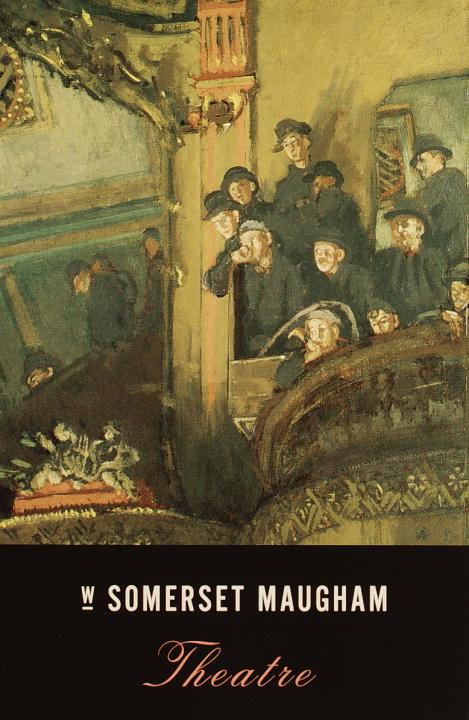
The 1937 Club: Maugham’s ‘Theatre’ from Book to Screen

To wrap up my week for The 1937 Club, I’m re-posting my review of W. Somerset Maugham’s Theatre published in 1937 which some of you have read. As I’m still reading Virginia Woolf’s The Years, haven’t time to reread Maugham’s book this time. I want to re-post my review mainly because I’d like to share my thoughts back in 2010 when I wrote it, and see how much our society has changed in terms of what is real, the main issue by which in Maugham’s book, the son Roger is so disturbed regarding his theatre actress mother Julia Lambert.

As for book turned into films, those familiar with Ripple Effects know that I see the literary and the visual as different art forms, therefore being ‘faithful’ isn’t the major qualifier for a good adaptation. However, in this case, I’m quite disappointed that the essence or, the main issue, as represented by Roger’s frustration with his mother has not been transposed onto the screen, downplaying the tension and conflict that’s so crucial in the book.

_____________________

Two pages into the book I knew right away I had seen it before. Of course, that’s the movie Being Julia (2004). Annette Bening got a Best Actress Oscar nom for her portrayal of Julia Lambert, a famous actress on the London stage in the 1930’s. The movie is a colourful account of how a successful stage actress deals with her mid-life crisis. Garnering fame, fortune, and achievement in bounty, what more could she ask for but… love and passion. And during the course, obstacles, jealousy, and betrayal are all overcome, and revenge carried out; on or off stage, no matter, it’s equally exciting for the glamorous Julia Lambert.

But not until I read this novel on which the movie was based did I realize that a most important passage had been left out. And oh what an omission! For the crux of the book rests on those few pages. And not only that, the screenwriter had chosen to alter a character to suit his fancy, rounding off the edges of conflicts and alleviating tensions in presenting a smooth and suave storyline.

In the movie, Julia’s son Roger is a young man fresh out of Eton and planning to attend Cambridge after the summer. That much is true to the book. Roger is shown to be a devoted son, lovingly supportive of his mother in her pursuits in career and love life. But this is not the case in the novel.  Maugham has crafted Roger as a critical young man, offering the necessary tension to the story. In a crucial scene at the end of the book, he questions Julia’s behaviour and integrity. These challenges form the climatic confrontation between mother and son, projecting the meaning behind the very title of the novel.

Here is an excerpt from this scene that captures the essence of the whole book. Julia asks Roger:

“What is it you want?”
Once again he gave her his disconcerting stare.  It was hard to know if he was serious, for his eyes faintly shimmered with amusement.
“Reality.”
“What do you mean?”
“You see, I’ve lived all my life in an atmosphere of make-believe…. You never stop acting. It’s second nature to you. You act when there’s a party here. You act to the servants, you act to Father, you act to me. To me you act the part of the fond, indulgent, celebrated mother. You don’t exist, you’re only the innumerable parts you’ve played. I’ve often wondered if there was ever a you or if you were never anything more than a vehicle for all these other people that you’ve pretended to be. When I’ve seen you go into an empty room I’ve sometimes wanted to open the door suddenly, but I’ve been afraid to in case I found nobody there.”

By turning Roger into a complacent and docile young man, the screenwriter had failed to present the necessary tension in the story. Further, by avoiding the character foil between the successful actress mother and her meaning-pursuing, idealistic son, the movie fails to deliver the essential subtext, despite an impressive performance by Annette Bening.

Further, the best is yet to come in the book… such is the ingenuity of Maugham.  After a superb, revengeful performance, overarching her rival, the young and beautiful Avice Crichton, and drawing everyone’s admiration back to herself, Julia celebrates on her own with a nice meal and mulls over a gratifying notion, on the very last page:

“Roger says we don’t exist. Why, it’s only we who do exist. They are the shadows and we give them substance. We are the symbols of all this confused, aimless struggling that they call life, and it’s only the symbol which is real. They say acting is only make-believe. That make-believe is the only reality.”

This is ever so relevant for us today. With all the online personae we can create and project, all behind the guard of anonymity, Roger’s quest for what’s real remains a valid search.

Sherry Turkle, the acclaimed ‘anthropologist of cyberspace’, has observed the liminal reality in our postmodern world and stated her own quest:

“I’m interested in how the virtual impinges on what we’ve always called the real, and how the real impinges on the virtual.”

Let’s just hope that the advancement of technology would not get the better of us, blurring the lines of fact and fiction, offering shields for fraud and deceits. Behind the liminal existence, let’s hope too that we still care what’s real and what’s not, and that our humanity will still be valued and not be compromised or lost in the vast abyss of bits and bytes.

The upcoming Academy Awards too, is another platform to showcase such a duality. I always find the acceptance speeches of award winners intriguing: what’s genuine and what’s fake in their thank you’s. Are they presenting their real self or merely acting? Outside of their roles, which part of them is authentic? Or, do they ever get out of their roles?

It’s interesting too to explore the influence of movies nowadays. Again, the postmodern emphasis is on the narrative, multiples of them, and storytelling the vehicle of meaning. Does the notion of Maugham’s character Julia mirror our world… that movies have become the symbols of what we call life? That make-believe has sometimes been merged with reality? Can we still tell them apart? Or, should we even try? Considering the pervasive effects of pop culture in our life today, considering a single movie can command a worldwide box office sale of $2.4 billion, and counting… Maugham was prophetic indeed.

***
Again, I thank Simon and Karen for hosting. Looking forward to the next year club in the coming months.

The 1937 Club: ‘Out of Africa’ Book to Movie

Twice a year, Simon at Stuck in a Book and Karen at Kaggsy’s Bookish Ramblings host an interesting reading event, the year club. We read books published in that year indicated by the number and write our reviews. This time, from April 15-21, we are doing the year 1937.

Many fine titles were published in 1937, but for me, it’s an easy choice: Out of Africa, the memoir of Danish author and baroness Karen Blixen (1985-1962). Interesting to note that she had several pen names. In the English speaking countries, she was Isak Dinesen.

Ever since watching the 1985 movie Out of Africa, I’ve always wanted to read the source material, Blixen’s autobiography about her seventeen years (1914-1931) living in Kenya operating a coffee farm. In a way, I want to cast aside the image from the movie, however romantic, of Meryl Streep and Robert Redford sitting in green pastures picnicking, with Mozart’s Clarinet Concerto coming out from a gramophone, the music sweeping serenely across the pristine African landscape.

Blixen’s life in Kenya was no small venture: a pioneer woman operating a coffee farm situated in the six thousand acres of her land at the foothills of the Ngong Mountains. She rode horses, went on safaris, shot lions to defend her oxen, herself and others. When in the capital, Nairobi, she was a business woman; when on her farm, she was doctor to those lined up to see her with their sickness and ailments. She sent those that she couldn’t handle to the hospital and visited them, seeing to their recovery.

Blixen’s chronicles of her life in Africa intertwine objective observations and intimate thoughts. When describing the different ethnic groups in the land, the Natives Kikuyu, or her neighbours the Masai, or the immigrants the Somali… her writing is like an astute anthropologist, always with admiration. When referring to the Somali women, she writes:

There was no ignorance in their innocence. They had all assisted at childbirths and death-beds… Sometimes to entertain me, they would relate fairy tales in the style of the Arabian Nights, mostly in the comical genre, which treated love with much frankness. It was a trait common to all these tales that the heroine, chaste or not, would get the better of the male characters and come out of the tale triumphant… I felt the presence of a great ideal… the idea of a Millennium when women were to reign supreme in the world. (131)

Considering the above was noted earlier than 1931 (the year she left) in Africa, was Blixen a visionary ahead of her times, or… was it the Somali women?

When describing those close to her, like her invaluable assistant Farah, she presents a character study with free flowing, deep feelings of love and respect. In the essay collection at the back of this book, Shadow on the Grass, she has a whole chapter on Farah, of whom she describes a special relationship of Unity, that of Master and Servant, in no subordinate sense but an indispensable bond of loyalty and mutual respect. Blixen gives a few examples of such Unity, like Don Quixote and Sancho Panza. For contemporary readers like us, maybe the Downton relationship between Robert Crawley and John Bates would be a more visible example.

[Spoiler Warning here] Unlike the movie, Blixen mentions her friend Denys Finch-Hatton (Robert Redford in the movie) only sporadically in the first half of the book. Towards the end she devotes a few chapters on him upon his tragic plane crash. The two chapter titles are indicative of his character: ‘The Noble Pioneer’ and ‘Wings.’ Denys had almost become a Native himself, knowing the people of the land thoroughly, having had spent decades there, his love for them is reciprocal. His bi-plane is an apt metaphor for his courage and unbound spirit of exploration. His gramophone is an object of desire as the music it plays is a shared joy between him and Blixen, as well as a novel attraction mesmerizing all those on the farm. Of Denys, Blixen writes:

What they really remembered in him was his absolute lack of self-consciousness, or self-interest, and unconditional truthfulness which outside of him I had only met in idiots. (247)

Kudos to film director Sydney Pollack, the movie shows what’s unsaid between the lines. Blixen had deep feelings for Denys, but from the text, she’s restrained and devoid of sentimentality. That’s what makes the final chapters so poignant. Unlike the movie, there’s no romance depicted, just friendship and mutual admiration. There are letters and other writings of Blixen’s which I’m sure the filmmakers had researched on, and thus the more intimate dramatization of them as lovers in the movie. Furthermore, the aerial shots of Deny’s bi-plane over the African landscape, hills and valleys, plains and waters, spurring flocks of shore birds to soar to the sky, our reading imagination visualized; John Barry’s heart-stirring, expansive score complements the mesmerizing cinematography. And yet, I’ve fully enjoyed Blixen’s writing as well, intimate and poignant.

The farm eventually failed financially and Blixen had to move back to Denmark. Selling it out and bidding farewell is like leaving her soul there. She describes her last safari at dusk:

The plains with the thorn-trees on them were already quite dark, but the air was filled with clarity – and over our heads, to the west, a single star which was to grow big and radiant in the course of the night was now just visible, like a silver point in the sky of citrine topaz. The air was cold to the lungs, the long grass dripping wet, and the herbs on it gave out their spiced astringent scent. In a little while on all sides the cicadas would begin to sing. The grass was me, and the air, the distant invisible mountains were me, the tired oxen were me. I breathed with the slight night-wind in the thorn-trees. (191)

This is one of those books that will linger in my heart long after I finish and to which I know I will return.

***

Related Post on Ripple Effects:

‘Flappers and Philosophers’ by F. Scott Fitzgerald: My entry into the 1920 Club

The Zone of Interest and the Banality of Evil

How does a German family spend their summer holidays? Imagine this one with mom and dad and their five children in a country house. Family picnic by the river, dad fishing, mom admiring her large and impressive garden, children splashing in the pool. Dad got a surprise birthday present, a canoe, which he takes to the quiet stream with two of his older children surrounded by bird songs. Dad not only loves his family, but his horse, his dog, and those lilac bushes.

A picture of an idyllic and peaceful family life. Zoom out a bit, the country house is right adjacent to the Auschwitz concentration camp, separated by just a wall, barbed wire on top. We can only see the top of the prison buildings. Yes, we also see heavy smoke shooting out from tall chimneys.

This is an actual, historic setting. The master of the household is Rudolf Höss (Christian Friedel), commandant of the Auschwitz concentration camp. He rides to work on his beloved horse, doesn’t have far to go, only next door. An idyllic family life and the horrors of genocide co-exist side by side, the Garden of Eden and Hell separated by just one wall. As for the wall, Rudolf’s wife Hedwig (Sandra Hüller) is thinking of growing some vine to cover it, making it disappear altogether.

Writer-director Jonathan Glazer’s Zone of Interest is a macabre juxtaposition of normality and atrocity, a cinematic representation of what the political thinker and philosopher Hannah Arendt calls the banality of evil. It doesn’t take a monster to commit monstrous acts. Ordinary people had committed them without questioning, as Judith Butler wrote about Arendt’s book on the trial of Adolf Eichmann, one of the organizers of the Holocaust:

In a sense, by calling a crime against humanity ‘banal’, [Arendt] was trying to point to the way in which the crime had become for the criminals accepted, routinised, and implemented without moral revulsion and political indignation and resistance.

The Guardian, Aug. 29, 2011

Glazer’s ingenuity in depicting the ‘horror next door’ is by not showing us visually but audibly. While we see the Höss family going about their daily life, we can hear constant gunshots, dogs barking, guards yelling, furnace rumbling, and anguished cries. Indeed, the whole Höss family have learned to ignore such ‘disturbances.’ Their callousness is chilling. When Rudolf received the order to transfer from Auschwitz to Oranienburg, Hedwig tells him that she wants to stay right there with the children while Rudolf can attend his new post alone. Their rationale: “The life we enjoy is very much worth the sacrifice.” Hedwig adds in, “this is the way Hitler would want us to live.” Here is their dream home.

If such a normal family can be complicit to evil without questioning, Arendt’s implication is that we who consider ourselves ordinary folks can also be susceptible to commit criminal wrongdoings out of the desire for group conformity or self-interest. It doesn’t take a villainous monster to commit atrocious acts, we all have the propensity for evil. That wall separating the garden and hell could be the metaphoric, thin line between good and evil within ourselves. Another chilling thought, this time much closer in our own backyard.

Two-time Oscar nominated cinematographer Lukasz Zal (Cold War, 2019; Ida, 2015) placed cameras in and outside of the house unobtrusively to capture the actors in their natural way. Shot in natural lighting, with no camera people on set, the film is a raw depiction of the behavior of a family in their mundane mode of living, a heartless picture of irony to what’s taking place on the other side of the wall.

Two scenes particularly stand out for me. Hedwig tries on a long fur coat––loot from the prisoners next door––looking into a full-length mirror, clutching the collars and posing from side to side as if trying it in a boutique shop. Another scene is one of the older boys using his flashlight to examine something while in bed at night. An insert shot shows what he’s studying: teeth with gold trims; not hard to figure out where they come from.

Any relief from such insensitivity? Glazer has inserted some fairytale-like sequences in reverse black and white of a girl hiding food in the bushes, for the prisoners we presume, that’s when we hear the voice-over of Rudolf reading to his children the story of Hansel and Gretel in their bed. Fairytale or dream sequence, or for real, is that one of the Höss girls? No matter, that’s the humanity we seek.

Loosely based on Martin Amis’ novel, Zone of Interest is an ‘arthouse’ style of filmmaking that offers a unique perspective of the Holocaust without showing any of the prisoners, except the one that works in the Höss garden. Sounds elicit unseen implications. The film starts and ends with a long, eerie cacophony of anguish and squeals with the screen a blurry mass of grey. The effects evoked are none less haunting than actual shots of the concentration camp. The ending scene comes back to today and the way the camera captures the people there is most effective in wrapping up this retelling of history.

With its one hour and forty-five minutes duration, the film is succinct, well-paced and edited, naturalistic in its styling, and leaves viewers with haunting ponderings after. Winner of four Cannes Prizes, The Zone of Interested is nominated in five categories in this coming Academy Awards on March 10: Best Picture, Best International Feature Film, Director, Adapted Screenplay, and Sound. Hope it could get some worthy recognition on this side of the Atlantic.

~ ~ ~ ~ Ripples

Related Ripple Reviews:

Anatomy of a Fall

Ida’s Choice: Thoughts on Pawlikowski’s Ida

Ripples from the 2024 Oscar Nominations

The 96th Academy Awards nominations were announced on January 23. To Oscar watchers, the Best Picture list is no surprise. All the ten movies have been garnering praises all along in the past year. Here are some ripples from Arti’s Pond. My views may not reflect yours, so, you’re welcome to throw in your two pebbles to generate yours.

This year the nominations are voted by members of The Academy of Motion Picture Arts and Sciences from 93 countries, over 9,400 eligible voters. Here are the ten Best Picture nominees with links to my full review and others a capsule review here.

Here are the Best Picture Nominees for the 96th Academy Awards:

American Fiction –– My favourite of all the nominees that I have watched on this list. Clever, funny, and superbly performed. While I haven’t read the literary source Percival Everett’s 2001 novel Erasure, I find the movie in itself thought-provoking, well-edited, and with a relevant, hilarious twist at the end. A heartfelt description of family relations while presenting an acerbic satire on racial stereotyping in the publishing industry, extending to the general American society. Winner of TIFF’s People’s Choice Awards last September, a choice, I suppose, is easier for us unhindered outsiders to make. 5 Oscar noms.

Anatomy of a Fall –– My full review here. 5 Oscar noms.

Barbie –– While Greta Gerwig is one of my favourite film writers, directors, and actors, I’m afraid I don’t share the enthusiasm of the populist. Is it that hard to imagine a girl growing up just might not like dolls and least of all a Barbie, and who averts anything pink? Exactly, it’s hard for me to embrace the movie that is a sensory overload of objects I’m apathetic about. Nevertheless, I must say, Greta, your dealing with existential issues of being and nothingness using a doll is ingenious. Above all, you’re bold to laugh at Mattel, Man and Money. Biggest irony is, in laughing at the three M’s you’re raking in billions of box office sales. 8 Oscar noms

The Holdovers –– My full review here. 5 Oscar noms.

Killers of the Flower Moon –– A typical Martin Scorsese film with in-depth storytelling using his trump cards, strong character actors Leonardo DiCaprio and Robert De Niro. How the discovery of oil brings not only wealth to the Osage people but grief and heartbreak is a chapter in early FBI history. But the movie doesn’t focus so much on the FBI investigation but the dubious marriage relationship between Earnest (DiCaprio) and Molly (Lily Gladstone). As I watched, I was thinking if I were the editor, I’d cut out an hour of its 3 hours 26 mins length and it can still run smoothly. A breakout performance for Gladstone. I first saw her in Kelly Reichardt’s Certain Women and later in First Cow, but Scorsese has brought out the strong actress in her. 10 Oscar noms

Maestro –– As a Leonard Bernstein fan since my college days, still have his book The Joy of Music on my shelf, his LP box album of the complete Beethoven’s Nine Symphonies with the NY Philharmonic in my LP collections, I’m disappointed that Bradley Cooper chooses to depict the side of the iconic composer, conductor, pianist, educator and writer that is the most disturbing and least admirable, i.e. his betrayal of his devoted wife. Of course, it makes sensational movie materials. Cooper’s portrayal comes off as flippant and cocky. Yes, Carey Mulligan deserves an Oscar nom after putting up with all those smoking and having had to inhale constantly as well. 7 Oscar noms.

Oppenheimer –– You might be surprised, but I still haven’t watched this Oscar frontrunner with 13 noms and for some reasons, have a weak desire to. Go ahead, psychoanalyze me.

Past Lives –– My full review here. 2 Oscar noms.

Poor Things –– It’s all good with fantastic set design and art rendering, fresh and meaningful storyline touching on existential issues behind its comic veneer. An adult behaving like a child isn’t anything new, we see these bodies almost everyday, but Emma Stone as Bella makes it entertaining, enlightening and thought-provoking. Mark Ruffalo deserves an Oscar nom. Brilliant LOL scene where he tries to pair with Bella’s crazy dance moves to deflect her oddity on the dance floor. All good except one section that I feel is gratuitous on the part of director Yorgos Lanthimos and that’s the Paris chapter where Bella works as a prostitute to earn money. No need to repeat her act with man after man after man. 11 Oscar noms.

The Zone of Interest –– On the top of my TBW list. 5 Oscar noms.

The 96th Academy Awards will take place Sunday, March 10, at the Dolby Theatre in Hollywood, Los Angeles.