Slumdog Millionaire (2008)

slumdogposter

Updates:

Feb. 22:  Slumdog Millionaire just won 8 Academy Awards. CLICK HERE for the Oscar Results 2009.

Feb. 8:  Slumdog Millionaire has just won 7 BAFTA Awards including Best Picture and Best Director tonight in London, England.

Jan. 25:  Slumdog Millionaire has just won the Screen Actors Guild Award for Outstanding Performance by a Cast in a Motion Picture.

Jan. 22:  Slumdog Millionaire just nominated for 10 Oscars including Best Picture. Click here to go to my Oscar Nominations Post.

Jan. 12:  Slumdog Millionaire just won 4 Golden Globes for Best Original Score, Best Screenplay, Best Director, and Best Motion Picture – Drama.

***

A. O. Scott in his 2008 year-end article and podcast on the New York Times website gives credits to movies that explore the element of hope. How fitting it is to start the new year by watching ‘hopeful movies’. In this turbulent time of ours, ‘Hope’ might just be the word of the year for us all.

Slumdog Millionaire not only explores the idea of hope, it builds its whole momentum on this element, and its fuel is none other than ‘love’.  The movie is a modern day fairy tale, an exciting concoction bubbling with fantastic visuals and sounds, a post-modern alchemy of culture, language, and place. But what unifies is the aspiration of requited love and shattered souls redeemed.

Directed by Danny Boyle (28 Days Later, 2002, Trainspotting, 1996) and based on Vikas Swarup’s award winning novel Q & A, which has been translated into 36 languages, the film has garnered high acclaims in film festivals. Just four months into its limited release, Slumdog Millionaire has already won 20 awards, and is nominated for 4 Golden Globes including Best Picture, and 2  SAG Awards, and is a possible contender for the Oscars.

Jamal Malik (Dev Patel) grows up in the slums of Mumbai, India. He and his brother Salim watch their mother killed by mobs. The two boys have to fend for themselves living on the streets. They survive the deplorable conditions with tact, style and grace, until Salim falls for the gang. Jamal has a childhood sweetheart Latika (Freida Pinto). In a heart wrenching episode, she gets separated from the brothers. Her fate seems to be sealed as a young girl on the street.

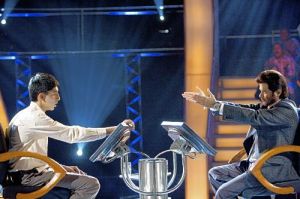
Years pass but Jamal’s heart still yearns for Latika. One thing that unites all Indians seems to be the popular quiz show “Who Wants To Be A Millionaire”. With his heart firmly fixed on reaching out to his long lost love  somewhere out there in the mass populace of India, Jamal gets on the show, hoping Latika would see him. Latika at this time is in the firm grip of a gang lord, her hope of freedom is dismal.
slumdog-millionaire-2

Yet, screenwriter Simon Beaufoy (Miss Pettigrew Lives for a Day, 2008 ) and director Danny Boyle gratify their viewers with some unexpected twists and turns, allowing us to savour an exhilarating end to the story. With their seamless, non-linear way of storytelling, framed by an upbeat musical score, they have turned what could be just another love story into a fresh and engrossing tale.

While the film features all Indian actors and some Bollywood stars, shot in Mumbai, many dialogues in Hindi with English subtitles, I don’t feel the cultural elements particularly stand out, drawing attention to themselves. Herein lies the success of the film. It has not led me to feel like I am watching something ‘foreign’ or ‘ethnic’, like some National Geographic features. The sense of place and subject matter, plus the amiable cast have all worked together effectively to transmit a universal appeal. The only Bollywood moment is when the end credits roll. Do stay for that.

Slumdog Millionaire evokes reminiscence of similar successful though lesser known titles like ‘Chop Shop’ (2007) and ‘Born into Brothels’ (2004), but on a grander scale, with an explicit message of hope and an unabashed resolution of requited love.

How satisfying! You’ll come out rejuvenated. The skeptic in you might say it’s only a movie, a fantasy too…  Mind you, not all fantasies end well. With some, the darkness can loom for days. Be good to yourself, start the year on a cheery note. Watch a ‘hopeful movie’. Love and Hope can sustain and triumph. As simple as that.

~ ~ ~½ Ripples


*****

The Best Movies of 2008

It’s that time of the year when film critics choose their ten best.  Here are a few of their lists.  Click on them to see the full content.

Breaking the top 10 tradition,  Roger Ebert has chosen 20 for 2008, because in his opinion, there are just too many good films this year.

A. O. Scott of the New York Times tends to agree, but still managed to pick his top 10 among the 650 films he has seen this year… incredible.

His colleague Manohla Dargis has also done the year-end cut from the hundreds she has seen.  Here’s her take on the ten best.  And while you’re there, click on the podcast where she and Scott discuss this year’s movies.

And finally, a Canadian perspective, represented by Johanna Schneller of the Globe and Mail.  I like how she puts it:  the 10 films “that I feel richer for having seen.”

What draws me to these lists is not so much about which movies get picked as the 10 best, but WHY they are selected, and HOW critics come around to that final decision after, I must suppose is a long, struggling process.  Imagine having had to pick 10 out of 650!

Comparing these lists, there are of course titles that are common among them, but not too many.  A few getting up on three of these lists but not all, like Rachel Getting Married, Milk, and Wendy and Lucy.  Only one film gets the nod from all of them and that’s Happy-Go-Lucky.  But for the rest, it seems like each critic has his or her own personal criteria when it comes to choosing what makes a good movie.  And I’m glad to see it this way.

Of course, there are theories, on film, aesthetics, and criticism, and then there are acting methods and execution criteria in camera works, lighting, sound, cinematography, editing, screenplay… it all boils down to one whole package, the final production.  And then there is also the receptive end of the movie, the viewer, and in this case, the critic, each bringing his or her own experience, sense of self, personal values and point of view.  And I’m relieved to see each critic pick what he or she feels is most affective and meaningful to him or her as an individual.

I’ve particularly enjoyed reading A. O. Scott’s year-end article in the New York Times entitled “In The Face of Loss, Celebrating Ties that Bind“.  Although not intended to answer the question: “What makes a good movie?”  Scott has inadvertently expressed his criteria.  When discussing a few movies that he thinks are well done, namely Doubt, The Reader, Revolutionary Road, and Frost/Nixon, he comments that they :

are impeccably acted, exquisitely production-designed excursions into the recent past.  And each one is a hermetically sealed melodrama of received thinking, feverishly advancing a set of themes that are the very opposite of provocative.

So, one criterion is originality, and not cliché treatment of subject or idea.

In the midst of our unsettling and troubled time, films could be manifestations of a collective predicament, and expressions of our hidden longings.  I’ve particularly appreciated Scott’s comment at the end of his article:

And while I am suspicious of easy affirmation or forced happy endings, I am nonetheless grateful for movies that, in spite of everything, investigate the possibility of hope.

Another criterion: good films are flowing conduit of hope.  I cannot agree with him more.  If you listen to the podcast on his webpage, you will hear him reiterate this point.

And on this note I end my post of 2008.  To all my readers, visitors, and fellow bloggers, may 2009 be a year of hopes abound and dreams fulfilled!

Happy New Year to All!

*****


Reading the Season: Fleming Rutledge

Two things I always do whenever I go to Vancouver:  Check out the indie movies and visit the Regent College Bookstore on the UBC campus.  I admit before that gloomy December day when I entered the Regent Bookstore,  I had not heard of the name Fleming Rutledge.  Thanks to Regent’s gigantic book sale, I came out with, among others, two of Rutledge’s titles:  The Bible and The New York Times and The Battle for Middle-earth, a commentary on Tolkein’s writing.  For the purpose of basking in the Christmas Season in a more meaningful way, I delved right into The Bible and The New York Times.

The theologian Karl Barth has a famous axiom that says sermons should be written with the Bible in one hand and the newspaper in the other.  This book is evidence that Fleming Rutledge has taken this motto to heart in her over twenty years of preaching and teaching ministry.  The book is a compilation of her sermons delivered in the 80’s and 90’s from the pulpit of Manhattan’s Grace (Episcopal) Church where she has served for 14 years, as well as from her visits to other churches in Eastern U.S.  As for her writing, Annie Dillard has commented that, “this is beautiful, powerful, literary writing.”

The 34 sermons are arranged according to the liturgical calendar, all eloquent reflections on the meaning of the occasion, from Thanksgiving to Advent, Christmas to Lent.  I’ve heard numerous sermons in my life, countless I dare say, but I admit this is the first time that I read through a compilation of sermons and thoroughly enjoy them all like a page-turner.  They throw light on events of our world, from politics to popular culture, addressing them as springboard to a spiritual perspective albeit not without practical wisdom; her commentaries on the human condition are incisive and spot-on.  I’ve come out heartily admiring Rutledge’s intellectual prowess and literary repertoire, but above all, her boldness in proclaiming what may not be politically correct in this day.

rembrandts-annunciation-of-the-angel-gabriel-to-mary

The four Advent Sundays are preparatory for the main event of Christmas.  Rutledge reminds us that without recognizing the darkness we are in, there is no need for the Light.  Oblivious to unresolvable conflicts and the depravity of our human condition, we would not be desperate enough to search for truth and redemption.  Without being shattered by tragedies and wounded by sorrow and grief, we would not be genuinely seeking solace and healing.  And, not until we see the absurdity of our human world, we would not humbly seek meaning in the transcendent.

In one of her Advent sermons, actually exactly today, the last Sunday of Advent, Rutledge relates the spiritual experience of John Updike one time when he was alone in a hotel room in Finland.   He was besieged by a sense of awareness that pulled him to confront what he called a “deeper, less comfortable self.”   She quotes Updike’s own words:

“The precariousness of being alive and human was no longer hidden from me by familiar surroundings and the rhythm of habit.  I was fifty-five, ignorant, dying, and filling this bit of Finland with the smell of my stale sweat and insomniac fury.”

Rutledge notes that at the time:

Updike is in the prime of his life, at the peak of his powers and the pinnacle of his fame.  Yet even a celebrity has to be alone with himself at three o’clock in the morning, even as you and I.

If we approach Christmas in such a state of  “deeper, less comfortable selves”, then we might come closer to appreciate the magnitude of its significance and meaning.

Annie Dillard has commented that Rutledge “writes as a person who knows she is dying, speaking to other dying people, determined not to enrage by triviality.”  The world situation today is grave, our hope lies not within but beyond ourselves.  For this reason the Word became flesh and dwelt among us.

Emmanuel, God with us …

This is the meaning of the Virgin Birth:  God has moved.  God has moved, not we to him in our impotence, but he to us.

This is not the Season to be merely festive and jolly.  Christmas is the celebration of the Grand Entrance into humanity, thus reason for deep rejoicing.

“All hopes and fears of all the years,

Are met in Thee tonight.”

rembrandts-adoration-of-the-shepherds

******

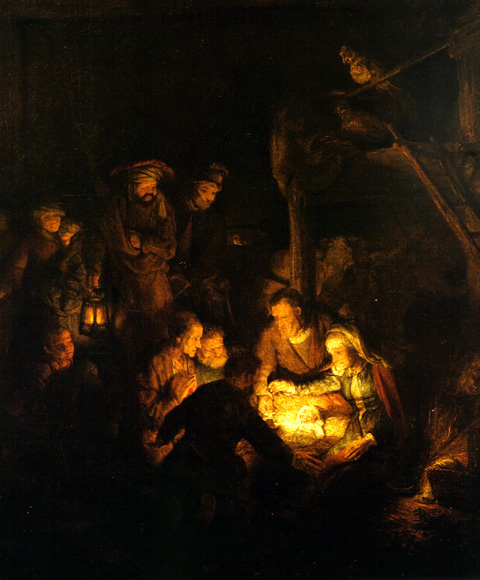
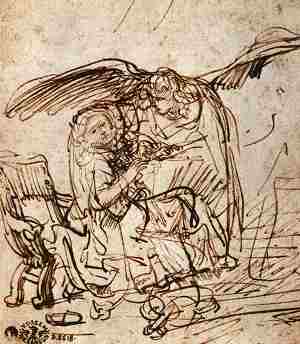
Art images:  Rembrandt’s Annunciation of the Angel Gabriel to Mary and Adoration of the Shepherds

‘Reading The Season’ Posts over a Decade:

2020: Jack by Marilynne Robinson

2019: ‘A Hidden Life’ – A Film for the Season

2018: A Verse from Madeleine L’Engle’s The Irrational Season

2017: A Wrinkle in Time by Madeleine L’Engle

2016: Silence by Shusaku Endo

2015: The Book of Ruth

2014: Lila by Marilynne Robinson

2012: Surprised by Joy by C. S. Lewis

2011: Walking on Water by Madeleine L’Engle 

2010: A Widening Light by Luci Shaw

2009: The Irrational Season by Madeleine L’Engle

2008: The Bible and the New York Times by Fleming Rutledge 

2008: A Grief Observed by C. S. Lewis

2009 Golden Globe Nominations

Update January 12:  CLICK HERE for the Golden Globe Winners.

Hollywood Foreign Press Association has just announced the 2009 Golden Globe Awards nominations.  Click here for the full list.

If, as they say, the Golden Globes usually is a good prediction of the Oscars, then I am hopeful that some of those who truly deserve the recognition might just get a nod for next year’s Academy Awards.

I’m thinking in particular of Kristin Scott Thomas for her role in I’ve Loved You So Long (France), nominated for a Golden Globe Best Actress Award (Drama), and the film getting a nod in the Best Foreign Film category.

Anne Hathaway is also a contender in the same category as Scott Thomas, for Rachel Getting Married.  Her performance is a good sign of her versatility.  But my choice is Kristin Scott Thomas, hands down.  She has delivered a superb performance in I’ve Loved You So Long as the deep and tormented Juliette Fontaine.   I wish her all the best all the way to the Oscars.

As to the two nominations Mamma Mia! receives for Best Picture (Comedy or Musical), and Meryl Streep for Best Actress (Comedy or Musical), I admit I am a bit surprised.  But then again, as a musical goes, especially one made up of amateur singers, maybe it does deserve a nomination for its entertainment value.

To read my reviews of the movies mentioned here, just click on their names.  My reviews are also linked by IMDB’s ‘external reviews’.

*****


I’ve Loved You So Long (2008, France) Il y a longtemps que je t’aime

Update: 

March 3:  The DVD has come out.  For those who don’t like to read subtitles, the DVD has an English Version with Kristin Scott Thomas voicing her own part.  But nothing compares to the original of course. 

Feb. 8  I’ve Loved You So Long has just won the BAFTA for Best Film Not In The English Lanugage tonight in London, England.

Dec. 11:  I’ve Loved You So Long has just been nominated for two Golden Globes, Best Foreign Film and Best Actress (Drama) for Kristin Scott Thomas.

Sisters reuniting is the storyline of several movies recently, as in Margot At The Wedding (2007) and Rachel Getting Married (2008 ).  But both Nicole Kidman and Anne Hathaway are just featherweights compared to Kristin Scott Thomas’s powerful performance here in I’ve Loved You So Long.

il-y-a-longtemps-que-je-taime

Winner of the 2008 Berlin International Film Festival, I’ve Loved You So Long is the  directorial debut of Philippe Claudel, French novelist, screenwriter, and professor of literature at The University of Nancy.  It is unfortunate that festival films like this one are rarely shown in North America, except in major selective cities.  I’ve wanted to see the film for a while, but not until my trip to Vancouver last week did I have the chance to watch it in a theatre.

In the film, the reunion of the sisters comes under the most unusual of circumstances.  Kristin Scott Thomas (The English Patient, 1996) plays Juliette, an older sister who has just been released on parole after 15 years in prison.  She rejoins society to the  embrace of her younger sister Léa (Elsa Zylberstein).  Léa was only a young teenager when her much older sister was disowned by their parents.  To them, the crime she had committed was unforgivable.   Léa was told to ostracize Juliette, as the rest of the family did.   Now years later, Léa is teaching literature at a university, and  mature enough to reconnect the tie that binds.   She receives Juliette  into her own home, a warm family with a loving husband, two adopted Vietnamese girls, and her father-in-law Papy Paul (Jean-Claude Arnaud), who has lost his ability to speak after a stroke.  But her husband Luc (Serge Hazanavicius) is apprehensive, and understandably so.

Like the viewers, Léa is kept in the dark as to the details of the act Juliette had done , a secret that is painfully borne by Juliette alone.  The slow unfolding of the facts thus sets the stage for the heart-wrenching performance by Scott Thomas.  The film is an exploration into the nature of good and evil, love and forgiveness.  In our society that excels in labeling people, the writer/director leads us to ponder the questions of what constitutes a crime, who are the victims, likewise, who are the strong, the helpers, and who are those that need help?  How can we truly know each other?  And ultimately, what is love?

ive-loved-you-so-long

I admire that the elegant Oscar nominated actress Scott Thomas was willing to take up a role that would cast her against type, and to work under a first-time director.  Devoid of  make-up, her gaunt and haunted look,  deep set eyes and languid lids, and the high cheek bones that used to speak of beauty in her other films now form the epitome of a soul tormented.  Her icy demeanor reflects a guarded self that is too wounded to risk another blow.  Though released from physical confinement, Juliette is still imprisoned by her own guilt, and has to serve a  life sentence of torments from the ambivalence of her act.  Scott Thomas has poignantly portrayed a believable character and effectively created a tragic heroine.  Juliet is out of prison, has nowhere to go, lost to herself and the world.

Yet love paves the road to redemption, and courage is the building block.  While Léa plays a major part in reaching out to Juliette, her adopted daughters and even the silent Papy Paul have all unknowingly participated  in the healing process. It is his silence and the calming effect of his books that Juliette finds affinity.  In sharing the French children’s song ‘Il y a longtemps que je t’aime’ with Léa’s adopted daughter P’tit Lys (Lise Ségur), she ventures out to reconnect in a meaningful way.

Léa also invites Juliette into her circle of friends, in particular, her colleague Michel (Laurent Grévill).  Michel has spent some time teaching in a prison.  He reaches out to Juliette with his understanding and compassion, and shares with her the enjoyment of art.  Although he does not know the full details of her circumstances, he respects her humanity and offers his friendship, even when Juliette is not ready to receive.  He patiently waits.

Engrossing and intense, the film nonetheless offers a satisfying experience.  Even though I was able to guess the nature of the dark secret underlying the suspense, such that it has lessened the effect of surprise on me at the end, I still find the film thoroughly enjoyable, in particular, the superb acting from both sisters.  For those who associate tears with melodramatic and contrived effects, the film is an apt refutation of such a view.  Tears are most welcome and cathartic as a closure here after almost 90 minutes of elliptical restraint,  for they are  the very expression of reconciliation and redemption.  The climax is one of the most poignant I’ve seen in a long while, and the subsequent ending, a triumph.

I look forward to more of Claudel’s work.  And for Kristin Scott Thomas, I think she deserves no less than an Oscar for her performance.

~ ~ ~ ½ Ripples

****

Lost in Austen Episode 4 (2008, TV): Lost and Found

After trudging through a slow and a tad too serious Episode 3, the production has redeemed itself by finishing up with a grand finale. Episode 4 has found its original pace with its fast sequences to wrap things up, offering unexpected and entertaining twists and turns.

One thing that screenwriter Guy Andrews remains consistent with is his attempt to mix things up as much as he can, like Lydia eloping with Bingley, Wickham turning wicked schemes into timely rescues, Mrs. Bennet coming to her senses and confronts Lady Catherine de Bourg, and ultimately, the big ultimate, Elizabeth Bennet swaps places with Amanda Price not for a moment, but for good. The laughs and fun derived from these “post-modern moments” are all based on juxtaposing time and mixing up of characters and story lines. The whole production is an effective deconstruction of an all-time classic and its adaptations.

gemma-arterton-as-elizabeth-bennet

The most fun of them all, of course, is Amanda coming back through the portal and see Elizabeth Bennet in 21st Century London, with a new pixie hairdo, working as a nanny, computer savvy, environmentally conscious, and fully liberated. What more, she enjoys modern, post-modern rather, life so much that she intends to stay for good. And once she sees Darcy, who follows Amanda to the modern world, Lizzy right away knows who he is, thanks, as we all do nowadays, to all the webpages about Colin Firth’s wet shirt scene.

Darcy on the other hand is totally lost in the future. Here the scene is almost a replication of the one from Kate and Leopold (2001), where Hugh Jackman portrays a late 19th Century English nobleman travelling through a time portal and lands in modern day NYC. Darcy is even wearing a similar long, blue coat like Leopold, mesmerized by the tele and the busy urban traffic. And the ending too, a similar twist as Meg Ryan’s ultimate choice at the end of the movie.

What would Jane Austen think? “Turns in her grave” as Amanda puts it? As a satirist and a fan of the burlesque, Jane might have a good laugh too I think. I’m sure she was confident and self-assured enough to know that parodies of her work, at best, remain only as they are, spin-offs and re-makes of something that is inimitable. No matter how you deconstruct Jane Austen, you would always come out admiring the ingenuity of the brilliant mind behind that original creation.

*****

Episode 1

Episode 2

Episode 3


Lost In Austen: Episode 3 (2008, TV)

Japanese man petitions to marry comic-book character“, thus says the headline. Taichi Takashita has launched an online petition to the Japanese government for the legalizing of marriages between human and cartoon characters. He’s aiming for a million signatures, as of the end of October, he’s got a thousand. In this day and age, I’ve more or less braced myself for any type of shocking news.

Now, back to fiction. I’m not surprised to see Amanda Price falling in love with a fictional character, especially one like Fitzwilliam Darcy, but I am quite unwilling to accept Darcy to be ardently in love with her. But of course, this is a parody, albeit in this episode, the humor has gone from LOL to subtle satire.

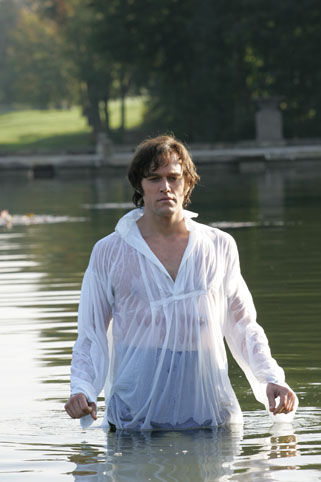
wet-shirt-scene-in-lost-in-austenI suppose the wet shirt scene in which Darcy heeding Amanda’s request to dip into the pool is meant to be the most notable moment, or maybe even the climax, of the whole production. This scene just confirms my view that Lost In Austen is more a parody on Pride and Prejudice adaptations, rather than the novel of Jane Austen’s. There never is a wet shirt scene in the book. The parody could well be on Andrew Davis’ imaginary take on wooing modern female viewers, or a satire on the cult following of Colin Firth’s role as Darcy since the 1995 BBC production.

The scene also offers another Firth moment when Amanda asks Darcy whether he loves her because of her change from the spikey and vulgar modern female to the simpering klutz trying to fit into the Regency mold. Well, truth be told, Darcy finds her character, both before and after, equally disagreeable, but he still loves her with all his heart. Isn’t that the Mark Darcy line to Bridget Jones, “I like you very much, just as you are.”

Anyway, there really isn’t much else to be excited about in this episode. The director seems to be indecisive as to where he wants to take us, and in what form. The lively and fresh beginning of Episode 1 has subsided and the production has turned into another TV drama, one that has taken itself a little too seriously.

So now, another week, another episode…oh, the ennui and the ambivalence.

Yet, I shall conquer this, I shall.

Episode 1

Episode 2

Episode 4

Flight of the Red Balloon (2007, France, DVD)

flight-of-the-red-balloon

In celebration of its 20th anniversary, the Musée d’Orsay in Paris has commissioned four notable directors to create a series of commemorative films. One of them is Olivier Assayas with his Summer Hours (l’Heure d’été) which I have reviewed.  Another is the highly acclaimed Taiwanese auteur Hou Hsiao-hsien. Flight of the Red Balloon is a unique piece of film art gently crafted by Hou in homage to Albert Lamorisee’s Oscar winning short Le Ballon Rouge (1956). Hou has long been garnering awards in international film festivals throughout Europe and Asia since the 1980’s, albeit relatively unknown in North America. Flight of the Red Balloon is his first French language film.

The little boy in this 2007 rendition is Simon (Simon Iteanu), a child growing up in the hustle and bustle of Paris. With an absentee father somewhere in Montreal pursuing his writing, and a frantically busy mother Suzanne (Juliette Binoche), Simon is alone in an adult world. Overloaded with her work as a voice-over artist in a puppet production plus other personal matters, Suzanne hires Song (Fang Song), a film student from Beijing, to look after Simon for her.

Suzanne is the embodiment of urban frenzy. As a single mother, she has to shuttle between home and work, deal with the eviction of a bad tenant in her lower apartment, confront her non-committal husband on the phone to Montreal, and connect with her daughter in Brussel, all in a day’s work. Simon is most perplexed.  “Why are you so busy, Mama?”, he asks.

song-and-simon

Song, on the other hand, offers the tranquility that is needed to balance life in the midst of chaos. As a film student, she uses her hand-held camera to record Simon’s activities, and by her quiet demeanor and calm observing, she reflects pleasure in the mundane, everyday trivialities called life. This is reality show without sensationalism.  Hou has ingeniously conveyed his perspective of realism with artistic overtone. No doubt, there is a lack of plot, suspense, or climax, but there is character contrasts, cinematic offerings in sights and sounds, and realistic, natural performance. Juliette Binoche has once again assured me why she is one of my favorite actresses. And no, you are not watching paint dry, you are watching life unplugged.

The red balloon forms the focal point of Hou’s signature long take. The almost God-like omnipresence hovering over buildings in the Paris skyline is a joyful symbol of childhood. Its silent drifting is as elusive as the fleeting memories of happiness. Even little Simon achingly remembers the pleasant days he had shared with his much older sister, who is now living in Brussel. We are all trying to catch and hold on to fond memories and meaningful relationships. Yet as the busyness of urban living numb our senses, we ignore and shove away what we think is a hindrance to our time, just like the people rushing out of the subway station, shoving away the red balloon. Only a child would try to catch and befriend it.

Complementing the cinematic artistry is the equally mesmerizing piano music, meditative, serene and restoring, setting the mood and the preamble of the film.  Other musical numbers are equally soulful. Click here for the official IFC site where you can have a taste of the sights and sounds of the film.

felix-vallotton-le-ballon-1899I particularly enjoy the ending. As Simon goes on a school trip to the art gallery of the Musée d’Orsay, the children gather on the floor to talk about Félix Vallotton’s 1899 painting Le Ballon, he leans back, slightly removes himself from his school mates, and lays on his back. As he looks up to the glass canopy of the museum ceiling, he sees it again, the red balloon, watching over him, removed yet engaged, far away, yet ever so near.

~ ~ ~ Ripples


Lost in Austen: Episode 2 (2008, TV)

For all of us Canadian viewers, who have patiently and faithfully waited VIVA to show us one episode at a time of Lost In Austen two months after its premiere in the UK, we have been short-changed last night! I knew Amanda Price would have to face some musical challenge in this episode. But I purposely did not try to find out what it is by reading others’ reviews. I want to see it first hand. But I was not given that opportunity. Why would VIVA cut out the most hilarious part of this second installment?

For those who don’t know what they have missed last night, here is the clip from YouTube:

Darcy’s “All ladies can sing.” is such a funny parallel to his statement in P & P: “Every savage can dance.”

I’m afraid though, the above may well be the few funny parts in this episode. And with VIVA cutting it out, we’re left with not much commotion. I admit that my earlier excitement from last week has died down. Without the Petula-Clark-inspired parody, this episode seems to have lost some of the initial lustre. There are still funny moments, and humorous lines, but the overall appeal seems to have waned.

I hope I’m not experiencing another version of lost in Austen. I find in this episode the screenwriter has taken us as far away as possible from the original P & P story just for the sake of gratuitous divergence. I was looking froward to seeing more of the LOL parody it has set up in Episode 1, more wild rides from the free-wheeling imaginary scenario. I was a bit disappointed to see its freshness replaced by banality. The slapstick humor makes me wonder what’s left in the bag of creative antics.

One more thing: I was most perplexed as to why the dress with the lowest neckline was being worn by none other than Mrs. Bennet, the mother of five daughters. Lady de Bourg would definitely have exclaimed: “Is she still out?”

However, all is not lost. I’m still eager to see how Amanda can right the wrongs and get out of the mess from her intrusion into the Bennet family. And if nothing else, this episode has at least achieved in making me love the original even more, not just JA’s ingenious creation, but the 1995 BBC production as well, yes, even Mr. Collins there. Further, last night’s episode just confirmed my view that nobody can do Darcy better than Colin Firth.

Episode 1

Episode 3

Episode 4

Two Guys Read Jane Austen: Again, the Gender Issue

two-guys-read-jane-austen 

Some guys would rather have jaw surgery than to read JA.  Steve Chandler could well have been one of them.  As an English major in college, now a successful writer in his sixties, Steve has miraculously managed to avoid reading JA all his life, until now.  On the other hand, his co-author Terrence N. Hill, an award-winning playwright and author, has read Pride and Prejudice three times, good man.  Prompted by their wives, Steve and Terry embarked on this new project in their “Two Guys” series, taking the risk of treading no man’s land.  However, considering their previous “Two Guys” titles, Two Guys Read Moby Dick and Two Guys Read the Obituaries, they are well-primed for this venture.

Thanks to blog reader Julie for sending me a copy of this book,  I’ve been thoroughly entertained.  Attaining to true Austenesque style, the two lifelong friends read two JA novels and wrote letters to each other about their thoughts over a six-month period. I must admit I’m surprised (sorry guys) at the incisive look and the fresh perspective they bring to the forefront.  Their sharp observations, humorous takes on many issues, their LOL commentaries on popular culture, and intelligent analysis on various topics make this a most gratifying read for both men and women, Janeites or would be’s.

Many do not want to read JA because they think she was just a 19th Century rural spinster awashed in naiveté, who had never heard of Napoleon or the war he was raging, ignorant about the slave trade from which England was benefiting, or couldn’t tell the difference between a country and a continent.  The most they might think of her is the mother of all modern day chick lit or the romance novel.  Well, these myths are all dispelled by two guys that have experienced Jane Austen first-hand, and lived to tell their discovery.

Here are some of their insights and words of wisdom as they read Pride and Prejudice and Mansfield Park.  I’m quoting directly from their letters to each other:

  • Jane’s got more adoring female fans than Brad Pitt, and my guess is they’re more intelligent too.
  • JA (through Elizabeth) is a witty, rebellious voice for intelligence and passion in the face of those stuffy British strictures.  I love this.  I love a woman (or a man, for that matter) who has no need to win anyone over.
  • Wasn’t Elizabeth Bennet heroic because she was such a totally self-responsible, proudly independent person?  Wasn’t Darcy the same?
  • I really enjoy how much you like Jane Austen, that you cry when reading her books, and that you can still be a man… A man not afraid of the feminine principle becomes even more of a man.
  • …elegantly cerebral.  But once you acclimate yourself to the flow of the language, it is addictive.  JA’s writing becomes more captivating with each new chapter because of how many layers of psychological posturing she strips away.
  • Men are often accused of putting their wives on a pedestal. Women build a pedestal and then spend their time trying to create something worthy of going on it.
  • I don’t think Austen ever gets proper credit for her role in the development of the comic novel.
  • Jane never attended school after the age of 11.  After that she was entirely self-taught…  S&S, P&P, NA, three of the greatest novels of all time–all written by 25.  Thinking of myself at that age.  If I had had time on my hands I could well imagine having written three novels… What I can’t imagine is that they would have been any good.  Ah, but then I had the disadvantage of an education.
  • The true measure of her characters is their hearts and minds.  What the movies cannot get to – or do justice to – is the intelligence.
  • What has excited Henry Crawford the most is Fanny’s inner strength.  On the surface she is delicate and demure.  But underneath she is power itself.  That’s what makes JA so great and so endearing.
  • Jane is all about principle.  Living true to your highest ideals, your highest self… she shows us there is a beauty to morality… there’s beauty in integrity!

Need I say more?

Two Guys Read Jane Austen by Steve Chandler and Terrence N. Hill, Robert D. Reed Publishers, Bandon OR.  2008, 126 pages.

*****

This article has been published in the Jane Austen Centre Online Magazine, where you can read more about Jane and the Regency Period.

Lost in Austen: Episode 1 (TV, 2008)

lost-in-austen

What a delight it was for me to catch the Canadian premiere of Lost in Austen on the new VIVA channel last night, two months after its UK debut on ITV. No, I had not anticipated it with much eagerness, I admit, nor had I held any expectations before I watched it. But, what a pleasant surprise.

I was somewhat skeptical about another time-travel movie and yet another take on Pride and Prejudice. It seems we are doing Jane Austen a disservice to have so many different “versions” of her ingenious work, turning P & P into a modern day literary cliché. How many more original antics can screen writers squeeze out after all the adaptations and fan fiction spin-offs in recent decades? But this one is fresh and original. It is laugh-out-loud funny, entertaining, with intelligent dialogues and a new perspective. I’m afraid to say too, that there are moments with SNL type of parody on the story and its characters, especially Colin Firth’s role as Mr. Darcy.

But it’s all harmless fun. “No offense taken.” I’m sure Jane, with her sense of humor and satire, would have responded, or Colin, for that matter.

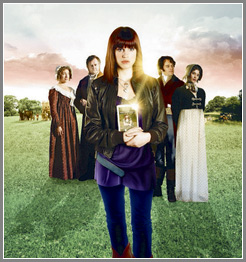
lost-in-austen-amanda-priceAmanda Price (Jemima Rooper, The Black Dahlia, 2006), a modern day working female living in Hammersmith, London, is a JA addict. Reading Pride and Prejudice has become her escape from her lacklustre life. She reminds me of Renée Zellweger’s Bridget Jones, although Amanda here manages to keep her weight under control and has a boyfriend that gets drunk on beer and proposes to her with a beer bottle tag as a wedding ring. So, it is a real fantasy for her to find Elizabeth Bennet (Gemma Arterton, Quantum of Solace, 2008 ) in her bathroom, showing her a portal that leads straight to the Bennet house. But understandably, Amanda is a bewildered and reluctant time-traveler, at least at this point.

The freshness of the story comes from all the twists that do not follow Jane Austen’s story. As with my usual reviews, I don’t like to give out spoilers. But I have to say, the key to these ingenious renderings is that Amanda Price swaps places with Elizabeth Bennet. With Lizzy out of the picture in P & P, the rest of the story is up to the screen writer Guy Andrews’ and director Dan Zeff’s own imagination.

In this first episode, most of the major characters are introduced. All of them deliver a lively performance, although I’m particularly fond of Amanda and Mr. Bingley (Tom Mison). The music reminds me of the 1995 BBC production, energetic and swift. In turn, the pacing is quick and effective. My main criticism though, is the set design of the interior of the Bennet house. It looks more like a modern day rather than an early 19th Century setting, quite incompatible with the exterior of the house.

Right from the start, I have resolved to not take this TV production too seriously, but just immerse myself in the wild and fanciful ride it freely takes me. After all, Jane herself had excelled in this very act, transporting us to meet all sorts of characters and situations through the imaginary worlds of her novels. I’m sure she would have a good laugh too tonight if she were watching with me… now that would be a fantasy indeed.

Just Click to read my review of the other episodes:

Episode 2

Episode 3

Episode 4

*****


Rewards and Awards of Blogging

Why do we blog? WordPress seems to have grasped the psyche of bloggers in five words: “Express yourself. Start a blog.” If being free to self-expression is the intrinsic reward of blogging, then being heard and read is the extrinsic reward. And, to top it all off, getting unexpected awards for what one already enjoyed doing is the icing on the cake.  A few months ago Arti had the first taste when she received the Excellent Blog Award.  This past week Arti has tasted more icing from fellow bloggers in the form of two awards.  In chronological order, they are:

The Premio Dardos from Ms. Place (Vic) of Jane Austen’s World. Thank you Vic for naming Arti as one of your 15 recipients of this award “that is given for recognition of cultural, ethical, literary, and personal values transmitted in the form of creative and original writing”. Thanks Vic for the honor and for the translation from Portuguese:“O conceito deste prémio passa por reconhecer valores culturais, éticos, literários e pessoais, transmitidos de forma criativa e original nos pedacinhos rabiscados por cada blogueiro que o receba.”

To meet the requirement, in turn, I am naming the following blogs to receive the same award.   To avoid duplication and to make it more meaningful, I have selected 10 instead of the 15 suggested.  Here are their excellent sites in alphabetical order:

  1. Austen Quotes is the blog of Lori Smith, writer of the book A Walk with Jane Austen, her personal experience of treading the paths of Jane’s in England.  She has inspired me with quotes from the works and letters of JA, some witty, some wise, some poignant, and all of them delightful.  Lori may have taken a hiatus due to physical ailment, but what she already has chronicled in her site is worth reading time and time again.
  2. Austenprose is a wealth of JA information and forum. Laurel Ann offers Janeites with a wealth of Regency knowledge, book discussion, interviews… a delight to visit every time.  This is one of the first blogs that got me hooked on JA…, no I wasn’t born a Janeite.  I only discovered this wonderful world a few years back.  And it’s blogs like this that feed me to my fill.
  3. Blogging for a Good Book is created by the staff of Williamsburg Regional Library.  In there you’ll find in-depth and insightful book reviews.  With several contributors, the blog offers a new post almost every day, keeping us up-to-date with newer titles. The quality writing and informative entries are enjoyable to read.
  4. Film Think is a site where films, theology, and criticism meet.  Writer M. Leary offers a wealth of resources and knowledgeable discussions and critique for those interested in the intellectual pursuit of the art of film, and its interaction with Christianity, criticism theory, other art forms, and their relevance in society today.
  5. Itinerant Idealist is Sarah’s journal  “in search of a soul awake”.  I’ve enjoyed her excellent writing.  In her casual way, Sarah embeds her prose and poems with style and spiritual insights.  Hers is one of the long time blogs I’ve been reading since the beginning of my own blog.  I’ve learned and gained much from reading her posts.
  6. Looking for Life’s Humor looks at life and brings out the joyous perspective.  As a mom with an autistic child, the writer of this blog depicts the humor and love that we often miss in many of life’s circumstances.  A heart-warming and delightful read in every post.  A truly enjoyable break in the midst of daily chores and chaos.
  7. Of Books and Bicycles As a book lover and an avid cyclist, Dorothy has successfully created a concoction of writings involving both…well maybe more about books.  Informative reviews and personal book experiences can be found here, while she has another site dedicated more to bikes and her training as a cyclist.
  8. So Many Books Stefanie chronicles “the agony and ecstasy of a reading life” with detailed research and insightful commentaries.  This is a literature lover’s blog.  Just the Blogroll is impressive enough, for there are probably hundreds of lit blogs on her list to provide almost unlimited avenues for blogging and reading pleasure.
  9. The Happy Wonderer It’s a joy every time I visit Ellen’s blog.  As a happy wonderer, Ellen wanders in the fields of photography, food, life, family, and the Bible, offering us musings, pictures, and inspiration, a celebration of life every day. This is one of the earliest blogs I found when I first started blogging, and I’ve been reading her since.  “To honor and encourage”, that is exactly so.
  10. The Task At Hand What Linda Leinen has created here in her relatively new blog is nothing short of a compilation of model writing.  Every single post is an example of style and inspiration.  At this point of her life she is a boat varnisher along the Texas Gulf Coast (how cool is that!), and she writes what she lives.  In her blog, she has woven artfully a tapestry of penetrative observations and skillful, affective writing.  I have gained and learned much from reading her every single post.

*****

The other award I received just a couple of days ago is the Arte y Pico given by Linda of The Task at Hand. Directly translated from Spanish means “Art and Peak”, at the peak of its art. Linda has included Arti’s Ripple Effects for its “creativity, design, content and contribution to the blogging community, regardless of language”.  Thank you Linda, I’m greatly humbled by such an honor.

To fulfill the requirement of the Arte y Pico, I’m naming 5 other blogs to be recipients in turn.  Noting that it’s Spanish in origin, and the phrase “regardless of language”, I attempt to highlight some of the ones I visit that have a different geographical or cultural flavour, although I admit they are all in English.

  1. Blogging in Paris As a 64 years-old cancer survivor, Claude’s attempt at blogging is in itself inspiring.  She writes from Paris, and from her many travels in Europe, affecting us with her zest for life and eye for beauty.  It’s a mixed bag in her blog, some photography, some journal writing, some personal musings.  A delight to visit.
  2. Moderato brings a European perspective to the discussions of art, books, music, films, and literature.  The writer offers in-depth and well researched commentaries on the subjects.  A very fine and intellectual lit blog.  Some great You-tube clips to augment the enjoyment.
  3. The Errant AEsthete From New York, “Essentials for the Cocktail Swilling Savant”, ok, it may sound a bit exclusive, but the art, photography and visuals presented in the blog are stunning and often thought-provoking.  And since it’s located in the ever widening blogosphere, anyone can visit and better yet, no dress code.
  4. Hidden Art A blog for the arts and crafters among us. The name says it all… art can be found and creativity unleashed in almost every homely place.  I’ve enjoyed the casual atmosphere and the stimulating ideas for mixed media and paper arts that are achievable by those who, like myself, are not art school graduates.  Accessible art speaks a universal language.
  5. Edible Landscape This is a unique blog on food written by a young guy from Hong Kong, an interesting diversion from the blogs on food and cooking we see from North America.  Wilson concocts an international flavour with his fine, quality writing on food and restaurants.  What more, where do you ever read a 20-something young man writing about cooking and cuisine art with such expertise?

Wow, that’s a mouthful!  Why do we blog?  The above are some of the obvious answers.