Soliloquy of a Book Hoarder

To read, or not to read, that is not the question:
Whether ’tis nobler in the mind to suffer
slings and arrows of outrageous fortune,
or to take arms against a shelf of troubles,
and by reading end them.

Before January is completely gone, I must make a resolution for this year. With all the good fortune, yes, books I’ve hoarded over the years at outrageously low prices, like slings and arrows raining down from shelves, many more shooting out from boxes… I must conquer them.

No excuse, but… loots hauled back from the annual Crossroad Market book sale is the Trojan horse of latent guilt. Why, wouldn’t you have fallen into the trap too, 15 books for $30? All in mint condition, some look like they’ve never been opened.

Upon reading two bloggers, Grad and Terri B, resolving to do similar courageous acts, I must start doing something to end the onslaught. I thereby resolve that in 2013 I’ll read from my TBR piles  only  , ok, mostly. Actually, the Bonheoffer and the Proust read-alongs are within this strategic move.

Here are some of the slings and arrows of my good fortune. Any of these in your TBR piles too? Read-along?

**

Margaret Atwood: The Handmaid’s Tale

Anne Bronte: The Tenant of Wildfell Hall

A. S. Byatt: Possession

Kate Chopin: The Awakening

Kiran Desai: The Inheritance of Loss

Junot Diaz: The Brief Wondrous Life of Oscar Wao

Jonathan Frantzen: The Corrections, Freedom

Shilpi Somaya Gowda: Secret Daughter

Henry James: The Ambassadors

Nicole Krauss: The History of Love

Ian MacEwan: Enduring Love, Saturday, Amsterdam

Herman Melville: Moby Dick (Will be reading in August with TerriB)

Hilary Mantel: Wolf Hall

Claire Messud: The Emperor’s Children

Toni Morrison: Love

Irène Némirovsky: Suite Française

Marilynne Robinson: Home, Housekeeping

Arundhati Roy: The God of Small Things

Salman Rushdie: The Enchantress of Florence

John Steinbeck: East of Eden

Zadie Smith: White Teeth

Jane Urquhart: The Underpainter

Winifred Watson: Miss Pettigrew Lives for a Day

Edith Wharton: The Age of Innocence

 **

Non-fiction:

Julia Briggs: Virginia Woolf, An Inner Life

Joseph Campbell: The Hero With A Thousand Faces

Mary Karr: Lit

Marilynne Robinson: Absence of Mind

**

Saturday Snapshot Jan. 26: Winter Birding

The sun and the birds are the main reasons for going into the woods in January. These are common birds for us, but catching a good photo of them is always a challenge. That’s when the common becomes a joy.

The Northern Flicker, I know where they hang out. And they’re not too hard to photo when perching or pecking.

Northern Flicker pecking

But what I’ve been aiming for is when they fly, I can shoot from below, for the orange underwing is beautiful. I’ve spent frustrating hours wading and standing in deep snow just to wait for such a moment. Here’s a semi-successful one.

Northern FlickerThis is my first photo of a Common Redpoll. Look at her demure pose.

Redpoll

This Red-Breasted Nuthatch is easy. She comes near me as if to greet a friend:

Red-Breasted Nuthatch

And for all ye squirrel lovers, here’s another one, too oblivious to be bothered by me taking pictures of her (him?) having breakfast. Look at the open mouth:

Squirrel at breakfast

***

Saturday Snapshot is hosted by Alyce of At Home With Books. CLICK HERE to see what others have posted.

***

Downton Abbey Season 3: Episodes 2 & 3

Posts like this should go without saying: Spoilers Alert!

After a shaky start in E1, slowly picks up in E2, Downton Abbey is back on track and full steam ahead in E3. What a relief! I want to see it go on and on, season after season. But I would not wish to see it just ride on its popularity. I want the Downton feel back, that appeal which first captivated me from Seasons 1 and 2. I can feel it again in last night’s E3.

Previously in E2, the main event is the Runaway Groom: Sir Anthony Strallan gets cold feet and jilts Edith at the altar. Dramatic? Yes. Contrived? No. It takes courage for him to run away like that. Of course, he should have done that long ago and not wait till everyone is all dressed up. But I know, he isn’t sure before. I give him credits though for stopping the new career of Edith right there at the altar. And he needs to get out of there quick, before he changes his mind again.

I trust Sir Anthony is altruistic, thinking only of Edith. It’s not right for her to give up her life for an old man even though she sees him as her life work. Violet Crawley is quick to step in, contradicting Robert, with the three words that show who is still in charge: “Let him go.” With this dramatic scene, all else in E2 seems to fade by comparison.

The fancy wedding cuisine goes to the servants downstairs, and to the poor. But if they don’t want it, Violet Crawley wants them doggie bagged.

Gourmet wedding cuisine for downstairs

And oh yes, a letter suddenly appears, from Lavinia’s dead father, its content releases Matthew of his guilt for inheriting the large sum. So he is now free to chip in to save Downton Abbey from appearing on the real estate page in the paper. Does this deus ex machina device qualify the show as melodrama, or just sloppy screenwriting? Oh, who cares, the Crawleys don’t have to move, and that’s what’s important. A big hassle, downsizing. You can ask the Dashwoods of Sense and Sensibility, no fun moving from a big mansion to a little cottage.

Good news for Mrs. Hughes, it’s benign something something, not cancer. The relief is equally shared by Mr. Carson. Good man, the news sends him back to his former showbiz days, singing his heart out. But the kind words from Cora Crawley should not go unchecked. I’m sure Mrs. Hughes will be forever grateful: “You will stay here, and we will look after you.” Even though not getting cancer is still better.

**

With that we move on to E3, that’s where the drama begins, and the plot thickens.

Watching E3, I’m captivated once again as in previous Seasons. There are witty LOL lines, mostly from Violet Crawley as always; there are some not so LOL lines that are equally well said by others.

First off, I’m glad that Edith is no Ms. Havisham. Life is too good to be bogged down, even when you’re being jilted at the altar. And, as her mother says, testing can only make you stronger. That turns her from a jilted bride to women’s suffrage advocate. Take that, Ms. Havisham. So Edith has shifted her life purpose from taking care of an old man donning an arm sling to writing letters to the editor.

But the main event here in E3 involves Tom Branson, the former Downton chauffer turned Downton son-in-law turned Irish revolutionary. Woa, what drama. He escapes from Dublin police and slips back into Downton, leaving Sybil to run for her life. Oh, it’s all planned. But still, herein lies the dilemma. He wants to go back to Dublin but he’ll be arrested as soon as he sets foot there. Sybil wants to give birth in Downton, peaceful and safe, two words that are not in her husband’s dictionary.

Some memorable lines come from Tom’s confrontation with his father-in-law Robert Crawley, patriarch of Downton, who seldom wears anything else other than a tux, choice of wardrobe being black or white ties, with clout in high places, albeit still a good man he is.

Robert:  What a harsh world you live in.

Tom: We all live in a harsh world, but at least I know I do.

Something Robert would not have understood.

Ethel saying goodbye

Ethel the former maid turned prostitute can surely understand. It is a harsh world she lives in, having to raise a child with little means. Of course it’s heart wrenching to have to give up her son, handing him back to his grandparents, out of her own choice this time, knowing the child will have the best opportunities with them; with her, he has no chance. She had fought to keep him, tried to raise him on her own, but it didn’t work. That’s what makes it sad. It is poignant to see her wave goodbye as the coach moves away, with Mrs. Hughes and Isobel Crawley standing behind her, supportive yet each holding a different opinion about her choice.

New footman Jimmy is the main attraction downstairs, a timed bomb I can tell. And Mrs. Patmore finally gets a new kitchen maid to lighten up Daisy’s work load. But with this new gal, I’m sure Daisy regrets having started labor grievances. Alfred wants to make the new kitchen maid feel at home in no time. Be careful what you wish for, Daisy, you just may get it, nemesis in disguise.

I haven’t mentioned Bates and Anna you may have noticed. I know, Bates legal team is working day and night on Twitter, and free John Bates signs in the real world. But for dramatic effects, and a change of scenery from the lofty and elegant Downton Abbey, we see Bates debased in a prison cell. Here’s another person to agree with Tom. It’s a harsh world outside Downton. But then as Cora Crawley has said, testing would only make you stronger. Bates and Anna are exemplary in living out this motto. That Julian fellow sure knows how to lead and tease. With Bates and Anna madly reading each other’s letters after weeks of non-communication, Episode 3 ends, leaving us wishing the week would just fly by.

***

Other Related Posts:

Downton Abbey Season 3, Episode 1

Season 3, Episodes 4 & 5

Season 3, Episodes 6 & 7 Finale

Quotable Quotes from Downton Abbey

Lady Almina and the Real Downton Abbey: Facts that Give Rise to Fiction

***

Saturday Snapshot January 19

Winter in snow country. Here are some photos I took while trying out my new camera, a Nikon D5100. No editing has been done here, not even cropping.

I admit these are the more successful ones. There are lots that I’m not satisfied, with capturing light and focusing. Still figuring out how to use it, especially for birds. If you’re familiar with this camera, do let me know what’s the best settings for flying objects, identified or not.

Fences

Sunset at 4

Black-capped Chickadee

Squirrel

Saturday Snapshot is hosted by Alyce of At Home With Books. CLICK HERE to see what others have posted.

***

Zero Dark Thirty and Argo

There are several reasons I link these two films together. Both are acclaimed productions which have already garnered awards. While both films have been nominated for Best Picture in the 2013 Academy Awards, both directors, Kathryn Bigelow and Ben Affleck have been snubbed in the Best Director category. The reason I do not want to speculate. But for one of them, I have a hunch.

These are very American films, depicting Americans in crisis and its aftermath. Argo is about getting Americans out of Iran during the 1979-80 hostage crisis in Tehran, Zero Dark Thirty (ZD30) about hunting and getting into Pakistan to take down Osama bin Laden. Both involve the intricate work of the CIA.

And, both have driven me to the edge of my seat, despite the fact that I know the ending of the event they portray. This is the power of visual storytelling. But for me, the similarities may well end here.

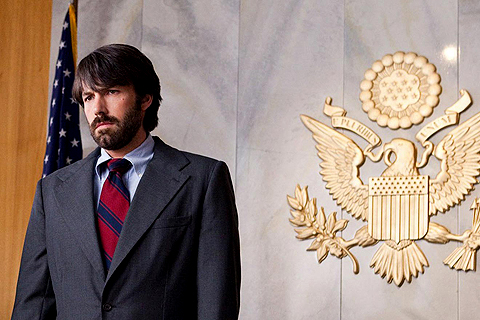
Ben Affleck

Argo rests on one man, Tony Mendez, a CIA officer who masterminded the rescue mission, information declassified only in recent years. Played by director Ben Affleck, Mendez is decorated with CIA’s Intelligence Star and received other accolades after that.

ZD30 rests on one woman, known only as Maya in the film. A young CIA officer who for ten years, dedicated her life to the searching for Osama bin Laden. She is relentless in her pursuit, fighting not only outward threats of physical dangers but bureaucracy within an alpha male work environment. Her identity remains hidden.

Jessica Chastain has once again shown how versatile an actor she is. I have seen her in some very different roles: The Debt, The Tree of Life, Take Shelter, The Help. Here in ZD30, she has convincingly portrayed a strong leading female character with finesse. Her performance not only carries the film but our emotion as well.

Jessica Chastain

And not only Maya, ZD30 has shown us there are other female CIA officers performing perilous duties. Her friend and colleague Jessica is one of them. Now, as I watched this Jessica on screen, I kept thinking she looked so familiar. Only when I watched the credits roll at the end did I find out, lo, that’s Jennifer Ehle, Elizabeth Bennet (Pride and Prejudice, 1995) or a bit closer, Myrtle Logue in The King’s Speech (2010).

Director Kathryn Bigelow has done an exceptional job in turning Mark Boal’s original screenplay into a tight and engrossing film. Both won Oscars for The Hurt Locker (2008), Bigelow being the first woman to win the Best Director award. At the beginning of the film, we are told it is based on firsthand accounts of actual events. Despite knowing the ending, I was still captivated every step of the way, following the intelligence gathering process, the narrowing down of leads and locations, the red tape. The film is an alchemy of facts and fiction, a creative fusion. But for the audience, there is no way to distinguish which is which.

That leads to the controversial issue, one that some in Washington and now the Academy have condemned, the issue of torture. And here’s my take. Isn’t it a bit simplistic to argue that since the film depicts scenes of torture of detainees to get leads and information, it means that the filmmakers condone or even promote torture?

While the U.S. Administration had denied using any torture tactics in the final capture of bin Laden does not mean the total absence of them over the ten year post 9/11 period, both known or later discovered. The photos from Abu Ghraib prison are still vivid in my mind. None of the scenes in the film can compare to those real life photos. Or, come to think of it, could Abu Ghraib have informed the screenwriting? This being not a documentary, but a dramatized fusion, can one separate facts and fiction so clearly?

Or take Argo, how much is true about the rescue mission? How much is dramatized? What proportion should we give credits to the mastermind Mendez and the CIA, and how much should we credit the Canadian ambassador Ken Taylor (Victor Garber) for hiding the six American embassy staff in his home at his own risk? The same kind of simplistic accusation ZD30 is getting could also apply here: Does the fact that they all escaped Iran using false identity mean the filmmakers, or the Canadian government for that matter, promote deception and the forging of Canadian passports?

Unlike Argo, the ending is not celebratory in ZD30. Things are not as clean cut as planned. The final mission of assassination is messy, a helicopter is down and has to be destroyed on site. There are collateral damages. But the target is hit, mission accomplished. Nevertheless, there is no applause or celebration. The tone is sombre, which I think is most apt. The final scene with Maya alone on the large transport plane leaving Pakistan is the epitome of ambivalence. Jessica Chastain leaves us with a poignant expression. Is it justice, national security, or rather, personal vendetta that has been accomplished? The last line delivered by the pilot echoed in my mind after I’d left the theatre, dazed… Where do we want to go from here?

Zero Dark Thirty ~~~~ Ripples

Argo ~~~1/2 Ripples

***

CLICK HERE to read Kathryn Bigelow’s article on L.A.Times addressing the controversy of torture in the film Zero Dark Thirty. 

Golden Globes, Jan. 13, 2013: Argo won Best Picture, Drama, and Ben Affleck Best Director. Jessica Chastain won Best Actress, Drama, for Zero Dark Thirty.

Related posts on Ripple Effects:

History Made At The Oscars

The Hurt Locker 

***

Downton Abbey Season 3: Episode 1

CLICK HERE to Season 3: Episodes 2 & 3

When the pre-show outshines the main feature, I’m beginning to have a little concern.

The episode “The Secrets of Highclere Castle” is a fantastic one-hour focus on the history and present day Highclere Castle, the setting of Downton’s Crawley mansion. The information is largely collected in the book written by Countess Fiona Carnarvon, Lady Almina and the Real Downton Abbey: The Lost Legacy of Highclere Castle. Read my review of the book here. And you can watch the whole one hour feature here.

Lady and Lord Carnarvon
Lady Fiona and Lord George Herbert Carnarvon

I have high praise for Downton Abbey S1 and S2. That’s why since last February, there have been quite a few ripples sent out from the pond here. Like numerous others, I’m following the countdown to S3, this cultural phenomenon of using Downton Abbey to measure the passing of a year. So it was with much anticipation that I watched S3 premiered in North America on PBS last night.

It begins shakily (metaphorically and literally… maybe some shots with a hand-held camera?) telling the recent development of how everyone is doing. So many stories, so little time. So what we get is a montage, vignettes by the seconds. That is fine too, but somehow, the people seem different now.

It takes a while for me to get into the act, to get back that captivating feel as in S1 and S2. Such moments are sparse and far between, I’m afraid to say. Ok… before you fans of Downton throw pebbles at me instead of into the pond, there are a few ‘movie moments’.

My favorite is when Robert reveals to Cora he has lost all her money in a failed railroad company (Canadian? Sorry). He sheds tears for the loss while she is so forgiving and loving. What a moving scene. Cora Crawley is now my favourite Downton character.

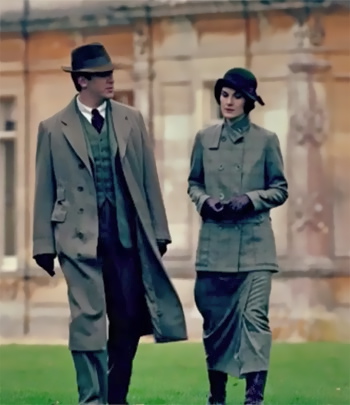
Matthew and Mary
Matthew and Mary

Another sweet moment gives me back the feeling of why I love DA in the first place, is the Matthew and Mary blind kiss the night before the wedding, a wedding that is almost called off. But here in S3 E1, it seems Mary has gone back to her old, old self where practical matters and Downton heritage surpasses love and honor. In this case, I’m all for Matthew, who is unwilling to take the large sum he inherits from Lavinia’s father. Again, here’s the guy with some backbone when it comes to moral dilemmas.

Shirley MaClaine as Martha Levinson
Grandmama from America

Shirley MacLaine as Martha Levinson, the Grandmama from America, is the highly anticipated new twist. And she doesn’t disappoint. We need someone to turn the table, tip the balance, add some spice of life to the stiff traditions of Downton, if that means setting a buffet table, guests choose their own food, be it cold cuts and what not, sit anywhere they like, and joining in an after dinner singing of ‘Let Me Call You Sweetheart’. Violet Crawley, take that.

The prison scenes with Bates and Anna are heartwarming, another reminder of why I love DA in the first place. Some nice shots. I particularly like the one he slowly limps down the long flight of stairs. While for justice’s sake he should be out of there. But for cinematic variety, I think Bates in prison offers a nice human touch of pathos, which again is why I like DA in the first place.

Other plot lines seem quite weak. Daisy goes on strike? She should first join a union. The too tall footman/valet Alfred’s troubles with Thomas, recycled from previous episodes of Bates’. And Mrs. Hughes, I feel so sorry for her. But Mrs. Patmore proves to be a solid and lively character. Edith has grown more beautiful while Sybil turns lacklustre.

I hope the rest of the episodes deliver what I’ve so highly anticipated. The 20’s is a stylish backdrop for a costume drama. They’re all dressed up, and I wish they have somewhere to go, and bring me there with them.

***

Other Related Posts:

Season 3: Episodes 2 & 3

Season 3: Episodes 4 & 5

Season 3: Episodes 6 & 7 Finale

Quotable Quotes from Downton Abbey

The Downton Ripples

Lady Almina and the Real Downton Abbey: Facts that give rise to Fiction

***

2013 Read-Along Begins: Bonhoeffer

Here we are already the third day into the new year. How fast time flies! To kick things off, here’s the first Read-Along. Allow me to just reiterate from my open invite on Dec. 12, 2012:

Bonhoeffer: Pastor, Martyr, Prophet, Spy by Eric Metaxas 

bonhoefer book cover

In the top ten of Barnes and Noble’s Best non-fiction books of 2010, and on New York Times Best-Seller list, this Dietrich Bonhoeffer biography intrigues me greatly. Author Metaxas’s title makes me want to know more about this legendary figure whose books I had read in my youth, but now think I don’t know him enough to fully appreciate his daring life, a man of faith and anti-Nazi in wartime Germany.

This slow reading plan gives you plenty of time so you can still pursue other books on your plate. I’ve roughly divided the biography in two parts, posting twice:

Chapters 1 – 18 (277 pages): to post on February 15

Chapters 19 – 31 (264 pages): to post on March 15

 **

With Arti, it’s always a slow read. You still have time now to order your book if you haven’t got it. And for others, dust it off the shelf. We’re reading the first part, Chapters 1 – 18 in Jan/Feb and posting our thoughts on these chapters on Feb. 15

Some of you may not be bloggers, you’re most welcome to join in the reading. Come to any of our posts on Feb. 15 and share your thoughts with us in the comment section. As I always say, the pond is open for all to throw in a pebble or two, make some ripples.

**

As of today, those who are joining in this read-along are:

Shoreacres of The Task At Hand (and cousin 🙂 )

Shari Green

Alison of Chino House

And those who have shown interest and still deciding, hope they will hop on soon:

nikkipolani

Jeanie of The Marmelade Gypsy

Hedda of Hedda’s Place

Ellen of The Happy Wonderer (reading already, hope she’ll join in the discussion)

If you’d like to read along with us, or join in any time later, just let me know in a comment and leave a link so I can add you on the list.

**

Before Feb. 15, you can always tweet me @Arti_Ripples or anyone of us who speaks in 140 characters.

Happy Reading!

***

COMING UP in March to May: Proust Read-Along

Top Ripples of 2012

The Ripple Rating System began when I started the blog Ripple Effects five years ago. I’ve been asked why I give three ripples so often, and how come there aren’t any one ripple. A look at how the rating works you’ll see why:

~ Ripple: Stay away, I did

~~ Ripples: Manage your time better

~~ 1/2 Ripples: Average, so-so

~~~ Ripples: Good, worth seeing

~~~1/2 Ripples: Superior, make time for it

~~~~ Ripples: Almost Perfect, must-see

You see, I’ve done the screening for you, just to save your time. But of course, the disclaimer here is, like Roger Ebert says, all reviews are subjective. But then too, here at the pond, ripples are the result of much thought.

**

In 2012, there are several movies I have given 3.5 or 4 Ripples. Two of them I have yet written a review. Here they are:

Life of Pi Book and Movie

Lincoln

Les Misérables

Birders: The Central Park Effect

Argo

Moonrise Kingdom

I’m still eagerly waiting for some to screen here, so I’ve yet to see them, like Zero Dark Thirty, Quartet.

**

There are reading experiences that I would give 4 Ripples, they are Read-Alongs:

Midnight’s Children by Salman Rushdie

Anna Karenina by Leo Tolstoy

A first for me, reading with others in a virtual reading group. Two brilliant books, some delightful camaraderie.

**

And then there are real life experiences that I’d gladly give 4 Ripples in my heart.

Bird Watching: See my photos on Saturday Snapshot Posts

Also my visit to:

The Salk Institute

The Grand Canyon

Rating with 4 Ripples is an understatement or maybe even an insult to the Creator of the Grand Canyon. But just an expression, I think He understands.

**

Thanks to WordPress, I receive a concise annual report on my blog. Top posts for 2012 are:

Memorable Movie Love Quotes (My Valentine post for 2008, Over 73,000 views since then). 2012 views: 15,237

The Glass Castle: Book Review (Since Aug. 2008, over 47,000 views). 2012: 8,334 views.

Quotable Quotes from Downton Abbey: Over 7,400 views since March, 2012

The Best Exotic Marigold Hotel: Now this is a surprise. Since I posted it in May this year, there have been over 6,200 views.

**

And now, my favorite, the Search Engine Terms, words people type in to come to Ripple Effects. These are some that not only bring a smile, but boost the spirit as well (I’ll leave them in their lower case as found in WordPress Stats):

heaven

grace in nature

oldest human frozen

colin firth chocolate

canada lost in austen

keep calm and act like kate middleton

e.m. forster can’t tell a good story

alien captured alive

studebaker truck girl

did red dog go to japan

the blogger arti  [Arti here: just love to know people actually Google about me!]

arti film life of pi

arti never let me go

the best exotic marigold hotel post modernism

nowhere

paleolithic hunting

does meryl streep have affairs

how many languages does colin firth have

yann martel lonely

joshua bell modest

why was ulysses poem chosen for skyfall

most memorable tv seduction quotes

anna karenina psychoanalysis

**

To everyone who has stopped by the pond and thrown in a pebble or two, thanks for the ripples. There are some new regular visitors and followers this year, I’m so glad to know you all. You’ve made me feel we’ve known each other for much longer. I’ve enjoyed our mutual visits. Thanks for the enrichment.

And to All

A Happy New Year!

***

Les Miserables (2012)

These last months of 2012 see a bumper crop of film adaptations from literary sources. We have an eclectic array from the minimalist rendition of Yann Martel’s Life of Pi, to this long awaited maximalist Les Misérables, adapted from Alain Boublil and Claude-Michel Schönberg’s 1980 stage musical based on Victor Hugo’s 1862 novel. From Ang Lee to Tom Hooper, we are gratified on both ends of the spectrum.

It is a shift too for Hooper, fresh from his much smaller scale, Oscar winning The King’s Speech (2010), to turn and adapt a successful stage musical into a huge cinematic production. Yes, maximalist could well be the word to describe Tom Hooper’s Les Misérables.

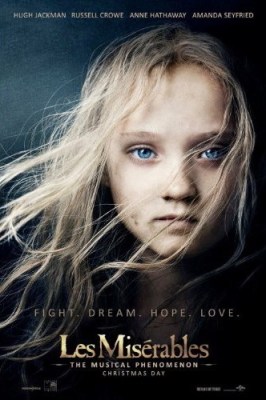
Les Miserables Movie Poster

I sat in a Cineplex theatre that offered Ultra AVX, Audio Visual Experience: wall to wall screen, big sound, huge images. Now of course, I would have seen it on a regular screen and with smaller head shots. For me, the AVX extravagance might even be a distraction. For as I watched the movie, it was in the small moments of torn sentiments, the minute scale of personal transformation, and the internal moral dilemmas so well acted out that I found Hugo a brilliant writer of the human soul. I don’t need big boom sound and maximized frames to sensitize me.

The epic scale is effective, and the cast is admirable in delivering a heartfelt performance. I can fully imagine the difficulty of casting, finding good film actors who can sing well. But overall, they are well chosen.

Hugh Jackman as Jean Valjean is impressive. No stranger to musicals, Jackman is a Tony Award winner himself, and here he is perfect for the role in every aspects, physiques, singing and acting. I’m glad to see he get a Golden Globe nomination for Best Actor (Comedy or Musical) in the coming Award Season.

Colm Wilkenson, a Broadway star dating back to Jesus Christ, Superstar and as Jean Valjean in the original musical of Les Miserables has a brief appearance as the Bishop, whose forgiveness of Valjean’s theft when he put him up for the night transforms the bitter soul of the hardened ex-con. His singing of course is impeccable.

Also glad to find out Eddie Redmayne can sing so well too. Like Jackman, he is a Tony Award winner, more recent and a much younger one. He plays Marius, among a group of young revolutionaries who set up the Barricade to defy the French militia. He is the young man who falls in love with Cosette (Amanda Seyfried) at first sight. Compared to his A Week With Marilyn, his performance here could well catapult him into more prominent roles in the future.

While many of the other main cast are not Broadway singers, their skills are laudable. Anne Hathaway singing ‘I Dreamed A Dream’ is probably one of the most successful trailers made. And here in the film, her affective appearance as Fantine only makes me wish she can stay a while longer. Good to see she gets a Golden Globe nomination for Best Supporting Actress (Comedy or Musical).

Anne Hathaway

Russell Crowe’s singing experience could have come mainly from his rock band, but his voice is fine here as Javert, the prison guard and later policeman on the trail looking for Valjean through the years. Yet it is not the singing, but the acting that I expected more. I know he is supposed to be cold and harsh, yet it is the internal fervor and depth that I find lacking. I think Geoffrey Rush is a more convincing Javert in the 1998 film adaptation… and I suppose he can sing too.

A marvellous duo that serve as a much needed comic relief is Sacha Baron Cohen’s Thénardier, ‘Master of the House’ and his Madame played by and Helena Bonham Carter. What a contrast with her role as Queen Elizabeth in The King’s Speech. The Thénardiers make one apt comic duo with their lively screen presence, great comic timing, and wonderful singing from both.

I must mention the two young actors. Daniel Huttlestone shines in his role as Gavroche, the boy at the Barricade. He has delivered a mature and poignant performance. I hope to see him appear in more films in the future.

The other is in the movie poster, an icon taken from the Musical. It is the image of little Cosette, here in the film movingly played by Isabelle Allen. The look-alike of the two images leads me to this thought:

I’m surprised to find the film adaptation follow the musical to the dot in terms of the song sequence. I think every one of them is performed, plus one more, ‘Suddenly’, written by Schönberg for the film. I was expecting a bit more creative cinematic treatment on screen. Further, the whole movie is connected by one song after another with almost no dialogues. For the film medium, editing could be better used here for pacing and avoiding redundancy. I feel the 157 minute production could be much tighter. With Schönberg directly involved in the adaptation, I’m sure he must have wanted every song preserved. Cutting the length must have been a delicate matter.

Overall, Hooper’s bold attempt to have the actors sing live instead of record the songs in a studio pays off. A first in recent decades, singing while they are acting creates and captures the emotions of the moment. With the title Les Misérables, we see a lot of heartfelt tears, and pathos of the human condition laid bare and raw. But Hugo’s universal theme also flows out as ready as the tears, that the power of forgiveness surpasses all wrongs, and grace triumphs over law. An apt offering for the Christmas season.

~ ~ ~ 1/2 Ripples

***

Reading the Season: Surprised by Joy

If Shakespeare and Hamlet could ever meet, it must be Shakespeare’s doing. Shakespeare could, in principle, make himself appear as Author within the play, and write a dialogue between Hamlet and himself. The ‘Shakespeare’ within the play would of course be at once Shakespeare and one of Shakespeare’s creatures. It would bear some analogy to Incarnation. — C. S. Lewis, Surprised by Joy (p. 227)

What an apt analogy for Christmas. surprised_by_joy_the_shape_of_my_early_life_frontcover_large_1thqlUR3XQVIcV2 Chronicle of Joy Surprised by Joy is C. S. Lewis’s (1898-1963) autobiographical account of his experience with Joy in his younger days, that elusive something of which he had a hard time grasping. Subtitled The Shape of my Early Life, it is an honest chronicle of an intellectual journey. As a young teenager going to the junior school of Wyvern, Lewis had shed the veneer of Christianity from home and declared himself an atheist. But his quest for Joy remained. It was to him an ‘inconsolable longing’ for ‘the real Desirable’. As a child, a form of Joy came to him through solitary reading, writing and drawing. In his youth, Joy channelled through Wagner’s Ring Cycle and Norse mythology, or Northernness. As he grew, he began to realize that pleasure did not equate with Joy, neither physical nor aesthetic, neither Nature nor Wagnerian music, neither books nor poetry, nor the intellectual gratification from reading, nor the excitement of Northernness.

You might as well offer a mutton chop to a man who is dying of thirst as offer sexual pleasure to the desire I am speaking of. .. Joy is not a substitue for sex; sex is very often a substitute for Joy. I sometimes wonder whether all pleasures are not substitutes for Joy. (p. 170)

Reading and Studying Surprised by Joy is Lewis’s chronicle of his encounters with books and countless authors. As a young boy he was first taught Latin by his mother, who sadly died of illness when he was only nine years old. He went through all forms of education, home, public, boarding school, and the most gratifying to him was after his father pulled him out of Wyvern and directed him to a private teacher in preparation for Oxford. While his father was uncertain about the move, Lewis secretly relished the idea and thrived in the experience. His teacher was Mr. Kirkpatrick, or ‘Bookman’. He was an atheist, a rationalist, a logician. He had acutely sharpened Lewis’s critical thinking with logic and Dialectics, and well prepared him to enter Oxford. He assigned to Lewis readings from classical literature: Homer, Demosthenes, Cicero, Lucretius, Catullus, Tacitus, Herodotus, Virgil, Euripides, Sophocles, and Aeschylus. On his own, Lewis immersed in Norse myths and the Wagner’s Ring Cycle. His reading expanded to Goethe and Voltaire. It was only later upon a friend Arthur’s influence that he began to devour literature in the English language. “I read … all the best Waverleys, all the Brontes, and all the Jane Austens.” There were of course others, Donne, Milton, Spenser, Malory, Thomas Browne, George Herbert, the Romantics, Yeats, William Morris, G. K. Chesterton, and George MacDonald.

I was by now a sufficiently experienced reader to distinguish liking from agreement. I did not need to accept what Chesterton said in order to enjoy it. (P. 190)

Yet he could not help but began to revise some of his world views. Yeats, Maeterlinck, and ultimately, George MacDonald informed him of alternative glimpses other than the material world. Unde hoc mihi I admit I had to look this Latin phrase up. And this I found: Unde hoc mihi … translated as “And whence is this to me” (KJV), or “And why is this granted to me” (ESV) A phrase that moved me so. As I was reading, two-third into his autobiography these words leapt out:

Unde hoc mihi? In the depth of my disgraces, in the then invincible ignorance of my intellect, all this was given me without asking, even without consent. (p. 181)

Lewis describes the epiphany, utterly inexplicable, the moment which came to him when all things seemed so clear, and the presence of something not mythical or magical which he had craved in his mind, but ‘Holiness’. It was then that his Atheism was transformed into Theism (In a moment of divine enlightenment not unlike Levin’s conversion at the end of Anna Karenina.) This humble exclamation unde hoc mihi is used by Lewis as he alludes to Luke 1:43 when Mary, pregnant with the Christ Child, went to see her cousin Elizabeth, who also by miraculous means in her barren state, pregnant with John, the forerunner before Christ. Upon hearing Mary’s salutation to her, Elizabeth felt the babe leap in her womb, and she exclaimed: “And why is this granted to me that the mother of my Lord should come to me?” Why, a learned scholar, specialist of the Classics, logical thinker skilled in Dialectics, claimed no credits of his own in this enlightenment. But it is only the beginning, he had not met the Person yet. Further, he realized that whatever that had given him Joy before, like Nature,

that those mountains and gardens had never been what I wanted but only symbols which professed themselves to be no more, and that every effort to treat them as the real Desirable soon honestly proved itself to be a failure. (p. 204)

As he began to teach at Oxford, Lewis was surprised to find two fellow professors he respected were, alas, Christians. One of them was J. R. R. Tolkien. But Lewis was an unlikely candidate for Christianity, with his ‘deep-seated hatred of authority, monstrous individualism, lawlessness’ and his abhorrence of a ‘transcendental Interferer’ (p. 172). Yet that unquenchable longing for Joy was ever present. Friendship with Tolkien began to break down some long held biases. He admitted that “I was by now too experienced in literary criticism to regard the Gospels as myths… To accept the Incarnation was a further step… It brings God nearer, or near in a new way.” It was another year before Lewis finally “gave in and admitted that God was God… Perhaps the most reluctant convert in all England.” Ironically, as he humbly exclaimed unde hoc mihi, ‘why is this granted to me’, he was submitting to ‘Divine humility’, the Incarnation. Hamlet finally met his Author. And what of Joy? I can’t give out too many spoilers, can I?

**

I read Surprised By Joy along with Bellezza. Do click here to read her thoughts on the book.

Surprised by Joy: The Shape of my Early Life by C. S. Lewis, Harcourt Publishing, Orlando, Florida, 1955, 238 pages. This is the edition I read with the image posted.

**

Reading the Season Posts in Previous Years:

2020: Jack by Marilynne Robinson

2019: ‘A Hidden Life’ by Terrence Malick: a film for the Season

2018: Madeleine L’Engle’s Poem The Irrational Season

2017: A Wrinkle In Time by Madeleine L’Engle

2016:  Silence by Shusaku Endo

2015: The Book of Ruth

2014: Lila by Marilynne Robinson

2013: Poetry by Madeleine L’Engle

2012: Surprised by Joy by C. S. Lewis

2011: Walking on Water by Madeleine L’Engle

2010: A Widening Light, Luci Shaw

2009: The Irrational Season by Madeleine L’Engle 

2008: The Bible and the New York Times by Fleming Rutledge

2008: A Grief Observed by C. S. Lewis

***

Saturday Snapshot Dec. 15

Some more photos I took a few weeks ago. This time, shorebirds. Before the birding course, all birds on water were the same to me. Now I can tell the difference between some of them. And oh… they can fly too other than swim. I’m learning everyday, weather permitting.

Common Goldeneye, male:

Male Golden Eye

Common Goldeneye, female:

Common Goldeneye, female

Male and female Mallard, first time I noticed the beautiful metallic blue on the male wing:

Male & Female Mallard

Canada Geese by the snowy shore:

Canada GeeseTaking flight:

Taking Flight

This one so close, it’s like I’m flying with them, no cropping has been done:

Flying

***

Thanks to Alyce of At Home With Books for hosting Saturday Snapshot.

Read-Along 2013: Bonhoeffer and Proust

CLICK HERE to Bonhoeffer Read-Along Part 2 Wrap-Up: Ch. 19 – 31

CLICK HERE to Bonhoeffer Read-Along Part 1: Ch. 1 – 18

CLICK HERE for an updated post “2013 Read-Along Begins: Bonhoeffer”

Just because they’ve been on the shelf staring at me for too long. And I’d love some company when I tackle them.

My experience of Read-Alongs started serendipitously this year upon the suggestion of another blogger. Thus began the four months journey of Midnight’s Children. Finding the experience so rewarding, I later held another one, Anna Kareninajust in time to coincide with the film.

So anyone who has come along with me know I like to take things slow. If I can finish a long book, anyone can. So here we are, hope you will join me in the winter months of 2013:

Bonhoeffer: Pastor, Martyr, Prophet, Spy by Eric Metaxas 

Bonhoeffer Pastor Martyr Prophet Spy-Eric Metaxas

In the top ten of Barnes and Noble’s Best non-fiction books of 2010, and on New York Times Best-Seller list, this Dietrich Bonhoeffer biography intrigues me greatly. Author Metaxas’s title makes me want to know more about this legendary figure whose books I had read in my youth, but now think I haven’t known him enough to fully appreciate his daring life, a man of faith and anti-Nazi in wartime Germany.

This slow reading plan allows you plenty of time to pursue your own reading and blogging. I’ve roughly divided it in two parts, posting twice:

Chapters 1 – 18 (277 pages): to post on February 15

Chapters 19 – 31 (264 pages): to post on March 15

**

And come Spring, I’d like to step into the world of Proust.

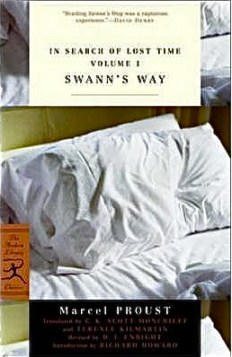
In Search of Lost Time Vol. 1, Swann’s Way by Marcel Proust

My curiosity of Proust has long been latent. The movie Little Miss Sunshine is the trigger. Remember Steve Carell’s character Frank, the Proust scholar in the movie? He just got out of the hospital recovering from a failed suicide attempt… uh… Yeah, that’s when I told myself, umm… one of these days I must read some Proust.

So here I am, again attracted first by the appealing book cover from my favorite publisher: Modern Library.

In Search of Lost Time Vol

I understand Lydia Davis has a newer translation of Swann’s Way. You can chose whatever translation you prefer. It may be good to compare notes on the different versions too.

Again, we’ll post twice. According to the parts in the book:

Part One, Combray (264 pages): to post April 15

Part Two, Swann In Love (278 pages) & Part Three, Places Names, The Name (61 pages): to post May 15

**

So these are my Read-Along plans for 2013. Sure hope you can join me on either or both of them. Just leave me with a comment and a link to your blog below. If you’re not a blogger, you can read along too. As we post, you can stop by and share your thoughts in the comment section. As I like to say, stop by the pond and throw in a pebble or two, make some ripples.

On Ripple Effects, the Read-Along bandwagon is a slow ride, but just as convivial. Hope to see you hop on!

***