12 Years A Slave (2013): Beauty and Sadness

UPDATE Feb. 16: 12 Years A Slave just won BAFTA 2014 Best Film and Chiwetel Ejiofor, Best Actor. 

UPDATE: 12 Years A Slave is nominated for 9 Academy Awards including Best Picture, Best Director, Best Actor, Best Supporting Actor, Best Supporting Actress, Best Adapted Screenplay, Best Costume Design, Best Production Design, Best Film Editing.

Movies this season seem to come in pairs in terms of subject matter, which makes interesting viewing. Gravity and All Is Lost is a pair. Lee Daniel’s The Butler and 12 Years A Slave another. I watched them purposely back to back.

12 Years A Slave is powerful in many ways, most readily is the aesthetics and styling, both visual and audio. Before he turned to directing, Steve McQueen was a visual artist trained in fine art in London and New York, and it shows. His cinematic work is a testament to the fact that film is a mixed-media art form. More importantly, it shows that film art does not have to be esoteric, or be appreciated only by an ‘artsy’ few. 12 Years A Slave is an exemplar. It carries no elitism but speaks to all. What more, the subject matter may be ugly, but the medium depicting it can be artistically gratifying, thus, conveying the message with even greater potency and inspiration.

12 Years A Slave Poster copy

The film is an adaptation of the 1855 memoir written by Solomon Northup, a free black man, known for his skills in playing the violin. He was living happily with his wife and two children in Saratoga, New York. One day, two men came to offer him a gig to play the fiddle at a circus. Solomon was deceived, drugged, and later smuggled to Louisiana to be sold as a slave. There for twelve years, he endured insufferable hardships until he miraculously met a Canadian carpenter named Bass who stood against slavery. With his help Solomon found freedom and rejoined his family.

I disagree with some critics who assert that the film is too artfully directed, pristine and sanitized to convey the ugliness of the subject matter. One of the qualms they have is with a scene at the beginning of the movie wherein a beating is being shot with artful camera work and lighting. After he is drugged and chained in a dark holding cell, Solomon is fiercely beaten until the torturing paddle breaks in two. Amidst the total darkness in that filthy cell, we see him cower in pain, yet his white shirt literally shines. I noticed that scene too and appreciated how well it was shot. For me, I saw the glowing white garment as a powerful symbol of purity and innocence amidst utter depravity. I’m glad there’s an artist/director to helm this film. We are seeing how the cinematic medium can be sculpted to its full potential. I don’t see anything ‘art’-ificial about it or sense any contrivance.

The issue here is the paradox of conveying ugliness in a well-crafted and artful frame. I have no qualms with that. Should art capture beauty only? Or, should ugliness be depicted by casual and shoddy work in order to be ‘realistic’? The answer is elementary. A quality medium can only enhance the poignancy of the message.

On another level, the film shows us that amidst evil, beauty can still be found. It exists in the persevering spirit of Solomon Northup. Herein lies the inspiration of the story. I found this quote from an excellent interview article with director Steve McQueen. It speaks to the fact that, in the midst of utter sadness, the human spirit can still glean what’s positive and beautiful. From the memoir of Solomon Northup we read these words:

There are few sights more pleasant to the eye, than a wide cotton field when it is in the bloom. It presents an appearance of purity, like an immaculate expanse of light, new-fallen snow.

Acclaimed British actor Chiwetel Ejiofor’s performance as Solomon Northup is inspiration itself. His nuanced expressions portray clearly some very mixed and intense emotions under the most desperate of circumstances, like consoling a female slave lying next to him at night and yet keeping his integrity, or being forced by the sadistic Epps to whip another slave. Even at the point of despair, Solomon maintains his self-respect, remains upright and kind, and upholds a human spirit that no whips can break. The actor is also heading straight to the Oscars according to consensual predictions.

Glimpse of hopeThe excellent supporting cast also renders beauty to the overall production, some of whom might garner recognition of their own come Awards time. Newcomer Lupita Nyong’o is impressive as fellow slave Patsey, a desperate soul dangled on the edge of survival and despair. Paul Giamatti (who won a Golden Globe as John Adams in 2009) plays a mercenary slave trader. The excellent character actor Michael Fassbender (in both of McQueen’s previous films Hunger, 2008 and Shame, 2011) as slave breaker Epps embodies the wickedness of the system and a soul derailed. Paul Dano (There Will Be Blood, 2007; Prisoners, 2013) is within type as the murderous slave driver Tibeats. Again the paradox appears. We’re glad to see actors giving superb performance playing villainous roles.

Then there’s the versatile Benedict Cumberbatch, picking up a Southern drawl to portray the kind slave owner Ford. His scenes with Solomon offer some needed relief. Unfortunately, those better days are short-lived. The man who helps Solomon to freedom is Canadian Samuel Bass, very short screen appearance by Brad Pitt. He is an itinerant carpenter working on Epps’ land. This chance encounter makes Solomon aware of Bass’s anti-slavery stance. For the first time in all those years of captivity, he confides his true identity in someone trustworthy and pleads for Bass to contact help in his home state up north.

The music and sound, or the lack of it, are equally effective. Composer Hans Zimmer’s soundtrack ‘Solomon’ is epic and heroic. The spirituals sung by the slaves on the plantation express their deep yearnings for release and freedom. In one scene towards the end, we see other slaves singing their heart out the spiritual ‘Roll Jordan Roll’. At first Solomon listens as a bystander. After a while he can’t help but pour his soul out and join in. That’s the point he totally identifies with the others in their hopeless condition, calling out to God for deliverance.

What follows is memorable. Sometimes silence speaks louder than sound. That moment of silence marks the change of fate for Solomon. I was captivated by the lack of sound, and the camera static, closing up on Solomon’s face of apprehension and despair for a long minute. Often it is the slow, silent space a director allows us to absorb and wait that I appreciate most.

As I stepped out of the theatre, I breathed out a sigh of satisfaction. True there was much sadness in Solomon’s story, but I was relieved to see ultimately his perseverance pay off. I was gratified too that this story of the human spirit triumphant is well told in a meditative pace, sculpted artfully, and delivered by poignant performance. This is the beauty of film art.

~ ~ ~ ~ Ripples

***

Related Links:

My Review of 12 Years A Slave the memoir by Solomon Northup

Download 12 Years A Slave the book

Solomon Northup from Wikipedia

The Underground Railroad

***

Munch 150: The Works Still Scream

This captivating documentary is the second installment of the ‘Exhibition: Great Art On Screen’ series with host Tim Marlow. An ‘event film’, the term refers to this kind of doc focusing on a special occasion, here, the 150th year of the renowned Norwegian expressionist Edvard Munch’s birthday (1863-1944). To celebrate, a comprehensive exhibition of Munch’s works is being held in two venues in Oslo from June to October, 2013, the National Museum and the Munch Museum. The film captures the highlights of this exhibition.

I soon learned too that the theatre charged more for the experience. However, the $17 ticket is acceptable. Short of seeing the actual paintings at the two venues and being free to walk around, I’ve saved a hefty plane ticket to Oslo, and I get to see the works magnified clearly on the big screen and hear expert commentary so I can appreciate even the minute brushstrokes up close. Sure, I can always wear a headphone, if it’s available, to hear the commentary while walking through the exhibition. But it’s a refreshing experience to look at the paintings enlarged on a giant screen, hearing in-depth analysis juxtaposed with dramatized biopic vignettes as I sit back and eat popcorn in a dark, air-conditioned theatre on a hot summer day.

The film Munch 150 has aptly taken advantage of the medium of the cinema. Unlike the previous film in this series, Manet: Portraying Life, which ironically, is devoid of life, Munch 150 has presented to the viewer what such a medium can best do. The camera as a guide and magnifying glass, projecting onto the big screen images larger than life, accompanied by insights from curators and host Tim Marlow, an audio-visual experience. Yes, I’ve mentioned ‘big screen’ several times. That is essentially the benefit that the TV screen or your computer monitor would not suffice.

Edvard Munch (Norwegian pronunciation: [ˈmuŋk], in English, something like ‘Moonk’ with a glottal sound on the ‘n’) was born in 1863 in a small Norwegian village. His family moved to Kristiania (now Oslo) the next year. From an early age, Munch was haunted by death and illness. He first saw his mother die of tuberculosis when he was five, and later, his beloved older sister Sophie tormented and died of the same illness when he was fourteen. He himself was plagued by frequent sickness, and at one time was near death with tuberculosis. Physically struggling with poor health, inwardly, Munch was often stricken by desires and guilt. Nihilistic thoughts added burning fuel to an already troubled soul. These all led to alcoholism, depression and breakdown later in life.

Writing and painting became his outlets. Journals allowed him to spill his thoughts, and the canvas was the visceral medium for him to release deep, psychological turmoils. His fears and anguish, all angst and pains found expression in his art.

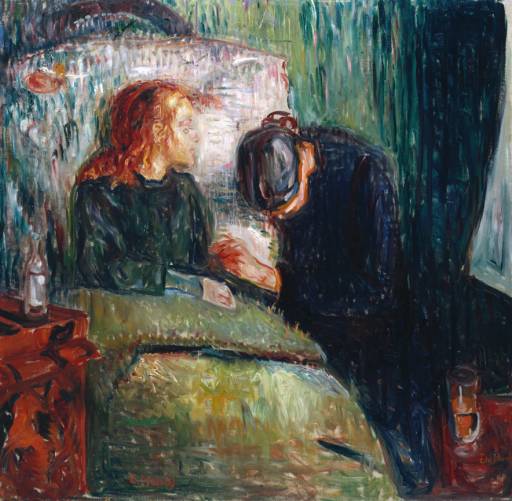
The Sick Child

I was particularly impressed by his early work The Sick Child (1885-86), depicting the trauma he had experienced as he watched his beloved, ailing sister Sophie lay in bed frail with tuberculosis. A grieving woman holding her hand, head bowed in sorrow. It was a disturbing scene, and yet I’d appreciated the colours and brushstrokes that seemed as if they were just rendered in a free and haphazard way. From the commentary, I felt the poignancy.

The Sick ChildThe camera and commentator guided me to see the scratches left on the canvas, most noticeably on the pillow near Sophie’s face, something which I wouldn’t have noticed if I just walked by it in the museum. These scratches were troubling to look at, probably made by a pallette knife, or a hard brush. They were marks of anguish and frustration, the outburst of emotions during what must have been a painful process. Munch always left ‘blemishes’ on his paintings. Here, the scratches and patchy layers of paints on paints showed raw emotions unleashed. That was the reason the work was met with criticisms and rejections in his day. It was not pretty and neat as his predecessors had done. He was, literally, painting outside the lines.

The Frieze of Life

Many of Munch’s more well known works are in the series called The Frieze of Life—A Poem about Life, Love and Death. The Munch Museum in Oslo exhibits the paintings as a series on four white walls in a room — and here’s the unconventional — without frames. The curator commented that this was what Munch would have intended. Without the distractions of the frames, the paintings speak out loud and clear. In The Frieze of Life, Munch explored the very essence of being human, the frameless, existential experience that is universal.

The Scream (1893)

The_ScreamThe Scream is in the section of The Frieze of Life categorized as ‘Angst’. It is the most well-known of Munch’s paintings. A deathlike skull-face devoid of gender, hands covering the ears and screaming out into the void. Munch painted this after an actual experience while he was walking in the woods, hearing a huge scream inside him. He was overcome with fear. After that episode, he painted The Scream. In it is a figure that has since become the epitome of existential angst. I’d appreciated the comment in the film stating that ‘it’s an icon, not a cliché.’

The Scream made history just last May. It had set an auction record for a piece of art work, fetching $119.9 million (£74m) at Sotheby’s in New York. Almost seventy years after his death, Munch’s works still scream.

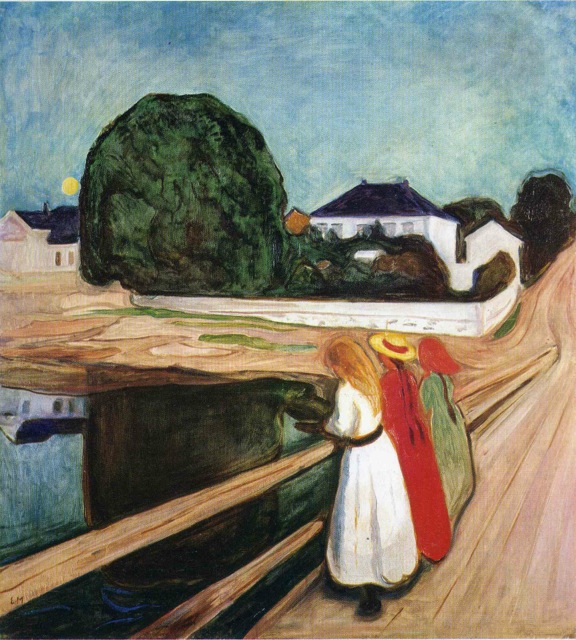
The Girls on the Bridge (1901)

The Girls on the BridgeA more delightful painting, The Girls on the Bridge is fresh, bright, and colourful, exuding a summer spirit. But even in this work, Munch depicted the struggles between innocence (white dress) and desire (red). And while we see the green clump of a tree, full of life, we also see its ominous, dark reflection on the water. In the midst of life, we are in death. Munch seemed like a party pooper, but maybe that’s why he needed to scream. Or else we wouldn’t have heard him.

~ ~ ~ Ripples

The next and last installment in the series is Vermeer and Music.

Sources of images: Wikipedia

***

Related Posts:

Art and Cliché

Arles: In the Steps of Van Gogh

Inspired by Vermeer

Edward Hopper, William Safire: The Visual and the Word

***
Summer Reading for Future Viewing

NOTE: Just added Far From The Madding Crowd by Thomas Hardy

Some updates on books into films or TV adaptations. Some I’ve read, some TBR.

Under The Dome copyUnder The Dome by Stephen King — Now a new TV series (CBS) produced by Steven Spielberg’s Amblin Entertainment, joining the trend of bypassing the big screen to opt for TV production. The future is now as the series has already started airing. First episode with 13.5 million viewers. Could this be a foretaste of the ‘implosion’ phenom Spielberg predicted, TV screen replacing the big screen?

.

outlanderOutlander by Diana Gabaldon — This wildly popular, NYT bestselling cross-genre series of novels (Sci-Fi/Romance/Historical/Adventure) will be adapted into a TV series. Again, TV is the emerging medium for literary adaptations. Versatile Gabaldon has multiple degrees in science and was a university professor before creating the Outlander book series. She’s also a comic script writer. Here’s her bio.

.

Winters-Tale-CoverWinter’s Tale by Mark Helprin — Sci-Fi is trending. This one will be on the big screen with some big names such as Will Smith, Russell Crowe, Colin Farrell. But if you are a fan of Downton Abbey, you’d be interested to know this is one of the reasons Lady Sybil met her tragic end. No hard feeling. I wish Jessica Brown Findlay all the best in her pursuit of big screen presence. Take a look at these photos.

.

The Ocean at the End of the LaneThe Ocean at the End of the Lane by Neil Gaiman — Book published June 18, 2013, film rights of Gaiman’s new novel (this one for adults) about childhood memories had already been snatched up by Tom Hanks’ production company Playtone and director found. That’s Joe Wright who brought us the screen adaptation of Ian McEwan’s Atonement (2007) and the most recent version of Anna Karenina (2012). Have put a hold on the audiobook from the library.

.

In The Garden of BeastsIn the Garden of Beasts by Erik Larson — Again, Tom Hanks had picked up the film rights and he will star in it. Before you say ‘Ha! Self-gratification’, I’d say he’s an apt choice to play William E. Dodd, America’s first ambassador to Hitler’s Nazi Germany. Natalie Portman is on board as Dodd’s flirtatious zealous daughter Martha. Michel Hazanavicius, the Oscar-winning director of The Artist (2011), will helm. The book focuses on dry facts and livens up with Martha’s escapades. I can expect how the movie would use them as leverage. But I certainly hope not.

.

The Monuments MenThe Monuments Men by Robert M. Edsel — A different perspective into Nazi atrocities. This time the victims are the art works in Europe. A special force of American and British museum directors, curators, art historians, and others, called the Monuments Men, risked their lives to prevent the destruction of thousands of years of culture under Hitler’s order and for his private gains. George Clooney, Matt Damon, Cate Blanchett star. Downton fans, Hugh Bonneville is also in. I’ve seen a doc based on Edsel’s other book The Rape of Europa, which is excellent. I eagerly await The Monuments Men.

Death Comes to PemberleyDeath Comes to Pemberley by P. D. James — BBC will produce this Austen’s Pride and Prejudice spin-off. Will it shift our devotion for Darcy from Colin Firth to Matthew Rhys? Not a chance. So why do it, especially when the book is overwhelmingly lackluster (there’s a new oxymoron for you). Lots of alterations will be needed for it to be put on screen. Here’s my take on the book.

.

AustenlandAustenland by Shannon Hale — Jane Austen spinoffs have to work extra hard to capture a wider audience, considering there are multitudes in the male population who avoid reading even the brilliant, original author Jane herself. Further, these imaginary sequels to P & P even have to woo female Austen purists. Kerri Russell stars, Stephenie Meyer produces. Maybe Meyer is ok with just reaching her own fans. If you’re not an Austen purist, here’s a beach read for you.

.

RebeccaRebecca by Daphne Du Maurier — Currently in development by Steven Spielberg’s Dreamworks. Do you think the 1940 Hitchcock film needs a makeover? Who should replace Laurence Olivier and Joan Fontaine? A new adaptation means drawing attention once again to Du Maurier’s novel, attracting first time readers. Good choice for book group, especially when you can read, discuss and watch movie together after.

.

Far from the Madding CrowdFar From The Madding Crowd by Thomas Hardy — Carey Mulligan’s next literary adaptation after The Great Gatsby. I’m glad she’s got this role, but, can she beat Julie Christie’s 1967 rendition of Bathsheba? The new version will be helmed by rising star director Thomas Vinterberg (The Hunt). Belgium actor Matthias Schoenaerts (Rust and Bone) and Juno Temple (in talks) also on board. I can see that all these remakes of classic films of literary adaptations are geared at a new generation of viewers. And I say, it’s alright. Another movie version just may draw more attention to reading literature.

the-grapes-of-wrathThe Grapes of Wrath by John Steinbeck — Just as we speak, Steven Spielberg’s Dreamworks is in talks with John Steinbeck’s estate to acquire the film rights, again, to remake another 1940 classic, this one with John Ford directing Henry Fonda. If the talk is successful, which I don’t doubt, who do you think should be in this new version? The book is on my TBR list with East of Eden, which also had plan for a new adaptation a few years back but since no more news had come out.

***

RELATED POSTS:

Upcoming Book to Movie Adaptations

Summer Viewing List

Can a movie adaptation ever be as good as the book?

My Review of:

The Artist

Atonement: Book Into Film

Anna Karenina: Book

Anna Karenina: Movie

Death Comes to Pemberley

***

Saturday Snapshot May 18: The Bow

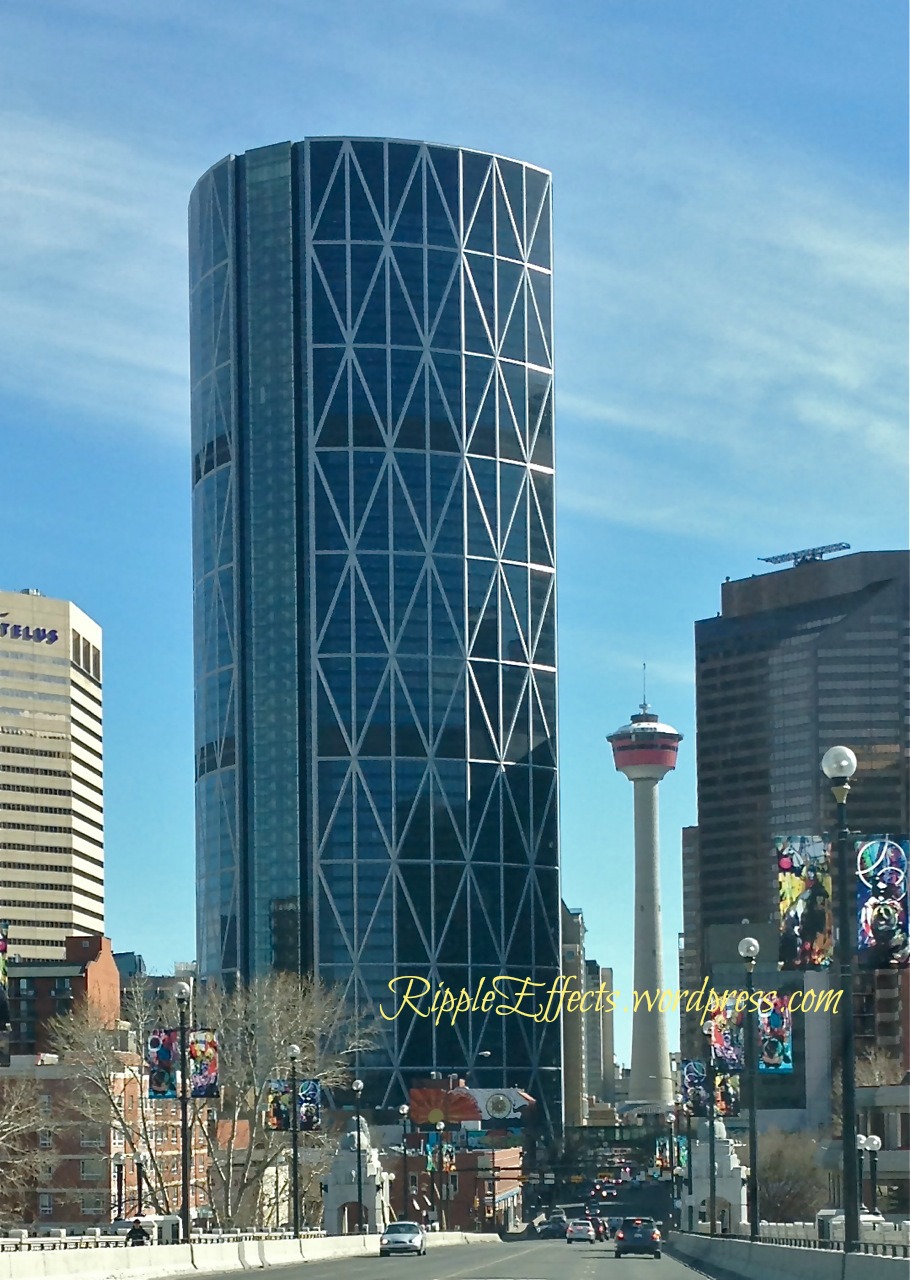
The Bow is the newest addition to our downtown cityscape. Design architects are the acclaimed, London-based Foster and Partners. This new kid on the block has put Cowtown Calgary on the map as it is recently named one of The World’s Most Spectacular Corporate Buildings by the German building database Emporis.

You can see how spectacular it is on Foster and Partners’ website with their professional presentation. But for Arti, the Cowtown inhabitant roaming in the midst of the buzz and the dust, weaving through busy downtown traffic, these snapshots are personal and authentic, no posing, and believe it or not, shot with just her iPhone:

The Bow 1

The Bow is named after the river that winds through our City. So it’s apt to design the building in a crescent shape, fluid as the river, and shaped like a bow:

The Bow 2

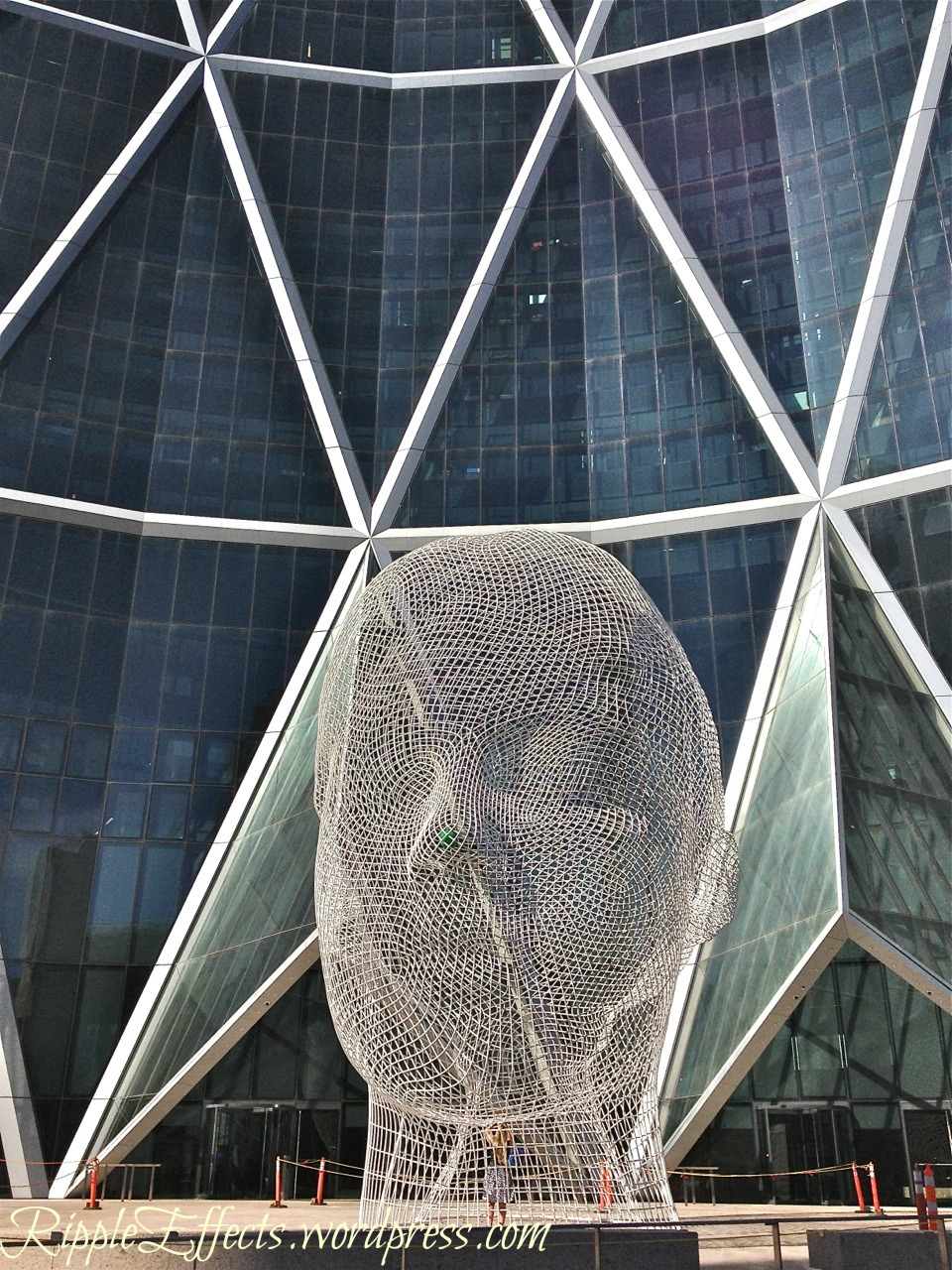
A bit closer now, you can see the art installation in front of the building. It’s a 12 m. tall wire sculpture entitled ‘Wonderland’, created by the renowned Barcelona-based designer Jaume Plensa whose works can be found all over the world:

The Bow 3

It’s the head of a girl, intriguing when you think of the title ‘Wonderland’. Why, of course, it must be a wonder to enter someone’s head. Here, you can do that through a door. See the green balloon inside her nose?

Wonderland

***

Saturday Snapshot is hosted by Alyce of At Home With Books. Click Here to see what other bloggers have posted.

Saturday Snapshot April 13: Bohemian Waxwings in Flight, Defying Grey

I had the chance to see the elusive Bohemian Waxwings converge in the past weeks. Now they are gone. From afar, they may evoke images from a Hitchcock movie:

Flocks of Bohemian Waxwings

But just a closer look would change your view… Avian Cirque du Soleil, acrobats of the sky:

Avian Cirque du soleil

Or… flight aesthetics, mesmerizing to behold:

Avian Aesthetics

I would have wanted a clear blue sky. But the grey offers a deeper fascination. These energetic Waxwings seem to defy the overcast dreariness, exuding a spirit and an aesthetics that colour cannot bring.

***

Saturday Snapshot is hosted by Alyce of At Home With Books.

All photos taken by Arti of Ripple Effects, 2013. All Rights Reserved.
I regret the obtrusive watermarks. I could well have positioned them down in a corner to enhance aesthetics. But practicality took over… hopefully they are deterrents of copying.

***

Arles: In Search of Van Gogh

Watching the movie Séraphine (my last post) made me think of another artist tormented by mental illness. Vincent Van Gogh (1853-1890) was born in the Netherlands. His artistic imagination was ignited when he moved to Paris in 1886 and saw the works of the impressionists. But the prolific period of his life began only after he went south to Arles.

I visited Provence in August, 2010, went on a walking tour of Arles following the footsteps of Van Gogh. For Paris in July hosted by Karen of Bookbath and Tamara of Thyme for Tea, I’m reposting an excerpt of my travelogue here. Some of you may remember my series of travel posts, but many of you have come to Ripple Effects only recently. Please join me as I revisit Arles and its nearby St-Rémy-de-Provence.

***

Van Gogh moved to Arles from Paris in 1888, seeking the tranquility that was so elusive to him in the big city. In his letter to his brother Theo upon arrival to Arles, he wrote:

It seems to me almost impossible to be able to work in Paris, unless you have a refuge in which to recover and regain your peace of mind and self-composure. Without that, you’d be bound to get utterly numbed.”  — Tuesday, Feb. 21, 1888.

The fresher and more colourful palette is apparent during this most prolific period of the artist’s life. Bright yellows, blues, shorter and swirling brush strokes established his signature style.

As for me, I was a bit disappointed to see the sunflowers have already withered in late August. Fields of yellow were now massive brown. They would be harvested at a later time for their oil, a good reminder that, for tourists, it’s the view and the photos, but for those living here, it’s their livelihood. The lavenders on the Luberon mountains too had long passed the season. Note to myself: Early to Mid July is best if I ever come this way again.

But all was not lost. I was gratified to follow some of Van Gogh’s footsteps as I explored the clearly posted Van Gogh sites in the town, the scenes and locales where the artist so vividly captured in his paintings.

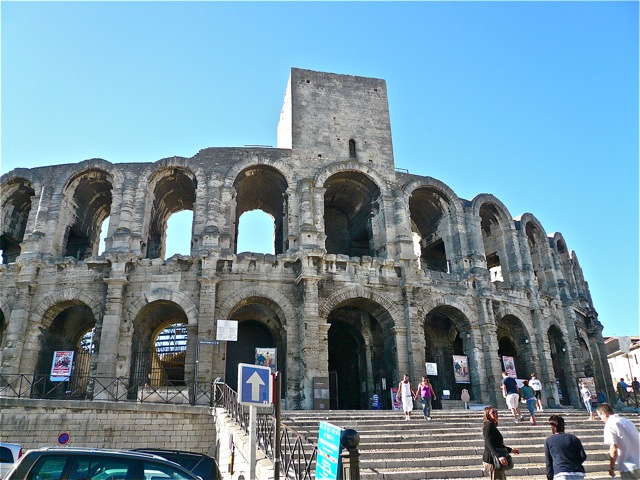
Arles is a Roman town. What more prominent landmark to reflect its past glory than the Roman Arena in the town centre. Why all the arches? The free flow of pedestrian traffic. The full seating capacity, 20,000 people, could exit the Arena in 7 minutes.

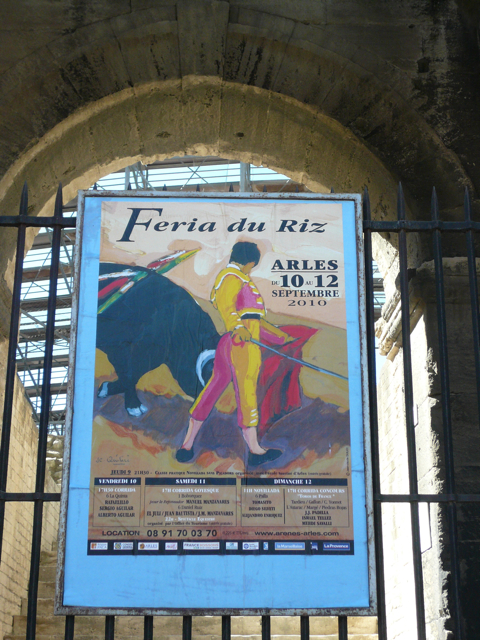
Used by gladiators in ancient time, the Arena is still the venue for bullfights:

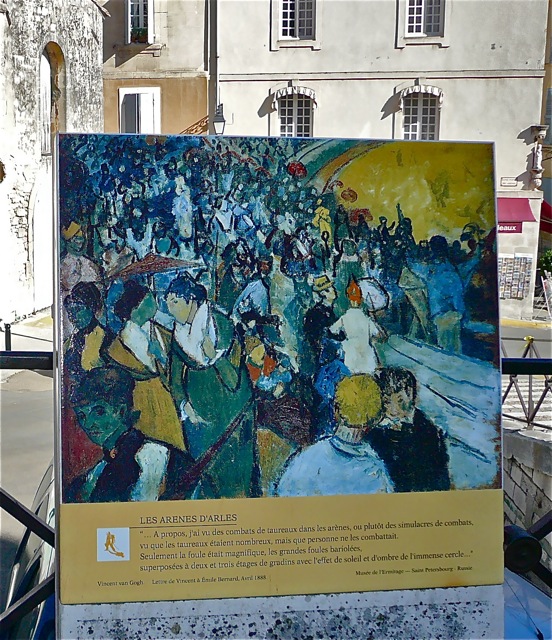
But Van Gogh’s interest was not so much in the violent action of bullfighting than the people, as his painting Spectators In The Arena At Arles (December, 1888) clearly shows:

The Café Terrace on the Place du Forum was his hang-out, renamed Café Van Gogh now. The yellow café upon the backdrop of the blue, starry night had deeply inspired the artist:

Café Terrace At Night (September, 1888):

Van Gogh had wanted to make Arles a hub for fellow artists. Upon his urging, Gauguin came to join him in October, 1888. The two painters frequented the Café Terrace many a night but only for two short months. What happened on December 23rd was reported by the local paper the next day:

At 11:30 pm., Vincent Vaugogh [sic], painter from Holland, appeared at the brothel at no. 1, asked for Rachel, and gave her his cut-off earlobe, saying, ‘Treasure this precious object.’  Then he vanished.

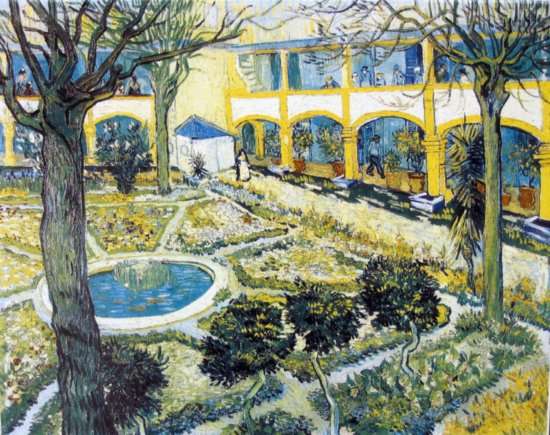
After this incident, Van Gogh was admitted to a local hospital, now the Espace Van Gogh in Arles, a cultural centre:

And here is Van Gogh’s rendering when he was staying there:

In January, 1889, Van Gogh returned home to his ‘Yellow House’ (which has now been torn down and reconstructed), but for the next few months, suffered onslaughts of hallucinations and delusions. His view of his own condition nevertheless was lucid and even progressive for his time. His letter to Theo is poignant, as he openly faced his predicament and earnestly sought a solution:

And for the time being I wish to remain confined, as much for my own tranquillity as for that of others.

What consoles me a little is that I’m beginning to consider madness as an illness like any other and accept the thing as it is, while during the actual crises it seemed to me that everything I was imagining was reality.”

— Sunday, April 21, 1889.

On May 8, 1889, he checked himself into the Saint Paul de Mausole, the mental hospital at St-Rémy-de-Provence. Under the care of his doctor Théophile Peyron, the artist’s condition improved and he thrived in the idyllic environment there. Art therapy had brought healing and prolific output. Van Gogh stayed there for a year and created more than 150 paintings.

Dr. Théophile Peyron out at the front garden of Saint Paul de Mausole hospital:

The olive grove outside:

Olive Grove (June, 1889):

To his brother Theo, he wrote on Sunday, May 11, 1890:

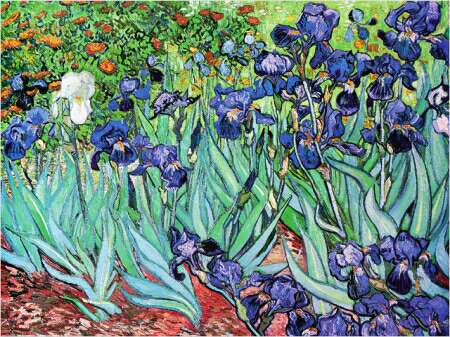
At the moment the improvement is continuing, the whole horrible crisis has disappeared like a thunderstorm, and I’m working here with calm, unremitting ardour to give a last stroke of the brush. I’m working on a canvas of roses on bright green background and two canvases of large bouquets of violet Irises…

My Van Gogh trip ended at St. Rémy, and so be it. I’ve seen the sites wherein the artist was at his most prolific. I’ve seen the town and surroundings where he found inspiration.  I’ve seen his final solace where he attained some stability and painted with passion. I’d like to keep these as memories of my travel to Provence. I could hardly bear to think of his last days, discharged from St. Rémy just a few days after the above letter, headed north to Auvers-sur-Oise on the outskirt of Paris, and in just two short months, succumbed to the recurrence of his illness. He shot himself in the chest with a revolver on July 27, 1890, and died of his wound two days later.

Back to the thoughts I wrote about: How do we keep art from turning into a cliché? I think it takes a certain awareness of the artist as a person, plus a measure of empathy and respect for the struggle to live and create… and realizing that the beautiful works are often triumphs in spite of life’s overwhelming adversities, rather than the natural products of bliss and fortune.

To wrap up my travel posts, and taking the risk of turning it into a cliché albeit my motive is pure, here’s the YouTube clip again, Don McLean’s tribute to Vincent:

***

My five-part travelogue on England and France:

  1. Tate Modern & Billy Elliot
  2. Bath’s Persuasion
  3. Paris: The Latin Quarter
  4. Art and Cliché
  5. Arles In the Steps of Van Gogh

Séraphine and the Wrought-Iron Chair

By day, she scrubs floors, cleans houses, washes dirty linens in the river. By night, she paints. She is Séraphine, a cleaning woman in her fifties. Later, she is better known as Séraphine de Senlis. 

Séraphine (2008), a film based on the life of the early 20th Century French painter Séraphine Louis (1864-1942), won 7 César Awards in France including Best Film of 2009 and Best Actress for Yolande Moreau as Séraphine. True to its subject matter, director Martin Provost has crafted an aesthetically pleasing work of art. The pace is slow for the viewer to savour every bit. Moreau’s charming portrayal of Séraphine is captivating. She wins my heart from the first scene.

It is gratifying to be noticed, to be confirmed of one’s worth. To the dismissive eye, an ageing cleaning woman is nothing to deserve another glance. Makes me think of the concierge Renée in The Elegance of the Hedgehog. In one of the apartment units which Séraphine cleans, a new tenant just moves in. He is Wilhelm Uhde, a noted art critic and collector of Picasso. He is also the one who has discovered Henri Rousseau of the naive art style, a term referring to untrained talents, a term to which Uhde doesn’t subscribe.

And right there in his rental unit Uhde notices another hidden gem of this style, his own housecleaner Séraphine. Uhdle is deeply moved by her work and soon becomes her patron. He stops her from mopping his floor, leads her out into the garden, seats her down in a wrought-iron chair and tells her she has talent. It is a wrought-iron chair that I notice since that scene, and it recurs later in the film, a metaphor for aesthetics, style and elegance, antidote to the crude reality of Séraphine’s life.

Séraphine loves nature, and nature rewards her with inspiration.

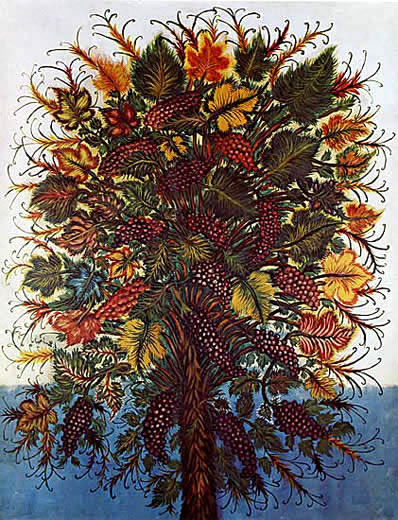
Her subjects are mainly flowers and fruits, their design exquisite, natural, colourful and lively. 

Deep religious fervour soon drives Séraphine to relentless, maddening obsession to paint. She claims to follow voices from her guardian angel. She would sing hymns at the top of her voice while painting through the night, waking up in the morning on the floor with her work-in-progress. She gradually becomes delusional and out of touch with reality.

Why is it that giftedness and mental illness often find affinity for each other? Van Gogh comes to mind. And only recently did I read this Guardian article drawing uncanny similarities between Séraphine and Susan Boyle.

As WWI draws near, the impending conflicts push Uhde out of France and back to Germany. They reunite after the War. Sadly, the painter’s growing achievement brings about more severe delusions. Later the economic depression ends contact between patron and artist for a while.

When Uhde finds Séraphine some years later, she is locked up in an insane asylum. This latter part of the movie is a bit uncomfortable to watch. Uhde is unable to communicate with her as she is restrained in a straight jacket, tied to the bed weeping in anguish.

Months pass and in 1935 Uhde visits her again. He needs to tell Séraphine her paintings are selling. Her condition has stabilized by now but upon doctor’s advice, Uhde should just leave her be. There in the asylum at Asile de Clermont Uhde quietly pays for her a private room with a view out towards a lush green meadow and full, leafy trees.

The ending that follows is one of the best I’ve seen in films. We see Séraphine being led into the room. She sits on her bed, dazed, unfeeling. Then she turns her head and notices the door leading outside to the trees and green meadow. The next three silent minutes bring us to a poignant closing:

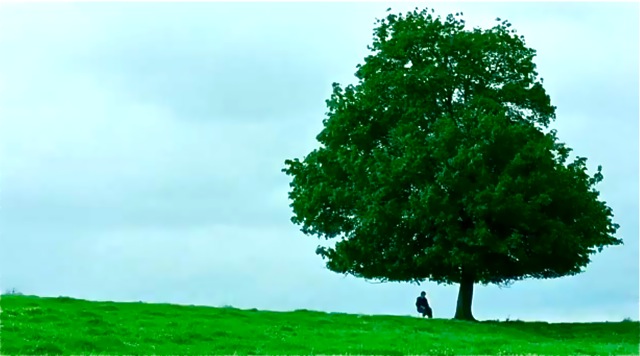
Séraphine slowly gets up and opens the door. She sees a wrought-iron chair on the porch. The frame on screen here is roughly split in two. On the left side is her room with a sterile, wooden chair of the asylum. On the right we see the porch outside with the wrought-iron chair, not unlike the one she had sat on while being declared a talent by Uhde years before. She tentatively steps out of her room, touches and examines the chair, then picks it up and slowly carries it with her up a green hill to a full, beautiful tree. From afar, we see her look at the tree, put the chair under its shade, sit down and tilt her head back, fully relaxed.

In the silence with just the wind blowing, it seems we can hear her gratified sigh of relief, being back in nature, coming home.

~ ~ ~ 1/2 Ripples

CLICK HERE to watch Séraphine’s official trailer on Youtube. You’ll be able to see the ending scene. But of course, nothing compares to watching the film in its entirety.

A NOTE ABOUT MOVIE PHOTOS: These images are used according to the Fair Use guidelines for criticism, comment and educational purposes. CLICK HERE for more information. CLICK HERE to read the Report of the Ad Hoc Committee of the Society For Cinema Studies, “Fair Usage Publication of Film Stills” by Kristin Thompson.

***

This movie review is my third post for Paris in July hosted by Karen of BookBath and Tamara of Thyme for Tea. To read my previous posts you can click HERE and HERE.

***

The Rant of the Armchair Traveller

From the comments in my last post, seems like Egyptology is a favorite subject of many, if not now, at least some time in our curious life. I’ve had the chance to visit Egypt twice during my travels to the Middle East. Since now is the warm month of May, kicking off the travelling season, and alas, since going anywhere far is a remote possibility for me at present, an armchair revisit is timely, if only to suppress burning wanderlust.

Here are some file photos from my last trip to Egypt five years ago. I only stayed in Cairo and its vicinity. But from my recent reading of Lord Carnarvon and Carter’s King Tut Tomb discovery, I regret I didn’t venture further to the Valley of the Kings in Luxor. However, I did see the iconic King Tut’s mummy mask at Cairo’s Egyptian Museum. Photography was forbidden, so no King Tut’s portrait here.

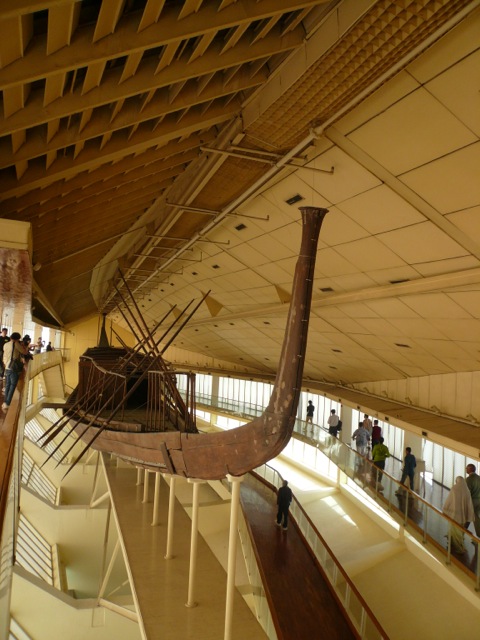
But I can show you another marvellous exhibit. In 1954, a Pharoah’s boat dating back four millenium was dug up in pieces and since reassembled. Beautifully showcased in another museum near the Great Pyramid of Giza. Photos were allowed here, but Arti’s pocket Lumix wasn’t enough to capture the magnificent whole. If you’re interested, click here to a full description.

Pharaoh’s Boat buried 26th Century B.C.

Another view:

The Pyramid and the Sphinx are probably what travellers go to Egypt for. While the Sphinx is a limestone statue of the mythical creature with the lion body and the human head, the Pyramid was piled up in stones. Can’t say which one is easier to make.

The oldest of the Seven Wonders of the Ancient World that is still standing, The Great Pyramid of Giza was built for the fourth dynasty Egyptian Pharaoh Khufu, a 20 year construction process which concluded around 2560 B.C. (Wikipedia data) As for Arti, no exact date was needed. Standing at the foot of the humungous pile of neatly stacked up stones was an experience itself.

The Great Pyramid of Giza

Not far from the Pyramid, The Sphinx:

The Pyramid and The Sphinx

A closer look… so what if I’ve lost a nose, I still stand sit after all these years:

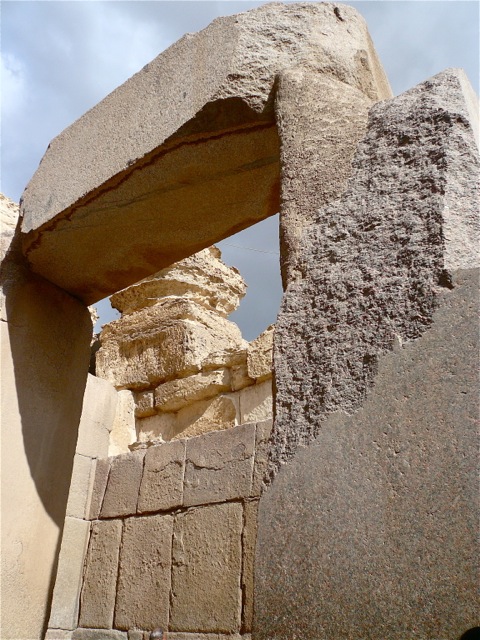
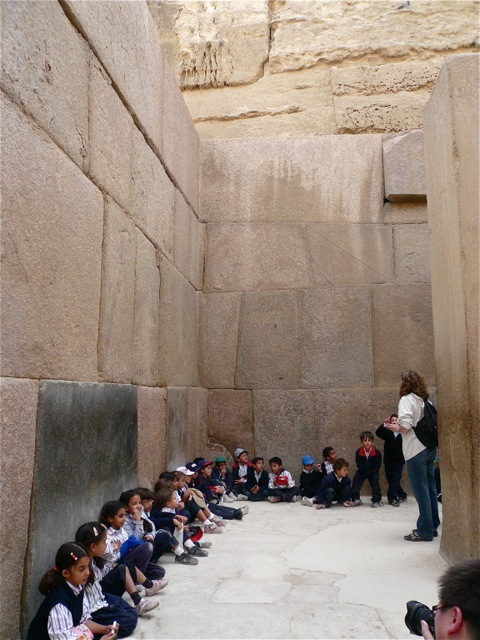
Let the stones speak:

and the children listen:

We were travelling in a bus through the desert, and stopped for a view. Here are some other children I saw, took this picture through the window:

Mount Sinai, the legendary place Moses received the Ten Commandments from God. At the foot of the mountain range is St. Catherine’s Monastery:

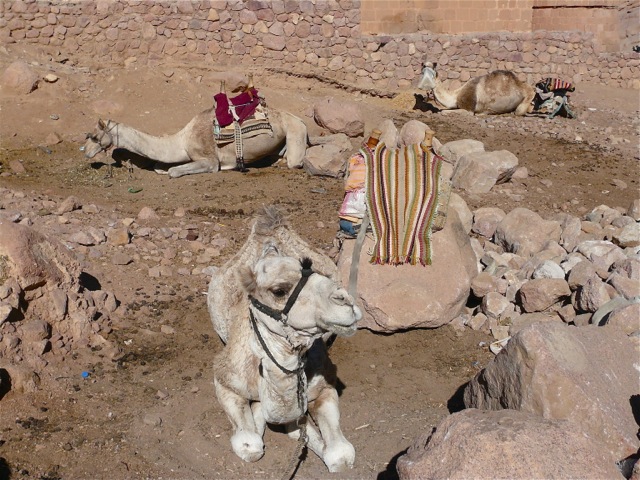
 Man’s best friend. They wait without complaint:

The desert is mesmerizing regardless of the hour:

Desert moon at dusk

While I faithfully pick up mail for neighbors gone to Paris, or read with pleasure blog posts of your recent travels, I feel like jumping on the armchair bandwagon and join the massive global tourism movement. Ok everyone, I’m coming along.

***