Read Some Possible Oscar Contenders

Emphasis on the ‘possible’. At this point of the race, some films have not been released other than screened in Film Festivals. The frontrunner so far is 12 Years A Slave. And then there are the rest, some long shots, some longer. But I’d like to include them on this list because I want to draw your attention to the books which inspire these film adaptations.

How come Gravity isn’t here? You ask. It’s a frontrunner too. Yes. But, ah… find me the book first. No book? Maybe because it’s much easier to pass you the 3D glasses.

Here’s a list of fall/winter reading to gear up for the upcoming Awards Season.

12 Years A Slave by Solomon Northup

12 Years a Slave copyThe movie adaptation directed by Steve McQueen is TIFF13 People’s Choice Award winner. From past years, this accolade is a good predictor of Oscar wins. Based on the real life story of Solomon Northup, a free black man in Upstate New York who was kidnapped into slavery in Louisiana. For twelve years he suffered in the hands of several masters. First published in 1853, the book is Northup’s first-person accounts of slavery in 19th C. America, noteworthy for its historical value and poignancy. The actor Chiwetel Ejiofor a likely Oscar Best Actor nom for his role as Solomon Northup. You can download the whole book in its original form here.

August: Osage County by Tracy Letts

August Osage CountyThe play won the 2008 Pulitzer Prize for Drama. Members of a dysfunctional family inevitably come together after tragedy strikes. The stage production was described by the NYT as ‘a fraught, densely plotted saga of an Oklahoma clan in a state of near-apocalyptic meltdown’. Before you see how the A-list cast interpret their roles on screen, maybe reading the play is rewarding since you get to experience the story first hand before being influenced by Meryl Streep, Julia Roberts, Benedict Cumberbatch, Ewan McGregor…

The Monuments Men by Robert Edsel

The Monuments MenI’ve mentioned this title in a previous post. Now I’ve got the book in my hands. The true but untold story of how a group of rescuers called the Monuments Men in war-torn Europe saved  art and artifacts from the Nazi’s. In the introduction of the book, the author writes: “Hitler and the Nazis pulled off the ‘greatest theft in history’, seizing and transporting more than five million cultural objects to the Third Reich.” George Clooney, Matt Damon, Cate Blanchett, Jean Dujardin (The Artist), Hugh Bonneville (so Lord Grantham finally gets the chance to go into the battlefield).

A Captain’s Duty: Somali Pirates, Navy SEALS, and Dangerous Days at Sea by Richard Philips

A Captain's Duty..Another likely contender that has been getting a lot of buzz is this thriller starring Tom Hanks, based on Captain Richard Phillips’ real life ordeal in the hands of Somali pirates. A lawsuit will begin in a few weeks filed by the crew of the ship Maersk Alabama against the shipping company for sending them to pirate-infested waters unprepared. They also claim the Captain was at fault in the case. Their attorneys had set up a Webpage to clarify the truths from the fiction. A turbulent epilogue to the real life adventure on high seas.

The Lost Child of Philomena Lee by Martin Sixsmith

The Lost Child of Philomena Lee copyJudi Dench could get a possible Best Actress Oscar nomination with her role as Philomena Lee. In her youth as an unwed mother, Philomena was sent to the convent of Roscrea, Limerick, her baby taken away and ‘sold’ to America for adoption. As she became an adult, Philomena was determined to search for her lost child. I missed this at TIFF13. Maybe an Oscar nomination for Dench could raise the prospect of it being screened in our theatres.

.

‘Hateship, Friendship, Courtship, Loveship, Marriage’ by Alice Munro

Hateship-Friendship-Courtship-Loveship-Marriage-book-cover copyWith Alice Munro garnering the newest top honor as Nobel Laureate, hopefully the film adaption of this short story with a shorter title Hateship, Loveship will receive a wider release. It has been a long while since Away From Her (2006). The film receives positive feedbacks at TIFF13. A good cast with Kristen Wiig (Best Actress and Best Original Screenwriting Oscar noms for Bridesmaids), Guy Pearce (The King’s Speech), Hailee Seinfeld (True Grit), Nick Nolte (too many to name).

The Secret Life of Walter Mitty by James Thurber (Click on link to read the story online.)

The Secret Life of Walter MittyInteresting to see another film adaptation of a short story. This one I have a feeling that it’s very loosely based on Thurber’s character Walter Mitty, considering it’s a Ben Stiller movie. I’m sure many have read this story in school, time to reread just to get the Walter Mitty psyche, then go and check out the Ben Stiller ride. Other than Stiller, there are Kristen Wiig (again, in two short story film adaptations the same year), Sean Penn (can you imagine?), Shirley MacLaine.

The Wolf of Wall Street by Jordan Belfort

The Wolf of Wall Street copyCoincidence that Leonardo DiCaprio jumps from being Jay Gatsby to Jordan Belfort, the real life fraud on Wall Street, notorious for his highflying lifestyle and his operating a boiler room brokerage firm Stratton Oakmont. A multimillionaire at 26, he was later indicted in 1998 for securities fraud and money laundering but only served 22 months in federal prison. The Wolf of Wall Street is his unabashedly candid memoir. Martin Scorsese directs with DiCaprio touted as a likely contender in the Best Actor Oscar category.

The Book Thief by Markus Zusak

The Book Thief copyNo Oscar buzz around this one, but a look at the movie trailer, I know I want to see it. Yes, mainly because of Geoffrey Rush I admit. And also, Brian Percival… ring a bell? Director of Downton Abbey. The film will be released in November, a time slot where contenders are placed. So, you can say it’s a long, long shot for, who knows, maybe Geoffrey Rush, or Emily Watson? I admit I still haven’t read this very popular YA title. I’d like to do that before watching the film. Is this one on your movie viewing radar?

***

The Disappearance of Eleanor Rigby: Him and Her (2013)

I keep reminding myself, my evaluation of The Disappearance of Eleanor Rigby: Him and Her should not be affected by the appearance of Jessica Chastain, her real self, in the theatre. That was an unexpected and most exhilarating episode in my TIFF13 experience.

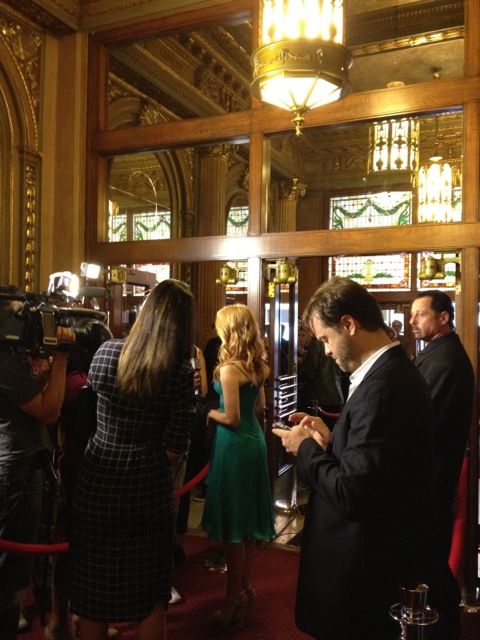
After over an hour waiting inline outside, we were ushered into the historic building (100th anniversary this year) that housed the beautiful Elgin and the Winter Garden Theatres. And lo and behold, I saw Jessica Chastain standing right there in a press line answering questions. Who can take a focused shot with steady hands while being herded like sheep quickly passing by Jessica Chastain?

Jessica Chastain

Here’s a sharper view but no better vantage point:

JC Another View

**

Disappearance is two films in one. It tells how a couple deals with loss, and the subsequent effect on their relationship, from His and Her point of view. Each is a 90 minute film that can stand on its own. We were shown first Him, then Her, with no intermission. I know at some other screenings, it’s the other way round. Now, that is intriguing. Will the audience perceive quite a different story then?

The concept had been found in previous films. Kurosawa’s classic Rashomon comes to mind. It presents four different points of view consecutively in one film from those involved in a crime. A more recent movie Vantage Point uses the idea but is miserably repetitive.

With Disppearance, we have a fresh, contemporary take on this high concept. Being made into two films allow deeper character development and more complex storytelling. It is innovative but not redundant as one might suspect. And that’s the ingenuity of writer/director Ned Benson. His screenplays for both are intelligent, perceptive and thought-provoking.

The first part Him is more elliptical. As viewers, we know little to start, but are eager to find out more about the couple. Why does an amicable and romantic relationship becomes incommunicable, and with the wife disappearing, walking out of the relationship? We soon find out the reason. I would not spoil it for you.

To deal with his situation, the husband, Conor (James McAvoy, Atonement), spends his energy on saving a losing business, his little restaurant in NYC. I suppose, as a man would, diverging his focus into career and business. Ciaran Hinds plays his father, a successful restaurateur who offers his son what he has established, a proposal that is turned down.

Bill Hader is deadpan funny as Conor’s good friend and chef in the restaurant. A friend can help him cope, but Conor knows ultimately he has to walk the path himself. The last scene is open-ended, a good lead into the Her perspective.

Him: ~ ~ ~ Ripples

**

After watching Him, I was eager to find out Her story. Jessica Chastain (Zero Dark Thirty, The Tree of Life) is Eleanor Rigby, her parents having met in a Beatles concert, thus the namesake. But the film is not about the song, albeit we do hear the relevant line.

This second part is most gratifying. Not only does it fill in the gaps, it has gone deeper into Eleanor’s pains and her struggles to find herself once again… or maybe, for the first time. While Conor immerses himself in his restaurant, Eleanor returns to her family.

William Hurt plays Eleanor’s dad, a psychology professor who stands by as a loving father would, albeit helplessly. He suggests Eleanor take courses part time, which she does. Thus leads to some interesting scenes and meaningful dialogues with her prof played by Viola Davis, a role that the talented actor deserves. She gets to deliver that poignant line in the Beatles song:

All the lonely people, where do they all come from?

The veteran French actor Isabelle Huppert is Eleanor’s mother, always with a glass of wine in hand. There is no perfect family. She has her own issues to deal with, let alone contributing to a healing process.

Jess Weixier as Eleanor’s sister puts forth an excellent, complementary performance to Chastain’s. She is a single mother living in her parents’ house and raising an eight year-old son. She too, has to play the hand life deals her as best she can. From the Q and A after the screening, we learn of the long-time friendship between Chastain and Weixier, and it shows. Their performance makes me long for the experience of sisterhood.

And we learn too that Ned Benson wrote Her especially for Jessica Chastain, who ten years earlier introduced herself after watching Benson’s short film and was much impressed by it. Chastain was emotional when recounting the incident, moved that now ten years later, Benson is finally being acknowledged.

With such a high calibre cast, I could have sat there for another hour. There are lots to think about, and the cast makes it enjoyable for us to do just that in the films.

How can a response to any situation be shared while we see and feel so differently? One’s perspective is uniquely one’s own, an interplay of subjective perceptions, past experiences, psychological makeup, temperaments, rationality…. These two films screened back-to-back is the most vivid way to convey this point. How then can two people unite despite differences in perspectives?

As I write this post, Proust’s madeleines eating episode comes to mind. The memory and sentiments elicited from an experience is personal and subjective. And that’s what these two films show us. Even within the same scene, the camera takes on a different angle and point of view. Most interesting is that, even the dialogues are different. We can see the discrepancies in their memories and knowledge (or lack of) of themselves and each other. And when it comes to love, how each would want to hear the other taking the initiative to say ‘I love you.’

Her: ~ ~ ~ 1/2 Ripples

**

To top it off, we were given a chance to hear the cast share their experience in a Q and A session after the screening. From left to right Jess Weixier, Cirian Hinds, James McAvoy, Jessica Chastain.

Disappearance of ER Q & AWhole Experience: ~ ~ ~ ~ Ripples

***

All photos in this post taken by Arti of Ripple Effects. Please do not copy or reblog.

***

Blue Jasmine (2013): Homage and Re-Imagining

Sometimes when we see different versions of an original piece of art we tend to dismiss them as cheesy imitations, turning art into a cliche, like, the many faces and parodies of the Mona Lisa.

And sometimes, when we see a work that we know is a new version of an older masterpiece and yet we appreciate it, all because it brings us a breath of fresh air, a different perspective, new insights, a re-imagining, or offers us some new pleasures.

Here are a few examples. Robert Bresson’s Pickpocket (1959) is the auteur’s version of Dostoevsky’s Crime and Punishment, and movingly crafted. West Side Story (1961), we appreciate it as a different styling of Romeo and Juliet. Kurosawa’s Ran (1985), we know it to be a Japanese rendition of King Lear, and we marvel at the director’s handling of a Shakespearean classic from a different culture. A bit later, the younger generation in the 1990’s enjoyed Clueless (1995) even though they may not have noticed the resemblance to Jane Austen’s Emma. With Disturbia (2007), we see Alfred Hitchcock’s Rear Window making its way into the minds of teenaged viewers, and who cares that they didn’t even know it.

Woody Allen has done that many a times in his over four decade career as a director, creating different versions of the works from those he had expressed deep admiration. Call it homage, if you will, or borrowing, but we never have the impression that he’s ‘copying’. Copying is mindless triviality. But a look at Allen’s Interiors, we’ll see the deep shadow of Ingmar Bergman’s Cries and Whispers, the intense yet intimate styling of a chamber drama. Or Hannah and Her Sisters, an apt parallel with Bergman’s Fanny and Alexander. Crimes and Misdemeanors and Match Point, we see him deal with the issue of Dostoevsky’s Crime and Punishment, or rather, crime and the absence of punishment. I’m sure you can think of some more examples.

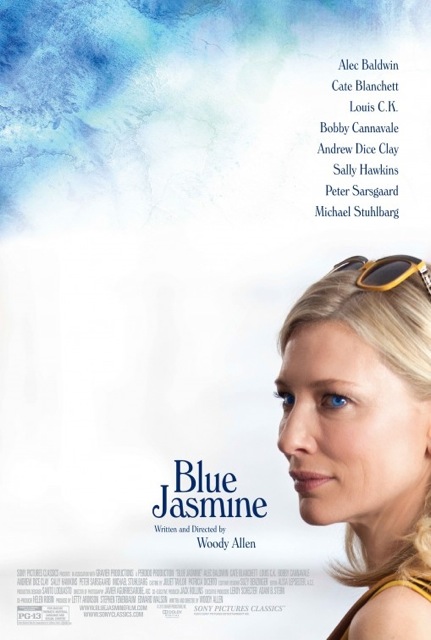
Blue Jasmine Movie Poster

So here with Allen’s 48th feature Blue Jasmine, does it matter that its structure and characterization parallel Tennessee Williams’ A Streetcar Named Desire, the Elia Kazan 1951 classic movie? Especially when we see such a finely crafted, enjoyable, and impressively performed modern version, we can only admire Allen’s imagination and creativity. I have a feeling that he (or his casting staff) gets Cate Blanchett to star as Jasmine because of her on-stage mastery of Blanche Du Bois in Tennessee Williams’ A Streetcar Named Desire performed not too long ago.

With Blue Jasmine, the 77 year-old director seems to have hit his stride yet again. Two years ago, Midnight in Paris brought him the highest opening box office gross in his career, now Blue Jasmine has surpassed that. Blue Jasmine will also be the widest screened Woody Allen movie, so far. It reaffirms the director’s talent in how he can bring out the best from his actors.

Cate Blanchett turns from blanche to blue, but just the same as she steps down the social ladder in a fragile mental state, dependent on a cocktail of alcohol and anti-depressants. She is Jasmine, a New York socialite who has to go stay with her working class sister Ginger (Sally Hawkins) in San Francisco after her husband Hal (Alec Baldwin) meets the full legal consequence of his fraudulent business dealings, a definite change of course from Allen’s earlier movies Crimes and Misdemeanors and Match Point.

The real and imaginary in Jasmine’s mind is smoothly shifted as we see her delusional self living in the present and the past at the same time. Allen handles it very well. The non-lineal storytelling is seamless. Blanchett is superb in her lucid performance, portraying convincingly a whole spectrum of emotions and mental states, while tugging at our heartstrings as we see her try desperately to stand on her own two feet for the first time in her life. This is where Allen is best, piercing sad human situations with light and gentle humor.

Allen has plenty of materials to poke fun at and chances to deliver his social commentaries. Yes folks, there is a class system in democratic America, and the humor in the film is at the expense of both the upper class and maybe more, the menial workers. Mind the gap, for it is unbridgeable. Fact is, the fun of the film, I’m afraid, is at the expense of depicting some of the characters a bit like caricatures. Having said that, I must applaud the wonderful acting from the supporting cast. They look like they are convinced first of their character’s idiosyncrasy, making their portrayals so unabashedly natural.

Further, Allen seems to redeem himself in presenting a moralistic stance. True love can be found right there in Ginger’s circle with her devoted boyfriend Chilli (Bobby Cannavale), whom Jasmine calls a ‘loser’; the deceivers are from the upper crust, Hal (Alec Baldwin) being the prominent figure. Others who may look like a step up for Ginger could well be a mirage. The wonderful supporting cast includes Andrew Dice Clay as Ginger’s ex-husband Augie, Louie C. K. the seemingly hopeful sound engineer, Michael Stuhlbarg, the serious man turned desperate dentist, and Peter Sarsgaard as Dwight, no doubt the parallel of Mitch (Karl Malden) in A Streetcar Named Desire (1951).

Blanchett’s Jasmine performance has already sent out Oscar buzz, and it’s only August. She carries the film through brilliantly. An Oscar nomination should be well deserved. We are glad to find too that Allen has not missed a beat after his success with Midnight in Paris, still churning out enjoyable films on an annual basis, while sometimes a superb actor can much enhance our appreciation, as it is the case here. 

~ ~ ~ Ripples

Other related posts:

Midnight In Paris

A Serious Man (Michael Stuhlbarg)

An Education (Peter Sarsgaard)

Do we need a Rebecca Remake? Another Grapes of Wrath?

Art and Cliché

***

Drifting with the Current of Memory: Kon-Tiki (2012)

Once upon a time a young school girl, an English language learner in the then British Colony of Hong Kong, had to read an abridged version of the book The Kon-Tiki Expedition written by Norwegian explorer Thor Heyerdahl. The ESL student was told it was a true story. She was most curious to find out the details of this extraordinary journey of six men on an open raft roughing it on the tumultuous South Seas. But due to her limited English language skills, she had a hard time comprehending the details of the adventure Heyerdahl described.

Now decades later, as soon as she knows that a movie by the name of Kon-Tiki is showing on the big screen, her long tucked-away curiosity is unleashed. Now she finally has a chance to find out what this sea voyage is all about. Here are the ripples.

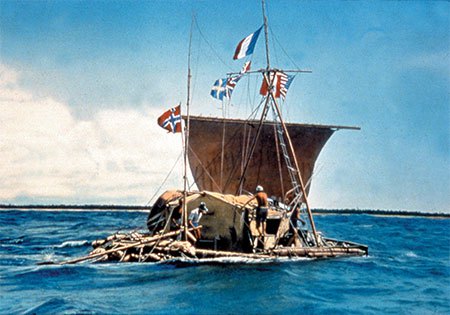
Norwegian ethnologist and explorer Thor Heyerdahl embarked on The Kon Tiki expedition in 1947 to prove his own theory that the Polynesian Islands on the Pacific Ocean were first colonized by people from Peru in South America some 1,500 years ago, and not those of nearby Asian countries as generally thought. Heyerdahl and five other men built a raft with balsa wood, using ropes and technology of pre-Columbian times, and set sail on it by letting it drift with the current from Peru, just to prove the feasibility of such a journey. Only one of the men had had some navigation experience, and, we found out later in the film, Heyerdahl himself could not swim. But in 1947, after a period of 101 days, they succeeded in reaching the Polynesian islands, almost 5,000 miles away. Quite a risky trip to prove a self-propelled theory. Herein was sown the seed of adventure and endurance.

Kon-Tiki (2012)

The film is 2013 Oscar nominee for Best Foreign Language Film from Norway. It starts off well by showing a young Heyerdahl as a child in Norway already a risk taker who seeks out the most dangerous feats to perform. The camera works at eliciting interesting human faces with close-ups of a mischievous child growing into a tall, blond hair, blue-eyed, chiselled physique, explorer of the Polynesian Islands. Listening to an aboriginal elder tell their people’s story, Heyerdahl (Norwegian actor Pål Sverre Hagen) is determined to test his theory with his life on the line, against the restrained protest of his wife Liv (Norwegian actress Agnes Kittelsen). More treatment of the conflicts is much wanting here, as enthusiasm of the adventurous husband meets exasperation from his wife and mother of his two boys.

Likewise, while on the rough seas, conflicts and comradeships among the six men seem to give way to tense moments of swashbuckling shark fights. At certain points, scenes from Life of Pi came to mind… the flying fish, the whale circling under the raft, the shark attacks, the sun sinking beneath the horizon. Moments that are aesthetically gratifying in Pi appear to be quite matter-of-fact here. No matter, Norwegian directors Joachim Rønning and Espen Sandberg chose to use a simple and straightforward style to tell their story, nothing philosophical to be pondered as in Pi.

If just to satisfy the curiosity of the once bewildered school girl, the movie suffices. It captures my attention and offers some suspenseful and thrilling scenes, at times reminiscence of yet another movie, Jaws. So, Pi and Jaws, what images the Kon-Tiki movie leaves me with that are its own are basically the six messy blond hair and bearded, muscular (except one), well tanned Norwegian and Swedish men speaking English, and, looking quite similar to each other. Eventually, they see a gull flying in the sky. Spirits are highest at that point, for land is near.

What’s quite effective is the inclusion of what seems to be the archival black and white footages of the original trip well mashed into this modern version. But here’s my disclaimer: Upon this first viewing, I’m not too sure if they are the actual footage, or imitation archival footage. I have tried to find out on Google but to no avail. However, I did find out that all the ocean life of sharks, whales, and fish are CGI, computer generated images… just like in Pi.

It’s also interesting to note that, at the end of the movie when the credits roll, there is a disclaimer stating the movie is fictional and that any relationship to the facts is accidental or coincidental. With this, I as a viewer is at a loss as to the accuracy of the whole storytelling on screen. This points to the value of the actual footage which the real life Thor Heyerdahl shot with his 16mm camera, later edited into a feature film that won the 1951 Academy Awards for Best Documentary.

We know for a fact that they reached their destination, no small feat of survival and endurance that from my childhood memory, was much more detailed even in the abridged ESL version of the book. So, yes, it looks a bit too easy and simplified in this movie. And, the ultimate argument still remains like a hung jury. The fact that they had succeeded in reaching the Polynesian Islands on an open raft all the way from Peru did not prove that the Peruvian had colonized the Islands. The film did not deal with this argument. But, just for satisfying the curiosity of the once young and bewildered English learner, it is a sufficiently entertaining movie. A highly watchable summer beach flick.

~ ~ ~ Ripples

***

Related Posts:

Life of Pi: The Magical 3D Experience

Life of Pi by Yann Martel: Take the Literary Journey Before the 3D Experience 

***

Summer Viewing List

Summer Reading Lists have begun to sprout everywhere. Some prefer lighter beach reads, and others use this time to catch up on heavier non-fiction works.

While I love book lists and recommendations, as a cinephile, I also have my list… films to be watched, those I highly anticipate to come around hopefully soon to my city. Here’s my TBV (To Be Viewed) list for this summer on the big screen:

Frances Ha – A NYC set black and white film in 2013? The trailer evokes Woody Allen’s Manhattan. I know Noah Baumbach has his own style, considering some of my favourite films are his works, The Squid and the Whale, Fantastic Mr. Fox. Co-writer and star Greta Gerwig, who is a good balance to Ben Stiller in Greenberg and distinctive in To Rome With Love albeit in a minor role, should be a delight. This I highly anticipate.

Before Midnight – The third and final instalment of Richard Linklater’s chance encounters of Before Sunrise, and Before Sunset. Real time, dialogue driven films almost created a genre of their own in the first two instalments. Ethan Hawke and Julie Delpy regroup nine years later in Greece. Whatever had happened in their lives between years?

Summer breeze, makes me feel fine…

Before Midnight

Much Ado About Nothing – Shakespeare and summer go hand-in-hand. Not in the park, this one’s shot right in director/screenwriter, of Avengers’ fame Joss Whedon’s own backyard in Santa Monica, CA. A postmodern take, and … black and white? Keeping the original work handy can help to reveal what’s Shakespeare’s and what’s Whedon’s.

Blue Jasmine – Woody Allen has been bringing us a new film a year over the past four decades. Can you not admire the stamina and creativity of this man, now 78. Allen’s 2013 instalment brings him home to NY and CA. Cate Blanchett, Alec Baldwin, Peter Sarsgaard star. I highly anticipate his 2014 work though, already announced and in pre-production. This time, back to France with Colin Firth. Yes folks, just another year.

Blowing through the jasmine in my mind…

Jasmine

Gambit – scheduled to come out later this year, Colin Firth and Cameron Diaz reprise the 1966 British comedy that starred Michael Caine and Shirley MacLaine. Alan Rickman also in this new remake. Much ado about a fake Monet painting. Should be another breezy flick but probably after summer, if it ever comes this way.

To The Wonder – Terrence Malick’s 2012 work just one year after The Tree of Life still hasn’t arrived here, albeit screened months ago in other more major cities. Not as highly acclaimed as the mesmerizing Tree of Life, To The Wonder is still alluring for me, a Malick fan. Good to see that the reclusive director seems to be busier now so we don’t have to wait for a decade to see his next work.

What Maisie Knew – Again, still not here albeit has been screened in other more major cities. Just rubs it in once more as to where I’m living. Julianne Moore and Alexander Skarsgård lead the cast in this newest Henry James adaptation. I’ve enjoyed previous James’ work on screen like The Wings of the Dove, The Golden Bowl, and The Portrait of a Lady. What Maisie Knew seems like a smaller work, looking at the novel. So would like to read that before seeing the film.

Summer in February – After Downton Abbey, Dan Steven’s new film … looks like an artsy romance. Alas, don’t think it will come to North America though. But hopefully PBS or HBO or the Movie Channel will one day pick it up. Dominic Cooper and Dan Stevens fall for the same girl in an Edwardian artist colony in Cornwall. From the trailer, looks very artsy and Downtony.

Inside Llewyn Davies – Coen Brothers’ newest film on 1960’s NY folk music scene. Oscar Isaac, Carey Mulligan, Justin Timberlake star. And they all sing… Music and singing play a key role in many Coen films. Now this one focuses on a musical period I love, and follows the erratic life of a fictional folk singer/songwriter. Just found out it is scheduled to be released in December. Long wait, but considering the timing, this one is bound to show up as a contender comes next Award Season.

And, while waiting for all these to come on the big screen (yes, I still feel movies ought to be viewed on the big screen, at least the first time), summer is also the best time to catch up on some classics I’ve missed in past years/decades. This list can be unending. Another post.

***

Related posts you might like:

Upcoming Books to Movie Adaptations

Woody Allen’s Midnight In Paris movie review

Terrence Malick’s The Tree of Life movie review

True Grit: A Cool Summer Read and Movie

***

Jasmine photo from Wikipedia Commons, Movie Poster original source unknown

Prometheus (2012): Still Searching

“What has been will be again, what has been done will be done again;
there is nothing new under the sun. ” — Ecclesiastes 1:9

**

We went to see Prometheus on Fathers Day. That’s a ‘family movie’ for us. Literal meaning: son taking father to the theatre, mom gladly tagged along as chaperone.

The quote above was what came to mind as I left the theatre. Haven’t I seen them all somewhere before? The whole idea of advanced ancient civilizations, as one blogger mentioned von Daniken (Chariots of the Gods), or the enemy inside (literally), or a robot watching old films to be informed of the human way (Wall-E). O wait, maybe there are plenty of CGI techniques that are new and that my amateur and non-technical eyes could not pick out. And the fact that I chose not to watch the 3D version means I’d missed out a lot of technical extravaganza.

Let’s just pick up where I left off.

I watched the very first, Ridley Scott’s Alien, in the theatre… that was 1979. In one notorious cinematic moment, the alien bursts out from within a human belly. That’s quite original I think, shocking scene at that time. So there incubates the subsequent alien offshoots, not only in movies, but I’ve read something like that too, unexpectedly, in the book The Astronaut’s Wife.

Prometheus is the latest version of Ridley Scott’s Alien. At the start we see a couple of archeologists/scientists discovering some ancient cave paintings pointing to a star map that they think could be invitation for them to find out the origin of human life. Following their instinct, they are put to cryo sleep and waken up in the year 2093 on the space exploration vessel Prometheus heading towards those stars.

Prometheus is a space ship purely for scientific discovery. It is also privately funded by Weyland (unrecognizable Guy Pearce) for his own agenda, to find the means to eternal life. Heading the ship’s operation is hard-nosed Meredith Vickers (Charlize Theron). Unfortunately, her character seems unnecessary except to deliver a few trite dialogues.

Leading the scientific team is Dr. Elizabeth Shaw, most aptly played by Noomi Rapace (Lisbeth… obvious name derivation). She has a chance to demonstrate her Dragon Tattoo Girl agility in combat, in resourcefulness, in quick thinking, and in acting. She’s a ‘believer’, wearing a cross necklace, always searching for the truth, despite the discovery that her Maker could be a creator-turned-terminator. She wants to know why.

In contrast, there’s David, an android/robot programmed to offer objective and unemotional info in all areas from scientific data to the various scopes of human civilization, icily played by Michael Fassbender (Jane Eyre, Shame, A Dangerous Method…) In a short exchange, David asks Elizabeth why she needs to know the reason for her Maker turning against its own creation. Elizabeth gives the answer: because I’m human and you’re just a robot.

So the search lands them on the moon LV 223 where they find some humanoid creatures with much more advanced technology. But who made them? Soon they see their dangerous predicament as some organic matter inside these ‘engineers’ are still alive and can turn agressive and powerful. Spectacular warfares ensue and lives lost as a result. And I should stop here to avoid giving away any more spoilers.

The movie ends with the idea that the search continues, and so will its sequels…

I’m not a fan of the Sci-Fi/futuristic genre. But I’m glad in the year 2093, these things remain: Chopin’s music, classic films, Christmas, and human’s search for their Maker.

~ ~ ~ Ripples

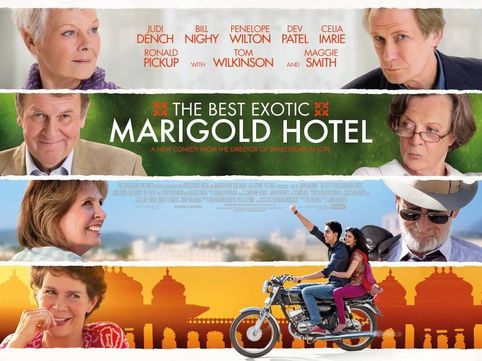
The Best Exotic Marigold Hotel

Outsourcing old age, that’s the idea.

Imagine in the distant (or not so distant) future, you retire to a warm climate, enjoy a colourful land and best of all, affordable living in a retirement resort. The concept is sold to several retirees from Britain. Little do they know the advertised Best Exotic Marigold Hotel for the Elderly and Beautiful is a run-down establishment of faded glory. The place is Jaipur, India.

The Hotel owner is Sonny Kapoor (Dev Patel of Slumdog Millionaire fame) who has inherited the property from his late father. Despite his mother’s insistence to close it down and get him back to live with her in Delhi to marry the girl of her choice, Sonny is determined to make it on his own. He has already picked out his girl, and is positive about his plan to outsource retirement, among many other services India is already offering to foreign countries.

The trailer doesn’t do justice to the movie. When I first watched it, I was totally baffled … why would such a top-notch cast of veteran British actors take up what seems to be a shallow and silly farce? But after watching the movie, I think I can make a guess: they must have known what fun it would be to do this, they must have sensed the thematic relevance as well. Why I went out to see it if I didn’t like the trailer? I just couldn’t resist the combined star power and my trust in their judgment.

Where can you see these actors together on one big screen: Judi Dench, Evelyn, who has depended on her husband all the years but now recently widowed, decides to take charge of her life; Maggie Smith, Muriel, who is xenophobic and won’t eat anything she can’t pronounce, goes to India mainly to have a hip replacement she can afford; Bill Nighy and Penelope Wilton, Douglas and Jean, are an incompatible couple who sticks together out of habit and loyalty; Tom Wilkinson, Graham, a judge who follows his heart and returns to his former home to look for a long-lost friend; Celia Imrie, Madge, who at retirement is still looking for the right one, and Ronald Pickup, Norman, seems to know exactly what he wants.

The humour is natural and not forced, the dialogues are witty and refreshing. Something that is not easily found in comedies, with the expert cast of veteran actors, a sense of seriousness exudes from their performance, giving weight to the characters and making their simple storylines convincing.

Oscar nominated director John Madden (Shakespeare In Love,1998) has done a great job in concocting the on-screen chemistry of his cast. Their camaraderie as fellow travellers from the UK and as guests in the Marigold Hotel emit an appealing and quiet persuasion. I’ve enjoyed every one of their storylines. From the very start of the film, I’m drawn into each of the characters while they are still in England. I follow their journey expectantly, open and ready to accept the unfolding of events.

As with all ‘exotic’ movies, there bound to be cultural features that can easily lead to stereotyping and patronizing. That I expected. But what I didn’t was that these ‘typical’ renderings are few and mostly restrained. Further, shot right in Udaipur, India, many scenes are in situ happenings that come out naturalistic and real. The whole movie is a delightful surprise, probably the main one is, I don’t mind watching it again.

~ ~ ~ Ripples

The Rant of the Armchair Traveller

From the comments in my last post, seems like Egyptology is a favorite subject of many, if not now, at least some time in our curious life. I’ve had the chance to visit Egypt twice during my travels to the Middle East. Since now is the warm month of May, kicking off the travelling season, and alas, since going anywhere far is a remote possibility for me at present, an armchair revisit is timely, if only to suppress burning wanderlust.

Here are some file photos from my last trip to Egypt five years ago. I only stayed in Cairo and its vicinity. But from my recent reading of Lord Carnarvon and Carter’s King Tut Tomb discovery, I regret I didn’t venture further to the Valley of the Kings in Luxor. However, I did see the iconic King Tut’s mummy mask at Cairo’s Egyptian Museum. Photography was forbidden, so no King Tut’s portrait here.

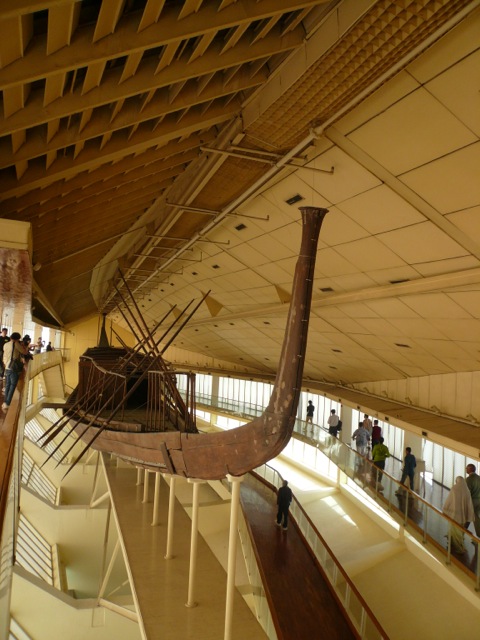
But I can show you another marvellous exhibit. In 1954, a Pharoah’s boat dating back four millenium was dug up in pieces and since reassembled. Beautifully showcased in another museum near the Great Pyramid of Giza. Photos were allowed here, but Arti’s pocket Lumix wasn’t enough to capture the magnificent whole. If you’re interested, click here to a full description.

Pharaoh’s Boat buried 26th Century B.C.

Another view:

The Pyramid and the Sphinx are probably what travellers go to Egypt for. While the Sphinx is a limestone statue of the mythical creature with the lion body and the human head, the Pyramid was piled up in stones. Can’t say which one is easier to make.

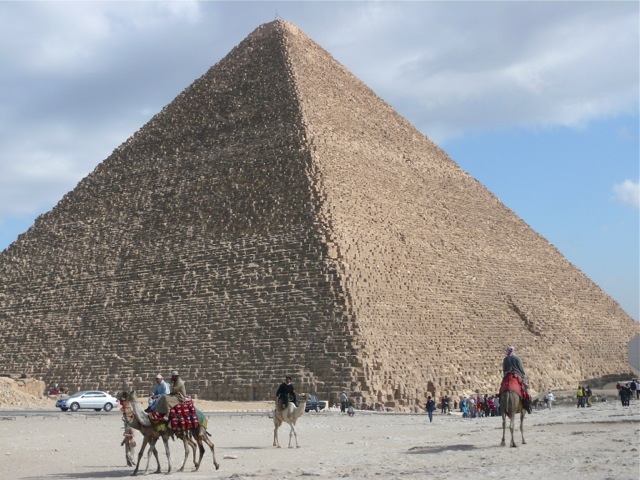
The oldest of the Seven Wonders of the Ancient World that is still standing, The Great Pyramid of Giza was built for the fourth dynasty Egyptian Pharaoh Khufu, a 20 year construction process which concluded around 2560 B.C. (Wikipedia data) As for Arti, no exact date was needed. Standing at the foot of the humungous pile of neatly stacked up stones was an experience itself.

The Great Pyramid of Giza

Not far from the Pyramid, The Sphinx:

The Pyramid and The Sphinx

A closer look… so what if I’ve lost a nose, I still stand sit after all these years:

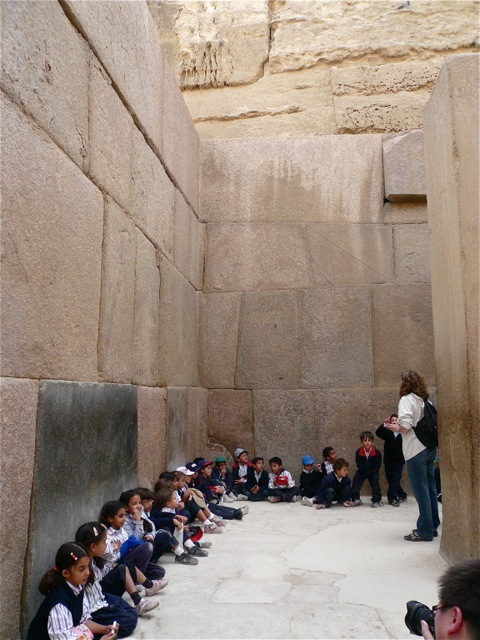
Let the stones speak:

and the children listen:

We were travelling in a bus through the desert, and stopped for a view. Here are some other children I saw, took this picture through the window:

Mount Sinai, the legendary place Moses received the Ten Commandments from God. At the foot of the mountain range is St. Catherine’s Monastery:

 Man’s best friend. They wait without complaint:

The desert is mesmerizing regardless of the hour:

Desert moon at dusk

While I faithfully pick up mail for neighbors gone to Paris, or read with pleasure blog posts of your recent travels, I feel like jumping on the armchair bandwagon and join the massive global tourism movement. Ok everyone, I’m coming along.

***