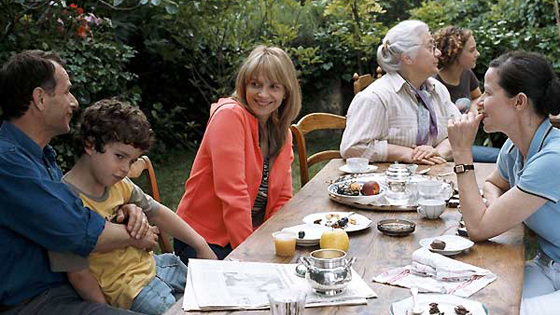
The Lunchbox (2013): A Meal that Binds

The Lunchbox premiered at Cannes last year. Since then, it had appeared in many other international film festivals, nabbing nominations and wins. I missed it at TIFF last September, so am glad I’ve the chance to watch it in the theatre recently. Here’s my review published in the May 18 issue of Asian American Press, a weekly newspaper based in Minneapolis, MN. That’s right, folks, it’s globalization.

***


The Lunchbox Movie Poster

The lunchbox, dabba, is a stackable unit of four or five round metal cans fastened by straps on the side that flip up to attach to a handle on top. Every day in Mumbai, India, five thousand dabbawallahs, or lunchbox deliverymen, would fetch the dabbas from homes after housewives have filled them with hot food and deliver the tiffin to their husbands in their offices. After lunch, they would return the empty dabbas back to each home.

In Mumbai alone, there are five thousands dabbawallahs, many of them illiterate. For one hundred and twenty years, they carry dozens of dabbas on their bicycles, negotiate the mass of humanity and impossible street traffic and railways to bring office workers a hot meal from home, or from dabba preparation outlets. Harvard University had studied their inexplicable coding and delivery system. Their finding: only one in a million of these dabbas would ever get lost.
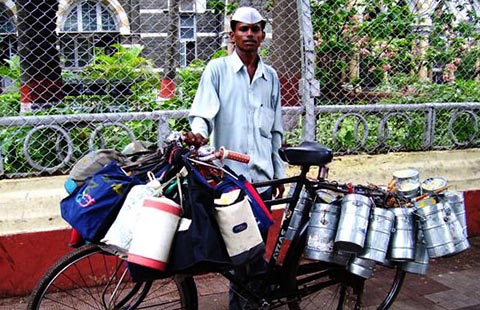
dabbawallah

If you think the title is too mundane for a movie, then just focus on that one-in-a million lost lunchbox. It is picked up from a young housewife, Ila (Nimrat Kaur), and delivered to the wrong recipient, Saajan Fernandes (Irrfan Khan, Life of Pi, 2012), a retiring office worker who has been on the job for thirty-five years. Thus begins the exchange of short notes then letters placed inside these tiffin cans, two strangers who are socially worlds apart, but joined together by a savory meal.

The veteran actor Irrfan Khan won Best Actor at the 8th Asian Film Awards in March this year for his role in The Lunchbox, adding to his several other wins for the film. His subtle and nuanced performance requires no dialogues. Indeed, both Saajan and Ila have not shared a frame together in the movie. I would not so much call this a romantic comedy as their relationship is purely platonic. The romance could well be the ideals and dreams they stir up in each other’s mind through the exchange of written notes. If there is anything comedic it comes as finding a listening ear, a slight relief from the mundane and inescapable in life.

It is interesting to watch how writer/director Ritesh Batra reveals to us the dabba as a metaphor. Like the stackable cans, the story is multi-layered. It touches on marriage, human connections, memories, and dreams. From the mass of humanity, we focus on two individuals striving to find meaning in their daily existence. Like the fastener that strap tight the cans of the dabba, Ila is caught in a loveless marriage with her husband Rajeev (Nakul Vaid), and the aging Saajan is bound by memories of his late wife.

Ila prepares lunch

The film begins with Ila’s attempt to make a delicious meal for her husband Rajeev to win back his heart through his stomach, an advice from an upstairs neighbor Ila calls Auntie (Bharati Achrekar). Ila communicates with Auntie by talking out of her kitchen window. Herein lies the subtle humor of the movie. We do not see Auntie, except just hear her voice. She is like an invisible adviser to Ila’s love life. Poignantly, Auntie herself has been taking care of her own husband, Uncle, who is bedridden and in a comatose state for fifteen years. If life is a bondage like the dabba, Auntie doesn’t show it a bit from her cheerful voice.

Ila’s delicious meals soon get through to the heart of Saajan, the mistaken recipient. Saajan lives alone, and seems to be heading straight to even more meaningless days in his retirement. The note exchanges gradually break through his isolation. Further, albeit reluctantly, he has to train his replacement at work, the young and enthusiastic Shaikh (Nawazuddin Siddiqui). Now this is one lively character that not only offers a humorous foil to the withdrawn Saajan, but like Auntie, Shaikh is optimistic about life, even though he has grown up an orphan. Soon, Shaikh has broken down the barrier with Saajan and the two establish a kind of father/son relationship.

Saajan & Shaikh

With The Lunchbox, his debut feature, Batra has won several screenplay and directing awards. He is definitely one promising filmmaker to watch. His approach here is naturalistic. Shooting on location in Mumbai, the camera captures realistic, ethnographic street scenes and the mass on public transits, telling this Mumbai story in situ. Through the handwritten notes hidden in the mundane dabba, delivered by a traditional human service, the film vividly shows us that even in our day of emails and instant messaging, the route to connect is still through the human heart.

~ ~ ~ 1/2 Ripples 

***

Related Movie Reviews on Ripple Effects:

Life of Pi (2012): The Magical 3D Experience

English Vinglish (2012)

Slumdog Millionaire (2008)

The Namesake (2006): Movie Review

***

Another Year (2010)

Update Feb. 10: Leslie Manville just won British Actress of the Year at the London Film Critics’ Circle Awards.

Update Jan. 25: Mike Leigh is nominated for an Oscar for Original Screenplay.

Update Jan. 18: Another Year is nominated for a BAFTA for Outstanding British Film of the Year, and Leslie Manville for Best Supporting Actress.

“Ah, look at all the lonely people.”

— ‘Eleanor Rigby’

Every DayAnother Year, film titles like these evoke the oblivious passage of time, and the human experiences that float down the stream of life. The kind of films we would find in art-house cinemas, not your fast-paced action or effects-generated spectacle.  Another Year would gratify one’s need for slow ruminations and offer one time to savour the dynamics among characters.  The film was on my ‘must-see’ list at the Calgary International Film Festival 2010, which ended last weekend.  It had met all my expectations and offered more.

What’s more is the excellent performance from a high calibre cast of British actors.  Their nuanced portrayals of characters convey emotions unabashedly, but in a deep, restrained and unsentimental manner.  That is what makes Another Year so satisfying.  I enjoyed it much more than director Mike Leigh’s previous title, equally acclaimed Happy-Go-Lucky (2008), in which Poppy (Sally Hawkins) the happy gal is just a bit too loud and even obnoxious for me.  While here in Another Year, Tom and Gerri are the happy couple whose relationship is one of mature, quiet and gentle bliss, compassionate towards themselves and others.

Framed in the passing of the four seasons, the film explores the realities of life: ageing, loneliness, death, love, marriage, friendship… Yet the occasional animated and humorous renderings of the characters allow a lighter way of handling the subject matters.

Gerri (Ruth Sheen) and Tom (Jim Broadbent) are a happily married couple living in London.  In the midst of the bustling city, they have their own plot of land close by their home where they work hard to grow vegetables. They bring home fresh produce to cook healthy meals and entertain guests.  Their vegetable garden is an apt metaphor for the love they cultivate in their relationship despite the busyness of everyday life. Tom is a geologist and Gerri a counsellor in a medical office. If there’s any pun intended here with their names, it would be for the very opposite effect that they are a harmonious pair whose relationship has attracted those less happy to cling on for stability and support.

Their usual dinner guest is Gerri’s office administrator Mary (Lesley Manville).  A single, middle-aged woman, emotionally fragile, alcohol dependent, and desperately seeking love and companionship. Her male version is Tom’s long time friend Ken (Peter Wight), equally miserable. A heavy smoker and drinker, Ken’s physical health mirrors his emotional state.

But why Tom and Gerri gather such damaged and dependent friends the film does not explain.  What we do see is a most gracious couple extending their lives to them. Through their interactions, we see the contrast. While we admire the almost perfect marriage, we ache for the singles, sad and lonely… as we see them in this film.  I trust the director is making a specific rendering and not a generalization on singlehood.  The contented Poppy (Sally Hawkins) in Happy-Go-Lucky (2008) is the best spokesperson for the single league.

Tom and Gerri have an adult son Carl (Martin Savage) who frequently comes home to visit his parents from a nearby town by train. When I saw the shot of a commuter train going past on screen, it flashed upon my mind the image in Ozu’s works.  That is one of the Japanese director’s signature shots, a train passing through, and his favourite subjects also being family, marriage, nuanced interactions.  I thought, if Ozu were an Englishman living today, this would be the kind of films he would make.  And lo and behold, I found this tidbit of trivia on IMDb: One of Mike Leigh’s top 10 films of all time is Tokyo Story (1953).

If one is to find fault with Another Year, it could be the very fact that Tom and Gerri’s marriage is just too perfect. But with all the ubiquitous dysfunctional families we see represented in movies nowadays, Leigh might have opened a window to let in some much needed fresh air. Tom and Gerri make an ideal contrast to what we have so sadly gotten used to seeing in films.

There are excellent performances from the veteran actors, but one stands out. Lesley Manville’s animated portrayal of the vulnerable Mary deserves an Oscar nomination. The most impressive shot comes at the end. Without giving it away, let me just say the ending shot lingering on her face and the ultimate fade to black is poignant and most effective. Of course, it’s acceptable to applaud after a festival screening. And so we did, appreciatively, a much needed channel for a cathartic response.

~ ~ ~ 1/2 Ripples

Every Day (2010)

In the movie Shadowlands, there’s a line that goes like this: “We read to know we are not alone.”  I think it applies to watching movies as well.

I’m glad somebody thinks the every day family life worthy of movie material.  Nothing spectacular or heroic, nonetheless difficult and to some, a struggle.  This is especially true when it comes to the so called sandwich generation, adult children who needs to care for their elderly parents as well as their own children.  Caught in the middle, parents to both.  In the midst of daily challenges, there remains the key relationship, the meat in the sandwich if you will, that which is between husband and wife, and always, the bare essence of a person and his/her integrity.  Herein lies the ingredients of the story.

Screened at the Calgary International Film Festival last night, the indie dramedy stars Liev Schreiber and Helen Hunt as a NYC couple, Ned and Jeannie.  Their marriage faces a testing turn as Jeannie, driven by guilt and responsibility, brought her recently widowed father home to stay.  Ernie (Brian Dennehy) is not just any grumpy old man.  He is wheelchair confined, in ill health, and utterly bitter about everything and with everyone.  Jeannie is stressed out as she keeps pace just to live every single day.

Ned too has his share of problems at work.  As a scriptwriter for a seedy TV series, he has to meet the perverted demands of his boss Garrett (Eddie Izzard) to churn out scripts that are beneath his style.  To solve the problem he is assigned to work with a flirtatious colleague Robin (Carla Gugino) to rewrite something more daring and less boring.  Ned is tempted to do exactly that not only in his script.

And for their sons, they may look alright, but both yearn for direction and care just the same.  15 year-old Jonah (Ezra Miller) has just come out and is heading towards some risky friendship.  The younger one Ethan (Skyler Fortgang), though talented, has to deal with a defeating self-image. Amidst their own problems, Ned and Jeannie try to be good parents, loving yet setting limits, albeit finding a happy medium is hard to do.

Though not meant to be a serious film, it does touch on two thought-provoking questions implied by two unlikely characters.  From Robin the seducer:  Is a marriage finished when the ‘fun’ is over? Similarly from Ernie the bitter old man:  Should a life be ended when there is no happiness?

With subject matters as such, sitting through Every Day could be a gloomy ordeal.  But as a fusion of comedy and drama, it has come through to me as an enjoyable film. Written and directed by Richard Levine of the TV series “Nip/Tuck” fame, Every Day could seem episodic.  But the fast scene changes keeps the momentum going and the subplots clear.  Liev Schreiber is convincing as the family man in mid-life crisis.  Brian Dennehy is a veteran and spot on in his performance.  The boys are alright.  I have enjoyed Helen Hunt the most.  Her precarious roles of mother, wife, and daughter have resonated with me.  It has been three years since her directorial debut Then She Found Me.  I look forward to more of her works in the coming year.

Every Day premiered at the Tribeca Film Festival in NYC this April.  During the Q & A after the screening, Schreiber mentioned that the film is “a simple story and simple stories are often overlooked.”  Somebody has to make simple films like this, and somebody has to watch them.  I was one of the lucky ones last night at the CIFF.

~ ~ ~ Ripples

Photo Source: myveronanj.com

I’ve Loved You So Long (2008, France) Il y a longtemps que je t’aime

Update: 

March 3:  The DVD has come out.  For those who don’t like to read subtitles, the DVD has an English Version with Kristin Scott Thomas voicing her own part.  But nothing compares to the original of course. 

Feb. 8  I’ve Loved You So Long has just won the BAFTA for Best Film Not In The English Lanugage tonight in London, England.

Dec. 11:  I’ve Loved You So Long has just been nominated for two Golden Globes, Best Foreign Film and Best Actress (Drama) for Kristin Scott Thomas.

Sisters reuniting is the storyline of several movies recently, as in Margot At The Wedding (2007) and Rachel Getting Married (2008 ).  But both Nicole Kidman and Anne Hathaway are just featherweights compared to Kristin Scott Thomas’s powerful performance here in I’ve Loved You So Long.

il-y-a-longtemps-que-je-taime

Winner of the 2008 Berlin International Film Festival, I’ve Loved You So Long is the  directorial debut of Philippe Claudel, French novelist, screenwriter, and professor of literature at The University of Nancy.  It is unfortunate that festival films like this one are rarely shown in North America, except in major selective cities.  I’ve wanted to see the film for a while, but not until my trip to Vancouver last week did I have the chance to watch it in a theatre.

In the film, the reunion of the sisters comes under the most unusual of circumstances.  Kristin Scott Thomas (The English Patient, 1996) plays Juliette, an older sister who has just been released on parole after 15 years in prison.  She rejoins society to the  embrace of her younger sister Léa (Elsa Zylberstein).  Léa was only a young teenager when her much older sister was disowned by their parents.  To them, the crime she had committed was unforgivable.   Léa was told to ostracize Juliette, as the rest of the family did.   Now years later, Léa is teaching literature at a university, and  mature enough to reconnect the tie that binds.   She receives Juliette  into her own home, a warm family with a loving husband, two adopted Vietnamese girls, and her father-in-law Papy Paul (Jean-Claude Arnaud), who has lost his ability to speak after a stroke.  But her husband Luc (Serge Hazanavicius) is apprehensive, and understandably so.

Like the viewers, Léa is kept in the dark as to the details of the act Juliette had done , a secret that is painfully borne by Juliette alone.  The slow unfolding of the facts thus sets the stage for the heart-wrenching performance by Scott Thomas.  The film is an exploration into the nature of good and evil, love and forgiveness.  In our society that excels in labeling people, the writer/director leads us to ponder the questions of what constitutes a crime, who are the victims, likewise, who are the strong, the helpers, and who are those that need help?  How can we truly know each other?  And ultimately, what is love?

ive-loved-you-so-long

I admire that the elegant Oscar nominated actress Scott Thomas was willing to take up a role that would cast her against type, and to work under a first-time director.  Devoid of  make-up, her gaunt and haunted look,  deep set eyes and languid lids, and the high cheek bones that used to speak of beauty in her other films now form the epitome of a soul tormented.  Her icy demeanor reflects a guarded self that is too wounded to risk another blow.  Though released from physical confinement, Juliette is still imprisoned by her own guilt, and has to serve a  life sentence of torments from the ambivalence of her act.  Scott Thomas has poignantly portrayed a believable character and effectively created a tragic heroine.  Juliet is out of prison, has nowhere to go, lost to herself and the world.

Yet love paves the road to redemption, and courage is the building block.  While Léa plays a major part in reaching out to Juliette, her adopted daughters and even the silent Papy Paul have all unknowingly participated  in the healing process. It is his silence and the calming effect of his books that Juliette finds affinity.  In sharing the French children’s song ‘Il y a longtemps que je t’aime’ with Léa’s adopted daughter P’tit Lys (Lise Ségur), she ventures out to reconnect in a meaningful way.

Léa also invites Juliette into her circle of friends, in particular, her colleague Michel (Laurent Grévill).  Michel has spent some time teaching in a prison.  He reaches out to Juliette with his understanding and compassion, and shares with her the enjoyment of art.  Although he does not know the full details of her circumstances, he respects her humanity and offers his friendship, even when Juliette is not ready to receive.  He patiently waits.

Engrossing and intense, the film nonetheless offers a satisfying experience.  Even though I was able to guess the nature of the dark secret underlying the suspense, such that it has lessened the effect of surprise on me at the end, I still find the film thoroughly enjoyable, in particular, the superb acting from both sisters.  For those who associate tears with melodramatic and contrived effects, the film is an apt refutation of such a view.  Tears are most welcome and cathartic as a closure here after almost 90 minutes of elliptical restraint,  for they are  the very expression of reconciliation and redemption.  The climax is one of the most poignant I’ve seen in a long while, and the subsequent ending, a triumph.

I look forward to more of Claudel’s work.  And for Kristin Scott Thomas, I think she deserves no less than an Oscar for her performance.

~ ~ ~ ½ Ripples

****

Rachel Getting Married (2008)

“I think families are weird and insane…

They are the best source material.”

Jenny Lumet Interview with L.A. Times

I can’t agree with Lumet more… well, maybe not the insane part.  As screenwriter (daughter of director Sydney Lumet), she must have pondered the facts that the family is the first point of social contact a newborn is introduced to, the hotbed of human relationships from jealousy to rivalry, and the school of harsh lessons, learning to love amidst hate, forgive despite hurt.  That is the scenario in her script Rachel Getting Married.

And usually it’s at weddings that the raw emotions are exposed and where conflicting sentiments are so intense that they become unmanageable, hence, the source materials for many of our films…

It was full house again at The Calgary International Film Festival’s screening of Rachel Getting Married. First time screenwriter Jenny Lumet has crafted a realistic family portrait.  Director Jonathan Demme (of The Silence of the Lambs fame) uses roving camera work to effectively capture the naturalistic look, giving me the impression that I’m watching the home-made video of another family.  This film is definitely not for those with weak stomach or who are easily nauseated.

The movie is about Kym (Anne Hathaway) returning home for her sister Rachel’s (Rosemarie DeWitt) wedding.  Kym has been in rehab for some years, trying to deal with substance abuse.  Coming home is bitter sweet for all. First, Kym’s father has remarried and a wedding means the re-appearance of Kym’s mother (Debra Winger), and the re-opening of old wounds.  Further, the jealousy and sibling rivalries are still intense, albeit hidden within a facade of good will most of the time. As the story unfolds, we see the tragic past of the family, its emotional residue still spilling out to the present.

Shot in a naturalistic style (Robert Altman is acknowledged in the end credits), with a hand-held camera jolting its way through family gatherings, punctuated with non-script-like casual and spontaneous talks, the film makes us feel like we’re secretly prying into another family’s affairs.  But herein lies the merit of such an incisive look.  The truth is, if we get the chance to peep behind the curtains into other people’s homes, we would probably find how similar they are with our own.   We may not have to deal with a substance abuser, or have gone through similar tragedies, but we have to live with the common human emotions of hurt and disappointment, rivalries and anger.  We are encouraged when we see how others find redemption, and from the pit of negativism, rise up and go forward.

Anne Hathaway has shown that she can act outside of the sweet and charming feminine roles as in The Devil Wears Prada (2006) and Becoming Jane (2007).  Here in Rachel Getting Married, she has effectively delivered an excellent performance as a messed up substance abuser struggling to redeem herself.  The film could well lead her to other more character-driven roles in the future, or maybe even an acting nomination.

As for the film itself, the roving camera work is not for everybody.  With its almost 2 hours running time, seems like it needs a bit more work on editing and pacing to make it more appealing.  Do we need so many musical numbers?  Overlooking the melodramatic parts, the film is still effective in delivering a very human story.

~ ~ ~ Ripples

Update December 11:  Anne Hathaway has just been nominated for a Best Actress Award at the 2009 Golden Globes for her role in Rachel Getting Married.

*****

COPYRIGHT WARNING:

Arti of Ripple Effects is the writer of the above original review, posted on September 30, 2008, here at https://rippleeffects.wordpress.com   ALL RIGHTS RESERVED.

If you see this article on some other blogs or websites (as I have) without acknowledgment, citing, or linking back to Ripple Effects, then you know it has been copied without permission from the author.

Summer Hours (l’Heure d’été, France 2008)

September is International Film Fest month in several Canadian cities.  Kicking off was the prominent TIFF (Toronto, world’s largest FF), now’s the CIFF (Calgary), and later on in the month, the VIFF (Vancouver).  Last year I was able to catch a glimpse from each one of these events.  But this year I’ll just stick with Calgary.

Went to see French director Olivier Assayas’ (Paris, je t’aime, 2006; Clean, 2004)  Summer Hours last night, the only screening in Calgary.  Writing the script himself, Assayas has created a film so realistic that it seems like a docudrama.  The story is about three adult siblings dealing with the estate of their mother (Edith Scob), a treasure house filled with objets d’arts, from furniture to vases, paintings to artist notebooks.  It’s a visual delight for the art lovers in the audience, albeit the camera doesn’t stay long enough for us to savor… I’d love to see more close-up lingering shots of the notebooks.

What’s realistic of course is, while the objects can easily be passed on from one generation to the next, the emotions and sentiments associated with them cannot.  The eldest son Frédéric (Charles Berling) wishes to leave the house as is so everyone in the family can still stop by and cherish the memories, but his other two siblings think otherwise.  Adrienne (Juliette Binoche) works as a designer in New York and is soon getting married.  Jérémie (Jérémie Renier) works with a sports manufacturing company in China and is settled there with his family.  Though all appreciate the memories of their childhood home in France and the artifacts within, they have their own life to live and family to raise elsewhere.  Their decision of how to deal with their mother’s estate is a practical one, sell it.

The Musée d’Orsay in Paris is the honorable recipient of these personal treasures.  Actually, Assayas was commissioned by the Museum to create the film in celebration of its 20th anniversary.  Here we see the pathos of turning family heirloom into museum pieces, albeit handled gently and meticulously by the staff.  Herein lies the crux of the film.  Assayas has depicted the human side of objets d’arts that we see in museums, how they could have been everyday household items, a table on which notes have been scribbled and letters written, a vase that has held many cut flowers from the garden.  These have been objects used and enjoyed privately by families, but are now desensitized, hung or displayed in a public arena.  The personal and subjective experiences could never be captured by the public eye.

The last scene is a closure for the pain of letting go.  The teenage grandchildren have one last chance to enjoy the house and its idyllic setting as they hold a large party for their friends.  The young immerse themselves in loud music, dancing, doping, and dipping in the pond, unaware of the passing of one era to the next.  A brief moment of sadness takes hold of the oldest granddaughter, as she savors a lingering memory in the garden.  She is joined by her boyfriend for a brief reminiscence and the next moment, they quickly dash back to the house to rejoin the party.  Assayas has painted the poignant in a most subtle manner.

~ ~ ~ Ripples

My Blueberry Nights (2007)

Shown last year at the Cannes and several other Film Festivals before coming here for a general but limited release, My Blueberry Nights is director Wong Kar Wai’s first English language film. Since his legendary Chungking Express (1994), Wong’s films have attracted a cult following. I’ve thoroughly enjoyed his previous titles like In the Mood for Love (2000) and its sequel 2046 (2004). Let me just describe his style as “Film Noir in Postmodern Colors”. Wong’s films are atmospheric, flashy, up-close and penetrating. His characteristic use of mirrors and small, enclosed settings juxtaposes the reflective and the surreal. Many find him incomprehensible, frustrated at his sometimes self-absorbed artistry.

Wong’s signature directorial style found some new players here in My Blueberry Nights. In this debut film of popular jazz diva Norah Jones, Wong cast her against some very impressive acting talents including Jude Law, David Strathairn, Rachel Weisz, and Natalie Portman. Visually, MBN is a colorful cinematic kaleidoscope. Unfortunately, it remains merely so, for underneath the visual plane, there is not much substance in the script to gratify. It is almost painful to see acting talents uttering cliches and simplistic dialogues, and to even overact to compensate.

Jones is Elizabeth, newly dumped by her boyfriend and finding a confidant in cafe owner Jeremy, played by Jude Law. To escape from the pain of lost love, she leaves on a road trip on her own across America. Working as a waitress along the way, she meets characters who are in worse shape than she is: A police officer (David Strathairn) despair in love, his estranged wife (Rachel Weisz), and a weathered gambler who befriends her and teaches her a life lesson: never trust anyone. This role is played by Natalie Portman…ok, there might be a miscast here, but Portman has delivered some captivating performance. While this is Jones’ first time acting, her unseasoned and naive persona ironically is quite appropriate as the young and impressionable Elizabeth.

All the acting and singing talents however are not sufficient to rescue a deficient script. If you’re not a devoted fan of Wong Kar Wai, or any of the actors and singer here in this film, you might just like to manage your time better. I’ve admired some of Wong’s previous works, but am disappointed at this first piece in a new page of his career. Having said that, I look forward to his future endeavors.

~ ~ Ripples

                                          *****