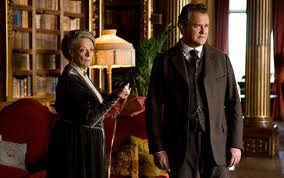
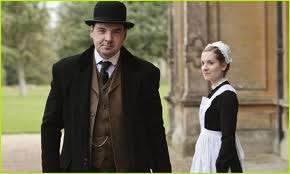
Downton Abbey, The Complete Scripts: Season One

I had once talked with someone who avoided watching the ‘making of’ special feature that comes with a DVD. His reason? He did not want to see his favorite movies demythicized. Well, if you’re that sort of a viewer, then this book is not for you.

Downton Abbey The Complete Scripts Season One

But, if you’ve enjoyed the phenomenon called Downton Abbey, and are curious to learn about the creative writing process that kicked it off, then I’d say, this is an absolute must-read. And for those who keep going online to find quotable quotes from the series, here you have them all, and some more.

As someone interested in screenwriting, I would look for the scripts of movies I like, usually online. So it’s a wonderful discovery for me to see this book at the bookstore. Julian Fellowes has dispelled the magic and shared with us the scripts of all episodes for Seasons One and Two, most importantly, with his own annotations. Consider this the literary version of the ‘making of’ in your special features, more accurately, the screenwriter’s commentary.

In his Foreword, Fellowes introduces the book as ‘the complete scripts of the first series as they were when they went forward into production.’ So here we have the whole idea before cutting and editing, including deleted scenes and dialogues, plus Fellowes’ own explanations for the deletions. He walks us through the whole series, literally, and offers helpful background on the social history of the time, and many more tidbits.

You can also see why the collection is such a useful tool as an exemplar of a successful writing process, in particular, the editing phase. The main reasons for deletion is redundancy, and with a TV production, time. Another is for keeping the integrity and consistency of the characterization and the story. It’s intriguing to see the final version is the outcome of well-pruned and collaborated efforts.

An example of a deleted scene where Matthew answers Robert’s bewildered query about how he would manage to commute and continue to work as a lawyer while being heir of Downton.

Robert: How will you manage it?
Matthew: Like many others, I shall bicycle to the station, take a train there and back, and bicycle home.

Here’s the screenwriter’s commentary:

Here we have Matthew talking about bicycling to the station which is quite unnecessary as we see him do it. When you’re writing something you often forget that it’s going to be told visually, and so there are things that don’t need to be said.

With eighteen characters in the story, the writer has done a superb job in keeping them well developed, and eliciting our interest in each one of them. First I notice how short each scene is, something that just flashed by when watching, but reading it can even be more obvious. I’ve counted most of the scenes to be less than 60 sec. on screen. Each therefore needs to be succinct to make the most of the time. Makes me think of another way to apply that famous Hemingway quest, always aim for that one true scene.

To manage the long list of characters, here’s the brilliant way, something that’s so obvious when Fellowes explains, but then so subliminal while we’re watching them on screen, foils and parallels:

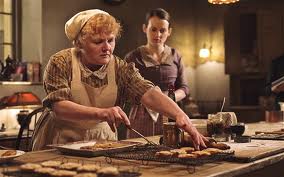
I love Mrs. Patmore. I think Lesley Nicol’s performance is fantastic. She is the kitchen Violet. Maggie Smith delivers the cryptic comments upstairs, Lesley has the barbed tongue downstairs. In a sense they balance each other, as Robert and Bates, or Anna and Mary, balance each other.

And here I add, other pairs we can see upstairs Violet and Isobel, or down, Mr. Carson and Mrs. Hughes. Great performance comes when an actor is given the chance to play against an equal, in character and caliber.

Further, Fellowes reminds us that it’s the actors that give life to mere words on the page. As the actors interpret, take off with and develop the characters on their own, the screenwriter continues with that development and write accordingly in the upcoming episodes. Isn’t this a most fascinating creative process? Writer and actors inspiring each other.

It’s always interesting to see what the screenwriter thinks of the final production. And Fellowes is candid in sharing his views, which reminds me of the fact that it’s all a collaboration, team work, and not just one person’s monopolized brainchild. The writer writes, the actors interpret and live out the words, the director sets the tone, the direction, the cuts, plus numerous others who work on the sets to play their roles.

I most appreciate and am somewhat surprised to find Fellowes uses many of his own experiences, stories he has heard, or memories of his own family, to create the scenes. Some interesting tidbits he shares include the scene in the kitchen rescuing the chicken from the cat before taking it upstairs, that comes from an embarrassing real life episode. Or Violet Crawley’s subtle dominance in the annual flower show, which he adapts from memories of his mother. Or his commentary on Sybil’s covering up of her political expeditions to Ripon, a parenting point:

Once children conceal their purposes or their social engagements or their plans for the weekend, that is the beginning of their move away from the parental set of values. Before that, God knows they may be rude or challenging, but they don’t usually have a private life, a secret agenda. And this is where it begins for Sybil.

It’s commentaries like this that you’d feel Fellowes is candid and open, just talking to you in a down-to-earth manner. Like everyone of us, he’d go online to do his research when he writes, such as the history of cataract surgery when writing about Mrs. Patmore’s.  Or admitting faults in certain scenes, and sharing about his own childhood experience and family dynamics, enlightening us with the norms and etiquettes of the time and the social history behind the scenes.

Demythicize? Definitely, with the effect that you’ll appreciate the production and the writing even more.

~ ~ ~ ~ Ripples

Downton Abbey The Complete Scripts Season One by Julian Fellowes, Harper Collins Publishers, 2012, 396 pages.

***

Related Posts You May Like:

Lady Almina and the Real Downton Abbey: Facts that give rise to Fiction

Quotable Quotes from Downton Abbey

Downton Abbey Season 3: Episodes 1

Season 3: Episodes 2 & 3

Season 3: Episodes 4 & 5

Season 3: Episodes 6 & 7 Finale

***

Lady Almina and the real Downton Abbey: Facts that give rise to Fiction

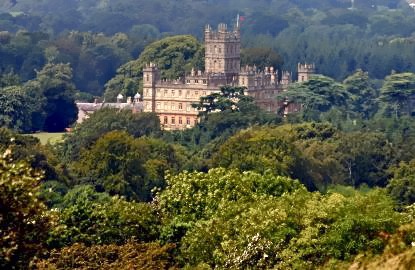
Downton Abbey in real life is Highclere Castle, situated among a thousand acres of beautiful parkland, perching on a hill with a vantage point of even more spectacular views. It is home to the Earls of Carnarvon for centuries. The book is written by Fiona Carnarvon. Lady Almina is the great grandmother of her husband, the 8th Earl of Carnarvon. The book chronicles the life and legacy of Lady Almina, who married into Highclere at 19, and evolved from a youthful debutante to a seasoned and capable, aristocratic lady with a heart. Here is the source material for the fictional creation so well received by viewers all over the world.

I’m not one easily swayed to follow what’s being hailed in current culture. But for some reasons I’ve been drawn to the human drama of the hugely successful Downton Abbey. Until I read this book I have not thought that mere facts can be as engaging as fiction. Compared to the epic proportion of historical events detailed in the book, the TV series are but minute vingnettes, albeit they do have their endearing appeal.

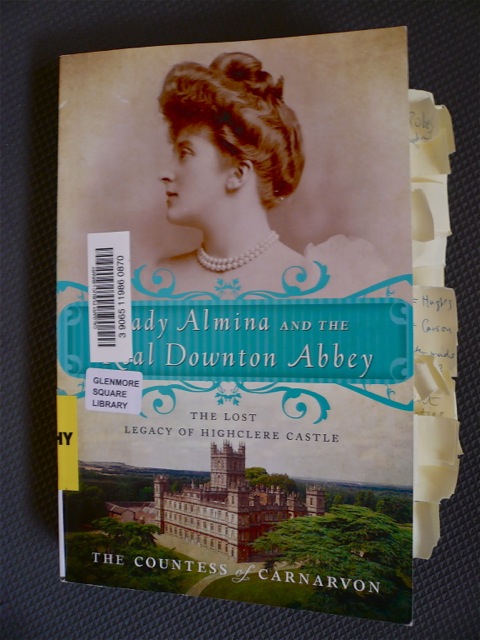
This is my library copy of the book after I finished reading it. There are no less than 80 tiny yellow stickies to mark my interest:

At first, I was expecting a book offering tidbits of the Highclere Castle, its designs and architecture, and how its life, both upstairs and downstairs, corresponds with the TV production, etc.

But while it lacks the design and architectural specifics I was looking for, the book has brought me something else. Yes, there is a myriad of Edwardian high society accounts, the fashion and the opulence, as expected. But to my surprise, the latter part of the book offers a greater appeal to me. I was fully absorbed by its massive archival information on The Great War, from the trenches in Europe to the battlefields in the Middle East, wartime to post-war politics, Highclere’s involvement in international power brokerage, George’s brother Aubrey and T.E. Lawrence’s friendship, and the last chapters bring me to the archeological site of the Valley of the Kings in Egypt.

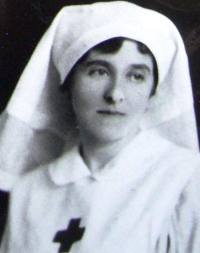
Nurse Almina

Unlike the Crawleys in Downton Abbey, the Carnarvons threw themselves fully into the war effort without hesitation. As soon as Britain entered The Great War (1914-1918), Highclere was turned into a well-equipped hospital, not just a convalescence home. Financially supported by her wealthy father, Almina hired the best in medical personel, well-trained nurses and specialized doctors, and furnished the Caslte with state-of-the-art equipment. Almina herself oversaw the whole operation and heavily involved in personal nursing care as well. A real-life Lady Cora/Isabel Crawley working in unity.

Seeing Matthew Crawley’s muddy face in the trenches cannot convey to me the horrors of the war. The detailed accounts in the book are terrifying to read. There were so many ways to die: guns and shells, broken bones even just a broken femur, long, bumpy rides to a hospital, gas, hunger, diseases, lack of medical supplies and doctors, even rain. Non-stop rain in Passchendaele had caused trenches to collapse, drowning many soldiers in the mud.

The Battle of Somme claimed 60,000 lives on its first day on July 1, 1916. Four months later, 415,000 British and Dominions soldiers had been killed or wounded. The Battle of Ypres saw the Germans use a new weapon. 168 tonnes of chlorine gas was released into Allied positions. 5,000 French soldiers in the trenches died within ten minutes, 10,000 were blinded as they escaped. In 1917, the number of British casualties and injured totalled 800,000. Many of Highclere staff were wounded and killed, those sent home were the lucky ones. The missing and the ones buried on foreign soil made the impact even more heartbreaking.

The Dowager Countess of Carnarvon, Elsie, had always been receptive to innovations and improvements. Unlike her counterpart in Downton Violet Crawley, Elsie welcomed electricity and the telephone. In 1919, at 63, she became vice-chairman of the Vocal Therapy Society and promoted the use of singing to help shell-shocked men to overcome debilitating stammers. Umm… she would have made a good team with Lionel Logue, who set up shop on Harley Street. Just ask Bertie KGVI, he knew it worked.

On a totally different note, the last chapters of the book transport me to the archaeological site of the Valley of the Kings in Luxor, Egypt. Almina’s husband George Herbert, 5th Earl of Carnarvon, was one of the last British aristocratic archaeologists, having spent £50,000 (£10 million in today’s money) over the course of fourteen years on excavating in Egypt.

Howard Carter, left, & Carnarvon at King Tut’s tomb

Lord Carnarvon personally hired the expert archaeologist Howard Carter to team up with him in his pursuit of Egyptian antiquities. Their breakthrough work came in 1922, when they discovered the burial chamber of the young King Tutankhamun. Unlike rumors that had distressed the archaeological dual that they would ship the finds to England, the King Tut artifacts have  been the possession of the Egyptian government since the discovery.

I had not realized the connection before… how Downton Abbey could have a certain degree of separation from King Tut. But the book soon ends with the sad news that the already weak Lord Carnarvon soon succumbed to illness. He died in Cairo at age 57, just a few months after the excavation. It’s noted in the book that at the time of his death, back at Highclere Castle in the night, his beloved terrier Susie howled once and died.

Here I’ve just touched on a few yellow stickies. You need to read the book to grasp all the significant events during that first quarter of the 20th century. As the book has been written and published ‘in record time’ as the author has noted, likely to coincide with the broadcast of Downton Abbey Season 2, it is not a literary work, not even a social or political commentary of any sort. Yes, I was looking for the author’s view on aristocracy and the Empire. Nevertheless, it is a compact historical account that chronicles the lives of some individuals who had left indelible marks in an era of irreversible change and new discoveries. 

Excellent Photos, A Bibliography of researched works and archival materials, and an Index make up the supplementary resources.

~ ~ ~ Ripples

Lady Almina and the Real Downton Abbey: The Lost Legacy of Highclere Castle by The Countess of Carnarvon, Broadway Paperbacks, NY, November, 2011, 310 pages.

***

Other posts you may like:

Quotable Quotes from Downton Abbey

The Rant of the Armchair Traveller

***

Quotable Quotes from Downton Abbey

SEASON 6 Recaps:

SEASON 6 FINALE: Goodbye to All That

SEASON 6 Episode 1, Jan.3, 2016

SEASON 6 Episode 2, Jan. 10, 2016

SEASON 6 Episode 3, Jan. 17, 2016

SEASON 6 Episode 4, Jan. 24, 2016

SEASON 6 Episode 5, Jan. 31, 2016

SEASON 6 Episode 6, Feb. 7, 2016

**

‘You can’t do very much as an actress unless you have the proper words to say…’ — Penelope Wilton, Isobel Crawley

Four weeks have passed since Downton Abbey Season 2 Finale aired on PBS. How are you holding up? To alleviate Downton Abbey withdrawal symptoms, I’ve been in a perpetual state of re-watching all the episodes from Season 1 and 2. Downton Abbey on Blu-ray is absolutely beautiful.

Downton Abbey film location: Highclere Castle

This Golden Globe, Emmy, and BAFTA award-winning miniseries has many appeals. For me, apart from the sumptuous setting, attention to details, great acting, and inspiring cinematography, the main attraction is the writing. Julian Fellowes’ script gives us intelligent dialogues reminiscent of Oscar Wilde’s wit and satire.

I have compiled a list of quotes from both Seasons. Lucky for 78 year-old Maggie Smith, she gets the best lines as Violet Crawley, Dowager Countess of Grantham.

Here they are in chronological order so you can reprise the scene. Enjoy!

Season 1

“O, heavens, girl. You’re building a fire, not inventing it.” — Mrs. Hughes to Daisy, S1E1

“Nothing in life is sure.” — Mrs. Patmore, re. Titanic sinking, S1E1

Mrs. Patmore and Daisy

“Every mountain is unclimbable until someone climbs it. So every ship is unsinkable until it sinks.” — Lord Grantham, S1E1

“We are allies, my dear, which can be a good deal more effective.” Violet Crawley, Dowager Countess of Grantham, in reply to Cora Crawley’s “Are we to be friends, then?” S1E1

Violet Crawley, Dowager Countess of Grantham

“What is a ‘weekend’?” — Violet Crawley, S1E2

“Daisy, what’s happened to you? I said you could go for a drink of water, not a trip up the Nile.”  — Mrs. Patmore. S1E3

“Are you afraid someone will think you’re American if you speak openly?” — Lord Grantham to Dowager Countess, S1E3

Dowager Countess and Lord Grantham

“But nobody learns anything from a governess, apart from French and how to curtsey.” Lady Sybil, S1E4

“No one ever warns you about bringing up daughters. You think it’s going to be like Little Women. Instead they’re at each other’s throats from dawn till dusk.” — Cora Crawley,  Countess of Grantham, S1E5

The Crawley Sisters

“Mary can be such a child. She thinks that if you put a toy down, it’ll still be sitting there when you want to play with it again.” — Lord Grantham, S1E5

“I love you Mr. Bates. I know it’s not ladylike to say it, but I’m not a lady and I don’t pretend to be.”  — Anna, S1E5
Mr. Bates and Anna
“If she won’t say yes when he might be poor, he won’t want her when he will be rich.” — Violet Crawley, Dowager Countess, S1E7
.
“First electricity, now telephones. Sometimes I feel as if I were living in an H.G. Wells novel.”  — Violet Crawley, S1E7
*****
Season 2
Mary Crawley seeing Matthew off to war.
 “War has a way of distinguishing between the things that matter and the things that don’t.” — Matthew Crawley, S2E1
.
Matthew Crawley in the trench

“I’m not a romantic… But even I concede that the heart does not exist solely for the purpose of pumping blood.” Violet Crawley, S2E2

“I’m a woman, Mary. I can be as contrary as I choose.” Violet Crawley, S2E4

“Are you like everyone else in thinking that because she’s a countess she has acquired universal knowledge by divine intervention?” Isobel Crawley to Dr. Clarkson re. Cora, Countess of Grantham, S2E4  (And you can substitute the word ‘countess’ with any word you need when quoting it.)

Dr. Clarkson and Isobel Crawley

“I’d rather have the right man, than the right wedding.” — Anna, S2E5

“I’m an American, I don’t share your English hatred of comfort.” Cora Crawley to Lord Grantham, S2E6

Lord Grantham and Cora Crawley

“Don’t be defeatist, dear. It’s very middle class.”  Violet Crawley to Edith, S2E8

“Sir Richard, life is a game in which the player must appear ridiculous.” Violet Crawley, Last Episode, Christmas at Downton Abbey.

“I want a good man for you, a brave man. Find a cowboy in the Middle West and bring him back to shake us up a bit.” Robert Crawley to daughter Mary. Last Episode, Christmas at Downton Abbey.

“1920. Is it to be believed? I feel as old as Methuselah.” Violet Crawley, Last Episode, Christmas at Downton Abbey.

***

DOWNTON RECAPS

DOWNTON Season 5 Finale, March 2, 2015: A Moorland Holiday

*

Season 4 Episode 8 (PBS): London 

Season 4 Episode 7 (PBS) 

Season 4 Episode 6 (PBS)

Season 4 Episode 5 (PBS)

Season 4 Episode 4 (PBS)

Season 4 Episode 3 (PBS)

Season 4 Episode 2 (PBS)

Downton Abbey Season 4 Opening (2 Hour) Special 

*

CLICK HERE to Quotable Quotes from Season 3: New List

*

SEASON 3: EPISODE 1  

SEASON 3: EPISODES 2 & 3 

SEASON 3: EPISODES 4 & 5 (More Downton Quotes)

SEASON 3: EPISODES 6 & 7 Finale

CLICK HERE to visit the Highclere Castle website. An absolute must-see.

*

Other posts you might like:

Quotable Quotes from Downton Abbey Season 3

Downton Abbey The Complete Scripts: Season 1

The Downton Ripples

Lady Almina and the real Downton Abbey: Facts that Give Rise to Fiction

***