Bright Star (2009)

Bright Star 1

Was it a vision, or a waking dream?

Fled is that music:– Do I wake or sleep?

— John Keats, Ode to a Nightingale (1819)

1819 was the most prolific year of the English Romantic poet John Keats.  Many of his well-known works were created then, two years before his untimely death from tuberculosis at age 25.  His muse was Fanny Brawne, his 18 year-old neighbor, a fresh and self-assured young fashion designer whom he met a year earlier. Untrained in poesy or prose, Fanny Brawne had nothing in common with the brooding poet, but Fate, cruel or kind, instilled in them a burning passion for each other.

Unable to maintain a living financially, Keats was honorable to restrain his love for Fanny, knowing marriage would never be realized.  Yet Fanny’s incessant devotion for him soon won him over.   In a short time, she devoured all of Keats’ poetry, as well as other literary works through the ages.  Their short-lived romance culminated in an engagement.  But they were never married.  Stricken by tuberculosis,  Keats left for Italy in 1820 to seek better climate for his ailing health, knowing that would be their last farewell.

When I have fears that I may cease to be

Before my pen has glean’d my teeming brain…

Nominated for a Palme d’Or at the Cannes Film Festival this year, Jane Campion’s Bright Star is a beautiful tapestry weaving together the visual and the word.  Based partly on Sir Andrew Motion’s biography on Keats, the film depicts the bittersweet romance between the poet and his muse, tragically short-lived yet ever burning bright.
Bright Star 3

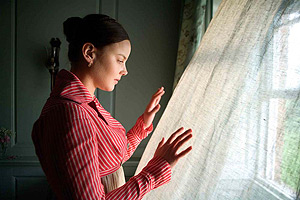
Campion has created on screen the dazzling visuals of the master painters.  There are numerous Vermeer moments in the interior shots, all done by the window with natural light seeping in as Fanny sews, makes her laces, reads love letters.  Outdoor scenes are a natural cinemascape reminiscence of impressionist vision.  Like the paintings of Monet and Seurat, hazy and dreamlike, they effectively convey the illusive union the young lovers achingly long for but is teasingly placed out of their reach.

Although never consummated, their passion for each other is no less ablaze.  The film is a clear statement that love is not synonymous with nudity and sex on screen.  Campion has depicted their passionate ardor with sensitivity and restraints.  There are moments of utter quietness, for love needs no language.  There are scenes adorned with melodious vocals and instrumentals, augmenting the yearning within.  Campion is a master of cinematic effects.

The talented Ben Whishaw (Perfume: The Story of a Murderer, 2006) is aptly cast as Keats.  Fanny Brawne is played by Abbie Cornish (Elizabeth: The Golden Age, 2007).  Both are award-winning rising stars in their homeland of England and Australia.  Bright Star could well be their breakout work in North America.

Bright Star 2

Paul Schneider (Lars and the Real Girl, 2007) is convincing as Keats’ friend Charles Brown, and what looks like Fanny’s love rival.  A stark contrast in character with the poet, Brown offers much needed tension and conflicts. Fanny’s adorable little sister Toots (Edie Martin) gets some of the best lines. Her brother and chaperone Samuel is played by Thomas Sangster.  But why Thomas Sangster?  The talented young actor who has held his own in such films as Love Actually (2003), Nanny McPhee (2005), and The Last Legion (2007) playing against such calibre actors as Liam Neeson, Ben Kingsley, Colin Firth and Emma Thompson, is put in the background only, with less than half a dozen speaking lines.  There’s definitely a miscast here. (Watch for his role as Paul McCartney in the upcoming John Lennon biopic Nowhere Boy.)

While the film is a beautiful testament of a star-crossed romance, compared to Campion’s previous works, I find it lacks the depth and complexity of The Piano (1993, Palme d’Or) and the intensity and riveting effect of The Portrait of a Lady (1996).  I have no problem with the slow pacing of Bright Star, but I do wish to see more dramatic conflicts and deeper exploration of character.  A thing of beauty should indeed bring us joy, or deep emotion, but for some reasons the visual beauty has not come across to me as affectively and engagingly as they are intended.

Nevertheless, as the only woman director to have won the Palme d’Or in the 62 years history of the Cannes Film Festival, and one of three women ever nominated for an Oscar in directing, Campion has much to offer.  I’m excited to see that it looks like the trajectory of Bright Star is one that shoots for the Academy Awards comes next March.

~ ~ ~ Ripples

(Photo Sources: canada.com, ctv.ca)

***

The Poets’ Corner

poets-corner-book-cover

Just got this from the library, and it’s a gem.  The Poets’ Corner is subtitled The One-And-Only Poetry Book for the Whole Family, compiled by John Lithgow.  Yes, that’s John Lithgow of the ‘3rd Rock from the Sun’.  From Matthew Arnold to W. B. Yeats, Geoffrey Chaucer to Allen Ginsberg, it’s more like a high school curriculum than your light family reading.  However, the collection includes many favorite selections, ideal to share as literary heirloom.

Lithgow presents fifty poets whose work he had grown up with.  He has written a two-page introduction for each of them, a personal response to a piece of literary art.  In the introduction of the book, he explains how it all started.  Lithgow was invited to host a benefit for a non-profit organization.  The fund raiser was for the fostering of creative approaches to educating autistic children.  He was given a few poems to read out that night, poignant poetry that speaks to the heart of parents with autistic children.  That night, Lithgow saw the power of poems read out, the voice and the words striking a shared chord with deep resonance. Thus planted the seed for this book.

The central theme here is not autism, but the selections here speak to a general and wider audience, humanity at large.  The bonus is a CD featuring readings from Lithgow And Friends.  I believe that poetry read out loud offers a heightened enjoyment than just from silent reading.  I had heard recordings of Robert Frost and William Carlos Williams  reading their own work, leaving indelible resonance that I didn’t get from reading off the page.

Here in this CD, what we have are  professional performers, experienced and well-trained in the art of speech, dramatically performing these selections. And Lithgow’s ‘Friends’ include: Eileen Atkins, Kathy Bates, Glenn Close, Jodie Foster, Morgan Freeman, Helen Mirren, Lynn Redgrave, Susan Sarandon, Gary Sinise, and Sam Waterston… what a cast.

Here are  some of my favorites, too bad I can’t embed the sound track.  But do check it out from your local library, or even get a copy of your own.  It’s a keeper.

We Real Cool by Gwendolyn Brooks

(Read by Morgan Freeman)

The Pool Players.

Seven at the Golden Shovel.

We real cool. We

Left school. We

Lurk late. We

Strike straight. We

Sing sin. We

Thin gin. We

Jazz June. We

Die soon.

***

I Wandered Lonely As A Cloud by William Wordsworth

(Read by Helen Mirren)

I wandered lonely as a cloud

That floats on high o’er vales and hills,

When all at once I saw a crowd,

A host, of golden daffodils;

Beside the lake, beneath the trees,

Fluttering and dancing in the breeze.

*

Continuous as the stars that shine

And twinkle on the milky way,

They stretched in never-ending line

Along the margin of a bay:

Ten thousand saw I at a glance,

Tossing their heads in sprightly dance.

*

The waves beside them danced; but they

Out-did the sparkling waves in glee: A poet could not but be gay, In such a jocund company: I gazed—and gazed—but little thought

What wealth the show to me had brought:

*

For oft, when on my couch I lie

In vacant or in pensive mood,

They flash upon that inward eye

Which is the bliss of solitude;

And then my heart with pleasure fills,

And dances with the daffodils.

***

The Red Wheelbarrow

by William Carlos Williams

(Read by Jodie Foster)

so much depends

upon

a red wheel

barrow

glazed with rain

water

beside the white

chickens.

***

No Doctors Today, Thank You by Ogden Nash

(Read by John Lithgow… I LOL listening to him)

They tell me that euphoria is the feeling of feeling wonderful,

well, today I feel euphorian,

Today I have the agility of a Greek god and the appetitite of a Victorian.

Yes, today I may even go forth without my galoshes,

Today I am a swashbuckler, would anybody like me to buckle any swashes?

This is my euphorian day,

I will ring welkins and before anybody answers I will run away.

I will tame me a caribou

And bedeck it with marabou.

I will pen me my memoirs.

Ah youth, youth! What euphorian days them was!

I wasn’t much of a hand for the boudoirs,

I was generally to be found where the food was.

Does anybody want any flotsam?

I’ve gotsam.

Does anybody want any jetsam?

I can getsam.

I can play chopsticks on the Wurlitzer,

I can speak Portuguese like a Berlitzer.

I can don or doff my shoes without tying or untying the laces because

I am wearing moccasins,

And I practically know the difference between serums and antitoccasins.

Kind people, don’t think me purse-proud, don’t set me down as vainglorious,

I’m just a little euphorious.

**

Lithgow and friends have convinced me all the more that poetry is written to be heard.

Poets’ Corner:  The One-And-Only Poetry Book For The Whole Family, compiled by John Lithgow, Grand Central Publishing, 2007,  280 pages.

National Poetry Month

April is National Poetry Month.  I’m glad we still celebrate poetry in this day of ephemeral twittering.  W. H. Auden once described poetry as “memorable speech”.  As millions upon millions join in on-line chats, exchanging the most trivial of their everyday life unreservedly, and even addictively all day long, how we need poetry all the more, to create lines that strive for some memorable quality worthy of keeping.

The late Canadian communication guru Marshall McLuhan was right, the medium is the message.   And such is the message of our time.  Mind you, I’m no Luddite, my iPhone is evidence.  I’ve gone through this before, so I’m not going to dwell on it here again.  It’s just that the rash and temporal nature of our medium, and mode, for that matter,  make me long for quality and permanence.

After posting an excerpt of  T.S. Eliot’s poetry in my last entry, I just didn’t have enough.  I re-read and explored more of his work and was amazed at how prophetic his vision was.  To celebrate National Poetry Month, here’s Arti’s selections of  lines from the work of T.S. Eliot, just for our post-modern, Facebook and Twitter generation.

nighthawk-by-edward-hopper

Twit twit twit

Jug jug “>jug jug jug jug jug

So rudely forc’d.

— The Waste Land (1922)


Teach us to care and not to care
Teach us to sit still.

— Ash Wednesday (1930)


There will be time, there will be time
To prepare a face to meet the faces that you meet;

….

Do I dare
Disturb the universe?
In a minute there is time
For decisions and revisions which a minute will reverse.

For I have known them all already, known them all: —
Have known the evenings, mornings, afternoons,
I have measured out my life with coffee spoons;

….

In the room the women come and go
Talking of Michelangelo.

— The Love Song of J. Alfred Prufrock (1915)


The endless cycle of idea and action,
Endless invention, endless experiment,
Brings knowledge of motion, but not of stillness;
Knowledge of speech, but not of silence;
Knowledge of words, and ignorance of The Word.

All our knowledge brings us nearer to our ignorance,
All our ignorance brings us nearer to death,
But nearness to death no nearer to God.
Where is the Life we have lost in living?
Where is the wisdom we have lost in knowledge?
Where is the knowledge we have lost in information?
The cycles of Heaven in twenty centuries
Brings us farther from God and nearer to the Dust.

— Choruses from The Rock (1934)


****

Visual: Nighthawks (1942) by Edward Hopper.  CLICK HERE FOR MORE EDWARD HOPPER.

The Maytrees by Annie Dillard: Book Review

To celebrate National Poetry Month, I am reviewing Annie Dillard’s novel The Maytrees.  That’s right.  For Annie Dillard, even her novel reads like poetry.  Consider these lines:

“Behind his head, color spread up sky.  In the act of diving, Orion, rigid, shoulder-first like a man falling, began to dissolve.  Then even the zenith and western stars paled and gulls squawked.”

Toby Maytree came home to Provincetown, Cape Cod, after the Second World War and met Lou Bigelow.  They soon fell in love and married, their lives bound by nature.

“His wife, Lou Maytree, rarely spoke.  She painted a bit on canvas and linen now lost.  They acted in only two small events–three, if love counts.  Falling in love, like having a baby, rubs against the current of our lives: separation, loss, and death.  That is the joy of them.”

Toby and Lou Maytree live a bohemian life. Toby works enough as a carpenter to support his real pleasure, poetry writing; Lou paints, rendering obsolete her MIT architecture degree.

“For a long time they owned no car, no television when that came in, no insurance, no savings.  Once a week they heard world news on the radio. They supported striking coal miners’ families with cash.  They loved their son, Pete, their only child.  Between them they read about three hundred books a year.  He read for facts, she for transport.  Nothing about them was rich except their days swollen with time.”

Can life, or love, be any simpler for any married couple?   Life in Cape Cod is idyllic for the Maytrees, and for a long while, time almost stood still.  Until, a third person, their long-time mutual friend Deary, came between them. Anticipating the ambivalence of guilt and desire, Toby and Deary secretly plans a move away to Maine, leaving Lou to raise Pete alone in Provincetown. 

“We bound ourselves to the fickle, changing, and dying as if they were rock.”

Dillard follows the Maytrees’ lives together, apart, and together again years later under very peculiar circumstances.  She uses condensed and poetic language to describe the subtle beauty of love, the reality of human frailty, the numbing of separation, and the inevitability of death.  Against the backdrop of nature, and a web of characters in the Maytrees’ lives, the author explores the power of forgiveness, the sharing of human responsibility, the acceptance of the human condition, and the preparation for death.  Love can still triumph despite failings, and yet, she also queries, what exactly, is love.

For most of the novel, Dillard displays fully her expertise: meditative nature writing, her thoughts touching the realms of science, literature, anthropology, religion, and philosophy. I do not pretend that I fully comprehend all that Dillard writes.  Eudora Welty in her 1974 New York Times review of Pilgrim at Tinker Creek admitted that: “I honestly do not know what she is talking about at such times.”  Who am I to say I have understood all that Dillard has written here in The Maytrees. It may help if you are well-versed in Keats, Kafka, and Wittgenstein.  But often it is in the language.  Occassionally, her condensed language has left me cold and clueless.  However, it is also her language that appeals to me.  Amidst the ambiguity, I have appreciated the mesmerizing power of her poetic sense.

“Later he stood on the foredune’s lip and looked at the stars over the ocean.  A wider life breathed in him, and things’ rims stirred and reared back.  Only the lover sees what is real, he thought.  Only the lover sees the beloved truly, inwardly.  Far from being blind, love alone can see.  Watching the sky now, and forever after, doubled his world.  He felt he saw through Lou’s eyes as an Aztec priest, having flayed an enemy, donned the skin.  Or somewhat less so.”

At the end, death wraps up a life and a narrative. Surprisingly, Dillard describes it in a prosaic and matter-of-fact manner. And yet, the images are vivid, and the humanity shines through.  This is the genius of Annie Dillard. The Maytrees is a gem of a story; it gives and demands much. It may need some effort to plough through, but well worth the time. And like poetry, you would want to go back and savor it again.

The Maytrees by Annie Dillard. Harper Collins, 2007.  224 pages.

~ ~ ~ Ripples