Diversity Wins at TIFF 2018

It’s a wrap for the 43rd Toronto International Film Festival as the awards were handed out on Sunday, September 16, 2018, at the TIFF Bell Lightbox Theatre 1. The top prize, the Grolsch People’s Choice Award went to Green Book, a world premiere at TIFF18. Directed by Peter Farrelly, the comedy-drama stars Mahershala Ali as classical pianist Don Shirley and Viggo Mortensen as a working-class Italian-American bouncer getting the job to drive Ali on the road in the American South during the 1960’s. Ali won an Oscar for his role in Moonlight (2016), Mortensen is a two-time Oscar nominee. Looks like the film has just got a huge boost with this win and will travel far in the upcoming Awards Season.
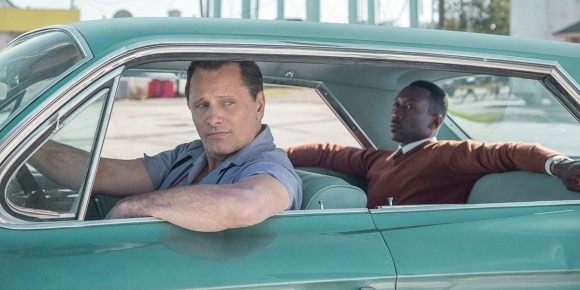
greenbook
Viggo Mortsensen driving Mahershala Ali in “Green Book”. Photo courtesy of TIFF.

If Beale Street Could Talk, a world premiere at TIFF18 and director Barry Jenkins’ follow-up to Moonlight (2016) was the People’s Choice Award First Runner-Up. Based on the novel by James Baldwin, the film tells the love story of a young African American woman trying to prove her imprisoned lover’s innocence. In the TIFF webpage, the film is described as a ‘gorgeous tone poem on love and justice.’

ifbealestreetcouldtalk_01
KiKi Layne and Stephan James in “If Beale Street Could Talk”. Photo courtesy of TIFF.

Alfonso Cuarón’s Roma (my review) came third in the People’s Choice Award. A Canadian Premiere at TIFF18, it is an artistic rendering of a young maid’s experience in a middle-class home in Mexico City during the 1970’s. Of note is the black-and-white film is regarded as a semi-autobiographical account of Mexican director Cuarón, the first Hispanic and Mexican to win the Academy Awards for Best Director with his sci-fi work Gravity (2013).
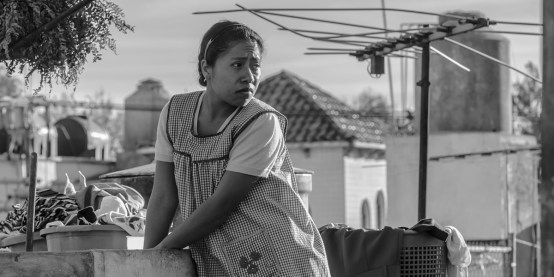
ROMA.jpg
Yalitza Aparicio as Cleo in Alfonso Cuarón’s “Roma”. Photo courtesy of TIFF.

The high-profile contenders First Man directed by Damien Chazelle with Ryan Gosling as astronaut Neil Armstrong, and Bradley Cooper and Lady Gaga’s A Star is Born did not place.

TIFF’s People’s Choice Award winner is often regarded as a predictor of the next Oscar Best Picture. Past winners that went on to capture the Oscar include Slumdog Millionaire, The King’s Speech, and 12 Years A Slave.

Capturing the People’s Choice Documentary Award is Free Solo, International premiere at TIFF18, directed by E. Chai Vasarhelyi and Chinese-American mountaineer/photographer Jimmy Chin. The duo chronicled the renowned rock climber Alex Honnold’s scaling free solo — without safety ropes — up the 3,000-foot cliff of El Capitan in California’s Yosemite National Park.

People’s Choice Award from the Midnight Madness program went to the The Man Who Feels No Pain, World Premiere at TIFF18, directed by Vasan Bala, one of the young, new wave filmmakers in India. This is a cinematic fusion throwing in Hong Kong martial arts comedy Stephen Chow styling, the agility of Jacky Chan, the Bollywood sensation, the American Superhero momentum, and the inspiration of Buster Keaton. Fits right in the Midnight Madness program of introducing new works by a new generation of filmmakers.

Platform Prize went to Cities of Last Things, directed by Ho Wi Ding. This world premiere at TIFF18 is a collaboration of filmmakers from Taiwan, China, USA, and France. From TIFF’s webpage, “a seamless blending of genres, from sci-fi to noir to romance, the Malaysian-born Ho commandingly employs cinematic language as a tool to discuss the root of our collective sadness, which is perhaps the very thing that makes us human.”

NETPAC Award for the world premiere of international and Asian film went to The Third Wife from female writer-director Ash Mayfair of Vietnam. A film about a 14-year-old girl’s struggles after she becomes the third wife of a wealthy landowner, set in 19th century rural Vietnam.


***


Dano’s ‘Wildlife’ elicits showcase performance from Carey Mulligan

Wildlife is a detailed capture of the dissolution of a marriage, from the point of view of the couple’s only child. It is also a coming-of-age story as 14 year-old Joe comes to realize the elusiveness of permanence in his parents Jerry and Jeanette’s once loving relationship. If all these names sound too common, that just might be one implication of the film – a specific look into a general human condition.

Wildlife
Carey Mulligan and Jake Gyllenhaal as Jeanette and Jerry in ‘Wildlife’. Photo courtesy of TIFF.

The film adaptation of Richard Ford’s novel is a selection in the Special Presentations program at the 2018 Toronto International Film Festival, screened as a Canadian premiere. It is the directorial debut of actor Paul Dano, co-writing the screenplay with Zoe Kazan (The Big Sick, 2017).

To those unfamiliar with Dano, maybe these titles will help you locate where he’s coming from and appreciate the variety of works he’s been in. Remember Little Miss Sunshine (2006)? He’s Olive’s older brother Dwayne who reluctantly gets into the yellow VW Beetle van and takes a vow of silence, or the dubious preacher confronting Daniel Day-Lewis in There Will Be Blood (2007)as the harsh slave driver in 12 Years a Slave (2013), or in the 2016 TV mini-series War & Peace as Pierre. Not the handsome leading man but always the character actor.

The small family in Wildlife consists of Jerry Brinson (Jake Gyllenhaal), a golf pro who has just moved into the town of Great Falls, Montana, with his wife Jeanette (Carey Mulligan) and son Joe (Ed Oxenbould). Just as they thought they’re settling in Jerry is fired from his job as a golf instructor in a country club. After waiting for a while for her husband to absorb the loss of job and pride but with no solution in sight to the household finance, Jeannette decides to come out of the home to look for work, ultimately finding a position as a swimming instructor at the Y.

That just may not be the cause of the conflict. What begins the total meltdown is when Jerry, out of the blue, packs up and follows a group of men heading to the forests to fight a wild fire fiercely raging near Great Falls, not knowing when he will return or if he can get out of it unscathed. Feeling utterly alone and abandoned, Jeanette begins to react to her precarious situation by venting with some out-of-character behavior. The successful businessman Warren Miller (Bill Camp), Jeannette’s swim student at the Y, just happens to be a convenient escape route. All these familial changes and development are observed uncensored by their sensitive teenaged son Joe.

From this his first attempt at directing, viewers would be gratified to find Dano to be an actor’s director; especially with the excellent cast he has under his helm, this is doubly rewarding. Dano lets the camera rest on the close-up faces of his characters to elicit superb performance, taking his time to capture the nuances in restraints, outburst, or just about any sort of inner feelings to surface.

Carey Mulligan.jpg
Carey Mulligan in ‘Wildlife’. Photo courtesy of TIFF.

This is one of the best, if not the best, performance I’ve seen Carey Mulligan in, changing from the loving wife and devoted mother to the angry and desperate single mom with a son to raise, to totally losing it, testing the boundaries of norms and behavior, and finally to the determined woman striking out on her own yet still bound by unseverable, familial ties. Mulligan deserves an Oscar nom for her role as Jeannette.

Watching his mother get close to Miller, Joe is torn between devotion and incredulity.  Although a successful businessman, Miller is a limping, older man. Joe is utterly perturbed by his mother’s capricious turn. Dano creates some poignant scenes depicting the interactions between mother and son during dad’s absence from home. Often the passive observer, Joe is restrained with countless questions he cannot express in words.

Mulligan gets all the juicy lines. After Jerry is gone to fight the wild fire, Jeanette brings Joe along to Miller’s house for dinner, putting on heavy make-up and dressing in a seductive night gown. She dances with the man intimately in front of her son. In another occasion, she dons cowgirl attire and admires herself in front of the mirror, reminiscing her younger days. Jeanette answers her son’s dazed expression with this line:

“It’s good to know your parents were once not your parents.”

There is a former life in every parent that even the closest child would not have known or understood. There are many thought-provoking lines in the film, but this one is particularly poignant.

Dano takes the liberty to follow the spirit of the text and creates a cinematic ending. His visual wrapping up is clear and spot-on, especially the scene at the studio where Joe works part-time. The final frame of the three sitting down together for a studio shot with Joe between his parents speaks volumes. A wild fire may have been put out, but the smouldering lingers; and the one keeping it under control may well have been a teenaged firefighter.


***
 

Update Nov. 16:

3 Nominations for “Wildlife” at the Film Independent Spirit Awards – Best First Feature, Best Female Lead, and Best Cinematography.


It Takes an International Film Festival to Remind Us

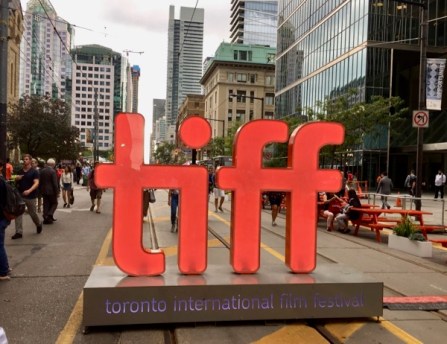
It takes an International Film Festival to remind us that we live in a world with many countries and myriad of cultures, languages and experiences beyond our own. The Toronto International Film Festival (TIFF) opens a window looking out towards such a diverse human kaleidoscope. (All photos in this post are by Diana Cheng, Sept. 2018)

TIFF on Festival Street

What better time than now for us to press on to connect and share when it seems the progress we had made in recent decades had been dismantled in no time. What better means than through the visceral medium of film art in exposing views, eliciting empathy, and inspiring minds. Films could well be the best avenue to reach out and understand, as well, to be understood.

TIFF is the largest public film festival in the world. Its top prize is judged by the audience. Named the Grolsch People’s Choice Award, the annual winner is often a predictor of the next Oscar Best Picture. Some past winners include Slumdog Millionaire, The King’s Speech, 12 Years A Slave.

Glamour aside, the variety of its film selections are examples of diversity and opened doors to places and issues that are foreign to many in the Western world. But then again, finding the gem of universality may just be the serendipitous reward.

This year, the number of films in TIFF’s various programs comes to about 342, representing 83 countries, from Algeria to Kazakhstan to Vietnam, just to go down the alphabetical list. These official selections are chosen from a total of 7,926 submissions, 6,846 from around the world, 1080 from Canada domestically. Among these three hundred some titles, over 80 languages are used. After watching half a dozen of the international entries, reading subtitles at the bottom and watching the whole screen at the same time will become a skill you’ll be happy to have acquired.

Share Her Journey

Further, the Share Her Journey Rally on Saturday, September 8, lends a voice to the #MeToo and #TimesUp movements, pressing for respect and equality for women on both sides of the camera. Attended by hundreds and led by actress Geena Davis among other distinguished guests, the Rally represents a united front to shatter the glass ceiling in the film industry. This year at TIFF, 35% of films are by women filmmakers, a statistic that TIFF is aiming at improving.

During the first few days kicking off the Festival, King Street West was closed for a few blocks for pedestrians to enjoy the fun, food, and free samplings. Here are some sights on Festival Street.

Fusion food is the best sign of diversity. Check these menus out:

Food Truck Menu where East meets West

Fusion

Or, be transported to Paris just for a dream trip:

On Festival Street

and stop for a latté and croissant at Bistro Air France, if you don’t mind waiting:

Bistro Air France

To many, the fun part of TIFF is waiting. Many wait for hours to get just one glimpse of their favourite stars to arrive at a red carpet, there are several in different venues in downtown Toronto:

Star Gazing

Here’s another one, also waiting for their faves:

Still Waiting

**

(All photos in this post are by Diana Cheng, Sept. 2018)

In the days ahead, my list of film reviews on both Asian American Press and Ripple Effects will include (director’s name after title):

Burning, Lee Chang-dong, S. Korea, N. American Premiere
Capernaum, Nadine Nabaki, Lebanon, N. American Premiere
Hotel Mumbai, Anthony Maras, Australia, World Premiere
Kursk, Thomas Vinterberg, Belgium, Luxembourg, World Premiere
Maya, Mia Hansen-Løve, France, World Premiere
Roma, Alfonso Cuarón, Medico, Canadian Premiere
Shoplifters, Hirokazu Kore-eda, Japan, Canadian Premiere
Shadow, Zhang Yimou, China, N. American Premiere
The Wild Pear Tree, Nuri Bilge Ceylan, Turkey, France, Germany, Bulgaria, North American Premiere
Wildlife, Paul Dano, U.S.A., Canadian Premiere

Just to name a few. More reviews coming up. Check out the details of the programs from tiff.net


***

Arti at TIFF and Ripple on Rotten Tomatoes

DSC_0718

Two major news. Yes, the above title says it all.

I’m in Toronto now, all geared up to watch the screenings of a dozen films I’ve selected at the Toronto International Film Festival Sept. 6 – 16. Will keep you posted on the sights and sounds here.

There are 342 films in TIFF’s various Programs, submitted by filmmakers from 84 countries. Among the selections, 254 are full feature films, 88 shorts. These are selected from 7,926 submissions from all over the world.

Following a Ripple tradition, presenting titles from book to screen, here are some of TIFF’s feature productions that are adaptations from published, written sources:

First Man, dir. by Damien Chazelle, Ryan Gosling as Neil Armstrong, based on the book First Man: The Life of Neil Armstrong by James R. Hansen

Beautiful Boy dir. by Felix Van Groeningen based on two memoirs, Beautiful Boy by father David Sheff and Tweak by son Nic. Steve Carell and Timothée Chalamet play father and son.

Burning dir. by Chang-dong Lee, based on the short story “Barn Burning” by Haruki Murakami, which (in my opinion) is in turn based on the short story of the same name by William Faulkner.

The Hate U Give dir. by George Tillman Jr., based on the book of the same name by Angie Thomas (2017 National Book Award longlist, Young People’s Literature)

If Beale Street Could Talk dir. by Barry Jenkins (2017 Oscar winner ‘Moonlight’), based on the book of the same name by James Baldwin.

The Front Runner dir. by Jason Reitman, based on the book All the Truth Is Out by Matt Bai. Hugh Jackman as the 1987 presidential candidate Gary Hart.

The Sisters Brothers dir. by Jacques Audiard, based on the book of the same name by Patrick Dewitt (shortlisted for the Booker Prize 2011)

Wildlife dir. by Paul Dano, based on the book of the same name by Richard Ford. Carey Mulligan and Jake Gyllenhaal star.

A Million Little Pieces dir. by Sam Taylor-Johnson, based on the (controversial) memoir by James Frey

**

The second piece of news actually is equally exciting. My movie reviews on Ripple Effects are now approved to be included in the Rotten Tomatoes® review aggregation website. That means, yes, my two pebbles will be counted in the Tomatometer® score for a movie which I’ve reviewed on Ripple and submitted to them. (This actually is a spin-off as they first approved me for my reviews on Asian American Press.)

Nothing’s changed. Just feeling good that the Ripples from the Pond can have far-reaching Effects.

***


Finally, Guernsey from Book to Screen

It was nine years ago that I posted a book review of The Guernsey Literary and the Potato Peel Pie Society, the post-WWII set, epistolary novel by Mary Ann Shaffer and Annie Barrows. It’s a book of letters between the writer Juliet Ashton and her publisher, and later the members of the Guernsey Literary and Potato Peel Pie Society, which is an impromptu excuse made up by quick-thinking Elizabeth to avoid arrest by German soldiers as she and her friends are caught walking home after curfew.

To prepare for German advances, residents on Guernsey evacuated their children and sent their young men to war. Later as the Channel Islands were under enemy occupation, the people were stripped of their freedom and had to endure hunger, casualties and disappearances of loved ones.

Here are some thoughts in my book review post:

“Despite the subject matters, readers will find the book witty and delightful. Authors Shaffer and Barrows have depicted a myriad of lively characters, charmingly joined in their humanity by their strengths and weaknesses.  Yes, we can also visualize the madness of war. But we’re relieved to see too that people can weather hardship much better when they have a common bond, here, in the reading and sharing of fine literary works.”

A few years ago I read that the NYT Bestseller would be turned into a movie and that Kate Winslet would play Juliet Ashton, and later, Rosamund Pike. And so we wait. Now we have Lily James, and I’m glad. She’s a younger Juliet, but her screen presence is always appealing, albeit the adaptation doesn’t give her much of a chance to shine as in Mamma Mia! Here We Go Again. She belongs in the singing and dancing limelight, maybe not unlike her character Lady Rose in Downton Abbey.

Lily James as Juliet Ashton (1).jpg

Matthew Goode (Henry Talbot from Downton) as Sydney, Juliet’s publisher, is a solid supportive figure. Surely what he wants is more books from her, but Sydney knows she can’t be forced to do anything she doesn’t want to. Nice play between the two, and some effective scenes as he tries to help Juliet dispel haunting war memories.

How do you turn letters into a movie? Director Mike Newell focused on storytelling and it worked. The helmer of Mona Lisa Smile (2003) and perhaps the more memorable, Four Weddings and a Funeral (1994), had chosen to depict the dramatic narratives in the letters rather than the actual reading and writing of them; the writing part can be done by another character, the typewriter.

There are fewer literary mentions in the movie, and the book club scenes are kept to a minimum but interesting. Don’t miss the one at the end when the credits roll. We hear the sound of the typewriter, remember Atonement? With just two hours for the movie, naturally a lot of the details are skimmed out. What’s left are the essentials, loss and love.

Kudos to Penelope Wilton (Isobel Crawley of Downton, of course, and many more), she leads all the way by holding the suspense, the reason for her pain. We see her expressive face conveys tensions and deep sadness. Viewers who have not read the book would find the movie a mystery slowly being revealed as Juliet investigates the Society’s history. I appreciate Wilton’s face, from which I can clearly see how the loss of loved ones can drag one down to mere existence and nothing more, if not for Kit (Florence Keen).

Joining the roles as Society members are veteran actor Tom Courtenay as Eben, Katherine Parkinson as Isola, and Kit Connor as Eli. The fine cast let us visualize the events of the book as experiences of real persons. This may well be the very reason why some hesitate to embrace movie adaptations of the literary. To the purists, the imageries and characters conjured up in their mind while reading reign supreme and they’d guard them with much possessiveness. In this case, however, I find the adaptation offers something that’s not in the book. I can see the restraints of the characters, the burden as keepers of secrets, their faces telling stories and then withholding some.

Jessica Brown Findlay (Lady Sybil from Downton) as Elizabeth is well cast, albeit not much time is spent on exploring her love story with the German soldier Christian (Nicolo Pasetti, limited appearance). The resolution to such a dilemma and its fallout will never be easy to find.

As for the love interests, or disinterest, Glen Powell aptly plays the rich American Mark Reynolds. Recognize him from Hidden Figure? He’s John Glenn there. Here, he’s the high flying socialite publisher. After Guernsey, Juliet has to be frank with him, and with much apology, returns his engagement ring. After just a short exchange, he gets up from the table, says goodbye and walks away, only to return quickly to pluck the champaign bottle from the ice bucket before he leaves for good. Just spot-on. Is that in the book?

True love belongs to Dawsey Adams (Michiel Huisman, Game of Thrones) who begins it all with his letter to a name and address written on a book he happens to stumble upon. The moment he encounters Juliet as she sets foot on Guernsey, his fate is sealed. Dawsey is good at restraints, until he can’t hold it anymore at the end. The setting may be different but who gets to pop the question remains true to the book.

A movie as well can offer the scenery which the book can’t. But then again, imagination may still be needed as the shooting location is not actually Guernsey Island but North Devon. Click on the link to check it out.

What doesn’t need imagination is also my favourite scene: Dawsey’s carving of the juicy roasted pig.


~ ~ ~ Ripples

***

Guernsey Literary and Potato Peel Pie Society is on Netflix.


Let ‘Things to Come’ be a Cooling Respite

July’s gone, but we’ll always have Paris.

There are many words I can use to describe the Paris born, veteran (here’s one of them) French actress Isabelle Huppert. Prolific, versatile, and age-defying. In 2016, two of her works came to prominence in the awards circuit, two features that show her in distinctly different roles that won her acclaims across the Atlantic. Playing a vigilant woman who schemingly fight back a rapist in her neighborhood in Elle, Huppert garnered a Best Actress Golden Globe and an Oscar nomination.

Things to Come

The other feature is Things to Come. Huppert is Nathalie Chazeaux, a philosophy professor, a published academic writer and editor, a mother of two almost grown children, a wife, a daughter, and a woman at the crossroads in her life.

On the career and academic front, Nathalie’s just been told by her publisher that her textbook would no longer be needed. On the home front, her husband of 25 years, Heinz (André Macron), has just confessed to her that he’s seeing another woman and will be leaving Nathalie to live with his younger love. Even though on good terms with their parents, her two children have grown enough to move away from home. As a daughter, Nathalie has to deal with a dementia-afflicted mother (Edith Scob) who calls her cell phone even while she’s teaching, delusional and threatening suicide. What is Nathalie to do?

Here, I must mention another crucial figure in the production, and that’s director Mia Hansen-Løve, who won Best Director with this feature at the Berlin International Film Festival in 2016. At eighteen, Hansen-Løve was cast by French director Olivier Assayas and later starred in another of his works. Partnered with him for a while, she’d chosen her own path, studying philosophy, writing for the prestigious French film magazine Cahiers Du Cinema, and later, directing.

Daughter of two philosophy professors, Hansen-Løve’s preoccupation with intellectual discourse is apparent in Things to ComeIn an interview, she’d said, “… for me, cinema is nothing but another way to practice philosophy… cinema is a search for wisdom, a search for good and for beauty, like philosophy could have been a search for my parents.” The intellectual exploration of what’s good and Utopian predominates in Things to Come. The film is worth a second, or third viewing just to capture the dialogues.

While she may be tossed like a floating weed in the torrents of life, Nathalie enjoys the fruit of her labor in her former star pupil Fabien (Roman Kolinka), now a writer and activist. However, as she’d influenced Fabien in his pursuit of philosophy and writing, he’d also chosen his own path by living with a few anarchists in a remote cabin in the French countryside. His outlook diverges from hers and which she can’t agree, ironically, that’s the reward of her teaching: training one to think for oneself and to choose one’s own path independently.

Upon his invitation, Nathalie had spent a few days there, an idyllic ,rural setting for her to recuperate from a life unhinged. She’s got her mother’s cat with her, Pandora, a cat that’s not used to the wild but takes off the instant Nathalie takes her out of the cabin. Lost for hours but Pandora finally finds her way back to the country abode in the middle of the night. ‘Instinct’, Fabien says. And that just might be what Nathalie needs to hang on to at this moment of her life.

Surely, Things to Come is a ‘thinking’ film, but viewers will also enjoy the nuanced performance of the cast, and what the camera reveals in the form of natural beauty and serenity for one to search things out. What more, Hansen-Løve lets us see both the larger scale of a flaw-ridden society and the trivial foibles in the interactions between Nathalie and Heinz.

Female viewers would likely find affiliation with Huppert’s role of an urban, professional woman who has to juggle many hats to fulfill her duties. Nathalie’s search for direction at the crossroads may not necessarily lead to obvious answers, but she manages to find comfort and joy in the birth of her grandchild, an endearing scene to end the film.

More importantly, Nathalie seems to have carved out a quiet solitude. an independence to mull on the unfathomable in life. Still searching, but in the meantime, she seems to have found a respite, a new solace to face what things may come.


~ ~ ~ ~ Ripples 


***

‘Cleo from 5 to 7’: A Film for Paris in July

Summertime… and the viewing is nostalgic. On a lazy, hazy summer afternoon, what better way to spend your time than to catch up on classic films that you’d missed through the years, or, rewatch them. Sure, a glass of pink lemonade and some chocolate-dipped madeleines would add to the enjoyment.

Here’s a wonderful film by the venerable Belgium born French director Agnès Varda, who turned 90 on May 30 this year. Just exactly what she was doing a few weeks before her 90th birthday?

On May 12, Varda joined Cate Blanchett in leading 82 female industry figures to walk up the stairs on the red carpet at the Cannes Film Festival, a silent protest symbolizing the challenges women face in climbing the industry ladder. Blanchett gave a speech in English, Varda in French.

Cleo from 5 to 7 (Cléo de 5 à 7) is a 1962 film by Varda, a Cannes Palme d’Or nominee the next year. The story takes place on one single day in the life of a popular recording singer Cleo (as in Cleopatra) who loves everything beautiful looking. But early in the day she receives all sorts of bad omens about her health. Her zest for life fizzles through the day as she would be calling her doctor to find out the result of the medical test she’d taken a couple days ago.

Cleo from 5 to 7.jpg

We follow Cleo on the longest day in 1962, yes, that’s the first day of summer, which could have brought her vitality and joy. How does the fear of illness and mortality affect the beauty-seeking and fun-loving Cleo? It totally changes her outlook. Instead of being cooped up in her apartment with musicians rehearsing her songs, she steps out into the streets of Paris to escape the gloomy sense of despair.

Don’t worry, this is not Sarte or Camus. Cleo is just a gal seeking to be loved, and for the first time in her life, fearing for her own mortality. Varda takes us along the streets of 1962 Paris, and offers us naturalistic scenes of cafes and roadside buskers, and leads us into an art studio as Cleo looks for her friend who works as a model for sculptors.

Finally, she’s alone in a park, the serene, meditative milieu is the ideal setting for her to meet Antoine. The encounter is the magic she needs. The rest you ought to see it for yourself. Varda’s pace is leisurely, her viewpoint insightful, and the ending is satisfying. Maybe by now, Cleo learns the difference between beautiful-looking and beauty.

The original music is soothing and cooling for a summer day, composed by Michel Legrand (who is the piano player in the movie). Legrand is a three times Oscar winning French film composer. Which three times? Yentl (1983), Summer of ’42 (1971), The Thomas Crown Affair (1968).

As I said, summer is the best time for nostalgic viewing.


~ ~ ~ ~ Ripples

***

Paris in July is hosted by Tamara of Thyme for Tea, an annual summer blogging event.

Paris in July 18

***


Summertime… and the feeding is easy

No matter where you stand in the food chain, in the summer woods, everywhere you turn is a ready picnic, nature’s smorgasbord. Just look at all these flies:

Appetizers.jpg

Yummy appetizers for the Yellow Warbler:

The Hungry Warbler

Or this succulent fruit. I’m sure the bee knows he’s an item on the smorgasbord too.

to eat or not to eat.jpg

But for the moment, indulge:

bee.jpg

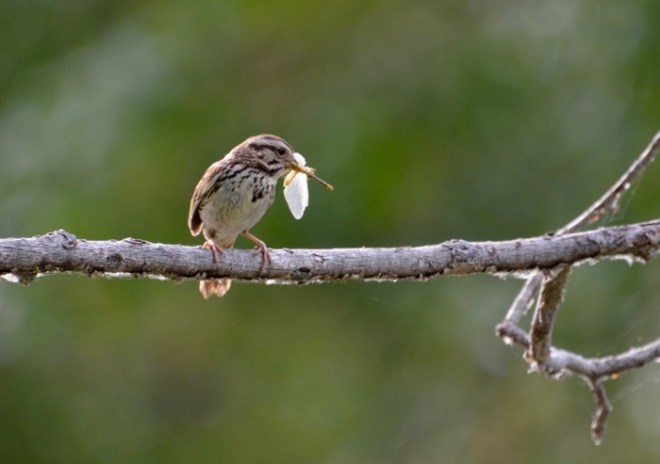
Not so lucky for this dragonfly, securely locked in the beaks of a Song Sparrow:

Song Sparrow lunch.jpg

Robins are clean eaters, they swallow berries whole:

Robin

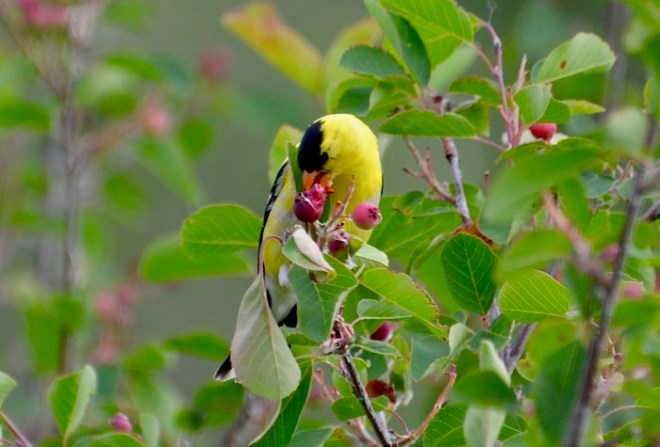
But not the Goldfinch:

American Goldfinch messy eater.jpg

Eat to your heart’s content, no need for etiquette here:

Messy eater.jpg

This baby Oriole in its high chair waiting for lunch. Be patient, junior, mommy’s coming:

Feeding 1.jpg

Feeding 2

Feeding 3.jpg

Take it easy, my Deer friend. I wouldn’t want to do the Heimlich Maneuver on you:

Deer friend.jpg

***

What’s your summer smorgasbord like?

The Colour of Summer

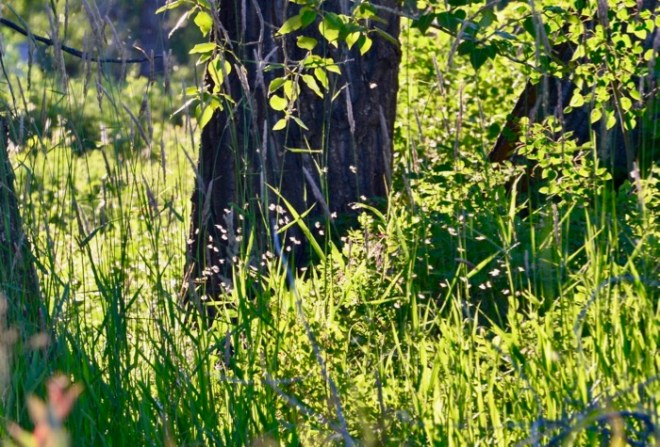
To be technically accurate, here are some photos I took after June 21. Not that I’m partial to the colour yellow, but that’s mostly the colour of our summer woods, greenish yellow.

The Colour of Summer.jpg


Sometimes you can see dots of pink, the Alberta wild rose:

Alberta Wild Rose.jpg

or tiny red fruits:

Summer fruits.jpg

Golden cattails by the water before they ripen into brown candlesticks:

Cattail.jpg

The Pond in summer is quiet. In contrast, the woods host a cacophony of songs and calls, like the tuning of strings and woodwinds before a symphony concert, albeit finding the actual sources is difficult, let alone taking photographs of them. The blurry pics just show how hard it is to find them staying still in the clearing for more than 2 seconds.

Migratory songbirds too are mostly yellow here, like this Wilson’s Warbler with his black cap. You might be surprised, but we don’t have any red birds like the Cardinals:

Wilson's Warbler.jpg

The Baltimore Oriole:

The Baltimore Oriole.jpg

The American Goldfinch:

blurry Goldfinch.jpg

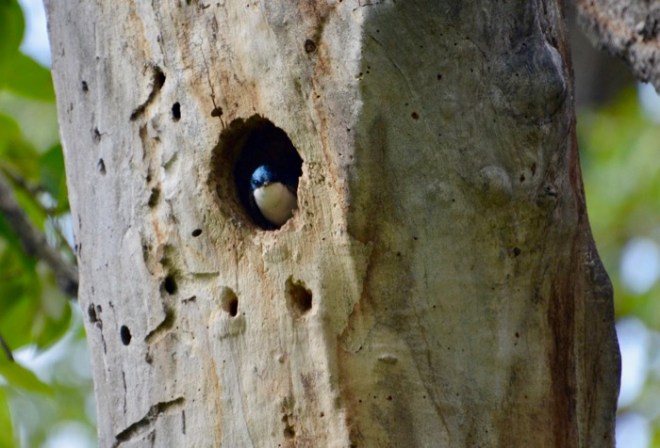
In the tree, there’s a tiny spot of silvery blue… the Tree Swallow waiting for lunchtime:

Tree Swallow.jpg

Some can’t wait, like this hungry Robin:

The Hungry Robin.jpg

or this Yellow Warbler. Whatever’s in your mouth, mosquito or fly, I’ve to say, ‘Thank you for eating!’

Hungry Yellow Warbler.jpg

The Hungry Warbler.jpg

What colour is your Summer?

***


Middlemarch: You be the Screenwriter

It’s a wrap. Here’s my finale for our Middlemarch in May Read-Along.

You may be a print purist, don’t want to see a movie made. Just take this as an imaginary writing exercise then:

You’re offered the job of writing a screenplay, the tall order of turning Eliot’s 800-page novel into a movie. The task at hand is to choose from the numerous storylines and just focus on a few that your feature will cover.

The following are some of the main storylines and thematic matters in Eliot’s Middlemarch. This list is just off the top of my head, feel free to add in. Which ones would you select and elaborate?

**

Sisterhood between Dorothea and Celia

Dorothea’s marriage to Casaubon

Celia and Sir James Chettam

Mr. Brooke’s political involvement

Politics, power and influence in Middlemarch

The mysterious cousin of Casaubon: Will Ladislaw’s backstory

Relationship between Casaubon and Ladislaw

Newcomer Lydgate: the young, aspiring doctor

Old vs. New: The introduction of new ideas and methods and their reception or rejection in Middlemarch

Lydgate’s character: idealism vs. practice

The Vincy family: Mr & Mrs., Fred and Rosamund

The Caleb Garth family: Mr. & Mrs., Mary Garth

Fred Vincy and Mary Garth

Fred’s lifestyle, his love and dreams, and his change

Rosamund’s lifestyle, her love and dreams, and her change (or, has she?)

Featherstone: The subjective construction of will and estate

Mary Garth’s moral dilemma in dealing with Featherstone’s order regarding his will

Farebrother and family: Farebrother’s role in joining Fred and Mary despite his secret love for her.

Raffles the disruptor of Bulstrode’s life: the wages of sins, or, the consequences of actions that last beyond the statute of limitations

Ladislaw’s true identity and Bulstrode’s dark history

Raffles’ falling ill and Bulstrode taking him in for fear of reverberation, hence leading to the suspected ‘wrongful death’ incident and the presumed guilty of bribery between Bulstrode and Lydgate.

Will Ladislaw being victim of class discrimination and racial prejudice in the provincial town of Middlemarch

Family finance, debts and gambling endangering a fragile marriage between Fred and Rosamund

How to choose a mate, keys to a happy marriage

Difference between romance and love, looking at three pairs of relationships: Lydgate and Rosamund, Fred and Mary, Dorothea and Will

And for that matter, how about intellectualism vs. passion, the marriage of Dorothea and Casaubon

Choices of actions of the characters based on values (or lack of), principles, and plain gut

Poverty, welfare, and social actions, responsibilities of the rich

Male/Female relationships in marriage and society, and how Dorothea both fulfills prescribed duties and overrides expectations.

Finally, probably the most important element in a movie, the emotional impact it elicits in your viewers: Which of the above storylines will you focus on to bring out such effects?

We all love the Finale of the book. But why does Eliot spend so few pages in describing the love relations between Dorothea and Will? They are seldom seen together, and in the rare occasions that we do see them, they’re caught in awkward and embarrassing situations. Would you give them more screen time together in a positive light?

I think one reason Eliot doesn’t elaborate on their courtship could be because she doesn’t want to mislead her readers that this is a ‘romance novel’. Rather, she brings out a kind of sublime love between the two, particularly on the part of Dorothea, a noble love that motivates her to give up her wealth, position and the familiarity of Middlemarch. These in Dorothea’s views are but shackles restraining her to do what she wants and to love freely.

Finally, any casting suggestions?

**

A huge thank-you to all participants and spectators for your input, comments and posts. It’s been a pleasurable ride, even though the length and numerous storylines and characters may have bogged us down occasionally. I appreciate the pebbles thrown into the Pond to make all those ripples.

Enjoy your summer!


Summer Reads before the Coming Movies

What to read next? I’m sure that’s not a question in many readers’ mind as their TBR pile is high. But if you love to read the books before watching the movie adaptations, or looking for summer reads, here are some titles that might pique your interest.

Where’d You Go Bernadette? by Maria Semple

Fun to listen to, love that voice in the audiobook. But if you’re a print aficionado, this  would make one breezy summer read and a movie to look forward to this fall. Cate Blanchett is Bernadett Fox, with Kristen Wiig and Judy Greer. Directed by Richard Linklater, who gave us the ‘Before…’ trilogy, Boyhood, and many other wonderful films.

Bel Canto by Ann Patchett 

Ann Patchett’s 2001 novel won the Orange Prize for Fiction and the Pen/Faulker Award. A world-renown opera singer is trapped in a hostage crisis and the subsequent events. Based on a true incident in the Japanese embassy in Lima, Peru in 1996-1997. A movie adaptation has been brewing for some years and finally it’s made. Julianne Moore plays the lead role. Directed by Paul Weitz (About A Boy)

Crazy Rich Asians by Kevin Kwan

Kevin Kwan’s Crazy trilogy is highly readable. Don’t get turned off by the titles like I was at first. They’re no-holds-barred satires that are bound to be eye-openers to many readers. A modern day, Asian version of Lizzy meeting Mr. Darcy. Movie adaptation coming out later this summer and will be a testing ground for audience world-wide with its all Asian cast and director. “Fresh Off the Boat” TV series star Constance Wu plays NYU prof Rachel Chu, Michelle Yeoh (Crouching Tiger), Ken Jeong (Dr. Ken) are in. Jon M. Chu (Now You See Me 2) directs.

The Sisters Brothers by Patrick DeWitt

Among the multiple awards Canadian writer Patrick DeWitt won with his 2012 novel was the Stephen Leacock Medal, which means it’s very humorous. A story about the brothers who share the last name Sisters. If you’re into dark but comedic Westerns, here’s your pick. A-listers Jake Gyllenhaal, Joaquin Phoenix, John C. Reily star. Acclaimed French director Jacques Audiard (Rust and Bone) helms. Story takes place in Oregon and California during the 1850’s. Shot in Romania and Spain. That’s movie making today.

**

Other interesting titles just announced or in development:

David Copperfield by Charles Dickens

Entitled The Personal History of David Copperfield which I believe was the original Dickens title, is now being adapted once again into a contemporary version. Exciting to see old classics not only survive but getting creative remakes for modern-day appeal. This may not sit well with purists, but hey, our world is changing and spinning crazily every minute, so might as well enjoy the ride. This one stars Dev Patel as David Copperfield. You remember that’s the promising young man from Slumdog Millionaire, and after that, some worthy titles. He’s come a long way. An apt choice, I’d say. Tilda Swinton, Ben Whishaw, Hugh Laurie all in.

How to Stop Time by Matt Haig

Benedict Cumberbatch acquired the film rights of Haig’s newest novel even before it’s published. So must be good. Cumberbatch will star as the 41 year-old man who actually has been living for centuries. Must contain some secrets of staying young, or maybe just a condition that you wouldn’t want. British novelist and journalist Haig’s books have been translated into 30 languages world-wide.

“The Judge’s Will” by Ruth Prawer Jhabvala

Ruth Prawer Jhabvala’s last short story will be adapted into film to be directed by Alexander Payne. The ideal screenwriter for this one? James Ivory of course. Ismail Merchant, James Ivory, Ruth Prawer Jhabvala, the literary-to-film triangle, my all time faves. You can read the story right here at The New Yorker online.

**

And here are some literary titles remade for TV series or movie on the small screen now or coming up:

King Lear by William Shakespeare

Vanity Fair by William Makepeace Thackeray

Little Women by Louisa May Alcott

Howards End by E. M. Forster 

The Miniaturist by Jessie Burton


***


Middlemarch Book II – IV: Inkblot Test

We’ve come to the midpoint of our tentative reading plan. Hard to believe one month’s gone by already. Instead of a review of all the chapters, how about a Middlemarch inkblot test?

What word comes to your mind when you see the following:


  • Dorothea 
  • Casaubon 
  • Ladislaw 
  • Fred 
  • Rosamond 
  • Lydgate 
  • Celia 
  • Mr. Brooke 
  • Mary Garth


I’ll just stop with these ones. Have your views about these characters changed from first you met them?

Any surprises in the storylines?

Which characters do you click ‘Like’?

What to do with the ones we don’t? Is Eliot having fun with Austen’s idea of creating characters whom no one would much like?

Favorite Quotes?

Here are some of mine, for various reasons, but mostly for Eliot’s power of association in her descriptions.

Will Ladislaw’s thought about Dorothea:

“To ask her to be less simple and direct would be like breathing on the crystal that you want to see the light through.”

About Dorothea’s predicament:

“I suppose it was that in courtship everything is regarded as provisional and preliminary, and the smallest sample of virtue or accomplishment is taken to guarantee delightful stores which the broad leisure of marriage will reveal. But the door-sill of marriage once crossed, expectation is concentrated on the present. Having once embarked on your marital voyage, it is impossible not to be aware that you make no way and that the sea is not within sight –– that, in fact, you are exploring an enclosed basin.”

And if Eliot were among us today, she would likely be vocal in the #Metoo and #Timesup movements:

“Society never made the preposterous demand that a man should think as much about his own qualifications for making a charming girl happy as he thinks of hers for making himself happy.”

***

Your two pebbles?

Wood Duck.jpg


***

Other posts from our Read-Along participants:

Men of Middlemarch

Middlemarch –– Ladislaw’s Force of Unreason

Middlemarch by George Eliot –– Completed today