Woman in Gold (2015): Then and Now

Gustav Klimt (1862 – 1918) was an Austrian Symbolist painter and one of the most prominent members of the Vienna Art Nouveau (Vienna Secession) movement. His major works include paintings, murals, sketches, and other art objects, but the most recognizable piece probably is the painting “Portrait of Adele Bloch-Bauer I” (1907), commonly known as “The Woman in Gold”.

The painting measures 54″ x 54″, oil, silver and gold on canvas, a highly embellished work reflecting the elegant lady active in the Viennese art circle, patron and muse of Klimt’s, Adele Bloch-Bauer. Adele was married to Ferdinand Bloch-Bauer, an Austrian Jewish industrialist who commissioned Klimt to do the two portraits of his wife. It had been hanging in his home until seized by the Nazis.

Portrait of Adele Bloch-Bauer I
Source: Wikipedia

After the war, the famous painting had been hanging in Austria’s federal art museum, the Galerie Belvedere, as a national treasure, until a near eight-year legal battle finally decided its restitution back to the hands of Adele and Ferdinand’s niece, Maria Altmann, who had escaped to the United States before the War broke out. The long legal fight to gain back the painting’s rightful ownership is the focus of this movie.

Arts looted by the Nazis have their screen time twice in the past year, first The Monuments Men, and now Woman in gold. Important subject but unfortunately both films fall short of cinematic rendering. Director Simon Curtis’s handling in Woman in Gold emits less glimmer than his previous My Week with Marilyn.

Helen Mirren delivers a fine performance as the determined yet conflicting Altmann, who, on the one hand, wants to see justice done in the restitution of her family heirloom but reluctant to re-open a traumatic chapter of her life and return to Austria for the case. She remembers her Aunt Adele well, with some endearing and awestruck moments beholding her beauty. The film handles the shifting between the past and present quite well. It is heart wrenching for a daughter to have to make a hasty escape from her home, leaving her parents behind as the Nazis take over the country.

The David and Goliath legal battle is handled by a young and inexperienced Los Angeles attorney E. Randol Schoenberg. Yes, that’s the grandson of the Austrian composer Arnold Schoenberg, who had escaped to the U.S. in time to avoid the Holocaust, just like Altmann. In 2004, the young lawyer argues his case Republic of Austria v. Altmann in the U.S. Supreme Court, and in January, 2006, heads over to Austria to present his arguments in front of a panel for a binding arbitration. An emotional Altmann sits beside Schoenberg as they hear the decision announced by the panel of three Austrian judges ruling in their favour.

The choice of Ryan Reynolds as Randol Schoenberg looks like a miscast. Something’s missing… But then again, it could be the screenplay, maybe infusing more cinematic moments, or cutting some banal scenes and dialogues would help. Katie Holmes who plays Randol’s wife and Daniel Brühl (excellent in Rush, 2013) as a helpful journalist are incidentals. I can understand condensing the almost decade-long legal story into 109 minutes with an ending that is already known is itself a difficult feat. So all the more we need a more effective screenplay.

However, for someone who did not know about the details of this piece of art history, the movie still captured my attention. I watched it like a documentary. Not knowing the details of this legal case, I found the movie informative in taking me through the obstacles, albeit in synopsis format and simplification.

The beginning is probably one of the most appealing sequence of the whole movie, and that’s a close up on the technique the painter Klimt uses on his painting, meticulously forming a gold leaf and pasting it on his work in progress. Unfortunately, the scene is way too short to allow us to savour. This may well be the only artistic spot a viewer will get.

In a post-script text, we learn that Altmann sold “The Woman in Gold” to Ronald Lauder for $135 million in 2006, at the time the highest purchase price on record for a painting. Those living in or visiting New York City now have a chance to see the current exhibition at the Neue Galerie – opened by Lauder in 2001 – “Gustav Klimt and Adele Bloch-Bauer: The Woman in Gold”, April 2 – Sept. 7, 2015.

In August last year, Lauder, as President of the World Jewish Congress, wrote a moving op-ed for the NYT about the persecution of Christians in the Middle East and Africa. He ends with this: “The Jewish people understand all too well what can happen when the world is silent. This campaign of death must be stopped.”

It’s all about speaking out. That’s what makes this movie important. I can’t help but imagine though: what if it were Klimt who made it…

~ ~ 1/2 Ripples

***
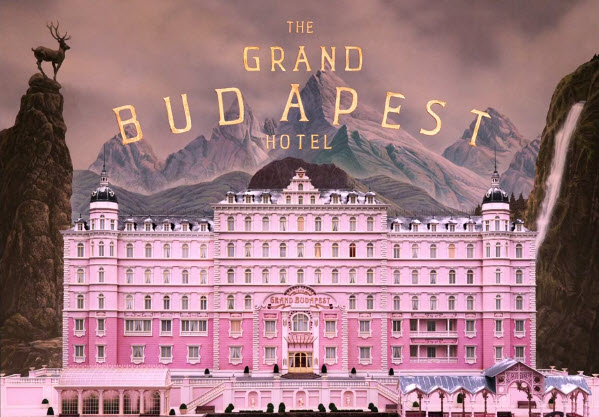
From Z to A: How Zweig Inspired Anderson’s Grand Budapest Hotel

The following is the first part of my article in the new Spring Issue of the online review magazine Shiny New Books. In the article, I introduce the Austrian writer Stefan Zweig, whom director Wes Anderson acknowledged as the source of inspiration for his Oscar winning production. To read the whole piece, CLICK HERE. I’m sure you’ll find the SNB site informative and a valuable resource of books and authors.

***

The Grand Budapest Hotel won four Oscars at the 87th Academy Awards this February. In the end of the film leading the credits is the acknowledgement of Stefan Zweig (1881-1942), whose writings had inspired the production. During interviews, director Wes Anderson had joked that he ‘stole’ from the Austrian writer: ‘It’s basically plagiarism,” he said. Anderson is all modesty when making such a remark, for the film has his own signature style. Unlike Zweig’s more serious and darker hue, Anderson has created a colourful fantasy. Rather than an imitation, the film should be regarded as a worthy homage to an author who had been noted as one of the most translated German-language writers during the 1930’s.

the-grand-budapest-hotel movie poster

Anderson came across Zweig by chance when he purchased his 1939 novel Beware of Pity in a Paris bookstore. After two pages, he knew he had discovered a new favorite author. Twenty pages later, he wanted to adapt it into film. Then he read some more Zweig and liked them all. So he made a peculiar endeavour, he transposed the author’s oeuvre, his life and spirit into his own re-imagining, creating a film that eventually would catapult him to the zenith of acclamation.

The Grand Budapest Hotel was nominated for nine Oscars at the 2015 Academy Awards, including Best Picture, Best Directing, and Best Original Screenplay for Anderson himself. Albeit not having won these major categories, the film did capture four wins in Original Score, Production Design, Costume Design, Makeup and Hairstyling. The triumph is shared by the late Zweig, for he has now been introduced to many more readers, especially those of us in North America. New York Review Books has seen Zweig’s popularity rise after the movie, but it is UK’s Pushkin Press that holds the banner of a ‘Zweig revival’ by republishing many of his works in English translation.

Zweig was born 1881 in Vienna to a Jewish family who circulated freely in the upper crust of Austro-Hungarian society. He was versatile and prolific as a poet, translator, biographer, essayist, lyricist, short story writer and novelist. His literary achievement was prodigious. At nineteen, Zweig saw his first publication, a collection of poetry by the respectable publisher Schuster & Löffler. Upon this debut on the literary stage, Zweig was ecstatic to receive a gift from his idol, Rilke, who had read the youngster’s work and sent him a special edition of his own poetry with the inscription addressed to Zweig: “with thanks.” Later, still at the tender age of nineteen, Zweig saw his essays published in the feuilleton, literary supplement, of Vienna’s prestigious newspaper the Neue Freie Presse, sharing the pages with such formidable literary figures as Ibsen, Zola, Strindberg and Shaw.

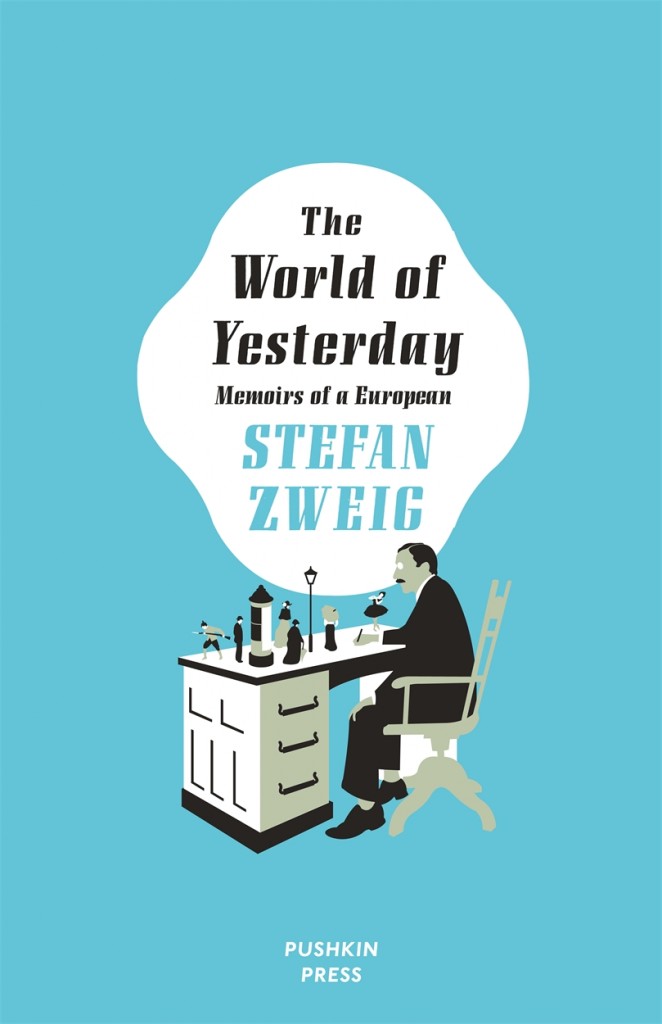
The World of Yesterday ZweigReaders can find his excitement in recalling these unexpected early successes in his autobiography The World of Yesterday. It was not so much about fame but identity. The glorious world of yesterday included not only the fulfilled dream of a young man, but that of the Jewish people in finding a homeland, free and secure in Vienna. At long last, they could taste the reality of belonging. Jews in Vienna had become respectable, contributing members of society, particularly in the realms of the arts and culture.

As we can see from history, such a triumph would soon be obliterated. In August 1914, Zweig saw the world order and security that he so cherished and thrived on crumble as WWI broke out. If that was the beginning of the end, Nazism in the 1930’s rang in the death toll. Zweig had to escape to England, later the United States, finally landed in Brazil. Exiled and alienated, the Austrian writer was overwhelmed by despair as he saw his homeland and Europe devoured by Hitler. The German language he was born into and had so aptly used in his literary success he now had to apologize for. Such devastation and emptiness was too much to bear. In 1942, just a few days after He sent off his last book Chess Story to his American publisher, Zweig and his second wife committed suicide together in Petrópolis, Brazil.

Wes Anderson recreated Zweig’s pre-war world in his fictional Republic of Zubrowka, with The Grand Budapest Hotel itself as a metaphor of that secure microcosm, everything runs smoothly under the supervision of the concierge M. Gustave (Ralph Fiennes), at least in the first half of the film. The boxy Academy Ratio we see on screen evokes the idea of looking into an old photo album in all its nostalgic charm. The exile life of a genocide survivor we can find in Zero the lobby boy (Tony Revolori young, F. Murray Abraham older).

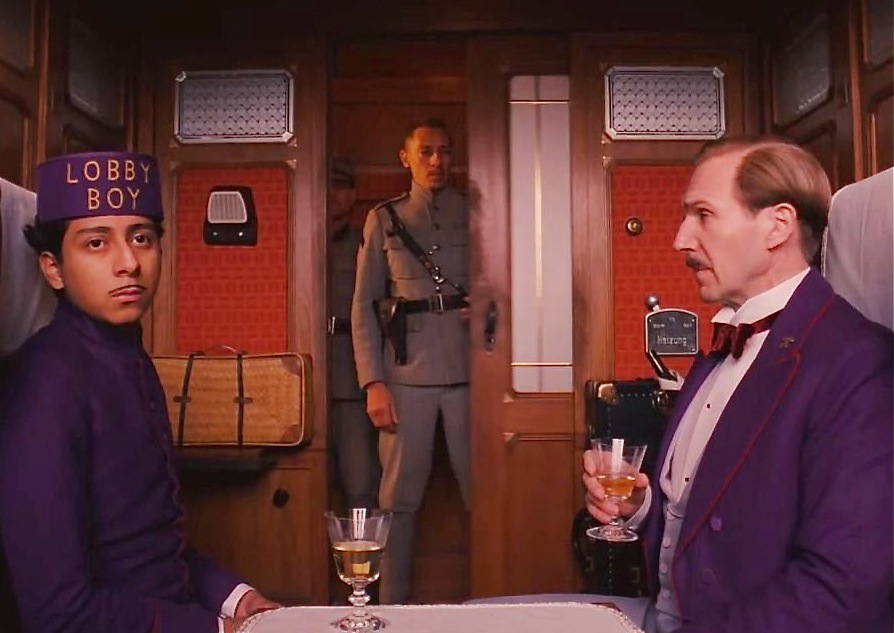
Passport CheckRichard Brody in his New Yorker article “Stefan Zweig, Wes Anderson, And a Longing for the Past” writes that Zweig himself had experienced the ‘practical difficulties’ and ‘psychological trauma’ of having lost his passport while on the run. The passport, Brody notes, “wasn’t even a commonplace document before the First World War.” Without it, one instantly was turned into an outlaw. Zero has M. Gustave to thank for standing up for him twice while travelling on the train without transit papers. The first time, officer Henckels (Edward Norton) recognizes M. Gustave, his parents’ friend, and remembers his kindness to him when he was a boy; human relations win over and Zero is spared. Unfortunately, luck runs out for M. Gustave in the second time, all because of the change in military control, a symbolic reference to the iron fist of the Nazi regime. No societal ties or achievements could save Zweig or the Jews in Europe during the Holocaust.

The following are two titles to which Anderson had made specific reference – Zweig’s only novel Beware of Pity and his novella The Post-Office Girl. The third is Anderson’s own selections, an excellent sampler of Zweig’s works, The Society of the Crossed Keys.

To continue reading my short reviews of these books, CLICK HERE to Shiny New Books. Or, just click anyway to see what an array of book reviews, author interviews and their own articles, book news and tidbits await you.

***

Seven Stanzas for a Happy Easter

Rocks


“Seven Stanzas At Easter” by John Updike

Make no mistake: if he rose at all
It was as His body;
If the cell’s dissolution did not reverse, the molecule reknit,
The amino acids rekindle,
The Church will fall.

It was not as the flowers,
Each soft spring recurrent;
It was not as His Spirit in the mouths and fuddled eyes of the
Eleven apostles;
It was as His flesh; ours.

The same hinged thumbs and toes
The same valved heart
That—pierced—died, withered, paused, and then regathered
Out of enduring Might
New strength to enclose.

Let us not mock God with metaphor,
Analogy, sidestepping, transcendence,
Making of the event a parable, a sign painted in the faded
Credulity of earlier ages:
Let us walk through the door.

The stone is rolled back, not papier-mache,
Not a stone in a story,
But the vast rock of materiality that in the slow grinding of
Time will eclipse for each of us
The wide light of day.

And if we have an angel at the tomb,
Make it a real angel,
Weighty with Max Planck’s quanta, vivid with hair, opaque in
The dawn light, robed in real linen
Spun on a definite loom.

Let us not seek to make it less monstrous,
For our own convenience, our own sense of beauty,
Lest, awakened in one unthinkable hour, we are embarrassed
By the miracle,
And crushed by remonstrance.

– John Updike (1932-2009)

***

Happy Easter to All!

Staying Awake in the Garden

I came across this image in Biola University’s Lent Project. It is by the Austrian children’s book illustrator Lisbeth Zwerger. Among several awards she had won, Zwerger received the acclaimed Hans Christian Andersen Medal for illustration—the highest international award given for “lasting contributions to children’s literature”.

Staying Awake in GG

Its title is Jesus praying in the Garden of Gethsemane, from her book Stories From the Bible. Without condescension, Zwerger’s image speaks with clarity such that a child can easily grasp its essence. Three people dozing off, each against a tree. From a distance, under a massive dark cloud, a tiny, lone figure walking towards the ominous void. The illustration is perhaps one of the rarer perspectives that accompanies this narrative:

“Then Jesus went with them to a place called Gethsemane, and he said to his disciples, “Sit here, while I go over there and pray.” And taking with him Peter and the two sons of Zebedee, he began to be sorrowful and troubled. Then he said to them, “My soul is very sorrowful, even to death; remain here, and watch with me.” And going a little farther he fell on his face and prayed, saying, “My Father, if it be possible, let this cup pass from me; nevertheless, not as I will, but as you will.” And he came to the disciples and found them sleeping. And he said to Peter, “So, could you not watch with me one hour? Watch and pray that you may not enter into temptation. The spirit indeed is willing, but the flesh is weak.” Again, for the second time, he went away and prayed, “My Father, if this cannot pass unless I drink it, your will be done.” And again he came and found them sleeping, for their eyes were heavy. So, leaving them again, he went away and prayed for the third time, saying the same words again. Then he came to the disciples and said to them, “Sleep and take your rest later on. See, the hour is at hand, and the Son of Man is betrayed into the hands of sinners. Rise, let us be going; see, my betrayer is at hand.”    – Matthew 26: 36 – 46

What struck me is how modern the feel; these three guys could be anyone. And they are so casual too, like, barefoot in the park. Considering the horrific mission their Master is facing, their body language speaks avoidance, indifference, and, even betrayal. The spirit is willing but the flesh is weak – blame it on the good supper – they’re totally oblivious while their Master in a distance, alone, is fighting the most anguished battle of his life.

Are these guys named Peter, James and John? Why, they could be you and me.

***

The Second, Best Exotic Marigold Hotel (2015)

The comma is not a typo. If you pause there before you say the rest, you’re clear in announcing the sequel, and not ‘The Second Best…’ for it’s not.

I’d say, it’s a little better maybe, funnier and more lively than the first. I can hear some protests. But in my case, kudos to the Bollywood dancers entertaining us before the movie began – two pairs of youthful and energetic Indian dancers giving us a taste of Bollywood – we were all warmed up and ready to embrace the show.

banner-the-second-best-exotic-marigold-hotel-film
Who will speak up against Ageism in the movie industry? What better spokespersons than the stars themselves? Let their charisma and performance speak.

The Second Best Exotic Marigold Hotel is all about checking into new beginnings. In the last chapter, life can be beautiful and fulfilling, and one is never too late to enjoy it, even if they are merely ephemeral, fleeting moments. With the latent energy of the Marigold residents, they intend to make those precious moments last for the rest of their lives.

Director John Madden, who helmed Shakespeare in Love (1998) and saw it go on to win seven Oscars, brings us the sequel to his unexpected box office success of the first Marigold Hotel. This is no Shakespeare In Love, of course, but from the digital ink of screenwriter Ol Parker, we have some fine dialogues despite a lack of substantial plot lines; from the mouths of the seasoned and weathered come some refreshing viewpoints.

Even if you’re not starstruck, you have to tip your hat to this cast of talents, veteran actors whose average age works out to be 70; yes, I looked them up and did the math. Two-time Oscar winner Maggie Smith, Judi Dench (also Oscar winner and exactly 19 days older than Maggie in real life, as she said in the movie), Bill Nighy, Penelope Wilton, Ronald Pickup, Celia Imrie, Diana Hardcastle, and this time around, the newly-aged and still handsome Richard Gere, with David Strathairn also playing a small role.

The young proprietor of the retirement hotel in Jaipur, India, Sonny Kapoor, is eagerly planning for an expansion of his business venture, a second Marigold Hotel. Performed with much animation by Dev Patel of Slumdog Millionaire fame, Sonny is basically the foil, not just in his youthfulness and agile Bollywood dance skills, but in his overacting. My query: why is his Indian accent thicker than his mother’s (Lillete Dubey)? Nevertheless, watching the threesome, the soon-to-be-married Sonny and Sunaina (Tina Desai) plus the odd addition of Kushal (Shazad Latif), is energizing and mood altering. In the last act, having the Marigold residents join in the Bollywood dance at the wedding party is a treat, an acquired taste for some viewers I admit.

Under the direction of DP Ben Smithard, we see some colourful street scenes and beautiful sights. Following the constant panning camera between pillars and doorways, we become silent observers of the lives of these Marigold residents.

Throughout the movie, I’ve jotted down a few fine lines which, if spoken by the inexperienced, could well become platitudes. But here delivered by these professionals of film and stage, the one-liners are spot-on and memorable. Everyone has a story and there are a few notable dialogues, like this between the eldest pair swept by clashing undercurrents:

Muriel (Maggie Smith): You’re just nineteen days older than I am.
Evelyn (Judi Dench): Nineteen days is the life span of a wasp.

Exactly, time is relative. Fact is, time is what these Marigold residents don’t have. That’s what makes each of their story so pressing. At 79, Evelyn is faced with the choice of accepting or declining a new career as well as a genuine but shy suitor, Douglas (Bill Nighy). Her feeling in a nutshell:

“Sometimes it seems the difference between what we want and what we fear is the width of an eyelash.”

Good that she realizes just in time, and it’s clever how she conveys her message to Douglas at Sonny’s wedding. So, her new insight after much pondering:

“I thought, how many new lives can we have? Then I thought, as many as we like.”

And for Norman (Ronald Pickup) and Carol (Diana Hardcastle), it’s never too late to change as we see love turn them from promiscuity to monogamy. Well, even a faint attempt is encouraging.

As for Madge (Celia Imrie), she finally decides which direction she should take, left, right, or straight ahead, probably for the first time in her life.

Who can laugh at the old but themselves? Here when Jean (Penelope Wilton) suddenly reappears at the Marigold, I can associate her role as the sharp-tongued Isobel Crawley in Downton Abbey:

“I couldn’t resist the opportunity to come out and visit the old ruins, and see how the hotel was doing too.”

As a self-appointed tour guide in Jaipur, Douglas knows it’s never too old to step out into uncharted territory. Some good laughs there with his little helper in the background feeding him info or he’ll be just as lost as his tourist clients. As well, he is experiencing love like an insecure young chap. This is my favourite line, not only for the words but the way Nighy says them can make your heart ache:

“The great and terrible thing about life is there’s just so much bloody potential.” The subtext is brilliantly conveyed by his obvious frustration and agitated demeanour.

Ah… “There is no present like the time” [sic, exactly]

Time is a gift and a torment when you’re only given a limited portion under the low-hanging clouds of mortality. Here’s the poignant scene at the end. It belongs to Muriel (Maggie Smith), could well be foreshadowing what we will see in Season 6 of Downton Abbey. Her voiceover is full of pathos:

“There is no such thing as an ending; just a place where you leave the story.”

Of course there are flaws in the movie. But just like wrinkles, you’ve come to overlook them while admiring the person. Call it an escape or a two-hour vacation, The Second, Best Exotic Hotel offers a fun and gratifying ride.

 ~ ~ ~ Ripples

*** 

Related Posts on Ripple Effects:

The Best Exotic Marigold Hotel (2012)

The Lunchbox (2013): A Meal that Binds

Downton Abbey Season 5 Finale

Slumdog Millionaire (2008)

Saturday Snapshot March 21: Welcome Back

We don’t have to wait for the official date. We’ve been enjoying unusually warm weather in the past few weeks. Creatures great and small come out to greet the early Spring; actually, many of them are here throughout the winter. The warm temperatures bring one creature out in particular, the birder.

Good to hear the Cedar Waxwings among the budding branches. Yes, I always hear their convivial buzz before seeing them:

cedar waxwings

Waxwing

The White-tailed deer, here all year round, but seldom do I see such a large party:

deer

The curious red squirrel loves company:

Red Squirrel

I think I saw both the pinkish Common and the white Hoary Redpoll, sent here by Spring and instinct:

Redpoll

Redpoll Hoary?

I’m always amazed to see our Great Horned Owl Mama and Papa coming back to the same spot to nest every Spring for the past few years. Every time, Mama will give birth to two Owlets in exactly the same hollow tree trunk.

Owl's Nest

Once they are fledged, the family will move on. Homing instinct will bring Mama and Papa back the next Spring. Where do the young ones go? Nobody knows.

Can you see Papa Owl in the trees?

Where's Papa Owl

Right in the middle. Here he is, eyes wide shut:

Papa Great Horned Owl

***

Saturday Snapshot is hosted by West Metro Mommy Reads. CLICK HERE to see what others have posted.

ALL PHOTOS TAKEN BY ARTI OF RIPPLE EFFECTS

DO NOT COPY OR REBLOG

Back to the Source: From Movie to Book

Those who have come to the pond here for a while would know I’m a Book to Movie person. If I know a film adaptation is coming out, I’d want to read the book first, as I’m always intrigued by the adaptation process. Maybe it’s the transposition of one art form into another that so fascinates me. Yes, you can say it’s a kind of theme and variation type of work.

But there are also times when I’m so captivated by a movie that, after watching it, I want to read the book on which it’s based. Thanks to Wes Anderson, I’m now reading Stefan Zweig.

the-grand-budapest-hotel movie poster

Before watching The Grand Budapest Hotel last April, I had never heard of the Austrian novelist, playwright, journalist and biographer Stefan Zweig. During the 1920’s and 1930’s, Zweig was one of the most famous and translated writers. And yes, here I am living under a Rock(ies), have never heard of the name until Wes Anderson’s confessional interviews, wherein he raved about how his (now) Oscar winning Budapest Hotel was influenced by the writings of Stefan Zweig. Also in the movie, there is the acknowledgement of Zweig as the source of inspiration as the film’s end credits begin to roll.

Here’s what’s interesting: Instead of adapting from one single work, Anderson created his Budapest Hotel sparked by the oeuvre of Zweig’s after he read his writings only a few years before. After watching the film, I’ve since read several of Zweig’s short stories, and a couple of novellas The Post Office Girl and Chess Story, and now continue to delve into more of his captivating, often bittersweet, stories. Watch for my article coming out in the April (Spring) issue of Shiny New Books on how Z inspired A.

So The Budapest is the most recent example of how a movie influences my reading. Over the years, there have been other ones. Here are some more:

12 Years A Slave (2013) – Steve McQueen’s artistic rendering of slavery may seem like a paradox, but acclaimed British actor Chiwetel Ejiofor’s performance as Solomon Northup is what spurred me to read the original memoir. Both are excellent works.

3:10 to Yuma (2007) – Have you ever read a Western short story? Western as in uh… cowboy, gunslingers. This is one of the few Western work I’ve ever read. The intriguing moral dilemma the movie depicts and its poignant ending had driven me to look for the short story by Elmore Leonard as soon as I left the theatre.

Bleak House (2005) – The BBC TV mini-series with Gillian Anderson as Lady Dedlock, Anna Maxwell Martin as Esther Summerson sealed the deal for me. The series also introduced me to the talented Carey Mulligan, her first role I believe. I turned to the 1,000 plus pages Dickens novel soon after the series finished. Because I’ve seen it first, it was a breezy read, almost.

Howards Ends (1992)  A cast with Emma Thompson, Helena Bonham Carter and Vanessa Redgrave is not hard to move and entertain. And thanks to Merchant Ivory, the dynamic dual of producer/director, and their team writer Ruth Prawer Jhabvala, I devoured the humorous and equally entertaining E. M Forster novel after that.

Revolutionary Road (2008) – I was captivated by the movie at first. Kate Winslet and Leo DiCaprio had done a marvelous job in depicting the entrapment of suburban life. But only through reading Richard Yates’ book did I sense the even deeper psychological entanglement that I missed in the film.

The Diving Bell and the Butterfly (2007) – I wrote in my book review, “This is one book that should be read after watching the film. Without visualizing what Jean-Dominique Bauby had gone through after his massive stroke, the reader simply could not empathize or appreciate enough of Bauby’s effort in ‘writing’ his memoir.” How? One blink at a time.

When Did You Last See Your Father (2007) – I watched the film twice at TIFF a few years back, Colin Firth as British writer Blake Morrison and Jim Broadbent as his overbearing and critical father dying of cancer. The life-long yearning of a son seeking his father’s approval is so sensitively portrayed. Reading Morrison’s memoir after only made me appreciate the film more.

How about you? Are there movies that have motivated you to go back to the source and read the book?

***

(CLICK ON the links in the titles to read my reviews.)

The Rite of Spring: Goldeneyes Courting

From afar, I could only see their amusing act through my camera lens. The male Common Goldeneye would let out a sharp call, stretch his neck straight up, drawing attention, then quickly bend his head far backwards, touching his rump, then snap right back, overcompensating by kicking his orange feet out of the water.

Pardon the inadequate description above. Actually looking at them is hilarious, like watching a bunch of class clowns trying desperately to impress. Here’s the sequence.

A sharp call to draw attention:

Sharp call

Stretch neck straight up:

Neck straight up

Bend over backwards:

Bend over backwards

Snap out of it:

Kick orange feet up

Male synchronized swimming – courting en masse:

Everybody together now

As for the females, looks like they are not easily moved, or maybe just feigning indifference:

Females paying no attention

No matter. Spring is at hand.

***

Saturday Snapshot is hosted by West Metro Mommy Reads. CLICK HERE to see what others have posted.

***

ALL PHOTOS TAKEN BY ARTI OF RIPPLE EFFECTS
DO NOT COPY OR REBLOG

Another Year, Another Downton: Season 5 Finale

For the past five years, Downton Abbey kicks off the new year for us North American viewers. For nine Sunday evenings in January and February, I’ve been prodded to get back home in time, or simply stay home so not to miss a Downton episode. Now that I can record the series on my HDTV, I can freely watch The Oscars without dilemma.

Last night’s Finale “A Moorland Holiday” has finally picked up rhythm and grabbed my attention for a too short 1.5 hours.

The time is Autumn of 1924. Rose’s father-in-law, Lord Sinderby, has rented the beautiful Brancaster Castle in Northumberland and invited the Crawley family to a grouse shooting party, a marvellous setting to end the Season. But why would the grumpy and disagreeable in-law want to do that? Probably because every Finale ends with an outing, the best setting for turns in the road, and we’re treated to an exciting ride. It is also the annual Christmas episode for the UK viewers, so we can see how that blessed Festival can join hearts in the Finale.

Last night’s extended Episode has once again confirmed why this annual major TV event is worth all the wait and staying in on Sunday evenings. Why don’t I just buy the DVD’s so not be constrained? No, watching Downton one week at a time together with all the millions of PBS viewers makes this Finale all the more gratifying.

This Episode has redeemed itself from a relatively uneventful Season, which begs the question, why didn’t Mr. Fellowes unleash his ingenuity more often instead of having us wait eight weeks to arrive at this gratifying end? No matter, we are a patient lot. Let’s face it, the Finale is well worth the wait; it rewards us with justifiable twists and turns, ties up all loose ends and gives us a major surprise. It has once again recharged my enthusiasm for the show and even moved me to tears at the rare spot.

If every episode this Season was as rich and juicy as the Finale, Downton could have easily doubled its weekly viewers.

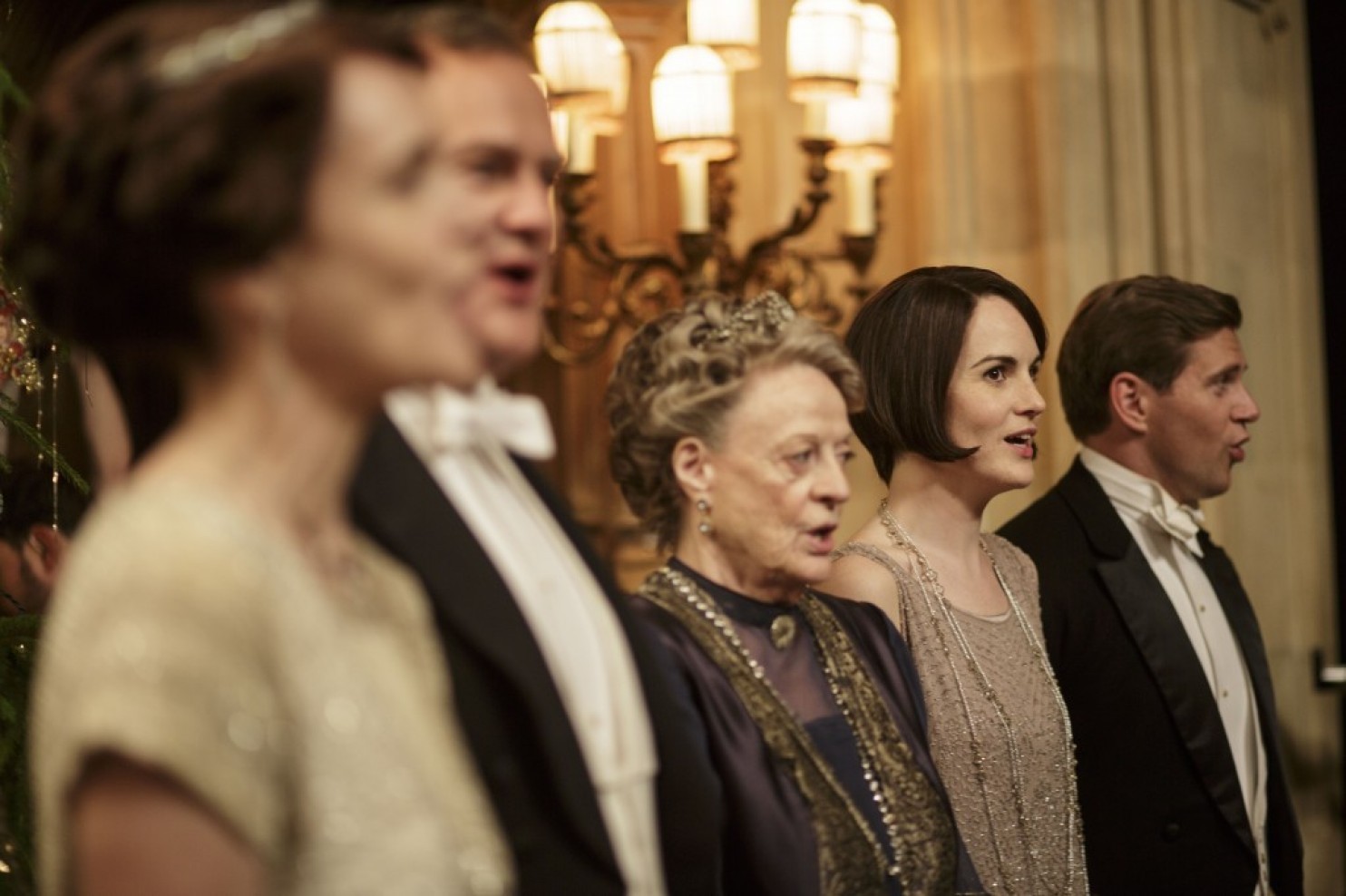
Downton S5 Finale

Kudos to director Minkie Spiro who has brought to life Julian Fellowes’ dense and captivating script. She has woven multiple story lines simultaneously, delivered the tensions, characters and conflicts at a flowing pace seamlessly without missing a beat. Both Fellowes and Spiro understand so well our collective psyche, that we in our hearts yearn for poetic justice: embarrassing the nasty, rewarding the good, reconciling the distant, and uniting the lovers… and I’m not just saying Rose and Atticus.

The father-daughter heart-to-heart in which Robert acknowledges Marigold, Edith’s child out of wedlock with Michael Gregson, is most endearing. How often do you hear a father utter these words: “I’m sure I need your forgiveness as much as you need mine.” And yes, he does have his secret of which even Cora is unaware.

Fellowes also ingeniously puts the skills and instincts of Downton’s trademark schemer, their very own Thomas Barrows to good use by letting him meet his equal in Stowell, and let them loose to wrestle and butt heads and finally to have Barrows come up on top, scoring for the visitors. The satisfying gesture is that he is winning the game for his employers and for Tom Branson, a worthy gentleman indeed, giving him his long due respect. Fellowes once again has proven that he is a master of tension at the formal dining table.

As for Anna and Bates, how many more trials and tribulations can a couple go through without having their marriage totally ruined? Fellowes knows when to stop; he is the ultimate puppeteer in the fates of the wrongly accused, but we thank him for leading them through thick and thin and bringing them out unharmed. And we enjoy the vicarious ride.

Rose too has redeemed herself. Looking back to her manipulative scheme in her earlier days, the fling on the town with jazz singer Jack Ross in Season 4 just to spite her mother, to Season 5 helping out the Russian refugees to finding and giving true love. We have seen Rose mature and proven herself considerate, trustworthy and resourceful, gaining favour from a very harsh father-in-law Lord Sinderby. BTW, recognize the man? He’s Uncle Geoffrey in Bridget Jones’s Diary.

And Atticus, don’t you just love that name? He is a good match with the totally transformed Rose. But with their move to America, we are sending them off with this Finale.

The ultimate union though belongs to Carson and Mrs. Hughes, Julian Fellowes once again knows what his viewers want and generously give them what their hearts desire. And Mrs. Hughes, being utterly surprised and most kind to demand Carson do it properly as Matthew and Atticus had done, kneel down and propose. Now that would have been a total shocker.

What falls short is the courtship between Isobel Crawley and Lord Merton, and that’s a shame, for they’d make a lovely pair. Violet Crawley can rest assure that her companion is still around to sharpen the iron in her, for it is not easy to find an equal like Isobel who is ever so ready to counteract her views. The reappearance of Prince Kuragin in her life turns out to be just a fleeting romantic interlude, gratifying still for an octogenarian.

Matthew Goode as Henry Talbot is an excellent prospect for Mary Crawley, why, they get to know each other by confrontations, however mildly put, not unlike Mary’s first encounters with Matthew. Hopefully this introduction would usher in Goode’s full-time presence in the upcoming Season, for here’s one that can make a worthy suitor for Mary. But what’s uncanny is, he’s into cars. And we all know what that passion can lead a man to, as Matthew’s tragic end is still vivid in our collective memory. I’m sure in Mary’s as well.

The heartbreaking event of course is Tom moving from Downton and England with young Sybbie to Massachusetts to help his brother with his auto-business. Again, the automobile seems to be the invention that brings mixed blessings. The most moving scene is the joining of hands of Tom, Mary, and finally Edith, to remember Sybil for a short moment, and Tom soaking in his last presence, storing memory of the room, or is it Fellowes’ way to let us do that, imprinting Allen Leech in our collective memory.

“We’re the three who should have grown old with her… and who knows when we’ll be together again.” I admit, this really hit me, the value of growing up and growing old together, the treasure of one’s peers. I’m not one who easily succumb to emotion, but this scene did it, not just for missing Tom in the future Season, but for all the family to miss seeing little Sybbie grow up.

Tom and Sibey

And now, another year’s wait… You know, Julian, we don’t mind waiting. Let’s have a few more.

***

If Winter Comes, Can Spring be Far Behind?

The English poet Percy Bysshe Shelley holds one view common with Balzac Billy, our Alberta Groundhog: an early spring is on its way.

Not to rub it in, but we’ve been enjoying a relatively mild winter, even a record high on Jan. 25, when the temperature reached 17C (63F).

These photos were not taken right on that day, but they all show how our ducks and geese shrugged off the icy river, spread their wings and echoed Balzac Billy’s prediction.

Here they are mass sunbathing:

Mass Sunbathing

The Mallards show their true colours:

Mallards show their colours

Compared to the Mallards, the Buffleheads are smaller in size, and are distinctly more playful. Why wait for spring to make a splash?

Playful Buffleheads

or try walking on water:

Bufflehead walking on water

The Common Merganser stands out among the crowd with their long, red beaks and eggshell white lower body with a yellow glow:

Male Merganser stands out

But my fave is the female Merganser. I like her roll-out-of-bed hairdo and natural mascara. For some reasons, she makes me think of Lucillle Ball:

Lucille Ball Merganser

Nature’s hourglass, every drip brings us closer to Spring:

Nature's Hourglass

***

Saturday Snapshot is hosted by West Metro Mommy Reads

All Photos in this post taken by Arti of Ripple Effects

Do Not Copy or Reblog

***

87th Academy Awards Winners (2015)

Inconsistencies marked the awards show last night. The opening number was so fascinating that it had set a standard and expectation that could not be met for the rest of the evening, from Neil Patrick Harris’s jokes to the incredulous performance by Lady Gaga singing a medley from The Sound of Music. Was that just to open for Julie Andrew to come out to present the Best Original Score? As for NPH’s Birdman imitation game, the naked escapade was a little too desperate an attempt to shock. But his guessing game was mind boggling I must admit.

There were notable high points though, most memorable being the performance of the Oscar winning song ‘Glory’ by John Legend, Common, and a massive group of backup singers re-enacting a Selma scene. Tears rolled down the face of David Oyelowo’s who played Martin Luther King Jr. in the movie, and Chris Pine’s, who played… uh… Captain Kirk.

Speeches were heartfelt and imbued with family value. J. K. Simmons had set it off with a passionate plea for all to thank their parents, mothers, spouse, and children. Patricia Arquette brought the house down with her cry for equal work, equal pay for the females in the movie industry. Is she now considered a whistleblower? Meryl Streep and Jennifer Lopez almost jumped out of their seats with approval. Ironic to think that some of those applauding were the gatekeepers of the system.

Major winner was Birdman, grabbing all the most coveted prizes, albeit a let down for Michael Keaton. The Grand Budapest Hotel tied with Birdman in the number of Oscars won, the exact categories predicted in my review written in April last year. Just sayin’.

Boyhood only got one nod, a gem of a film that is the epitome of innovation, perseverance, and risk-taking. The fact that it has travelled so far all the way to Oscar night, thirteen years by now, is already an admirable success for the filmmakers and all involved, albeit I’d like to see them win a few more, especially for director Richard Linklater.

Excited to see Ida honoured as the Best Foreign Language Film of the year, and to hear director Pawel Pawlikowski’s take on the occasion: Ida was intended to be a quiet film of contemplation about withdrawing from the world, “and here we are at the epicenter of noise and attention. It’s fantastic. Life is full of surprises.”

CitizenFour won Best Documentary, deservedly. Director Laura Poitras had done an extraordinary job capturing (no pun intended; better than NPH’s ‘treason’) Edward Snowdon’s initial coming out with all the classified materials, filming his meeting with journalist Glenn Greenwald in a Hong Kong hotel room. Considering how the events unfolded later, these footage are now invaluable. The film is on my Top Ripples 2014 list.

Here are the major Oscar 2015 winners:

Birdman (4) – Best Picture, Directing, Original Screenplay, Cinematography.

The Grand Budapest Hotel (4) – Best Makeup, Costume Design, Production Design, Original Score.

Whiplash (3) – Best Supporting Actor J. K. Simmons, Film Editing, Sound Mixing

Boyhood (1) –  Best Supporting Actress Patricia Arquette.

The Imitation Game (1) – Best Adapted Screenplay

The Theory of Everything (1) – Best Actor Eddie Redmayne

Still Alice (1) – Best Actress Julianne Moore

American Snipper (1) – Best Sound Editing

Selma (1) – Best Original Song ‘Glory’

Ida – Best Foreign Language Film

CitizenFour – Best Documentary

Interstellar – Visual Effects

For a complete list, CLICK HERE.

***

Click on the links to my reviews of Oscar Movies:

The Budapest Hotel: A Grand Escape

Whiplash: What Price Perfection?

Boyhood: The Moment Seizes Us

Ida’s Choice

Interstellar and Ida: The Sound and Silence of Exploration

Leviathan: The Beast Within Us


Leviathan: The Beast Within Us

The Chinese have a saying – while we’re at foreign language films – ‘A tyrannical government is more ferocious than the tiger’. That Leviathan is selected as the official entry from Russia to the Oscar race baffles me. But I can also see those in power there just may not be bothered by small town corruptions which the film depicts, for they must be more focused on the larger picture that carries greater magnitude, the scenery in Crimea.

Leviathan, that monstrous beast the priest in the film quotes to the main character Kolya is from the book of Job in the Bible. While the context in the Biblical passage is about the Creator’s might over the huge creature, it is a metaphor with layered meaning in writer/director Andrey Zvyagintsev’s film: A citizen against a powerful mayor vying for his home property, and the monstrous beast inside the characters with which they all have to wrestle.

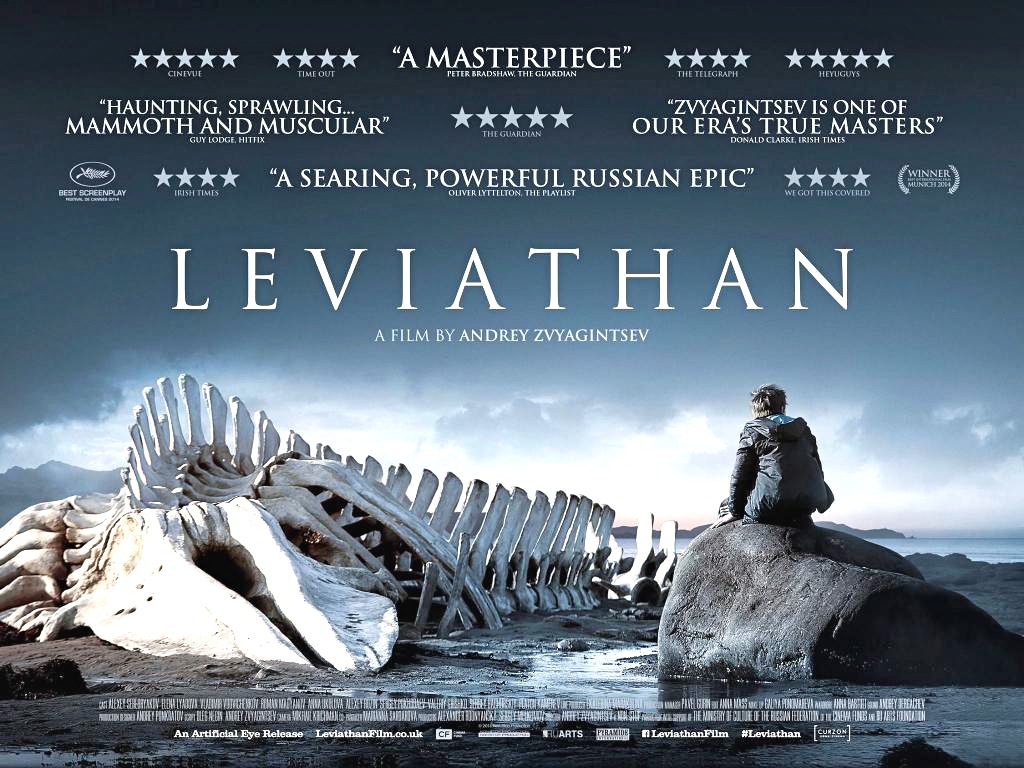
Leviathan Movie Poster

Kolya (Aleksey Serebryakov) is an apt parallel of a modern day Job in the sense of the misfortunes he encounters. The little guy is no match for a greedy and powerful mayor and a corrupt system when it comes to holding on to what he legally owns, his home on a piece of  land by the shoreline in the coastal town of Pribrezhny. Even his lawyer friend Dimitry (Vladimir Vdovichenkov), who has come all the way from Moscow to advocate for him, falls victim to the small town mayor Vadim (Roman Madyanov).

The seemingly idyllic setting of Kolya’s coastal home is apparently an illusion. The cinematography is stunning and probing at the same time, for apart from the scenic serenity, there are also broken and derelict boats discarded on the shore, as well as carcasses of sea creatures, in particular, a whale-like skeleton that we the audience would gasp upon seeing but that the local residents don’t even take a second look. Their lives are intertwined with the Leviathan, however skeletal its remains.

But Kolya is not Job. He is hotheaded and impulsive. Apart from fighting the external beast of the mayoral hostile take-over of his home property, Kolya has to keep his wife Lilya (Elena Lyadova) at bay from his lawyer friend Dimitry, as well as bring up teenaged son Roman (Sergey Pokhodaev) on a path he himself is at a loss in finding. The worst is yet to come though. We empathize with Kolya, a man so trapped, he is unable to find a way out other than drowning his misery in alcohol. The church is not helping either, why, its most powerful congregation member is the mayor himself.

Too far and remote a film to identify? The setting maybe, but not the story. Leviathan resonates with the human condition it depicts, the Leviathans within us that we have to wrestle wherever we may be. Not just Kolya, but every character is crying for a redemptive way out of his or her predicament, unless blind as the mayor who basks in his own schemes. With the nuanced performance of the cast, we have the pleasure to appreciate a production superbly crafted, and that’s what gratifies when watching a film well made, despite the subject matter.

Leviathan has won 2014 Cannes Film Festival’s Best Screenplay Award, and last month the Golden Globe’s Best Foreign Language Film. This Sunday at the Oscars, Leviathan has a good chance of grabbing the coveted prize in its category, Best Foreign Language Film of the Year.

My pick? Still rooting for Ida, for its positive choice at the end.

~ ~ ~ 1/2 Ripples

***

My Reviews of 2015 Oscar Nominated Films:

Ida

Boyhood

The Grand Budapest Hotel

Whiplash

Gone Girl 

Interstellar and Ida