The Girl With The Dragon Tattoo: The Movie (2009)

Update Feb. 13: The Girl With the Dragon Tattoo just won BAFTA’s Best Film Not In The English Language.

Summertime… and the viewing is chilling.
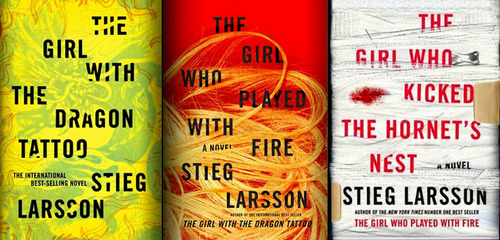
By now, we North Americans have caught the blazing heat that had swept other parts of the world a few years back, as we get the English translation of the Millennium Trilogy:  The Girl With The Dragon Tattoo, The Girl Who Played With Fire, and last of the series, The Girl Who Kicked The Hornets’ Nest.  All three books dominate the New York Times Best Seller Lists: When I last checked, the first two novels occupied the first and second places on the Paperback Trade and Mass-Market Lists, the newly published third title quickly claimed its second place on the Hardcover List.  The Trilogy has sold more than 27 million copies in 41 countries world wide.
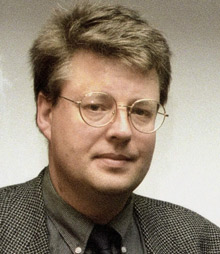
It’s just too sad that the Swedish author did not get a taste of his own success.  Stieg Larsson died in 2004 of a heart attack at 50.  All three books were published posthumously.  Before his fame as a writer and journalist, Larsson had championed against racism and right-wing extremism for decades.

Those who frequent Ripple Effects might know, I’m interested in the transforming of books into films.  There are many instances where I would read the book first before seeing the movie.  But here’s an exception.  I’m glad I went into the movie theatre knowing nothing about the story.  Because of that, I was held on the edge of my seat from beginning to end, my mind fully engaged, all 152 minutes of it.

The story begins with a high profile journalist with Stockholm’s Millennium Publication, Mikael Blomkvist (Michael Nyqvist), losing a libel suit brought on by a corrupt financial giant. Blomkvist is given half a year of freedom before serving a three-month jail term. Meanwhile, the reclusive industrial tycoon Henrik Vanger (Sven-Bertil Taube) approaches and hires the disgraced journalist to investigate the disappearance and likely murder of his beloved niece Harriet Vanger 40 years ago, a unique assignment that intrigues Blomkvist.  Initially, Vanger has recruited Lisbeth Salander (Noomi Rapace), a ‘researcher’ with a security firm, to do a background check on Blomkvist. Lisbeth is in fact an expert hacker. Believing Blomkvist to be set up in the libel suit, she continues to track him, and the two finally meet up and join hands in search of the truth behind the disappearance of Harriet Vanger… and a bit more.
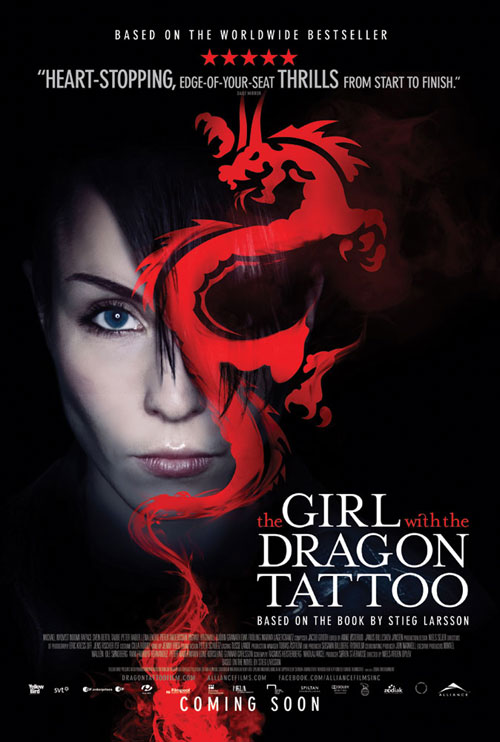
This is one engrossing and highly suspenseful piece of filmmaking in the crime thriller genre.  First off, the cinematography and the overall visual tonality is reminiscent of film noir, setting the mood effectively.  As well, the many Vermeer moments wherein the playout of light and shadows reflect aptly the complexity of the characters.  The revealing of hidden facts and personal secrets drive the riveting momentum.  Pacing is suitably executed.  While it’s not your bullet-speed Bourne flick, it unfolds the story smoothly, allowing some real acting to take place.  There are effective action sequences and some poignant moments.  And yes, there are also scenes where the audience could well be aware that their emotions are being led towards an intended end.  As witness of a violent crime against the heroine, the audience is pulled to a cathartic revenge, and feels okay with it.  Herein lies the effectiveness of the film.  Less obscure is the original Swedish title: “Men Who Hate Women”.  So the warning is: graphic violence.  But it’s not gratuitous and I have to say, only reveals the reality of how low and depraved human can be.


Another measure of success is how quickly the film has elicited my empathy and even compassion for the female protagonist.  It can make an ear and nose-pierced, misanthropic, rage-wrapped goth to become the heroine within minutes into the film.  This idea is original, iconoclastic, and timely too.  It draws us from the surface of looks and attire into understanding one’s psyche, to see how past experiences mould a life.  There are layers of truths to be understood if one is willing to go past the facade.

Condensing 600 some pages (Paperback) into 152 minutes must be an arduous task.  A lot of details are bound to be put aside.  But with every adaptation, the movie ought to be viewed as a totally different medium, and not be judged by how literal the transformation is.  Turning words into visuals has always been the demanding job of the screenwriter but also the realization of a vision from the director.  As a movie viewer, I’ve appreciated the work as a congruent whole, very well edited and all loose ends tied, even opening a tiny portal for the sequels coming up.

Shot entirely on location in Sweden, the work is an artful piece of filmmaking.  The wintry Swedish landscape is a quiet visual relief for our hot summer months. The movie has garnered several noms and awards, most notably The Swedish Guldbagge Awards in Best Film for director Niels Arden Oplev and Best Actress for Noomi Rapace.  It was also honored with the Audience Award at the Palm Springs IFF.

.

.

But will the movie and its two sequels gather as much hype as the novels?  Here in English only North America, I’m afraid not, at least not with the Swedish versions. Here are the stats if you’re interested. Watching a movie with subtitles is much more common in other parts of the globe than here.  Thus prompts Hollywood to plan for an English version. Well, is it language or profit?

My recommendation is: go for the Swedish one.  See a film in its most authentic adaptation, Swedish setting, original language dialogues, and superb performance.  Don’t let Hollywood distract you from the real thing. There have been rumors of Carey Mulligan, Natalie Portman, and Kristen Stewart taking the role as Lisbeth Salander, and Daniel Craig, Johnny Depp, Brad Pitt, and George Clooney as Blomkvist.  Well, if they must make an English version, my picks for the leads are Ellen Page and Jeremy Renner.

But no matter what, the Swedish original is a hard act to follow.  It’s now on DVD and Blu-ray.  And if it’s still being shown in theatres in your area, nothing beats seeing a thriller on a sweltering summer day, or night, inside a cool, dark theatre.

~ ~ ~ 1/2 Ripples


To Kill A Mockingbird

Clint turns 80 today.  A book dedicated to him as well as a special DVD just out to celebrate his life-long achievement.  There’s no shortage of Father’s Day gift ideas.  I understand though the man himself does not want any celebration on his birthday.  So to make his day, I’m not going to say anything more about him.

But there’s another birthday, or anniversary rather, that should be mentioned.  To Kill A Mockingbird turns 50 this year. Another good choice for Father’s Day, or any day really, and not just for fathers.  In recent years, as I see current events unfold, I truly feel this will make a marvellous gift for Law School graduates, or any graduate for that matter.   In this tumultuous time we’re in, where honor, justice, and nobility of character seem to become obsolete as quickly as the latest techno gadget, we all need a guidepost, a moral compass, ever more so.

To commemorate the 50th anniversary of its publication, Harper Collins has published a special edition:

Harper Lee had based the story on her childhood experiences in her hometown Monroeville, Alabama.  Her understated storytelling of Atticus Finch, Scout and Jem of Maycomb had won readers’ hearts the world over.   Two children growing up learning the value of respect and justice, love and integrity from their father.  Theirs was a most trying of times when racism and the Depression joined hands to destroy any fragile decency still present in a poverty-stricken town in the deep south.

Strangely, the story of such a parochial setting had triggered universal resonance.  The novel has been translated into at least 40 languages, sold over 30 million copies.  It has gained the number one spot on the list of greatest novels of all time.  It is the choice of British librarians according to a poll conducted by the Museum, Libraries and Archives Council (MLA), in which librarians around UK were asked the question, “Which book should every adult read before they die?”  Just hope people don’t wait till then.

***

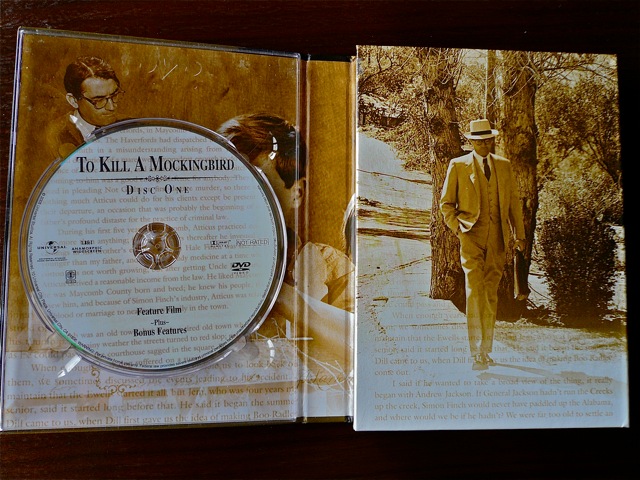
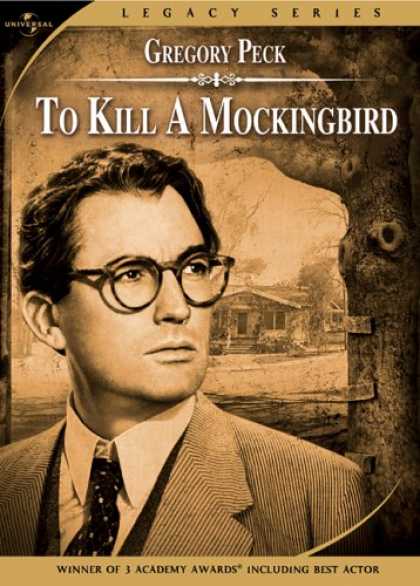
To Kill A Mockingbird DVD, Universal Legacy Series


To complement the book, I highly recommend the DVD set of the Oscar-winning movie (1962).  Make sure it’s the Universal Legacy Series (2005).  This is a two-disc collection with loads of memorable special features. Here’s a list:

  • Academy Award Best Actor Acceptance Speech — Gregory Peck
  • American Film Institute Life Achievement Award — Gregory Peck
  • Daughter Cecilia Park’s heartwarming tribute to her father
  • Scout Remembers — An interview with Mary Badham, who talks about her experiences working with Gregory Peck
  • Fearful Symmetry: The Making of To Kill A Mockingbird
  • The documentary A Conversation With Gregory Peck, produced by Cecilia Peck.  Scenes with Lauren Bacall, Martin Scorsese, President Bill Clinton and the Peck family.  Most moving is ordinary people sharing how the movie had impacted them, in their career choice, parenting and life.

“All the children of the whole world must have wished they could have Gregory Peck as their father.  He was ours, and that was our blessing.  He really was a lot like Atticus Finch… The last page of his film script of To Kill A Mockingbird, he had scrawled these four words at the bottom: Fairness, Courage, Stubbornness, Love. And they remind me so much of him…”  — Cecilia Peck’s tribute to his father

“It’s difficult to separate the man from the character.”  — Mary Badham (Scout) reminisces on her experience working with Gregory Peck

“Making millions is not the whole ballgame.  Pride of workmanship is worth more, artistry is worth more.  The human imagination is a priceless resource.  The public is ready for the best you can give them.  It just maybe that you can make a buck, and at the same time encourage, foster, and commission work of quality and originality.”  — From Gregory Peck’s acceptance speech for American Film Institute’s Life Achievement Award.

And if you think it’s all about Gregory Peck, well in a way it is.  I can’t think of anyone better to climb into the skin of Atticus and walk around in it.  The man is Atticus Finch, as his colleagues and family had testified. Gregory Peck received a well-deserved Best Actor Oscar for his role.  I must mention too that this is where Robert Duvall made his acting debut, without saying one single word, as Boo Radley.

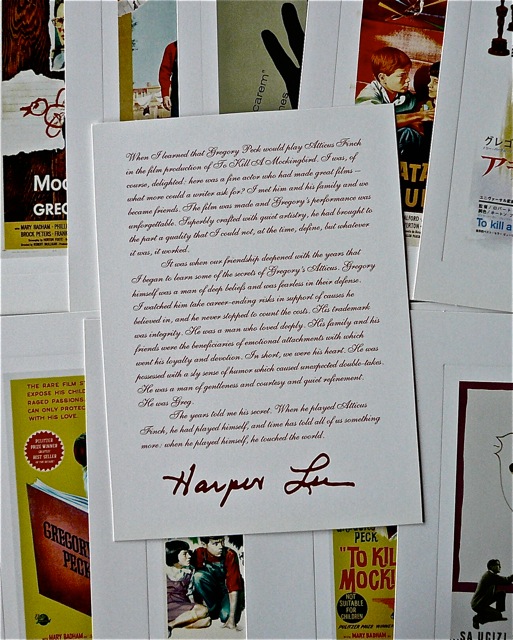
The other good reason for this Legacy Series is the 11 Exclusive Reproductions of Original Theatrical Posters. They are printed in a handsome set of cards, each a tribute from the country it comes from: Australia, Belgium, Italy, Japan, Argentina…

And last but never the least, a note from Harper Lee herself about the actor playing a character that was a cinematic reflection of her own father.

“When he played Atticus Finch, he had played himself, and time has told all of us something more:  when he played himself, he touched the world.”   —  Harper Lee

***

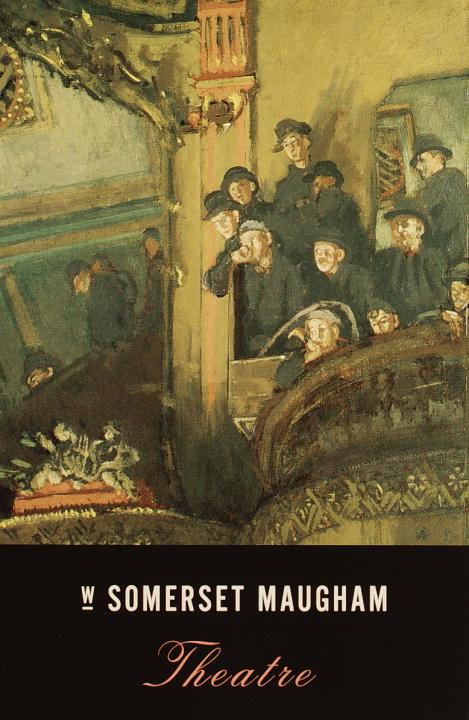
THEATRE by W. Somerset Maugham: In Search of Reality

It was pure serendipity. I thought I knew almost all of Maugham’s titles, but this one just escaped me.  I found it on the ‘New and Notable’ shelf in the public library. It’s a Vintage International edition paperback published in 2001. Not new but it looked untouched and inviting.

Two pages into the book I knew right away I had seen it before. Of course, that’s the movie Being Julia (2004). Annette Bening got a Best Actress Oscar nom for her portrayal of Julia Lambert, a famous actress on the London stage in the 1930’s. The movie is a colorful account of how a successful stage actress deals with her mid-life crisis. With fame, fortune, and achievement in bounty, what more could she ask for but… love and passion. And during the course, obstacles, jealousy, and betrayal are all overcome, and revenge carried out; on or off stage, no matter, it’s equally exciting for the glamourous Julia Lambert.

But not until I read this novel on which the movie was based did I realize that a most important passage had been left out. And oh what an omission! For the crux of the book rests on those few pages. And not only that, the screenwriter had chosen to alter a character to suit his fancy, rounding off the edges of conflicts and alleviating tensions in presenting a smooth and suave storyline.

In the movie, Julia’s son Roger is a young man fresh out of Eton and planning to attend Cambridge after the summer. That much is true to the book.  Roger is shown to be a devoted son, lovingly supportive of his mother in her pursuits in career and love life. But this is not the case in the novel.  Maugham has crafted Roger as a critical young man, offering the necessary tension to the story. In a crucial scene at the end of the book, he questions Julia’s behaviour and integrity. These challenges form the climatic confrontation between mother and son, projecting the meaning behind the very title of the novel.

Here is an excerpt from this scene that captures the essence of the whole book. Julia asks Roger:

“What is it you want?”
Once again he gave her his disconcerting stare.  It was hard to know if he was serious, for his eyes faintly shimmered with amusement.
“Reality.”
“What do you mean?”
“You see, I’ve lived all my life in an atmosphere of make-believe…. You never stop acting. It’s second nature to you. You act when there’s a party here. You act to the servants, you act to Father, you act to me. To me you act the part of the fond, indulgent, celebrated mother. You don’t exist, you’re only the innumerable parts you’ve played. I’ve often wondered if there was ever a you or if you were never anything more than a vehicle for all these other people that you’ve pretended to be.  When I’ve seen you go into an empty room I’ve sometimes wanted to open the door suddenly, but I’ve been afraid to in case I found nobody there.”

By turning Roger into a complacent and docile young man, the screenwriter had failed to present the necessary tension in the story. Further, by avoiding the character foil between the successful actress mother and her meaning-pursuing, idealistic son, the movie fails to deliver the essential subtext, despite an impressive performance by Annette Bening.

Further, the best is yet to come in the book… such is the ingenuity of W. Somerset Maugham.  After a superb, revengeful performance, overarching her rival, the young and beautiful Avice Crichton, and drawing everyone’s admiration back to herself, Julia celebrates on her own with a nice meal and mulls over a gratifying notion, on the very last page:

“Roger says we don’t exist. Why, it’s only we who do exist.  They are the shadows and we give them substance. We are the symbols of all this confused, aimless struggling that they call life, and it’s only the symbol which is real. They say acting is only make-believe. That make-believe is the only reality.”

This is ever so relevant for us today. With all the online personae we can create and project, all behind the guard of anonymity, Roger’s quest for what’s real remains a valid search.

Sherry Turkle, the acclaimed ‘anthropologist of cyberspace’, has observed the liminal reality in our postmodern world and stated her own quest:

“I’m interested in how the virtual impinges on what we’ve always called the real, and how the real impinges on the virtual.”

Let’s just hope that the advancement of technology would not get the better of us, blurring the lines of fact and fiction, offering shields for fraud and deceits. Behind the liminal existence, let’s hope too that we still care what’s real and what’s not, and that our humanity will still be valued and not be compromised or lost in the vast abyss of bits and bytes.

The upcoming Academy Awards too, is another platform to showcase such a duality. I always find the acceptance speeches of award winners intriguing: what’s genuine and what’s fake in their thank you’s. Are they presenting their real self or merely acting? Outside of their roles, which part of them is authentic? Or, do they ever get out of their roles?

It’s interesting too to explore the influence of movies nowadays. Again, the postmodern emphasis is on the narrative, multiples of them, and storytelling the vehicle of meaning. Does the notion of Maugham’s character Julia mirror our world… that movies have become the symbols of what we call life? That make-believe has sometimes been merged with reality? Can we still tell them apart? Or, should we even try? Considering the pervasive effects of pop culture in our life today, considering a single movie can command a worldwide box office sale of $2.4 billion, and counting… Maugham was prophetic indeed.

***

Emma (2009, TV): Episode 3

The final instalment of Emma has a major challenge, to reveal the hidden agendas, and to tie up all the loose ends in just under an hour. The hurried scenes leave me with a feeling of watching a trailer, a montage of excerpts loosely linking up the story.  This is especially so in the first half dealing with Jane Fairfax and Frank Churchill’s secret relationship.

If the story feels a bit fragmented in this last episode, the cinematography makes up for that shortfall.  The hour is saturated with stunning shots, magnificent scenic views and exquisite interior renditions.  The Box Hill picnic scene is a vivid example:

Ironically, the pivotal Box Hill scene was not shot in Box Hill, a busy tourist attraction in Surrey.  Instead, it was shot in Leith Hill, Mole Valley, another much quieter scenic point.  For an interesting comparison of the two hills, click here to go to ‘this is surrey today’.

The Box Hill picnic is a crucial turning point in the story.  Emma’s callous and sarcastic joke on Miss Bate and the subsequent scolding she receives from Mr. Knightly is nothing short of an epiphany in self-knowledge.  The genuine remorse she feels could well reflect her greatest strength.  I’m sure such quality of character is what seizes Mr. Knightly with tenderness, moving him to consider her “faultless in spite of all her faults.”

I have a feeling too that this is the very reason Austen finds her heroine likable.  Romola Garai has effectively portrayed a contrite and humbled Emma, while Jonny Lee Miller has delivered convincingly a silent lover with passion and principle.  My initial reservation about his role has definitely changed for the better in this final episode.

Fortunately as well, the endearing lines of Mr. Knightly to Emma, no, not the ‘badly done!’ admonition, but the heartfelt praise he spurts out in spontaneity, remains intact and without any modernized alteration from screenwriter Sandy Welch.  Of course it needs to be declared in its authentic whole… Miller has the best lines of the series:

“I cannot make speeches, Emma… If I loved you less, I might be able to talk about it more.  But you know what I am.  You hear nothing but truth from me.  I have blamed you, and lectured you, and you have borne it as no other woman in England would have borne it.”

As with all Austen’s novels, the ending comes with nuptial ties. But as Masterpiece Classic’s host Laura Linney points out at the opening, considering the social discriminations inflicted upon the woman in Jane Austen’s time, allowing no ownership of properties, no decent employment (even Jane Fairfax compares the governess position with slavery), and no respect or rights given to the single female of low means, it is only a justifiable reward for the author to end her story with loving marriages for her well-deserved protagonists.

Towards this end, the camera takes us to the magnificent view of Beachy Head in the last scene.  As Emma and Mr. Knightly stand on the edge of the cliff overlooking the boundless ocean, we see the series come to an idealistic end, maybe a broader stroke than that in Austen’s novel. But as some critics have noted, it is love that the author emphasizes rather than romance.  From that perspective, looking outward together to the ocean vast instead of gazing into each other’s eyes may well be an apt interpretation of Austen’s heart.

***

CLICK HERE to go to Episode 1

CLICK HERE to go to Episode 2

Arti’s reviews of Emma (2009), Episodes 1 to 3, have been compiled into one article and published in the Jane Austen Centre Online Magazine. CLICK HERE to read the many other interesting articles on Jane Austen and her time.

**Photo Sources: Box Hill Picnic bbc.com; Beachy Head, not a scene from the movie, taken from Wikimedia Commons.

Emma (2009, TV): Episode 2

‘An authentic human being’ is how the host of Masterpiece Classic Laura Linney describes Emma.  Jane Austen’s characters have no supernatural powers, she notes.  But herein lies the magic of her writing.  She takes the ordinary and draws out the unnoticed features.  From these everyday characters like you and me, she skillfully displays the intricacies woven in their interactions, and reveals the undercurrents of hidden intentions and desires.  It is in the revealing of the subtext that makes her story so captivating even for us modern day readers.

Episode 2 continues with this interesting story as we see Emma confused by her own feeling towards Frank Churchill, Harriet’s shifting admiration for the same, Frank Churchill’s seemingly open admiration for Emma, Mr. Knightly’s growing sentiments for the same, and, Jane Fairfax’s hidden anguish, ignored by the subject of her desire.  It seems that everybody’s feeling is mixed up with everybody else’s.  The comedy of errors gathers momentum.

Cinematography continues to be a major contributor to the storytelling.  I particularly appreciate the several Vermeer moments, like the one with Emma gazing out the window deep in thought, or the camera silently captures her playing the pianoforte, immersed in diffused light.  I’ve also enjoyed how the visual reveals inner thoughts.  Mr. Knightly’s longing is projected by the flashback of his dancing with Emma, shifting to the single swan in the pond, warm music enfolding… a beautiful cinematic moment where the visual and music communicate effectively without words.

Mrs. Elton is animatedly played by Christina Cole.  In terms of comedic and obnoxious effects, she is of her husband’s equal, a good match indeed. While Rupert Evans is proficient in portraying a sly Frank Churchill, he does not look like the one I have in mind.  But that is not important. My main concern is with the role of Jane Fairfax.  This second episode confirms my misgiving from the beginning.  I feel there is a miscast here.  I miss her elegance, poise and subtleties as described by the author.  She is supposed to be Emma’s worthy rival after all.

The dance at The Crown Inn is a delight to watch.  That is also the occasion showing everybody’s true colour.  And Mr. Knightly has proven himself to be one considerate gentleman as he invites Harriet to dance after she is slighted by Mr. Elton.  Also, we’re beginning to see Mr. Knightly more and more in love, while the object of his desire remains relatively clueless, albeit a sense of appreciation has arisen in her confused heart.  The dances are fun to watch too, much more lively and convivial than the courtly dances we see in other Austen adaptations.

After two episodes, the story and the characters are well developed, the overall effects pleasing and enjoyable.  I look forward to the next instalment.

*****

CLICK HERE TO GO TO MY REVIEW OF EPISODE 1

CLICK HERE TO GO TO EPISODE 3, THE CONCLUSION

Arti’s reviews of Emma (2009), Episodes 1 to 3, have been compiled into one article and published in the Jane Austen Centre Online Magazine. CLICK HERE to read the many other interesting articles on Jane Austen and her time.


Emma (2009, TV): Episode 1

Previously on Masterpiece Classic

Yes, treat this post as a recap to prepare you for Episode 2 in just a couple of days.

So finally, North American viewers have the chance to see the long awaited 2009 BBC production of Emma, three months after its release in the UK.  A click on imdb will find no less than 15 different versions of this popular Austen work.  Yet another one?  It just naturally leads one to question, why?  After seeing this first episode, let me give it a shot: just because it’s so much fun to do.

That’s how I felt as I watched the PBS broadcast last Sunday.  This newest adaptation of Emma is probably the best I’ve seen, and Romola Garai easily the best-cast Emma so far.  Yes, I’m comparing her with Gwyneth Paltrow (1996) and Kate Beckinsale (1996, TV).  She may well be one of the best-cast Austen heroines for their roles in my opinion, let’s just say, neck and neck with Jennifer Ehle’s Elizabeth Bennet.

What a difference from her guilt-ridden Briony in the movie Atonement.  Well, Garai’s Emma is guilt-ridden too as the errant, over-confident matchmaker, but her genuine heart and willingness to own up to her misjudgment have made her personality shine through.

In creating Emma, Austen had said that “I’m going to take a heroine whom no-one but myself will much like.”  Seems like this adaptation does a great service pulling us over to Austen’s side. Garai’s Emma reflects the probable reasons why the author found her character likable: vivacious, charmingly clueless, and above all, her readiness to admit faults, her genuine heart towards herself and others.  Garai’s animated performance is most apt in a comedic genre such as this.  So far in the first episode, the irony and humor have come through.

The impressive cinematography matches perfectly the personality and atmosphere of the novel, brisk, agile, fun, and yes, as Mr. Knightly narrates in the beginning, golden.  Just the kind of colour scheme for a clever comedy, the exact reflection of its main character.  As a comedy, a little exaggeration in the colours is acceptable and quite effective I think.  Overall, the visuals are captivating, beautiful shots of the English country landscape, the well situated mansions and their interior renderings.  I’ve particularly appreciated the few overhead shots, and some of the contrasting darker scenes in the beginning.

And yes, the beginning is where a film can captivate right away.  I’ve enjoyed screenwriter Sandy Welch’s treatment of the plot, drawing out three characters, Emma, Frank Churchill, and Jane Fairfax, who had all lost their mother as a young child, and focusing on how markedly different their lives have turned out.

For the casting of Jonny Lee Miller as Mr. Knightly, however, I have a little reservation, in this first episode anyway.  The sparks between Emma and him look more like sibling bickering than the undercurrents of subliminal lovers’ quarrels, which Austen so brilliantly depicts. The 16 years of age difference is almost unobservable here, although in real life they are ten years apart.  But I’ve enjoyed Jonny Lee Miller’s portrayal of the conflicting Mr. Knightly, at times detached, at times involved, and at times, exasperated.

Michael Gambon is excellent as the fastidious Mr. Woodhouse. The legendary actor has delivered a convincing performance as an endearing but taxing hypochondriac.  As for Harriet Smith and Jane Fairfax, I’m afraid my preference is the 1996 TV production‘s casting of Samantha Morton and Olivia Williams in these roles.  But then again, my view can change as I continue watching.

This first episode strikes me as a lively, contemporary rendition. While screenwriter Sandy Welch had chosen to use more modern language in her dialogues, I don’t think she needed to stray too far from the original to achieve this.  As I’m re-reading Emma for these screenings, I find the book very accessible for modern readers, the characters are those whom we can relate to, their motives and emotions very similar to what we are familiar with.  Austen’s skills in observation and her intelligence in depicting human nature and her characters’ inner world are simply impressive, considering she was writing almost a hundred years before Freud and the birth of modern psychology.

****

CLICK HERE TO GO TO MY REVIEW OF EPISODE 2

CLICK HERE TO GO TO EPISODE 3, THE CONCLUSION

Arti’s reviews of Emma (2009), Episodes 1 to 3, have been compiled into one article and published in the Jane Austen Centre Online Magazine. CLICK HERE to read the many other interesting articles on Jane Austen and her time.


Why We Read Jane Austen

The first challenge you face when writing about Pride and Prejudice is to get through your first sentences without saying, “it is a truth universally acknowledged…”

—–  Martin Amis

Isn’t it true that these words from the clever and satirical opening line of Jane Austen’s Pride and Prejudice [1] have been so overused that they have sadly become a cliché in our contemporary language, together with ‘zombies’ and ‘vampires’?

So what did I expect from a book entitled A Truth Universally Acknowledged:  33 Great Writers on Why We Read Jane Austen?

I admit, at first I thought it was a literary version of those lifetime achievement award presentations, where the honoree is showered with superfluous speeches by his/her peers, over champagne and frivolous dinner, something which Jane Austen herself would abhor.

I found out soon enough that between the modest and classic looking covers, Susannah Carson, the editor of the volume, had gathered the essays of 33 writers, not toasts or roasts, but detailed biographical notes, thoughtful musings, heartfelt admiration and in-depth analysis of Austen characters and works.  It is a collection of articles stemming from a balanced fusion of sense and sensibility, something that Austen herself would have approved.

Included are literary figures from the late 19th to 20th centuries like E. M. Forster, W. Somerset Maugham, C. S. Lewis, Eudora Welty and Virginia Woolf.  Contemporary contributors include writers, academics, Austen historian, and screenwriters.  There are views from Harold Bloom, Lionel Trilling, Janet Todd, Anna Quindlen, A. S. Byatt, Amy Bloom, to name a few.  All of them point to Austen’s inimitable humor, incisive observations of human nature and unwavering moral stance that make her works still relevant two hundred years later today.

The following are some samples from this smorgasboard of Austen delights.

Harold Bloom, writing the preface, concludes with these lines:

We read Austen because she seems to know us better than we know ourselves, and she seems to know us so intimately for the simple reason that she helped determine who we are both as readers and as human beings.

Anna Quindlen, defending the subject matter in Austen’s works being mainly about the family (it’s a pity that she even needs to do this):

…[Austen was] a writer who believed the clash of personalities was as meaningful as—perhaps more meaningful than—the clash of sabers.  For those of us who suspect that all the mysteries of life are contained in the microcosm of the family, that personal relationships prefigure all else, the work of Jane Austen is the Rosetta stone of literature.

Austen once referred her own writing as “the little bit (two inches wide) of ivory on which I work with so fine a brush, as produces little effect after much labour.”  In response, screenwriter and director Amy Heckerling, who has adapted Emma into the movie ‘Clueless’, compares Austen’s writing to a Vermeer painting:

“Sometimes the finest brushes paint the biggest truths.”

James Collins, a writer and editor, and frequent contributor to The New Yorker, shares a very personal view:

I find that reading Jane Austen helps me clarify ethical choices, helps me figure out a way to live with integrity in the corrupt world, even helps me adopt the proper tone and manner in dealing with others… Reading Austen I sometimes feel as if my morals are a wobbly figurine that her hand reaches out and steadies.

But she is not all didactic and stern… far from it.  Jane Austen has long been celebrated for her animated humour and witty ironies, the essence of her writing.  I love this analogy that Collins uses:

Her ironies swirl and drop like the cast of a fly fisherman. This rhythmic motion seems to me ideal for both accepting and rejecting the ways of the wretched world while maintaining balance.

Demonstrating the relevance of her satires for today, Benjamin Nugent, the author of American Nerd: The Story of My People, discusses the nerds in Pride and Prejudice, Mary Bennett and Mr. Collins, and why they miss out on life.

If you read sci-fi novels, you’ll generally read about worlds in which scientists and the technologies they create drive the plot; if you read Austen, you’ll read about a world in which technology means nothing and the triumphs and failures of conversational agility drive everything.

His advice for modern day nerds:

Young nerds should read Austen because she’ll force them to hear dissonant notes in their own speech they might otherwise miss, and open their eyes to defeats and victories they otherwise wouldn’t even have noticed.  Like almost all worthwhile adolescent experience, it can be depressing, but it can also feel like waking up.

It takes a sharp ear and intelligence to be a good humorist, and Austen shows that she has what it takes to be one at an early age.  About her prodigious talent, Virginia Woolf praises her first work, the novella Love and Friendship, written when Austen was only 15:

an astonishing and unchildish story… Spirited, easy, full of fun, verging with freedom upon sheer nonsense–Love and Friendship is all that…  The girl of fifteen is laughing, in her corner, at the world.

Indeed, as editor Susannah Carson has stated, any hint of ‘romance’ in her novels is merely the irony of it. About the seemingly unconvincing romantic plot in Northanger Abbey, Carson asserts:

What if Austen actually intended the romance plot to be unconvincing?  … It is probable… that Austen intended the failure of the romance plot, not to sabotage her own work, but to make a point about romance plots in general… that [they] are inherently artificial.

That Northanger Abbey is a satire on the gothic novel has long been noted.  Other writers also stress that Austen should not be labelled as a ‘romance writer’ because of the satirical styling behind her writing.  W. Somerset Maugham keenly observes:  “She had too much common sense and too sprightly a humor to be romantic.”

In his essay ‘Beautiful Mind’, writer Jay McInerney bravely admits that: “If my actual romantic life has sometimes been influenced by superficial considerations, as an Austen reader the basis of my affections has been almost entirely cerebral.

Amy Bloom sums it up succinctly about this common confusion about romance and love:

Jane Austen is, for me, the best writer for anyone who believes in love more than in romance, and who cares more for the private than the public. She understands that men and women have to grow up in order to deserve and achieve great love, that some suffering is necessary (that mewling about it in your memoir or on a talk show will not help at all), and that people who mistake the desirable object for the one necessary and essential love will get what they deserve.

To master such a distinction could well be one of the main reasons why we read Jane Austen.

**

A Truth Universally Acknowledged:  33 Great Writers on Why We Read Jane Austen, edited by Susannah Carson, published by Random House, NY, 2009, 295 pages.

**

[1] The first line of Pride and Prejudice goes like this: “It is a truth universally acknowledged, that a single man in possession of a good fortune, must be in want of a wife.”

Photos Sources: Book cover randomhouse.com, Jane Austen Portrait tvo.org, Jane Austen Centre, Bath, taken by Arti of Ripple Effects, Dec. 07.

This article has recently been published in the current Jane Austen Centre Online Magazine. Click to go there for other interesting articles on Jane and the Regency world.

**

Related Posts you might enjoy:

In Praise of Austen: Virginia Woolf’s A Room Of One’s Own

A Jane Austen Education by William Deresiewicz

**

Whip It (2009)

Whip It

I can’t recall how many times I’d watched roller derby on TV, years back, maybe just a few times.  When I asked my niece who watched the movie with me, as a twenty-something, she hasn’t even seen it once.   But Drew Barrymore, in her directorial debut, has effectively captured the human side of a sport not many know about.  And with it, she has poignantly woven in some relevant issues her audience could relate to, no matter what demographics they’re in: coming-of-age, finding love, confronting parental expectations, searching for personhood and empowerment, parenting and letting go.

After watching Juno (2007), I knew I must see more of Ellen Page.  Here in Whip It, Page has proven that she’s not just impressive as an actor, but also as an athlete.   She plays Bliss Cavendar, a 17 year-old small town Texas girl, bored, docile, shuffled from one beauty pageant to another by her overbearing mother Brooke, a former beauty queen turned middle-age mail clerk (sensitively played by Marcia Gay Harden, Mystic River, 2003; Pollack, 2000).

After she watches a roller derby game with her best friend Pash (Alia Shawkat), and successfully tries out for the team Hurl Scouts in Austin, Texas, Bliss, now Babe Ruthless, sees her life take off with high octane energy.  She has passionately fallen for the high contact sport and a new boyfriend, rock band member Oliver (Landon Pigg).

The head-smashing, rowdy derby culture is probably the farthest away from the frothy and genteel beauty pageants of Texas, thus forms the great chasm between mother and daughter.  Of course Bliss tries to hide all her activities from her mother, until it can’t be covered anymore.  For she has become the poster girl for the final championship.

There are cliché sequences that we’ve all seen before, the light version of physical prowess as in Million Dollar Baby (2004), the get-back-up perseverance of Rocky, and, reminiscence of Shall We Dance (2004) in the final championship.  But, it’s all fun and even exhilarating.  Thanks to a great cast, the humor comes through naturally.  I must mention some great deadpan act from diner manager Birdman (Carlo Alban), who reminds me of Pedro in Napoleon Dynamite (2004).   Another great support is Hurl Scouts coach Razor played by Andrew Wilson.  His performance makes me feel like I’m watching a Wes Anderson movie.  Later I find out he’s older brother to Owen, then it’s all clear to me… it runs in the family.

[picapp src=”6/4/3/c/Whip_It_Los_86ef.JPG?adImageId=5337308&imageId=6660163″ width=”180″ height=”250″ /]  Barrymore has effectively created some powerful and touching scenes that make the comedy worthwhile.  It’s scenes like these that propel a comedy into the realm of meaning.  She has balanced the comical with hard reality, for it’s not simply about a girl choosing what she wants to do, purely from her own point of view.  Often our choices are entangled in a web of relationships.  Yes, we may have the autonomy to choose, but our choices also affect others.  Some gratifying moments are sensitively performed, between mother and daughter, father and daughter, and a 36 year-old derby teammate who openly shares her heart with Bliss in the car, with her young son in the back seat.

Into its second week of screening, Whip It has not fared as well as expected at the box office.  But for screenwriter Shauna Cross, who has turned her own novel Derby Girl into screenplay, I trust this is just another blow she’s got all too used to, as a roller derby girl herself from Austin Texas, before moving to L.A.  She knows how to get back up and keep on skating, even in the aggressive arena that’s L.A.

(Top Photo Source: USA Today, Bottom: PicApp.com)

~ ~ ~ Ripples

Julie and Julia (2009): Movie Review

julie-and-julia1

UPDATE Feb. 2, 2010: Meryl Streep is nominated for a Best Actress Oscar in the coming 82nd Academy Awards.

UPDATE Jan. 17, 2010:  Meryl Streep has just won the Best Actress Award (Comedy or Musical) at the Golden Globes.

Update Dec. 16, 2009: Julie and Julia has been nominated for a Golden Globe Best Motion Picture Award (Musical or Comedy).

Meryl Streep has been nominated for a Golden Globe Best Actress Award (Musical or Comedy).

For someone who would rather lie on the couch and watch the Food Channel than work in the kitchen, what better way to entertain herself than to watch a full feature movie on the legendary Julia Child and her modern day follower scrambling to keep pace.  But still, I had my doubt.

123 minutes of cooking, even though I don’t need to lift a finger, could still make me feel stuffed and exhausted. And, watching a novice attempt an almost impossible feat of cooking through Child’s 524 French recipes in 365 days in a cramped apartment could mean unlimited servings of predictable, clichéd kitchen mishaps.

So, it was with little expectation that I entered the theater.  But I was pleasantly surprised and much gratified.  For first of all,  the movie is not just about food and cooking.  Rather, it describes a journey of writing, publishing, and yes, blogging.  Now that really piqued my appetite.  As for the klutzy culinary mishaps, despite their banality, they are turned into laughable moments that we can all relate to, kudos to Amy Adams (Julie) and Meryl Streep (Julia).

Writer/director Nora Ephron has done a wonderful job weaving together two different books to create the screenplay:  Julia Child’s My Life in France (co-authored by Alex Prud’homme) and Julie Powell’s Julie and Julia:  My Year of Cooking Dangerously.  The two stories, which take place 50 years apart, are intertwined so seamlessly that the audience is given the impression that the two are acting side by side.  Now here’s a spoiler alert, skip to the next paragraph right now if you don’t want to know…  The parallel story lines remained so, Julie and Julia never met. And oh how much more the plot could have thickened if they did.  I was a bit let down by this, after being set up with the ‘Guess Who’s Coming to Dinner’ cue.

The beginning of the movie sets the stage for some visually pleasing sequences.  The retro design of Julia’s 50’s France is a scrumptious delight.  A revelation: Julia Child was not born knowing how to cook.  After following her diplomat husband Paul (the ever reliable Stanley Tucci, The Devil Wears Prada, 2006; Shall We Dance, 2004) to France, she began exploring her interests.  She had to start from scratch by going to culinary school, the Cordon Bleu.  A late bloomer she was, and what an inspiration… never too late to follow your heart.  Streep has done a marvelous job delivering the personality, speech and nuances of the legendary Julia Child.  I must say though, her performance in this movie seems like a prolonged bed bouncing scene from Mamma Mia!

julie-and-julia

And fast forward to the present, the cinematic effect makes a run down, one-bedroom apartment in Queens look cozy and even inspiring, which is justly so.  Julie Powell (Amy Adams, Doubt, 2008; Enchanted, 2007) is a struggling writer, emotionally drained by her day job answering the phone at the Lower Manhattan Development Corp in the wake of 911.  Following Child’s Mastering The Art of French Cooking at home after work saves her sanity and invigorates her desire to write.  Through blogging daily about her culinary experiment, Julie ultimately realizes her dream.

It is Amy Adams that has won my heart.  She is such a natural.  Her performance is pleasingly understated, just a touch to bring out the taste.  It is after all a thankless role, a novice following the cooking guru to the dot in her cramped kitchen.  A tad bit more spicy would spoil her portrayal as merely slapstick and banal.  Her down-to-earth demeanor, like her attempt to explain to her mother what blogging is, makes it sound like a conversation taken out of our own home.  And above all, it’s her relationship with her husband Eric (Chris Messina, Made of Honor 2008) that makes the story grounded and realistic.

And finally, bravo to the two husbands who are always supportive, encouraging, eat and praise whatever their wives cook.  And all the more for Julie’s Eric, who has to silently pop Tums before bed, and, even after running away to escape the nightly ordeal, would faithfully come back ready to reconcile.  Can these men be real?  Like Ephron’s other works, let’s just treat this one as another fantasy.  For it is she who created the screenplays for Sleepless in Seattle (1993), You’ve Got Mail (1998), and yes, When Harry Met Sally (1989).  But wait, Julia Child’s My Life In France is autobiographical.  And so’s Julie Powell’s account.  The tag line does not fail to inform us so: Based on two true stories. It’s good to know.

~ ~ ~ Ripples


Girl With A Pearl Earring

The Painting (1665)

Girl With A Pearl Earring

Not much is known about this girl looking back at the artist with her soulful glance.  The pearl earring, the focal point of the painting, is obviously incompatible with her humble attire.  Vermeer has captured a mystery open to anyone’s imagination.  But it takes a master storyteller to create a believable and poignant narrative that can move modern readers three hundred some years later.

**

The Novel (1999)

Vermeer taught me that Less Is More, and I have been practicing that aesthetic principle in my writing ever since.”     — Tracy Chevalier

You can see it coming… it’s almost like reflex that after seeing a Vermeer exhibition I’d go back to the book Girl With A Pearl Earring by Tracy Chevalier, and re-watch the DVD of the movie based on it.  Well, especially when I didn’t get the chance to see the painting itself in the exhibition.

GWAPE Book CoverIt was this book that first sparked curiosity in me about Vermeer and his works.  Tracy Chevalier has done a superb job in creating out of her imagination the story behind the girl with the pearl earring, within the realistic social and historical contexts.  She has brought to the surface layers of possible subtexts hidden in this seemingly simple portrait.

I’ve appreciated that she has chosen the social segregation and hierarchical class structure of 17th century Delft as the backdrop of her novel.  So, instead of a sweet little tale or melodramatic story,  Chevalier highlights the complex social reality of power relations between servant and master, artist and patron.  She has masterfully created a scenario whereby the social distance between the servant girl, Griet,  and her master Vermeer, is drawn closer by her quiet understanding and appreciation of aesthetics.  With the same sharpness and sensitivity,  Chevalier has also shown how a wealthy patron can exploit art with his despicable, self-serving lust.

Chevalier’s ingenuity tugs at our heartstrings as we see the innocent and powerless being played as pawns,  no more than flies caught in the web of the rich and powerful.  The struggle between survival and artistic freedom is poignantly painted as irreconcilable subjects on the canvas of financial reality.  And fate teases all.  Yet among all these, the natural light that comes from art and beauty silently seeps through, brushing us warmly with a tender glow.

Do try to get hold of the Deluxe Edition.  It includes 9 full-color Vermeer paintings, which are cleverly incorporated into the story by the author.

Girl With A Pearl Earring by Tracy Chevalier, Deluxe Edition, published by PLUME, Penguin Group, 2005, 233 pages.

~ ~ ~ 1/2 Ripples

**

The Movie (2003)

.

GirlWithPearEarring1

Watching the movie Girl With A Pearl Earring is the closest to actually seeing a Vermeer exhibition.  Every frame is like a Vermeer painting with its extensive use of natural light from windows, contrasting the shadows in the interior of the Delft household.  The film was nominated for three Oscars in 2004, Best Art Direction-Set Decoration, Best Cinematography, and Best Costume Design.  In other words, it’s a pleasure to watch… it has to be because dialogues are sparingly used throughout.  Herein lies the strength of acting and the effectiveness of sound and visual communication.

The restrained performance of Colin Firth as Vermeer and Scarlett Johansson as Griet brings out the reality of the social order of the day.  A servant is not supposed to speak unless spoken to.  And what does a master has to say to an uneducated maid, unless he sees in her the appreciation of art and the clear understanding of aesthetics, of light and shadows, of beauty in the mundane.

Vermeer’s asking Griet to be his assistant and ultimately putting her in one of his works, albeit reluctantly for both, sparks off repugnant reverberation in town, and of course, the fierce jealousy of the painter’s wife Catherine (Essie Davis).  But as flies caught in the web of patron Van Ruijven (Tom Wilkinson), with debts to pay and a full household of mouths to feed, the artist has to bow to reality, and the even lower-ranked servant has to yield to her fate.

The visuals and music are the key to revealing the internal.  Beautifully shot in Luxembourg to simulate 17th Century Delft, the movie is a work of art in itself.  Colin Firth’s usual reticent persona on film fits him perfectly this time.  His taciturn portrayal of the ambivalent artist betrays the struggles within.  Scarlett Johansson delivers a convincing performance as pure and innocent Griet, and her gradual growth on the path of experience, albeit the book, as usual, depicts the inner turmoil more effectively.

The special feature on the DVD is enjoyable as well, chronicling the making of the movie.  I hope though that a Blu-ray version will come out one of these days, for that will indeed do justice to the cinematography and to the original artist, the master painter Johannes Vermeer himself.

~~~ Ripples

CLICK on the following links to go to related posts on Ripple Effects:

Inspired By Vermeer

Books and the Gender Issue


**

The Merchant Ivory Dialogues

Re-watching The White Countess (2005) has prompted me to savor other Merchant Ivory films .  I love their sumptuous period set design, stunning cinematography and exceptional acting.  Some of them have garnered Oscar accolades, and since become classics, creating a genre of their own.

Long before Bollywood and Slumdog Millionaire, there was Ismail Merchant, born in Mumbai (formerly Bombay), India, in 1936.  He later went to New York to further his education, and started making movies in 1960.  On his way to the Cannes Film Festival in 1961 representing the U.S. with his nominated short, he met American director James Ivory.  The two formed a production company that same year, and the rest is history.

Before producer Ismail Merchant passed away in 2005, the Merchant Ivory Productions had created timeless masterpieces, most notably, adaptations from the work of E. M. Forster, Henry James, and Kazuo Ishiguro.  Together with German/Polish screenwriter Ruth Prawer Jhabvala, they have turned literary satires and portrayal of class-conscious Edwardian and Victorian English society into accessible popular movies, interpreting the humor and wit with a mark of their own.  Ironically, none of the three are English.  Maybe it does take an outsider to see clearly.   A short list of their impressive productions includes  A Room With A View (1985),  Howards End (1992),  The Remains of the Day (1993),  and The Golden Bowl (2000).

james-ruth-and-ismail


But here in this post, I must present to you The Merchant Ivory Dialogues.  Oh that’s not how it’s titled.  But Arti just named it so.  In the 2005 Criterion Merchant Ivory Collection DVD of Howards End (1992, 9 Oscar nominations, 3 wins) I found in the Special Features this amusing interview with producer Ismail Merchant and director James Ivory.  The conversation between the two are so whimsical that they could almost form a comedic duo.


howards-end


Here are some excerpts:

On the idea of creating Howards End the movie:

 M: Howards End started with Ruth (screenwriter) telling me and I think gave Jim the novel to read.                                     


I: Well hold on. I’d read it.

M:    Oh, You’ve read it.  I see.

I: I’d read it in fact twice.   Ruth always sort of not exactly dangled the book in front of us after A Room with a View and Maurice.  But she saw it  as a really ambitious, and to her would be most, most rewarding project for us and for her.

M: Anyway, it was slow going for me.


***


On Jim Ivory’s favorite scene

I: For me … from the first time, if I remember anything about it, except this scene where Margaret jumps out of the car when they run over a cat.  Charles Wilcox doesn’t want to go back and a little girl runs into the road and starts crying and Margaret leaps out of the car…

M: We had to go to this incredible preparation, real cat and the artificial cat and the dead cat…

 I: There’s no real cat.

M: And so I said no I don’t want to do it, you know.  But he insisted because it was his favorite scene, and it is not in the film.  So you should listen to the producer first.

 I: That’s all I can really remember about the book the first time I read it was that scene,  which I thought is incredibly dramatic…

M: That’s your favorite scene which is not in the film.

I: Which we shot and cut out of the film. Anyway…


***


On Forster the Social Critic:

M: Howards End is about the class system, and what Forster said about the inheritance of England. This beautiful house, a metaphor for England,  will be inherited by the lower class. That is what happens here. This beautiful house is inherited by the clerk’s illegitimate son. Well anyway, this is an interpretation of mine.

I: I don’t think Forster had all that great love for the working classes …

M: Not love for the working class but…

I (voice covering M): He had an ideal, which was, people should be able to mingle from whatever their background, whatever their class, they all ought to be able to in a civilized and happy world. And in the good England everyone ought to be able to mix together if only the different kinds and types of people could make a connection. Then it would be for the betterment of all.


***


On American Funding (or the lack of)

M: Howards End was an ambitious film at that time, eight million dollars, the budget. We could not get eight million dollars from anybody, you know, it’s just not possible because Americans never saw the possibility of this film being successful as they never see anything of consequence or civilized film to be successful. They have blinkers on their eyes, they never see anything beyond, you know, the form …

I (moving about in his seat, almost rolling his eyes): All Americans?

M: All Americans

I (raises his eyebrows just enough to show his disagreement):   All Americans.

M: All American film companies… with the exception… there are some sensible people like Sony Classics, they were at that time with Orion pictures….they were very excited but they only gave us a very small sum of money…of course, their enthusiasm and support were greatly appreciated but we had to raise 85% of the money outside…


***

emma-thompson-vanessa-redgrave


On Getting Vanessa Redgrave on Board

I: And then there was the casting of Vanessa Redgrave, who all along, from the very beginning I had wanted in that part. I thought she was the actress to play the first Mrs. Wilcox. And we kept sending her scripts, and this is the way it’s always is with Vanessa… You’re not sure she’s got the script, you’re not quite sure she’s read it, whether she likes it, whether she’ll do it…

M: I’ll tell you the story. Jim’s heart was set on Vanessa, and so was mine. So we sent this script and then we went to tea at Waldorf  Hotel. And so we were sitting there and she said she had four, five months all planned… and the money you offer is not enough. So I said what would you like.  She said if you could double that amount, I would do it. So I said ok, that’s it, you said it, now it’s double your salary. She couldn’t believe it was instantly, spontaneously done, because knowing that we had a small budget and we had to struggle for every penny. This was like giving whatever you want.

I: A very bad precedent.

M: Sorry?

I: A very bad precedent.

M: No it’s not a bad precedent at all. And for her I would do anything, you know. If she said get me the moon, I would get the moon for her. And it’s not possible for people to get the moon, but I would do it.

***


Ah… the creative process, the self and the collaboration, the art and the business, the part and the whole… just fascinating.

~~~~~


Photos:  James Ivory, Ruth Prawer Jhabvala, and Ismail Merchant received BAFTA Fellowship Award (2002)  news.bbc.co.uk;  Emma Thompson and Vanessa Redgrave in Howards End, toutlecine.com


The Reader: Book Into Film

the-reader1

The Reader is the highly acclaimed novel by German writer Bernhard Schlink.  It was first published in 1995 in Europe and the English translation came out two years later.  Anthony Minghella (Cold Mountain, 2003) was said to be the original director of the film adaptation, with his friend Sydney Pollack (Sketches of Frank Gehry, 2005) producing.   Their untimely death sadly altered the scene somewhat, even though they were still named as producers when the Awards Season arrived.  Thus the poignant acknowledgement from Kate Winslet as she received her Oscar Best Actress Award.

Selected as a New York Times Notable Book and a Los Angeles Times Book of the Year, the novel’s 218 pages are packed densely with poignant images and thought-provoking moral questions.  The first part takes place in the 1950’s. 15 year-old Michael Berg gets sick on his way home from school and is helped by a woman, Hanna Schmitz.  Thus sparks the sexual encounter and later love affair between the two.  Every time they meet, Hanna makes sure Michael reads to her literature from Homer to Chekhov.

After a while, Hanna disappears, and not until Michael becomes a law student does he see her again, this time in a post-war trial of Nazi criminals.  Hanna turns out to be a guard at a concentration camp during the Holocaust.  As Michael is awash by torrents of conflicting emotions while watching the trial, he is aghast at a personal secret Hanna refuses to reveal, one which could have saved her from a lengthy prison term.  Her only statement of defence is wrapped in one sentence:  “What would you have done?”  She asked the judge.

The last part of the book is in the present day.  Michael, now a lawyer, is still haunted by his past and the residual emotional ambivalence upon the release of Hanna from prison.  The story wraps up with a heart-wrenching ending.

Hidden behind the romantic facade is a story that deals with a deeply complex set of moral issues; the love affair between a 30 some year-old woman and a 15 year-old boy is only the initial spark.  This is not a Holocaust novel, but rather, an incisive depiction of psychological dilemma confronting a new, post-war generation in Germany.  The moral burden that Michael faces is heavy, seemingly unresolvable and yet born by the collective psyche:

“I wanted simultaneously to understand Hanna’s crime and to condemn it… When I tried to understand it, I had the feeling I was failing to condemn it as it must be condemned.  When I condemned it as it must be condemned, there was no room for understanding… it was impossible to do both.”

I read the book  a while back but have delayed seeing the movie, directed by Stephen Daldry and screenplay by David Hare (both of The Hours, 2002).  First off, I could imagine the film, having the advantage of transporting the literary into visual realism, can go all out gratuitously to depict the love affair between Michael and Hanna.  Further, the very complex moral issues the book deals with would be a challenge to transfer into film, making it less effective and maybe even trivializing the crux of the matter.

Well, I was both right and wrong.  The first part of the movie depicting the seduction of Michael (18 year-old David Kross) by Hanna (Kate Winslet) and which gradually grows into a full-fledged love affair does carry some gratuitous erotic sequences.  However, having watched the movie I have also come to appreciate the necessity of this relationship.  The love affair between Michael and Hanna is the very analogy of a younger generation having had to deal with the conflicting emotions of loving their own parents, many of whom were involved in the atrocities of the Nazi regime.

Both Winslet and Kross have delivered a most affective cinematic rendering of an otherwise despicable affair.  Winslet has brought out an exceptional performance, from a simple and passionate young woman to a grey-haired, seemingly amoral and yet deeply tormented prisoner.   The irony of the movie is that, by crafting a visually appealing cinematic offering, it has won over its viewers’ heart (especially Winslet fans), resulting in a much more sympathetic rendition of someone who has a hand in the death of hundreds of Jews under her guard.

Likewise, the portrayal of the older Michael (Ralph Fiennes) is less effective than it deserves.  Maybe due to his limited scenes, it appears that Fiennes lacks the time to dwell himself fully in the character to elicit the spectrum of conflicting emotions.  It may also be the weaker script, compared to the book, that has shrouded some critical issues with ambiguity.

But I did appreciate the scene where a distressed Michael consults with his professor (Bruno Ganz), who  distinguishes between law and morality.   The law has nothing to do with right or wrong, he tells Michael.  What’s legal doesn’t make it right.  Implication follows that duty and legality do not excuse wrongdoings.  While the  law regulates the behavior, it is morality that constrains the heart.

While the movie is appealing visually and offers some riveting performance, I urge viewers to be the reader.  That’s what I did, re-read the book as soon as I got home, and appreciated the written words even more.

Book and Movie

~ ~ ~ Ripples

The Reader by Bernhard Schlink, translated by Carol Brown Janeway, published by Vintage International, 2008,  218 pages.

Photo Source:  usatoday.com

****