No Texting for Lent and The End of Solitude

Roman Catholic Bishops in Italy have added some contemporary relevance in the fasting tradition during Lent:  High Tech Fast.  The faithful are urged to free themselves from the bondage of technology and gadgets, and refrain from surfing, emailing, twittering, texting … in order to prepare themselves for Easter.  This could prove to be a penance much harder to practice than not eating meat, even just on Fridays, for texting could well be the newest form of addiction today.

At about the same time, I heard an interview on the CBC Radio program Spark.  Host Nora Young conducted an interview with William Deresiewicz, literary critic and essayist, who has recently written an article entitled ‘The End of Solitude’.

Deresiewicz taught at Yale from 1998 to 2008.  When he asked his students what place solitude had in their lives, he got this reply: “Why would anyone want to be alone?”

With the ubiquitous use of high tech gadgets, and the torrents of Internet social networks around us, we are caught in a web of connectivity like never before:

Not long ago, it was easy to feel lonely.  Now, it is impossible to be alone.

Not only that, the goal now seems to be to gain as much self-exposure as possible, to be visible.  It seems that the number of friends we have on Facebook, and the number of hits on our blog directly leads to our self-esteem and our quality of self.  The irony is, the pseudo and the virtual are substituting the genuine and the authentic.

What does friendship mean when you have 532 “friends”?  How does it enhance my sense of closeness when my Facebook News Feed tells me that Sally Smith (whom I haven’t seen since high school, and wasn’t all that friendly with even then) ‘is making coffee and staring off into space’?

Deresiewicz notes that solitude used to be a desirable social value.  From religious sages to the Romantics like Wordsworth, solitude is the channel one hears the still, small voice of God, or heed the beckoning of Nature.  As modernism crept in,  the literati turned inward to find validation of self, like Woolf, Joyce, Proust.

Then came urbanization and suburbanization.  The generation that used to vegetate in front of the TV has given way to the child of the Internet, the networked self.  And we no longer believe in the solitary mind.

So what does it matter when we have lost the moments to be alone?  What have we lost?

First, the propensity for introspection, that examination of the self that the Puritans, and the Romantics, and the modernists (and Socrates, for that matter) placed at the center of spiritual life — of wisdom, of conduct.

Also, the urge to be instantly connected has bred a new generation of skippers and skimmers, replacing readers.

… five minutes on the same Web page is considered an eternity

No wonder we’re told to keep our blog posts short if we want to attract readership.

With the loss of the capacity for solitude, we’ve lost the ability to cultivate depth of self  and create independent thinking.  Emerson said that “Solitude is to genius the stern friend.”  Deresiewicz goes on to say:

…no real excellence, personal or social, artistic, philosophical, scientific or moral, can arise without solitude.

The irony is, the more we are connected with the virtual world out there, the less we are connected with ourselves inwardly.  But this is what’s valued nowadays, isn’t it, to be open, sociable, gregarious.  But to maintain a sense of authentic self, we may have to sacrifice popularity, to be not so polite:

Thoreau understood that securing one’s self-possession was worth a few wounded feelings.  He may have put his neighbors off, but at least he was sure of himself.

Those who would find solitude must not be afraid to stand alone.

Maybe this is one meaningful connection we should strive for: solitude, introspection, slow blogging, quality thinking, quality reading, quality writing, quality self.

****

Click here to listen to the full interview.

Click here to read the article ‘The End of Solitude’ by William Deresiewicz.

Click here to read my review of Sherry Turkle’s Alone Together

Click here to read my post on Virginia Woolf’s A Room of One’s Own in which she explored the privilege of Solitude.


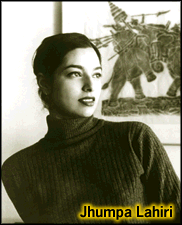
Unaccustomed Earth by Jhumpa Lahiri

unaccustomed_earth

“Jhumpa Lahiri is the kind of writer who makes you want to grab the next person you see and say, ‘Read this!'”

— Amy Tan

Unaccustomed Earth is one of the five fiction selections of  New York Times Best Books for 2008.  Jhumpa Lahiri’s debut work, Interpreter of Maladies, a collection of short stories, won the 2000 Pulitzer Prize for fiction, and later received the PEN/Hemingway Award, the New Yorker Debut of the Year award,  American Academy of Arts and Letters Addison Metcalf Award, and was translated into twenty-nine languages.  Her next work was The Namesake, a novel which was turned into film by acclaimed director Mira Nair.  Unaccustomed Earth is her third book.

Jhumpa Lahiri was born in London, England, to Bengali immigrants.  Her family later moved to the United States and settled in Rhode Island where she grew up. Lahiri went to Barnard College and received a B.A. in English Literature.  She furthered her studies in literature and creative writing and obtained three M.A.’s, and ultimately, a Ph.D. in Renaissance Studies at Boston University.  So, she knows her subject matter well.  In Unaccustomed Earth, characters are Bengali immigrants, mostly academics, their second generation who are born in foreign soil and their non-Indian friends or spouse.  The stories deal with the entanglement of cultural traditions, incompatible values, failed hopes and expectations, and the subsequent internal strives that haunt them all.

But why would we be interested in stories like these?  Herein lies Lahiri’s insight.  While the viewpoint of these characters might be parochial, Lahiri’s stories bring out the larger universal significance.  Who among us doesn’t belong to a community, and at one time or another, question his/her conformity in that very community?   Regardless of our ethnicity, who among us isn’t born into a family with its own peculiar traditions and values?  Who among us doesn’t feel the distance separating generations in our world of rapidly shifting paradigms, be they cultural, social, or spiritual?   And who among us, as one in the mass diaspora of drifting humanity, doesn’t want to lay down roots in fertile soil?

Despite the somber themes, reading Lahiri is an enjoyable ride.  Herein lies Lahiri’s talent.  She is a sensitive storyteller, personal in her voice, subtle in her description, meticulous in her observation of nuances, and stylish in her metaphoric inventions.  Her language is deceptively simple.  The seemingly lack of suspense is actually the calm before the storm, which usually comes as just a punchline in the end of each story, leaving you with a breath of  “Wow, powerful!”  But it is for that very line that you eagerly press on as if you are reading a thriller or a page-turner.

jhumpa_lahiriThe book is divided into two main parts.  The first contains five short stories.  The second, entitled “Hema and Kaushik”, consists of three stories but can be read as a novella on the whole, for they are about two characters whose lives intertwine in an inexplicable way.  While the characters and their situations are contemporary, their quest is the age old longing for love and connection.
I have enjoyed all the stories, but the most impressionable to me is the title one.  In  “Unaccustomed Earth”,  Ruma is married to an American, Adam, with a young child Akash, and pregnant with another.   Her recently widowed father comes to stay with her in Seattle from the East Coast, just for a visit.   During his stay, Ruma’s father builds up a bond with his grandson Akash.   The two create a little garden at the back of the house, a relationship thus flourishes as the flowers and plants blossom.  Ruma struggles with the idea of whether she should welcome her father to live with her for good to fulfil her filial duty, but by so doing, she would be adding a burden to her nuclear family.  What she does not know though is that her father has his secret and internal conflict as well.  He too wants a life of freedom and love.  The story ends with a dash of humor and a little surprise, reminiscent of a Somerset Maugham story.  I will not say more, or the spoiler will lessen your enjoyment.

I have read all three of Lahiri’s work.  And this is my query:  If her first book garnered the many literary awards including the Pulitzer, I just wonder what else could she win with her newest creation, which I enjoy far more.

Unaccustomed Earth by Jhumpa Lahiri, published by Alfred A. Knopf, NY, 2008.  333 pages.

~ ~ ~ Ripples

****


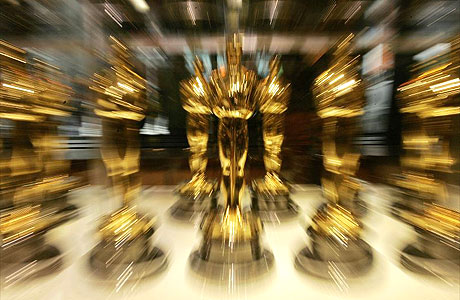
81st Academy Awards Nominations (2009)

oscars

CLICK HERE to read The 2009 Oscar Results.

So, the news is out. For a complete list of the 2009 Oscar nominees, click here to go to the official Oscars website. For those who didn’t bother getting up at 5:30 am PT to watch the announcement live, here’s the video clip.

The clear front runner is The Curious Case of Benjamin Button, grabbing 13 nominations, just one short of the record shared by All About Eve (1950) and Titanic (1997).

Slumdog Millionaire is not far behind, a fantastic rags to riches exemplar in itself, garnering 10 nominations.

When I look at the Best Picture categories, I notice that four of the five nominees are produced from an adapted screenplay.  Here are the origin of these now famous movies, the source materials that first spark and channel the creative energy of screenwriters,  causing them to propel a much lesser known work into the orbit of box office profits:

  • The Curious Case of Benjamin Button:  Loosely based on a short story of the same name by F. Scott Fitzgerald.  The imdb site does not even mention this source material.  But for those of you who want to acknowledge the original writer’s work, click here to read the short story online.
  • Frost/Nixon:  Based on a play by Peter Morgan.  To read the NY Times review of this theatre production, click here.
  • The Reader:  Based on the novel by the German writer Bernhard Schlink.  To read the discussion of book into film at guardian.co.uk, click here.
  • Slumdog Millionaire:  Based on the novel Q & A by the Indian novelist Vikas Swarup.  To read his interview on guardian.co.uk, click here.

So I say, kudos to all the original writers out there, without getting as much notice, not in this part of the world anyway, until their work is chosen to be made over into a movie, or picked by Oprah (The Reader).  It says a lot about our consumer and celebrity driven culture, that a piece of writing gains recognition only when it is released in a movie tie-in edition, or favored by a TV icon.

Well,  the message of Wall-E is relevant here.  I’m glad to see it getting 6 Oscar nods including Best Original Screenplay.  The last time an animated feature received 6 nominations was Beauty and the Beast (1991), itself a case in point with the hype of commercialism boosting the literary form.

And then on another note, I read about the first edition of Emma that Jane Austen signed and gave to her friend Anne Sharp (thought to be the inspiration for the character of Mrs. Weston in Emma) was on sale at the Antiquarian Book Fair in Hong Kong last week, asking price HK$3.95 million (approx. US $500,000).  I wonder also how much all those movies profited from adapting her novels.  I lament Jane who died impoverished.

Photo Source: guardian.co.uk

*****


Flight of the Red Balloon (2007, France, DVD)

flight-of-the-red-balloon

In celebration of its 20th anniversary, the Musée d’Orsay in Paris has commissioned four notable directors to create a series of commemorative films. One of them is Olivier Assayas with his Summer Hours (l’Heure d’été) which I have reviewed.  Another is the highly acclaimed Taiwanese auteur Hou Hsiao-hsien. Flight of the Red Balloon is a unique piece of film art gently crafted by Hou in homage to Albert Lamorisee’s Oscar winning short Le Ballon Rouge (1956). Hou has long been garnering awards in international film festivals throughout Europe and Asia since the 1980’s, albeit relatively unknown in North America. Flight of the Red Balloon is his first French language film.

The little boy in this 2007 rendition is Simon (Simon Iteanu), a child growing up in the hustle and bustle of Paris. With an absentee father somewhere in Montreal pursuing his writing, and a frantically busy mother Suzanne (Juliette Binoche), Simon is alone in an adult world. Overloaded with her work as a voice-over artist in a puppet production plus other personal matters, Suzanne hires Song (Fang Song), a film student from Beijing, to look after Simon for her.

Suzanne is the embodiment of urban frenzy. As a single mother, she has to shuttle between home and work, deal with the eviction of a bad tenant in her lower apartment, confront her non-committal husband on the phone to Montreal, and connect with her daughter in Brussel, all in a day’s work. Simon is most perplexed.  “Why are you so busy, Mama?”, he asks.

song-and-simon

Song, on the other hand, offers the tranquility that is needed to balance life in the midst of chaos. As a film student, she uses her hand-held camera to record Simon’s activities, and by her quiet demeanor and calm observing, she reflects pleasure in the mundane, everyday trivialities called life. This is reality show without sensationalism.  Hou has ingeniously conveyed his perspective of realism with artistic overtone. No doubt, there is a lack of plot, suspense, or climax, but there is character contrasts, cinematic offerings in sights and sounds, and realistic, natural performance. Juliette Binoche has once again assured me why she is one of my favorite actresses. And no, you are not watching paint dry, you are watching life unplugged.

The red balloon forms the focal point of Hou’s signature long take. The almost God-like omnipresence hovering over buildings in the Paris skyline is a joyful symbol of childhood. Its silent drifting is as elusive as the fleeting memories of happiness. Even little Simon achingly remembers the pleasant days he had shared with his much older sister, who is now living in Brussel. We are all trying to catch and hold on to fond memories and meaningful relationships. Yet as the busyness of urban living numb our senses, we ignore and shove away what we think is a hindrance to our time, just like the people rushing out of the subway station, shoving away the red balloon. Only a child would try to catch and befriend it.

Complementing the cinematic artistry is the equally mesmerizing piano music, meditative, serene and restoring, setting the mood and the preamble of the film.  Other musical numbers are equally soulful. Click here for the official IFC site where you can have a taste of the sights and sounds of the film.

felix-vallotton-le-ballon-1899I particularly enjoy the ending. As Simon goes on a school trip to the art gallery of the Musée d’Orsay, the children gather on the floor to talk about Félix Vallotton’s 1899 painting Le Ballon, he leans back, slightly removes himself from his school mates, and lays on his back. As he looks up to the glass canopy of the museum ceiling, he sees it again, the red balloon, watching over him, removed yet engaged, far away, yet ever so near.

~ ~ ~ Ripples


Two Guys Read Jane Austen: Again, the Gender Issue

two-guys-read-jane-austen 

Some guys would rather have jaw surgery than to read JA.  Steve Chandler could well have been one of them.  As an English major in college, now a successful writer in his sixties, Steve has miraculously managed to avoid reading JA all his life, until now.  On the other hand, his co-author Terrence N. Hill, an award-winning playwright and author, has read Pride and Prejudice three times, good man.  Prompted by their wives, Steve and Terry embarked on this new project in their “Two Guys” series, taking the risk of treading no man’s land.  However, considering their previous “Two Guys” titles, Two Guys Read Moby Dick and Two Guys Read the Obituaries, they are well-primed for this venture.

Thanks to blog reader Julie for sending me a copy of this book,  I’ve been thoroughly entertained.  Attaining to true Austenesque style, the two lifelong friends read two JA novels and wrote letters to each other about their thoughts over a six-month period. I must admit I’m surprised (sorry guys) at the incisive look and the fresh perspective they bring to the forefront.  Their sharp observations, humorous takes on many issues, their LOL commentaries on popular culture, and intelligent analysis on various topics make this a most gratifying read for both men and women, Janeites or would be’s.

Many do not want to read JA because they think she was just a 19th Century rural spinster awashed in naiveté, who had never heard of Napoleon or the war he was raging, ignorant about the slave trade from which England was benefiting, or couldn’t tell the difference between a country and a continent.  The most they might think of her is the mother of all modern day chick lit or the romance novel.  Well, these myths are all dispelled by two guys that have experienced Jane Austen first-hand, and lived to tell their discovery.

Here are some of their insights and words of wisdom as they read Pride and Prejudice and Mansfield Park.  I’m quoting directly from their letters to each other:

  • Jane’s got more adoring female fans than Brad Pitt, and my guess is they’re more intelligent too.
  • JA (through Elizabeth) is a witty, rebellious voice for intelligence and passion in the face of those stuffy British strictures.  I love this.  I love a woman (or a man, for that matter) who has no need to win anyone over.
  • Wasn’t Elizabeth Bennet heroic because she was such a totally self-responsible, proudly independent person?  Wasn’t Darcy the same?
  • I really enjoy how much you like Jane Austen, that you cry when reading her books, and that you can still be a man… A man not afraid of the feminine principle becomes even more of a man.
  • …elegantly cerebral.  But once you acclimate yourself to the flow of the language, it is addictive.  JA’s writing becomes more captivating with each new chapter because of how many layers of psychological posturing she strips away.
  • Men are often accused of putting their wives on a pedestal. Women build a pedestal and then spend their time trying to create something worthy of going on it.
  • I don’t think Austen ever gets proper credit for her role in the development of the comic novel.
  • Jane never attended school after the age of 11.  After that she was entirely self-taught…  S&S, P&P, NA, three of the greatest novels of all time–all written by 25.  Thinking of myself at that age.  If I had had time on my hands I could well imagine having written three novels… What I can’t imagine is that they would have been any good.  Ah, but then I had the disadvantage of an education.
  • The true measure of her characters is their hearts and minds.  What the movies cannot get to – or do justice to – is the intelligence.
  • What has excited Henry Crawford the most is Fanny’s inner strength.  On the surface she is delicate and demure.  But underneath she is power itself.  That’s what makes JA so great and so endearing.
  • Jane is all about principle.  Living true to your highest ideals, your highest self… she shows us there is a beauty to morality… there’s beauty in integrity!

Need I say more?

Two Guys Read Jane Austen by Steve Chandler and Terrence N. Hill, Robert D. Reed Publishers, Bandon OR.  2008, 126 pages.

*****

This article has been published in the Jane Austen Centre Online Magazine, where you can read more about Jane and the Regency Period.

Rewards and Awards of Blogging

Why do we blog? WordPress seems to have grasped the psyche of bloggers in five words: “Express yourself. Start a blog.” If being free to self-expression is the intrinsic reward of blogging, then being heard and read is the extrinsic reward. And, to top it all off, getting unexpected awards for what one already enjoyed doing is the icing on the cake.  A few months ago Arti had the first taste when she received the Excellent Blog Award.  This past week Arti has tasted more icing from fellow bloggers in the form of two awards.  In chronological order, they are:

The Premio Dardos from Ms. Place (Vic) of Jane Austen’s World. Thank you Vic for naming Arti as one of your 15 recipients of this award “that is given for recognition of cultural, ethical, literary, and personal values transmitted in the form of creative and original writing”. Thanks Vic for the honor and for the translation from Portuguese:“O conceito deste prémio passa por reconhecer valores culturais, éticos, literários e pessoais, transmitidos de forma criativa e original nos pedacinhos rabiscados por cada blogueiro que o receba.”

To meet the requirement, in turn, I am naming the following blogs to receive the same award.   To avoid duplication and to make it more meaningful, I have selected 10 instead of the 15 suggested.  Here are their excellent sites in alphabetical order:

  1. Austen Quotes is the blog of Lori Smith, writer of the book A Walk with Jane Austen, her personal experience of treading the paths of Jane’s in England.  She has inspired me with quotes from the works and letters of JA, some witty, some wise, some poignant, and all of them delightful.  Lori may have taken a hiatus due to physical ailment, but what she already has chronicled in her site is worth reading time and time again.
  2. Austenprose is a wealth of JA information and forum. Laurel Ann offers Janeites with a wealth of Regency knowledge, book discussion, interviews… a delight to visit every time.  This is one of the first blogs that got me hooked on JA…, no I wasn’t born a Janeite.  I only discovered this wonderful world a few years back.  And it’s blogs like this that feed me to my fill.
  3. Blogging for a Good Book is created by the staff of Williamsburg Regional Library.  In there you’ll find in-depth and insightful book reviews.  With several contributors, the blog offers a new post almost every day, keeping us up-to-date with newer titles. The quality writing and informative entries are enjoyable to read.
  4. Film Think is a site where films, theology, and criticism meet.  Writer M. Leary offers a wealth of resources and knowledgeable discussions and critique for those interested in the intellectual pursuit of the art of film, and its interaction with Christianity, criticism theory, other art forms, and their relevance in society today.
  5. Itinerant Idealist is Sarah’s journal  “in search of a soul awake”.  I’ve enjoyed her excellent writing.  In her casual way, Sarah embeds her prose and poems with style and spiritual insights.  Hers is one of the long time blogs I’ve been reading since the beginning of my own blog.  I’ve learned and gained much from reading her posts.
  6. Looking for Life’s Humor looks at life and brings out the joyous perspective.  As a mom with an autistic child, the writer of this blog depicts the humor and love that we often miss in many of life’s circumstances.  A heart-warming and delightful read in every post.  A truly enjoyable break in the midst of daily chores and chaos.
  7. Of Books and Bicycles As a book lover and an avid cyclist, Dorothy has successfully created a concoction of writings involving both…well maybe more about books.  Informative reviews and personal book experiences can be found here, while she has another site dedicated more to bikes and her training as a cyclist.
  8. So Many Books Stefanie chronicles “the agony and ecstasy of a reading life” with detailed research and insightful commentaries.  This is a literature lover’s blog.  Just the Blogroll is impressive enough, for there are probably hundreds of lit blogs on her list to provide almost unlimited avenues for blogging and reading pleasure.
  9. The Happy Wonderer It’s a joy every time I visit Ellen’s blog.  As a happy wonderer, Ellen wanders in the fields of photography, food, life, family, and the Bible, offering us musings, pictures, and inspiration, a celebration of life every day. This is one of the earliest blogs I found when I first started blogging, and I’ve been reading her since.  “To honor and encourage”, that is exactly so.
  10. The Task At Hand What Linda Leinen has created here in her relatively new blog is nothing short of a compilation of model writing.  Every single post is an example of style and inspiration.  At this point of her life she is a boat varnisher along the Texas Gulf Coast (how cool is that!), and she writes what she lives.  In her blog, she has woven artfully a tapestry of penetrative observations and skillful, affective writing.  I have gained and learned much from reading her every single post.

*****

The other award I received just a couple of days ago is the Arte y Pico given by Linda of The Task at Hand. Directly translated from Spanish means “Art and Peak”, at the peak of its art. Linda has included Arti’s Ripple Effects for its “creativity, design, content and contribution to the blogging community, regardless of language”.  Thank you Linda, I’m greatly humbled by such an honor.

To fulfill the requirement of the Arte y Pico, I’m naming 5 other blogs to be recipients in turn.  Noting that it’s Spanish in origin, and the phrase “regardless of language”, I attempt to highlight some of the ones I visit that have a different geographical or cultural flavour, although I admit they are all in English.

  1. Blogging in Paris As a 64 years-old cancer survivor, Claude’s attempt at blogging is in itself inspiring.  She writes from Paris, and from her many travels in Europe, affecting us with her zest for life and eye for beauty.  It’s a mixed bag in her blog, some photography, some journal writing, some personal musings.  A delight to visit.
  2. Moderato brings a European perspective to the discussions of art, books, music, films, and literature.  The writer offers in-depth and well researched commentaries on the subjects.  A very fine and intellectual lit blog.  Some great You-tube clips to augment the enjoyment.
  3. The Errant AEsthete From New York, “Essentials for the Cocktail Swilling Savant”, ok, it may sound a bit exclusive, but the art, photography and visuals presented in the blog are stunning and often thought-provoking.  And since it’s located in the ever widening blogosphere, anyone can visit and better yet, no dress code.
  4. Hidden Art A blog for the arts and crafters among us. The name says it all… art can be found and creativity unleashed in almost every homely place.  I’ve enjoyed the casual atmosphere and the stimulating ideas for mixed media and paper arts that are achievable by those who, like myself, are not art school graduates.  Accessible art speaks a universal language.
  5. Edible Landscape This is a unique blog on food written by a young guy from Hong Kong, an interesting diversion from the blogs on food and cooking we see from North America.  Wilson concocts an international flavour with his fine, quality writing on food and restaurants.  What more, where do you ever read a 20-something young man writing about cooking and cuisine art with such expertise?

Wow, that’s a mouthful!  Why do we blog?  The above are some of the obvious answers.

First Blogaversary and Summer Wrap-up

Last year on this day, August 29, 2007, I began my blogging journey on WordPress.  One year and 104 posts later, this sputtering engine is still chugging along.  I’d like to think of my blogging experience as a road trip.  The kind of vehicle I have in mind is the VW van in the movie Little Miss Sunshine.  Almost an obsolete wreck and yet still functioning, just needs a little running push.   

It has been an eventful summer for me.  Having had to move twice and living out of a suitcase, sustaining the horrors of home renos, tending illness in the family, and caring for two elderly parents have put my life on hold…or maybe this is life.  All this time, I didn’t have easy access to the internet, no TV, or other high tech luxuries.  While my posts have been more sparse than I’d like, blogging, even though infrequent, has at least kept some kind of normalcy for me during this unsettling and chaotic period.

While I’ve missed many important events during these two months, such as Hilary’s concession speech, and the Olympics… I’ve been able to catch some summer flicks and read a few books.  As I take stock of this summer’s entertainment consumption, I’m surprised to find that my list is long despite the interruptions:

The following are straight from memory, in no particular order:

Movies seen at theatres:

  • Mamma Mia! 
  • The Dark Knight
  • Swing Vote
  • Brideshead Revisited

Live Musical:

  • Spamalot

DVD’s watched or re-watched:

  • Persuasion (1996)
  • Persuasion (2008)
  • Sketches of Frank Gehry (2005)
  • Life As A House (2001)
  • Eternal Sunshine of the Spotless Mind (2004)
  • Vantage Point (2008)
  • The Bank Job (2008)
  • Miss Pettigrew Lives for a Day (2008)
  • Plus about 25 titles previewed for a Film Festival

Books read or re-read:

  • Persuasion by Jane Austen
  • Then She Found Me by Elinor Lipman
  • The Savior by Eugene Drucker
  • The Glass Castle by Jeannette Walls
  • Up Till Now by William Shatner
  • Lady Killer by Lisa Scottoline

So this is the summer of 2008.  Will be leaving for Ontario tomorrow to take our son back to university, Arti is wrapping up another summer, and the first year of blogging. 

What’s your blogging trip been like this summer?   And your list of books and entertainment?

                                                                           *****

Glenn Gould: The Russian Journey (2002, TV)

 For two months, I had to stay away from home while my house underwent a major renovation.  After sequestered from TV watching for the whole summer, that was one of the first things I delved into as soon as I moved back last week.  A couple of days ago, in between re-runs of Olympics events, I was most gratified to watch this CBC/National Film Board documentary.  What a breath of fresh air and what an invigorating luxury I have been deprived of all summer!  Only on CBC.

The legendary Canadian pianist Glenn Gould (1932 – 1982) visited the Soviet Union in 1957, at the age of 24, the first concert pianist from North America to be extended and accepted an invitation to play behind the Iron Curtain.  Stalin died just four years ago.  The Cold War was at its climax.  Very few had heard of a Canadian pianist named Glenn Gould, what more, very few had heard Bach since the composer was banned by the totalitarian regime for the religiosity of his work. 

This 56 minutes documentary, which won the Grand Prize of the 2003 Montreal International Festival of Films on Art, is packed with valuable archival footage of the actual Gould concerts, meditative shots of the lone pianist against the grand Russian architectural backdrop, as well as some of Gould’s own reminiscence of the historic journey. Interspersed are interviews with significant personalities within the Soviet arts and music circles, sharing their life-changing Gould experiences.  Among them are prominent musicians such as the renowned pianist and conductor Vladimir Ashkenazy, and dissident cellist Mstislav Rostropovich, who sheltered the writer Solzhenitsyn and resulted in the Soviet government banning his performances.

Tatiana Selikman, a pianist and teacher at the Russian Academy of Music, recalls the day of Gould’s first concert in May, 1957.  She saw the poster and was curious about a pianist from Canada, playing The Art of the Fugue, which nobody ever played in Communist Soviet Union.  The Grand Hall of the Moscow Conservatory was sparsely seated.  Then the pale faced pianist came on stage, sat on a low chair, and unleashed a magical performance that mesmerized his small audience.  During the intermission, those in the concert hall dashed out to phone their friends, urging them to come right away.  As the concert resumed for the second half, the hall was packed to overflow.

And the rest is history…

What Gould brought to the Russian audience was not just Bach, or the intricacies of the Fugue, or the beguiling Goldberg Variations, but a new perspective.  Gould’s performance embodied the liberating effect of music, the freedom of artistic expression and the bold exhibition of individualism.  The audience was emancipated to a new found freedom that was not sanctioned under totalitarian rule.  Using the words of some of the musicians interviewed in the film, the Berlin Wall of music came down, warming the Cold War by a few degrees. For the first time, they were applauding something that was not Soviet.  And they were exhilarated.

The recent passing of the Russian dissident writer Alexander Solzhenitsyn, and the events taking place in Georgia, or even the Olympics, have whirled up sentiments in me that I thought was long gone… the pathos of hearing the muffled cries of the oppressed, be it political, social, or artistic. 

There are those who are indignant about the Canadian government subsidizing the Glenn Gould trip, arguing it was a waste of taxpayers’ money.  If a lone pianist can inspire the masses, and if music can soften the hearts of man, enhance international goodwill, and reiterate the ideals of humanity, I am all for it.  Would it not cost more to send hundreds of thousands of soldiers to the front line?

 ~ ~ ~ ½ Ripples

The documentary has been posted on YouTube in six parts.  Here is the beginning.  However, nothing compares to the big screen especially with Glenn Gould playing Bach:


                                                                              *****

Beach Reads and Summer Reading 2008

It’s that time of the year when you let it all hang loose and not care about whether what you’re reading is ‘literature’ or not. For some strange reasons, the hot summer months, the taking leave of work and school, the temporal evasion of chores and responsibilities seem to have emboldened us to new adventures, legitimizing ‘escape reading’. But my question is why only in the summer? Do seasons regulate our choices? Should ‘summer reading’ differ from that of the other 10 months in the year? Has the term “Beach Read” been coined merely to jack up book sales?

A look at some current writers’ “summer reading” casts even more doubts on arriving at a clear cut definition of “Beach Reads”. Dan Zak of Washington Post interviewed a sample of them and surveyed their summer reads. Here’s what he found:

  • Mary Higgins Clark: Gift from the Sea by Anne Morrow Lindbergh
  • Susan Choi: War and Peace by Leo Tolstoy
  • Janet Evanovich: The Great Gatsby by F. Scott Fitzgerald
  • Thomas Mallon: Nicholas Nickleby by Charles Dickens
  • Sue Monk Kidd: The Grimke Sisters From South Carolina: Pioneers for Women’s Rights and Abolition by Gerda Lerner.

… and so on and so forth. Click here to read more of Dan Zak’s article on summer reading.

And here’s Arti’s list. I’m currently reading Lisa Scottoline’s Lady Killer, which should satisfy a ‘traditional’ definition of a ‘beach read’. Other than that, I’m also re-reading Jane Austen’s Persuasion, and still plowing through two of Robert K. Johnston’s books, Reel Spirituality: Theology and Film In Dialogue and Reframing Theology and Film. If a ‘beach read’ is defined as a fast pace, plot-driven page-turner, these definitely don’t qualify.

I’ve just finished The Glass Castle by Jeannette Walls, which is one dynamite read, a wild ride any time of the year. It deserves a whole new post. But to categorize it as a ‘beach read’ would seem to have down-graded its quality and impact.

A few titles I plan on getting hold of this summer:

  • Then She Found Me by Elinor Lipman. After watching the film, I’m really interested to find out how a writer instills spirituality into the narrative of everyday living.
  •  Away by Amy Bloom. I’ve wanted to know more about her through her reading. So far I’ve only read one thing from her: Introduction to Jane Austen’s novel Persuasion.
  • The Savior by Eugene Drucker, founding member of the renowned Emerson String Quartet. In this debut novel, he dispels the myth of the saving power of music, using a Holocaust death camp as the backdrop. Should be one poignant read.

What’s your summer reading list like? Typical ‘beach read’ or evidence shattering its existence?

Summer Reading 2009 Click Here.

***

Music in my iPod

My son left me his old iPod when he visited me over the weekend. No, he doesn’t get the privilege to enjoy country living because he has to stay in the city for his summer job.  So, technically it’s not my iPod. But just the same. I’ve declared what’s in there my music. He has categorized all music into genres, easy for me to sort out what I like. And, what a pleasant surprise to find so many gems in there, wonderful embellishment for my pristine living out here in the log home.

There are 1,696 selections for me, grouped  into genres. I admit there are ones that I won’t venture into, like metal and rap, but there are enough categories for me to choose from.  Imagine my feeling listening to the music and looking out towards the open, green fields, distant snow-capped mountains underneath a canopy of dramatic clouds, against a big, blue sky…it’s not out-of-this-world, for I’m right in it! Magnificent!

So…what’s in my 18-year-old’s iPod?  Lots I can indulge in.  Here are some samples…

Classical:

  • Bach’s Partita played by Nigel Kennedy
  • The Complete Goldberg Variations played by Glenn Gould
  • The Art of the Fugue, The Well-Tempered Clavier all by Gould
  • Beethoven’s Symphony #6 Pastoral (For real!)
  • Chopin’s Sonatas, Etudes and Nocturnes
  • Holst’s The Planets  (How cool is that!?)
  • Rachmaninoff’s Piano Concertos
  • Tchaikovsky’s Cello Concertos

Classics:

  • ABBA
  • Andy Williams
  • The Beach Boys
  • The Beatles
  • Bette Midler (She’d be happy to be categorized as ‘Classics’)
  • Bob Dylan
  • Don McLean
  • Frank Sinatra
  • Gordon Lightfoot (Yes, Alberta Bound)
  • Joan Baez
  • Jimi Hendrix
  • Leonard Cohen
  • Simon & Garfunkel
  • Van Morrison

Jazz:

  • Art Tatum
  • Dave Brubeck Quartet
  • Duke Ellington
  • Eva Cassidy (Yes, he put her under Jazz)
  • George Gershwin
  • Glenn Miller,
  • John Coltrane
  • Miles Davis
  • Norah Jones
  • Ray Charles

Rock, Pop and Soundtracks:

  • Elton John
  • Jason Mraz
  • Mariah Carey & Whitney Houston
  • The Rolling Stones
  • Amy Adams
  • Broadway Musicals Cats, Les Miserables,
  • The Phantom of the Opera

With this techno luxury of sound bytes, who needs to go to the city!  And…I’m relieved to know there isn’t much of a generation gap here after all…

                                                               ******

JunoFest: Celebrating Classical at the Junos

Junos 2008 Venue Calgary Pengrowth Saddledome

What do Toronto classical composer Brian Current, Montreal cellist Matt Haimovitz, or violinist James Ehnes have in common with Anne Murray, Avril Lavigne, Feist, Jann Arden, Paul Brandt, or Michael Bublé?

They are all Canadian musicians sharing the limelight in this year’s Juno Awards coming up April 6.

The Canadian Music Awards extravaganza is to be held this Sunday April 6 in Calgary’s Pengrowth Saddledome.  Click here for the official website of the 2008 Juno Awards.

Before the grand event, there is going to be a celebration of classical music.  A first ever JunoFest will be held in Calgary’s Grand Theatre this Saturday.  The event celebrating classical music is organized by CBC Radio 2, the Canadian Music Centre Prairie Region, the 2008 Juno Awards Host Committee, and the Honens International Piano Competition.  It will feature works and performance by nominees in the classical music categories of this year’s Juno Awards.

Click here to read the April 2 Calgary Herald article on JunoFest.

Items on the JunoFest program include work by Toronto composer Brian Current (nominee for Classical Composition of the Year), performance by Montreal cellist Matt Haimovitz (nominee for Classical Album of the Year), and the renowned violinist James Ehnes (nominee for two Album of the Year).

Cellist and McGill faculty member Matt Haimovitz’s work may be most effective in dispelling the myth of Classical music being elitist and passé.  His work embraces both the classical and modern day popular genres, as well as the multicultural roots of folk music.  From his own repertoire, he has an eight-cello rendition of Jimi Hendrix’ war protest song Machine Gun, and from his multicultural, fusion CD “Goulash”, Led Zeppelin’s Kashmir in a four-cellos arrangement.

As we go further into this so-called postmodern era, we’re going to see the increasing blurring of the line between “classical” and “contemporary”.  And why not, we’re already enjoying a proliferation of fusion food.

This is another reason CBC Radio 2 should all the more venture into this brave new world.  Instead of cutting classical music programs, instill fresh and creative ideas to present the exciting development of “classical music” in the 21st century, and act as a bridge to draw closer the cultural and musical chasm.  Just look into the myriad of modern day film scores, Crouching Tiger Hidden Dragon, The Kite Runner, Atonement, just to name a few, you’ll be surprised how much you enjoy ‘fusion’ music.  You may not recognize the classical music theory on which the compositions are based, but you’ll be enthralled just the same.

Calgary’s Pengrowth Saddledome Photo Source: aol travel

CBC Disbands Radio Orchestra

Update April 1:  Reader Tom has alerted me to the site for online petition to save the CBC Radio Orchestra.  http://www.savecbcorchestra.com  Please sign the petition and spread the word. 

Another shocking news:  The CBC Radio executives have just decreed that The CBC Radio Orchestra is to be dismantled as of November, 2008, on the heels of Cutting Classical Music Programs on Radio 2. 

What a swift one-two punch!

Formed in 1938, mandated “to make engaging musical radio programs, commission and perform works by Canadian composers, showcase Canadian performers and conductors, and discover and expose Canadian excellence”, the orchestra has been a Canadian cultural and musical tradition for 70 years.

 Click here for the news coverage in the Globe and Mail of March 27, 2008.

Click here for the Vancouver Sun article on Canada.com: CBC Kills Radio Orchestra

Click here for the article:  The Day The Music Died in The McGill Daily.

Does the CBC management even have the right to do that?  I thought this is a publicly-owned national radio station.  A cultural and arts institution with 70 years of history can be chopped off the Canadian landscape by a few executives like a branch off an old tree in the backyard? 

With this executive order, the CBC has finished off a piece of North American history, disbanding the last radio orchestra in the continent.

Again, I was alerted to this piece of appalling news by my teenaged son…talking about axing classical music to attract younger audiences.  CBC has gravely miscalculated the musicality of our youth and done an utter disservice to them, depriving them of knowing and appreciating a heritage dating back to hundreds of years of human civilization.

To save Classical Music from being axed off the cultural tree, Click here for the Online Petition.

BTW, the Facebook Group ‘Save Classical Music on the CBC’ now has over 8,000 members…I’m not trying to stereotype, but would these not be some of the ‘younger audiences’ CBC is trying to woo?

                                                            ******