Séraphine and the Wrought-Iron Chair

By day, she scrubs floors, cleans houses, washes dirty linens in the river. By night, she paints. She is Séraphine, a cleaning woman in her fifties. Later, she is better known as Séraphine de Senlis. 

Séraphine (2008), a film based on the life of the early 20th Century French painter Séraphine Louis (1864-1942), won 7 César Awards in France including Best Film of 2009 and Best Actress for Yolande Moreau as Séraphine. True to its subject matter, director Martin Provost has crafted an aesthetically pleasing work of art. The pace is slow for the viewer to savour every bit. Moreau’s charming portrayal of Séraphine is captivating. She wins my heart from the first scene.

It is gratifying to be noticed, to be confirmed of one’s worth. To the dismissive eye, an ageing cleaning woman is nothing to deserve another glance. Makes me think of the concierge Renée in The Elegance of the Hedgehog. In one of the apartment units which Séraphine cleans, a new tenant just moves in. He is Wilhelm Uhde, a noted art critic and collector of Picasso. He is also the one who has discovered Henri Rousseau of the naive art style, a term referring to untrained talents, a term to which Uhde doesn’t subscribe.

And right there in his rental unit Uhde notices another hidden gem of this style, his own housecleaner Séraphine. Uhdle is deeply moved by her work and soon becomes her patron. He stops her from mopping his floor, leads her out into the garden, seats her down in a wrought-iron chair and tells her she has talent. It is a wrought-iron chair that I notice since that scene, and it recurs later in the film, a metaphor for aesthetics, style and elegance, antidote to the crude reality of Séraphine’s life.

Séraphine loves nature, and nature rewards her with inspiration.

Her subjects are mainly flowers and fruits, their design exquisite, natural, colourful and lively. 

Deep religious fervour soon drives Séraphine to relentless, maddening obsession to paint. She claims to follow voices from her guardian angel. She would sing hymns at the top of her voice while painting through the night, waking up in the morning on the floor with her work-in-progress. She gradually becomes delusional and out of touch with reality.

Why is it that giftedness and mental illness often find affinity for each other? Van Gogh comes to mind. And only recently did I read this Guardian article drawing uncanny similarities between Séraphine and Susan Boyle.

As WWI draws near, the impending conflicts push Uhde out of France and back to Germany. They reunite after the War. Sadly, the painter’s growing achievement brings about more severe delusions. Later the economic depression ends contact between patron and artist for a while.

When Uhde finds Séraphine some years later, she is locked up in an insane asylum. This latter part of the movie is a bit uncomfortable to watch. Uhde is unable to communicate with her as she is restrained in a straight jacket, tied to the bed weeping in anguish.

Months pass and in 1935 Uhde visits her again. He needs to tell Séraphine her paintings are selling. Her condition has stabilized by now but upon doctor’s advice, Uhde should just leave her be. There in the asylum at Asile de Clermont Uhde quietly pays for her a private room with a view out towards a lush green meadow and full, leafy trees.

The ending that follows is one of the best I’ve seen in films. We see Séraphine being led into the room. She sits on her bed, dazed, unfeeling. Then she turns her head and notices the door leading outside to the trees and green meadow. The next three silent minutes bring us to a poignant closing:

Séraphine slowly gets up and opens the door. She sees a wrought-iron chair on the porch. The frame on screen here is roughly split in two. On the left side is her room with a sterile, wooden chair of the asylum. On the right we see the porch outside with the wrought-iron chair, not unlike the one she had sat on while being declared a talent by Uhde years before. She tentatively steps out of her room, touches and examines the chair, then picks it up and slowly carries it with her up a green hill to a full, beautiful tree. From afar, we see her look at the tree, put the chair under its shade, sit down and tilt her head back, fully relaxed.
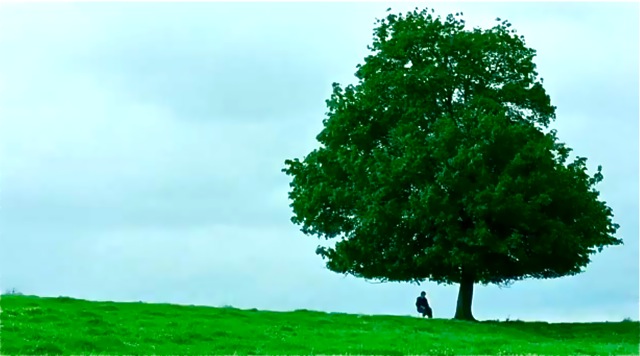
In the silence with just the wind blowing, it seems we can hear her gratified sigh of relief, being back in nature, coming home.

~ ~ ~ 1/2 Ripples

CLICK HERE to watch Séraphine’s official trailer on Youtube. You’ll be able to see the ending scene. But of course, nothing compares to watching the film in its entirety.

A NOTE ABOUT MOVIE PHOTOS: These images are used according to the Fair Use guidelines for criticism, comment and educational purposes. CLICK HERE for more information. CLICK HERE to read the Report of the Ad Hoc Committee of the Society For Cinema Studies, “Fair Usage Publication of Film Stills” by Kristin Thompson.

***

This movie review is my third post for Paris in July hosted by Karen of BookBath and Tamara of Thyme for Tea. To read my previous posts you can click HERE and HERE.

***

Saturday Snapshot & Paris in July

Here are my photos for two blogging events: Saturday Snapshot hosted by At Home With Books and Paris in July over at BookBath.

In August, 2010, I was in Paris, stayed at a small hotel on a side street in the Latin Quarter, across from the Sorbonne. And just recently I was reading the book The Hundred-Foot Journey (my last post). In the book, the protagonist Hassan was offered a place to start his own restaurant, at 11 Rue Valette, near the Panthéon. When I came to that part of the book, I quickly went Googling and found, ta-da! Hassan’s restaurant was within walking distance of the hotel I stayed in.

This is what happens, you fuse together reality and fiction… that’s the joy of reading. And I could even imagine stopping by the restaurant to have a taste of Hassan’s haute French cuisine.

No, I didn’t get to Hassan’s Le Chien Méchant, but found this little cinema not far from our hotel on another narrow side street, Cinema du Panthéon, and it was showing the acclaimed film Des Hommes Et Des Dieux.

I had an urge to go in and watch it, but on second thought, I was in Paris, a French film showing in Paris would probably not have English subtitles.

I did get to see the film Of Gods and Men (2010) when I came back home, French with English subtitles.

***

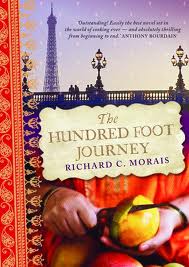
The Hundred-Foot Journey by Richard C. Morais

How do you get to Paris from Bombay? Food, Food, Food.

What better transport is there than a light vehicle that provides a fun and wild ride, taking me out of Midnight’s Children‘s Bombay to my next destination, Paris in July? Thanks to Karen of Book Bath for organizing the trip.

This delightful, breezy read is that speedy transit. It tells the story of Hassan Haji, a Muslim boy who lives above his grandfather’s restaurant in then Bombay and how he ultimately ends up as a three-star chef in Paris.

Growing up immersed in the savoury aroma of Indian food and spices,

I suspect my destiny was written from the very start, for my first sensation of life was the smell of machli ka salan, a spicy fish curry, rising through the floorboards to the cot…

Hassan is endowed with an exceptional gift of culinary talent. After the Partition and the death of his grandfather, religious and political turmoils push his family out of the country. They first land in London, later immigrate to France. The boisterous family finds a home in the resort village Lumière near the Alps and starts its own restaurant Maison Mumbai, serving Indian dishes and bringing a welcome change to the villagers.

Hassan soon is jealously noticed by the veteran, feisty two-star French Chef Madame Mallory across the street. She is the proprietor of the small country hotel, Le Saule Pleureur. Her restaurant is a haute French culinary establishment that plays Satie in contrast to the Indian music from a loudspeaker at the Haji’s. After many animated and almost cartoonish conflicts between Madame Mallory and Hassan’s Papa, Abbas Haji, both concede to the reconciliatory move of allowing Hassan to become Chef Mallory’s apprentice.

Thus, Hassan takes the one hundred-foot journey and crosses the street to stay at Le Saule Pleureur, learn all he can from the great Chef and answer ‘the irrefutable call of destiny’ to be one himself. Towards the end of his apprenticeship, Hassan is left on his own to create recipes for pigeons, gigot, and hare, all to the satisfaction of Chef Mallory. After three years under her wings, Hassan is ready to move on.

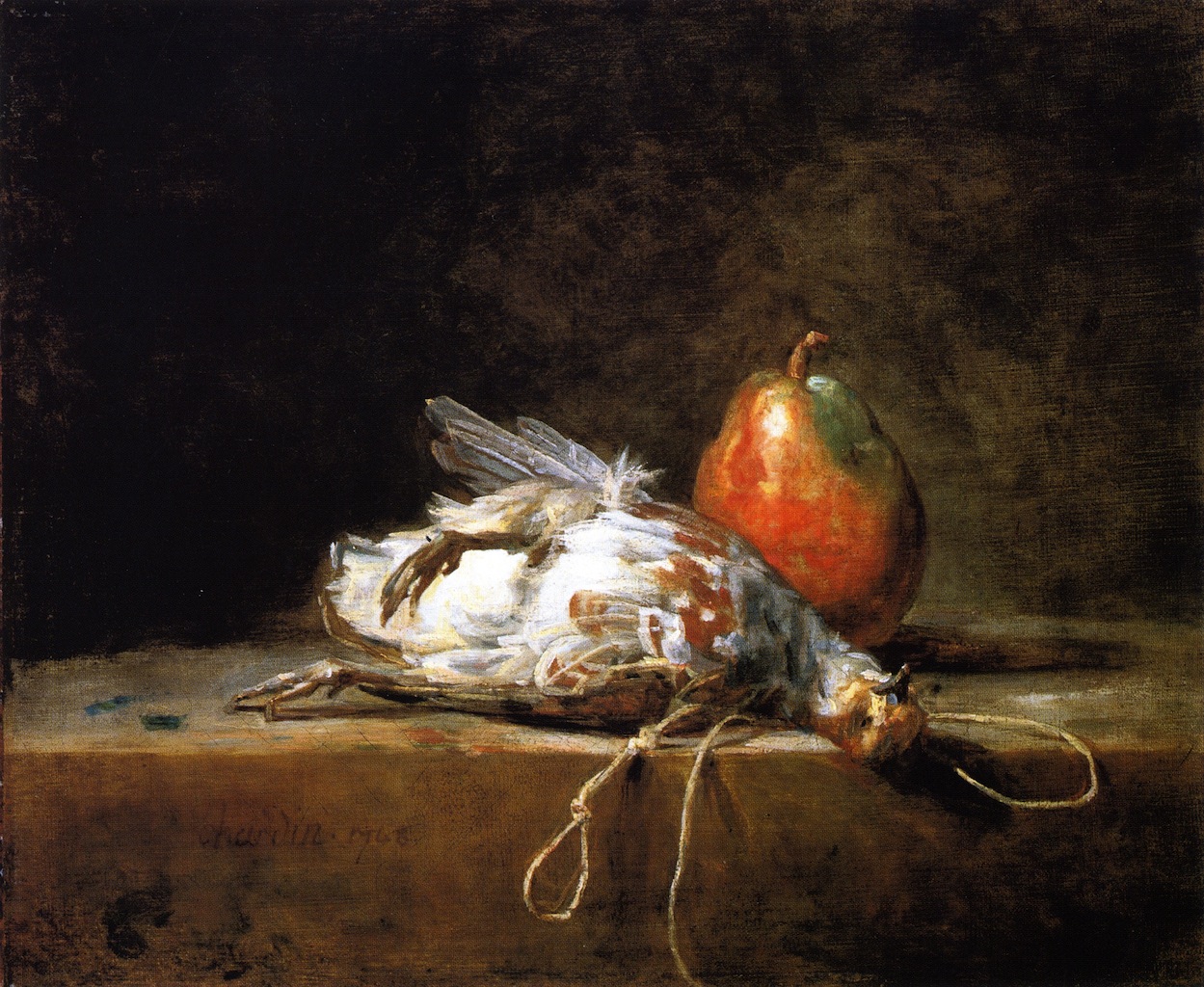
Chardin’s Grey Partridge Pear and Snare on Stone Table, one of Hassan’s favorite paintings.

Next step, Paris. Hassan starts as a sous chef with a couple of smaller restaurants. After a few years, he decides to open his own and is approached by a benefactor who offers him reduced rent in an upscale location near the Panthéon. The one-hundred foot journey has brought him fine training, now he can take flight.

Here is his trademark dish:

the Siberian ptarmigan, roasted with the tundra herbs taken from the bird’s own crop, and served with caramelized pears in an Armagnac sauce.

We as readers are privy to the actual cooking procedure beginning with the feathered live bird.

For me, more a movie buff than a foodie, the book conjures up many cinematic images… the colours and conflicts in The Best Exotic Marigold Hotel, the prejudice in Chocolat, the sumptuous offering in Babette’s Feast, and, the training sessions in the The Karate Kid. Dev Patel (Marigold Hotel, Slumdog Millionaire) will be perfect for the role as young Hassan. I couldn’t help but think, this book is good movie material.

And then I found out from the Acknowledgements after I finished, the book is an homage to the late Ismail Merchant, the film producer behind the Merchant Ivory productions (Room With A View, Howards End, The Remains of the Day) who met an untimely death in 2005. The bond between the author Richard Morais and his friend Ismail Merchant was food. This book was started with a subsequent movie in mind.

In-depth research has gone into writing the book, culinary history, recipes, game, desserts, soups, the French kitchen, the Indian kitchen, restaurant operations, even for me the uninformed and casual eater, there are plenty to savour. The book is a smorgasbord of gastronomic delights. My only criticism is that its literary treatment may taste a bit raw, simplistic, and at times, didactic. However, read it like a comedy, it can satisfy like a dessert.

~~~ Ripples

The Hundred-Foot Journey by Richard C. Morais, Scribner, NY, 2010, 245 pages.

***

Audiobook Review: Brideshead Revisited Read by Jeremy Irons

Don’t be misled by the cover design. This audiobook is not related to the 2008 movie adaptation. Rather, it’s an unabridged recording of Evelyn Waugh’s novel, engagingly read by Jeremy Irons, who plays the narrator Charles Ryder in the 1981 award-winning British TV series.

Jeremy Irons exemplifies what an ideal audio performance should be like. We look for the visuals in a movie; we are drawn to the voice in an audiobook.

For one who has had his share of youthful desires, tasted love and loss, and known the ambivalent effect family and religion can bring, now twenty years after, Charles Ryder is resigned to a numb and dreamless existence. Irons delivers such a tone perfectly… his deep, quiet and sombre voice an apt reflection of Ryder’s sentiments.

His voice dramatizes the various characters with clarity. As a listener, I can easily tell who’s talking, as simple as that. From the senior Lord Marchmain to 12 year-old Cordelia, from the stuttering Anthony Blanche to the constantly drunk Sebastian Flyte, Irons’ portrayal is natural and apt. Characterization is consistent in their manner of speech, quirks and eccentricities. Further, he has also effectively conveyed the subtext, the undercurrents in the dialogues, for example, the sardonic remarks Edward Ryder often hurls at his son.

On top of all these, Irons has presented Waugh’s beautiful language and descriptions with poetic eloquence. His articulation stops me time and again to rewind so I can listen and savor the language once more.

Here is the excerpt that seized me from the start and sent me to find the passage in the book to recap every word. This is in the Prologue when Charles unknowingly arrives Brideshead in his army duty twenty years later and asks his subordinate where they are. This is the moment when he is told the name of the place:

He told me and, on the instant, it was as though someone had switched off the wireless, and a voice that had been bawling in my ears, incessantly, fatuously, for days beyond number, had been suddenly cut short; an immense silence followed, empty at first, but gradually, as my outraged sense regained authority, full of a multitude of sweet and natural and long forgotten sounds: for he had spoken a name that was so familiar to me, a conjuror’s name of such ancient power, that, at its mere sound, the phantoms of those haunted late years began to take flight.

I know it’s a bit long, but I must include it here, for this is the passage that has drawn me to the written word, all because of the voice reading it. Can this be the measure of a good audiobook?

***

Brideshead Revisited by Evelyn Waugh read by Jeremy Irons, BBC Audiobooks America, 10 CD’s, 11 hrs 21 min, Unabridged. July 22, 2008.

~ ~ ~ ~ Ripples

***

Thanks to Devourer of Books for hosting Audioweek 2012.

Other related posts on Ripple Effects:

The Downton Ripples

Dances With Words

***

Saturday Snapshot June 23

… Amina Sinai and Baby Saleem arrived home in a borrowed Studebaker…

Don’t laugh. But I’d never heard of a Studebaker until I read Midnight’s Children by Salman Rushdie in recent months.

You can imagine what a pleasant surprise it was for me as I came out of the Book Sale at Crossroads Market. The name on the back of that antique truck had an almost electrifying effect: STUDEBAKER.

Wow here it is, a real-life, bright and shiny Studebaker. From the antique license plate at the front you can see it’s a 55. I know the one that brings Baby Saleem home has to be 1947 or older, and definitely not a farm truck.

Here are the back, side, and front views… exact sequence of my discovery. O what joy. Those two people watching me take photos of it with my iPhone must have thought I was … uh… born yesterday.

***

Thanks to Alyce of At Home With Books for hosting Saturday Snapshot… for keeping my eyes peeled, making finding a farm truck as exciting as watching a sunset.

***

Prometheus (2012): Still Searching

“What has been will be again, what has been done will be done again;
there is nothing new under the sun. ” — Ecclesiastes 1:9

**

We went to see Prometheus on Fathers Day. That’s a ‘family movie’ for us. Literal meaning: son taking father to the theatre, mom gladly tagged along as chaperone.

The quote above was what came to mind as I left the theatre. Haven’t I seen them all somewhere before? The whole idea of advanced ancient civilizations, as one blogger mentioned von Daniken (Chariots of the Gods), or the enemy inside (literally), or a robot watching old films to be informed of the human way (Wall-E). O wait, maybe there are plenty of CGI techniques that are new and that my amateur and non-technical eyes could not pick out. And the fact that I chose not to watch the 3D version means I’d missed out a lot of technical extravaganza.

Let’s just pick up where I left off.

I watched the very first, Ridley Scott’s Alien, in the theatre… that was 1979. In one notorious cinematic moment, the alien bursts out from within a human belly. That’s quite original I think, shocking scene at that time. So there incubates the subsequent alien offshoots, not only in movies, but I’ve read something like that too, unexpectedly, in the book The Astronaut’s Wife.

Prometheus is the latest version of Ridley Scott’s Alien. At the start we see a couple of archeologists/scientists discovering some ancient cave paintings pointing to a star map that they think could be invitation for them to find out the origin of human life. Following their instinct, they are put to cryo sleep and waken up in the year 2093 on the space exploration vessel Prometheus heading towards those stars.

Prometheus is a space ship purely for scientific discovery. It is also privately funded by Weyland (unrecognizable Guy Pearce) for his own agenda, to find the means to eternal life. Heading the ship’s operation is hard-nosed Meredith Vickers (Charlize Theron). Unfortunately, her character seems unnecessary except to deliver a few trite dialogues.

Leading the scientific team is Dr. Elizabeth Shaw, most aptly played by Noomi Rapace (Lisbeth… obvious name derivation). She has a chance to demonstrate her Dragon Tattoo Girl agility in combat, in resourcefulness, in quick thinking, and in acting. She’s a ‘believer’, wearing a cross necklace, always searching for the truth, despite the discovery that her Maker could be a creator-turned-terminator. She wants to know why.

In contrast, there’s David, an android/robot programmed to offer objective and unemotional info in all areas from scientific data to the various scopes of human civilization, icily played by Michael Fassbender (Jane Eyre, Shame, A Dangerous Method…) In a short exchange, David asks Elizabeth why she needs to know the reason for her Maker turning against its own creation. Elizabeth gives the answer: because I’m human and you’re just a robot.

So the search lands them on the moon LV 223 where they find some humanoid creatures with much more advanced technology. But who made them? Soon they see their dangerous predicament as some organic matter inside these ‘engineers’ are still alive and can turn agressive and powerful. Spectacular warfares ensue and lives lost as a result. And I should stop here to avoid giving away any more spoilers.

The movie ends with the idea that the search continues, and so will its sequels…

I’m not a fan of the Sci-Fi/futuristic genre. But I’m glad in the year 2093, these things remain: Chopin’s music, classic films, Christmas, and human’s search for their Maker.

~ ~ ~ Ripples

The Downton Ripples

Or, How I Overcome Downton Abbey Withdrawal Syndrome.

First, I bought the Blu-rays and rewatched both Season 1 and 2 several times. And then, I let my curiosity lead and follow mere intuition. Downton has prompted me to seek out books and films with setting in the early part of the 20th C.

I was most intrigued by the irreversible changes modernity has brought about, but on a more sombre note, I was moved to learn of the grave number of lives lost in a war I knew so little, WWI.

As heir to Downton Matthew Crawley has aptly noted while fighting in the trenches:

War has a way of distinguishing between the things that matter and the things that don’t.

The Great War did not end all wars as claimed, but had ended countless lives of a young generation, and altered numerous others. On the positive side, it had toppled society’s status quo and broken down previously impenetrable barriers, when men of different social classes fought side by side in the trenches, and where women played a substantial role in the war effort.

And then there are the stories of individuals and families… I’ve thoroughly enjoyed this reading and watching spree. But I have to stop somewhere and share with you what marvellous works you can follow while waiting for Downton Abbey Season 3 to arrive.

So, here’s Arti’s Annotated List of Downton Ripples:

Lady Almina and the Real Downton Abbey by Fiona Carnarvon — A springboard to all my WWI period exploration. What impressed me was that Highclere Castle itself was actually turned into a hospital during the War and many of its staff enlisted and some killed. I was moved by the number of casualties and the horrific conditions in the battlefields. My full review of the book is posted here. 

The World of Downton Abbey — by Jessica Fellowes, niece of write/creator of the series Julian Fellowes. A compendium to the production, the hardcover larger-sized book is filled with photos, background info and quotes from the actors. After skimming through the whole book, one item stands out: Mr. Bates’ fall. That’s when Mrs. O’Brien trips him and he falls flat on his face on the gravel. How did they shoot this? Any special effects? Well, unfortunately for Mr. Bates, none whatsoever.

This is what Bates, Brendan Coyle said:

I must have done it 18 times and by the end I was wounded! I wore knee pads and a torso shield, but when you fall you have to really commit to falling.

Ouch! Some method acting.

Lost Empires (1986)— 7 Episode mini-series based on J. B. Priestly’s novel set in 1913, a year before WWI broke out. Colin Firth is young Richard Herncastle. Lost both parents at 19, he follows his Uncle Nick on his travelling magic stage show, learning the ropes of the itinerant performer in the music hall circuit. A coming-of-age saga chronicling the loss of innocence in love and life. Some noted actors in the series include Sir Laurence Olivier and John Castle.

A Farewell to Arms (1929) — Hemingway’s WWI semi-autobiographical sketch of love and loss. I listened to the audiobook read by Mad Men’s John Slattery. In authentic Hemingway style, his narrative is matter-of-fact and stoic. After that I watched the 1932 movie adaptation with Gary Cooper and Helen Hayes. An adaptation that makes me wish Hemingway was the screenwriter and director.

Brideshead Revisited (1945)– Evelyn Waugh has used a huge and magnificent mansion owned by an aristocratic family to tell his story. Something like Downtown but in a much serious tone. Its subtitle “The Sacred and Profane Memories of Captain Charles Ryder” sets the stage for a tug of war between God and man. I listened to the audio book read by Jeremy Irons, who has turned Waugh’s narratives into pure poetry. Probably the best audiobook I’ve ever listened to.

I’m still watching the 11 Episode TV series (1981) with Jeremy Irons playing the main character of Charles Ryder. So far, I’ve enjoyed the detailed and slower-paced depiction of the work. The book really needs a whole series to tell its story.

I’ve also rewatched the 2008 movie adaptation. As much as I respect the actors in it, Emma Thompson, Matthew Goode, Michael Gambon… I think it has trivialized Waugh’s masterpiece. The adaptation has taken the crux of the matter out and replaces with photogenic visuals and a story converted for more popular appeal. But it could well send one back to the book for curiosity’s sake.

Easy Virtue (2008) — For something totally light and swift, I rewatched this movie based on a Noel Coward play. Filled with Coward’s own music and some Cole Porter, the film depicts how the changes of the times have brought to yet another aristocratic family.

Larita (Jessica Beale) is the first woman race car driver to cross the finish line in Monte Carlo. The year is 1930. An American, she marries on a whim John Whittaker (Ben Barnes), the son of an English aristocratic family… and quickly becomes enemy on the home front to matriarch Veronica Whittaker (Kristin Scott Thomas), and subversive ally to her husband, disillusioned WWI officer played by Colin Firth. If you’re interested, here’s my full review of the movie.

A Handful of Dust (1988) — After Brideshead Revisited I went on to watch another of Evelyn Waugh’s adaptation. Again, a large mansion… how many of these architectural heirlooms do they have in England? Anyway, the master of this house Tony Last (James Wilby) is too busy looking after his property that he loses his wife Brenda (Kristin Scott Thomas). Title comes from T.S. Eliot’s The Waste Land (1922)… that sent me into reading the poem again.

Goodbye To All That (1929) — Autobiography of Robert Graves, English poet and writer. I’m most impressed by the men of letters in that period, they enlisted readily. Robert Graves and Siegfried Sassoon were both involved in the most devastating battles in France. Both were seriously injured. Deep in the trenches they wrote poetry. Their views towards the war changed as time went by, but their experiences in the battlefields brought about poignant legacies as eye witnesses of a horrific war and its aftermath. Ironically, Graves handles his subject matter with some light-hearted reminiscence.

The Remains of the Day (1993) — Not quite the same period but a bit later in the brewing year before England’s engagement in WWII. I rewatched this film adaptation of Kazuo Ishiguro’s Booker Prize winning novel in full, sumptuous Merchant Ivory style. The film leads me to think of a few parallels… Darlington ~ Downton, Stevens ~ Carson, but I’m glad Carson has more heart. And in both Downton and Remains of the Day, a character named Richard Carlisle.

The list goes on with Passchendaele and Birdsong yet to read and watch. But I know when Season 3 of Downton commences, I’ll gladly return and transfix myself once again in the Crawley family.

What have you been doing since Downton Abbey?

***

You may also be interested in:

Quotable Quotes from Downton Abbey

Lady Almina and the Real Downton Abbey

Saturday Snapshot: Book Sale 2012

For Paris in Julyclick here to my home page. I’ll be starting to post the first week of July. 

Saturday Snapshot is hosted by At Home With Books.

Every year the gigantic book sale organized by the Servants Anonymous Society in our City kicks off my summer reading stock-up. This weekend begins their tenth annual book sale at the Crossroads Market. Here’s a photo of the books I hauled back yesterday, all in like-new condition, all for $1.50 each since I’ve got 20 of them.

Many of the titles I’ve been watching out for some time. Some of them I came to know when I read their reviews on your blogs. Glad I can find them in the book sale and in such good condition. A few of the books look like they haven’t been opened.

Here’s the list in no particular order:

Travels In The Scriptorium by Paul Auster

England, England by Julian Barnes

Pulse, stories by Julian Barnes

Home by Marilynne Robinson

The Virgin Suicides by Jeffrey Eugenides

The Tragedy of Arthur by Arthur Phillips

Lit by Mary Karr

Suite Française by Irène Némirovsky

The Secret Daughter by Shilpi Somaya Gowda

Lottery by Patricia Wood

Blindness by José Saramago

The Reinvention of Love by Helen Humphreys

The Enchantress of Florence by Salman Rushdie

Wolf Hall by Hilary Mantel

The Mistress of Nothing by Kate Pullinger

Cool Water by Dianne Warren

The Imperfectionists by Tom Rachman

One Summer by David Baldacci

The King’s Speech by Mark Logue and Peter Conradi (biography of Lionel Logue)

Changing My Mind by Margaret Trudeau (autobiography)

**

Any of your favorites here? The Sale lasts for three weekends beginning June 8. If you were me, would you go back in the next two? Know my struggling sentiment?

**

Saturday Snapshot — June 2

Saturday Snapshot hosted by At Home With Books.

At long last, Spring has finally sprung. For those of you in a much warmer climate, you can’t imagine we’re just beginning to see greens and buds.

Here are some of the photos I took while taking an evening walk in my neck of the woods a couple of days ago.

Wildflowers emerge:

The evening sun turning the green trees into golden fall colours.

And this morning I find all these buds on a pine tree, haven’t seen them so red like berries before:

Yes, Spring is finally here for us.

***

Midnight’s Children Read-Along: Book Two (Part B)

CLICK HERE to read my Movie Review of Midnight’s Children

***

From the best exotic Marigold Hotel of today we go back to 1960’s India and Pakistan…

Here in this part, we see our protagonist Saleem Sinai’s changeling status finally revealed to his parents. The ‘Alpha and Omega’ chapter in our last section has let out Saleem’s blood type being neither A nor O, throwing question on his origin. Mary Pereira finally confesses to the crime of switching the two babies at birth.

This is where I find most true and moving. Saleem talking about his parents Ahmed and Amina:

Never once, to my knowledge, never once in all the time since Mary Pereira’s revelations, did they set out to look for the true son of their blood… maybe, despite everything, despite cucumber-nose stainface chinlessness horn-temples bandy-legs finger-loss monk’s-tonsure… my parents loved me. I withdrew from them into my secret world; fearing their hatred, I did not admit the possibility that their love was stronger than ugliness, stronger even than blood.

And from here, Saleem experiences two important moves of his life. One is being sent to temporarily live with his filmmaker uncle Hanif and his wife Pia Aziz, and has enjoyed a fun and pampered time in their home.

Later, in the sixteenth year of Saleem’s life and India’s independence, his father Ahmed makes the resolute decision: there is no future for them as a Muslim family in India. They are moving to Pakistan.

I’m afraid Mr. Rushdie begins to lose me here. As one not familiar with Indian/Pakistani political history, I can only follow his narratives on the surface regarding the war between the two countries. I must have lost the deeper meaning and parallels as he depicts the political turmoils there, or the Indo-Pakistani war of 1965.

While in Pakistan, Saleem’s sister Brass Monkey has changed her name to Jamila and turned into a singer of patriotic songs. Saleem is ambivalent about this… he is excited about Monkey finding her voice, but is apprehensive about her fanaticism. With his ultra sensitive Snotnose, Saleem can distinguish the different kinds of smells that pass through it, one of them being “the hard unchanging stink of my fellow-students’ closed minds.”

Despite being an outsider and not understanding the political parallels of the narratives, I can grasp Rushdie’s meaning about political ‘truths’ declared by the government. Saleem has gleaned some insights into his short life growing up in both India and Pakistan:

… and maybe this was the difference between my Indian childhood and Pakistani adolescence–that in the first I was beset by an infinity of alternative realities, while in the second I was adrift, disorientated, amid an equally infinite number of falsenesses, unrealities and lies.

And a little sardonic humour as he concludes:

A little bird whispers in my ear: “Be fair! Nobody, no country, has a monopoly of untruth.” I accept the criticism: I know, I know…

An outsider can still enjoy Rushdie’s stylish surprises.

It is also in this section that I’m a bit disappointed to read that along with the move to Pakistan, Saleem loses his supernatural power to tune into the minds of all other Midnight’s Children, thus terminating any more Conferences. I hope this is temporary though, for I relish the confrontations between Saleem and the others he calls to congregate in his mind, in particular, the opposing sides represented by Saleem and Shiva: idealism and pragmatism, thoughts and things.

I look forward to the last section, Book Three, and see how the story concludes. Hope you’re still with me…

***

CLICK HERE to BOOK THREE CONCLUSION

Do go visit other reviews in the Group Read:

Gavin of Page247

Janell of An Everyday Life

Jerika of averydisorientedreader

***

CLICK HERE to watch Salman Rushdie and Deepa Mehta talk about the film adaptation of Midnight’s Children at TIFF last year.

***

The Best Exotic Marigold Hotel

Outsourcing old age, that’s the idea.

Imagine in the distant (or not so distant) future, you retire to a warm climate, enjoy a colourful land and best of all, affordable living in a retirement resort. The concept is sold to several retirees from Britain. Little do they know the advertised Best Exotic Marigold Hotel for the Elderly and Beautiful is a run-down establishment of faded glory. The place is Jaipur, India.

The Hotel owner is Sonny Kapoor (Dev Patel of Slumdog Millionaire fame) who has inherited the property from his late father. Despite his mother’s insistence to close it down and get him back to live with her in Delhi to marry the girl of her choice, Sonny is determined to make it on his own. He has already picked out his girl, and is positive about his plan to outsource retirement, among many other services India is already offering to foreign countries.

The trailer doesn’t do justice to the movie. When I first watched it, I was totally baffled … why would such a top-notch cast of veteran British actors take up what seems to be a shallow and silly farce? But after watching the movie, I think I can make a guess: they must have known what fun it would be to do this, they must have sensed the thematic relevance as well. Why I went out to see it if I didn’t like the trailer? I just couldn’t resist the combined star power and my trust in their judgment.

Where can you see these actors together on one big screen: Judi Dench, Evelyn, who has depended on her husband all the years but now recently widowed, decides to take charge of her life; Maggie Smith, Muriel, who is xenophobic and won’t eat anything she can’t pronounce, goes to India mainly to have a hip replacement she can afford; Bill Nighy and Penelope Wilton, Douglas and Jean, are an incompatible couple who sticks together out of habit and loyalty; Tom Wilkinson, Graham, a judge who follows his heart and returns to his former home to look for a long-lost friend; Celia Imrie, Madge, who at retirement is still looking for the right one, and Ronald Pickup, Norman, seems to know exactly what he wants.

The humour is natural and not forced, the dialogues are witty and refreshing. Something that is not easily found in comedies, with the expert cast of veteran actors, a sense of seriousness exudes from their performance, giving weight to the characters and making their simple storylines convincing.

Oscar nominated director John Madden (Shakespeare In Love,1998) has done a great job in concocting the on-screen chemistry of his cast. Their camaraderie as fellow travellers from the UK and as guests in the Marigold Hotel emit an appealing and quiet persuasion. I’ve enjoyed every one of their storylines. From the very start of the film, I’m drawn into each of the characters while they are still in England. I follow their journey expectantly, open and ready to accept the unfolding of events.

As with all ‘exotic’ movies, there bound to be cultural features that can easily lead to stereotyping and patronizing. That I expected. But what I didn’t was that these ‘typical’ renderings are few and mostly restrained. Further, shot right in Udaipur, India, many scenes are in situ happenings that come out naturalistic and real. The whole movie is a delightful surprise, probably the main one is, I don’t mind watching it again.

~ ~ ~ Ripples

The Rant of the Armchair Traveller

From the comments in my last post, seems like Egyptology is a favorite subject of many, if not now, at least some time in our curious life. I’ve had the chance to visit Egypt twice during my travels to the Middle East. Since now is the warm month of May, kicking off the travelling season, and alas, since going anywhere far is a remote possibility for me at present, an armchair revisit is timely, if only to suppress burning wanderlust.

Here are some file photos from my last trip to Egypt five years ago. I only stayed in Cairo and its vicinity. But from my recent reading of Lord Carnarvon and Carter’s King Tut Tomb discovery, I regret I didn’t venture further to the Valley of the Kings in Luxor. However, I did see the iconic King Tut’s mummy mask at Cairo’s Egyptian Museum. Photography was forbidden, so no King Tut’s portrait here.

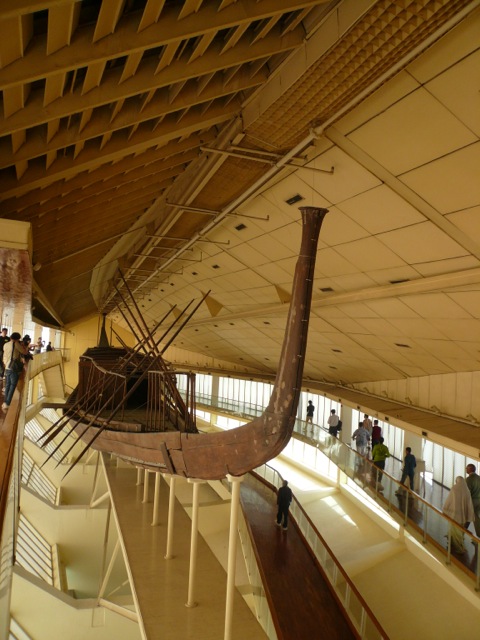
But I can show you another marvellous exhibit. In 1954, a Pharoah’s boat dating back four millenium was dug up in pieces and since reassembled. Beautifully showcased in another museum near the Great Pyramid of Giza. Photos were allowed here, but Arti’s pocket Lumix wasn’t enough to capture the magnificent whole. If you’re interested, click here to a full description.

Pharaoh’s Boat buried 26th Century B.C.

Another view:

The Pyramid and the Sphinx are probably what travellers go to Egypt for. While the Sphinx is a limestone statue of the mythical creature with the lion body and the human head, the Pyramid was piled up in stones. Can’t say which one is easier to make.

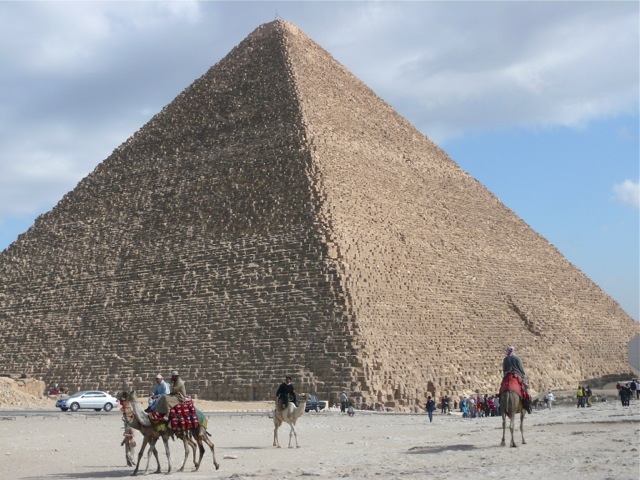
The oldest of the Seven Wonders of the Ancient World that is still standing, The Great Pyramid of Giza was built for the fourth dynasty Egyptian Pharaoh Khufu, a 20 year construction process which concluded around 2560 B.C. (Wikipedia data) As for Arti, no exact date was needed. Standing at the foot of the humungous pile of neatly stacked up stones was an experience itself.

The Great Pyramid of Giza

Not far from the Pyramid, The Sphinx:

The Pyramid and The Sphinx

A closer look… so what if I’ve lost a nose, I still stand sit after all these years:

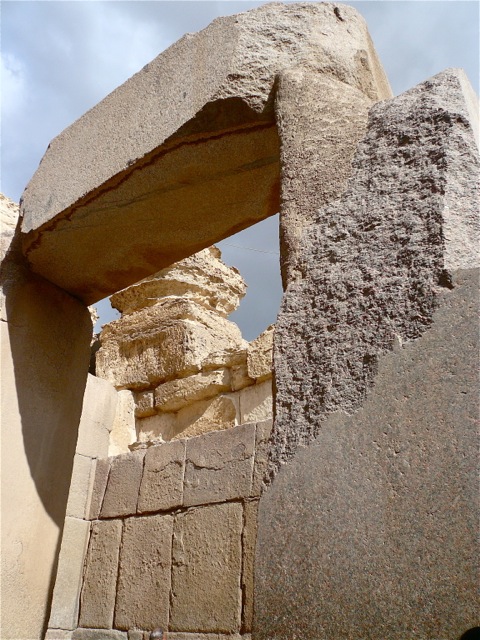
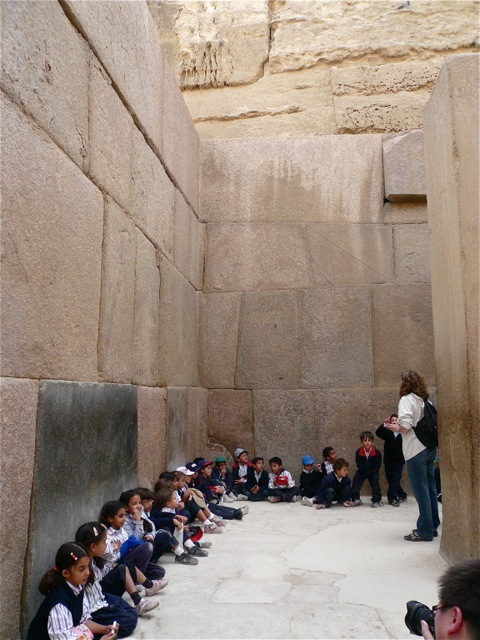
Let the stones speak:

and the children listen:

We were travelling in a bus through the desert, and stopped for a view. Here are some other children I saw, took this picture through the window:

Mount Sinai, the legendary place Moses received the Ten Commandments from God. At the foot of the mountain range is St. Catherine’s Monastery:

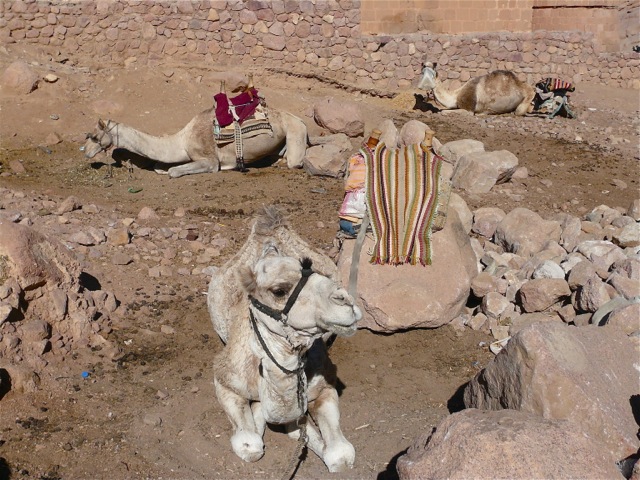
 Man’s best friend. They wait without complaint:

The desert is mesmerizing regardless of the hour:

Desert moon at dusk

While I faithfully pick up mail for neighbors gone to Paris, or read with pleasure blog posts of your recent travels, I feel like jumping on the armchair bandwagon and join the massive global tourism movement. Ok everyone, I’m coming along.

***