Oscar Nominations 2012

Feb. 26th is Oscar night. I’m reposting here my take on the Best Picture nominees, and some more… a post I wrote on Jan. 24th, shortly after they were announced at 5:30 am PST.

***

With the announcement of the 84th Academy Awards Nominees this morning, I’ve prepared here a guide to the nominated films for Best Picture plus some more. I’ve seen them all except one, which I admit is somewhat unexpected, that’s Extremely Loud and Incredibly Close. For some of the others, do click on the link in the title to read my full review.

Here are the 9 nominees for Best Motion Picture:

The Artist —  Riding high the waves in this Awards Season, and most likely to grab the top Oscar. Kudos to the filmmakers for taking a bold and contrary step to pay homage to the silent era of Hollywood. Audacious in its attempt at a black and white silent film in 2011, where CGI and 3D’s are the cinematic effects, a long way from the great advancement of sound. Sure it’s light and frothy, which makes me admire all the more the boldness and foresight of the financial backers. Actions do speak louder than words. 10 noms in all.

The Descendants —  Well acted, probably George Clooney’s best performance I’ve seen, a close Oscar contender with Jean Dujardin of The Artist for Best Actor. The idyllic setting in Hawaii shrouds conflicts among family members: between husband and wife, parents and children, and in the extended level, relatives when it comes to monetary gains and interests. A fine film from Oscar winning director Alexander Payne of Sideways fame. While there are interesting twists and turns, the ending is predictable. A close contender with The Artist for Best Picture.

The Tree of Life — I’m excited to see Terrence Malick’s existential epic included in the list.  The film generally draws two opposing reactions, like its premiere in Cannes, boos and applause. Ironically, those might well be the two ways the film portrays, two possible views towards life. Other noms: Terrence Malick for Best Director, and deservedly, Emmanuel Lubezki for Best Cinematography.

Midnight In Paris — It has been a long time since Woody Allen won a Best Picture Oscar (Annie Hall, 1977), glad it’s time again for a nod, even though its chance of winning is slim. As in a few other nominated movies on this list, nostalgia is key. An imaginary trip back to Paris during the literary and artistic golden age of Gertrude Stein, Hemingway and Picasso, an aspiring writer from California learns the notion of golden is only relative. What’s precious may well be the time at hand. Woody Allen also receives noms for Directing and Original Screenplay.

Hugo — Leading the Oscar nom counts with 11. Another homage to the cinema, or, the creation of the cinema dating back to the Lumière Brothers, but specifically to Georges Méliès, the French innovator of cinematic special effects. Interesting to see Martin Scorsese uses the modern technique of 3D to honor the pioneer Méliès. A visually stunning adaptation of Brian Selznick’s The Invention of Hugo Cabret. Scorsese has proven to me that 3D doesn’t have to be synonymous with soulless gimmick. Heart-warming, beautiful film for everyone.

The Help — As Roger Ebert was labelled “a lackey for imperialism” after writing that he likes ‘Downton Abbey’, I must put in this Disclaimer: I have high respect for the courageous fighters in the civil rights movement, both on a societal level like Martin Luther King Jr. and those making personal steps like Rosa Parks. How I feel about this movie is strictly to do with the movie itself. Ok, here it is: I find it riddled with simplistic and contrived sentiments. The pool of major acting talents are morphed into caricatures. As I was watching, I felt they were all acting, not being. Can’t blame them, they were following a script and a director. Viola Davis nom for Best Actress, Jessica Chastain and Octavia Spencer for Best Supporting Actress. And the Oscar likely goes to Spencer.

The War Horse — Again, a Disclaimer here: I’m not against animals in movies… often, it’s the humans that leave much to be desired. Personally, I’m surprised that this is from Spielberg. Lacklustre storytelling, cliché moments and superficial characterization. The most natural and beautiful actor could well be Joey, the horse. The film is an adaptation of the children’s book of the same name written from the POV of the horse. Now, that sounds fresh and unique.

Moneyball — Can strike the heart of even non-baseball fans. A well paced and edited, engaging movie. The real story of Oakland A’s general manager Billy Beane. It’s always satisfying when the underdog wins, David overcoming Goliath, especially when money is involved. Brad Pitt getting Best Actor nom, and Jonah Hill Best Supporting. Other categories include Editing and Adapted Screenplay.

Extremely Loud and Incredibly Close — The is the only one among the nine I have yet to see, for truly I did not expect it to be nominated for Best Picture. I’ve read Jonathan Safran Foer’s novel, the source material, with mixed feelings. And for it to be adapted into a film, much has to be done to interpret, alter, and display.  So, I reserve judgement on the film until I’ve seen it.

Other Nominees:

Meryl Streep for Best Actress in The Iron Lady — If you want historical accuracy, go see a documentary. But even there it depends on the POV of the filmmaker.  Director Phyllida Lloyd (Mamma Mia!) has conjured up an internal world of the only woman Prime Minister of Britain, Margaret Thatcher. Unless she comes to rebut the director’s view, who are we to argue against it? Let’s just go beyond the debates and appreciate the marvellous performance by Meryl Streep. This might well be her chance for a second Best Actress Oscar since Sophie’s Choice in 1983. Jim Broadbent always complements superbly.

Michelle Williams for Best Actress in My Week With Marilyn — Michelle Williams proves her amazing versatility here. I mean, after seeing Wendy and Lucy, Blue Valentine, can you imagine a more diverse role as Marilyn Monroe? She delivers convincingly. Kenneth Branagh gets the nom for Best Supporting Actor as Sir Laurence Olivier. And who’s that obscure chap that gets to spend a week with Marilyn? Why, he’s Eddie Redmayne, Angel Claire in Tess of the D’Urbervilles.

Gary Oldman for Best Actor in Tinker Tailor Soldier Spy — Film scholar David Bordwell suggests that we see it as ‘a moving mosaic’. This film is made up of fragments of John Le Carré’s complex and massive work. So it’s better that you’ve read it first before watching. But if you’re like me, abandoning the book without finishing, you can still appreciate the overall atmosphere and the fine acting. Intricately weaving characters and time frames, the film’s intriguing ending has prompted me to go back to the book after watching it. CLICK HERE to read Bordwell‘s insightful review to help you through the Labyrinth.

***

CLICK HERE for a full list of Nominees.

Death Comes to Pemberley by P. D. James

This is how I see it. Living to 91 is an achievement in itself, let alone write a book at that age. I admire the adventurous spirit of P. D. James, sailing out to new waters at this stage of her career. This is her first attempt at creating an Austen sequel, a Pride and Prejudice fan fiction. So, how do I reconcile the flaws in this book with her previous acclaimed mystery works?  Let’s just say… the editor did it.

Take for example the error in referring Darcy as an Oxford man, who had actually gone to Cambridge, and with Wickham too. The ubiquitous redundancy of retelling, or the irrelevant details such as taking an inventory of how many candles are lit in which room.

Or, this dialogue between Sir Selwyn’s, the magistrate, and Darcy, as Darcy goes to his home to report to him a body is found in the woodlands. Are lines like these necessary? I find them incredibly amusing. Greeting Darcy, Sir Selwyn says:

Please sit. That chair with the carved back is said to be comfortable and should hold your weight.”

Since it was the chair Darcy usually occupied he had every confidence that it would. He seated himself and told his story…

The book begins with an epilogue detailing the story of Pride and Prejudice framed by a Jamesian view. It then starts off with the Darcy household preparing for the annual Lady Anne’s Ball at Pemberley, a tradition honouring Darcy’s mother ever since he was a child. A screaming Lydia comes charging in, uninvited, manically hysterical. Somebody has shot her dear husband Wickham, she claims. A search party led by Colonel Fitzwilliam soon takes action, and a body is found lying in the dense woodlands on Pemberley grounds. Wickham, very much alive, is seen hovering over it, blood stained and drunk. The episode comes early, the rest of the book is the revealing of the facts, whodunnit and why.

This is no CSI. The body is removed once found and brought back to Pemberley. Wickham, the key witness also now the key suspect, is washed clean of the blood on him, given a sedative, and is deep asleep when the magistrate arrives to question him. The later inquest at Lambton and final trial at London’s Old Bailey sound like child’s play when compared to, what comes to mind for me, Dicken’s Bleak House trials.

Simple, straight forward, not much mystery to it. But readers get to be entertained by James’ literary rendering and imagination of all the main characters from Pride and Prejudice, six years after it has ended in Austen’s hands. Darcy and Elizabeth now are parents to two boys, Fitzwilliam, 5, and Charles, 2. Readers so fond of their courtship would be disappointed at not seeing them together much in the book. Georgiana still lives in Pemberley, has two suitors, Colonel Fitzwilliam and a young lawyer Alveston, who seems to have a much higher chance.

At the end, we see the problem that has given rise to the motive of the crime neatly resolved by … Harriet Smith, who is married to farmer Robert Martin, no kidding. You’re right, that’s the Harriet Smith who used to go to a successful girl’s school run by Mrs. Goddard in Highbury, and the farmer Robert Martin who is a good friend of Mr. and Mrs. Knightley. All characters from Emma. This part reads like a parody. But we ought to be familiar with this sort of things by now in our current culture, a total mash-up.

All in all, I say, don’t resist your curiosity. Despite its flaws, and if you don’t take Austen or James too seriously, this just could make one great escape from all the demands of rationality in your daily routines.

~ ~ 1/2 Ripples

***

For all Jane Austen / Pride and Prejudice fans, this review from The Guardian is a must-read.

The End of the Affair: Book and Movie

It’s a bit ironic to post this on Valentine’s Day. It’s a story of an extramarital affair, and it doesn’t end well. But then again, maybe this is the best time to talk about it.

This is my second instalment to meet the Graham Greene Challenge hosted by Carrie of Books and Movies. Spoiler Alert here. But since it’s a classic, I’m sure many of you have read it or seen the movie.

The End of the Affair

The book opens with a meeting between novelist Maurice Bendrix and civil servant Henry Miles on a cold, rainy night in 1946 London. Miles’ wife Sarah had ended an affair with Bendrix 18 months earlier. Bendrix has not seen them since. In this chance meeting on the street, Bendrix observes that Miles is heavy-laden, suspecting Sarah has ‘secrets’. Volunteering to hire a detective to tail the wife for the husband, Bendrix is in fact acting out of jealousy, for he too wants to find out who Sarah is seeing now. “Anyone who loves is jealous.”

Again, in just 160 pages, Greene has intricately explored the depth and complexity of the human psyche, love and hate, trust and insecurity, faith and lameness. Yes, the lameness in Bendrix’s leg can well be a metaphor for his numbness of unbelief. Isn’t there such an argument: “If God does not exist, everything is permitted?”

Love with all its smothering, blinding passion, its persistent, burning desire, its all-consuming emotions that distill into pure jealousy and hate… Graham Greene is a master of such incisive descriptions. But here’s the rub, they’re all found in an adulterous affair.

Isn’t that a pity that such intensity of love is often depicted outside of a marriage. Why, we see them all the time in literature and movies. And, don’t we tend to cheer for the romantic heroes and heroines? Guinevere and Lancelot, for example, to whom Bendrix in the book alludes when he talks to the detective Parkis, who has named his son Lance. Readily come to mind are some others: Madame Bovary, Anna Karenina, and in the epic cinematic versions like The English Patient, in a more restrained way Out of Africa, and the near success in The Bridges of Madison County…  didn’t you wish Meryl Streep would have gone with Clint Eastwood? I’m just thinking, if Ralph Fiennes were the one beckoning her, she’d probably had jumped out of her husband’s truck.

O the fantasy of romance vs. the mundane reality of a marriage. The forbidden fruit seems sweeter, for it arouses excitement, it entices with adventure. Bendrix accuses the oblivious and dull husband Henry Miles as an accomplice in Sarah’s affairs, calling him ‘an eternal pimp’:

“You pimped with your ignorance. You pimped by never learning how to make love with her, so she had to look elsewhere. You pimped by giving opportunities… You pimped by being a bore and a fool…”

There might be some truths in his rants. But then again, are these reasons enough to drive one to discard the marriage vow and seek other allurements? Alas, it seems like boredom is the major impediment to fulfilling that commitment… “If I could love a leper’s sores, couldn’t I love the boringness of Henry?” Sarah tries to reason with herself.

But of course, here, the key is the End of the affair between Bendrix and Sarah. What causes the end is none other than God Himself according to Sarah. A bomb drops near Bendrix’s home while they are both there, striking him dead. Sarah, in her horror and desperation, prays to a God she doesn’t believe to exist, but pleads for the life of her lover just the same. She makes the promise that if God gives Bendrix back his life, she would stop seeing him. As she’s still kneeling by her bed praying, Bendrix walks into the room, injured but very much alive. Thus begins the agony of keeping a promise to a God whose existence now has become an inconvenient truth.

We learn at the end, Sarah has attempted to shift her love from Bendrix to God, albeit with much searing pain. She has gone to a priest and converted to Catholicism. In the crucifix she knows that God Himself is a suffering God too. If only she can see the scale of the pain in the nail-pierced hands in a greater cosmic proportion compared to her own…

***

The marvellous cinematography, the diffused lighting of many scenes, all work to cast a romantic veil over an adulterous affair. Two Oscar noms in 2000 included one in cinematography and one for Julianne Moore as Sarah Miles. Ralph Fiennes plays Bendrix, a suitable choice. He is in his element. Since The English Patient (1996), Fiennes seems to have mastered the persona of the romantic tragic hero and obsessed lover.

While the screenwriter is understandably free to invent more scenes for the visual storytelling and change some plot points, one alteration I feel  is definitely unacceptable and that’s the character Richard Smythe. In the book, Smythe is an atheist whom Sarah visits several times to discuss views about atheism. Ironically it is Smythe’s atheistic stance that drives Sarah into believing God. She then confides in Father Crompton her wish to convert to Catholicism. But in the film, Smythe is the priest, and what more, he is implied to be another of Sarah’s lovers. I think here is where integrity to the source material should have given priority over dramatic effects.

***

And what does Colin Firth have to do with The End of the Affair? Well, for all you Colin fans, he is among some A-list stars to have signed with the UK audiobook provider Audible to record their reading of their favorite classic novel.

Audible’s founder, Donald Katz, told the Observer: “Colin Firth could read me the back of a Marmite jar and I would listen.” Well, Colin has chosen, not Marmite or Cornflakes, but for more flavour, Graham Greene’s The End of the Affair. CLICK HERE to read the announcement and see what other stars are reading for Audible’s recordings.

Now we have another portal to appreciate Colin, and, another channel to enjoy a Graham Greene book.

Update May 7, 2012: The Audiobook The End of the Affair narrated by Colin Firth is released today.

***

The Quiet American by Graham Greene: Book and Movie

This is my first selection for the Graham Greene Challenge hosted by CarrieK at Books And Movies.

I watched the film The Quiet American some years back, but not read the book. And my memory is vague. Only remember Michael Caine and Brendan Fraser, the setting in Vietnam, in the early 50’s, a complex fusion of political thriller, murder mystery, and a love triangle.

But now that I’ve read the book I’m thoroughly intrigued, thanks to this Penguin Classics Graham Greene Centennial Edition (1904 – 2004), with the intro written by American novelist Robert Stone. Stone’s novel Dog Soldiers about the Vietnam war and its effects won the 1975 National Book Award. From his introduction, I’ve come to appreciate how intricate and multi-layered the conflicts are, and, how political the novel stands.

Interesting to learn from Stone about the joke embedded in the title: the only quiet American is a dead American. In the midst of a colonial war between the French and the communists in 1950’s Saigon, American Alden Pyle’s subversive brand of democracy satisfied none other than his own idealism. A Harvard grad, armed with naiveté and book knowledge, a CIA under the guise of the American Economic Attaché, Pyle’s involvement might well represent American meddling in other country’s affairs in the name of spreading democracy.

We see all these through the eyes of the narrator, the British reporter Thomas Fowler. Much older, more experienced, and having been posted in Vietnam for some years, Fowler has grown to love the humanity therein, but is plagued by bitter cynicism. He doesn’t take sides, he just writes his story as an observer, smokes his opium pipe prepared by his young mistress Phuong, and lies in bed with her. But Fowler’s noncommittal stance comes to a breaking point at the end:

… one has to take sides. If one is to remain human.

The Quiet American is noted for its divergent from Greene’s ‘Catholic’ novels. But the existential issues are very much in the forefront. Fowler is a man of conscience, albeit aloof in his outward stance. The climax comes as he resolves a moral dilemma. Guilt is his nemesis, regarding his wife in England, regarding Phuong, and much more acutely at the end of the novel, regarding Pyle. The book ends with this line:

I wished there existed someone to whom I could say that I was sorry.

And then there’s Phuong, manipulated by her older sister, weaves herself between the two foreigners whom she sees as her ticket out of the country and into a dream future. I find her reaction to Pyle’s death most disturbing.

In a short 180 pages, Greene has brilliantly depicted the political complexities of the conflicts at the time, and addressed the internal war waged within a man’s conscience, ironically, a man whose outward creed is noninvolvement. I’m thoroughly intrigued by the story that is told with depth, eloquence and skill by a master storyteller.

~ ~ ~ 1/2 Ripples

***

The Movie: DVD

I watch the film again after finishing the book. It has altered some characters, and taken a more sympathetic view of Phuong. But the overall story and perspective remain intact. Upon this second time viewing, I find several interesting facts that I wasn’t aware of before.

Michael Caine was nominated for a Best Actor Oscar and Golden Globe in 2003 for his role as British reporter Thomas Fowler. He has portrayed the character convincingly. Brendan Fraser as the young American I feel is a miscast. If they’re making the film today, James Franco would be my choice for Alden Pyle.

Director is the award-winning Australian Phillip Noyce. (Rabbit-Proof Fence, 2002). One of the two screenwriters is Christopher Hampton who got an Oscar nom for his adapted screenplay Atonement from Ian McEwan’s novel. He is also the screenwriter for the current film A Dangerous Method. Executive producers were two personalities whom I highly respect, Anthony Minghella of The English Patient fame plus some more, and Sydney Pollack whose credits are too numerous to mention. It was a great loss that they both passed away within two months in 2008.

The DVD comes with a resource of special features. Other than all the interviews and making-of, there is a useful “Vietnam Timeline”, outlining the history of Vietnam from 1940 to 1980. Further, I appreciate the inclusion of original book reviews. One line particularly stands out. From the 1956 review of the book by John Lehman of The New Republic: 

The Quiet American is one of the most icily anti-American books I’ve ever read.

Oh…  the wealth of information one can gather from watching these special features.

~ ~ ~ Ripples

***

Oscar Nominations 2012

With the announcement of the 84th Academy Awards Nominees this morning, I’ve prepared here a guide to the 9 nominated films for Best Picture plus a few more. I’ve seen them all except one, which I admit is somewhat unexpected, that’s Extremely Loud and Incredibly Close. For some of the others, do click on the link in the title to read my full review.

Here are the 9 nominees for Best Motion Picture:

The Artist —  Riding high the waves in this Awards Season, and most likely to grab the top Oscar. Kudos to the filmmakers for taking a bold and contrary step to pay homage to the silent era of Hollywood. Audacious in its attempt at a black and white silent film in 2011, where CGI and 3D’s are the cinematic effects, a long way from the great advancement of sound. Sure it’s light and frothy, which makes me admire all the more the boldness and foresight of the financial backers. Actions do speak louder than words. 10 noms in all.

The Descendants —  Well acted, probably George Clooney’s best performance I’ve seen, a close Oscar contender with Jean Dujardin of The Artist for Best Actor. The idyllic setting in Hawaii shrouds conflicts among family members: between husband and wife, parents and children, and in the extended level, relatives when it comes to monetary gains and interests. A fine film from Oscar winning director Alexander Payne of Sideways fame. While there are interesting twists and turns, the ending is predictable. A close contender with The Artist for Best Picture.

The Tree of Life — I’m excited to see Terrence Malick’s existential epic included in the list.  The film generally draws two opposing reactions, like its premiere in Cannes, boos and applause. Ironically, those might well be the two ways the film portrays, two possible views towards life. Other noms: Terrence Malick for Best Director, and deservedly, Emmanuel Lubezki for Best Cinematography.

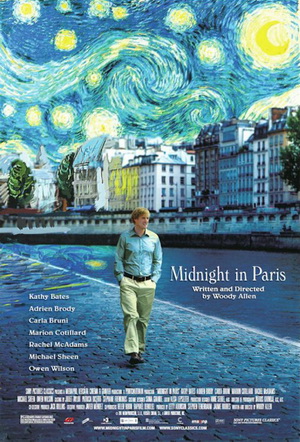
Midnight In Paris — It has been a long time since Woody Allen won a Best Picture Oscar (Annie Hall, 1977), glad it’s time again for a nod, even though its chance of winning is slim. As in a few other nominated movies on this list, nostalgia is key. An imaginary trip back to Paris during the literary and artistic golden age of Gertrude Stein, Hemingway and Picasso, an aspiring writer from California learns the notion of golden is only relative. What’s precious may well be the time at hand. Woody Allen also receives noms for Directing and Original Screenplay.

Hugo — Leading the Oscar nom counts with 11. Another homage to the cinema, or, the creation of the cinema dating back to the Lumière Brothers, but specifically to Georges Méliès, the French innovator of cinematic special effects. Interesting to see Martin Scorsese uses the modern technique of 3D to honor the pioneer Méliès. A visually stunning adaptation of Brian Selznick’s The Invention of Hugo Cabret. Scorsese has proven to me that 3D doesn’t have to be synonymous with soulless gimmick. Heart-warming, beautiful film for everyone.

The Help — As Roger Ebert was labelled “a lackey for imperialism” after writing that he likes ‘Downton Abbey’, I must put in this Disclaimer: I have high respect for the courageous fighters in the civil rights movement, both on a societal level like Martin Luther King Jr. and those making personal steps like Rosa Parks. How I feel about this movie is strictly to do with the movie itself. Ok, here it is: I find it riddled with simplistic and contrived sentiments. The pool of major acting talents are morphed into caricatures. As I was watching, I felt they were all acting, not being. Can’t blame them, they were following a script and a director. Viola Davis nom for Best Actress, Jessica Chastain and Octavia Spencer for Best Supporting Actress. And the Oscar likely goes to Spencer.

The War Horse — Again, a Disclaimer here: I’m not against animals in movies… often, it’s the humans that leave much to be desired. Personally, I’m surprised that this is from Spielberg. Lacklustre storytelling, cliché moments and superficial characterization. The most natural and beautiful actor could well be Joey, the horse. The film is an adaptation of the children’s book of the same name written from the POV of the horse. Now, that sounds fresh and unique.

Moneyball — Can strike the heart of even non-baseball fans. A well paced and edited, engaging movie. The real story of Oakland A’s general manager Billy Beane. It’s always satisfying when the underdog wins, David overcoming Goliath, especially when money is involved. Brad Pitt getting Best Actor nom, and Jonah Hill Best Supporting. Other categories include Editing and Adapted Screenplay.

Extremely Loud and Incredibly Close — The is the only one among the nine I have yet to see, for truly I did not expect it to be nominated for Best Picture. I’ve read Jonathan Safran Foer’s novel, the source material, with mixed feelings. And for it to be adapted into a film, much has to be done to interpret, alter, and display.  So, I reserve judgement on the film until I’ve seen it.

Other Nominees:

Meryl Streep for Best Actress in The Iron Lady — If you want historical accuracy, go see a documentary. But even there it depends on the POV of the filmmaker.  Director Phyllida Lloyd (Mamma Mia!) has conjured up an internal world of the only woman Prime Minister of Britain, Margaret Thatcher. Unless she comes to rebut the director’s view, who are we to argue against it? Let’s just go beyond the debates and appreciate the marvellous performance by Meryl Streep. This might well be her chance for a second Best Actress Oscar since Sophie’s Choice in 1983. Jim Broadbent always complements superbly.

Michelle Williams for Best Actress in My Week With Marilyn — Michelle Williams proves her amazing versatility here. I mean, after seeing Wendy and Lucy, Blue Valentine, can you imagine a more diverse role as Marilyn Monroe? She delivers convincingly. Kenneth Branagh gets the nom for Best Supporting Actor as Sir Laurence Olivier. And who’s that obscure chap that gets to spend a week with Marilyn? Why, he’s Eddie Redmayne, Angel Claire in Tess of the D’Urbervilles.

Gary Oldman for Best Actor in Tinker Tailor Soldier Spy — Film scholar David Bordwell suggests that we see it as ‘a moving mosaic’. This film is made up of fragments of John Le Carré’s complex and massive work. So it’s better that you’ve read it first before watching. But if you’re like me, abandoning the book without finishing, you can still appreciate the overall atmosphere and the fine acting. Intricately weaving characters and time frames, the film’s intriguing ending has prompted me to go back to the book after watching it. CLICK HERE to read Bordwell‘s insightful review to help you through the Labyrinth.

***
CLICK HERE for a full list of Nominees.

2012 Golden Globes Results

Some of the major winners at the 69th Golden Globes Awards last night.

  • Best Motion Picture – Drama: The Descendants
  • Best Motion Picture – Comedy or Musical: The Artist
  • Best Actress – Drama: Meryl Streep (Iron Lady)
  • Best Actor – Drama: George Clooney (The Descendants)
  • Best Actress – Comedy or Musical: Michelle Williams (My Week with Marilyn)
  • Best Actor – Comedy or Musical: Jean Dujardin (The Artist)
  • Best Director – Motion Picture: Martin Scorsese (Hugo)
  • Best Screenplay – Motion Picture: Woody Allen, Midnight In Paris

I must say I’m not too excited about this year’s Golden Globes to start with. Main reason: how can they totally snub Terrence Malick’s The Tree of Life? Not even one single nomination for that epic production! I hope the Academy Awards can correct that negligence.

But I’m glad though for The Artist winning Best Picture, Comedy or Musical. It offers me a unique experience: watching a silent movie made in 2011 in the theatre, a successful, nostalgic attempt paying homage to the golden era of Hollywood. Last night, Uggie got a chance to share the spotlight.

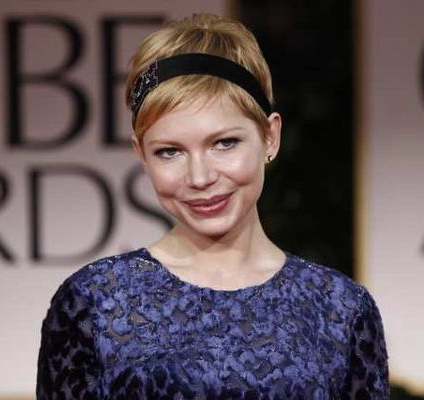
Michelle Williams is impressive as Marilyn Monroe. Just a look at her at the Golden Globes and you’ll know how acting and make-up can create a whole world of difference. The transformation of an understated actor into a legendary personality in a dreamscape is what’s so magical about the cinema.


George Clooney is good in The Descendants, a showcase for his acting talent. You can actually see a tear welling up in his eye then flow slowly down his cheek to the tip of his nose. That scene is so deeply imprinted in my memory.

Haven’t seen Iron Lady yet, but what I remember from last night Meryl Streep winning Best Actress is her presenter, the inimitable, ever poised (even more so this time… marvellous result of some great workout?): Colin Firth.

And last but not least, excited to see Woody Allen once again getting recognized for his talent, albeit not in directing, still a worthy nod, winning Best Screenplay with Midnight In Paris. And I must mention this: not too long ago I read a book entitled Insanity Defense: The Complete Prose by Woody Allen. In it I read a story called “A Twenties Memory”.  O what a discovery! Of course! This piece of writing dating back to 1971 must be the original spark that later materialized into the script for Midnight In Paris, some forty years later. CLICK HERE to read “A Twenties Memory”. This just shows it’s never too late to bring ingenuity to life.

***

For a full list of nominations and winners, CLICK HERE.

***

Midnight’s Children Read-A-Long

Midnight’s Children Read-Along has begun. Here are the post to:
Midnight’s Children Read-Along Begins
Midnight’s Children by Salman Rushdie, Book One
Midnight’s Children Book Two (Part A: up to ‘Alpha and Omega’) 
Midnight’s Children Read-Along Book Two Part B
Midnight’s Children: Book Three

On Dec. 29 of last year, I posted “Year End Tally and 2012 Outlook“, and I thought that would be it. The two challenges I’ve taken up for this year, the Graham Greene and the Ireland Reading, would be sufficient in lieu of any new year’s resolutions. Further, there will always be movie reviews and other choices in reading on the spur of the moment.

Along came the new year and another opportunity. Thanks to Mrs. B of The Literary Stew, who suggested to me a read-a-long of Salman Rushdie’s Midnight’s Children, I gladly accepted the idea. We’re excited that Bellezza of Dolce Bellezza and Colleen of Books in the City will also be joining us. I know that on Bellezza’s blog, she has a few who have shown interest. You’re invited to hop on as well.

Salman Rushdie’s Midnight’s Children won the 1981 Booker Prize. In 1993, it was awarded the Booker of the Bookers trophy, the best novel to have won the Booker Prize for Fiction in the Award’s 25-year history. I admit I haven’t read any Rushdie before, so I just thought this would be a good one to start. Do click on the link above to Booker’s website for the synopsis and bio.

Another major reason for my interest in reading it this year is that its film adaptation is currently in post-production. Acclaimed Canadian director Deepa Mehta (Water, 2005) is at the helm of the production. Rushdie is closely involved in the process with Mehta in condensing his novel into 130 pages of screenplay. Filming has already been completed in Sri Lanka. According to IMDb, it will be released this fall.

My copy is the 25th Anniversary Edition. It has 533 pages. Considering the dense writing and the historical backdrop of the novel, it sounds like a book that calls for reading camaraderie and dialogue. Also, we’ve decided to take it slow. By so doing, we can also pursue other readings or blogging activities while doing this.

So here’s our plan. The novel is divided into 3 sections, with the middle the longest, so we’ll split it in two. We’ll begin reading in March. One month for each part. Review posts are to be posted according to the following schedule:

March 31 — Book One
April 30   — Book Two (Part A ending with ‘Alpha and Omega’)
May 31    —  Book Two (Part B starting with ‘The Kolynos Kid’)
June 30   — Book Three

You’re welcome to join us in this slow read. Just indicate in the comment section and leave a link. 

**

And to everyone, Happy Reading in 2012!

***

The Artist (2011)

I like to start the year with something bright and cheerful. Glad I found it in The Artist. It’s a colourful and spirited romance comedy, kicking off the new year with style. The Artist is a black and white silent film made in 2011.

Directed by Michel Hazanavicius, it premiered at Cannes and was nominated for the Palme d’Or. The French actor Jean Dujardin won Best Actor at the Festival. The Artist is now gathering momentum for an Oscar Best Picture nom.

I was totally captivated by the film, an homage to the silent era of Hollywood movie-making. In the style and tradition of Charlie Chaplin and Buster Keaton, The Artist is a comedy with a heart. It’s not a deep exploration of true love, or what makes an artist, but a light, fun and melodramatic genre piece, gratifying without demanding much.

The story is about a silent movie star George Valentin (Jean Dujardin), who is the rave of the time. His presence is cheered by live audiences at the cinema and on the streets, greeted by swarms of women screaming and swooning. One of them is Peppy Miller (Bérénice Bejo), an aspiring actress. Miller’s dance steps and perky personality soon open doors for her into Hollywood. She can now get close to George, who in turn is mesmerized by her.

But the torrents of change are callous and indifferent. The year is 1927, the pioneering of talking movies. Sound quickly replaces silence. George soon finds himself swept from the top of the world into oblivion. He’s dumped by his producer Al Zimmer (John Goodman), for George is now a nobody from yesterday. Reduced to poverty, he has to let go of his last supporter, his faithful butler Clifton (James Cromwell).

Now folks, this is 1927… not unlike what we’re seeing today. All trends are ephemeral. And uh… I hate to say this, but it was mentioned by my college son who saw the movie with me, sound ~ 3D of today?

Seeing George Valentin’s plight, Peppy Miller cautiously comes to the rescue. Now a popular Hollywood star, she knows how proud he is of his career as a silent film actor, an artist, a purist who refuses to be lured into what he perceives as the gimmick of sound productions. So ultimately, the story is about change, and how one can still seek to accommodate without compromising.

The Artist is a genre romance comedy, silent style. That’s when acting and outward expressions of thoughts and emotions take over in the absence of dialogues. I was impressed by how effective it is. I remember in a screenwriting course, I was told to leave the dialogues to the last. Since film is a visual medium, the actions should tell the story even without any words spoken.

How true it is. I can see vividly this axiom in action by watching The Artist. Sure there are prompters for us, like the old silent films where short descriptions of words are inserted on occasions, more for comedic effects I feel. But I can follow the story, totally immersed in the circumstance of the characters, their highs, their lows, purely from watching them act without saying a word. That is a wonderful experience.

It’s not totally silent though… there’s music of course, and it’s an important part of the movie, generating the mood and momentum. I was totally engaged through it.

And last but not least, I must mention this. All ye dog lovers, even if you aren’t, this is a film for you. If there’s an Oscar for the Best Dog Actor, Uggie should definitely get the honor.

A new year bang. Let the silence speak for itself. Uggie never has to say a word.

~ ~ ~ 1/2 Ripples

Year End Tally and 2012 Outlook

Lots to say on this post, but I promise you I’ll keep the pace swift. First off, a wrap-up of this my fourth year of blogging. I’m always amused to see what words people use to come to Ripple Effects. So, here are some of them over this past year.

Search Engine Terms

  • modern day insane asylum
  • stranger than fiction free will or predestination
  • Vermeer skulls
  • how many hunting license were sold before and after  the movie Bambi
  • Toronto International Film Festival social impact
  • culture and imperialism in Mansfield Park
  • Shawshank Redemption sewer pipe
  • Hemingway beaten up by Canadian authors
  • what value in life if not together
  • how to get in touch with Diane Keaton

Give you a feel of what Ripple Effects is all about, right? Yes, it’s a mixed bag of ruminations on books and films, where crawling through a sewer pipe could be noted as an existential quest, and always, a lookout for the minutest ripples of current culture… while maintaining humor and sanity doing all that. And, if you know how to get in touch with Diane Keaton, do let me know.

Most Popular Post

Slowly heading towards half a million views, this turtle does not intend  to win any races, but is glad just the same to see some posts maintaining their popularity. This is the all time most popular post:

Memorable Movie Love Quotes which I compiled and posted for Valentine’s Day 2008. I sure hope that the 24,000 views in 2011 have contributed to some consolidation (and conciliation?) of relationships.

My Personal Best Picks

There are posts people may like, there are also posts that I favour more. Books into films is Arti’s ‘specialty’, and it’s always fun to link the two, albeit I know they are distinctly different art forms.  Some of my favorite posts in 2011 are:

And that leads me to the coming new year. From my upcoming book to movie lists, I look forward to reading the following titles, as they are in development with their film adaptations:

Books to Read in 2012 (before the film comes out)

  • The Marriage Plot by Jeffrey Eugenides
  • The Emperor’s Children by Claire Messud
  • Runaway (short story) by Alice Munro
  • Midnight’s Children by Salman Rushdie
  • As I Lay Dying by William Faulkner

Book Challenges in 2012

I’m excited to sign up for two Book Challenges sponsored by CarrieK. at Books And Movies.

2012 Graham Greene Challenge — What better way to delve into books and movies than reading Graham Greene, who had almost all of his works adapted into feature film or TV series. I’ve selected these titles:

  • The Quiet American
  • The End of the Affair
  • Brighton Rock

.

2012 Ireland Challenge — I’m to pick four titles, including fiction and non-fiction by Irish writers with setting in Ireland. Now this is uncharted water for me. I’ve John Banville and Anne Enright in my TRB pile which I want to get to, and Deirdre Madden’s book suggested by litlove. I’m open to other recommendations.

  • Molly Fox’s Birthday by Deirdre Madden
  • The Sea by John Banville
  • The Gathering or
  • The Forgotten Waltz by Anne Enright

Most Anticipated Books to be Released in 2012

  • When I Was a Child I Read Books by Marilynne Robinson
  • Some Assembly Required: A Journal of My Son’s First Son by Anne Lamott

I’ll be reading screenplays too. Selections will likely be driven by spur of the moment, but these I’d like to get hold of:

Screenplays to Read in 2012

  • The Descendants (see how Alexander Payne adapts from novel)
  • Midnight In Paris (Woody Allen’s always fun to read)
  • Young Adult (Screenwriter Diablo Cody’s script after Juno)

Ironically, I find reading and blogging feed my procrastination. Finishing a book or a blog post is usually the best reason to delay, pulling me away from ‘real’ writing… I still have a screenplay half finished. 2012 looks like a good year to get that done.

And then of course…

The Awards Season 2012

  • Golden Globes – Jan. 15
  • SAG Awards (Screen Actors Guild) – Jan. 29
  • BAFTA Awards (British Academy) – Feb. 12
  • WGA Awards (Writers Guild) – Feb. 19
  • Independent Spirit Awards – Feb. 25
  • The 84th Academy Awards – Feb. 26

As we edge towards the end of the year, my thanks to all who have visited, and those who have stirred up ripples by leaving their thoughts. The pond is all yours.

Best Wishes to All for a Wonderful 2012!

Happy New Year!

***

All The Year’s Best

All the year’s best are coming out now: Best books, best movies, best… whatever. And I admit, I’m one who’s always on the look-out for such lists. Hundreds of books and movies in a year reduced to a list of 10, definitely makes one convenient Christmas shopping list.

Here are some of the best book lists:

Publishers Weekly Top 10 Books of 2011

NPR 10 Best Novels of 2011

New York Times 10 Best Books of 2011

Best Fiction 2011 from “The World’s Toughest Book Critics”

The Globe 100 Best Books of 2011 shopping list

Books of the Year 2011 The Telegraph

A list of indispensable books from Harvard Gazette, not your usual best-sellers

And here’s a one-stop shopping lists for The Top 10 Everything of 2011 from TIME Magazine.

**

Movies? Year’s best lists are everywhere. Of course, all lead to the ultimate finale of the Award Season: The Oscars. But for Christmas shopping suggestions, here are several lists, albeit some of the current releases may not have come out in DVD or Blu-ray yet:

American Film Institute’s Best Films 2011

Critics Awards for 2011 Best Films

Roger Ebert’s Best Films of 2011

NYT Stephen Holden Best Films 2011

NYT A. O. Scott’s & Manohla Dargis’s lists

Metacritic’s Best Films 2011

Toronto Film Critics’ Picks

Time-Out London

And more lists are coming out even as I type.

But of course, the most important to readers/movie viewers is whether they agree or not, whether what the critics say happen to be their own favorites. If not, there’s really not much relevance to all these lists, is there? No? I’d like to hear from you… Do you read movie reviews first before heading out to the theatre? Do you depend more on film critics or ‘user-reviewers’? Herein lies another subtle (or not so subtle) battle between the critics vs. the reader/movie watcher, and… alright, the blogger.

So, from one POV, here’s Arti’s year-end tally. Yes, I happen to have written down, if I remembered to do so, all the movie titles I’ve watched this year. There are about 90 that I’ve got down, not including those I previewed for a film festival.

If I’m to choose the best film of this year from all that I’ve watched, I’ll have to say The Tree Of Life by Terrence Malick. It’s a film by far the most unique, cinematically gratifying, cerebral, transcendent, and a showcase of excellent talents. I hope the young actor Hunter McCracken can get some recognition for his sensitive and intelligent performance.

Other titles I should mention for my list of best 2011 films include The Artist, Midnight In Paris, Drive, Cave of Forgotten Dreams, My Week With Marilyn, and The Descendants. I’m still waiting for the screening in our city of some titles which I highly anticipate, including A Dangerous Method, Carnage, Take Shelter, Tomboy, and Tinker, Tailor, Soldier, Spy, and We Need to Talk About Kevin.

And for older films I’ve seen this year, some I rewatched, others are my catch-up on acclaimed titles I’ve missed in the past. I’ve a few favorites (in no particular order):

Animal Kingdom, My Life As A Dog, Truly, Madly, Deeply, Autumn Sonata, Play It Again Sam, Interiors, Marvin’s Room, Shine, Badlands, Days of Heaven, Fargo, The Makioka Sisters, Radio Days, Anne Hall, Manhattan, Match Point, Pickpocket, Howards End, The Third Man.

As a slow reader, much slower than my movie-watching speed, the ratio of film to book for me this year is about 2:1. My picks for my favorite reads this year (not all published in 2011), and in no particular order:

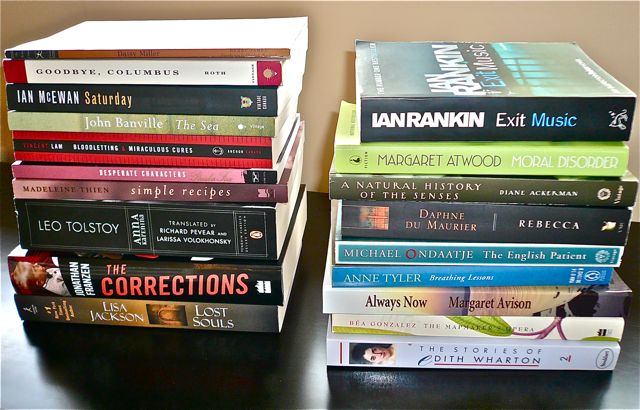
Then Again by Diane Keaton, The Sense of An Ending by Julian Barnes, Blue Nights by Joan Didion, Let The Great World Spin by Colum McCann, The Paris Wife by Paula McLain, A Moveable Feast by Ernest Hemingway, The Letters of Vincent Van Gogh, True Grit by Charles Portis, Howards End by E. M. Forster, The Cat’s Table by Michael Ondaatje, The English Patient by Michael Ondaatje, Diary of a Country Priest by Georges Bernanos.

**

What about you? What are your year’s best in books and movies?

Upcoming Books Into Movies — List 3

For an update of this post, CLICK HERE to Great Film Expectations.

What makes a book movie material? I’m not thinking of the plot-driven page turners. I mean literary fiction, albeit the term is open to debate. Anyway, what baffles me is, how do filmmakers determine whether a book is good for a movie adaptation? Just let me give a few examples.

The English Patient. Michael Ondaatje’s Booker Prize winning novel that reads like poetry and leaves me swirling in nostalgic daze. When Anthony Minghella finished reading it in one sitting late one night, he knew right away that he must make the movie. Well, he did and won 9 Oscars for his film. But for another equally poetic work that I’ve enjoyed, Fugitive Pieces by Anne Michaels, its movie adaptation just didn’t work that well for me.

I can name many others. Muriel Barbery’s philosophical novel The Elegance of the Hedgehog stirred up deep resonance in me, but its movie adaptation Le Hérisson failed to produce such impact. Booker Prize winner Kazuo Ishiguro’s novel The Remains of the Day delves into the internal worlds of the two main characters, and is turned into film effectively, thanks to the fine performance of the actors, Anthony Hopkins and Emma Thompson.  Ishiguro’s more recent work, Never Let Me Go is both cerebral and emotionally charged, it too enjoys a good film transposition.

Or, how about short stories like Alice Munro‘s “The Bear Came Over The Mountain”, about an elderly couple dealing with the wife’s Alzheimer’s. When 28 year-old Sarah Polley finished reading the short story on the plane, she decided she would adapt it into film and who she would get to play the main character. The result is Polley’s directorial debut, the Oscar nominated film Away From Her, with Julie Christie getting a nom for Best Actress and Sarah Polley for Best Adapted Screenplay.

I’ve learned to appreciate books and movies as two distinct art forms. While I used to delve into the ‘loyalty’ issue, how close the film is to its source material, now I’m more accepting to new interpretations and diverse visual representations as long as the work holds up to its artistic values. But one thing still baffles me: How does a filmmaker decide whether a book is movie material?

The following are my recent findings on some literary works that are or will be adapted into films (ie, movie rights sold). On the top of the list, generating a lot of buzz these days is Jeffrey Eugenides’s The Marriage Plot. Now, it’s on my TBR list, as I’m still no. 213  in the hold lineup at my local library. But for those of you who have read the book, what do you say? Do you think the book makes good movie material? And the most intriguing for me, as always, how do you transpose philosophical ruminations into a visual medium? How do you dramatize intellectual angst?

Here’s Ripple Effects generated Upcoming Books Into Movies — List 3.  If you’ve missed List 1 and List 2, just click on the links. Some of the works mentioned on those previous lists have already been shown on screen. Arti will continue to furnish you with updated info on future books into films.  And all ye book group members, here are your 2012 suggestions:

Upcoming Books Into Movies — List 3

The Marriage Plot by Jeffrey Eugenides (2015, Scott Rudin producer, who will also bring you Jonathan Franzen’s The Corrections in 2013. Impressive record as a producer of modern literary works into films: Revolutionary RoadDoubtNo Country for Old MenTrue Grit… and soon Extremely Loud and Incredibly Close)

The Emperor’s Children by Claire Messud (Keira Knightly, Richard Gere, Eric Bana, Emma Thompson, Rachel McAdams will be directed by Scott Cooper, who did Crazy Heart, 2009)

The Paris Wife by Paula McLain (From producer Ileen Maisel who’s bringing you a new Romeo & Juliet in 2012. I’m curious to see how they approach this adaptation, a sequel to Midnight In Paris?)

A Visit from the Goon Squad by Jennifer Egan (TV movie. The Pulitzer Prize winning novelist cited the HBO series The Sopranos as her inspiration.)

The Weekend by Bernhard Schlink (2013, Schlink has a previous work The Reader adapted into film.)

Before I Go To Sleep by S. J. Watson (Ridley Scott has got the film rights, and it’s going to be “a blend of the popular and the literary.” What’s popular may well be the subject matter these days, memory and the loss of it.)

Les Misérables by Victor Hugo (2012, A Musical in “good old-fashioned 2D”, directed by Tom Hooper of The King’s Speech. Anne Hathaway, Huge Jackman, Russell Crowe, Helena Bonham Carter, Geoffrey Rush. Sorry, no Colin Firth singing here.)

Runaway by Alice Munro (short story, screenplay by Jane Campion. Like I said earlier in this post, a short story can be turned into a deep feature film. I await this one from Campion, who won a screenwriting Oscar as well as the Palme d’Or for her 1994 film The Piano. Her more recent Bright Star on the poet John Keats reaffirms her literary style in the visual medium.)

***

Other related posts on Ripple Effects:

Can a movie adaptation ever be as good as the book?

Upcoming Books Into Films (List 1)

More Upcoming Books Into Movies (List 2)

Movies Reviewed

Photo Source: Films, Wikimedia Commons, Books, Arti’s file.

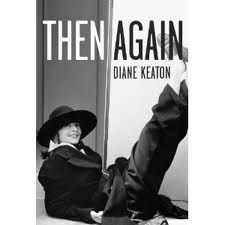
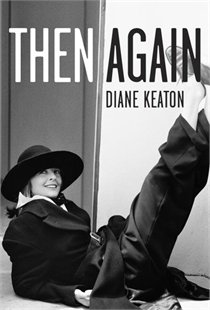
Then Again by Diane Keaton

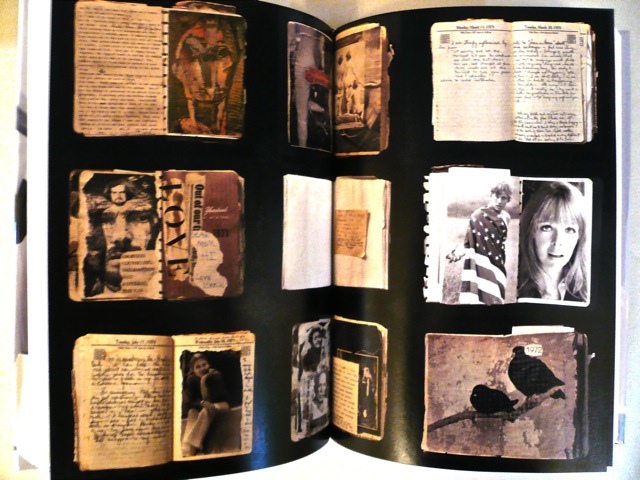
It’s interesting to read Diane Keaton’s memoir after Julian Barnes’ The Sense of an Ending. In contrast to Tony’s hazy past in Barnes’s novel, here we have memories strung together with clarity and adequate documentation. Take a look at these insert photos. I admit, they were the very reasons the second I opened the library copy that I decided I must get my own to keep.

Dorothy Keaton’s Journals

These are journals belonging to Diane’s mother Dorothy Keaton.  She first started with a series of letters she wrote from her California home to her eldest daughter Diane, who had moved to NYC at age 19. Letter writing developed into full volumes of family journals and scrapbooks. Further, she had kept detailed documentation of Diane’s career from 1969 to 1984. With the onset of Alzheimer’s, Dorothy still kept close contact with her daughter through letters and phone calls, leaving phone messages which showed the signs of a mind quickly sliding down the slope.

Stacks of memories

Diane has poignantly interwoven her own thoughts and memories with her mother Dorothy’s, a daughter’s attempt to capture life that was THEN in order to relive the moments AGAIN. Diane’s father Jack Hall died of cancer in 1990, only a few months after the diagnosis. Dorothy died of Alzheimer’s in 2008. This memoir is a joint endeavor of a daughter with her mother who has passed on, yet whose presence is strongly felt:

Now I’m alone, juggling with a memoir that’s also your memoir.

Family Scrapbook

Diane Hall grew up in California and had enjoyed a vibrant suburban family life before she moved to NYC to study at The Neighborhood Playhouse. She kept close contact with her family through letters. I admire her courage to reveal these correspondences, for through them, we see the private side of Diane Keaton, a persona with all the insecurities and non-glamorous aspects of a real life human being. After the Neighborhood Playhouse, she decided to change her name from Hall to Keaton. She got her first break in the musical Hair. This is her letter home:

Hi, Everyone,

Well, I’m in a hit, we opened the 29th… A real job, and on Broadway. Big stars have come to see it, like Warren Beatty (remember my crush on him from Splendore in the Grass) and Julie Christie, who is the most beautiful woman I’ve ever seen, and Liza Minnelli… Apparently Hair is the in thing to see. People stand in lines every day to get tickets.

Things are pretty much the same. I’m certainly the same. Will I ever change? I’m still the dumbest person alive. One apparently does not grow out of stupidity. Oh, also I’m on a diet…

And on that note, Diane goes on to reveal her past battle with bulimia in the next chapter, a piece of private history that has been kept secret until now.

From Hair, to Play It Again, Sam, and later from stage to screen. Thanks to Woody Allen, we have many fabulous movies but the most memorable probably is Annie Hall (1977), which brought Diane Keaton the Best Actress Oscar, and Woody Allen the Best Director and Best Writing Oscars. It also won Best Picture. Here’s Diane’s memory of the production:

Woody’s direction was the same. Loosen up the dialogue. Forget the marks. Move around like a real person. Don’t make too much of the words, and wear what you want to wear. Wear what you want to wear?  That was a first. So I did what Woody said: I wore what I wanted to wear…

And her choice of ‘costume’ became a classic:

And yes, there was a real life Grammy Hall. She was Jack Hall’s mother Mary Hall. She could have given Woody the idea of the movie character, for she was just as nasty. Regarding Diane winning the Oscar, this is Grammy Hall’s response when interviewed in the local paper:

People say I’m in the clouds, I ain’t in no clouds. I’ll tell you one thing about the Academy Awards. It’s something big for a small family. That Woody Allen must be awfully broadminded to think of all that crap he thinks of

As for Woody Allen, he didn’t even attend the Awards ceremony nor did he talk about it afterwards.

Diane is also candid about her ‘romantic failures’, beginning with Woody Allen, then Warren Beatty whom she co-starred in Reds, and Al Pacino as they worked together on Godfather II & III.

At age 50, Diane stepped out to make a most courageous move: she adopted a newborn baby girl, Dexter, and  five years later a baby boy, Duke. Her role as a single mother bringing up a daughter and a son is probably the most gratifying.

In between some serious skirmishes–like when he refuses to have his diaper changed, or when he starts crying because he’s been put down or Dexter has stolen his waffle, or when he bangs his head on the sidewalk… –in between these scuffles, there are moments that feel like an eternity of bliss.

The final pages of the memoir are the most moving for me. Diane Keaton as daughter who ultimately had to say farewell to both parents, writing at 63 and as mother to a 14 and 9 year-old, she could hear as if Dorothy is telling her: “Dear Diane, my firstborn, take a deep breath, be brave, and let go…”

Here’s her reply:

I’m trying, Mom, but it goes against every instinct I possess. I promise you one thing though. I promise to unleash Duke and Dexter from the stranglehold of my need before it’s too late. I promise to give them their freedom no matter how much I want them to hang on. I promise to let go of you too, the you I created for the benefit of me…

Through her memoir, moments Then are relived Again. It is also a catch and release, the challenging process of gathering and letting go.

~ ~ ~ ~ Ripples

***