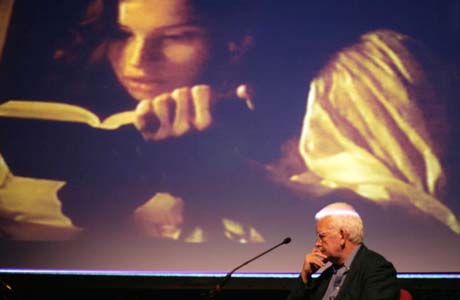
The Soloist (2009): The Issue of Authenticity

The True Story

Nathaniel Anthony Ayers was born 1951 in Cleveland, Ohio.  He started his music education in the public schools.  He would be lucky to get a violin, be it one or two strings.  Music was his love and he showed his talent at a young age.  Ayers later went to Ohio University and Ohio State University. He had also played many times at the Aspen Music Festival.  His musical achievement culminated in a scholarship that sent him to Juilliard in New York City in 1970 when he was 19.

Ayers started with the double bass, later changed to the cello.  He was one of the few African-American students at the prestigious music school at that time.  Unfortunately, he only stayed there for two years.  Stricken with paranoid schizophrenia, Ayers had to drop out and return home to Cleveland.  With his talent and the training he was getting, if he had stayed on, he would have no problem getting a spot in any major orchestra in the country.  But his mother could find no solution for his worsening condition.  He was in and out of hospitals, receiving shock treatment as a last resort.

Ayers later drifted off to California and ended up living on the streets of L.A.  When L.A. Times reporter Steve Lopez found him, it was at Pershing Square, where a statue of Beethoven found a permanent home.  Passing by, Lopez heard classical music, and later discovered that it was played on a 2-string violin by a homeless man whose possessions were all that a shopping cart could hold.  That was the beginning of their friendship and the re-discovery of Nathaniel Anthony Ayers.

Lopez not only got his story, he had introduced back into society from the fringe of homelessness, the talented Mr. Ayers.  Based on this story, he went on to write the book The Soloist.  The members of the L.A. Philharmonic also offer help, letting Ayers in to listen to their rehearsals at the Disney Concert Hall, giving him lessons and playing with him the music he has loved.  As Lopez describes, music is Ayers’ medicine, these musician friends his doctors, the Disney Concert Hall his hospital.

Ayers’ real life story has been succinctly captured in a short 12 minutes documentary on CBS 60 Minutes.  From the short clip, Ayers’ gentleness, grace, articulation and musical talent readily shine through.  These few minutes’ glimpses into the person and talent of Nathaniel Anthony Ayers just show us that any story on him would be most authentically done by Mr. Ayers himself, and any feature film deservedly be a documentary.

The Movie

The authentic transposing of Ayers’ unique personality, his musical talent and techniques onto screen proves to be a challenge.  With all due respect to the excellent actors Jamie Foxx as Ayers, and Robert Downey Jr. as Lopez, the real life story just doesn’t transpose that effectively.  Ironically, the problem might well be that they are actors.  I was watching a life acted out.  Director Joe Wright has imbued the characters and scenes with colors and dramatic effects that at times, masking the poignancy with contrived overtones.

Depicting classical music talents on screen is difficult unless the actor is proficient in the same instrument.  I remember how I cringed seeing Meryl Streep ‘play’ the violin in Music of the Heart (1999).  I know Foxx is an achieved musician himself, trained in the piano but not a stringed instrument.  And I’ve heard how he had worked hard at placing his fingers on the cello to be in sync with the melody for his part in The Soloist.  Naturally, such preparation is insufficient to portray a string player of Ayers’ calibre.  The musical authenticity comes when the L.A. Philharmonic performs, but it only brings a sense of incongruence by comparison.

Director Joe Wright’s works include the passionate Atonement (2007) and the adaptation of Austen’s Pride and Prejudice (2005).  Ironically, in The Soloist, a movie where compassion and the healing power of music should be in the forefront, he falls short in depicting the heart and soul of Ayers’ story.  Wright has brought forth a hip flick, surprisingly dispassionate and two-dimensional.  The music of Beethoven could have been used more poignantly overall.  (I can’t help but think of Wright’s other work Atonement, where the rhythm and sound of just a typewriter can be so riveting.)   Also, maybe it’s a sign of our time, but I was disappointed that in a crucial scene, Beethoven’s affective power is being reduced to simply digital, visual effects.

With all its best intentions, the movie tries to touch on too many issues: homelessness, mental illness, the cure for mental illness, religious street ministry, journalism, career and marriage, … just to name a few.  I once heard a nurse say after feeling someone’s pulse: “Irregular heartbeat, all over the place.”  Now why do I have that memory while watching this movie?

I’ve been trying to pinpoint what is lacking.  One of the better film versions of classical musicians plagued with mental illness is Hilary and Jackie (1998).  Director Anand Tucker sensitively crafted an engrossing story.  Emily Watson gave a superb performance in not only depicting the inner struggles but the outward musicality of the renowned cellist Jacqueline du Pré.  Now, come to think of it, maybe what The Soloist lacks is such sensitive, articulate and refined artistry, in which light Mr. Ayers truly deserves to be portrayed.

~ ~ ½ Ripples


The Appeal and Fallout of the Susan Boyle Phenomenon

Update:  CLICK HERE to read my post on Susan Boyle’s debut Album ‘I Dreamed A Dream’.

By now, tens of millions have converged on YouTube to watch the sensational phenomenon of Susan Boyle, the middle-age woman from Scotland on Britain’s Got Talent.  Arti has waited for the dust to settle a bit before commenting, allowing her hindsight to catch up.

So, what’s the appeal of Susan Boyle?  The planned and scripted intention of the producer and judges aside, what is so attractive about the 47 year-old woman?  Is it the plain, country look, the greying frizzy hair, the unkempt and overweight physique?  In this image-driven, urbane society of ours, these features definitely aren’t valuable assets.  Or, as so many have claimed, it’s her voice that has enthralled us all.  Yes,  the lady certainly has potential and talent in this regard.   But truth be told, could Susan Boyle have garnered so much praise if she had looked differently?

The universal appeal of Susan Boyle is the mismatch of her look with her voice, a perceived dissonance based on a prejudiced, preconceived notion marking viewers’ expectations.   What talent could a middle-age, plain-looking, hamlet-dwelling woman have?  The public has a real fun case of being fooled.  Ha, the joke is on us.  We’ve been wrong all along.  Unattractive bodies can be talented personalities.  And the audience had enjoyed the twist and surprise.  Susan Boyle’s  TV appearance provides real entertainment value, albeit manipulative according to skeptics of reality shows.  Simon Cowell should be most gratified.   It’s all about the ratings, and future record sales.

susan-boyles-new-lookBut wait, don’t speak too soon.  Now the 47 year-old has a few hairs on her eyebrows plucked, her unruly lock trimmed and dyed a younger look, donned some neater attire.  Lo and behold, the mismatch has diminished.  As the excitement wanes, criticisms arise.  “She shouldn’t change too much,” the public decries.  “That’s the limit that she should go, no further,” the critics advise.  Wouldn’t it be terrible if Susan Boyles decides to join Weight Watchers.  Of course she shouldn’t, it’ll be much less entertaining.

What have we become now?  Spectators of a freak show in a circus?  What about those lyrics that have enthralled us initially?  Can a woman not be allowed to have her own way, make her own decision to change or not, choose her own lifestyle, and interpret her own dream?  Is she selling her soul just by having a facial?  I’m afraid Susan Boyle is no match for our sensationalism and thrill-seeking crowd of  reality TV viewers, or the humongous entertainment business looking to generate more profits in whatever way possible.

I worry too that the overnight rise to stardom is making Susan Boyle equally vulnerable to become an instant victim of the fallout.  A trampled rose or discarded weed, they meet the same destiny.  Of course, I wish her well and that the pursuit of her dream will not become a nightmare in the callous arena of public opinion.

The curious case of Susan Boyle also reminds me of another woman with talent living in obscurity two hundred years ago.  She was a bit younger,  living in rural England, striving to be herself in the pursuit of her dream to become a writer.  Sadly, she did not live to middle-age, nor see her name credited to her work.  To avoid fallouts and social reverberations, she had to seek anonymity.  Now we know her as Jane Austen.

The lyrics of that tune still sound poignant:  “After changes upon changes, we’re more or less the same;  after changes, we’re more or less the same…”

Photo Credit:  Andrew Milligan/PA,  Source: Times Online http://entertainment.timesonline.co.uk/tol/arts_and_entertainment/tv_and_radio/article6161198.ece

***

Original writing by Arti of Ripple Effects.  ALL RIGHTS RESERVED.  If you are reading this on a website other than Ripple Effects, you are reading a post that has been copied without permission.  Go to https://rippleeffects.wordpress.com to read this and other original and interesting articles on entertainment, books and movies.

The Proximidade: Celebrating Closeness

Arti of Ripple Effects is honored to receive The Proximidade Blogging Award from ds of  third-storey window.  A wonderful view she has over there.  Thanks again ds!

“The Proximidade Award believes in the Proximity – nearness in space, time and relationships. These blogs are exceedingly charming. These kind bloggers aim to find and be friends. They are not interested in prizes or self-aggrandizement! Our hope is that when the ribbons of these prizes are cut, even more friendships are propagated. Please give more attention to these writers! Deliver this award to eight bloggers who must choose eight more and include this clever-written text into the body of their award.”

proximade_award1

This is a while back now.  Although ds is very generous as to spare us the obligation to pass it on, I feel I should share this award by naming  some worthy recipients whose blog has closed the gap among us, in one way or another, narrowing our physical distances through common interests and other higher ideals.

It’s my pleasure to pass the Proximidade Award to the following Blogs, in alphabetical order:

Book Club Girl — for closing the gap between authors and readers by her own radio show ‘Authors on Air’.

Classy Music — for drawing us closer with news and views of classy musicians and their performance.  Take note, ye fans of Susan Boyle and Paul Potts.

FilmChat — Movie reviewer Peter Chattaway (no kidding) engages us with insightful and interesting dialogues between faith and film.

Jane Austen Today —  Great job Laurel Ann and Vic,  in connecting Janeites the world over by their excessively diverting blog.   (LA and V:  I’m still working at finding ‘classics’ blogs for the ED Award.)

Visual Dialogues — Blogging from Hong Kong, Molly Mavis closes the gap between East and West with her perceptive photography.

I trust you’ll find the above blogs informative and entertaining, well deserving the Proximidade Award.

The Merchant Ivory Dialogues

Re-watching The White Countess (2005) has prompted me to savor other Merchant Ivory films .  I love their sumptuous period set design, stunning cinematography and exceptional acting.  Some of them have garnered Oscar accolades, and since become classics, creating a genre of their own.

Long before Bollywood and Slumdog Millionaire, there was Ismail Merchant, born in Mumbai (formerly Bombay), India, in 1936.  He later went to New York to further his education, and started making movies in 1960.  On his way to the Cannes Film Festival in 1961 representing the U.S. with his nominated short, he met American director James Ivory.  The two formed a production company that same year, and the rest is history.

Before producer Ismail Merchant passed away in 2005, the Merchant Ivory Productions had created timeless masterpieces, most notably, adaptations from the work of E. M. Forster, Henry James, and Kazuo Ishiguro.  Together with German/Polish screenwriter Ruth Prawer Jhabvala, they have turned literary satires and portrayal of class-conscious Edwardian and Victorian English society into accessible popular movies, interpreting the humor and wit with a mark of their own.  Ironically, none of the three are English.  Maybe it does take an outsider to see clearly.   A short list of their impressive productions includes  A Room With A View (1985),  Howards End (1992),  The Remains of the Day (1993),  and The Golden Bowl (2000).

james-ruth-and-ismail


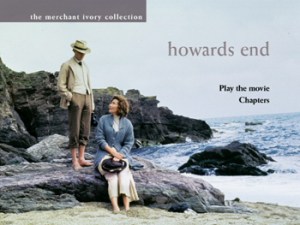
But here in this post, I must present to you The Merchant Ivory Dialogues.  Oh that’s not how it’s titled.  But Arti just named it so.  In the 2005 Criterion Merchant Ivory Collection DVD of Howards End (1992, 9 Oscar nominations, 3 wins) I found in the Special Features this amusing interview with producer Ismail Merchant and director James Ivory.  The conversation between the two are so whimsical that they could almost form a comedic duo.


howards-end


Here are some excerpts:

On the idea of creating Howards End the movie:

 M: Howards End started with Ruth (screenwriter) telling me and I think gave Jim the novel to read.                                     


I: Well hold on. I’d read it.

M:    Oh, You’ve read it.  I see.

I: I’d read it in fact twice.   Ruth always sort of not exactly dangled the book in front of us after A Room with a View and Maurice.  But she saw it  as a really ambitious, and to her would be most, most rewarding project for us and for her.

M: Anyway, it was slow going for me.


***


On Jim Ivory’s favorite scene

I: For me … from the first time, if I remember anything about it, except this scene where Margaret jumps out of the car when they run over a cat.  Charles Wilcox doesn’t want to go back and a little girl runs into the road and starts crying and Margaret leaps out of the car…

M: We had to go to this incredible preparation, real cat and the artificial cat and the dead cat…

 I: There’s no real cat.

M: And so I said no I don’t want to do it, you know.  But he insisted because it was his favorite scene, and it is not in the film.  So you should listen to the producer first.

 I: That’s all I can really remember about the book the first time I read it was that scene,  which I thought is incredibly dramatic…

M: That’s your favorite scene which is not in the film.

I: Which we shot and cut out of the film. Anyway…


***


On Forster the Social Critic:

M: Howards End is about the class system, and what Forster said about the inheritance of England. This beautiful house, a metaphor for England,  will be inherited by the lower class. That is what happens here. This beautiful house is inherited by the clerk’s illegitimate son. Well anyway, this is an interpretation of mine.

I: I don’t think Forster had all that great love for the working classes …

M: Not love for the working class but…

I (voice covering M): He had an ideal, which was, people should be able to mingle from whatever their background, whatever their class, they all ought to be able to in a civilized and happy world. And in the good England everyone ought to be able to mix together if only the different kinds and types of people could make a connection. Then it would be for the betterment of all.


***


On American Funding (or the lack of)

M: Howards End was an ambitious film at that time, eight million dollars, the budget. We could not get eight million dollars from anybody, you know, it’s just not possible because Americans never saw the possibility of this film being successful as they never see anything of consequence or civilized film to be successful. They have blinkers on their eyes, they never see anything beyond, you know, the form …

I (moving about in his seat, almost rolling his eyes): All Americans?

M: All Americans

I (raises his eyebrows just enough to show his disagreement):   All Americans.

M: All American film companies… with the exception… there are some sensible people like Sony Classics, they were at that time with Orion pictures….they were very excited but they only gave us a very small sum of money…of course, their enthusiasm and support were greatly appreciated but we had to raise 85% of the money outside…


***

emma-thompson-vanessa-redgrave


On Getting Vanessa Redgrave on Board

I: And then there was the casting of Vanessa Redgrave, who all along, from the very beginning I had wanted in that part. I thought she was the actress to play the first Mrs. Wilcox. And we kept sending her scripts, and this is the way it’s always is with Vanessa… You’re not sure she’s got the script, you’re not quite sure she’s read it, whether she likes it, whether she’ll do it…

M: I’ll tell you the story. Jim’s heart was set on Vanessa, and so was mine. So we sent this script and then we went to tea at Waldorf  Hotel. And so we were sitting there and she said she had four, five months all planned… and the money you offer is not enough. So I said what would you like.  She said if you could double that amount, I would do it. So I said ok, that’s it, you said it, now it’s double your salary. She couldn’t believe it was instantly, spontaneously done, because knowing that we had a small budget and we had to struggle for every penny. This was like giving whatever you want.

I: A very bad precedent.

M: Sorry?

I: A very bad precedent.

M: No it’s not a bad precedent at all. And for her I would do anything, you know. If she said get me the moon, I would get the moon for her. And it’s not possible for people to get the moon, but I would do it.

***


Ah… the creative process, the self and the collaboration, the art and the business, the part and the whole… just fascinating.

~~~~~


Photos:  James Ivory, Ruth Prawer Jhabvala, and Ismail Merchant received BAFTA Fellowship Award (2002)  news.bbc.co.uk;  Emma Thompson and Vanessa Redgrave in Howards End, toutlecine.com


The Savages (2007, DVD)

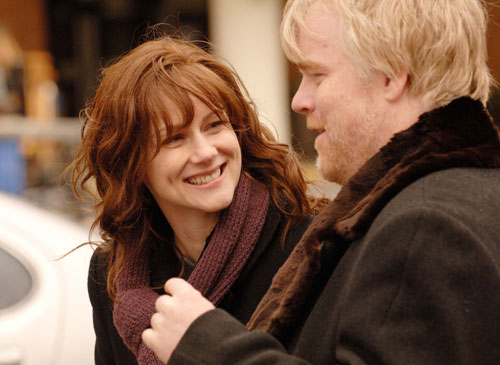
the-savages-linney-hoffman

After my last post I had to take some time to withdraw. That’s when solitude can work as a soothing balm, allowing the personal space for reflection. Whether sudden or expected, young or old, death affects us all. And some strike a deeper chord.

A couple of days ago I got hold of The Savages on DVD. I thought I was late in watching this highly acclaimed indie film, and writing a review two years after its release. But watching it, I was surprised by the coincidence; for alas, it’s about death and aging. It’s ever timely now. I wouldn’t have appreciated it as much if I’d seen it then. For now, I’ve the first-hand experience of caring for two aging parents, and with my mother being in the early stage of Alzheimer. Two years ago I would not have imagined this scenario. But as those who have cared for the old can attest, two months can make a lot of difference.

As baby boomers begin to pass the turnstile into midlife, they now have to face the hard fact about their parents, and preparing for the ultimate to befall. Herein lies the story of The Savages.

Wendy Savage (Laura Linney, Best Actress Emmy for John Adams, 2008; Love Actually, 2003) and her brother Jon (Philip Seymour Hoffman, Oscar Best Actor for Capote, 2005) live miles apart. Their childhood home had been dysfunctional. Their mother left them when they were still young, their father was neglectful and abusive.  Now as adults, they both have trouble committing to intimate relationships. Jon teaches theater at the University of Buffalo, while Wendy is a struggling playwright, working as a temp to make ends meet in NYC. Living apart from each other and their father, both strive to carve out some sort of meaningful existence with their life. Now they are brought back together by the tie of responsibility, reluctantly, in the caring for their ailing father (Philip Bosco). An old man who is afflicted with Parkinson’s related dementia, Lenny Savage is still fiery and intimidating.

Among the acclaims the film has garnered (AFI movie of the year, Golden Globes, Independent Spirit Awards…) are two Oscar nominations, one for Laura Linney for Best Actress, the other for Tamara Jenkins’s  Original Screenplay.  Both deserve the recognition hands down.  Unlike Sarah Polley’s impressive film Away From Her (2006) with Julie Christie as an Alzheimer stricken wife, The Savages looks at dementia and death from the point of view of the son and daughter, and delicately explores their conflicting emotions of having to care for an estranged father. The rebuilding of sibling relationship has also proven to be difficult, yet through the process, both find the experience to be worthwhile.

The Savages is classified as a comedy. The script is smart and funny. But it is dark and deadpan humor that marks its appeal. The reality of human failings is handled with care and sensitivity. Linney, Hoffman, and Bosco form a dynamic trio in portraying the tension of love hate emotions among family members.  Despite the past failings of their father and their present perplexities of how best to care for him, the siblings know where their duty lies. Screenwriter and director Tamara Jenkins has effectively explored the issues without sentimentality and imbued humor at the appropriate moments. As with all of life’s predicaments, a little dash of humor can offer the most direct perspective into our shared humanity.

The special features offer insights into the making of the film and into the mind of the screenwriter and director Tamara Jenkins. Of all the subject matters, she chose the caring of our aging parents. I’ve appreciated her intent: “The idea was to make you realize that you’re not alone, that you’re part of the human race, that we’re all going through this together.” She’s done a great job in doing just that.

~ ~ ~ Ripples

(photo source:  mtv.com)


Natasha Richardson: Nell and The White Countess

natasha-richardson1

I’m shocked and saddened to learn of Natasha Richardson’s sudden passing.  I followed the news all day yesterday.  She had a minor fall on a beginners ski slope at the Quebec resort Mont Tremblant not far from Montreal while vacationing with her sons Michael and Daniel.  It turned out that she had sustained a serious head injury which was not noticeable at first.  But an hour later she started to have headaches and rapidly deteriorated.  She was rushed to Montreal’s Sacré-Coeur hospital and later transported to NYC Lenox Hill Hospital.  Her husband Liam Neeson (Taken, 2008, Schindler’s List, 1993) flew to Montreal to be with her from his Toronto set of Atom Egoyan’s Chloe, and had not left her side.

Natasha Richardson was a shining actor on the London stage and on Broadway, winning a Tony Award in 1998 for her lead role as Sally Bowles in the revival of the musical ‘Cabaret’, directed by Sam Mendes (Revolutionary Road, 2008 ).  Acting was in her genes as she was privileged to be born into a family of astounding theatre talents, her grandfather being Sir Michael Redgrave, one of England’s finest tragedians according to The New York Times, her mother Vanessa Redgrave (Oscar Best Actress, Julia, 1977; Howards End, 1992Atonement, 2007), her father the director/producer Tony Richardson, her sister Joely Richardson (Nip/Tuck).  Natasha Richardson died March 18, 2009.  She was only 45.

The highly acclaimed actress had left an impressive body of work from Shakespeare to the silver screen.  Her long filmography spans from comedies like The Parent Trap (1998) to the futuristic fable by Margaret Atwood The Handmaid’s Tale (1990).  One of her earlier film is A Month in the Country (1987) with Colin Firth and Kenneth Branagh.  But these two are most memorable to me:  Nell (1994) and The White Countess (2005).

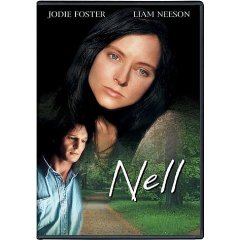
NELL (1994)

nell1Natasha Richardson met Liam Neeson on the set, and married him that year.   Jodie Foster is Nell, who grows up in the wild forest of N. Carolina, far away from human civilization.  She knows no language, well, none that other human can understand.  The only two people she has seen are her mother and her twin sister, whom she communicates with a language of their own.  After they die, Nell is left alone to deal with her loss and survival, until one day, she is discovered by Dr. Jerome Lovell (Liam Neeson) and Dr. Paula Olson (Natasha Richardson).  From an initial academic interest, Lovell has grown to appreciate Nell as a person, and wants to bring her back to human society.  While both doctors have good intentions, others do not.  Herein lie the conflicts in the plot, the wild child versus the modern world, the experimental object versus the human being.  All three main characters put forth an impressive performance.  If you can still get hold of the DVD, now may be the poignant time to reminisce.
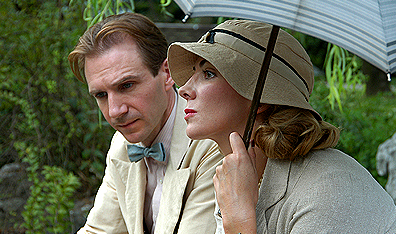
THE WHITE COUNTESS (2005)

the-white-countessA lesser known film by Natasha Richardson, The White Countess (2005)  is a Merchant Ivory production (Merchant’s last film), its screenplay by the talented writer Kazuo Ishiguro (The Remains of the Day).  The story takes place in the exotic setting of Shanghai, China, shortly before WWII.  Slightly resembling Casablanca (1942), the movie excels in its mood and atmosphere.  Ralph Fiennes is Todd Jackson, a blind, former American diplomat who meets a Russian refugee Sofia (Natasha Richardson) in a night club.  Sofia belongs to a family of nobility, a White Russian countess herself, but now has to work in the lowliest line to support her family.  The Japanese invasion sets the stage for suspense, and the plot thickens.  Vanessa Redgrave plays Sofia’s aunt, and has delivered some moving moments performing with her daughter.  Natasha’s aunt Lynn Redgrave is also in the movie.  Now those scenes are ever more memorable.  The behind-the-scenes interviews with the three of them, together with Ralph Fiennes, commentary with Natasha Richardson and director James Ivory in the Special Features are just priceless now.  I purchased the DVD a while back, and have seen it several times.  I know I’ll treasure it even more now.

*****

Photo Sources:

Natasha Richardson: mirror.co.uk, Nell: Amazon.com, The White Countess:  cbc.ca

The Reader: Book Into Film

the-reader1

The Reader is the highly acclaimed novel by German writer Bernhard Schlink.  It was first published in 1995 in Europe and the English translation came out two years later.  Anthony Minghella (Cold Mountain, 2003) was said to be the original director of the film adaptation, with his friend Sydney Pollack (Sketches of Frank Gehry, 2005) producing.   Their untimely death sadly altered the scene somewhat, even though they were still named as producers when the Awards Season arrived.  Thus the poignant acknowledgement from Kate Winslet as she received her Oscar Best Actress Award.

Selected as a New York Times Notable Book and a Los Angeles Times Book of the Year, the novel’s 218 pages are packed densely with poignant images and thought-provoking moral questions.  The first part takes place in the 1950’s. 15 year-old Michael Berg gets sick on his way home from school and is helped by a woman, Hanna Schmitz.  Thus sparks the sexual encounter and later love affair between the two.  Every time they meet, Hanna makes sure Michael reads to her literature from Homer to Chekhov.

After a while, Hanna disappears, and not until Michael becomes a law student does he see her again, this time in a post-war trial of Nazi criminals.  Hanna turns out to be a guard at a concentration camp during the Holocaust.  As Michael is awash by torrents of conflicting emotions while watching the trial, he is aghast at a personal secret Hanna refuses to reveal, one which could have saved her from a lengthy prison term.  Her only statement of defence is wrapped in one sentence:  “What would you have done?”  She asked the judge.

The last part of the book is in the present day.  Michael, now a lawyer, is still haunted by his past and the residual emotional ambivalence upon the release of Hanna from prison.  The story wraps up with a heart-wrenching ending.

Hidden behind the romantic facade is a story that deals with a deeply complex set of moral issues; the love affair between a 30 some year-old woman and a 15 year-old boy is only the initial spark.  This is not a Holocaust novel, but rather, an incisive depiction of psychological dilemma confronting a new, post-war generation in Germany.  The moral burden that Michael faces is heavy, seemingly unresolvable and yet born by the collective psyche:

“I wanted simultaneously to understand Hanna’s crime and to condemn it… When I tried to understand it, I had the feeling I was failing to condemn it as it must be condemned.  When I condemned it as it must be condemned, there was no room for understanding… it was impossible to do both.”

I read the book  a while back but have delayed seeing the movie, directed by Stephen Daldry and screenplay by David Hare (both of The Hours, 2002).  First off, I could imagine the film, having the advantage of transporting the literary into visual realism, can go all out gratuitously to depict the love affair between Michael and Hanna.  Further, the very complex moral issues the book deals with would be a challenge to transfer into film, making it less effective and maybe even trivializing the crux of the matter.

Well, I was both right and wrong.  The first part of the movie depicting the seduction of Michael (18 year-old David Kross) by Hanna (Kate Winslet) and which gradually grows into a full-fledged love affair does carry some gratuitous erotic sequences.  However, having watched the movie I have also come to appreciate the necessity of this relationship.  The love affair between Michael and Hanna is the very analogy of a younger generation having had to deal with the conflicting emotions of loving their own parents, many of whom were involved in the atrocities of the Nazi regime.

Both Winslet and Kross have delivered a most affective cinematic rendering of an otherwise despicable affair.  Winslet has brought out an exceptional performance, from a simple and passionate young woman to a grey-haired, seemingly amoral and yet deeply tormented prisoner.   The irony of the movie is that, by crafting a visually appealing cinematic offering, it has won over its viewers’ heart (especially Winslet fans), resulting in a much more sympathetic rendition of someone who has a hand in the death of hundreds of Jews under her guard.

Likewise, the portrayal of the older Michael (Ralph Fiennes) is less effective than it deserves.  Maybe due to his limited scenes, it appears that Fiennes lacks the time to dwell himself fully in the character to elicit the spectrum of conflicting emotions.  It may also be the weaker script, compared to the book, that has shrouded some critical issues with ambiguity.

But I did appreciate the scene where a distressed Michael consults with his professor (Bruno Ganz), who  distinguishes between law and morality.   The law has nothing to do with right or wrong, he tells Michael.  What’s legal doesn’t make it right.  Implication follows that duty and legality do not excuse wrongdoings.  While the  law regulates the behavior, it is morality that constrains the heart.

While the movie is appealing visually and offers some riveting performance, I urge viewers to be the reader.  That’s what I did, re-read the book as soon as I got home, and appreciated the written words even more.

Book and Movie

~ ~ ~ Ripples

The Reader by Bernhard Schlink, translated by Carol Brown Janeway, published by Vintage International, 2008,  218 pages.

Photo Source:  usatoday.com

****

Man On Wire (2008, DVD): Romancing the Towers

man-on-wire1When the idea of building the World Trade Center Twin Towers began to germinate in NYC, on the other side of the globe, a young man in France started to weave a dream.  He wanted to walk across the top of the Towers on a wire after they were built.  Six years later, with the Towers nearing completion, Philippe Petit fulfilled his dream a few days short of his 25th birthday.  On August 7, 1974, he stepped on a wire strung across the roof top of the then tallest buildings in the world.  Hailed as ‘The Artistic Crime of the Century’, Philippe Petit’s breathtaking, and illegal, high wire act is the ultimate test of the human spirit, pushing the limit of audacity and strength.
Based on Philippe Petit’s book To Reach The Clouds,  Man On Wire has won over 20 film awards only a few short months after its release, ultimately receiving the Oscar Best Documentary for 2008.  Director James Marsh chronicles the extraordinary endeavor of Philippe Petit by means of interviews, dramatic re-creation, and archival footage.  Before the WTC, Petit had walked across the two steeples of the Nortre Dame Cathedral in Paris, and the Sydney Harbour Bridge.  The WTC Towers meant the summit of his aspirations.  In a Sundance Film Festival interview, he described his act as ‘marrying the Towers’.

 Director James Marsh has chosen a very human angle to present his subject, such that we’re not just watching an extraordinary circus feat.  The documentary reveals a child growing up with unusual physical talents.  It vividly depicts the fearlessness of youth, the weaving of a fairy tale, the bond of friendship without which Philippe could not have achieved, and finally the euphoria of a dream fulfilled.  The smile on Philippe’s face while on the wire says it all.

The interviews in the film have also brought some very personal elements into this enthralling event.  We see Philippe’s childhood friend and accomplice Jean-Louis overcome with emotion, now more than 30 years later, as he recalls and is still moved by the immensity of the experience.

It’s a crime, no doubt, but it’s team work of the highest level of difficulty.  That they had to haul hundreds of pounds of wire and equipment up to the roof top, shoot the wire across, anchor it safe, all without detection was itself an incredible feat.  Once that was done, the rest was easy for Philippe, he just needed to walk on the wire suspended 1,350 feet above ground.

And that is when the artful part comes in.  Philippe had not just walked on tightrope, but performed with grace and serenity, movements conjuring up images of ballet on air.  For 45 minutes, he slow-danced across the Towers eight times, lay, knelt, and sat on the wire to the amazement of the awestruck crowd on the ground.  There was unspeakable beauty in his magnificent boldness.

Police had to threaten him with a helicopter to get him off.  He and his friends were immediately handcuffed, taken to jail, and Phillipe undergone a psychiatric examination.  He was later released and given a life-time pass to the Towers.  When asked why he did it, he answered:

“There’s no why… Life should be lived on the edge.”

Excellent special features that come with the DVD include Philippe Petit’s 1973 Sydney Harbour Bridge Crossing, exclusive interview with Philippe Petit, and an animated short film based on the children book by Mordicai Gerstein “The Man Who Walked Between the Towers”, narrated by Jake Gyllenhaal.  Further,  in this post 9/11 world, the DVD is even more significant in that it chronicles someone who had taken the arduous steps to appreciate and to relate to the Towers in a most memorable way.

And then there’s the music.  I admit it’s the music that has enthralled me from the start, yes, even with just the menu.  While Michael Nyman has written some fantastic original score for the documentary, it’s French composer Eric Satie’s pieces that so captivate me.   Satie’s Gymnopedie No. 1 is the music that augments the beauty of Philippe’s poetic walk on wire.

While most of us would rather watch life being lived on the edge from the comfort of our living room, we would be inspired nonetheless to venture out of our couch for a little more excitement, and motivated to take just a bit more risks with our life.  For us ordinary folks, maybe living life to the fullest is an aspiration challenging enough.

~ ~ ~ ½ Ripples

  “If no one ever took risks, Michaelangelo would have painted the Sistine floor.”      — Neil Simon 


Philippe Petit and James Marsh Interviews:

Click here for the  NPR’s Studio 360 Interview

Click here for the Sundance Film Festival Interview on YouTube


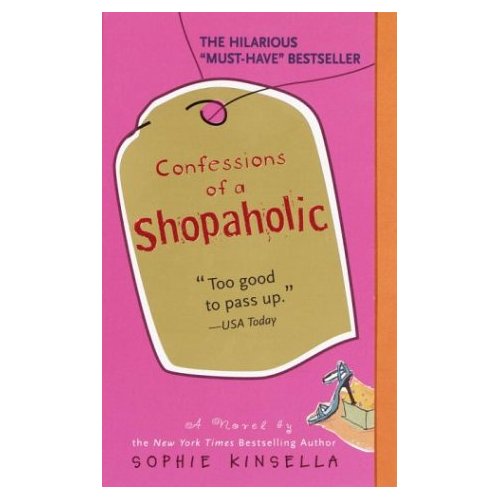
Confessions of a Shopaholic: Book and Movie

confessions-of-a-shopaholic-book-cover

‘Are you serious?’ my son exclaimed as he pried open my Amazon package.

‘It’s just a filler to make up the amount for free shipping,’  I said.  (Didn’t he know it was for his CD that I had to make this purchase in the first place?)

Ok, after reading Thomas Hardy, Jhumpa Lahiri, Philip Roth, not to mention the very hard-to-get-through Amy Bloom, all in a month’s time, I needed a break.  A break it is.

The book Confessions of a Shopaholic is like a commercial break:  it gives you a chance to relax in between tense moments, a filler, but unlike most commercials, it’s entertaining, very funny, and not as dismissible as it looks.  (To my copy-writer friend: Nothing personal,  it’s just the genre.)

I’d many LOL moments, and several times I caught myself reading with a smile on my face.  How many books have you read that can elicit that facial response? Not that I looked at the mirror while I read, but I just noticed.

I learned a long time ago that the best kind of humor is the self-deprecating kind.  Kinsella’s Shopaholic series just might have extended that axiom to include her own gender.  But why not, Jane Austen did that too, plus the other gender along the way.  And that reminds me, reading Shopaholic conjures up images of Bridget Jone’s Diary,  which in turn,  and remotely, suggests certain Austen-esque styling.

Rebecca Bloomwood is a twenty-five year old college grad lucky enough to have launched a job as a financial journalist at Successful Saving.  A whole new world opens up to her as she gets her VISA card and automatically given an overdraft limit at her bank.  Loaded with such financial ammunition, Becky plunges right into the swirl of brandname fashion and all other fancy stuff a gal just got to have.  After all, they’re all an investment to her, and shopping just seems to be the ideal workout. How can she keep fit just sitting at home?

“They should list shopping as a cardiovascular activity.  My heart never beats as fast as it does when I see a ‘reduced by 50%’ sign.”

In no time, Becky Bloomwood the financial journalist has sunk deep in debt.  The irony becomes more acute when she is invited to appear on TV as an adviser on personal finance management.

Kinsella has crafted a modern day satire on the female psyche vis-a-vis consumerism.  Ok, some female psyche… not all.  Her sharp observation of human nature, and spot-on nuances on both genders, together with the generous unleashing of self-deprecating humor, effectively mask the didactic end of  Shopaholic.  The book might have delivered the message for us all in today’s slumping economy.  It has unwittingly (or perhaps wittingly) depicted some of the causes of such a major breakdown in our financial system:  the allure of credits, the insatiable quest for posession, the deception of desire over need, and the tyranny of brandname consumerism.

The author has effectively created a comic caricature.   Rebecca is an addict in denial, but she’s amiable nonetheless.  We laugh at her flaws and errors because we can sympathize with her predicament, or maybe even identify with some of her weaknesses.  The book is almost script-ready, it has the funny dialogues, the colorful characters, the dramatic elements.  Although the story doesn’t get fired up until the last hundred pages, it’s an enjoyable read overall.

~ ~ ½ Ripples

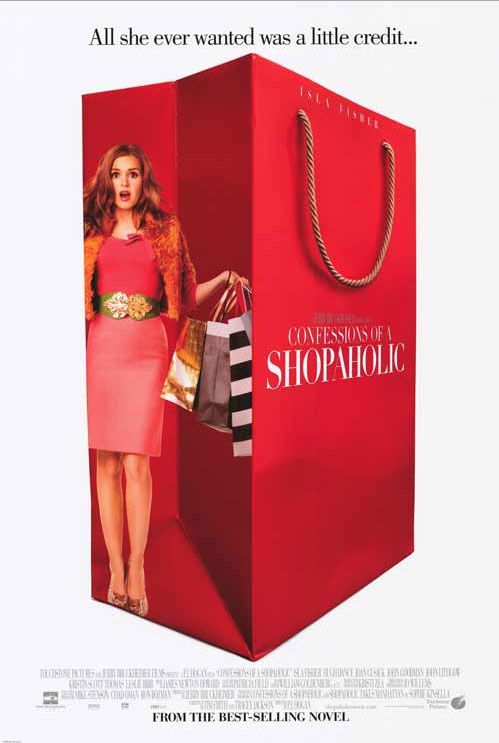
confessions_of_a_shopaholic_movie_poster

And for the movie, well, the movie is a different matter.

Australian director P.J. Hogan (My Best Friend’s Wedding, 1997) has wasted some highly workable comedic materials, and a talented supporting cast like Kristin Scott Thomas, Joan Cusack, John Lithgow, and John Goodman.  He has reduced a pleasing, humorous, and relatively intelligent book into a slapstick, patchy, and mindless farce.  LOL response in the theatre was almost nil, because the script is simply flat and not funny, despite the earnest attempt of the cast.  Isla Fisher (Definitely Maybe, 2008) has downgraded Becky Bloomwood into a stereotypical, silly female wrapped in pink;  Hugh Dancy (The Jane Austen Book Club, 2007), who plays her boss and later love interest, seems too constrained to be effective.  The movie simply epitomizes and confirms the bad rap ‘chick flicks’ are getting.

Throughout, I’ve the feeling that I’m watching the sequel of The Devil Wears Prada (2006) but without its depth of characterization, and Becky Bloomwood is the dumbed down version of Elle Woods in Legally Blonde (2001)… alas, a pitiful rendition of Pretty In Pink (1986).   What it lacks in brain it rescues itself with a little heart in the latter part.  But the fond feeling comes too little too late.

And I can’t help myself but to ask if the movie was directed by a female, would it be quite different.  But then I’d be stereotyping.

~ ½ Ripples

*****

The Oscar Results 2009

CLICK HERE for Oscar Results 2010

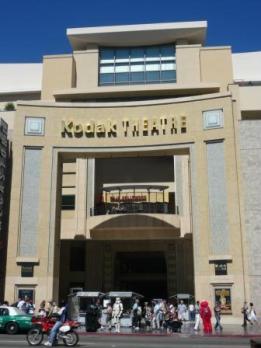
The film that defies all odds,  Slumdog Millionaire, was the big winner at the 81st Academy Awards at the Kodak Theatre in LA last night.  It won 8 Oscars:  Adapted Screenplay, Cinematography, Sound Mixing, Film Editing, Original Score, Original Song, Best director and Best Picture.

Its major rival, The Curious Case of Benjamin Button, which led the nominations with 13 nods, took only three golden statuettes, mainly in the technical categories.

Click here for the complete list of Oscar Winners.

Actually, the Academy Awards Show itself may well be the winner, thanks to a talented, Tony Award winning Hugh Jackman. After the slumping ratings in the past few years, the Oscars could well have been resuscitated last night.  Which previous Oscar host can sing and dance Broadway style so naturally, and bringing out the musical talent of Anne Hathaway at the opening gig, plus performing a tribute to previous musicals from West Side Story to Mamma Mia! with Beyoncé?  And, who says it takes a comedian to crack jokes?

Speaking of musical numbers, who could have thought the two songs of Slumdog Millionaire, with traditional Indian melodies, can be performed together with the other nominee, “Down To Earth” from the Sci Fi Animation Wall E.,  a collaboration of John Legend and A. R. Rahman.   It was a colorful post-modern rendition of musical fusion.

Entertainment aside, there are some moving moments that I’ve appreciated:

  • Penélope Cruz in her acceptance speech for Best Supporting Actress: “… art in any form has is and will always be our universal language and we should do everything we can to protect its survival.”
  • Heath Ledger’s posthumous award for Best Supporting Actor was accepted by his parents and sister who delivered some heartfelt words of thanks, ending with: “… we proudly accept this award on behalf of your beautiful Matilda.”
  • The Jean Hersholt Humanitarian Award was presented to Jerry Lewis, who began fundraising for muscular dystrophy since the 1950’s.
  • Kate Winslet paying tribute to Anthony Minghella and Sydney Pollack, two talented directors and producers who passed away last year, two months apart: “Anthony and Sydney, this is for you, this is for both of you.”
  • Previous winners in Acting categories came out together as a group to announce this year’s nominees.  Kudos to the writers for some moving intro narratives.  So, it was a night of gathering of veteran actors like Sophia Loren, Alan Arkin, Anthony Hopkins, Shirley MacLaine, Anjelica Huston and 85 year-old Eva Marie Saint, who won her Oscar in 1955 for On the Waterfront.
  • All the children who play major roles in Slumdog Millionaire came from India to attend the Awards and had the honor of winning an Oscar, no doubt a surreal experience for them.

A word about Slumdog Millionaire:  The two young actors Dev Patel and Frieda Pinto are the future stars to watch for.  They are poised, articulate, modest, and carry themselves marvellously in the limelight of fame and glamour.  I wish this Hollywood episode is the springboard to further career opportunities.  And for the children who still have to go back to the slums of Mumbai, I hope this experience would open doors for them to a better life in the days ahead.

*****

Gran Torino (2008)

gran-torino

Still planning for this Valentine’s weekend?  How about a date movie?  Wait, guys, don’t run away.  This one’s for you.

I hate to read movie reviews with the tag line “Bring tissues”.   Half of our demographics would clearly stay away.  But what with a movie entitled “Gran Torino” starring Clint Eastwood?  Will it scare away the other half?  I’m here to ensure you all girlfriends, wives and future wives, it’s safe.  You won’t be bombarded with ear-piercing explosions and car crashes, or gratuitous adrenalin pumping violence, but there are engrossing moments that both of you will find meaningful.

Clint Eastwood is Walt Kowalski, a hardened and critical old man who has just lost his wife.   Walt Kowalski is Dirty Harry in his 70’s.  He hasn’t lost any of his macho madness.  Adding oil to the fire, he is one growling racist, and he makes his feelings known to all who cross his path, specifically, his new neighbors, a Hmong family originally from Laos.

The 1972 Gran Torino Walt owns and treats with great care is what the teenager next door has to steal under coercion as an act of gang initiation.  That night begins the series of events  that change the lives of these two households.

What’s interesting to watch is how Walt Kowalski’s antagonistic fervor is diverted into a protective mode, when the teenagers next door are bullied by gangs.  Here the spirit of Dirty Harry rises to the occasion.  Taking the teenage boy Thao (Bee Vang) under his wings, he begins to connect and even come to treasure a bond that he subtly strives to build up.

Contributing to the otherwise simple storyline is the  internal exploration of Walt’s tormented inner world.  He encounters his nemesis in the young Catholic priest Father Janovich (Christopher Carley), who has promised Walt’s wife that he would come check on him after she’s gone.  The movie efficiently makes the best use of these two character foils.  The innocent and naive versus the disgruntled skeptic.  It’s gratifying to see how both of them change over the course of events.  And it’s utterly moving to watch the slow process of one man’s ultimate search for redemption in the context of a beleaguered society riddled with hatred and racism.

Eastwood is by far the most experienced actor here.  In contrast, the young ones pale in their performance.  However, this is in a way realistic, for who wouldn’t be intimidated by such a formidable neighbor.  And yet, the movie excels in its delivery of a message, or two, so poignantly, it catches you off guard.

The multi-talented Eastwood here directs, acts, and composes the music.  He has crafted a powerful and moving piece of entertainment.  If you’re not too critical about the language, or a few simplistic stereotyping, this is one movie that can certainly make your day.

~ ~ ~ Ripples


Too Much Jane?

davies460

Andrew Davis pondering

The Welsh filmmaker Peter Greenaway once made a controversial remark criticising film versions of literary work as mere “illustrated books”.  Regarding Jane Austen’s work, he said:

Cinema is predicated on the 19th century novel.  We’re still illustrating Jane Austen novels–there are 41 films of Jane Austen novels in the world.

What a waste of time.

Click here for the Wales news article containing the above quote.

To the discomfort of Mr. Greenaway, there have been more Austen adaptations made since he spoke.  As recent as just two weeks ago, BBC has announced that a four-episode production of Emma will be launched this fall.  The award-winning writer Sandy Welch (Jane Eyre, 2006, TV; Our Mutual Friend, 1998, TV) is working on the new script, with actors pending.

Why do we need another Austen adaptation?  Do we need another “illustrated book” as Greenaway has argued?

I was surprised to hear such remarks from Mr. Greenaway, himself an art house filmmaker.  He certainly doesn’t need to be reminded of the power of the visual.  I have expressed my stance against his argument in a previous post entitled ‘Vision not Illustration’.  But as more Austen adaptations appear, laying ratings and profits aside, I still believe there is an artistic merit in turning book into film.

The visual has an immense power in bringing out the essence of the literary.  An image can elicit deep and hidden thoughts, stir up emotions of past experiences, point to new insights, and unleash multiple responses in just a short lapse of time.  The cliché  “A picture speaks a thousand words” has its application in this visually driven generation.  Not that I do not treasure the classics, or the literary tradition.  Far from it.  I think a good film adaptation can, at best, enhance our enjoyment of the literary, and if it fails, can only help us appreciate the original genius even more.

If Bach, over 300 years ago, could invent Theme and Variations, why can’t we in this post-modern age, where multiple narratives are cherished, create adaptations to a recognized original?  Of course, the key is held by the filmmakers. It takes the insightful and  interpretive lens of a good writer, director, and cinematographer to craft a fresh perspective, one that can evoke a new vision and yet still remain true to the spirit of the original.

Kate Harwood of BBC explains why another adaptation of Emma is ensued:

In Emma, Austen has created an intriguing heroine, and our four-hour canvas allows us to explore this multi-faceted character in detail.  Emma was Austen’s last novel, written when she was at the height of her craft, and we are delighted that such an esteemed writer as Sandy Welch is bringing her vision to this appealing story.

How appropriate it is for Harwood to see film as a canvas for visual exploration, and the writer’s vision as a crucial element in the creative process.

I say, bring on more Austen adaptations.  Jane would be most pleased… belatedly.

*****

The above posted article has since been published in the Jane Austen Centre Online Magazine, where you can read more about Jane and her world.  Click here to go there.   

Click here to read my review of Part 1 and Part 2 of Sense and Sensibility, broadcast on PBS Masterpiece Classic Feb. 1 and 8.