Jane Austen: Sense Or Sensibility?

With PBS Masterpiece Classic broadcsting Sense and Sensibility (2008 ) again on Feb 1 and 8, it’s good time to muse on the question:  Which Austen heroine was Jane herself most like?  You can see the poll on my side bar, and the results so far. 

As you watch Sense and Sensibility once again, look closer at Elinor and Marianne.  Mind you, if you have a chance, watch the 1995 movie too, then you’d appreciate Emma Thompson and Kate Winslet in bringing out the differences between sense and sensibility even more clearly I think.

No doubt, we all like to perceive Jane herself as the very source that had inspired the creation of our all time heroine, Elizabeth Bennet of Pride and Prejudice, intelligent, witty, self-assured, sharp in her critique of social norms, and brave enough to challenge, and diverge.  She dominates our popular votes here with a 44% lead… so far.

But Anne Elliot of Persuasion is also a popular choice, mature, patient and wise.  The silent lover is a strong second with 23%.

magrittes-le-blanc-seing

After reading the biographies of Jane, knowing how she had loved the burlesque and to play a part in the family’s performances, how openly she had engaged in activities with her brothers and the student boarders in her home, how she had  written satires while still a youngster, how critical she could be, and above all, upon my reading Claire Tomalin’s incisive analysis of Jane’s relationship with her older sister Cassandra, I tend to lean toward a very unpopular choice. 

I think Jane by nature was more like Marianne Dashwood, passionate, spontaneous, expressive and bold.  It’s Cassandra, like Elinor, who reminded her to rein in her emotions, to keep her skepticism in check, and to help her fit into a world that was not ready for a female like her.  Have you wondered why Cassandra needed to burn so many of Jane’s letters to her after Jane’s death?

Is it sense and sensibility we’re talking about here, or rather nature and nurture? 

No matter.  It’s best that our favorite writer remains an enigma.  But, if you have to choose, thinking back to all the Austen heroines in her six novels, who do you think Jane resembled the most?

Cast your vote and let Janeites decide.

To read my review of Sense and Sensibility (2008, TV), Part 1, Click here.

Click here for Part 2.


*****  

Unaccustomed Earth by Jhumpa Lahiri

unaccustomed_earth

“Jhumpa Lahiri is the kind of writer who makes you want to grab the next person you see and say, ‘Read this!'”

— Amy Tan

Unaccustomed Earth is one of the five fiction selections of  New York Times Best Books for 2008.  Jhumpa Lahiri’s debut work, Interpreter of Maladies, a collection of short stories, won the 2000 Pulitzer Prize for fiction, and later received the PEN/Hemingway Award, the New Yorker Debut of the Year award,  American Academy of Arts and Letters Addison Metcalf Award, and was translated into twenty-nine languages.  Her next work was The Namesake, a novel which was turned into film by acclaimed director Mira Nair.  Unaccustomed Earth is her third book.

Jhumpa Lahiri was born in London, England, to Bengali immigrants.  Her family later moved to the United States and settled in Rhode Island where she grew up. Lahiri went to Barnard College and received a B.A. in English Literature.  She furthered her studies in literature and creative writing and obtained three M.A.’s, and ultimately, a Ph.D. in Renaissance Studies at Boston University.  So, she knows her subject matter well.  In Unaccustomed Earth, characters are Bengali immigrants, mostly academics, their second generation who are born in foreign soil and their non-Indian friends or spouse.  The stories deal with the entanglement of cultural traditions, incompatible values, failed hopes and expectations, and the subsequent internal strives that haunt them all.

But why would we be interested in stories like these?  Herein lies Lahiri’s insight.  While the viewpoint of these characters might be parochial, Lahiri’s stories bring out the larger universal significance.  Who among us doesn’t belong to a community, and at one time or another, question his/her conformity in that very community?   Regardless of our ethnicity, who among us isn’t born into a family with its own peculiar traditions and values?  Who among us doesn’t feel the distance separating generations in our world of rapidly shifting paradigms, be they cultural, social, or spiritual?   And who among us, as one in the mass diaspora of drifting humanity, doesn’t want to lay down roots in fertile soil?

Despite the somber themes, reading Lahiri is an enjoyable ride.  Herein lies Lahiri’s talent.  She is a sensitive storyteller, personal in her voice, subtle in her description, meticulous in her observation of nuances, and stylish in her metaphoric inventions.  Her language is deceptively simple.  The seemingly lack of suspense is actually the calm before the storm, which usually comes as just a punchline in the end of each story, leaving you with a breath of  “Wow, powerful!”  But it is for that very line that you eagerly press on as if you are reading a thriller or a page-turner.

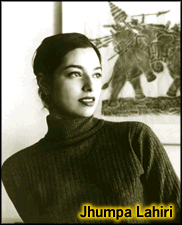
jhumpa_lahiriThe book is divided into two main parts.  The first contains five short stories.  The second, entitled “Hema and Kaushik”, consists of three stories but can be read as a novella on the whole, for they are about two characters whose lives intertwine in an inexplicable way.  While the characters and their situations are contemporary, their quest is the age old longing for love and connection.
I have enjoyed all the stories, but the most impressionable to me is the title one.  In  “Unaccustomed Earth”,  Ruma is married to an American, Adam, with a young child Akash, and pregnant with another.   Her recently widowed father comes to stay with her in Seattle from the East Coast, just for a visit.   During his stay, Ruma’s father builds up a bond with his grandson Akash.   The two create a little garden at the back of the house, a relationship thus flourishes as the flowers and plants blossom.  Ruma struggles with the idea of whether she should welcome her father to live with her for good to fulfil her filial duty, but by so doing, she would be adding a burden to her nuclear family.  What she does not know though is that her father has his secret and internal conflict as well.  He too wants a life of freedom and love.  The story ends with a dash of humor and a little surprise, reminiscent of a Somerset Maugham story.  I will not say more, or the spoiler will lessen your enjoyment.

I have read all three of Lahiri’s work.  And this is my query:  If her first book garnered the many literary awards including the Pulitzer, I just wonder what else could she win with her newest creation, which I enjoy far more.

Unaccustomed Earth by Jhumpa Lahiri, published by Alfred A. Knopf, NY, 2008.  333 pages.

~ ~ ~ Ripples

****


81st Academy Awards Nominations (2009)

oscars

CLICK HERE to read The 2009 Oscar Results.

So, the news is out. For a complete list of the 2009 Oscar nominees, click here to go to the official Oscars website. For those who didn’t bother getting up at 5:30 am PT to watch the announcement live, here’s the video clip.

The clear front runner is The Curious Case of Benjamin Button, grabbing 13 nominations, just one short of the record shared by All About Eve (1950) and Titanic (1997).

Slumdog Millionaire is not far behind, a fantastic rags to riches exemplar in itself, garnering 10 nominations.

When I look at the Best Picture categories, I notice that four of the five nominees are produced from an adapted screenplay.  Here are the origin of these now famous movies, the source materials that first spark and channel the creative energy of screenwriters,  causing them to propel a much lesser known work into the orbit of box office profits:

  • The Curious Case of Benjamin Button:  Loosely based on a short story of the same name by F. Scott Fitzgerald.  The imdb site does not even mention this source material.  But for those of you who want to acknowledge the original writer’s work, click here to read the short story online.
  • Frost/Nixon:  Based on a play by Peter Morgan.  To read the NY Times review of this theatre production, click here.
  • The Reader:  Based on the novel by the German writer Bernhard Schlink.  To read the discussion of book into film at guardian.co.uk, click here.
  • Slumdog Millionaire:  Based on the novel Q & A by the Indian novelist Vikas Swarup.  To read his interview on guardian.co.uk, click here.

So I say, kudos to all the original writers out there, without getting as much notice, not in this part of the world anyway, until their work is chosen to be made over into a movie, or picked by Oprah (The Reader).  It says a lot about our consumer and celebrity driven culture, that a piece of writing gains recognition only when it is released in a movie tie-in edition, or favored by a TV icon.

Well,  the message of Wall-E is relevant here.  I’m glad to see it getting 6 Oscar nods including Best Original Screenplay.  The last time an animated feature received 6 nominations was Beauty and the Beast (1991), itself a case in point with the hype of commercialism boosting the literary form.

And then on another note, I read about the first edition of Emma that Jane Austen signed and gave to her friend Anne Sharp (thought to be the inspiration for the character of Mrs. Weston in Emma) was on sale at the Antiquarian Book Fair in Hong Kong last week, asking price HK$3.95 million (approx. US $500,000).  I wonder also how much all those movies profited from adapting her novels.  I lament Jane who died impoverished.

Photo Source: guardian.co.uk

*****


Last Chance Harvey (2008)

last_chance_harvey

Dustin Hoffman, Emma Thompson, London, England… attractions enough.  Can anyone ask for more?

… Well, yes…  how about a good plot.

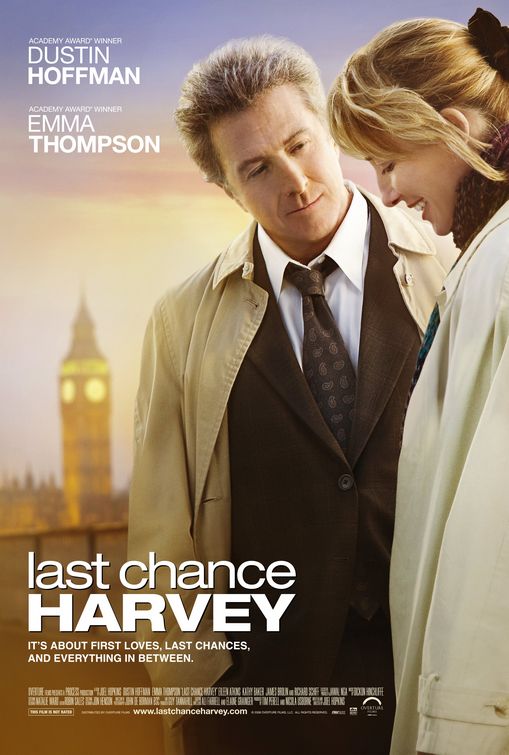
The relatively new director/writer Joel Hopkins must have great confidence in his actors unleashing their charisma in lieu of a substantial plot… well, he’s lucky.  They do.  Despite a slow start, an uneventful and banal storyline reminiscence of past movies, I’ve enjoyed it, mainly because of the actors.  Just watching Hoffman and Thompson strike it up can lighten your day.  Their performance is worth the ticket, especially Hoffman.  Just watching his toast to the bride in the wedding of his daughter is worth the 92 minutes you sit in the theatre.

For their performance, both are nominees in their respective best acting category for a comedy or musical at the recent Golden Globe Awards.

Weddings are popular in recent movies.  Maybe because a wedding is the most sensitive occasion where families, past and present, have to come together, tempted to open old wounds, but also given the chance to mend relationships, or to simply love those for whom you haven’t got time in your life. A hotbed for drama to ensue.

Hoffman here plays Harvey, a divorced jingle writer facing a post mid-life crisis.  Not only is he hanging in a dead-end job, his life is one stale and stagnant bore.   The movie begins as he flies to London England for his daughter’s wedding. The excitement is soon doused by his realizing that the wedding ceremonies have all been planned without him. An embarrassment to his ex-wife Jean (Kathy Baker, The Jane Austen Book Club, 2007) and even to his daughter Susan (the fresh Canadian Liane Balaban, Definitely Maybe, 2008 ), Harvey nevertheless grasps the most critical moment to express his heart-felt endearment for his daughter at the reception.

Other than that self-assertion, and the father-daughter dance which is made possible only because his son-in-law is gracious enough to initiate, Harvey is totally slighted.  While drenched in self-pity, he meets Kate (Thompson).  She too is beginning to, (or has she already?), give up the chance of falling in love.   Kate is self-sufficient though, and probably feels she could fare better on her own, especially without her mother (Eileen Atkins, Evening, 2007) calling her every hour.  But of course, the rest of the story is predictable;  yet you still want to cherish the two great actors hitting it off, to witness Harvey winning Kate over.

Last Chance Harvey is like a stroll in the park.  It’s simple, light, relaxing.  I mean for both the viewers and the actors.  It sure looks like this is one easy job that the two of them can do even in their sleep.

But of course, for me as a viewer, I’d like to see more depth, more characterization, more twists and turns, more laughs.

I suppose it’s alright if you don’t mind coming out of a restaurant half-full… and you did enjoy the dessert.

~ ~ ½ Ripples


Tess of the D’Urbervilles (2008, TV): Part 2

tessThe “lite version” of Part 1 has turned into a heavy and somber continuation on PBS Masterpiece.  In this second and final part, screenwriter David Nicholls and director David Blair unleash the gloomy Hardy worldview unreservedly,  releasing the bleak and dismal elements that are almost too much for new year viewing.  The music has played a major and dramatic role in setting the tone and mood of the movie.  The cinematography too, in contrast to the lush green opening in the first part, has drawn us into a slough of mud, grey and black.  Hardy’s view of nature lamenting the tragic condition of his heroine is effectively conveyed, engrossing albeit a tad too melodramatic.

Kudos to David Nicholls for a meticulous job in adaptation.  He has kept the plot intact, for the most part faithful to Hardy’s book.  While a couple of incidents are left out, quite meaningful and symbolic too, but not to diminishing effects.  These include the sleepwalking episode, the Freudian slip of Angel’s innermost longing to love Tess despite all restraints.  The second being Tess’ mercy-killing of pheasants wounded by hunters, a sensitive portrayal of her own predicament.  However, Hardy would not have her killed off so easily.  Like the sadistic “President of the Immortals” in his view, Hardy the author wreaks havoc on his heroine, leading her into scenes after scenes of tragic events beyond her control.

tess-part-23

Tess can forgive Angel for his sexual sin, but he refuses to forgive her.  Actually, what sin has she committed if she was innocently violated by Alec D’Urberville when she was a young girl.  She loves Angel unconditionally, but his love for her is marred by constraints.  Later, she cannot avoid stalking by Alec, who keeps preying on her, and in her most needy and vulnerable, takes advantage of her again by manipulating her love for her family.  Whatever dignity she may have Tess ultimately sacrifices it for her beloved family.  But I admire Tess’  integrity, yes I like to see it as integrity, and not pride, that has sustained her until that very end when she finally has no choice but to yield to Alec’s sinister scheme.

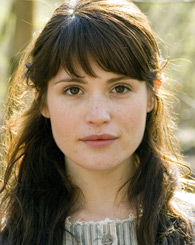
It is for this reason that I find Gemma Arterton’s portrayal of Tess as just a proud and feisty gal to suit modern viewers incongruent with the book.  She may look innocent enough, but her performance at times is contrived and lacks the striving complexity required.  But her tears are effective and moving, I must say.  While Hans Metheson has delivered his diabolic role adequately, Eddie Redmayne as the losing lover at the end is a bit lacking.

And Angel, oh, what a tragic character.  The seemingly altruistic lover cannot stand the test against social mores.  In the book, the chapter describing the mutual confession of sins between the newlyweds is aptly entitled:  “The Woman Pays”.  What an irony of double standard!  This might well be the name of the novel.  While Hardy may have held an entangled and agnostic view of the transcendent, his social critique is incisive and spot-on.

the-stonehenge-1

At long last, Tess and Angel can enjoy marital bliss, but only for a painful, fleeting moment.  Tess says in her anguish:  “It is too late”,  the four words that define the tragedy of her life.  As a young girl, she did not understand the meaning of Alec’s sinister advances until too late.  And now as a married woman, her husband has come to her rescue too late.  I learn from the end notes of my Penguin edition that the original title of the book was Too Late, Beloved! What a heart-wrenching story.

PBS has a link to an online interactive Q & A with screenwriter David Nicholls.  In there he  answers the many questions viewers have regarding the process of turning book into film. I have enjoyed Nicholls’ previous adaptation of Blake Morrison’s memoir into the movie “And When Did You Last See Your Father”, starring Colin Firth and Jim Broadbent, an excellent and sensitive film.  I look forward to seeing more of Nicholls’ work in the future.

~ ~ ½ Ripples

Click here to go back to Tess of the D’Urbervilles, Part 1.

*****

2009 Golden Globe Winners

If you’re looking for the 2010 Golden Globes, CLICK HERE.

slumdog-golden-globe Photo Source:  Irish Times

Click here for the list of the 2009 Golden Globe winners

Slumdog Millionaire is the big winner of the night, garnering the golden globe in four categories:  Best Original Score (A. R. Rahman),  Best Screenplay (Simon Beaufoy),  Best Director (Danny Boyle), and Best Motion Picture – Drama.  Good to see the underdog win.  Hopefully the bright road leads all the way to the Oscars.

Another big winner is Kate Winslet, surprising even herself by winning both Best Supporting Actress (The Reader) and Best Actress (Drama, Revolutionary Road).  Her emotion was spontaneous… She even said sorry to her fellow nominees Meryl  (Doubt),  Kristin (I’ve Loved You So Long), and who’s the other one?  Yes,  Angelina (Changeling).  But ooh, she forgot Anne (Rachel Getting Married), who got all the hype from being recognized as the winner due to an earlier glitch on the GG website.

kate-winslet-golden-globe-2009 Photo Source: CBC.ca

Sally Hawkins nabbed the Best Actress trophy  (Comedy, Happy-Go-Lucky), beating fellow Brit  Emma Thompson (Last Chance Harvey).

After waited for a whole year, Steven Spielberg finally received the Cecil B. DeMille Award which he won in 2008  but was not presented due to the cancellation of the GG Awards ceremony. Or was it 50 years that he waited?  It was in 1959 that Spielberg made his first film, an 8 min. short.  He was 13.

Heath Ledger won posthumously Best Supporting Actor for The Dark Knight.  Chris Nolan accepted it on his behalf: “He will be eternally missed, but he will never be forgotten.”

Wall-E took the Globe for Best Animated Feature Film, deservedly.

As for the TV division, John Adams garnered four Awards, seeing Laura Linney, Tom Wilkinson, Paul Giamatti receiving their honors.

Overall, a big night for the Brits.

Click here to read CBC reporting.

Click here to see a clip of the highlights from BBC News.

*****

WALL-E (2008, DVD)

Continuing with my review of  ‘hopeful movies’ for the new year,  this is a must-see… for your whole family.

wall-e

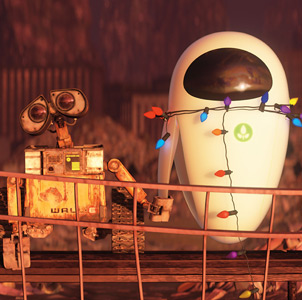
WALL-E has re-defined for me what makes a good movie.  It doesn’t need human actors, doesn’t even need dialogues.  Its visuals are stunning and thought-provoking, and the silent scenes speak volumes. Especially the first part of the movie, I’m fascinated by how human meanings and sentiments are conveyed with almost no dialogues yet with such eloquence.  It is ironic, I know, that it takes an animated robot, or two, to bring out what is important for us humans: The need to connect, the joy of simplicity, the power of a tiny green sapling bursting with life, and love, the essence of being human.  The creators of WALL-E have invented a fresh and entertaining way to send these age-old messages back to us humans, with grace, humor, and wonderment.  Now that’s creativity.

The time is post-apocalyptic, some time in the future where Earth is no longer habitable because its junks are piled up higher than sky scrappers.  WALL-E is a robot with one directive: garbage compacting.   Earth is no man’s land now.  One ‘human remains’ that WALL-E treasures is an old video tape of “Hello Dolly”.  WALL-E plays it constantly to admire that very human act and emotion:  courtship and love.  One day, he witnesses the landing of a spacecraft, from which comes Eve, an exploratory robot.  Now WALL-E has a chance to practice what he has learned.

As Earth is no longer viable for life, humans, ever ingenious, especially when it comes to their own enjoyment and gratuitous consumerism, have branched out into space, the final frontier.  They have created for themselves a utopia in a cruise ship, perpetually holidaying in space.  Their pastime is lounging on a couch, being served by automated robots.  Due to lack of use, their limbs have shrunk while their bodies have bloated.  No matter, they only need one finger to press buttons to eat, drink, and be merry.  WALL-E’s adventures begin as he follows Eve back to this ultra high-tech space station.

wall-e-and-eve

But Earth is home for humans, not a cruise ship in space.  Earth is meant for us to cultivate, to nurture, and to enjoy.  So, that’s the ultimate epiphany for all these perpetual space vacationers.  Herein lies the miniscule hope, symbolized by the tiny sapling of green, that there’s still a chance to return home and set roots once again, to live and grow.  The movie ends with all the right notes without being preachy or turning into a propaganda, nor does it wake us up by scare tactics.  It leads you on a pleasant ride and brings you to its intended destination without coercion or didactics.

The DVD has some excellent special features including a couple of animated short films, deleted scenes, and many more.  But my favorite part is ‘Animation Sound Design: Building Worlds From the Sound Up”, in which the legendary sound designer Ben Burtt shares secrets of creating the sounds of WALL-E. Credited by writer/director Andrew Stanton as the genius behind WALL-E, Burtt has won Oscars for his sound effects in E.T. The Extra-Terrestrial, Star Wars, and Indiana Jones movies.

Teach your children well… while there’s still time,  that’s the underlying axiom (the name of the cruise ship) of the movie.  An animation more relevant for adults than kids. After all, who are in a better position to bring hope to the next generation other than parents themselves?

~ ~ ~ ½ Ripples


Tess of the D’Urbervilles (2008, TV): The Lite Version

tess-of-the-durbervilles-movie

After reading Thomas Hardy’s Tess of the D’Urbervilles just shortly before watching the new re-make on PBS Masterpiece, I can fully understand why screenwriter David Nicholls has done what he did.  He has turned a heavyweight into a light classic.  For if Hardy’s book is to be adapted in spirit and letter, it would certainly be less appealing and just too heavy a burden to cast upon our collective psyche.

As an author, Hardy himself personifies the sadistic ‘President of the Immortal’ he perceives.  Humans are just the playthings for The Immortal’s jest.  As an agnostic, he can’t just outright blame it all on God, since he isn’t sure even if God exists.  But in the book, he makes his readers know clearly the cosmic tragedy his characters are caught in, by turning Browning’s lines into:

God’s not in his heaven:  all’s wrong with the world!

If we can see Hardy on the streets today, I’m sure he’s the guy who takes Murphy’s Law to heart:  Anything bad that can happen will happen.  That’s what he makes of his heroine Tess in the story.  A pure, beautiful and innocent country girl, fresh and untouched for life, is being caught in all sorts of circumstances that will bring only heart-wrenching consequences, one after the other all the way to the end.

David Nicholls has spared us the looming Hardy worldview and lightened it up for us, and I don’t blame him for that.  For who needs more tragedies of cosmic proportion in this very tumultuous time in our human history.   Mind you, he has presented the plot faithfully.  In this first part at least, you see the sequence of events in the book adapted to the dot, albeit in a much more condensed and hurried pace.  Considering the full length of the book is about 400 pages, and the made-for-TV movie is four hours long, that means for every hour he has to cover 100 pages.  From this first part, I’d say he has done an admirable job.

tess-and-alec

Now to Gemma Arterton.  I’ve enjoyed her role as Elizabeth Bennet in ITV’s Lost In Austen.  So it is with high expectation that I come to watch Tess.  If the screenplay is a light version, then Arterton’s Tess is aptly portrayed, for I have a feeling that she has turned it into a comic character at the beginning of the movie.  But maybe that is to contrast her later portrait of lost innocence.  Nevertheless, I feel there is something lacking, maybe the almost god-like purity and depth of love in Tess are qualities just too demanding for so young an actress to depict.

Hans Matheson’s Alec D’Urberville is much more attractive than the detestable Alec described in the book.  Though the obvious villain, his dark and sensual appearance is symptomatic of a soul in turmoil. He has added complexity to his character that even sheds a bit of appeal. I look forward to his crucial role in the latter part of the story.

angel-clareIn contrast, Angel Clare is the innocent lover.  His willing to challenge his strict Victorian upbringing in a clergy family for love of a milkmaid indicates his bold rejection of social norms and family expectations… up to this stage.   Eddie Redmayne has delivered a convincing performance.
The character that really draws my attention, surprisingly, is Tess’ younger sister Liza-Lu, played by Jo Woodcock.  For some reason that face has the look and intensity that’s so fitting in a film like this.  And the three milkmaids that offer the much needed relief to the story, Marion, Retty and Izz, are well cast and portrayed.  They play no minor roles in Tess’ life.

Finally, I must also mention the new host of Masterpiece Laura Linney.  I admit, she’s more what I had in mind for the character of Tess while reading the book.  Unfortunately that part is taken.  Oh well, I’ll see her again next week, and in future Masterpiece presentations.

So, for a lighter and entertaining take on the tragic story of Tess,  and to browse through the plot in a few visually appealing hours while sidestepping the somber philosophical view of Hardy’s, this BBC production offers a viable choice.

(Photos Source: bbc.co.uk)

~ ~ ½ Ripples (so far)

Click here to go to Tess of the D’Urbervilles, Part 2

*****


Slumdog Millionaire (2008)

slumdogposter

Updates:

Feb. 22:  Slumdog Millionaire just won 8 Academy Awards. CLICK HERE for the Oscar Results 2009.

Feb. 8:  Slumdog Millionaire has just won 7 BAFTA Awards including Best Picture and Best Director tonight in London, England.

Jan. 25:  Slumdog Millionaire has just won the Screen Actors Guild Award for Outstanding Performance by a Cast in a Motion Picture.

Jan. 22:  Slumdog Millionaire just nominated for 10 Oscars including Best Picture. Click here to go to my Oscar Nominations Post.

Jan. 12:  Slumdog Millionaire just won 4 Golden Globes for Best Original Score, Best Screenplay, Best Director, and Best Motion Picture – Drama.

***

A. O. Scott in his 2008 year-end article and podcast on the New York Times website gives credits to movies that explore the element of hope. How fitting it is to start the new year by watching ‘hopeful movies’. In this turbulent time of ours, ‘Hope’ might just be the word of the year for us all.

Slumdog Millionaire not only explores the idea of hope, it builds its whole momentum on this element, and its fuel is none other than ‘love’.  The movie is a modern day fairy tale, an exciting concoction bubbling with fantastic visuals and sounds, a post-modern alchemy of culture, language, and place. But what unifies is the aspiration of requited love and shattered souls redeemed.

Directed by Danny Boyle (28 Days Later, 2002, Trainspotting, 1996) and based on Vikas Swarup’s award winning novel Q & A, which has been translated into 36 languages, the film has garnered high acclaims in film festivals. Just four months into its limited release, Slumdog Millionaire has already won 20 awards, and is nominated for 4 Golden Globes including Best Picture, and 2  SAG Awards, and is a possible contender for the Oscars.

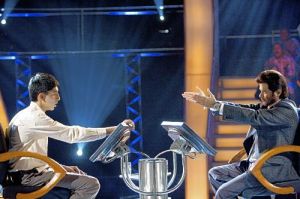
Jamal Malik (Dev Patel) grows up in the slums of Mumbai, India. He and his brother Salim watch their mother killed by mobs. The two boys have to fend for themselves living on the streets. They survive the deplorable conditions with tact, style and grace, until Salim falls for the gang. Jamal has a childhood sweetheart Latika (Freida Pinto). In a heart wrenching episode, she gets separated from the brothers. Her fate seems to be sealed as a young girl on the street.

Years pass but Jamal’s heart still yearns for Latika. One thing that unites all Indians seems to be the popular quiz show “Who Wants To Be A Millionaire”. With his heart firmly fixed on reaching out to his long lost love  somewhere out there in the mass populace of India, Jamal gets on the show, hoping Latika would see him. Latika at this time is in the firm grip of a gang lord, her hope of freedom is dismal.

slumdog-millionaire-2

Yet, screenwriter Simon Beaufoy (Miss Pettigrew Lives for a Day, 2008 ) and director Danny Boyle gratify their viewers with some unexpected twists and turns, allowing us to savour an exhilarating end to the story. With their seamless, non-linear way of storytelling, framed by an upbeat musical score, they have turned what could be just another love story into a fresh and engrossing tale.

While the film features all Indian actors and some Bollywood stars, shot in Mumbai, many dialogues in Hindi with English subtitles, I don’t feel the cultural elements particularly stand out, drawing attention to themselves. Herein lies the success of the film. It has not led me to feel like I am watching something ‘foreign’ or ‘ethnic’, like some National Geographic features. The sense of place and subject matter, plus the amiable cast have all worked together effectively to transmit a universal appeal. The only Bollywood moment is when the end credits roll. Do stay for that.

Slumdog Millionaire evokes reminiscence of similar successful though lesser known titles like ‘Chop Shop’ (2007) and ‘Born into Brothels’ (2004), but on a grander scale, with an explicit message of hope and an unabashed resolution of requited love.

How satisfying! You’ll come out rejuvenated. The skeptic in you might say it’s only a movie, a fantasy too…  Mind you, not all fantasies end well. With some, the darkness can loom for days. Be good to yourself, start the year on a cheery note. Watch a ‘hopeful movie’. Love and Hope can sustain and triumph. As simple as that.

~ ~ ~½ Ripples


*****


The Best Movies of 2008

It’s that time of the year when film critics choose their ten best.  Here are a few of their lists.  Click on them to see the full content.

Breaking the top 10 tradition,  Roger Ebert has chosen 20 for 2008, because in his opinion, there are just too many good films this year.

A. O. Scott of the New York Times tends to agree, but still managed to pick his top 10 among the 650 films he has seen this year… incredible.

His colleague Manohla Dargis has also done the year-end cut from the hundreds she has seen.  Here’s her take on the ten best.  And while you’re there, click on the podcast where she and Scott discuss this year’s movies.

And finally, a Canadian perspective, represented by Johanna Schneller of the Globe and Mail.  I like how she puts it:  the 10 films “that I feel richer for having seen.”

What draws me to these lists is not so much about which movies get picked as the 10 best, but WHY they are selected, and HOW critics come around to that final decision after, I must suppose is a long, struggling process.  Imagine having had to pick 10 out of 650!

Comparing these lists, there are of course titles that are common among them, but not too many.  A few getting up on three of these lists but not all, like Rachel Getting Married, Milk, and Wendy and Lucy.  Only one film gets the nod from all of them and that’s Happy-Go-Lucky.  But for the rest, it seems like each critic has his or her own personal criteria when it comes to choosing what makes a good movie.  And I’m glad to see it this way.

Of course, there are theories, on film, aesthetics, and criticism, and then there are acting methods and execution criteria in camera works, lighting, sound, cinematography, editing, screenplay… it all boils down to one whole package, the final production.  And then there is also the receptive end of the movie, the viewer, and in this case, the critic, each bringing his or her own experience, sense of self, personal values and point of view.  And I’m relieved to see each critic pick what he or she feels is most affective and meaningful to him or her as an individual.

I’ve particularly enjoyed reading A. O. Scott’s year-end article in the New York Times entitled “In The Face of Loss, Celebrating Ties that Bind“.  Although not intended to answer the question: “What makes a good movie?”  Scott has inadvertently expressed his criteria.  When discussing a few movies that he thinks are well done, namely Doubt, The Reader, Revolutionary Road, and Frost/Nixon, he comments that they :

are impeccably acted, exquisitely production-designed excursions into the recent past.  And each one is a hermetically sealed melodrama of received thinking, feverishly advancing a set of themes that are the very opposite of provocative.

So, one criterion is originality, and not cliché treatment of subject or idea.

In the midst of our unsettling and troubled time, films could be manifestations of a collective predicament, and expressions of our hidden longings.  I’ve particularly appreciated Scott’s comment at the end of his article:

And while I am suspicious of easy affirmation or forced happy endings, I am nonetheless grateful for movies that, in spite of everything, investigate the possibility of hope.

Another criterion: good films are flowing conduit of hope.  I cannot agree with him more.  If you listen to the podcast on his webpage, you will hear him reiterate this point.

And on this note I end my post of 2008.  To all my readers, visitors, and fellow bloggers, may 2009 be a year of hopes abound and dreams fulfilled!

Happy New Year to All!

*****


Jesu, Joy of Man’s Desiring

J. S. Bach’s Jesu, Joy of Man’s Desiring has never ceased to stir my heart.  Of all the renditions, none can grab me so movingly as Josh Groban in his captivating performance with the mesmerizing Lili Hayden on the violin.

Bach wrote the Cantata that contains this excerpt in 1723.  Its lyrics articulate for us what is unspoken in the depth of our souls, releasing our yearnings for a transcendent Creator, magnificent yet compassionate, afar yet ever so near.

Jesu, joy of man’s desiring
Holy wisdom, love most bright

Drawn by Thee, our souls aspiring
Soar to uncreated light

Word of God, our flesh that fashioned
With the fire of life impassioned
Striving still to truth unknown
Soaring, dying round Thy throne

Through the way where hope is guiding
Hark, what peaceful music rings
Where the flock, in Thee confiding
Drink of joy from deathless springs
Theirs is beauty’s fairest pleasure
Theirs is wisdom’s holiest treasure
Thou dost ever lead Thine own
In the love of joys unknown

*****

2009 Golden Globe Nominations

Update January 12:  CLICK HERE for the Golden Globe Winners.

Hollywood Foreign Press Association has just announced the 2009 Golden Globe Awards nominations.  Click here for the full list.

If, as they say, the Golden Globes usually is a good prediction of the Oscars, then I am hopeful that some of those who truly deserve the recognition might just get a nod for next year’s Academy Awards.

I’m thinking in particular of Kristin Scott Thomas for her role in I’ve Loved You So Long (France), nominated for a Golden Globe Best Actress Award (Drama), and the film getting a nod in the Best Foreign Film category.

Anne Hathaway is also a contender in the same category as Scott Thomas, for Rachel Getting Married.  Her performance is a good sign of her versatility.  But my choice is Kristin Scott Thomas, hands down.  She has delivered a superb performance in I’ve Loved You So Long as the deep and tormented Juliette Fontaine.   I wish her all the best all the way to the Oscars.

As to the two nominations Mamma Mia! receives for Best Picture (Comedy or Musical), and Meryl Streep for Best Actress (Comedy or Musical), I admit I am a bit surprised.  But then again, as a musical goes, especially one made up of amateur singers, maybe it does deserve a nomination for its entertainment value.

To read my reviews of the movies mentioned here, just click on their names.  My reviews are also linked by IMDB’s ‘external reviews’.

*****