I’ve Loved You So Long (2008, France) Il y a longtemps que je t’aime

Update: 

March 3:  The DVD has come out.  For those who don’t like to read subtitles, the DVD has an English Version with Kristin Scott Thomas voicing her own part.  But nothing compares to the original of course. 

Feb. 8  I’ve Loved You So Long has just won the BAFTA for Best Film Not In The English Lanugage tonight in London, England.

Dec. 11:  I’ve Loved You So Long has just been nominated for two Golden Globes, Best Foreign Film and Best Actress (Drama) for Kristin Scott Thomas.

Sisters reuniting is the storyline of several movies recently, as in Margot At The Wedding (2007) and Rachel Getting Married (2008 ).  But both Nicole Kidman and Anne Hathaway are just featherweights compared to Kristin Scott Thomas’s powerful performance here in I’ve Loved You So Long.

il-y-a-longtemps-que-je-taime

Winner of the 2008 Berlin International Film Festival, I’ve Loved You So Long is the  directorial debut of Philippe Claudel, French novelist, screenwriter, and professor of literature at The University of Nancy.  It is unfortunate that festival films like this one are rarely shown in North America, except in major selective cities.  I’ve wanted to see the film for a while, but not until my trip to Vancouver last week did I have the chance to watch it in a theatre.

In the film, the reunion of the sisters comes under the most unusual of circumstances.  Kristin Scott Thomas (The English Patient, 1996) plays Juliette, an older sister who has just been released on parole after 15 years in prison.  She rejoins society to the  embrace of her younger sister Léa (Elsa Zylberstein).  Léa was only a young teenager when her much older sister was disowned by their parents.  To them, the crime she had committed was unforgivable.   Léa was told to ostracize Juliette, as the rest of the family did.   Now years later, Léa is teaching literature at a university, and  mature enough to reconnect the tie that binds.   She receives Juliette  into her own home, a warm family with a loving husband, two adopted Vietnamese girls, and her father-in-law Papy Paul (Jean-Claude Arnaud), who has lost his ability to speak after a stroke.  But her husband Luc (Serge Hazanavicius) is apprehensive, and understandably so.

Like the viewers, Léa is kept in the dark as to the details of the act Juliette had done , a secret that is painfully borne by Juliette alone.  The slow unfolding of the facts thus sets the stage for the heart-wrenching performance by Scott Thomas.  The film is an exploration into the nature of good and evil, love and forgiveness.  In our society that excels in labeling people, the writer/director leads us to ponder the questions of what constitutes a crime, who are the victims, likewise, who are the strong, the helpers, and who are those that need help?  How can we truly know each other?  And ultimately, what is love?

ive-loved-you-so-long

I admire that the elegant Oscar nominated actress Scott Thomas was willing to take up a role that would cast her against type, and to work under a first-time director.  Devoid of  make-up, her gaunt and haunted look,  deep set eyes and languid lids, and the high cheek bones that used to speak of beauty in her other films now form the epitome of a soul tormented.  Her icy demeanor reflects a guarded self that is too wounded to risk another blow.  Though released from physical confinement, Juliette is still imprisoned by her own guilt, and has to serve a  life sentence of torments from the ambivalence of her act.  Scott Thomas has poignantly portrayed a believable character and effectively created a tragic heroine.  Juliet is out of prison, has nowhere to go, lost to herself and the world.

Yet love paves the road to redemption, and courage is the building block.  While Léa plays a major part in reaching out to Juliette, her adopted daughters and even the silent Papy Paul have all unknowingly participated  in the healing process. It is his silence and the calming effect of his books that Juliette finds affinity.  In sharing the French children’s song ‘Il y a longtemps que je t’aime’ with Léa’s adopted daughter P’tit Lys (Lise Ségur), she ventures out to reconnect in a meaningful way.

Léa also invites Juliette into her circle of friends, in particular, her colleague Michel (Laurent Grévill).  Michel has spent some time teaching in a prison.  He reaches out to Juliette with his understanding and compassion, and shares with her the enjoyment of art.  Although he does not know the full details of her circumstances, he respects her humanity and offers his friendship, even when Juliette is not ready to receive.  He patiently waits.

Engrossing and intense, the film nonetheless offers a satisfying experience.  Even though I was able to guess the nature of the dark secret underlying the suspense, such that it has lessened the effect of surprise on me at the end, I still find the film thoroughly enjoyable, in particular, the superb acting from both sisters.  For those who associate tears with melodramatic and contrived effects, the film is an apt refutation of such a view.  Tears are most welcome and cathartic as a closure here after almost 90 minutes of elliptical restraint,  for they are  the very expression of reconciliation and redemption.  The climax is one of the most poignant I’ve seen in a long while, and the subsequent ending, a triumph.

I look forward to more of Claudel’s work.  And for Kristin Scott Thomas, I think she deserves no less than an Oscar for her performance.

~ ~ ~ ½ Ripples

****

Lost in Austen Episode 4 (2008, TV): Lost and Found

After trudging through a slow and a tad too serious Episode 3, the production has redeemed itself by finishing up with a grand finale. Episode 4 has found its original pace with its fast sequences to wrap things up, offering unexpected and entertaining twists and turns.

One thing that screenwriter Guy Andrews remains consistent with is his attempt to mix things up as much as he can, like Lydia eloping with Bingley, Wickham turning wicked schemes into timely rescues, Mrs. Bennet coming to her senses and confronts Lady Catherine de Bourg, and ultimately, the big ultimate, Elizabeth Bennet swaps places with Amanda Price not for a moment, but for good. The laughs and fun derived from these “post-modern moments” are all based on juxtaposing time and mixing up of characters and story lines. The whole production is an effective deconstruction of an all-time classic and its adaptations.

gemma-arterton-as-elizabeth-bennet

The most fun of them all, of course, is Amanda coming back through the portal and see Elizabeth Bennet in 21st Century London, with a new pixie hairdo, working as a nanny, computer savvy, environmentally conscious, and fully liberated. What more, she enjoys modern, post-modern rather, life so much that she intends to stay for good. And once she sees Darcy, who follows Amanda to the modern world, Lizzy right away knows who he is, thanks, as we all do nowadays, to all the webpages about Colin Firth’s wet shirt scene.

Darcy on the other hand is totally lost in the future. Here the scene is almost a replication of the one from Kate and Leopold (2001), where Hugh Jackman portrays a late 19th Century English nobleman travelling through a time portal and lands in modern day NYC. Darcy is even wearing a similar long, blue coat like Leopold, mesmerized by the tele and the busy urban traffic. And the ending too, a similar twist as Meg Ryan’s ultimate choice at the end of the movie.

What would Jane Austen think? “Turns in her grave” as Amanda puts it? As a satirist and a fan of the burlesque, Jane might have a good laugh too I think. I’m sure she was confident and self-assured enough to know that parodies of her work, at best, remain only as they are, spin-offs and re-makes of something that is inimitable. No matter how you deconstruct Jane Austen, you would always come out admiring the ingenuity of the brilliant mind behind that original creation.

*****

Episode 1

Episode 2

Episode 3


Lost In Austen: Episode 3 (2008, TV)

Japanese man petitions to marry comic-book character“, thus says the headline. Taichi Takashita has launched an online petition to the Japanese government for the legalizing of marriages between human and cartoon characters. He’s aiming for a million signatures, as of the end of October, he’s got a thousand. In this day and age, I’ve more or less braced myself for any type of shocking news.

Now, back to fiction. I’m not surprised to see Amanda Price falling in love with a fictional character, especially one like Fitzwilliam Darcy, but I am quite unwilling to accept Darcy to be ardently in love with her. But of course, this is a parody, albeit in this episode, the humor has gone from LOL to subtle satire.

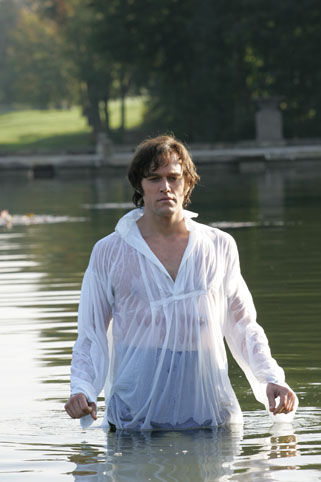
wet-shirt-scene-in-lost-in-austenI suppose the wet shirt scene in which Darcy heeding Amanda’s request to dip into the pool is meant to be the most notable moment, or maybe even the climax, of the whole production. This scene just confirms my view that Lost In Austen is more a parody on Pride and Prejudice adaptations, rather than the novel of Jane Austen’s. There never is a wet shirt scene in the book. The parody could well be on Andrew Davis’ imaginary take on wooing modern female viewers, or a satire on the cult following of Colin Firth’s role as Darcy since the 1995 BBC production.

The scene also offers another Firth moment when Amanda asks Darcy whether he loves her because of her change from the spikey and vulgar modern female to the simpering klutz trying to fit into the Regency mold. Well, truth be told, Darcy finds her character, both before and after, equally disagreeable, but he still loves her with all his heart. Isn’t that the Mark Darcy line to Bridget Jones, “I like you very much, just as you are.”

Anyway, there really isn’t much else to be excited about in this episode. The director seems to be indecisive as to where he wants to take us, and in what form. The lively and fresh beginning of Episode 1 has subsided and the production has turned into another TV drama, one that has taken itself a little too seriously.

So now, another week, another episode…oh, the ennui and the ambivalence.

Yet, I shall conquer this, I shall.

Episode 1

Episode 2

Episode 4

Flight of the Red Balloon (2007, France, DVD)

flight-of-the-red-balloon

In celebration of its 20th anniversary, the Musée d’Orsay in Paris has commissioned four notable directors to create a series of commemorative films. One of them is Olivier Assayas with his Summer Hours (l’Heure d’été) which I have reviewed.  Another is the highly acclaimed Taiwanese auteur Hou Hsiao-hsien. Flight of the Red Balloon is a unique piece of film art gently crafted by Hou in homage to Albert Lamorisee’s Oscar winning short Le Ballon Rouge (1956). Hou has long been garnering awards in international film festivals throughout Europe and Asia since the 1980’s, albeit relatively unknown in North America. Flight of the Red Balloon is his first French language film.

The little boy in this 2007 rendition is Simon (Simon Iteanu), a child growing up in the hustle and bustle of Paris. With an absentee father somewhere in Montreal pursuing his writing, and a frantically busy mother Suzanne (Juliette Binoche), Simon is alone in an adult world. Overloaded with her work as a voice-over artist in a puppet production plus other personal matters, Suzanne hires Song (Fang Song), a film student from Beijing, to look after Simon for her.

Suzanne is the embodiment of urban frenzy. As a single mother, she has to shuttle between home and work, deal with the eviction of a bad tenant in her lower apartment, confront her non-committal husband on the phone to Montreal, and connect with her daughter in Brussel, all in a day’s work. Simon is most perplexed.  “Why are you so busy, Mama?”, he asks.

song-and-simon

Song, on the other hand, offers the tranquility that is needed to balance life in the midst of chaos. As a film student, she uses her hand-held camera to record Simon’s activities, and by her quiet demeanor and calm observing, she reflects pleasure in the mundane, everyday trivialities called life. This is reality show without sensationalism.  Hou has ingeniously conveyed his perspective of realism with artistic overtone. No doubt, there is a lack of plot, suspense, or climax, but there is character contrasts, cinematic offerings in sights and sounds, and realistic, natural performance. Juliette Binoche has once again assured me why she is one of my favorite actresses. And no, you are not watching paint dry, you are watching life unplugged.

The red balloon forms the focal point of Hou’s signature long take. The almost God-like omnipresence hovering over buildings in the Paris skyline is a joyful symbol of childhood. Its silent drifting is as elusive as the fleeting memories of happiness. Even little Simon achingly remembers the pleasant days he had shared with his much older sister, who is now living in Brussel. We are all trying to catch and hold on to fond memories and meaningful relationships. Yet as the busyness of urban living numb our senses, we ignore and shove away what we think is a hindrance to our time, just like the people rushing out of the subway station, shoving away the red balloon. Only a child would try to catch and befriend it.

Complementing the cinematic artistry is the equally mesmerizing piano music, meditative, serene and restoring, setting the mood and the preamble of the film.  Other musical numbers are equally soulful. Click here for the official IFC site where you can have a taste of the sights and sounds of the film.

felix-vallotton-le-ballon-1899I particularly enjoy the ending. As Simon goes on a school trip to the art gallery of the Musée d’Orsay, the children gather on the floor to talk about Félix Vallotton’s 1899 painting Le Ballon, he leans back, slightly removes himself from his school mates, and lays on his back. As he looks up to the glass canopy of the museum ceiling, he sees it again, the red balloon, watching over him, removed yet engaged, far away, yet ever so near.

~ ~ ~ Ripples


Lost in Austen: Episode 2 (2008, TV)

For all of us Canadian viewers, who have patiently and faithfully waited VIVA to show us one episode at a time of Lost In Austen two months after its premiere in the UK, we have been short-changed last night! I knew Amanda Price would have to face some musical challenge in this episode. But I purposely did not try to find out what it is by reading others’ reviews. I want to see it first hand. But I was not given that opportunity. Why would VIVA cut out the most hilarious part of this second installment?

For those who don’t know what they have missed last night, here is the clip from YouTube:

Darcy’s “All ladies can sing.” is such a funny parallel to his statement in P & P: “Every savage can dance.”

I’m afraid though, the above may well be the few funny parts in this episode. And with VIVA cutting it out, we’re left with not much commotion. I admit that my earlier excitement from last week has died down. Without the Petula-Clark-inspired parody, this episode seems to have lost some of the initial lustre. There are still funny moments, and humorous lines, but the overall appeal seems to have waned.

I hope I’m not experiencing another version of lost in Austen. I find in this episode the screenwriter has taken us as far away as possible from the original P & P story just for the sake of gratuitous divergence. I was looking froward to seeing more of the LOL parody it has set up in Episode 1, more wild rides from the free-wheeling imaginary scenario. I was a bit disappointed to see its freshness replaced by banality. The slapstick humor makes me wonder what’s left in the bag of creative antics.

One more thing: I was most perplexed as to why the dress with the lowest neckline was being worn by none other than Mrs. Bennet, the mother of five daughters. Lady de Bourg would definitely have exclaimed: “Is she still out?”

However, all is not lost. I’m still eager to see how Amanda can right the wrongs and get out of the mess from her intrusion into the Bennet family. And if nothing else, this episode has at least achieved in making me love the original even more, not just JA’s ingenious creation, but the 1995 BBC production as well, yes, even Mr. Collins there. Further, last night’s episode just confirmed my view that nobody can do Darcy better than Colin Firth.

Episode 1

Episode 3

Episode 4

Lost in Austen: Episode 1 (TV, 2008)

lost-in-austen

What a delight it was for me to catch the Canadian premiere of Lost in Austen on the new VIVA channel last night, two months after its UK debut on ITV. No, I had not anticipated it with much eagerness, I admit, nor had I held any expectations before I watched it. But, what a pleasant surprise.

I was somewhat skeptical about another time-travel movie and yet another take on Pride and Prejudice. It seems we are doing Jane Austen a disservice to have so many different “versions” of her ingenious work, turning P & P into a modern day literary cliché. How many more original antics can screen writers squeeze out after all the adaptations and fan fiction spin-offs in recent decades? But this one is fresh and original. It is laugh-out-loud funny, entertaining, with intelligent dialogues and a new perspective. I’m afraid to say too, that there are moments with SNL type of parody on the story and its characters, especially Colin Firth’s role as Mr. Darcy.

But it’s all harmless fun. “No offense taken.” I’m sure Jane, with her sense of humor and satire, would have responded, or Colin, for that matter.

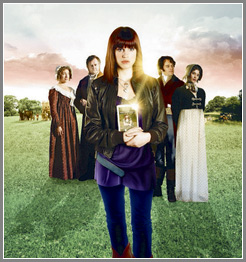
lost-in-austen-amanda-priceAmanda Price (Jemima Rooper, The Black Dahlia, 2006), a modern day working female living in Hammersmith, London, is a JA addict. Reading Pride and Prejudice has become her escape from her lacklustre life. She reminds me of Renée Zellweger’s Bridget Jones, although Amanda here manages to keep her weight under control and has a boyfriend that gets drunk on beer and proposes to her with a beer bottle tag as a wedding ring. So, it is a real fantasy for her to find Elizabeth Bennet (Gemma Arterton, Quantum of Solace, 2008 ) in her bathroom, showing her a portal that leads straight to the Bennet house. But understandably, Amanda is a bewildered and reluctant time-traveler, at least at this point.

The freshness of the story comes from all the twists that do not follow Jane Austen’s story. As with my usual reviews, I don’t like to give out spoilers. But I have to say, the key to these ingenious renderings is that Amanda Price swaps places with Elizabeth Bennet. With Lizzy out of the picture in P & P, the rest of the story is up to the screen writer Guy Andrews’ and director Dan Zeff’s own imagination.

In this first episode, most of the major characters are introduced. All of them deliver a lively performance, although I’m particularly fond of Amanda and Mr. Bingley (Tom Mison). The music reminds me of the 1995 BBC production, energetic and swift. In turn, the pacing is quick and effective. My main criticism though, is the set design of the interior of the Bennet house. It looks more like a modern day rather than an early 19th Century setting, quite incompatible with the exterior of the house.

Right from the start, I have resolved to not take this TV production too seriously, but just immerse myself in the wild and fanciful ride it freely takes me. After all, Jane herself had excelled in this very act, transporting us to meet all sorts of characters and situations through the imaginary worlds of her novels. I’m sure she would have a good laugh too tonight if she were watching with me… now that would be a fantasy indeed.

Just Click to read my review of the other episodes:

Episode 2

Episode 3

Episode 4

*****


Rachel Getting Married (2008)

“I think families are weird and insane…

They are the best source material.”

Jenny Lumet Interview with L.A. Times

I can’t agree with Lumet more… well, maybe not the insane part.  As screenwriter (daughter of director Sydney Lumet), she must have pondered the facts that the family is the first point of social contact a newborn is introduced to, the hotbed of human relationships from jealousy to rivalry, and the school of harsh lessons, learning to love amidst hate, forgive despite hurt.  That is the scenario in her script Rachel Getting Married.

And usually it’s at weddings that the raw emotions are exposed and where conflicting sentiments are so intense that they become unmanageable, hence, the source materials for many of our films…

It was full house again at The Calgary International Film Festival’s screening of Rachel Getting Married. First time screenwriter Jenny Lumet has crafted a realistic family portrait.  Director Jonathan Demme (of The Silence of the Lambs fame) uses roving camera work to effectively capture the naturalistic look, giving me the impression that I’m watching the home-made video of another family.  This film is definitely not for those with weak stomach or who are easily nauseated.

The movie is about Kym (Anne Hathaway) returning home for her sister Rachel’s (Rosemarie DeWitt) wedding.  Kym has been in rehab for some years, trying to deal with substance abuse.  Coming home is bitter sweet for all. First, Kym’s father has remarried and a wedding means the re-appearance of Kym’s mother (Debra Winger), and the re-opening of old wounds.  Further, the jealousy and sibling rivalries are still intense, albeit hidden within a facade of good will most of the time. As the story unfolds, we see the tragic past of the family, its emotional residue still spilling out to the present.

Shot in a naturalistic style (Robert Altman is acknowledged in the end credits), with a hand-held camera jolting its way through family gatherings, punctuated with non-script-like casual and spontaneous talks, the film makes us feel like we’re secretly prying into another family’s affairs.  But herein lies the merit of such an incisive look.  The truth is, if we get the chance to peep behind the curtains into other people’s homes, we would probably find how similar they are with our own.   We may not have to deal with a substance abuser, or have gone through similar tragedies, but we have to live with the common human emotions of hurt and disappointment, rivalries and anger.  We are encouraged when we see how others find redemption, and from the pit of negativism, rise up and go forward.

Anne Hathaway has shown that she can act outside of the sweet and charming feminine roles as in The Devil Wears Prada (2006) and Becoming Jane (2007).  Here in Rachel Getting Married, she has effectively delivered an excellent performance as a messed up substance abuser struggling to redeem herself.  The film could well lead her to other more character-driven roles in the future, or maybe even an acting nomination.

As for the film itself, the roving camera work is not for everybody.  With its almost 2 hours running time, seems like it needs a bit more work on editing and pacing to make it more appealing.  Do we need so many musical numbers?  Overlooking the melodramatic parts, the film is still effective in delivering a very human story.

~ ~ ~ Ripples

Update December 11:  Anne Hathaway has just been nominated for a Best Actress Award at the 2009 Golden Globes for her role in Rachel Getting Married.

*****

COPYRIGHT WARNING:

Arti of Ripple Effects is the writer of the above original review, posted on September 30, 2008, here at https://rippleeffects.wordpress.com   ALL RIGHTS RESERVED.

If you see this article on some other blogs or websites (as I have) without acknowledgment, citing, or linking back to Ripple Effects, then you know it has been copied without permission from the author.

Appaloosa (2008)

Yes, they’re still making westerns. The plots are still generic. Lawmen upholding the law in a lawless land. So what’s new?

What’s new is the fine tuning of characterization, the focus on internal conflicts and dilemmas, and the more stylistic and agile camera works, the music, and the slower, almost meditative pace of story development. I have in mind Open Range (2003), and the recent 3:10 to Yuma (2007).

… And at the Globe where the movie was screened, among the full house attendance at the Calgary International Film Festival, some enthusiasts even dressed western for the occasion.

Ed Harris has proved that he is versatile as an actor and director (Pollack, 2000), and now as a screenwriter. He is all three in Appaloosa. Based on the book by Robert B. Parker, Appaloosa is a typical western buddy movie.  Virgil Cole (Ed Harris) and his sidekick Everett Hitch (Viggo Mortensen, with Harris in A History of Violence, 2005) are two “itinerant lawmen”.  They are hired this time by the town of Appaloosa, as marshal and deputy, to get rid of the lawless rancher Randall Bragg (Jeremy Irons) and his gang.  The twists begin to emerge when a young widow shows up in town.  Allie French (Renée Zellweger) is so alone, so vulnerable, that she has her eye on the tough marshal Cole as soon as she enters town.

The buddy duo has some adjustment to make with this sudden appearance of a third party.  With a woman in his life, Cole himself has become vulnerable and is soon confronted with the dilemma: woman or duty.  Well that’s just one of the several twists of the story, a plot that takes its time to unfold.

As much as I like Renée Zellweger, I find her portrayal of Allie French less than satisfactory. There is definitely a miscast here. It takes more than just acting to bring out the sly femme fatale persona… her look and demeanour just do not reflect the menacing shrewdness and seductive lure needed here. It is unfortunate that Zellweger is cast into a role that she simply does not look the part.

But the movie is still enjoyable just the same. It is slick, funny, clever, and entertaining. Overall the acting is superb, but it is Viggo Mortensen who steals the show. As the quiet, and very intelligent sidekick of Virgil Cole, Everett Hitch has been more than supportive of his buddy. He is Cole’s vocabulary teacher, attentive listener and counsellor, and at the end, fulfills what justice and honor require a man to do, something which Cole himself has neglected. Mortensen has delivered a most gratifying performance which I think deserves an Oscar nomination.

At the end, after twists and turns, the hero rides off into the sunset, a typical conclusion. But this time, we are reminded why we come to see a western to begin with.  Such is the kind of movies where honor and nobility of character is expected of the protagonist, and that the good still wins, and justice served.  How satisfying.  Maybe that is why they are still making westerns, knowing there is an insatiable yearning for such ideals which are beyond time and genre.

~ ~ ~ Ripples

Literacy and Longing in L.A. Book Review

“Outside of a dog,  a book is Man’s best friend.

And inside of a dog, it’s too dark to read.”

— Groucho Marx (1890-1977)

There’s got to be a name for this genre of work, modern novels written by women authors, savvy, hip, like scripts for romantic comedies, featuring self-deprecating heroines at the crossroads, but alas, with a large dose of literary or scholastic flare.  Simply “Chick Lit” won’t do,  they are not giddy enough; “Intellectual Chick Lit” may sound like an oxymoron.

Well this one is a wild ride, with literary figures and quotes streaming by your window.  Authors Jennifer Kaufman, a staff writer at L.A. Times and Karen Mack, a former attorney and a Golden Globe Award winning TV and Film producer, have performed cleverly the feat of embedding over 200 authors, artists, and works in their story, from Marcel Proust to Andy Warhol, Matthew Arnold to Kurt Vonnegut. To be helpful, a 9-page Book List is included at the back.

This is the story of a bibliomaniac who uses book binges to escape from her problems, and just a little too much wine to de-stress.  As Freud would have put it, it all started with our protagonist as a child.  The fateful incident when Dora (named after Eudora Welty) and her sister Virginia (who else…) were riding in the car with their alcoholic, and literary, mother behind the wheel.  They ended up in the river.  That’s the last straw for their dad, who deserted them a few weeks later.  Ever since that accident, Dora has been using binge reading to cope with life’s disappointments and ennui.  Now as an adult, she “collects new books the way [her] girlfriends buy designer handbags.”

While separated from her second husband, Dora, a former L. A. Times writer, meets Fred in an indie bookstore in L.A.  She is attracted to his intellectual side, and just knowing he’s writing a play is appeal enough for her to fall for him.  As she gets to know more about Fred and some of his family ties, Dora is swirled into problems that her safe, upper middle class life would never come into contact with.  Here the plot thickens.

I’m ambivalent about this one.  First of all, I don’t like the book cover.  The cover directly or subliminally leads to the impression that has given “Chick Lit” its bad rap.  I know, I shouldn’t judge a book by its cover.  I’m attracted by the title, however, and am glad I’ve explored further than the cover.

I often wonder how exactly do two authors write a book together.  Do they each write different chapters?  Well, here in LALILA, it certainly reads like it.  Just as you thought it’s all about a self-deprecating female trying to stay afloat, the story peels off a few layers and reveals the courage and heart underneath the surface.  In contrast to the lighter shade, the darker chapters depict a more complex and thinking individual who is not afraid to care and embrace the pathos in life.

What I enjoy most is the clever inclusion of literary quotes and figures in the story.  Each chapter starts with one that’s pertinent to the content.  Some are funny, some thought provoking, but all smart and relevant.  And for the Janeites among us, I’m afraid the authors have taken side with Mark Twain regarding Jane Austen.  Now those parts you might just want to skim over.

I can also see the debates the book and its many literary quotes could spark in a book discussion group.  LALILA makes one enjoyable title for those looking for light, fun, and contemporary women’s writing.  The ambiguous ending may also spur lively speculations.  And for the bibliomaniacs among us, whether you agree or not with the protagonist’s decisions in life or values in love, you’re bound to empathize with the notion of book binging.  It may not be the solution to life’s problems, but reading is definitely one appealing and enjoyable thing to do in our very stressful modern day living.

The book has a website which includes book discussion questions and a lit quiz, well worth exploring.  Just Click Here to go.

Literacy and Longing in L.A. is written by Jennifer Kaufman and Karen Mack, published by Delacorte Press, 2006, 325 pages.

*******

Then She Found Me: Book Review

This is one of those frequent examples where a film is so drastically different from the book that they are virtually two very separate entities. But what’s unusual is, I’ve enjoyed them both.

Then She Found Me, published in 1990, is written by award winning New England author Elinor Lipman. Helen Hunt, together with Alice Arlen and Victor Levin, wrote the screenplay and turned it into a movie. I can understand why those who have read the book first before seeing the movie are flabbergasted. The only commonality between the book and the film other than the title may just well be the two main characters, the quiet and rational high school Latin teacher April Epner and her birth mother Bernice Graverman, the ostentatious TV talk show host who wants to claim back the daughter she had given up for adoption more than 30 years ago. There are almost no traces of the original story in the movie.

The amusing character contrast in the book is a springboard for some creative channelling for Hunt and her screenwriter team, kudos to Lipman’s original conception of the story idea. Despite its digression from the book, the movie still works and entertains. What more, it has preserved the spirit of the book and has brought to the screen the basic issues the book touches on, the major one being the meaning of motherhood, and the inevitable debate over the value of the birth versus the adoptive mother. For my detailed review of the movie, click here.

The She Found Me is my introduction to Elinor Lipman, the acclaimed author of eight books of fiction and short stories. The book is almost script ready, for it is predominantly dialogues, witty, intelligent, and incisive dialogues. Lipman’s sensitivity and subtle humor effectively bring out the nuances of her characters and their relationships, at times sarcastic, at times genuine, at times poignant.

36 year-old April Epner is a high school Latin teacher, quiet, rational, academic, and single. Her long-sleeved cotton jersey and drop-waist Indian cotton jumper persona hides a kind and genuine soul. The only parents she has known all her life are her adoptive Jewish parents Trude and Julius Epner, Holocaust survivors, who have lovingly brought her up and given her a Radcliffe education. After they have passed away and as she stands in the crossroads of her life, the last thing April needs is to be found by a brassy and impulsive talk show host Bernice Graverman, who claims to be her birth mother. Conscientious April has to match wit with evasive Bernice, with the help of her school librarian Dwight, who happens to be much more than just a supplier of encyclopedic information. Without giving out spoilers, let me just say the story unfolds with sprightly twists and turns, effectively driven by Lipman’s first-rate, cutting and entertaining dialogues.

Those who have seen the movie but have not read the book should move right along to savor the source material. In here you’ll find the intended closure to the seemingly unsolvable conflict and ambivalence. I can see this as a good choice for book/movie discussion in reading groups and book clubs.

As I was reading, I thought I saw Jane Austen cameo. What Lipman has created here is something close to what Austen would have written today: a contemporary comedy of manners, a likable heroine reminiscence of Anne Elliot, an anti-Darcy male character, albeit with similar height and social ineptness, and through the characters and their situations, dares to explore some serious social issues that are masked by very funny, sharp and witty lines. The result is a tasty concoction of humor and heart.

And lo and behold, guess whose portrait I see when I open up Elinor Lipman’s website ?

Then She Found Me by Elinor Lipman is published by Washington Square Press, 1990, 307 pages.

~ ~ ~ Ripples

First Blogaversary and Summer Wrap-up

Last year on this day, August 29, 2007, I began my blogging journey on WordPress.  One year and 104 posts later, this sputtering engine is still chugging along.  I’d like to think of my blogging experience as a road trip.  The kind of vehicle I have in mind is the VW van in the movie Little Miss Sunshine.  Almost an obsolete wreck and yet still functioning, just needs a little running push.   

It has been an eventful summer for me.  Having had to move twice and living out of a suitcase, sustaining the horrors of home renos, tending illness in the family, and caring for two elderly parents have put my life on hold…or maybe this is life.  All this time, I didn’t have easy access to the internet, no TV, or other high tech luxuries.  While my posts have been more sparse than I’d like, blogging, even though infrequent, has at least kept some kind of normalcy for me during this unsettling and chaotic period.

While I’ve missed many important events during these two months, such as Hilary’s concession speech, and the Olympics… I’ve been able to catch some summer flicks and read a few books.  As I take stock of this summer’s entertainment consumption, I’m surprised to find that my list is long despite the interruptions:

The following are straight from memory, in no particular order:

Movies seen at theatres:

  • Mamma Mia! 
  • The Dark Knight
  • Swing Vote
  • Brideshead Revisited

Live Musical:

  • Spamalot

DVD’s watched or re-watched:

  • Persuasion (1996)
  • Persuasion (2008)
  • Sketches of Frank Gehry (2005)
  • Life As A House (2001)
  • Eternal Sunshine of the Spotless Mind (2004)
  • Vantage Point (2008)
  • The Bank Job (2008)
  • Miss Pettigrew Lives for a Day (2008)
  • Plus about 25 titles previewed for a Film Festival

Books read or re-read:

  • Persuasion by Jane Austen
  • Then She Found Me by Elinor Lipman
  • The Savior by Eugene Drucker
  • The Glass Castle by Jeannette Walls
  • Up Till Now by William Shatner
  • Lady Killer by Lisa Scottoline

So this is the summer of 2008.  Will be leaving for Ontario tomorrow to take our son back to university, Arti is wrapping up another summer, and the first year of blogging. 

What’s your blogging trip been like this summer?   And your list of books and entertainment?

                                                                           *****

Glenn Gould: The Russian Journey (2002, TV)

 For two months, I had to stay away from home while my house underwent a major renovation.  After sequestered from TV watching for the whole summer, that was one of the first things I delved into as soon as I moved back last week.  A couple of days ago, in between re-runs of Olympics events, I was most gratified to watch this CBC/National Film Board documentary.  What a breath of fresh air and what an invigorating luxury I have been deprived of all summer!  Only on CBC.

The legendary Canadian pianist Glenn Gould (1932 – 1982) visited the Soviet Union in 1957, at the age of 24, the first concert pianist from North America to be extended and accepted an invitation to play behind the Iron Curtain.  Stalin died just four years ago.  The Cold War was at its climax.  Very few had heard of a Canadian pianist named Glenn Gould, what more, very few had heard Bach since the composer was banned by the totalitarian regime for the religiosity of his work. 

This 56 minutes documentary, which won the Grand Prize of the 2003 Montreal International Festival of Films on Art, is packed with valuable archival footage of the actual Gould concerts, meditative shots of the lone pianist against the grand Russian architectural backdrop, as well as some of Gould’s own reminiscence of the historic journey. Interspersed are interviews with significant personalities within the Soviet arts and music circles, sharing their life-changing Gould experiences.  Among them are prominent musicians such as the renowned pianist and conductor Vladimir Ashkenazy, and dissident cellist Mstislav Rostropovich, who sheltered the writer Solzhenitsyn and resulted in the Soviet government banning his performances.

Tatiana Selikman, a pianist and teacher at the Russian Academy of Music, recalls the day of Gould’s first concert in May, 1957.  She saw the poster and was curious about a pianist from Canada, playing The Art of the Fugue, which nobody ever played in Communist Soviet Union.  The Grand Hall of the Moscow Conservatory was sparsely seated.  Then the pale faced pianist came on stage, sat on a low chair, and unleashed a magical performance that mesmerized his small audience.  During the intermission, those in the concert hall dashed out to phone their friends, urging them to come right away.  As the concert resumed for the second half, the hall was packed to overflow.

And the rest is history…

What Gould brought to the Russian audience was not just Bach, or the intricacies of the Fugue, or the beguiling Goldberg Variations, but a new perspective.  Gould’s performance embodied the liberating effect of music, the freedom of artistic expression and the bold exhibition of individualism.  The audience was emancipated to a new found freedom that was not sanctioned under totalitarian rule.  Using the words of some of the musicians interviewed in the film, the Berlin Wall of music came down, warming the Cold War by a few degrees. For the first time, they were applauding something that was not Soviet.  And they were exhilarated.

The recent passing of the Russian dissident writer Alexander Solzhenitsyn, and the events taking place in Georgia, or even the Olympics, have whirled up sentiments in me that I thought was long gone… the pathos of hearing the muffled cries of the oppressed, be it political, social, or artistic. 

There are those who are indignant about the Canadian government subsidizing the Glenn Gould trip, arguing it was a waste of taxpayers’ money.  If a lone pianist can inspire the masses, and if music can soften the hearts of man, enhance international goodwill, and reiterate the ideals of humanity, I am all for it.  Would it not cost more to send hundreds of thousands of soldiers to the front line?

 ~ ~ ~ ½ Ripples

The documentary has been posted on YouTube in six parts.  Here is the beginning.  However, nothing compares to the big screen especially with Glenn Gould playing Bach:


                                                                              *****