Emma (2009, TV): Episode 2

‘An authentic human being’ is how the host of Masterpiece Classic Laura Linney describes Emma.  Jane Austen’s characters have no supernatural powers, she notes.  But herein lies the magic of her writing.  She takes the ordinary and draws out the unnoticed features.  From these everyday characters like you and me, she skillfully displays the intricacies woven in their interactions, and reveals the undercurrents of hidden intentions and desires.  It is in the revealing of the subtext that makes her story so captivating even for us modern day readers.

Episode 2 continues with this interesting story as we see Emma confused by her own feeling towards Frank Churchill, Harriet’s shifting admiration for the same, Frank Churchill’s seemingly open admiration for Emma, Mr. Knightly’s growing sentiments for the same, and, Jane Fairfax’s hidden anguish, ignored by the subject of her desire.  It seems that everybody’s feeling is mixed up with everybody else’s.  The comedy of errors gathers momentum.

Cinematography continues to be a major contributor to the storytelling.  I particularly appreciate the several Vermeer moments, like the one with Emma gazing out the window deep in thought, or the camera silently captures her playing the pianoforte, immersed in diffused light.  I’ve also enjoyed how the visual reveals inner thoughts.  Mr. Knightly’s longing is projected by the flashback of his dancing with Emma, shifting to the single swan in the pond, warm music enfolding… a beautiful cinematic moment where the visual and music communicate effectively without words.

Mrs. Elton is animatedly played by Christina Cole.  In terms of comedic and obnoxious effects, she is of her husband’s equal, a good match indeed. While Rupert Evans is proficient in portraying a sly Frank Churchill, he does not look like the one I have in mind.  But that is not important. My main concern is with the role of Jane Fairfax.  This second episode confirms my misgiving from the beginning.  I feel there is a miscast here.  I miss her elegance, poise and subtleties as described by the author.  She is supposed to be Emma’s worthy rival after all.

The dance at The Crown Inn is a delight to watch.  That is also the occasion showing everybody’s true colour.  And Mr. Knightly has proven himself to be one considerate gentleman as he invites Harriet to dance after she is slighted by Mr. Elton.  Also, we’re beginning to see Mr. Knightly more and more in love, while the object of his desire remains relatively clueless, albeit a sense of appreciation has arisen in her confused heart.  The dances are fun to watch too, much more lively and convivial than the courtly dances we see in other Austen adaptations.

After two episodes, the story and the characters are well developed, the overall effects pleasing and enjoyable.  I look forward to the next instalment.

*****

CLICK HERE TO GO TO MY REVIEW OF EPISODE 1

CLICK HERE TO GO TO EPISODE 3, THE CONCLUSION

Arti’s reviews of Emma (2009), Episodes 1 to 3, have been compiled into one article and published in the Jane Austen Centre Online Magazine. CLICK HERE to read the many other interesting articles on Jane Austen and her time.


Emma (2009, TV): Episode 1

Previously on Masterpiece Classic

Yes, treat this post as a recap to prepare you for Episode 2 in just a couple of days.

So finally, North American viewers have the chance to see the long awaited 2009 BBC production of Emma, three months after its release in the UK.  A click on imdb will find no less than 15 different versions of this popular Austen work.  Yet another one?  It just naturally leads one to question, why?  After seeing this first episode, let me give it a shot: just because it’s so much fun to do.

That’s how I felt as I watched the PBS broadcast last Sunday.  This newest adaptation of Emma is probably the best I’ve seen, and Romola Garai easily the best-cast Emma so far.  Yes, I’m comparing her with Gwyneth Paltrow (1996) and Kate Beckinsale (1996, TV).  She may well be one of the best-cast Austen heroines for their roles in my opinion, let’s just say, neck and neck with Jennifer Ehle’s Elizabeth Bennet.

What a difference from her guilt-ridden Briony in the movie Atonement.  Well, Garai’s Emma is guilt-ridden too as the errant, over-confident matchmaker, but her genuine heart and willingness to own up to her misjudgment have made her personality shine through.

In creating Emma, Austen had said that “I’m going to take a heroine whom no-one but myself will much like.”  Seems like this adaptation does a great service pulling us over to Austen’s side. Garai’s Emma reflects the probable reasons why the author found her character likable: vivacious, charmingly clueless, and above all, her readiness to admit faults, her genuine heart towards herself and others.  Garai’s animated performance is most apt in a comedic genre such as this.  So far in the first episode, the irony and humor have come through.

The impressive cinematography matches perfectly the personality and atmosphere of the novel, brisk, agile, fun, and yes, as Mr. Knightly narrates in the beginning, golden.  Just the kind of colour scheme for a clever comedy, the exact reflection of its main character.  As a comedy, a little exaggeration in the colours is acceptable and quite effective I think.  Overall, the visuals are captivating, beautiful shots of the English country landscape, the well situated mansions and their interior renderings.  I’ve particularly appreciated the few overhead shots, and some of the contrasting darker scenes in the beginning.

And yes, the beginning is where a film can captivate right away.  I’ve enjoyed screenwriter Sandy Welch’s treatment of the plot, drawing out three characters, Emma, Frank Churchill, and Jane Fairfax, who had all lost their mother as a young child, and focusing on how markedly different their lives have turned out.

For the casting of Jonny Lee Miller as Mr. Knightly, however, I have a little reservation, in this first episode anyway.  The sparks between Emma and him look more like sibling bickering than the undercurrents of subliminal lovers’ quarrels, which Austen so brilliantly depicts. The 16 years of age difference is almost unobservable here, although in real life they are ten years apart.  But I’ve enjoyed Jonny Lee Miller’s portrayal of the conflicting Mr. Knightly, at times detached, at times involved, and at times, exasperated.

Michael Gambon is excellent as the fastidious Mr. Woodhouse. The legendary actor has delivered a convincing performance as an endearing but taxing hypochondriac.  As for Harriet Smith and Jane Fairfax, I’m afraid my preference is the 1996 TV production‘s casting of Samantha Morton and Olivia Williams in these roles.  But then again, my view can change as I continue watching.

This first episode strikes me as a lively, contemporary rendition. While screenwriter Sandy Welch had chosen to use more modern language in her dialogues, I don’t think she needed to stray too far from the original to achieve this.  As I’m re-reading Emma for these screenings, I find the book very accessible for modern readers, the characters are those whom we can relate to, their motives and emotions very similar to what we are familiar with.  Austen’s skills in observation and her intelligence in depicting human nature and her characters’ inner world are simply impressive, considering she was writing almost a hundred years before Freud and the birth of modern psychology.

****

CLICK HERE TO GO TO MY REVIEW OF EPISODE 2

CLICK HERE TO GO TO EPISODE 3, THE CONCLUSION

Arti’s reviews of Emma (2009), Episodes 1 to 3, have been compiled into one article and published in the Jane Austen Centre Online Magazine. CLICK HERE to read the many other interesting articles on Jane Austen and her time.


Golden Globes 2010

I love quotes.  So instead of checking out who wore who, I was more interested in who said what as I watched the Golden Globes last night. Of course, I was curious to see who won what.  There was no major sweep, but Avatar took the two most coveted ones, Best Picture and Best Director.  And then there were the unexpected ones.  For a list of the winners, you can click here to go to the Hollywood Foreign Press Association’s official website.

But here are the quotes of the night that I find most interesting.  Among all of Ricky Gervais’ jokes, prepared and improvised, which can be dismissed the next minute, this one seems to have a stronger aftertaste. When introducing the Best Screenplay Award, referring to what’s more important, he quipped, “It’s not the words but how good you look when saying them.”

And for the winner of that writing award, I’m glad to see Up In The Air get to bring home the Globe, shared by both Jason Reitman and Sheldon Turner, in their adaptation of Walter Kirn’s novel. Montreal born Reitman delivered an endearing speech, giving credits to the most important people in his life.  “… people like how I write women.  I can never write women who wasn’t for my wife. You are the fuel to my creative fire, Michelle.”

[picapp align=”none” wrap=”false” link=”term=golden+globes+2010&iid=7581735″ src=”4/4/e/d/11th_Annual_Warner_5996.jpg?adImageId=9210655&imageId=7581735″ width=”180″ height=”255″ /]

.

And to his parents, director Ivan Reitman and actress Genevieve Robert, he left with these words: “… you taught me how to be the man I am… to be the storyteller that I am.  I love you.  I thank you for everything.”  I think his films show his parents had done a pretty good job.

Meryl Streep won the Best Actress Globe for a Motion Picture, Comedy or Musical, for her role as Julia Child in Julie and Julia.  She started off with this most interesting line: “I just want to say that in my long career, I’ve played so many extraordinary women, I’m being mistaken for one.”

[picapp align=”none” wrap=”false” link=”term=golden+globes+2010&iid=7579893″ src=”1/6/6/6/67th_Annual_Golden_d034.jpg?adImageId=9211762&imageId=7579893″ width=”180″ height=”250″ /]

.

Remembering her mother, who was not unlike Julia Child, Streep noted her ‘joy in living’.  And if she ever needed a new image, she wished to be called ‘T-Bone Streep’.  Ah… the power of Julia Child.

And then there’s this line from Robert Downey Jr., who won the Best Actor Award, Comedy or Musical, for his portrayal of Sherlock Holmes, quoting Arthur Conan Doyle:

“Art in the blood is liable to take the strangest forms.”

Of course he was just joking when he said: “I don’t have anybody to thank.” But besides the people he did mention, he forgot Sherlock himself.

[picapp align=”none” wrap=”false” link=”term=golden+globes+2010&iid=7581377″ src=”3/5/a/d/Robert_Downey_Jr_0b01.JPG?adImageId=9211567&imageId=7581377″ width=”180″ height=”250″ /]

.

The most thought-provoking speech of the night comes from Martin Scorsese, who received the Cecil B. DeMille Award for his contribution as an iconic filmmaker.  He quoted William Faulkner’s words:

“The past is never dead.  It’s not even past.”

I like his perspective in acknowledging that they are all living history, continuing and in debt to the works of pioneers and pathfinders in filmmaking.  “We’re all walking in their footsteps everyday, all of us.” Herein lies humility, a most apt reminder for all in attendance at the glitzy Beverly Hilton ballroom.

[picapp align=”none” wrap=”false” link=”term=golden+globes+2010&iid=7581861″ src=”9/8/d/0/Scorsese_given_the_58dc.JPG?adImageId=9211366&imageId=7581861″ width=”255″ height=”200″ /]

.

****

All photos from picapp.com

Why We Read Jane Austen

The first challenge you face when writing about Pride and Prejudice is to get through your first sentences without saying, “it is a truth universally acknowledged…”

—–  Martin Amis

Isn’t it true that these words from the clever and satirical opening line of Jane Austen’s Pride and Prejudice [1] have been so overused that they have sadly become a cliché in our contemporary language, together with ‘zombies’ and ‘vampires’?

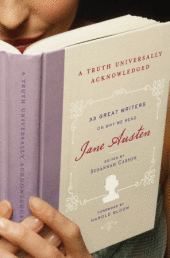
So what did I expect from a book entitled A Truth Universally Acknowledged:  33 Great Writers on Why We Read Jane Austen?

I admit, at first I thought it was a literary version of those lifetime achievement award presentations, where the honoree is showered with superfluous speeches by his/her peers, over champagne and frivolous dinner, something which Jane Austen herself would abhor.

I found out soon enough that between the modest and classic looking covers, Susannah Carson, the editor of the volume, had gathered the essays of 33 writers, not toasts or roasts, but detailed biographical notes, thoughtful musings, heartfelt admiration and in-depth analysis of Austen characters and works.  It is a collection of articles stemming from a balanced fusion of sense and sensibility, something that Austen herself would have approved.

Included are literary figures from the late 19th to 20th centuries like E. M. Forster, W. Somerset Maugham, C. S. Lewis, Eudora Welty and Virginia Woolf.  Contemporary contributors include writers, academics, Austen historian, and screenwriters.  There are views from Harold Bloom, Lionel Trilling, Janet Todd, Anna Quindlen, A. S. Byatt, Amy Bloom, to name a few.  All of them point to Austen’s inimitable humor, incisive observations of human nature and unwavering moral stance that make her works still relevant two hundred years later today.

The following are some samples from this smorgasboard of Austen delights.

Harold Bloom, writing the preface, concludes with these lines:

We read Austen because she seems to know us better than we know ourselves, and she seems to know us so intimately for the simple reason that she helped determine who we are both as readers and as human beings.

Anna Quindlen, defending the subject matter in Austen’s works being mainly about the family (it’s a pity that she even needs to do this):

…[Austen was] a writer who believed the clash of personalities was as meaningful as—perhaps more meaningful than—the clash of sabers.  For those of us who suspect that all the mysteries of life are contained in the microcosm of the family, that personal relationships prefigure all else, the work of Jane Austen is the Rosetta stone of literature.

Austen once referred her own writing as “the little bit (two inches wide) of ivory on which I work with so fine a brush, as produces little effect after much labour.”  In response, screenwriter and director Amy Heckerling, who has adapted Emma into the movie ‘Clueless’, compares Austen’s writing to a Vermeer painting:

“Sometimes the finest brushes paint the biggest truths.”

James Collins, a writer and editor, and frequent contributor to The New Yorker, shares a very personal view:

I find that reading Jane Austen helps me clarify ethical choices, helps me figure out a way to live with integrity in the corrupt world, even helps me adopt the proper tone and manner in dealing with others… Reading Austen I sometimes feel as if my morals are a wobbly figurine that her hand reaches out and steadies.

But she is not all didactic and stern… far from it.  Jane Austen has long been celebrated for her animated humour and witty ironies, the essence of her writing.  I love this analogy that Collins uses:

Her ironies swirl and drop like the cast of a fly fisherman. This rhythmic motion seems to me ideal for both accepting and rejecting the ways of the wretched world while maintaining balance.

Demonstrating the relevance of her satires for today, Benjamin Nugent, the author of American Nerd: The Story of My People, discusses the nerds in Pride and Prejudice, Mary Bennett and Mr. Collins, and why they miss out on life.

If you read sci-fi novels, you’ll generally read about worlds in which scientists and the technologies they create drive the plot; if you read Austen, you’ll read about a world in which technology means nothing and the triumphs and failures of conversational agility drive everything.

His advice for modern day nerds:

Young nerds should read Austen because she’ll force them to hear dissonant notes in their own speech they might otherwise miss, and open their eyes to defeats and victories they otherwise wouldn’t even have noticed.  Like almost all worthwhile adolescent experience, it can be depressing, but it can also feel like waking up.

It takes a sharp ear and intelligence to be a good humorist, and Austen shows that she has what it takes to be one at an early age.  About her prodigious talent, Virginia Woolf praises her first work, the novella Love and Friendship, written when Austen was only 15:

an astonishing and unchildish story… Spirited, easy, full of fun, verging with freedom upon sheer nonsense–Love and Friendship is all that…  The girl of fifteen is laughing, in her corner, at the world.

Indeed, as editor Susannah Carson has stated, any hint of ‘romance’ in her novels is merely the irony of it. About the seemingly unconvincing romantic plot in Northanger Abbey, Carson asserts:

What if Austen actually intended the romance plot to be unconvincing?  … It is probable… that Austen intended the failure of the romance plot, not to sabotage her own work, but to make a point about romance plots in general… that [they] are inherently artificial.

That Northanger Abbey is a satire on the gothic novel has long been noted.  Other writers also stress that Austen should not be labelled as a ‘romance writer’ because of the satirical styling behind her writing.  W. Somerset Maugham keenly observes:  “She had too much common sense and too sprightly a humor to be romantic.”

In his essay ‘Beautiful Mind’, writer Jay McInerney bravely admits that: “If my actual romantic life has sometimes been influenced by superficial considerations, as an Austen reader the basis of my affections has been almost entirely cerebral.

Amy Bloom sums it up succinctly about this common confusion about romance and love:

Jane Austen is, for me, the best writer for anyone who believes in love more than in romance, and who cares more for the private than the public. She understands that men and women have to grow up in order to deserve and achieve great love, that some suffering is necessary (that mewling about it in your memoir or on a talk show will not help at all), and that people who mistake the desirable object for the one necessary and essential love will get what they deserve.

To master such a distinction could well be one of the main reasons why we read Jane Austen.

**

A Truth Universally Acknowledged:  33 Great Writers on Why We Read Jane Austen, edited by Susannah Carson, published by Random House, NY, 2009, 295 pages.

**

[1] The first line of Pride and Prejudice goes like this: “It is a truth universally acknowledged, that a single man in possession of a good fortune, must be in want of a wife.”

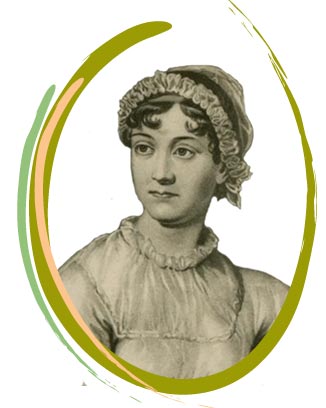
Photos Sources: Book cover randomhouse.com, Jane Austen Portrait tvo.org, Jane Austen Centre, Bath, taken by Arti of Ripple Effects, Dec. 07.

This article has recently been published in the current Jane Austen Centre Online Magazine. Click to go there for other interesting articles on Jane and the Regency world.

**

Related Posts you might enjoy:

In Praise of Austen: Virginia Woolf’s A Room Of One’s Own

A Jane Austen Education by William Deresiewicz

**

Up In The Air (2009)

UPDATE February 21: Up In The Air just won Best Adapted Screenplay at the BAFTA (British Academy of Film and Television Arts) Awards.   CLICK HERE TO READ MORE.

UPDATE February 2nd OSCARS NOMINATIONS:  Up In The Air has been nominated for a Best Picture Oscar in the coming 82nd Academy Awards.  Jason Reitman gets a nod in the directing category, George Clooney in the Best Actor category, Vera Farmiga and Anna Kendrick for Best Actress.  Jason Reitman and Sheldon Turner also received nomination for Best Adapted Screenplay.

UPDATE January 17th: Jason Reitman and Sheldon Turner have just won the Best Screenplay Award at the Golden Globes tonight.

Now that we’ve entered the new year, the awards season has arrived.  Only two weeks to go before the Golden Globes presentation, and about a week after that the Screen Actors Guild Awards, the buzz now is around the nominees.  And this one is a good start for the new year.

Watching Up In The Air is like reading an O. Henry story.  The twist at the end makes it hauntingly poignant. But O. Henry probably would not have imagined that a story could be told in such a visually dynamic way.

Following Oscar nominated Juno (2007) and Golden Globe nom Thank you for Smoking (2005), director Jason Reitman, together with screenwriter Sheldon Turner, have created a screen adaptation of Walter Kirn’s novel.  Reitman has crafted an apt and relevant contemporary tale with just the right pacing, suitable for those too rushed to stop for a story.  I’m sure they’ll enjoy this one.

‘I fly, therefore I am’ … that could well be the philosophical stance of Ryan Bingham (George Clooney).  He flies from city to city, doing something most bosses shy away from: laying off people.  Apparently Ryan loves his job.  It gives him the reason to be constantly on the go. One time on the plane, he is asked “Where are you from?’  With just the slightest hesitation, he answers: “Here.”

Ryan Bingham is also a motivational speaker.  He brings a backpack to the podium, an object lesson too vivid to ignore:  the more you put in, things and people the same, the heavier it’ll get, the more bogged down you’ll be.  His warning to his audience: ‘The slower we move, the faster we die.’  He’s the guru of non-committal living.

Goerge Clooney is perfectly cast as Ryan Bingham.  His suave, urbane sophistication is tailor-made for the role. Add in the nonchalant nuances, no wonder his performance earns him a nom for the Golden Globe.

But just when Ryan is performing so well with his air ballet — even his carry-on-suitcase-packing manuevers look sleek and stylish, thanks to some fascinating series of shots — Ryan gets notification that he’ll soon be grounded. Thanks to newly hired, Cornell grad Natalie Keener (Anna Kendrick), who has developed a video conferencing system for the company, Ryan can now do his job without leaving his office.

To phase in, Ryan is to bring Natalie along to familiarize her with his job.  It’s most amusing to watch the foil between the experienced and the naive, the callous and the tender.  At the same time, the plot thickens as Ryan meets another frequent flyer, Alex Goran (Vera Farmiga), in a hotel lounge.  Meeting Alex, who seems to share his airborne lifestyle, Ryan’s outlook on life soon faces a major turnaround.

As the film unfolds, you’ll find the title ‘Up In the Air’ not so much refers to the obvious: air travel, but a more metaphorical meaning.  It points to the existential limbo in which we sometimes find ourselves, always moving but never arriving, constantly twirling in the transitory, never coming to a rest.

Further, the film deftly deals with the questions most relevant to us all:  Is the rootless and ungrounded life worth living?  Does the ‘airborne’ phenomenon define the modern man/woman? What makes life meaningful after all?

The dramedy explores these issues without being didactic.  You’d be gratified to see Ryan’s awakening, and empathize with his situation as his path twists and turns.  With its slick editing, catchy music, witty dialogues, and great acting, the movie offers some worthwhile and enjoyable entertainment.

Up In The Air is nominated for 6 Golden Globes: Best Picture, Best Director, Best Actor, Best Supporting Actress (both, Farmiga against Kendrick), and Best screenplay.  I think this will be a strong contender comes January 17th, and will likely soar to the Oscars.

As to which O. Henry story particularly stood out in my mind as I was watching the movie? Without giving out any spoilers, let me just say: when we know we need to change, let’s just hope that we’d get the chance to do so.

~ ~ ~ Ripples

Writing from Memory and Imagination

P1010393

Upon a request from her friend and Granta Magazine editor to submit a birdwatching article, journalist Lynn Barber instead sent in a piece of memoir.   Well it was published just the same, in the 2003 Spring Issue of Granta… good to have friends in the right places.  But why not, it was an entertaining piece, albeit the name of the article might be a bit of a surprise to the editor:  ‘An Education’.  And who would have known that six years later, the short memoir would evolve into a full length, award-winning film.

In her recent article in Granta, Lynn Barber reminisced on the creative process and the adaptation from print to screen.  I find the article both amusing and enlightening.  Here are some tidbits.

Soon after her memoir was published in Granta, Barber was contacted by film producer Amanda Posey about turning it into film.  (Now that’s quick! But no… don’t think I’ll start writing a memoir, not just yet.)  But Barber was too preoccupied with other personal matters at that time to take it seriously.  Nevertheless she said okay to the proposal.  Months passed, and a contract ‘the size of a phone directory’ arrived.  Then she realized it wasn’t just talk after all.

Now to the screenwriting process.  Barber declined to write the screenplay herself, to the delight of film producer Posey, who had someone in mind already.  That was her then boyfriend and now husband the writer Nick Hornby.  Hornby’s books include About A Boy, Fever Pitch, and High Fidelity, all turned into well-received movies.  But what caught my attention is Barber’s comment:

I found it odd (still find it odd) that this pre-eminently ‘boy’ writer should so completely understand what it felt like to be a sixteen-year-old schoolgirl who was on the one hand very bright but on the other very ignorant about the world but, miraculously, he did. He even seemed to understand my parents, which is more than I could ever say myself.

Do writers always understand their own gender better?  Are they necessarily less equipped to write about their opposite sex?  Barber’s comment mentioned Hornby had grasped an understanding of her parents just as well.  Maybe it’s not so much a gender issue but one of sensitivity, empathy, and observational skills:  A good writer is a good reader of people, regardless of their gender, or age, for that matter.

It took years for the screenplay to evolve, after eight drafts to be exact.  The last one is quite a divergence from the very first.  Herein lies another interesting point.  The first draft is close to the memoir, while the last has taken a life of its own, reality has been altered to fit the screenplay genre.  The ending has also been tailored to elicit intended effects.  It speaks to the creative writing process:  Memories may be the initial springboard, but imagination is the fuel that propels the work to a visual realm.

The adaptation from memoir to screen has been a long process.  Barber notes:

Years passed, draft screenplays came and went, possible backers came and went. I would have given up by year two, but Nick and Amanda and their partner Finola Dwyer persisted and eventually, last year, the film went into production.

Apart from creativity and talent, persistence and diligence could well be the key ingredients in all sorts of production.

And finally, it boils down to memories again.  When asked about her thoughts upon seeing her sixteen-year-old self being portrayed on-screen, Barber, now at sixty-five, has no immediate answer.  She is lost in memory, again.  What exactly was her feeling at sixteen?  Or, for that matter, what had happened at twenty, or thirty?

Poignantly she asks:  Who owns memories after all?

Do memories belong to one’s subjective self?  Or to those around you who had shared your experience?  Is it merely age that has blurred the boundaries between memories and imagination, or is it our creative mind?

Or, does it even matter anyway… as long as you don’t call it non-fiction.

***

To read my review of the movie An Education, CLICK HERE.

To read Lynn Barber’s personal essay on her memoir, CLICK HERE.

Photo:  Banff, Alberta.  Taken by Arti of Ripple Effects, August, 09.  All Rights Reserved.

An Education (2009)

2725416803.JPG

UPDATE Feb. 21:  Carey Mulligan just won Best Actress at the BAFTA (British Academy of Films and Television Arts) Awards. CLICK HERE to read more. 

UPDATE Feb. 2, 2010 OSCAR NOMINATIONS: An Education receives a nomination for Best Picture in the coming 82nd Academy Awards.  Carey Mulligan gets a nod in the Best Actress category, and Nick Hornby gets a nom for Best Adapted Screenplay.

Update Jan. 23, 2010:  Carey Mulligan is a Best Actress nominee and a presenter at the Screen Actors Guild Award tonight.

Update Dec. 16:  Carey Mulligan has been nominated for a Golden Globe Best Actress Award.

Now is the time of the year that’s most gratifying. The awards season is coming up in just a few months. So this is when possible contenders are released, albeit some with just limited screening, and they aren’t likely to be your Hollywood blockbusters that might stay on for a while. That’s why I opted for ‘An Education’ over the weekend. ‘A Christmas Carol’ can wait.

An Education is the little British film that comes with high acclaim. The coming-of-age story is based on the memoir by British journalist Lynn Barber.  It first appeared in Granta magazine, later published by Penguin. The screenplay is written by Nick Hornby, the popular writer who gave us About A Boy, Fever Pitch, and High Fidelity, all turned into movies.

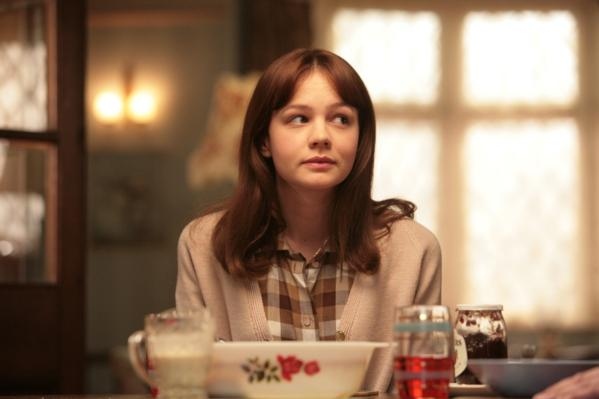
An Education won the Audience and Cinematography Awards at Sundance earlier this year.  And it might well propel Carey Mulligan to an Oscar nomination, which she so deserves. She has been noted as the young, modern Audrey Hepburn. But my impression of her is one fresh acting talent, sweet and extremely amiable. I’ve enjoyed her role in the BBC TV drama Bleak House as Ada Carstone. She’s Kitty Bennet in the 2005 version of Pride and Prejudice, and has a small role in the memorable When Did You Last See Your Father (2007). An Education is her first major role in a feature film.

Carey Mulligan plays 16 year-old Jenny convincingly. Jenny is a top high school student aiming for Oxford as she graduates in a few months, an aspiration directed by her protective yet gullible father (Alfred Molina). Oxford is certainly within reach. Jenny is smart, talented, and self-assured. She has all the potentials needed to excel academically and to launch a successful future in life. She loves art, foreign films, classical music, and French pop culture.  The city of her dream is, naturally, Paris.

1-500x332

In the cloister of 1961 Twickenham, a suburb of London, all a girl needs is just a little door opened for her and she’ll leap right out. This door to the adult world and high culture seems to have swung wide open as she meets David (Peter Sarsgaard), a man in his 30’s who offers her a ride home from school in the rain one day. That fateful afternoon marks the beginning of a dramatic turn in her life.

David brings her to art auctions, concerts, fancy restaurants and ultimately, Paris. Yet he remains secretive regarding his work. No, he did not go to Oxford, but he has graduated with flying colors from the University of Life. Thinking her new-found friend is their daughter’s ticket to higher society, Jenny’s parents gladly give their consent to their friendship, but not without some suave persuasion from David.

David also introduces Jenny to his friend and business partner Danny (Dominic Cooper, Mamma Mia!, 2008; Sense and Sensibility 2008) and his girlfriend Helen (Rosamund Pike, Jane Bennet in Pride & Prejudice, 2005)  They are to Jenny the mesmerizing and glamorous circle of adult sophistication.

Cheered on by her peers, Jenny is only frowned upon by two people, her hard-nosed headmistress (effectively played by Emma Thompson) and her English teacher Miss Stubbs (Olivia Williams, who plays Jane Austen in Miss Austen Regrets, 2008), whose devotion to her student turns out to be extremely valuable. And then there’s her school mate Graham (Matthew Beard, When Did You Last See Your Father, 2007) who has a crush on her but is no match in front of towering David.

An Education is a film of revealing. Danish director Lone Scherfig takes her time in telling the story, leading the audience through passages of beautiful cinematography and fine acting, suspenseful scenes and memorable interludes. David does not at all appear to be the nasty predator. And Jenny, on her part, also attempts to test the limit. She’s not vain, but honestly dazzled and bewildered. The consent of her naive parents passes the ball back to her court, she must learn to make choices for herself.

And so the story leads the audience through twists and turns to a gratifying end. After the ordeal, Jenny said: “I feel old, but not very wise.”  It could well be the sign of maturity itself.  There’s no short cut to adulthood after all. Great cast, impressive performance, entertaining story, enjoyable education.

~ ~ ~ 1/2 Ripples

***

CLICK HERE to read Lynn Barber’s essay in Granta magazine, chronicling the process of writing from memory, and transporting print onto screen.

AFTER you’ve watched the movie, you might like to CLICK HERE to read an excerpt of Lynn Barber’s memoir.  I urge you NOT to read it if you don’t want SPOILERS before watching the movie.


Whip It (2009)

Whip It

I can’t recall how many times I’d watched roller derby on TV, years back, maybe just a few times.  When I asked my niece who watched the movie with me, as a twenty-something, she hasn’t even seen it once.   But Drew Barrymore, in her directorial debut, has effectively captured the human side of a sport not many know about.  And with it, she has poignantly woven in some relevant issues her audience could relate to, no matter what demographics they’re in: coming-of-age, finding love, confronting parental expectations, searching for personhood and empowerment, parenting and letting go.

After watching Juno (2007), I knew I must see more of Ellen Page.  Here in Whip It, Page has proven that she’s not just impressive as an actor, but also as an athlete.   She plays Bliss Cavendar, a 17 year-old small town Texas girl, bored, docile, shuffled from one beauty pageant to another by her overbearing mother Brooke, a former beauty queen turned middle-age mail clerk (sensitively played by Marcia Gay Harden, Mystic River, 2003; Pollack, 2000).

After she watches a roller derby game with her best friend Pash (Alia Shawkat), and successfully tries out for the team Hurl Scouts in Austin, Texas, Bliss, now Babe Ruthless, sees her life take off with high octane energy.  She has passionately fallen for the high contact sport and a new boyfriend, rock band member Oliver (Landon Pigg).

The head-smashing, rowdy derby culture is probably the farthest away from the frothy and genteel beauty pageants of Texas, thus forms the great chasm between mother and daughter.  Of course Bliss tries to hide all her activities from her mother, until it can’t be covered anymore.  For she has become the poster girl for the final championship.

There are cliché sequences that we’ve all seen before, the light version of physical prowess as in Million Dollar Baby (2004), the get-back-up perseverance of Rocky, and, reminiscence of Shall We Dance (2004) in the final championship.  But, it’s all fun and even exhilarating.  Thanks to a great cast, the humor comes through naturally.  I must mention some great deadpan act from diner manager Birdman (Carlo Alban), who reminds me of Pedro in Napoleon Dynamite (2004).   Another great support is Hurl Scouts coach Razor played by Andrew Wilson.  His performance makes me feel like I’m watching a Wes Anderson movie.  Later I find out he’s older brother to Owen, then it’s all clear to me… it runs in the family.

[picapp src=”6/4/3/c/Whip_It_Los_86ef.JPG?adImageId=5337308&imageId=6660163″ width=”180″ height=”250″ /]  Barrymore has effectively created some powerful and touching scenes that make the comedy worthwhile.  It’s scenes like these that propel a comedy into the realm of meaning.  She has balanced the comical with hard reality, for it’s not simply about a girl choosing what she wants to do, purely from her own point of view.  Often our choices are entangled in a web of relationships.  Yes, we may have the autonomy to choose, but our choices also affect others.  Some gratifying moments are sensitively performed, between mother and daughter, father and daughter, and a 36 year-old derby teammate who openly shares her heart with Bliss in the car, with her young son in the back seat.

Into its second week of screening, Whip It has not fared as well as expected at the box office.  But for screenwriter Shauna Cross, who has turned her own novel Derby Girl into screenplay, I trust this is just another blow she’s got all too used to, as a roller derby girl herself from Austin Texas, before moving to L.A.  She knows how to get back up and keep on skating, even in the aggressive arena that’s L.A.

(Top Photo Source: USA Today, Bottom: PicApp.com)

~ ~ ~ Ripples

Julie and Julia (2009): Movie Review

julie-and-julia1

UPDATE Feb. 2, 2010: Meryl Streep is nominated for a Best Actress Oscar in the coming 82nd Academy Awards.

UPDATE Jan. 17, 2010:  Meryl Streep has just won the Best Actress Award (Comedy or Musical) at the Golden Globes.

Update Dec. 16, 2009: Julie and Julia has been nominated for a Golden Globe Best Motion Picture Award (Musical or Comedy).

Meryl Streep has been nominated for a Golden Globe Best Actress Award (Musical or Comedy).

For someone who would rather lie on the couch and watch the Food Channel than work in the kitchen, what better way to entertain herself than to watch a full feature movie on the legendary Julia Child and her modern day follower scrambling to keep pace.  But still, I had my doubt.

123 minutes of cooking, even though I don’t need to lift a finger, could still make me feel stuffed and exhausted. And, watching a novice attempt an almost impossible feat of cooking through Child’s 524 French recipes in 365 days in a cramped apartment could mean unlimited servings of predictable, clichéd kitchen mishaps.

So, it was with little expectation that I entered the theater.  But I was pleasantly surprised and much gratified.  For first of all,  the movie is not just about food and cooking.  Rather, it describes a journey of writing, publishing, and yes, blogging.  Now that really piqued my appetite.  As for the klutzy culinary mishaps, despite their banality, they are turned into laughable moments that we can all relate to, kudos to Amy Adams (Julie) and Meryl Streep (Julia).

Writer/director Nora Ephron has done a wonderful job weaving together two different books to create the screenplay:  Julia Child’s My Life in France (co-authored by Alex Prud’homme) and Julie Powell’s Julie and Julia:  My Year of Cooking Dangerously.  The two stories, which take place 50 years apart, are intertwined so seamlessly that the audience is given the impression that the two are acting side by side.  Now here’s a spoiler alert, skip to the next paragraph right now if you don’t want to know…  The parallel story lines remained so, Julie and Julia never met. And oh how much more the plot could have thickened if they did.  I was a bit let down by this, after being set up with the ‘Guess Who’s Coming to Dinner’ cue.

The beginning of the movie sets the stage for some visually pleasing sequences.  The retro design of Julia’s 50’s France is a scrumptious delight.  A revelation: Julia Child was not born knowing how to cook.  After following her diplomat husband Paul (the ever reliable Stanley Tucci, The Devil Wears Prada, 2006; Shall We Dance, 2004) to France, she began exploring her interests.  She had to start from scratch by going to culinary school, the Cordon Bleu.  A late bloomer she was, and what an inspiration… never too late to follow your heart.  Streep has done a marvelous job delivering the personality, speech and nuances of the legendary Julia Child.  I must say though, her performance in this movie seems like a prolonged bed bouncing scene from Mamma Mia!

julie-and-julia

And fast forward to the present, the cinematic effect makes a run down, one-bedroom apartment in Queens look cozy and even inspiring, which is justly so.  Julie Powell (Amy Adams, Doubt, 2008; Enchanted, 2007) is a struggling writer, emotionally drained by her day job answering the phone at the Lower Manhattan Development Corp in the wake of 911.  Following Child’s Mastering The Art of French Cooking at home after work saves her sanity and invigorates her desire to write.  Through blogging daily about her culinary experiment, Julie ultimately realizes her dream.

It is Amy Adams that has won my heart.  She is such a natural.  Her performance is pleasingly understated, just a touch to bring out the taste.  It is after all a thankless role, a novice following the cooking guru to the dot in her cramped kitchen.  A tad bit more spicy would spoil her portrayal as merely slapstick and banal.  Her down-to-earth demeanor, like her attempt to explain to her mother what blogging is, makes it sound like a conversation taken out of our own home.  And above all, it’s her relationship with her husband Eric (Chris Messina, Made of Honor 2008) that makes the story grounded and realistic.

And finally, bravo to the two husbands who are always supportive, encouraging, eat and praise whatever their wives cook.  And all the more for Julie’s Eric, who has to silently pop Tums before bed, and, even after running away to escape the nightly ordeal, would faithfully come back ready to reconcile.  Can these men be real?  Like Ephron’s other works, let’s just treat this one as another fantasy.  For it is she who created the screenplays for Sleepless in Seattle (1993), You’ve Got Mail (1998), and yes, When Harry Met Sally (1989).  But wait, Julia Child’s My Life In France is autobiographical.  And so’s Julie Powell’s account.  The tag line does not fail to inform us so: Based on two true stories. It’s good to know.

~ ~ ~ Ripples


Easy Virtue (2008)

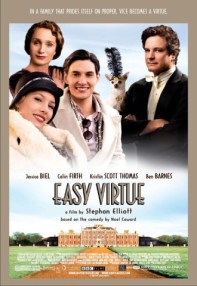
Easy Virtue posterCan we all get along?  That poignant plea is ever applicable,  from L.A to all corners of the world, today or years past.   And when it comes to families, which one doesn’t have its ups and downs?  So, since the answer is obvious, might as well make comedies out of the situation.
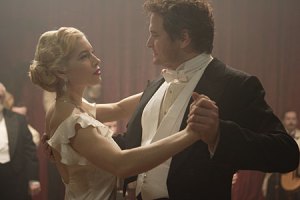
Based on the play by Noel Coward, and lavishly adorned with his songs, credits to the Easy Virtue Orchestra, the film is otherwise re-written to appeal to a contemporary audience.

The story takes place some years after the First World War, in the 1920’s.   The eldest son of an English aristocratic family, John Whittaker (Ben Barnes, The Chronicles of Narnia: Prince Caspian), comes home from abroad and brings back his new wife Larita, a race car driver (Jessica Biel, The Illusionist).  What ensue are battles on the home front between the audacious new bride and the stuffy and snobby matriarch of the family, Mrs. Whittaker (Kristin Scott Thomas, I’ve Loved You So Long).  The main spark of their explosive confrontations:  Larita is American.  And Larita does not disappoint.  She is exactly what Mrs. Whittaler expects her to be, and some more:  a gale of forbidden ideas and scandalous history.  For her performance, Kristin Scott Thomas received two Best Actress nominations.

The most intriguing character is Mr. Whittaker, played by Colin Firth (When Did You Last See Your Father, The Girl With The Pearl Earring, Pride and Prejudice).  A veteran of the Great War, Mr. Whittaker is a disillusioned man, aloof, perceptive, and cynical all at the same time.   He is the only one in the family extending a welcoming hand to Larita, and stands by his new found comrade in the domestic clash of cultures.   The climax of the story comes near the end in an enthralling scene of the two tango dancing.  Naturally, what follows is just anti-climatic.

Easy Virtue 1

The Whittakers live in a humongous mansion on acres of lush grounds for generations, reminiscence of Darcy’s Pemberley (yes, Colin Firth again), and for Mrs. Whittaker especially, no short supplies of pride or prejudice.  Whether it’s intentional of the director or not, at one scene in the Whittakers ballroom, I see Darcy, poised and tall.  But director Stephan Elliott and co-writer Sheridan Jobbins are no Jane Austen.  This comedy of manners may appear to be a burlesque of the traditional upper-class English family, but it lacks the depth of characterization and cathartic effect of an Austen work.

And that’s alright.

Easy Virtue may be frothy, loud, and ephemeral, but it is effective in delivering some witty lines, great comedic timing, some cool cinematography, and fine performance not just from the main characters, but the supporting roles.  I must mention the butler Furber (Kris Marshall), and the two Whittaker sisters Hilda (Kimberley Nixon) and Marion (Katherine Parkinson).  They have added much delight to the film.  A fun ride all the way.

I have not seen Colin Firth and Kristin Scott Thomas together in a movie since The English Patient (1996).  And truth be told, they are the reason for me to see this one.

Easy Virtue is currently released on limited screens across North America.

~ ~ ~ Ripples

Girl With A Pearl Earring

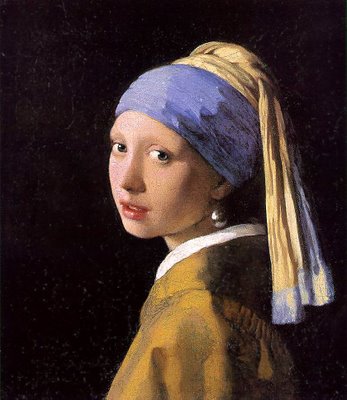
The Painting (1665)

Girl With A Pearl Earring

Not much is known about this girl looking back at the artist with her soulful glance.  The pearl earring, the focal point of the painting, is obviously incompatible with her humble attire.  Vermeer has captured a mystery open to anyone’s imagination.  But it takes a master storyteller to create a believable and poignant narrative that can move modern readers three hundred some years later.

**

The Novel (1999)

Vermeer taught me that Less Is More, and I have been practicing that aesthetic principle in my writing ever since.”     — Tracy Chevalier

You can see it coming… it’s almost like reflex that after seeing a Vermeer exhibition I’d go back to the book Girl With A Pearl Earring by Tracy Chevalier, and re-watch the DVD of the movie based on it.  Well, especially when I didn’t get the chance to see the painting itself in the exhibition.

GWAPE Book CoverIt was this book that first sparked curiosity in me about Vermeer and his works.  Tracy Chevalier has done a superb job in creating out of her imagination the story behind the girl with the pearl earring, within the realistic social and historical contexts.  She has brought to the surface layers of possible subtexts hidden in this seemingly simple portrait.

I’ve appreciated that she has chosen the social segregation and hierarchical class structure of 17th century Delft as the backdrop of her novel.  So, instead of a sweet little tale or melodramatic story,  Chevalier highlights the complex social reality of power relations between servant and master, artist and patron.  She has masterfully created a scenario whereby the social distance between the servant girl, Griet,  and her master Vermeer, is drawn closer by her quiet understanding and appreciation of aesthetics.  With the same sharpness and sensitivity,  Chevalier has also shown how a wealthy patron can exploit art with his despicable, self-serving lust.

Chevalier’s ingenuity tugs at our heartstrings as we see the innocent and powerless being played as pawns,  no more than flies caught in the web of the rich and powerful.  The struggle between survival and artistic freedom is poignantly painted as irreconcilable subjects on the canvas of financial reality.  And fate teases all.  Yet among all these, the natural light that comes from art and beauty silently seeps through, brushing us warmly with a tender glow.

Do try to get hold of the Deluxe Edition.  It includes 9 full-color Vermeer paintings, which are cleverly incorporated into the story by the author.

Girl With A Pearl Earring by Tracy Chevalier, Deluxe Edition, published by PLUME, Penguin Group, 2005, 233 pages.

~ ~ ~ 1/2 Ripples

**

The Movie (2003)

.

GirlWithPearEarring1

Watching the movie Girl With A Pearl Earring is the closest to actually seeing a Vermeer exhibition.  Every frame is like a Vermeer painting with its extensive use of natural light from windows, contrasting the shadows in the interior of the Delft household.  The film was nominated for three Oscars in 2004, Best Art Direction-Set Decoration, Best Cinematography, and Best Costume Design.  In other words, it’s a pleasure to watch… it has to be because dialogues are sparingly used throughout.  Herein lies the strength of acting and the effectiveness of sound and visual communication.

The restrained performance of Colin Firth as Vermeer and Scarlett Johansson as Griet brings out the reality of the social order of the day.  A servant is not supposed to speak unless spoken to.  And what does a master has to say to an uneducated maid, unless he sees in her the appreciation of art and the clear understanding of aesthetics, of light and shadows, of beauty in the mundane.

Vermeer’s asking Griet to be his assistant and ultimately putting her in one of his works, albeit reluctantly for both, sparks off repugnant reverberation in town, and of course, the fierce jealousy of the painter’s wife Catherine (Essie Davis).  But as flies caught in the web of patron Van Ruijven (Tom Wilkinson), with debts to pay and a full household of mouths to feed, the artist has to bow to reality, and the even lower-ranked servant has to yield to her fate.

The visuals and music are the key to revealing the internal.  Beautifully shot in Luxembourg to simulate 17th Century Delft, the movie is a work of art in itself.  Colin Firth’s usual reticent persona on film fits him perfectly this time.  His taciturn portrayal of the ambivalent artist betrays the struggles within.  Scarlett Johansson delivers a convincing performance as pure and innocent Griet, and her gradual growth on the path of experience, albeit the book, as usual, depicts the inner turmoil more effectively.

The special feature on the DVD is enjoyable as well, chronicling the making of the movie.  I hope though that a Blu-ray version will come out one of these days, for that will indeed do justice to the cinematography and to the original artist, the master painter Johannes Vermeer himself.

~~~ Ripples

CLICK on the following links to go to related posts on Ripple Effects:

Inspired By Vermeer

Books and the Gender Issue


**

The Soloist (2009): The Issue of Authenticity

The True Story

Nathaniel Anthony Ayers was born 1951 in Cleveland, Ohio.  He started his music education in the public schools.  He would be lucky to get a violin, be it one or two strings.  Music was his love and he showed his talent at a young age.  Ayers later went to Ohio University and Ohio State University. He had also played many times at the Aspen Music Festival.  His musical achievement culminated in a scholarship that sent him to Juilliard in New York City in 1970 when he was 19.

Ayers started with the double bass, later changed to the cello.  He was one of the few African-American students at the prestigious music school at that time.  Unfortunately, he only stayed there for two years.  Stricken with paranoid schizophrenia, Ayers had to drop out and return home to Cleveland.  With his talent and the training he was getting, if he had stayed on, he would have no problem getting a spot in any major orchestra in the country.  But his mother could find no solution for his worsening condition.  He was in and out of hospitals, receiving shock treatment as a last resort.

Ayers later drifted off to California and ended up living on the streets of L.A.  When L.A. Times reporter Steve Lopez found him, it was at Pershing Square, where a statue of Beethoven found a permanent home.  Passing by, Lopez heard classical music, and later discovered that it was played on a 2-string violin by a homeless man whose possessions were all that a shopping cart could hold.  That was the beginning of their friendship and the re-discovery of Nathaniel Anthony Ayers.

Lopez not only got his story, he had introduced back into society from the fringe of homelessness, the talented Mr. Ayers.  Based on this story, he went on to write the book The Soloist.  The members of the L.A. Philharmonic also offer help, letting Ayers in to listen to their rehearsals at the Disney Concert Hall, giving him lessons and playing with him the music he has loved.  As Lopez describes, music is Ayers’ medicine, these musician friends his doctors, the Disney Concert Hall his hospital.

Ayers’ real life story has been succinctly captured in a short 12 minutes documentary on CBS 60 Minutes.  From the short clip, Ayers’ gentleness, grace, articulation and musical talent readily shine through.  These few minutes’ glimpses into the person and talent of Nathaniel Anthony Ayers just show us that any story on him would be most authentically done by Mr. Ayers himself, and any feature film deservedly be a documentary.

The Movie

The authentic transposing of Ayers’ unique personality, his musical talent and techniques onto screen proves to be a challenge.  With all due respect to the excellent actors Jamie Foxx as Ayers, and Robert Downey Jr. as Lopez, the real life story just doesn’t transpose that effectively.  Ironically, the problem might well be that they are actors.  I was watching a life acted out.  Director Joe Wright has imbued the characters and scenes with colors and dramatic effects that at times, masking the poignancy with contrived overtones.

Depicting classical music talents on screen is difficult unless the actor is proficient in the same instrument.  I remember how I cringed seeing Meryl Streep ‘play’ the violin in Music of the Heart (1999).  I know Foxx is an achieved musician himself, trained in the piano but not a stringed instrument.  And I’ve heard how he had worked hard at placing his fingers on the cello to be in sync with the melody for his part in The Soloist.  Naturally, such preparation is insufficient to portray a string player of Ayers’ calibre.  The musical authenticity comes when the L.A. Philharmonic performs, but it only brings a sense of incongruence by comparison.

Director Joe Wright’s works include the passionate Atonement (2007) and the adaptation of Austen’s Pride and Prejudice (2005).  Ironically, in The Soloist, a movie where compassion and the healing power of music should be in the forefront, he falls short in depicting the heart and soul of Ayers’ story.  Wright has brought forth a hip flick, surprisingly dispassionate and two-dimensional.  The music of Beethoven could have been used more poignantly overall.  (I can’t help but think of Wright’s other work Atonement, where the rhythm and sound of just a typewriter can be so riveting.)   Also, maybe it’s a sign of our time, but I was disappointed that in a crucial scene, Beethoven’s affective power is being reduced to simply digital, visual effects.

With all its best intentions, the movie tries to touch on too many issues: homelessness, mental illness, the cure for mental illness, religious street ministry, journalism, career and marriage, … just to name a few.  I once heard a nurse say after feeling someone’s pulse: “Irregular heartbeat, all over the place.”  Now why do I have that memory while watching this movie?

I’ve been trying to pinpoint what is lacking.  One of the better film versions of classical musicians plagued with mental illness is Hilary and Jackie (1998).  Director Anand Tucker sensitively crafted an engrossing story.  Emily Watson gave a superb performance in not only depicting the inner struggles but the outward musicality of the renowned cellist Jacqueline du Pré.  Now, come to think of it, maybe what The Soloist lacks is such sensitive, articulate and refined artistry, in which light Mr. Ayers truly deserves to be portrayed.

~ ~ ½ Ripples