Our Mega Culture

A look at our summer offerings on the big screens can readily point to one fact: Bigger and louder is what we get. Apparently, they seem to be the key to box office sales. After all, aren’t those figures the raison d’etre, the reason why movies are made in the first place?

From Box Office Mojo come these stats: Iron Man 3 ($400m+ domestic box office sales, 8 weeks in release), Star Trek Into Darkness ($200m+, 6 weeks), Man of Steel ($200m+, 2 weeks), World War Z ($88m, 1 week). Don’t think it’s only the superheroes and zombies that dominate, Luhrmann’s spectacle The Great Gatsby rakes in $142 million in 7 weeks.

Here’s the irony: the bigger your city is, the more small movies you can see. And if you’re like me dwelling in one of those hamlets not on the list of ‘selective cities’, then you’re stuck with bigness all summer, like it or not. (This is my list of ‘small’ movies I’m waiting for.)

The French director Jean-Luc Godard once said:

As soon as you can make films, you can no long make films like the ones that made you want to make them.

The legendary film critic Pauline Kael interpreted his statement as follows [1]:

This we may guess is not merely because the possibilities of making big expensive movies on the American model are almost nonexistent for the French but also because as the youthful film enthusiast grows up, if he grows in intelligence, he can see that the big expensive movies now being made are not worth making. And perhaps they never were: the luxury and wastefulness, that when you are young seems … magical, become ugly and suffocating when you’re older and see what a cheat they really were.

Kael wrote that in 1966, that’s forty-seven years ago. How I wish she could be around now. Sure like to hear what she has to say about all the summer blockbusters we’re getting. What we have mainly are sequels to previous blockbusters, their makers hoping the trend would perpetuate. Would Kael revise her view now? Big movies not only are still being made, they have become more and more popular. It seems viewers don’t care much that the emperor has no clothes.

It’s Gatsby’s idea, isn’t it? The grander, louder and more spectacular the party you throw, the higher chance you just might get what you’re looking for. Alas, look at the ending.

Who makes the trend? The marketers of movies would tactfully say they’re just offering what people want. But subtly, or not so subtly, what people want is also shaped by marketers. Mass appeal and popularity have overridden discernment and individuality. Do you find viewers’ tastes have changed over the years? Or, do movie goers nowadays belong to a different demographics than before?

What I’m concerned is the obliteration of the already elusive notion of film as an art form. We’re now too dominated by bigness, and spectacles, and technologies, rather than going into the story, characters, techniques, meaning… the still, small voice of fine artistry.

Star Trek Into Darkness

I’d the chance, ok, my choice, to go watch Star Trek Into Darkness and Man of Steel recently. Interesting contrasts there. I used to be a Star Trek fan. Yes, used to be because the Star Trek we have today is a totally different product altogether, albeit the character names remain the same. This current one looks like school children play-acting… serious pretending, frantic scurrying here and there, and loud blasts into oblivion. The only adult seems to be Benedict Cumberbatch as Khan.

Man of Steel has more mature actors and more serious acting, but the second half is not much different, gratuitous CGI action sequences that are 30 minutes too long, and loud blasts into oblivion.

The constant bombardment of expanded loudness in the theater had only one effect on me, made me turn off my receiver, same effect as somebody wanting to win an argument by raising his voice at me.
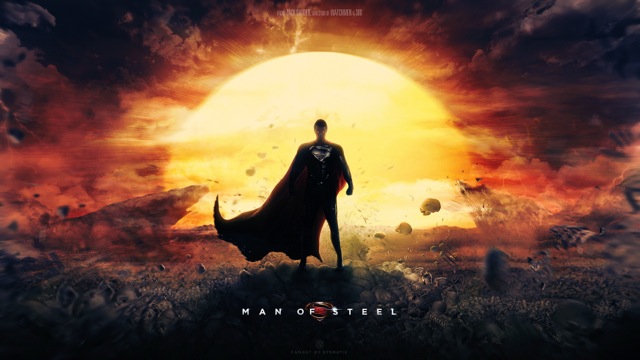
Man of Steel 1

Truth be told, because of the cast I went to see this revision of Superman. Kevin Costner and Diane Lane as Clark Kent’s earth parents? Who can miss that? Amy Adams as Lois Lane? I’m sold. And, Michael Shannon as the evil General Zod coming to turn earth into Krypton? I must see how he does it.

And the current Star Trek, what strange new world it has gone to where no one had predicted before. My favorite is still the original TV series. As for the movies? It’s Star Trek VI: The Undiscovered Country (1991). That’s the swan song of the original TV cast and one where Christopher Plummer as the Klingon General Chang recites Shakespeare like he’s at the Stratford Festival. His lines come from The Merchant of Venice, The Tempest, Romeo and Juliet, Julius Caesar and Hamlet. If you want postmodernism across the media, here you have a perfect mash-up. Yes, light years away from the Star Trek of Summer 2013, and generations apart.

Steven Spielberg in a recent statement made at the opening of a new USC Cinematic Arts building predicted there would be an ‘implosion’ in the movie industry, ‘where three or four or maybe even a half-dozen megabudget movies are going to go crashing into the ground, and that’s going to change the paradigm.”

He also added we might have to pay $25 to see the next Iron Man, but $7 to see Lincoln. A scenario which George Lucas echoed. Umm… if those are the ticket prices for the different kinds of movies in the future, not a bad sort of a paradigm shift.

***

[1] These two quotes are taken from Pauline Kael’s review of Jean-Luc Godard’s Band of Outsiders (1964), from American Movie Critics: An Anthology from the Silents Until Now, Expanded Edition, edited by Phillip Lopate, published by The Library of America, N.Y., 2008.
Drifting with the Current of Memory: Kon-Tiki (2012)

Once upon a time a young school girl, an English language learner in the then British Colony of Hong Kong, had to read an abridged version of the book The Kon-Tiki Expedition written by Norwegian explorer Thor Heyerdahl. The ESL student was told it was a true story. She was most curious to find out the details of this extraordinary journey of six men on an open raft roughing it on the tumultuous South Seas. But due to her limited English language skills, she had a hard time comprehending the details of the adventure Heyerdahl described.

Now decades later, as soon as she knows that a movie by the name of Kon-Tiki is showing on the big screen, her long tucked-away curiosity is unleashed. Now she finally has a chance to find out what this sea voyage is all about. Here are the ripples.

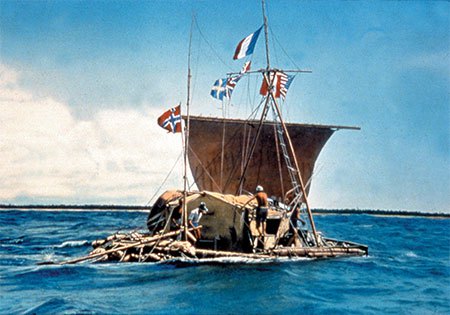
Norwegian ethnologist and explorer Thor Heyerdahl embarked on The Kon Tiki expedition in 1947 to prove his own theory that the Polynesian Islands on the Pacific Ocean were first colonized by people from Peru in South America some 1,500 years ago, and not those of nearby Asian countries as generally thought. Heyerdahl and five other men built a raft with balsa wood, using ropes and technology of pre-Columbian times, and set sail on it by letting it drift with the current from Peru, just to prove the feasibility of such a journey. Only one of the men had had some navigation experience, and, we found out later in the film, Heyerdahl himself could not swim. But in 1947, after a period of 101 days, they succeeded in reaching the Polynesian islands, almost 5,000 miles away. Quite a risky trip to prove a self-propelled theory. Herein was sown the seed of adventure and endurance.

Kon-Tiki (2012)

The film is 2013 Oscar nominee for Best Foreign Language Film from Norway. It starts off well by showing a young Heyerdahl as a child in Norway already a risk taker who seeks out the most dangerous feats to perform. The camera works at eliciting interesting human faces with close-ups of a mischievous child growing into a tall, blond hair, blue-eyed, chiselled physique, explorer of the Polynesian Islands. Listening to an aboriginal elder tell their people’s story, Heyerdahl (Norwegian actor Pål Sverre Hagen) is determined to test his theory with his life on the line, against the restrained protest of his wife Liv (Norwegian actress Agnes Kittelsen). More treatment of the conflicts is much wanting here, as enthusiasm of the adventurous husband meets exasperation from his wife and mother of his two boys.

Likewise, while on the rough seas, conflicts and comradeships among the six men seem to give way to tense moments of swashbuckling shark fights. At certain points, scenes from Life of Pi came to mind… the flying fish, the whale circling under the raft, the shark attacks, the sun sinking beneath the horizon. Moments that are aesthetically gratifying in Pi appear to be quite matter-of-fact here. No matter, Norwegian directors Joachim Rønning and Espen Sandberg chose to use a simple and straightforward style to tell their story, nothing philosophical to be pondered as in Pi.

If just to satisfy the curiosity of the once bewildered school girl, the movie suffices. It captures my attention and offers some suspenseful and thrilling scenes, at times reminiscence of yet another movie, Jaws. So, Pi and Jaws, what images the Kon-Tiki movie leaves me with that are its own are basically the six messy blond hair and bearded, muscular (except one), well tanned Norwegian and Swedish men speaking English, and, looking quite similar to each other. Eventually, they see a gull flying in the sky. Spirits are highest at that point, for land is near.

What’s quite effective is the inclusion of what seems to be the archival black and white footages of the original trip well mashed into this modern version. But here’s my disclaimer: Upon this first viewing, I’m not too sure if they are the actual footage, or imitation archival footage. I have tried to find out on Google but to no avail. However, I did find out that all the ocean life of sharks, whales, and fish are CGI, computer generated images… just like in Pi.

It’s also interesting to note that, at the end of the movie when the credits roll, there is a disclaimer stating the movie is fictional and that any relationship to the facts is accidental or coincidental. With this, I as a viewer is at a loss as to the accuracy of the whole storytelling on screen. This points to the value of the actual footage which the real life Thor Heyerdahl shot with his 16mm camera, later edited into a feature film that won the 1951 Academy Awards for Best Documentary.

We know for a fact that they reached their destination, no small feat of survival and endurance that from my childhood memory, was much more detailed even in the abridged ESL version of the book. So, yes, it looks a bit too easy and simplified in this movie. And, the ultimate argument still remains like a hung jury. The fact that they had succeeded in reaching the Polynesian Islands on an open raft all the way from Peru did not prove that the Peruvian had colonized the Islands. The film did not deal with this argument. But, just for satisfying the curiosity of the once young and bewildered English learner, it is a sufficiently entertaining movie. A highly watchable summer beach flick.

~ ~ ~ Ripples

***

Related Posts:

Life of Pi: The Magical 3D Experience

Life of Pi by Yann Martel: Take the Literary Journey Before the 3D Experience 

***

Summer Viewing List

Summer Reading Lists have begun to sprout everywhere. Some prefer lighter beach reads, and others use this time to catch up on heavier non-fiction works.

While I love book lists and recommendations, as a cinephile, I also have my list… films to be watched, those I highly anticipate to come around hopefully soon to my city. Here’s my TBV (To Be Viewed) list for this summer on the big screen:

Frances Ha – A NYC set black and white film in 2013? The trailer evokes Woody Allen’s Manhattan. I know Noah Baumbach has his own style, considering some of my favourite films are his works, The Squid and the Whale, Fantastic Mr. Fox. Co-writer and star Greta Gerwig, who is a good balance to Ben Stiller in Greenberg and distinctive in To Rome With Love albeit in a minor role, should be a delight. This I highly anticipate.

Before Midnight – The third and final instalment of Richard Linklater’s chance encounters of Before Sunrise, and Before Sunset. Real time, dialogue driven films almost created a genre of their own in the first two instalments. Ethan Hawke and Julie Delpy regroup nine years later in Greece. Whatever had happened in their lives between years?

Summer breeze, makes me feel fine…

Before Midnight

Much Ado About Nothing – Shakespeare and summer go hand-in-hand. Not in the park, this one’s shot right in director/screenwriter, of Avengers’ fame Joss Whedon’s own backyard in Santa Monica, CA. A postmodern take, and … black and white? Keeping the original work handy can help to reveal what’s Shakespeare’s and what’s Whedon’s.

Blue Jasmine – Woody Allen has been bringing us a new film a year over the past four decades. Can you not admire the stamina and creativity of this man, now 78. Allen’s 2013 instalment brings him home to NY and CA. Cate Blanchett, Alec Baldwin, Peter Sarsgaard star. I highly anticipate his 2014 work though, already announced and in pre-production. This time, back to France with Colin Firth. Yes folks, just another year.

Blowing through the jasmine in my mind…

Jasmine

Gambit – scheduled to come out later this year, Colin Firth and Cameron Diaz reprise the 1966 British comedy that starred Michael Caine and Shirley MacLaine. Alan Rickman also in this new remake. Much ado about a fake Monet painting. Should be another breezy flick but probably after summer, if it ever comes this way.

To The Wonder – Terrence Malick’s 2012 work just one year after The Tree of Life still hasn’t arrived here, albeit screened months ago in other more major cities. Not as highly acclaimed as the mesmerizing Tree of Life, To The Wonder is still alluring for me, a Malick fan. Good to see that the reclusive director seems to be busier now so we don’t have to wait for a decade to see his next work.

What Maisie Knew – Again, still not here albeit has been screened in other more major cities. Just rubs it in once more as to where I’m living. Julianne Moore and Alexander Skarsgård lead the cast in this newest Henry James adaptation. I’ve enjoyed previous James’ work on screen like The Wings of the Dove, The Golden Bowl, and The Portrait of a Lady. What Maisie Knew seems like a smaller work, looking at the novel. So would like to read that before seeing the film.

Summer in February – After Downton Abbey, Dan Steven’s new film … looks like an artsy romance. Alas, don’t think it will come to North America though. But hopefully PBS or HBO or the Movie Channel will one day pick it up. Dominic Cooper and Dan Stevens fall for the same girl in an Edwardian artist colony in Cornwall. From the trailer, looks very artsy and Downtony.

Inside Llewyn Davies – Coen Brothers’ newest film on 1960’s NY folk music scene. Oscar Isaac, Carey Mulligan, Justin Timberlake star. And they all sing… Music and singing play a key role in many Coen films. Now this one focuses on a musical period I love, and follows the erratic life of a fictional folk singer/songwriter. Just found out it is scheduled to be released in December. Long wait, but considering the timing, this one is bound to show up as a contender comes next Award Season.

And, while waiting for all these to come on the big screen (yes, I still feel movies ought to be viewed on the big screen, at least the first time), summer is also the best time to catch up on some classics I’ve missed in past years/decades. This list can be unending. Another post.

***

Related posts you might like:

Upcoming Books to Movie Adaptations

Woody Allen’s Midnight In Paris movie review

Terrence Malick’s The Tree of Life movie review

True Grit: A Cool Summer Read and Movie

***

Jasmine photo from Wikipedia Commons, Movie Poster original source unknown

The Great Gatsby (2013): Movie Review

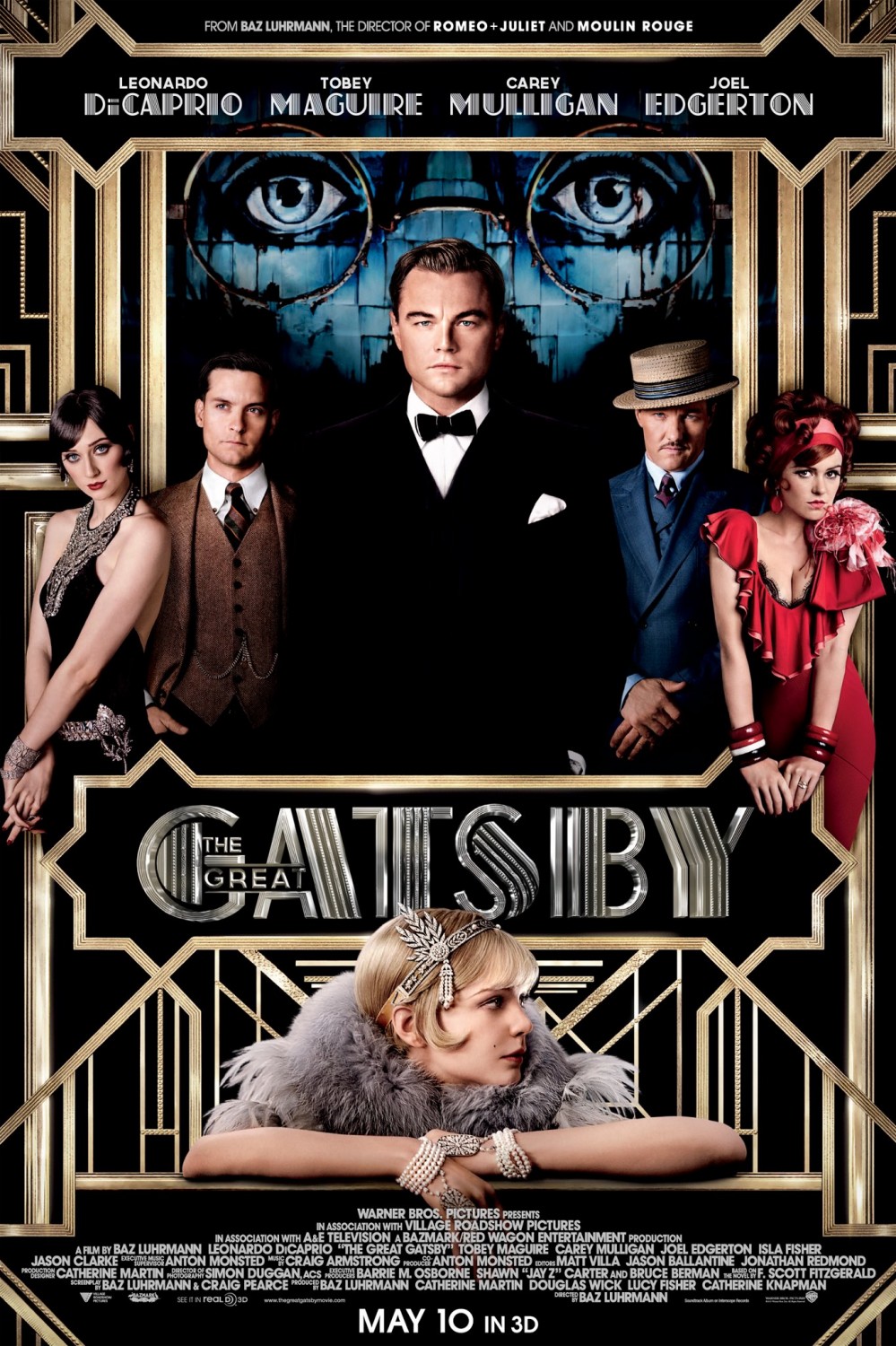
In just 172 pages, F. Scott Fitzgerald has captured the zeitgeist of the Jazz Age, and told the stirring story of love and loss. In this new adaptation of the book, director Baz Luhrmann has used an estimated $127 million, glamorizing with 3D and over the top cinematic effects.

Here is a prime example of ‘the medium is the message.’ Instead of depicting extravagance and excess, the production has become that.

the-great-gatsby-poster1

I went in with an open mind. After all, I had expected a mashed-up, postmodern fusion Luhrmann style. So, even the Jay-Z curated hip hop selections a la Gershwin cacophony was fine with me. After all, it was the unruly Jazz Age, so be it. Gatsby’s creamy yellow roadster speeding towards Manhattan, zigzagging its way through busy streets, Fast and Furious 1920’s version is still acceptable. By the way, the movie was shot in Australia. So, all the Manhattan scenes are visual remixes.

But the main issue for me is the 3D. Not much to be gained there but hindrances. The effects make me feel like I’m looking into a View-Master, artificial and gratuitous. For Gatsby, the extravaganzas in his mansion are only means to an end, to attract his love, Daisy; in Luhrmann’s hands, they are an end in themselves. The flamboyant and ostentatious parties, like their uninvited guests, overstay their welcome in the first part of the almost 2.5 hour production.

If Luhrmann had only used more of his wealth of resources: the rich and talented cast, to explore the story more and go deeper into characterization, and less partying, the movie would have been a wonder.

After all the glitz and glam in the first act, my enjoyment begins when Gatsby meets Daisy in Nick’s humble abode, a set up masterminded by Gatsby. It has taken him five years to this very moment. It is this scene that draws me in from being just an aloof onlooker. From without to within, it is the story and the characters that engage me more than the visual spectaculars.

Leonardo DiCaprio is a fine Gatsby, convincing and comical at times. Carey Mulligan may not be the Daisy I had conjured up from reading the book, but she has mastered her role well on her own terms. She’s a much sweeter, less careless Daisy than I had in mind. Elizabeth Debicki is an apt Jordan Baker. Joel Edgerton as sneaky and snobbish Tom Buchanan needs to smile more, and Tobey Maguire as Nick Carraway less. The veteran actor Amitabh Bachchan is a good choice for Meyer Wolfsheim. Isla Fisher as Myrtle Wilson, what a change from a shopaholic, and Jason Clarke too much a hunk to be wimpy Wilson.

One major alteration that I’ve appreciated is Nick writing out the story as a therapy recommended by his doctor, apparently a psychiatrist. The story of Jay Gatsby is also Nick’s own story as a writer. By articulating his experience in words he pays tribute to an unforgettable character, a dreamer who always sees the green light. Without giving out a spoiler, let me just say, the little twist at the end is a nice touch to this new adaptation of The Great Gatsby.

Does it worth a watch? I’d say yes, even in the 3D version. Curiosity is insatiable. And hopefully, the visual spectaculars can draw the viewer back once again to the literary offering Fitzgerald had first created. That’s one positive effect a movie adaptation can generate.

~ ~ 1/2 Ripples

***

A related Post I wrote 3 years ago at the announcement of this new adaptation. My open letter to Baz Luhrmann:

The Great Gatsby: A New Version

***

Ruth Prawer Jhabvala: A Tribute to Rootlessness

On April 3, one day before Roger Ebert died, Ruth Prawer Jhabvala passed away from illness at the age of 85. Her death seemed to have been overshadowed in the next few days by Ebert’s. I feel here’s a life that ought to be noted as well, but maybe for a special reason.

ruth-prawer-jhabvala

Ruth Prawer Jhabvala was best known for her Oscar winning adaptations of E. M. Forster’s A Room With A View and Howards End. Her other screenplays include Kazuo Ishiguro’s The Remains of the Day, Henry James’s The Golden Bowl and The Bostonians, among a total of twenty-six.

But for Ruth (to discard formality and to focus on the person, allow me to call her Ruth), adapting screenplays was only a hobby. Her main calling was to be a writer of her own stories. She had heeded that call with fervour since childhood. Guardian’s obituary mentions Ruth once said about her writing time as “the only three hours in the day I’m really alive.”

There are thirty titles by Ruth Prawer Jhabvala on Goodreads, including novels, short story collections, and her works in anthologies. Among her accolades, most well known is the 1975 Booker Prize for her novel Heat and Dust, about the meeting of East and West in India. Her short stories had been published in The New Yorker since 1957, thirty-nine of them. Her latest appeared just one month before her death. She is the only person who had ever won both the Booker and the Oscar. Two Oscars, to be exact.

Reading her obituaries from several sources, I’m more intrigued by this matter of laying down roots, or rather, of rootlessness in the landscape of our life.

**

Ruth was born in Cologne in 1927 to a Polish father and a German mother. Her family was assimilated Jews in Nazi Germany. Her grandfather was the cantor in Cologne’s biggest synagogue. Her father Marcus was a lawyer. Assimilated or not, Ruth and her brother had to flee with her parents in the nick of time in 1939 to England. She was 12.

For the next twelve years, she grew up in London, learned a new language, adopted a new identity, and later graduated in English literature from Queen Mary College, London University. In 1948, upon finding out all members of his family were killed in the Holocaust, more than forty of them, Ruth’s father took his own life.

In 1951, when she was 24, Ruth married the architect Cyrus Jhabvala in London and followed him back to his native country India. Another uproot and transplant, this time, to a whole new continent. They settled in Delhi. For the next 25 years, Ruth immersed herself in her adopted country as a wife, mother, and writer. Colonial and post-colonial Indian life, East-West relationship and caste conflicts became her subject. Despite her effort in total immersion, she had not taken roots in India.

Finally, In 1976, a third continent, as Ruth and her husband moved to New York City. There, she found a place closest to a notion of home, paradoxically, because of “many people like herself: refugees, outsiders, interesting American discontents,” wrote the remaining Merchant-Ivory-Jhabvala collaborators, director James Ivory, in Time magazine’s tribute.

**

While still in India, Ruth had already collaborated with Merchant and Ivory on several movies. Now in New York, she lived in an apartment on the same block as they. The proximity of actual geographical location fostered a prolific period of their lives. Together, they had joined hands in more than twenty productions. Their forty years of collaboration remains the longest in movie history.

Ivory Jhabvala Merchant
Ivory, Jhabvala, Merchant

How did rootlessness affect her perspective? In Guardian’s obituary, I found this inspiring excerpt:

I stand before you as a writer without any ground of being out of which to write: really blown about from country to country, culture to culture, till I feel—till I am—nothing.” And yet, she said, this was one of her strengths. Many of her stories are about a kind of inner travel: feeling rootless, her protagonists find new ways to feel at home in the worlds they happen to inhabit.

Perhaps, in the vast landscape of literature, such rootlessness is essential for the imagination to take flight. Rootlessness allows flexibility and fluidity of navigation, the freedom to roam. Rootlessness can more readily unlock the wayfaring spirit within, and embrace change.

One result of being rootless could well be the hybrid identity. Amusingly the Merchant-Ivory-Jhabvala team itself is a good example. Producer Ishmael Merchant was a Muslim from Bombay who had settled in America; director James Ivory is the son of a French-Irish American; Ruth Prawer Jhabvala was a Polish-German-Jew from Cologne, Delhi, London, and New York City.

Perhaps as Nick Carraways, the narrator in The Great Gatsby, observes, only by being “within and without” can we see “the inexhaustible variety of life.”

***

Related posts and links:

Obituaries and tributes from The Guardian, The Telegraph, The Paris Review, Time Magazine, The New York Times.

Since 1957, The New Yorker had been publishing Ruth Prawer Jhabvala’s short stories, a total of 39, her last appeared only one month before her death. Thanks to The New Yorker, we can now read Ruth Prawer Jhabvala’s short stories online.

My book review of Howards End, my post on the Merchant Ivory production of Howards End, my review of A Room With A View (TV, 2007)

***

Photo Sources:

First photo from The Paris Review; Second photo from The Telegraph

Oscar Results 2013

Argo (3): Best Picture, Film Editing, Adapted Screenplay

Life of Pi (4): Best Director Ang Lee, Cinematography, Original Score, Visual Effects

Les Misérables (3): Best Actress in a Supporting Role Anne Hathaway, Makeup & Hairstyling (hair’s new this year), Sound Mixing

Lincoln (2): Best Actor in a Leading Role Daniel Day-Lewis, Best Production Design

Silver Linings Playbook (1): Best Actress in a Leading Role Jennifer Lawrence

Django Unchained (2): Best Supporting Actor Christoph Waltz, Original Screenplay Quentin Tarantino.

Skyfall (2): Best Original Song Adele, Best Sound Editing (draw with ZDT)

Zero Dark Thirty (1): Best Sound Editing

Anna Karenina (1): Costume Design

Amour (1): Best Foreign Language Film

The above is a list of the major winners. For a full list, CLICK HERE.

**

The film winning Best Picture is always considered the major winner. So Argo it is. Interesting that the director of a Best Picture is not even nominated. No matter, the 1979 Iran hostage crisis came to a glorious end for Ben Affleck. “… it doesn’t matter how you get knocked down in life because that’s going to happen. All that matters is you gotta get up.” Glad he thanked Canada in his acceptance speech, along with Iran. Equal opportunity thanker he is.

Life of Pi has the most Oscars. I’m excited for them. Canadian composer Mychael Danna wins with his Indian-influenced score. Director Ang Lee gave a gracious acceptance speech thanking Taiwan, where he filmed the majority of the movie, all the 3,000 people involved in the production, and yes, the author of the Booker Prize winning novel, Canadian writer Yann Martel. For those who are book lovers and don’t want to spoil their good memory of their reading experience, I say, go see the film. It’s worthy of its literary source.

Glad to see Les Miz being honored with three awards. The dream came true for Anne Hathaway, winning her first Oscar, as expected. Deservedly, the Make-up and Hairstyling people won as well, with hairstyling being the first time recognized at the Oscars. Just look at Hugh Jackman at the opening scenes you’d appreciate their effort. That he didn’t eat or drink for over 13 hrs to shoot those scenes helped too. The highlight of last night’s Awards Show for me was the whole Les Miz cast singing on stage.

While I’m at that, get the orchestra back in the Theatre where the action is next time. You can hear the discrepancy in timing with the singing at certain points. And please, don’t rush people off stage by playing all those irrelevant (or maybe tackily relevant) old movie themes. So rude to the present winners and disrespectful to those past productions. Here are some I remember… Jaws, The Magnificent Seven, The Godfather, Gone with the Wind (that’s when Quentin Tarantino was speaking).

Why, with all the technical talents around, the tribute to fifty years of James Bond was done with such a lack-lustre montage? To help us forget it, Shirley Bassey came on stage to sing Goldfinger after that. In my opinion, Goldfinger is probably the best James Bond song. And Bassey just showed, at 76, the unfading colours of a great voice. So’s Barbra Streisand, at 70, delivered a moving The Way We Were after the Memoriam clip, paying tribute to Marvin Hamlisch who wrote the Oscar winning song (1974). Memories flooded back as she sang at the Oscars the first time last night after 36 years. With all due respect to Adele and her Skyfall win, these two veteran singers made a sharp contrast to her shaky performance.

Now, Lincoln‘s disappointing results baffled me. Coming into the Awards Season, it was the strongest contender, with 12 nominations. The only major win was Daniel Day-Lewis who was almost locked-in for Best Actor, and deservedly so. He is now the only actor winning three Oscar Best Actor awards. I’ve seen all his winning films. While his Lincoln portrayal is impressive, I remember being captivated by his first Oscar winning role in My Left Foot (1989) as Irish writer Christy Brown who was afflicted with cerebral palsy and could only use his left foot to write.

And then there’s Jennifer Lawrence, what a good sport. It’s embarrassing falling on the steps going up the stage, but getting an Oscar way over compensates for it. Her performance in Silver Linings Playbook confirms her position as a leading female character actor at 22. I’ve seen her much younger performances before all the Hunger Games hype, and knew that she would be a rising star. The two films I’m thinking of are The Burning Plain (2008) and Winter’s Bone (2010).

As for the film and the actress I’ve been silently rooting for, Zero Dark Thirty and Jessica Chastain, well, at least it has one Oscar. I’m not too disappointed though for I trust Kathryn Bigelow‘s talent and skill can only create more strong productions, and hopefully not being marred by unnecessary controversies like she has with ZDT. As for Jessica Chastain, I know she will deliver in whatever film she’s in… given a good role and in the hands of a capable director. I wish her all the best.

As for next year’s Oscars? Captain Kirk is right… you’d want to honour the film industry, not to spite it with a bad host and degrading jokes, no matter how entertaining the singing and dancing are. Yes, I’m referring to the opening number, plus some other ones that left us with a bad aftertaste. So please, bring on a different perspective, one that represents the other half of the human race. Let’s have Tina Fey and Amy Poehler to co-host next year’s Oscars.

 ***

CLICK ON the following links to my review of:

Life of Pi the movie

Life of Pi the book

Zero Dark Thirty and Argo

Lincoln

Les Miserables

Anna Karenina the movie

Anna Karenina the book

***

The Girl In the Cafe (2005): The Hunger for Connection

February is the month that raves about love. It’s also Awards Season, culminating with the Oscars. With all the competing productions on the big screen, are you getting a bit overwhelmed by now? Or maybe a little indigestion even?

Here’s a little gem of a film, like lemon sorbet, simple and fresh, just to clear the palette. It’s only recently that I come across this DVD dated a few years back. O what a find! I took it out from the public library, have watched it three times, and maybe more before I ultimately return it.

Directed by David Yates (State of Play, TV) and written by the screenwriter who has brought us Bridget Jones’s Diary, Notting Hill, Four Weddings and a Funeral, Love Actually… Richard Curtis, The Girl in the Cafe is a reason why we should not dismiss TV movies or those that go directly from production to DVD.

The Girl in the Cafe

The story begins with a chance encounter. Lawrence (Bill Nighy, The Best Exotic Marigold Hotel) is an aging civil servant, a senior-level analyst working for the British Chancellor (Ken Stott). During one coffee break Lawrence, single, well no, married to his job, shares a table with a girl Gina (Kelly Macdonald, Dolly in Anna Karenina) in a crowded cafe. Thus sparks a genuine connection between the two. On a whim, Lawrence asks Gina to accompany him to attend the G8 Summit in Reykjavík, Iceland, the following week.

What’s that? Gina asks. Right, a most incompatible relationship. But just because of that, the drama, and conflict, sparks off. Lawrence’s shy demeanour fits perfectly with Gina’s quiet composure. But for both actors, their restrained and understated performance form the very essence of this charming and thought-provoking film.

Once there in Reykjavík, Gina is appalled by the facts she learns about world poverty from Lawrence, like, one child dying in every three seconds. She takes a very personal stance on the success of the Millenium Development Goals to fight extreme poverty. While heavy police force keeps protesters out of the Conference venue, Gina becomes one small voice that speaks out from inside, genuine and innocent among seasoned politicians, albeit bringing Lawrence unexpected ambivalence. Some may find it uncomfortable to watch this scenario, but I feel it is one that deserves to be played out, and definitely to be heard.

What grabs me right away as the movie begins is the soul stirring song ‘Cold Water’ as the images of Lawrence going by his daily routine all alone. At coffee break, he steps into the crowded cafe, and finds another soul also alone. It’s gratifying and a pleasure to watch them connect and warm up to each other in a most genuine and tender manner.

As the film ends, ‘Cold Water’ reprises, but by now I see the parallel. Not only do Lawrence and Gina reach out for human connectedness and love, the millions of dying children in extreme poverty are also uttering these words of the lyrics:

“Cold water surrounds me now.
And all I’ve got is your hand.
Lord can you hear me now?
Or am I lost?”

Don’t we all need a helping hand for the different kinds of hunger we experience as human? The song and the music in the film augment its impact in a quiet and haunting way.

Bill Nighy owns the role of Lawrence. His self-deprecating and gentle manner fits in perfectly with Kelly Macdonald’s authentic and genuine Gina. The two have such connectedness in their performance that they earned Golden Globes nomination for Best Actor and Actress the following year.

The DVD came with special features which include director and screenwriter’s commentary. That is definitely a bonus after viewing the film. From there I found out Nighy and Macdonald were in the British TV series State of Play before doing The Girl in the Cafe. So that’s exactly what I did… went to the library to borrow the DVD’s of the TV series, and binged-watched all six episodes, which I highly recommend as well.

~ ~ ~ Ripples

***

Watch on YouTube Damien Rice’s ‘Cold Water’ with lyrics.

***

Read my other reviews on films about love:

I’ve Loved You So Long

Away From Her

Never Let Me Go 

Zero Dark Thirty and Argo

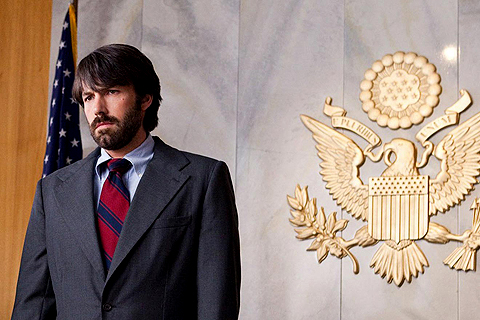
There are several reasons I link these two films together. Both are acclaimed productions which have already garnered awards. While both films have been nominated for Best Picture in the 2013 Academy Awards, both directors, Kathryn Bigelow and Ben Affleck have been snubbed in the Best Director category. The reason I do not want to speculate. But for one of them, I have a hunch.

These are very American films, depicting Americans in crisis and its aftermath. Argo is about getting Americans out of Iran during the 1979-80 hostage crisis in Tehran, Zero Dark Thirty (ZD30) about hunting and getting into Pakistan to take down Osama bin Laden. Both involve the intricate work of the CIA.

And, both have driven me to the edge of my seat, despite the fact that I know the ending of the event they portray. This is the power of visual storytelling. But for me, the similarities may well end here.

Ben Affleck

Argo rests on one man, Tony Mendez, a CIA officer who masterminded the rescue mission, information declassified only in recent years. Played by director Ben Affleck, Mendez is decorated with CIA’s Intelligence Star and received other accolades after that.

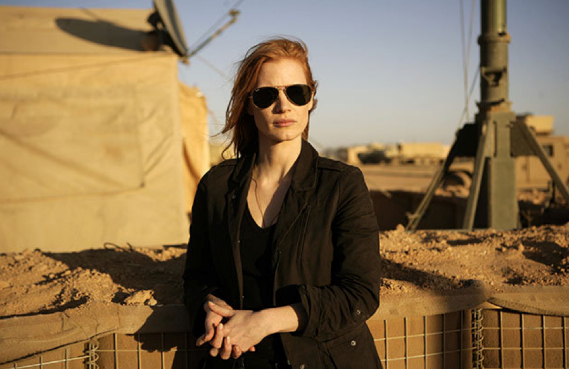
ZD30 rests on one woman, known only as Maya in the film. A young CIA officer who for ten years, dedicated her life to the searching for Osama bin Laden. She is relentless in her pursuit, fighting not only outward threats of physical dangers but bureaucracy within an alpha male work environment. Her identity remains hidden.

Jessica Chastain has once again shown how versatile an actor she is. I have seen her in some very different roles: The Debt, The Tree of Life, Take Shelter, The Help. Here in ZD30, she has convincingly portrayed a strong leading female character with finesse. Her performance not only carries the film but our emotion as well.

Jessica Chastain

And not only Maya, ZD30 has shown us there are other female CIA officers performing perilous duties. Her friend and colleague Jessica is one of them. Now, as I watched this Jessica on screen, I kept thinking she looked so familiar. Only when I watched the credits roll at the end did I find out, lo, that’s Jennifer Ehle, Elizabeth Bennet (Pride and Prejudice, 1995) or a bit closer, Myrtle Logue in The King’s Speech (2010).

Director Kathryn Bigelow has done an exceptional job in turning Mark Boal’s original screenplay into a tight and engrossing film. Both won Oscars for The Hurt Locker (2008), Bigelow being the first woman to win the Best Director award. At the beginning of the film, we are told it is based on firsthand accounts of actual events. Despite knowing the ending, I was still captivated every step of the way, following the intelligence gathering process, the narrowing down of leads and locations, the red tape. The film is an alchemy of facts and fiction, a creative fusion. But for the audience, there is no way to distinguish which is which.

That leads to the controversial issue, one that some in Washington and now the Academy have condemned, the issue of torture. And here’s my take. Isn’t it a bit simplistic to argue that since the film depicts scenes of torture of detainees to get leads and information, it means that the filmmakers condone or even promote torture?

While the U.S. Administration had denied using any torture tactics in the final capture of bin Laden does not mean the total absence of them over the ten year post 9/11 period, both known or later discovered. The photos from Abu Ghraib prison are still vivid in my mind. None of the scenes in the film can compare to those real life photos. Or, come to think of it, could Abu Ghraib have informed the screenwriting? This being not a documentary, but a dramatized fusion, can one separate facts and fiction so clearly?

Or take Argo, how much is true about the rescue mission? How much is dramatized? What proportion should we give credits to the mastermind Mendez and the CIA, and how much should we credit the Canadian ambassador Ken Taylor (Victor Garber) for hiding the six American embassy staff in his home at his own risk? The same kind of simplistic accusation ZD30 is getting could also apply here: Does the fact that they all escaped Iran using false identity mean the filmmakers, or the Canadian government for that matter, promote deception and the forging of Canadian passports?

Unlike Argo, the ending is not celebratory in ZD30. Things are not as clean cut as planned. The final mission of assassination is messy, a helicopter is down and has to be destroyed on site. There are collateral damages. But the target is hit, mission accomplished. Nevertheless, there is no applause or celebration. The tone is sombre, which I think is most apt. The final scene with Maya alone on the large transport plane leaving Pakistan is the epitome of ambivalence. Jessica Chastain leaves us with a poignant expression. Is it justice, national security, or rather, personal vendetta that has been accomplished? The last line delivered by the pilot echoed in my mind after I’d left the theatre, dazed… Where do we want to go from here?

Zero Dark Thirty ~~~~ Ripples

Argo ~~~1/2 Ripples

***

CLICK HERE to read Kathryn Bigelow’s article on L.A.Times addressing the controversy of torture in the film Zero Dark Thirty. 

Golden Globes, Jan. 13, 2013: Argo won Best Picture, Drama, and Ben Affleck Best Director. Jessica Chastain won Best Actress, Drama, for Zero Dark Thirty.

Related posts on Ripple Effects:

History Made At The Oscars

The Hurt Locker 

***

Top Ripples of 2012

The Ripple Rating System began when I started the blog Ripple Effects five years ago. I’ve been asked why I give three ripples so often, and how come there aren’t any one ripple. A look at how the rating works you’ll see why:

~ Ripple: Stay away, I did

~~ Ripples: Manage your time better

~~ 1/2 Ripples: Average, so-so

~~~ Ripples: Good, worth seeing

~~~1/2 Ripples: Superior, make time for it

~~~~ Ripples: Almost Perfect, must-see

You see, I’ve done the screening for you, just to save your time. But of course, the disclaimer here is, like Roger Ebert says, all reviews are subjective. But then too, here at the pond, ripples are the result of much thought.

**

In 2012, there are several movies I have given 3.5 or 4 Ripples. Two of them I have yet written a review. Here they are:

Life of Pi Book and Movie

Lincoln

Les Misérables

Birders: The Central Park Effect

Argo

Moonrise Kingdom

I’m still eagerly waiting for some to screen here, so I’ve yet to see them, like Zero Dark Thirty, Quartet.

**

There are reading experiences that I would give 4 Ripples, they are Read-Alongs:

Midnight’s Children by Salman Rushdie

Anna Karenina by Leo Tolstoy

A first for me, reading with others in a virtual reading group. Two brilliant books, some delightful camaraderie.

**

And then there are real life experiences that I’d gladly give 4 Ripples in my heart.

Bird Watching: See my photos on Saturday Snapshot Posts

Also my visit to:

The Salk Institute

The Grand Canyon

Rating with 4 Ripples is an understatement or maybe even an insult to the Creator of the Grand Canyon. But just an expression, I think He understands.

**

Thanks to WordPress, I receive a concise annual report on my blog. Top posts for 2012 are:

Memorable Movie Love Quotes (My Valentine post for 2008, Over 73,000 views since then). 2012 views: 15,237

The Glass Castle: Book Review (Since Aug. 2008, over 47,000 views). 2012: 8,334 views.

Quotable Quotes from Downton Abbey: Over 7,400 views since March, 2012

The Best Exotic Marigold Hotel: Now this is a surprise. Since I posted it in May this year, there have been over 6,200 views.

**

And now, my favorite, the Search Engine Terms, words people type in to come to Ripple Effects. These are some that not only bring a smile, but boost the spirit as well (I’ll leave them in their lower case as found in WordPress Stats):

heaven

grace in nature

oldest human frozen

colin firth chocolate

canada lost in austen

keep calm and act like kate middleton

e.m. forster can’t tell a good story

alien captured alive

studebaker truck girl

did red dog go to japan

the blogger arti  [Arti here: just love to know people actually Google about me!]

arti film life of pi

arti never let me go

the best exotic marigold hotel post modernism

nowhere

paleolithic hunting

does meryl streep have affairs

how many languages does colin firth have

yann martel lonely

joshua bell modest

why was ulysses poem chosen for skyfall

most memorable tv seduction quotes

anna karenina psychoanalysis

**

To everyone who has stopped by the pond and thrown in a pebble or two, thanks for the ripples. There are some new regular visitors and followers this year, I’m so glad to know you all. You’ve made me feel we’ve known each other for much longer. I’ve enjoyed our mutual visits. Thanks for the enrichment.

And to All

A Happy New Year!

***

English Vinglish (2012)

If The Best Exotic Marigold Hotel is from the outside looking in, then English Vinglish is the reverse shot, bringing us a point of view from the inside looking out.

Writer-director Gauri Shinde gleaned from her real life experiences to craft this delightful dramedy that is rooted in human miscommunication, but speaks much more. The film is one of the Gala Presentations at the Toronto International Film Festival in September.

The legendary Bollywood star Sridevi comes back to the big screen after a 15 years hiatus to play Shashi, a devoted wife and mother in a modern, middle-class family in Pune, India. She is a lively, capable woman, a good cook who runs her own catering business, her specialty the ladoos, sweet golden balls of dainty delights. But she has to struggle with one major insecurity: she knows little English. Well, you may think, what’s the big deal. But with English recognized as the lingua franca by those living in a former British colony, and a patriarchal society, Shashi as a woman with no English sorely feels disadvantaged, even within her own family.

Her daughter teases her for her pronunciation, even her preschooler. She shies away from parent-teacher interviews, for her daughter goes to an English-speaking school. No matter how devoted a wife she tries to be, she feels the gap between herself and her husband (Adil Hussain, Life of Pi, 2012; The Reluctant Fundamentalist, 2012), who is proficient in English and thus becomes her spokesman in social situations.

“She’s born to make ladoos,” her husband’s intended praise of her cooking skills only reflects the confining social reality in which she finds herself. Not knowing English makes her feel subservient, without a voice.

The tipping point comes when Shashi’s niece is getting married in New York City. She has to go on her own to help her prepare for the wedding. Her family will travel later. An Indian woman in a sari on her first international flight alone, Shashi is understandably timid and insecure. But a friendly and helpful gentleman who sits beside her eases her anxiety. That role is aptly played by the veteran actor Amitabh Bachchan (Watch for him in The Great Gatsby, 2013)

A funny and quite original scene comes when this helpful gentleman suggests they watch the same in-flight movie, and he be her interpreter. Only he wears the headphone, and translates the dialogues out loud from English to Hindi for Shashi to hear, in a voice that’s animated and true-to-life, sound effects included. Here’s the rub… the movie is an action thriller of terrorists committing violence with guns and bombs. Other passengers trying to sleep have to shush him, short of subduing him for uttering bomb and death threats.

New York City, the place where one can transform oneself in a surprising way. Shashi has her first major language mishap in a coffee shop. Turning insult into courage, she enrolls in an English language class. The camaraderie of fellow learners lowers her guard and builds up her confidence. In a few short weeks, she has not only gained some mastery of the language but supportive friendship, with one being more intimately intended.

Shashi’s vindication comes at the wedding of her niece. Her husband and children have arrived for the occasion, not knowing her secret English lessons. In front of all the guests, Shashi is asked to make a speech to the newlyweds. While her husband tries to deflect the embarrassment and excuses her for lack of English, Shashi stands up and uses her new found voice to urge the bride and groom to value equality and treat each other with respect, a heartfelt speech well intended for her husband, and a lesson that brings tears of remorse to her daughter. This is one of the most moving wedding speeches in films I’ve seen. In case you’re interested, another memorable one is Dustin Hoffman’s at his daughter’s wedding in Last Chance Harvey (2008).

The 130 minute movie could benefit from keener editing, but the charming Sridevi carries it through with style and grace. It is a joy to watch her even amidst her insecurities, for she has won my heart with her quiet determination to overcome the odds, her strength of character shines through beautifully.

The movie offers a variety of entertainment, albeit not without some contrived moments. It is a full pack of heartwarming comedy, melodrama, cultural mishaps, the ESL classroom, Bollywood style music and dance numbers, but above all, reality. The film has brought to the forefront children showing disrespect for a parent with no English. This could be an issue particularly among immigrant families. Such a portrayal could well be indicative of society at large. Shashi has demonstrated that language does not define who she is, nor should it be the condition of respect and meaningful relationships.

The fact that we in North America can thoroughly enjoy a Hindi film, no doubt by reading English subtitles, could only mean that we can cross the language barrier to understand each other and appreciate different points of view. English may be the lingua franca in certain parts of the world, but it is compassion that joins us. What better way than to be entertained as we go about learning other perspectives?

~ ~ ~ Ripples

***

Other posts you might like:

The Best Exotic Marigold Hotel

Midnight’s Children Film Adaptation

The Hundred-Foot Journey by Richard C. Morais

Life of Pi by Yann Martel

Birders: The Central Park Effect (2012)

This is a must-see for all bird watchers, nature lovers, or anyone who lives in an urban jungle, thinking how one can stay there and escape at the same time. And, one would soon find this one-hour documentary just too short.

Beautifully shot, this exquisite gem of a film features its main characters the birds in Central Park. No make-up, no staging, no studio set-ups, all natural surrounding. Appearing also are the humans who dedicate their time, and some, their life in pursuing the sightings of these avian celebrities. The interviews of the birders show they are a species all their own.

Baltimore Oriole

Central Park is another major character in the film. I didn’t know this before, that it is completely man-made. The trees were planted there, the landscaping and ponds designed and built by human hands. But it is also nature. More than 200 species of birds pass through Central Park each year. During migration periods in the spring and fall, it is the hot spot of traffic thoroughfare, the hub of north-south continental flight routes.

Jeffrey Kimball is the film’s producer, director, cinematographer and narrator. I was so eager to see him in person for the Q & A after the film at the Vancouver International Film Festival on Oct. 8. Unfortunately, he had to rush back to his wife due to a medical emergency. I wish her well of course.

Common Yellowthroat

The 60 mins. documentary starts off right away by bringing us up-close to the avian paradise that is New York City’s Central Park, and with interviews of their inhabitants’ human admirers. What’s more interesting to hear than the exhilarating tone of the humans are the cheerful chirping of bird calls and songs throughout the film.

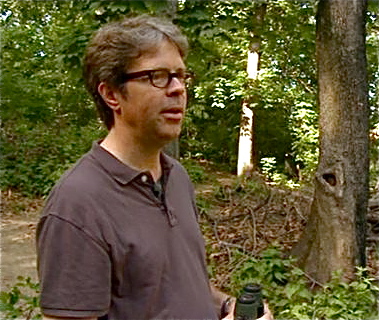
As a newly converted birder, I don’t need Jonathan Franzen to tell me the joy of birding, but it’s good to hear him share his view just the same: it’s ‘addictive’, that he would ‘miss work’ to go out to Central Park to have his fix of birdwatching. Oh, it’s also ’embarrassing’ too.

Jonathan Franzen

Yes, that’s the view of another birder, adult male. He shares that it’s been noted that birdwatching is not manly. There are guys who would carry their fishing rod and tell their wives they are heading out fishing, too embarrassed to admit actually it’s a birding they will go. It’s just… not cool.

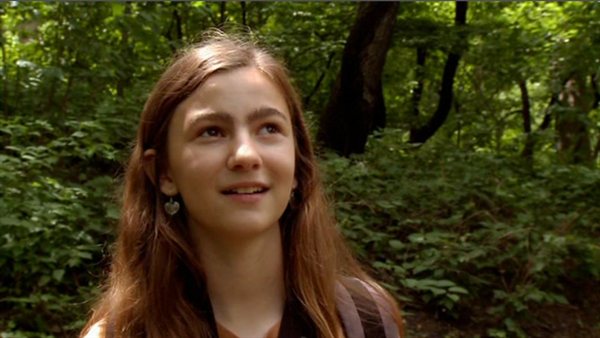
Anya Auerbach, 15, echoes that sentiment. Not cool, geeky even. But does she care? The answer is obvious. She is not into fashion like her peers, but she is into something deeply gratifying.

Anya Auerbach

As any birder would readily admit, binoculars hanging on their neck, and maybe a camera with a long lens on the side, they look like walking geeks, to be spotted and laughed at. But as they weigh the joy of actually seeing that rare thrush, to be labelled and misunderstood is a small price to pay.

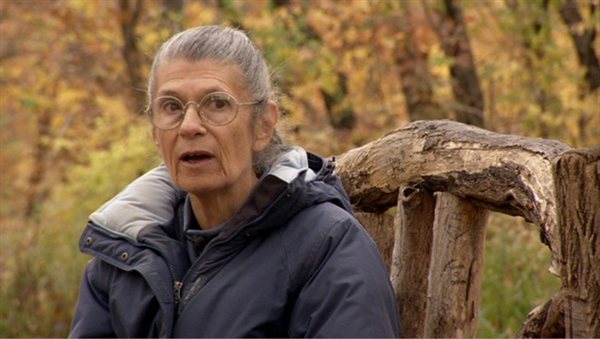
Starr Saphir is the matriarch of birding in Central Park. She has been leading birding groups in the spring and fall, four times a week for over 30 years. She could well be a walking specimen of the psychosomatic benefits of birding. Diagnosed with terminal breast cancer for a decade, Saphir testifies to how watching birds keeps her going. “Looking at birds really takes away sadness…” When one considers the fleeting nature of life, the joy is even more precious.

Starr Saphir

Chris Cooper disappears from his human social circle every year between April to Memorial Day. His friends know from experience that he has gone birding in Central Park. They understand his obsession. In the film, we can see his contagious enthusiasm.

Chris Cooper

Birdwatching is like collecting. The numbers count, how many species you’ve seen, which ones, the rarer the higher valued. It’s like seeing a unicorn… or, a bit more down-to-earth, it’s like you’ve seen pictures of a movie star, but when you actually see her/him in person, it’s a totally different feeling and experience.

“It’s mystical,” another birder articulated.

And to correct a misguided notion, birding is not a hobby, as one dedicated birder explains. Like raising children, it is a “deeply human activity.”

The Annual Central Park Christmas Bird Count is the longest running citizen science survey in the world. It is disheartening to note that the bird counts are dropping significantly in recent years.

Birds are nature’s celebrities, seeing them gives a birder deep pleasure and exhilaration. What’s most precious though, they are oblivious to their fame. They don’t flaunt their beauty, they don’t pose for pictures. They are as natural as can be.

As the credits roll at the end of the film, we see all those deserved to be named: species of birds that have appeared in the film.

~ ~ ~ 1/2 Ripples

CLICK HERE to the official site of the documentary Birders: The Central Park Effect.

Photo Source: BirdwatchingDaily.com

***

Midnight’s Children Film Adaptation

Midnight’s Children is Calgary International Film Festival’s Red Carpet Opening Gala presentation. Directed by Indo-Canadian, Oscar nominated Deepa Mehta (Water, 2005) in close collaboration with author Salman Rushdie, the film’s screening on September 20 marked its Western Canadian premiere.

Midnight’s Children won the Booker Prize in 1981, and the Best of the Booker in 2008. While the novel is magic realism in genre, the film adaptation is a realistic, almost exact transposition of the novel into screen. Author Salman Rushdie asserts his authority in condensing 533 pages into 148 minutes of screen time, offering us a concise rendition of an epic story spanning four generations. “It was an exercise in discovering the essence of the book,” Rushdie said in an interview on CBC radio.

The audience has much to gain not only from Rushdie adapting his own work, but also from his voiceover narration. This is especially beneficial for those who have not read the novel. Here, the narrator is speaking directly to the viewers, and not like the book narrator Saleem telling his story to Padma as the reader eavesdrops. Rushdie’s narration strings together time, places, events, emotions and nuances into coherence.

Not only is the condensing of an epic a daunting task, the actual production faced numerous hurdles in the process. Director Deepa Mehta had to shoot the film in Sri Lanka under another title to avoid protests, but even there still had to deal with obstacles including Iran’s pressure to stop the filming.

Mehta has proficiently brought the story to screen with relatively fast pacing, engaging us with a kaleidoscope of sights and sounds as we zip past sixty years of India’s history. From Kashmir in 1917 to Bombay 1977, it brings us through the ending of British rule, the birth of a nation, the Partition of India and Pakistan, later the war of independence of Bangladesh, and finally, the Emergency under the government of Indira Gandhi.

Amidst the torrents of history emerges the main character Saleem Sinai. The film begins with his grandfather Dr. Aziz (Rajat Kapoor) in Kashmir, examining his patient and future wife Naseem (Shabana Azmi) through a perforated sheet. Humour adds to the enjoyment of seeing the scene visualized.

Then comes the next generation of Saleem’s parents Amina (Shahana Goshwami) and her husband Ahmed Sinai (Ronit Roy), moving to Bombay, giving birth to a baby boy at the stroke of midnight, the dawn of India’s independence on August 14, 1947. But baby Saleem is a changeling with another baby born the same time, Shiva, by the hands of Mary (Seema Biswas) the nurse.

Young Saleem is played by the charming Darsheel Safary. He has an appealing and affable screen presence, brightening up the film instantly when his story comes into focus. Saleem discovers that he has the special power to summon all midnight children to appear in his mind, children born at the stroke of India’s birth.

It is interesting to see how these Midnight’s Children Conferences convene, and watch the confrontations intensify between Saleem and his rival changeling, Shiva. If there’s any line that sticks out from the movie, it is this: Wars are often fought between friends. These Conferences only mirror the adult world of governments and nations, as we see conflicts and wars unfold chronologically with Saleem being tossed in the torrents of it all.

Music adds an interesting touch to the film. British colonial culture is reflected by Wee Willie Winkie’s (Samrat Chakrabarti) busking tunes in Methwold’s Estate as well as the hymn singing in Saleem’s boys school. We also see the change of political climate with Saleem’s sister Jamina (Soha Ali Khan) humming Indian melodies with her sweet young voice at home. After the family moves to Pakistan, she later grows up to be a popular singer supported by the Pakistani leader, as Saleem warns her, something doesn’t smell right. Throughout, music in the film enriches the storytelling, adding more colours to the cultural canvas.

After a forced surgery to correct his snotnose, the now adult Saleem (Satya Bhabha) gains a special power of smell, and is glad to welcome the smell of love. And love it is that leads him later to marry Parvati, another midnight’s child, abandoned by Shiva and carrying his son. It is love that prompts Saleem to raise Shiva’s child as his own. He knows it full well as he himself is not his parents’ son by birth. In turn, his reunion with his nanny Mary in a pickle factory later in Bombay ends with the moving moment when he acknowledges her role in raising him, addressing her as mother.

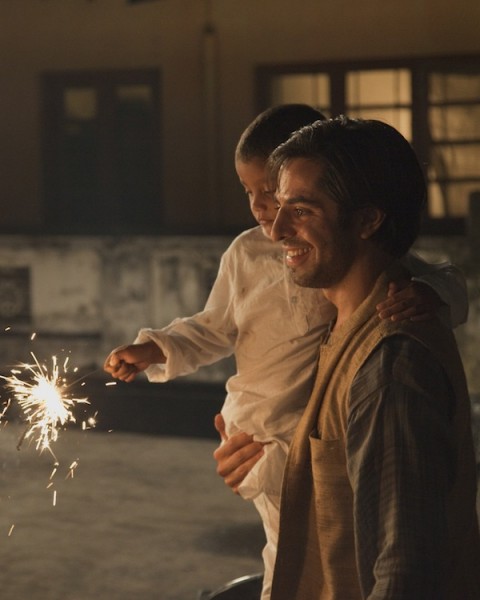
The character of Saleem carries the story affectively throughout, culminating in the final moment of love, for a son who is not his own, for a nation that has brought him pain and hardship. The last scene is another birthday of Saleem’s, thus India’s. Against the celebrative fireworks in the night sky, Saleem holds his son, a second generation of magical children, and looks out towards a brighter future, with the love that is essential to fuel the furnace of hope.

Indeed, the tone of the film is less acerbic and irreverent than the book, the two spanning a gap of 30 years. The milder cinematic version nevertheless is no less engrossing. With the realization of characters and emotions plainly in sight, it is effective in its conveyance of pathos and sentiments.

The shortfalls of a 148 minute cinematic adaptation from a long written work could be expected. The mega canvas of countless lives, deaths, and historical events in the book may appear cursory in the film and sometimes quickly wrapped up by the narration instead of being dealt with in greater depth. Nevertheless, all in all, the cinematic offering is entertaining and engaging, its characterization authentic, making it an enjoyable rendition of Rushdie’s literary work.

~ ~ ~ Ripples

***

CLICK HERE to read Midnight’s Children’s book review posts on Ripple Effects.

A NOTE ABOUT MOVIE PHOTOS: These images are used according to the Fair Use guidelines for criticism, comment and educational purposes. CLICK HERE for more information.

***