Zero Dark Thirty and Argo

There are several reasons I link these two films together. Both are acclaimed productions which have already garnered awards. While both films have been nominated for Best Picture in the 2013 Academy Awards, both directors, Kathryn Bigelow and Ben Affleck have been snubbed in the Best Director category. The reason I do not want to speculate. But for one of them, I have a hunch.

These are very American films, depicting Americans in crisis and its aftermath. Argo is about getting Americans out of Iran during the 1979-80 hostage crisis in Tehran, Zero Dark Thirty (ZD30) about hunting and getting into Pakistan to take down Osama bin Laden. Both involve the intricate work of the CIA.

And, both have driven me to the edge of my seat, despite the fact that I know the ending of the event they portray. This is the power of visual storytelling. But for me, the similarities may well end here.
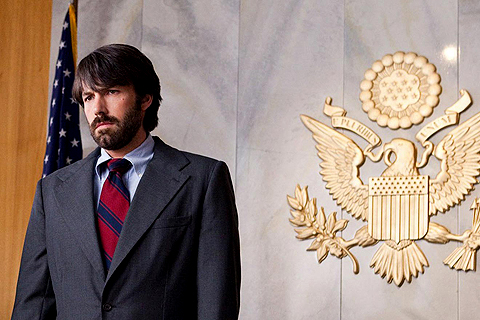
Ben Affleck

Argo rests on one man, Tony Mendez, a CIA officer who masterminded the rescue mission, information declassified only in recent years. Played by director Ben Affleck, Mendez is decorated with CIA’s Intelligence Star and received other accolades after that.

ZD30 rests on one woman, known only as Maya in the film. A young CIA officer who for ten years, dedicated her life to the searching for Osama bin Laden. She is relentless in her pursuit, fighting not only outward threats of physical dangers but bureaucracy within an alpha male work environment. Her identity remains hidden.

Jessica Chastain has once again shown how versatile an actor she is. I have seen her in some very different roles: The Debt, The Tree of Life, Take Shelter, The Help. Here in ZD30, she has convincingly portrayed a strong leading female character with finesse. Her performance not only carries the film but our emotion as well.

Jessica Chastain

And not only Maya, ZD30 has shown us there are other female CIA officers performing perilous duties. Her friend and colleague Jessica is one of them. Now, as I watched this Jessica on screen, I kept thinking she looked so familiar. Only when I watched the credits roll at the end did I find out, lo, that’s Jennifer Ehle, Elizabeth Bennet (Pride and Prejudice, 1995) or a bit closer, Myrtle Logue in The King’s Speech (2010).

Director Kathryn Bigelow has done an exceptional job in turning Mark Boal’s original screenplay into a tight and engrossing film. Both won Oscars for The Hurt Locker (2008), Bigelow being the first woman to win the Best Director award. At the beginning of the film, we are told it is based on firsthand accounts of actual events. Despite knowing the ending, I was still captivated every step of the way, following the intelligence gathering process, the narrowing down of leads and locations, the red tape. The film is an alchemy of facts and fiction, a creative fusion. But for the audience, there is no way to distinguish which is which.

That leads to the controversial issue, one that some in Washington and now the Academy have condemned, the issue of torture. And here’s my take. Isn’t it a bit simplistic to argue that since the film depicts scenes of torture of detainees to get leads and information, it means that the filmmakers condone or even promote torture?

While the U.S. Administration had denied using any torture tactics in the final capture of bin Laden does not mean the total absence of them over the ten year post 9/11 period, both known or later discovered. The photos from Abu Ghraib prison are still vivid in my mind. None of the scenes in the film can compare to those real life photos. Or, come to think of it, could Abu Ghraib have informed the screenwriting? This being not a documentary, but a dramatized fusion, can one separate facts and fiction so clearly?

Or take Argo, how much is true about the rescue mission? How much is dramatized? What proportion should we give credits to the mastermind Mendez and the CIA, and how much should we credit the Canadian ambassador Ken Taylor (Victor Garber) for hiding the six American embassy staff in his home at his own risk? The same kind of simplistic accusation ZD30 is getting could also apply here: Does the fact that they all escaped Iran using false identity mean the filmmakers, or the Canadian government for that matter, promote deception and the forging of Canadian passports?

Unlike Argo, the ending is not celebratory in ZD30. Things are not as clean cut as planned. The final mission of assassination is messy, a helicopter is down and has to be destroyed on site. There are collateral damages. But the target is hit, mission accomplished. Nevertheless, there is no applause or celebration. The tone is sombre, which I think is most apt. The final scene with Maya alone on the large transport plane leaving Pakistan is the epitome of ambivalence. Jessica Chastain leaves us with a poignant expression. Is it justice, national security, or rather, personal vendetta that has been accomplished? The last line delivered by the pilot echoed in my mind after I’d left the theatre, dazed… Where do we want to go from here?

Zero Dark Thirty ~~~~ Ripples

Argo ~~~1/2 Ripples

***

CLICK HERE to read Kathryn Bigelow’s article on L.A.Times addressing the controversy of torture in the film Zero Dark Thirty. 

Golden Globes, Jan. 13, 2013: Argo won Best Picture, Drama, and Ben Affleck Best Director. Jessica Chastain won Best Actress, Drama, for Zero Dark Thirty.

Related posts on Ripple Effects:

History Made At The Oscars

The Hurt Locker 

***

Top Ripples of 2012

The Ripple Rating System began when I started the blog Ripple Effects five years ago. I’ve been asked why I give three ripples so often, and how come there aren’t any one ripple. A look at how the rating works you’ll see why:

~ Ripple: Stay away, I did

~~ Ripples: Manage your time better

~~ 1/2 Ripples: Average, so-so

~~~ Ripples: Good, worth seeing

~~~1/2 Ripples: Superior, make time for it

~~~~ Ripples: Almost Perfect, must-see

You see, I’ve done the screening for you, just to save your time. But of course, the disclaimer here is, like Roger Ebert says, all reviews are subjective. But then too, here at the pond, ripples are the result of much thought.

**
In 2012, there are several movies I have given 3.5 or 4 Ripples. Two of them I have yet written a review. Here they are:

Life of Pi Book and Movie

Lincoln

Les Misérables

Birders: The Central Park Effect

Argo

Moonrise Kingdom

I’m still eagerly waiting for some to screen here, so I’ve yet to see them, like Zero Dark Thirty, Quartet.

**
There are reading experiences that I would give 4 Ripples, they are Read-Alongs:

Midnight’s Children by Salman Rushdie

Anna Karenina by Leo Tolstoy

A first for me, reading with others in a virtual reading group. Two brilliant books, some delightful camaraderie.

**

And then there are real life experiences that I’d gladly give 4 Ripples in my heart.

Bird Watching: See my photos on Saturday Snapshot Posts

Also my visit to:

The Salk Institute

The Grand Canyon

Rating with 4 Ripples is an understatement or maybe even an insult to the Creator of the Grand Canyon. But just an expression, I think He understands.

**

Thanks to WordPress, I receive a concise annual report on my blog. Top posts for 2012 are:

Memorable Movie Love Quotes (My Valentine post for 2008, Over 73,000 views since then). 2012 views: 15,237

The Glass Castle: Book Review (Since Aug. 2008, over 47,000 views). 2012: 8,334 views.

Quotable Quotes from Downton Abbey: Over 7,400 views since March, 2012

The Best Exotic Marigold Hotel: Now this is a surprise. Since I posted it in May this year, there have been over 6,200 views.

**

And now, my favorite, the Search Engine Terms, words people type in to come to Ripple Effects. These are some that not only bring a smile, but boost the spirit as well (I’ll leave them in their lower case as found in WordPress Stats):

heaven

grace in nature

oldest human frozen

colin firth chocolate

canada lost in austen

keep calm and act like kate middleton

e.m. forster can’t tell a good story

alien captured alive

studebaker truck girl

did red dog go to japan

the blogger arti  [Arti here: just love to know people actually Google about me!]

arti film life of pi

arti never let me go

the best exotic marigold hotel post modernism

nowhere

paleolithic hunting

does meryl streep have affairs

how many languages does colin firth have

yann martel lonely

joshua bell modest

why was ulysses poem chosen for skyfall

most memorable tv seduction quotes

anna karenina psychoanalysis

**

To everyone who has stopped by the pond and thrown in a pebble or two, thanks for the ripples. There are some new regular visitors and followers this year, I’m so glad to know you all. You’ve made me feel we’ve known each other for much longer. I’ve enjoyed our mutual visits. Thanks for the enrichment.

And to All

A Happy New Year!

***

Life of Pi (2012): The Magical 3D Experience

Movies this fall is a bumper crop of film adaptations from literary sources. Two belong to the same genre of magic realism. While Midnight’s Children is more akin to realism, Life of Pi is pure magic.

Ang Lee has done it, filming what is considered the ‘unfilmable’. Canadian author Yann Martel’s Booker Prize winning novel Life of Pi is an existential fantasy, a story that challenges the limitations of human reasoning and opens the door to the imaginary and the quest for the Transcendent. What Martel has succeeded in literary form, Lee has realized in this visually stunning cinematic offering. While I know book and film are two very different art forms, I am glad that screenwriter David Magee has stayed true to the spirit of the novel, which I think is crucial in this case. Cinematographer Claudio Miranda’s creative camera work is also essential in turning Martel’s imaginary world into mesmerizing visuals on screen.

The difficulties are not just transposing the philosophical ruminations from book to screen, but to keep the audience’s attention and interest for two hours when the bulk of the story is about a 16 year-old boy adrift at sea for 227 days in a lifeboat with a Bengal tiger. Kudos to Lee for taking up this daunting task, a project of which several other directors had bowed out, including Jean-Pierre Jeunet (Amélie), M. Night Shyamalan (The Sixth Sense), and Alfonso Cuaron (Harry Potter and the Prisoner of Azkaban).

The production has taken Lee years to complete. He had to build the world’s largest self-generating water tank of its kind in Taiwan to shoot his film, utilize 3D technology and CGI to overcome many obstacles, do extensive research, and above all, find an actor who is capable to be Pi.

Ultimately Lee found 17 year-old Suraj Sharma in Delhi, India, from 3,000 candidates. Fate has it that Sharma was just accompanying his younger brother to the audition. The next set of challenges for Lee soon follows: directing Sharma who has never acted before, and, coaching him to imagine there is a fierce tiger present at the scenes, for Richard Parker is a virtual reality.

As I watched the film, I could see Lee’s own tenacity reflected in the character of Pi. In fact, the whole process of the production parallels the thematic significance of the story: the essence of reality, the nature of storytelling, the role of the imagination and faith in survival and in life.

**

The film begins with Pi as a boy (Gautam Belur at 5, Ayush Tandom at 12) growing up in Pondicherry, India. His father (Adil Hussain, English Vinglish) owns the Pondicherry Zoo. The most impressionable lesson he learns from his father is, the tiger is not his friend.

Pi has a loving mother (Tabu, The Namesake), and an older brother Ravi (Ayan Khan 7, Mohd Abbas Khaleeli 14, Vibish Sivakumar 19), a typical older sibling who teases and dares. This first act of family life is a delight, and the 3D effect in the opening sequence is wonderful to watch. The original score composed by Mychael Danna matches well with the exotic context.

We soon realize the story we are watching actually is the adult Pi (Irrfan Khan, Slumdog Millionaire) telling what had happened to him as a boy to a Canadian writer (Rafe Spall, A Room With A View), a story, Pi claims, that will make him believe in God.

Pi is short for Piscine. After the boy is constantly teased by his schoolmates with the pun of the name, he begins to introduce himself as Pi. He just might not have known how prophetic his name is. Precocious and earnest by nature, Pi embraces Hinduism, Christianity and Islam in his search for the divine. The value of Pi, the mathematical symbol, is 3.14, a number that goes on to infinity, which aptly reflects the boy’s heart for the Eternal.

**

When he is 16 (Suraj Sharma), Pi’s family emigrates to Canada. They set sail on the Japanese cargo ship Tsimtsum, bringing on board the zoo animals. One stormy night, tragedy strikes. A shipwreck sends Tsimtsum to the bottom of the Pacific Ocean. Pi alone is saved as some sailors throw him overboard onto a lifeboat. Thus begins the magical journey of life in an open boat. Pi soon finds out he is not alone, for there in the boat is a hyena, a zebra, an orangutan called Orange Juice, and Richard Parker, a Bengal tiger. Soon there remain only two survivors, a 16 year-old Indian boy and a hungry tiger.

Lee demonstrates his technical and directorial prowess in this major second act of the film. He has aptly chosen to use the 3D camera. I’m not a fan of 3D, nor animal movies, but Lee’s usage of it makes what could have been an uneventful drifting at sea into an extraordinary movie experience.

What I read in the book jump out alive in magnificent visuals: the squall of flying fish, the gigantic whale shooting up from the ocean deep, the cosmic showcase of thunder and lightning, and the island overrun by meerkats. Magical realism in 3D, pure cinematic fantasy.

Lee’s style is minimalist: a life boat, a makeshift raft, a boy, a tiger, the open sea. Its simplicity exudes immense beauty; its stillness evokes quiet ruminations. This is not just a castaway, survival story. It depicts a close encounter of a soul experiencing nature and its maker. It also portrays an unlikely companionship between a boy and a tiger. Despite the loss of his family and the perils thrown at him, Pi clings to life with bare faith and the companionship he finds in Richard Parker.

The last part comes as a twist. Two employees of the ship’s insurance company interview the sole survivor of the shipwreck after Pi is rescued. Upon hearing Pi tell his ordeal, their rationale overrides any acceptance of the improbable. Here we see the thematic elements of fantasy versus reality, faith versus plausibility cleverly laid out. Like Martel’s novel, it poses a question that is open-ended, more for the viewer to resolve than for Pi to prove. A most thought-provoking end to a magical journey.

~ ~ ~ ~ Ripples

This review has been published in the Asian American Press print version, Nov. 30, 2012 issue. Online edition here. (Hint: There you’ll find Arti morphing from virtual reality into real life… take whatever is real for you.)

**

CLICK HERE to read my Book Review of Life of Pi by Yann Martel.

**

Photos posted here are stills from movie trailer.

A NOTE ABOUT MOVIE PHOTOS: These images are used according to the Fair Use guidelines for criticism, comment and educational purposes. CLICK HERE for more information. CLICK HERE to read the Report of the Ad Hoc Committee of the Society For Cinema Studies, “Fair Usage Publication of Film Stills” by Kristin Thompson.

***

Lincoln (2012): Some Alternative Views

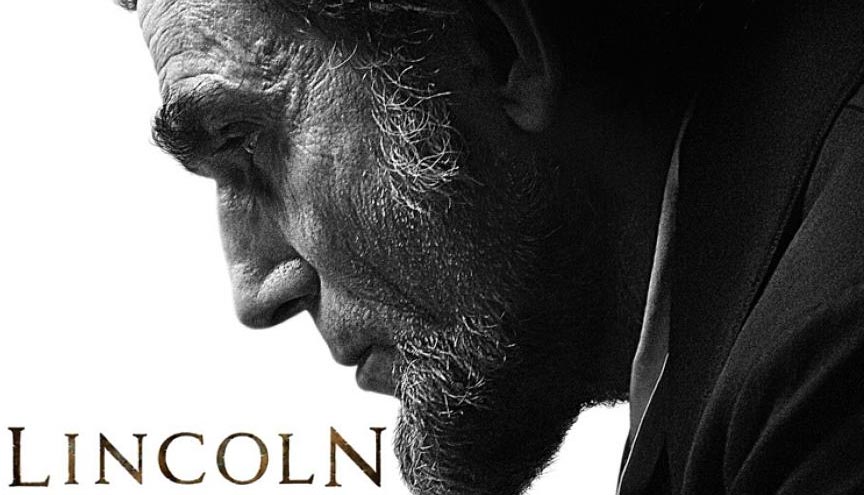
What more can I say that has not been said about this movie? I don’t want to repeat that it’s a strong contender for the Oscar race, or that Daniel Day-Lewis will likely taste his third Best Actor win as Lincoln, or that Tommy Lee Jones should get a nom in Best Supporting Actor for his role as Thaddeus Stevens, or Tony Kushner’s fine dialogues and captivating screenplay…

Here are some other thoughts that came to me as I watched the film, and later brewed in my mind.

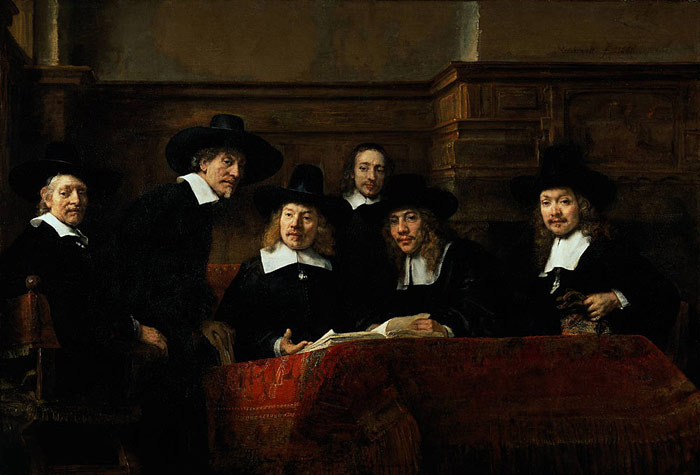
The Rembrandt impression. Watching the film is like seeing Rembrandt’s paintings come to life… especially all the indoor scenes with men gathering, in black, blue, and brown overtone throughout. Yes, the diffusing light from the windows may suggest Vermeer, but the predominantly men in most scenes dressed in black remind me more of Rembrandt. Like this one:

I can’t say much about the Dutch Masters in the above painting, they look pretty tame. But in the film Lincoln, the scenes wherein men congregate to discuss national affairs show the fierce power brokering and politicking of the time. We all know it was men who conferenced, talked about serious issues, made and won decisions, with whatever means avail to them, insults, intimidations, bickering, and persistent lobbying just to name a few.

And the women… The limited screen time Sally Field as Mary Todd Lincoln gets in the film could well indicate their position. Heaven forbid they get suffrage, and a voice. Truly, what can a wife do behind, in Mary’s own words, the most loved and powerful man in the country? How far we’ve come… but, does suffrage guarantee voices being heard? Just wondering.

As Mary Todd Lincoln, Field could well get an Oscar nom for her supporting role. She has done a fine job portraying the private grief behind the public face. Her son Willie died of high fever the night they had to entertain guests in a reception three years ago. A poignant scene occurs when the Lincolns as husband and wife quarrel over their past loss and now the possibility of losing another as their eldest son Robert (Joseph Gordon-Levitt) determines to enlist in the army, against his parents’ wish, or, is it only his mother’s?

From the photos above, we can tell how the casting, make-up and costume bring out the historic Mary Todd Lincoln. I remember Sally Field on Jay Leno said that she had to gain 25 pounds in 6 months to play the role, and later had to shed them all.

As an outsider, i.e., a non-American, I can’t say much about the accuracy of the content. I’m most interested to know which are Lincoln’s own words and in what context, and which are the scriptwriter’s. Even the British actor Daniel Day-Lewis himself had reportedly turned down the role at first as he felt he knew too little about the 16th U.S. President to portray him. As an outsider, I find it intriguing how an immensely influential historical figure is interpreted and portrayed. And apparently, there’s more than one angle.

Some time ago I watched PBS’s Looking For Lincoln, a documentary presented and written by Harvard professor Henry Louis Gates, Jr. It brings out a very different Lincoln, a complex, morally conflicting figure who had not initially tied the notions of freedom for the slaves with equality of the races. Gates went through extensive archival documents, Lincoln’s own notebooks, writings and debates, and interviews with scholars and academics to discover a Lincoln who had to lay aside prejudicial views and take on gradual personal changes as the Civil War bled on.

Interestingly, Gates interviews Doris Kearns Goodwin, the Pulitzer Prize winning biographer whose book Team of Rivals was what Spielberg based his film in parts on. It has been noted that even before she wrote it Spielberg was willing to secure the film rights. In Gates’ documentary, Goodwin admits that there is a need to demythologize the man Lincoln. While generations revere his greatness, he is very much human with strengths and weaknesses.

Spielberg’s interpretation is the popular frame and presents a singularly, saintly and benevolent emancipator instead of a complex and pragmatic politician, a 19th century white man who was very much a product of his times.

No matter, whatever angle Spielberg has chosen to interpret and present Lincoln, he has done it convincingly. Credits are due to Daniel Day-Lewis’s superb performance. He has salvaged any shortfalls with great charisma.

However, I do feel there are two weak sections in the film… the opening and later at the end. Seems like Spielberg is trying a tad bit too hard right at the start, for the opening scene sounds contrived as four young Union soldiers, two from each race, stand in awe in front of Lincoln in an army camp and recite back to him the Gettysburg Address.

The other is the assassination. With the whole movie resting on careful detailing of the passage of the 13th Amendment, I was surprised to find Spielberg’s treatment of Lincoln’s assassination in such a hasty manner, albeit the young son Tad’s reaction is moving. This is a scene that deserves much greater intensity and depth, not only for dramatic effects but for the balance of the whole story and expectation from the audience. Now this is the director who gave us the chilling sequences of Jaws, building the suspense of impending danger through the thumping of music and the ironic oblivion of the crowds.

Nevertheless, the second Inaugural Address ends the film on a poignant note. With malice toward none, with charity for all… Spielberg leaves us with Day-Lewis’s charismatic persona of Lincoln exhorting the crowd. With that, he has crafted another epic which will long be remembered, but in the short term, a sure contender come Oscars 2013.

~ ~ ~ ~ Ripples

***

CLICK HERE to watch PBS’s ‘Looking For Lincoln’. It is presented in titled segments. You can click on any of them to watch. But I highly recommend that you go through the whole documentary, just for some alternative views.

PHOTO SOURCES: Mary Todd Lincoln and Sally Field from Vanity Fair. Others are stills from movie trailer. 

Skyfall (2012)

And now for something totally different…

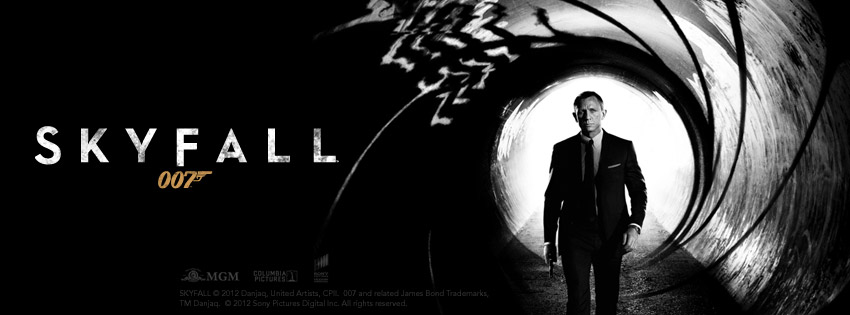
After 50 years, this 23rd instalment of the James Bond film franchise has just raised the bar and anchored its place in the 21st century spy action genre. Ian Fleming has long passed, but his iconic character lives on, portrayed and later resurrected by different suave British actors beginning with, and still my man, Sean Connery, to now Daniel Craig.

Resurrection is the word. You’ll hear it, and see its effect, for with Skyfall, looks like the franchise has just been resuscitated to a brand new life, just like the hero in the film. Kudos to Sam Mendes, the Oscar winning director who helmed such human drama as American Beauty and Revolutionary Road, working with cinematographer Roger Deakins, whose talent has enhanced some of my favorite films like Shawshank Redemption, Fargo, A Serious Man, True Grit

So what we have is a slick and stylish action thriller but not just in form. Sure, Daniel Craig in his Tom Ford suit, always standing straight and legs apart is all about style, isn’t it? Well, yes and no. Here, we see some internal tapping into the Bond character, just enough to tie over to the next action sequence. And we see too Bond shedding a few tears, for a good reason.

The villain is Javier Bardem. The cold-blooded psychotic killer in No Country for Old Men is just as ruthless and haunting here, but with a change in hair-do. He is Raoul Silva, a vengeful ex-MI6 agent who has gotten hold of a list of all the identities of MI6 agents embedded in terrorist organizations. His pleasure is to kill them down the list. Bardem’s image of Silva reminds me of Hannibal Lecter in The Silence of the Lambs, especially the scene with that transparent cylindrical cage… just gives away what would be coming next.

And our beloved Judie Dench, who’s so versatile that one minute you see her in The Best Exotic Marigold Hotel and the next transported into MI6 headquarters as M. Of course, she’s long been M before Marigold. In Skyfall, Dench deservedly gets more significant screen time than in previous Bond movies. In a later part of the film, M is called to a public hearing to justify her actions and even the existence of MI6. She has some powerful lines which make the scene so gratifying. Her voice-over juxtaposes with the urgent sequence in which we see the villain Silva leaving a trail of violence heading over to get her. Here are the poignant lines she delivers, from Tennyson’s poem ‘Ulysses’:

Though much is taken, much abides; and though
We are not now that strength which in old days
Moved earth and heaven; that which we are, we are;
One equal temper of heroic hearts,
Made weak by time and fate, but strong in will
To strive, to seek, to find, and not to yield.

Can you sense a bit how this is quite a different Bond film?

A fine cast is always the major asset. Another veteran is Albert Finney, who appears almost incognito (to me that is) but a good match with Dench.

With the new life comes two new faces. Both are excellent choices. One is Ralph Fiennes, and he definitely suits the part. Another is Ben Whishaw. Can’t imagine his transformation from John Keats in Bright Star to the digitally savvy young Q. Playing alongside Craig, Whishaw makes an interesting contrast, the gun-wielding old-timer in the field and the young computer geek in the office, taking control of situations with his fingertips.

Further, there are the exotic locations, Istanbul and other places in Turkey, Shanghai, Macau and… Scotland, which not for its exoticism but atmosphere. Cinematographer Deakins has crafted some very stylish scenes that distinguish Skyfall from just any other action flick… aesthetically appealing, moody and atmospheric, a mixed bag of nostalgic noir and contemporary, and in the last part, even a dash of gothic. If not for that iconic Aston Martin DB5 from Goldfinger parked outside the old stone mansion by the moor, you’d think it’s right out of Wuthering Heights.

Adele also joins the league. She co-wrote the Skyfall theme song and sings it in a way that echoes previous Bond numbers, most obviously, ‘Diamonds Are Forever’.

Skyfall has propelled the Bond film to a new era and up a notch. I’ve appreciated the internal character exploration but of course, there are still the spectacular explosions and car chases, the over-the-top mayhem and implausible escapes. We need those to ensure the audience that our hero is alive and well, after given a new lease on life. He’s still the same old Bond, James Bond.

~ ~ ~ Ripples

***

English Vinglish (2012)

If The Best Exotic Marigold Hotel is from the outside looking in, then English Vinglish is the reverse shot, bringing us a point of view from the inside looking out.

Writer-director Gauri Shinde gleaned from her real life experiences to craft this delightful dramedy that is rooted in human miscommunication, but speaks much more. The film is one of the Gala Presentations at the Toronto International Film Festival in September.

The legendary Bollywood star Sridevi comes back to the big screen after a 15 years hiatus to play Shashi, a devoted wife and mother in a modern, middle-class family in Pune, India. She is a lively, capable woman, a good cook who runs her own catering business, her specialty the ladoos, sweet golden balls of dainty delights. But she has to struggle with one major insecurity: she knows little English. Well, you may think, what’s the big deal. But with English recognized as the lingua franca by those living in a former British colony, and a patriarchal society, Shashi as a woman with no English sorely feels disadvantaged, even within her own family.

Her daughter teases her for her pronunciation, even her preschooler. She shies away from parent-teacher interviews, for her daughter goes to an English-speaking school. No matter how devoted a wife she tries to be, she feels the gap between herself and her husband (Adil Hussain, Life of Pi, 2012; The Reluctant Fundamentalist, 2012), who is proficient in English and thus becomes her spokesman in social situations.

“She’s born to make ladoos,” her husband’s intended praise of her cooking skills only reflects the confining social reality in which she finds herself. Not knowing English makes her feel subservient, without a voice.

The tipping point comes when Shashi’s niece is getting married in New York City. She has to go on her own to help her prepare for the wedding. Her family will travel later. An Indian woman in a sari on her first international flight alone, Shashi is understandably timid and insecure. But a friendly and helpful gentleman who sits beside her eases her anxiety. That role is aptly played by the veteran actor Amitabh Bachchan (Watch for him in The Great Gatsby, 2013)

A funny and quite original scene comes when this helpful gentleman suggests they watch the same in-flight movie, and he be her interpreter. Only he wears the headphone, and translates the dialogues out loud from English to Hindi for Shashi to hear, in a voice that’s animated and true-to-life, sound effects included. Here’s the rub… the movie is an action thriller of terrorists committing violence with guns and bombs. Other passengers trying to sleep have to shush him, short of subduing him for uttering bomb and death threats.

New York City, the place where one can transform oneself in a surprising way. Shashi has her first major language mishap in a coffee shop. Turning insult into courage, she enrolls in an English language class. The camaraderie of fellow learners lowers her guard and builds up her confidence. In a few short weeks, she has not only gained some mastery of the language but supportive friendship, with one being more intimately intended.

Shashi’s vindication comes at the wedding of her niece. Her husband and children have arrived for the occasion, not knowing her secret English lessons. In front of all the guests, Shashi is asked to make a speech to the newlyweds. While her husband tries to deflect the embarrassment and excuses her for lack of English, Shashi stands up and uses her new found voice to urge the bride and groom to value equality and treat each other with respect, a heartfelt speech well intended for her husband, and a lesson that brings tears of remorse to her daughter. This is one of the most moving wedding speeches in films I’ve seen. In case you’re interested, another memorable one is Dustin Hoffman’s at his daughter’s wedding in Last Chance Harvey (2008).

The 130 minute movie could benefit from keener editing, but the charming Sridevi carries it through with style and grace. It is a joy to watch her even amidst her insecurities, for she has won my heart with her quiet determination to overcome the odds, her strength of character shines through beautifully.

The movie offers a variety of entertainment, albeit not without some contrived moments. It is a full pack of heartwarming comedy, melodrama, cultural mishaps, the ESL classroom, Bollywood style music and dance numbers, but above all, reality. The film has brought to the forefront children showing disrespect for a parent with no English. This could be an issue particularly among immigrant families. Such a portrayal could well be indicative of society at large. Shashi has demonstrated that language does not define who she is, nor should it be the condition of respect and meaningful relationships.

The fact that we in North America can thoroughly enjoy a Hindi film, no doubt by reading English subtitles, could only mean that we can cross the language barrier to understand each other and appreciate different points of view. English may be the lingua franca in certain parts of the world, but it is compassion that joins us. What better way than to be entertained as we go about learning other perspectives?

~ ~ ~ Ripples

***

Other posts you might like:

The Best Exotic Marigold Hotel

Midnight’s Children Film Adaptation

The Hundred-Foot Journey by Richard C. Morais

Life of Pi by Yann Martel

Birders: The Central Park Effect (2012)

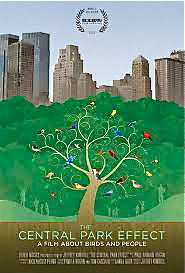
This is a must-see for all bird watchers, nature lovers, or anyone who lives in an urban jungle, thinking how one can stay there and escape at the same time. And, one would soon find this one-hour documentary just too short.

Beautifully shot, this exquisite gem of a film features its main characters the birds in Central Park. No make-up, no staging, no studio set-ups, all natural surrounding. Appearing also are the humans who dedicate their time, and some, their life in pursuing the sightings of these avian celebrities. The interviews of the birders show they are a species all their own.

Baltimore Oriole

Central Park is another major character in the film. I didn’t know this before, that it is completely man-made. The trees were planted there, the landscaping and ponds designed and built by human hands. But it is also nature. More than 200 species of birds pass through Central Park each year. During migration periods in the spring and fall, it is the hot spot of traffic thoroughfare, the hub of north-south continental flight routes.

Jeffrey Kimball is the film’s producer, director, cinematographer and narrator. I was so eager to see him in person for the Q & A after the film at the Vancouver International Film Festival on Oct. 8. Unfortunately, he had to rush back to his wife due to a medical emergency. I wish her well of course.

Common Yellowthroat

The 60 mins. documentary starts off right away by bringing us up-close to the avian paradise that is New York City’s Central Park, and with interviews of their inhabitants’ human admirers. What’s more interesting to hear than the exhilarating tone of the humans are the cheerful chirping of bird calls and songs throughout the film.

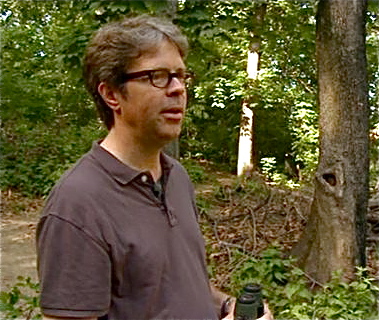
As a newly converted birder, I don’t need Jonathan Franzen to tell me the joy of birding, but it’s good to hear him share his view just the same: it’s ‘addictive’, that he would ‘miss work’ to go out to Central Park to have his fix of birdwatching. Oh, it’s also ’embarrassing’ too.

Jonathan Franzen

Yes, that’s the view of another birder, adult male. He shares that it’s been noted that birdwatching is not manly. There are guys who would carry their fishing rod and tell their wives they are heading out fishing, too embarrassed to admit actually it’s a birding they will go. It’s just… not cool.

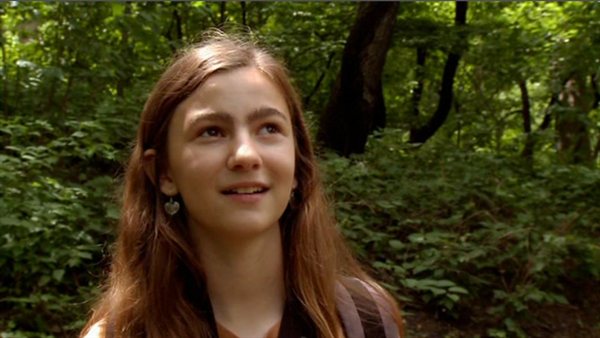
Anya Auerbach, 15, echoes that sentiment. Not cool, geeky even. But does she care? The answer is obvious. She is not into fashion like her peers, but she is into something deeply gratifying.

Anya Auerbach

As any birder would readily admit, binoculars hanging on their neck, and maybe a camera with a long lens on the side, they look like walking geeks, to be spotted and laughed at. But as they weigh the joy of actually seeing that rare thrush, to be labelled and misunderstood is a small price to pay.

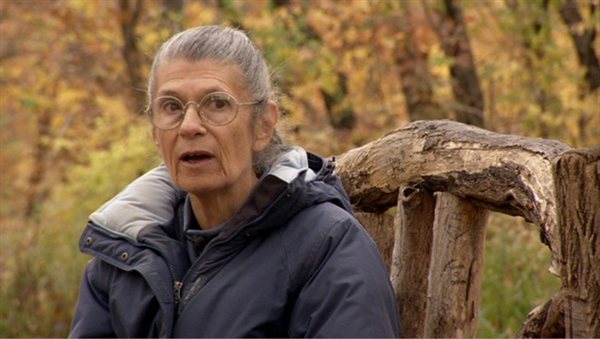
Starr Saphir is the matriarch of birding in Central Park. She has been leading birding groups in the spring and fall, four times a week for over 30 years. She could well be a walking specimen of the psychosomatic benefits of birding. Diagnosed with terminal breast cancer for a decade, Saphir testifies to how watching birds keeps her going. “Looking at birds really takes away sadness…” When one considers the fleeting nature of life, the joy is even more precious.

Starr Saphir

Chris Cooper disappears from his human social circle every year between April to Memorial Day. His friends know from experience that he has gone birding in Central Park. They understand his obsession. In the film, we can see his contagious enthusiasm.

Chris Cooper

Birdwatching is like collecting. The numbers count, how many species you’ve seen, which ones, the rarer the higher valued. It’s like seeing a unicorn… or, a bit more down-to-earth, it’s like you’ve seen pictures of a movie star, but when you actually see her/him in person, it’s a totally different feeling and experience.

“It’s mystical,” another birder articulated.

And to correct a misguided notion, birding is not a hobby, as one dedicated birder explains. Like raising children, it is a “deeply human activity.”

The Annual Central Park Christmas Bird Count is the longest running citizen science survey in the world. It is disheartening to note that the bird counts are dropping significantly in recent years.

Birds are nature’s celebrities, seeing them gives a birder deep pleasure and exhilaration. What’s most precious though, they are oblivious to their fame. They don’t flaunt their beauty, they don’t pose for pictures. They are as natural as can be.

As the credits roll at the end of the film, we see all those deserved to be named: species of birds that have appeared in the film.

~ ~ ~ 1/2 Ripples

CLICK HERE to the official site of the documentary Birders: The Central Park Effect.

Photo Source: BirdwatchingDaily.com

***

Midnight’s Children Film Adaptation

Midnight’s Children is Calgary International Film Festival’s Red Carpet Opening Gala presentation. Directed by Indo-Canadian, Oscar nominated Deepa Mehta (Water, 2005) in close collaboration with author Salman Rushdie, the film’s screening on September 20 marked its Western Canadian premiere.

Midnight’s Children won the Booker Prize in 1981, and the Best of the Booker in 2008. While the novel is magic realism in genre, the film adaptation is a realistic, almost exact transposition of the novel into screen. Author Salman Rushdie asserts his authority in condensing 533 pages into 148 minutes of screen time, offering us a concise rendition of an epic story spanning four generations. “It was an exercise in discovering the essence of the book,” Rushdie said in an interview on CBC radio.

The audience has much to gain not only from Rushdie adapting his own work, but also from his voiceover narration. This is especially beneficial for those who have not read the novel. Here, the narrator is speaking directly to the viewers, and not like the book narrator Saleem telling his story to Padma as the reader eavesdrops. Rushdie’s narration strings together time, places, events, emotions and nuances into coherence.

Not only is the condensing of an epic a daunting task, the actual production faced numerous hurdles in the process. Director Deepa Mehta had to shoot the film in Sri Lanka under another title to avoid protests, but even there still had to deal with obstacles including Iran’s pressure to stop the filming.

Mehta has proficiently brought the story to screen with relatively fast pacing, engaging us with a kaleidoscope of sights and sounds as we zip past sixty years of India’s history. From Kashmir in 1917 to Bombay 1977, it brings us through the ending of British rule, the birth of a nation, the Partition of India and Pakistan, later the war of independence of Bangladesh, and finally, the Emergency under the government of Indira Gandhi.

Amidst the torrents of history emerges the main character Saleem Sinai. The film begins with his grandfather Dr. Aziz (Rajat Kapoor) in Kashmir, examining his patient and future wife Naseem (Shabana Azmi) through a perforated sheet. Humour adds to the enjoyment of seeing the scene visualized.

Then comes the next generation of Saleem’s parents Amina (Shahana Goshwami) and her husband Ahmed Sinai (Ronit Roy), moving to Bombay, giving birth to a baby boy at the stroke of midnight, the dawn of India’s independence on August 14, 1947. But baby Saleem is a changeling with another baby born the same time, Shiva, by the hands of Mary (Seema Biswas) the nurse.

Young Saleem is played by the charming Darsheel Safary. He has an appealing and affable screen presence, brightening up the film instantly when his story comes into focus. Saleem discovers that he has the special power to summon all midnight children to appear in his mind, children born at the stroke of India’s birth.

It is interesting to see how these Midnight’s Children Conferences convene, and watch the confrontations intensify between Saleem and his rival changeling, Shiva. If there’s any line that sticks out from the movie, it is this: Wars are often fought between friends. These Conferences only mirror the adult world of governments and nations, as we see conflicts and wars unfold chronologically with Saleem being tossed in the torrents of it all.

Music adds an interesting touch to the film. British colonial culture is reflected by Wee Willie Winkie’s (Samrat Chakrabarti) busking tunes in Methwold’s Estate as well as the hymn singing in Saleem’s boys school. We also see the change of political climate with Saleem’s sister Jamina (Soha Ali Khan) humming Indian melodies with her sweet young voice at home. After the family moves to Pakistan, she later grows up to be a popular singer supported by the Pakistani leader, as Saleem warns her, something doesn’t smell right. Throughout, music in the film enriches the storytelling, adding more colours to the cultural canvas.

After a forced surgery to correct his snotnose, the now adult Saleem (Satya Bhabha) gains a special power of smell, and is glad to welcome the smell of love. And love it is that leads him later to marry Parvati, another midnight’s child, abandoned by Shiva and carrying his son. It is love that prompts Saleem to raise Shiva’s child as his own. He knows it full well as he himself is not his parents’ son by birth. In turn, his reunion with his nanny Mary in a pickle factory later in Bombay ends with the moving moment when he acknowledges her role in raising him, addressing her as mother.

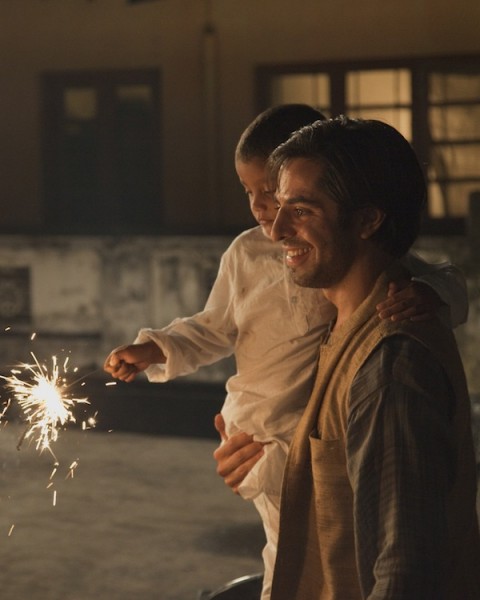
The character of Saleem carries the story affectively throughout, culminating in the final moment of love, for a son who is not his own, for a nation that has brought him pain and hardship. The last scene is another birthday of Saleem’s, thus India’s. Against the celebrative fireworks in the night sky, Saleem holds his son, a second generation of magical children, and looks out towards a brighter future, with the love that is essential to fuel the furnace of hope.

Indeed, the tone of the film is less acerbic and irreverent than the book, the two spanning a gap of 30 years. The milder cinematic version nevertheless is no less engrossing. With the realization of characters and emotions plainly in sight, it is effective in its conveyance of pathos and sentiments.

The shortfalls of a 148 minute cinematic adaptation from a long written work could be expected. The mega canvas of countless lives, deaths, and historical events in the book may appear cursory in the film and sometimes quickly wrapped up by the narration instead of being dealt with in greater depth. Nevertheless, all in all, the cinematic offering is entertaining and engaging, its characterization authentic, making it an enjoyable rendition of Rushdie’s literary work.

~ ~ ~ Ripples

***

CLICK HERE to read Midnight’s Children’s book review posts on Ripple Effects.

A NOTE ABOUT MOVIE PHOTOS: These images are used according to the Fair Use guidelines for criticism, comment and educational purposes. CLICK HERE for more information.

***

To Rome With Love (2012)

If you’ve been writing and making one movie every year, you’re faced with a greater challenge after each production. It’s an annual increment of difficulty. You need to create something original and not recycle old jokes, not a clone from your previous works but still imbued with your own style and signature.

A movie a year, that’s what Woody Allen has been doing for over four decades. Hats off to him for his creative energy and motivation. I’m more than willing and ready to overlook the ones that are not so great in his repertoire. For me, his misses are still better than some others’ hits.

And for those who still linger in the Annie Hall/Manhattan trance, I’d say, move on. His recent works may not be as unique and stylish as those in his earlier days, they are still entertaining and funny in their Woody Allen way.

Last year’s Midnight In Paris is an Oscar worthy hit. First you think, then you laugh. This year, Allen brings us To Rome With Love. You can just laugh. It is not as cerebral as Midnight. You don’t get to meet Hemingway or Dali, instead, you see the vignettes of ordinary folks who happen to be living in or visiting Rome.

An interesting film structure here, and in the hands of an auteur, it looks alright to tell four totally unrelated stories at the same time. The plots are interwoven well, albeit the ending, or endings, seem a bit abrupt.

Here they are, simple stories in the hands of a veteran writer/director…

A prominent American architect (Alec Baldwin) revisits Rome where he  studied architecture in his youth. He encounters a young architecture student (Jesse Eisenberg) and is most ready to offer the young man his advice, not on his profession but relationships, as he sees the young man succumb to the lure of his wife’s (Greta Gerwig) best friend (Ellen Page) staying shortly in their home while recuperating from a failed relationship.

It seems in every Woody Allen film, there’s a pseudo-intellectual. This role falls surprisingly on Ellen Page, giving us a fresh view of the young Canadian actress, a departure from Juno, Whip It, and Inception. Jesse Eisenberg is dreamy and sweet, unlike his Mark Zuckerberg in The Social Network. And Alec Baldwin is… Alec Baldwin.

Six years after Scoop, Woody Allen comes back on screen in his own movie as a reluctantly retired opera director. He travels with his wife (Judy Davis) to Rome to meet his daughter’s fiancé and his family. While in their home, he can’t resist the talent he finds as he hears the father sing in the shower. The real-life, acclaimed tenor Fabio Armiliato has many chances to sing in this movie, but in a very different setting. Some hilarious scenes, albeit they look like they are made in the expense of culturally stigmatizing. But I admire that Armiliato is willing to go along with the wacky Woody scenarios.

A third story line is a mistaken identity subplot with a newly-wed couple moving to Rome from a small town. As the wife (Alessandra Mastronardi) steps out of the hotel room to get her hair done, a prostitute (Penelope Cruz) drops in, to the horror of the husband (Alessandro Tiberian). His relatives are just outside the door soon after so the two have to improvise.

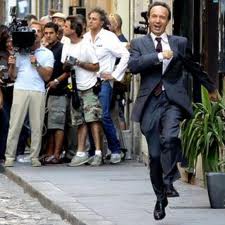
The fourth story is very funny and could well be Allen’s commentary on the making of celebrity by paparazzi. An ordinary citizen, well-played by the animated Roberto Benigni (Won Oscar for his role in Life is Beautiful), is turned into a celebrity for no apparent reason. He is chased everywhere by the paparazzi, interviewed on TV, asked the most trivial questions like what he has for breakfast, shaver or razor, boxer or brief… Uncanny parallels of what social media make of us, everyone can be readily exposed, everyone can be a celebrity if only one has enough followers. The simple lesson here is, they can drop you as quickly as they pick you up. Unfollow by just a click.

A breezy summer treat. The scenes may seem episodic but they are smoothly woven. Again here, the actors are the major assets, especially when you need to improvise as some scenes look like. Every character likable, and the overall effect enjoyable. Not epic but still an entertaining piece of Allen humor. After all, you don’t churn out an epic every year.

~ ~ ~ Ripples

***

A NOTE ABOUT MOVIE PHOTOS: These images are used according to the Fair Use guidelines for criticism, comment and educational purposes. CLICK HERE for more information. CLICK HERE to read the Report of the Ad Hoc Committee of the Society For Cinema Studies, “Fair Usage Publication of Film Stills” by Kristin Thompson.

***

Séraphine and the Wrought-Iron Chair

By day, she scrubs floors, cleans houses, washes dirty linens in the river. By night, she paints. She is Séraphine, a cleaning woman in her fifties. Later, she is better known as Séraphine de Senlis. 

Séraphine (2008), a film based on the life of the early 20th Century French painter Séraphine Louis (1864-1942), won 7 César Awards in France including Best Film of 2009 and Best Actress for Yolande Moreau as Séraphine. True to its subject matter, director Martin Provost has crafted an aesthetically pleasing work of art. The pace is slow for the viewer to savour every bit. Moreau’s charming portrayal of Séraphine is captivating. She wins my heart from the first scene.

It is gratifying to be noticed, to be confirmed of one’s worth. To the dismissive eye, an ageing cleaning woman is nothing to deserve another glance. Makes me think of the concierge Renée in The Elegance of the Hedgehog. In one of the apartment units which Séraphine cleans, a new tenant just moves in. He is Wilhelm Uhde, a noted art critic and collector of Picasso. He is also the one who has discovered Henri Rousseau of the naive art style, a term referring to untrained talents, a term to which Uhde doesn’t subscribe.

And right there in his rental unit Uhde notices another hidden gem of this style, his own housecleaner Séraphine. Uhdle is deeply moved by her work and soon becomes her patron. He stops her from mopping his floor, leads her out into the garden, seats her down in a wrought-iron chair and tells her she has talent. It is a wrought-iron chair that I notice since that scene, and it recurs later in the film, a metaphor for aesthetics, style and elegance, antidote to the crude reality of Séraphine’s life.

Séraphine loves nature, and nature rewards her with inspiration.

Her subjects are mainly flowers and fruits, their design exquisite, natural, colourful and lively. 

Deep religious fervour soon drives Séraphine to relentless, maddening obsession to paint. She claims to follow voices from her guardian angel. She would sing hymns at the top of her voice while painting through the night, waking up in the morning on the floor with her work-in-progress. She gradually becomes delusional and out of touch with reality.

Why is it that giftedness and mental illness often find affinity for each other? Van Gogh comes to mind. And only recently did I read this Guardian article drawing uncanny similarities between Séraphine and Susan Boyle.

As WWI draws near, the impending conflicts push Uhde out of France and back to Germany. They reunite after the War. Sadly, the painter’s growing achievement brings about more severe delusions. Later the economic depression ends contact between patron and artist for a while.

When Uhde finds Séraphine some years later, she is locked up in an insane asylum. This latter part of the movie is a bit uncomfortable to watch. Uhde is unable to communicate with her as she is restrained in a straight jacket, tied to the bed weeping in anguish.

Months pass and in 1935 Uhde visits her again. He needs to tell Séraphine her paintings are selling. Her condition has stabilized by now but upon doctor’s advice, Uhde should just leave her be. There in the asylum at Asile de Clermont Uhde quietly pays for her a private room with a view out towards a lush green meadow and full, leafy trees.

The ending that follows is one of the best I’ve seen in films. We see Séraphine being led into the room. She sits on her bed, dazed, unfeeling. Then she turns her head and notices the door leading outside to the trees and green meadow. The next three silent minutes bring us to a poignant closing:

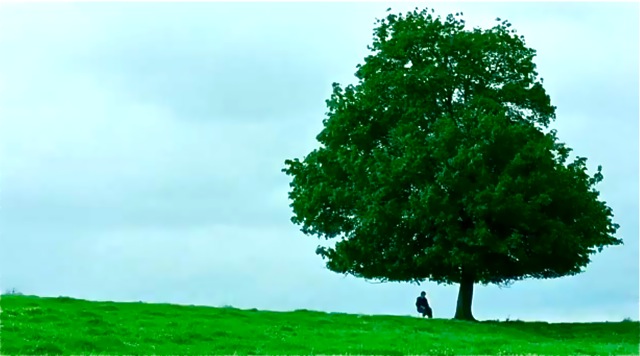
Séraphine slowly gets up and opens the door. She sees a wrought-iron chair on the porch. The frame on screen here is roughly split in two. On the left side is her room with a sterile, wooden chair of the asylum. On the right we see the porch outside with the wrought-iron chair, not unlike the one she had sat on while being declared a talent by Uhde years before. She tentatively steps out of her room, touches and examines the chair, then picks it up and slowly carries it with her up a green hill to a full, beautiful tree. From afar, we see her look at the tree, put the chair under its shade, sit down and tilt her head back, fully relaxed.

In the silence with just the wind blowing, it seems we can hear her gratified sigh of relief, being back in nature, coming home.

~ ~ ~ 1/2 Ripples

CLICK HERE to watch Séraphine’s official trailer on Youtube. You’ll be able to see the ending scene. But of course, nothing compares to watching the film in its entirety.

A NOTE ABOUT MOVIE PHOTOS: These images are used according to the Fair Use guidelines for criticism, comment and educational purposes. CLICK HERE for more information. CLICK HERE to read the Report of the Ad Hoc Committee of the Society For Cinema Studies, “Fair Usage Publication of Film Stills” by Kristin Thompson.

***

This movie review is my third post for Paris in July hosted by Karen of BookBath and Tamara of Thyme for Tea. To read my previous posts you can click HERE and HERE.

***

The Hundred-Foot Journey by Richard C. Morais

How do you get to Paris from Bombay? Food, Food, Food.

What better transport is there than a light vehicle that provides a fun and wild ride, taking me out of Midnight’s Children‘s Bombay to my next destination, Paris in July? Thanks to Karen of Book Bath for organizing the trip.

This delightful, breezy read is that speedy transit. It tells the story of Hassan Haji, a Muslim boy who lives above his grandfather’s restaurant in then Bombay and how he ultimately ends up as a three-star chef in Paris.

Growing up immersed in the savoury aroma of Indian food and spices,

I suspect my destiny was written from the very start, for my first sensation of life was the smell of machli ka salan, a spicy fish curry, rising through the floorboards to the cot…

Hassan is endowed with an exceptional gift of culinary talent. After the Partition and the death of his grandfather, religious and political turmoils push his family out of the country. They first land in London, later immigrate to France. The boisterous family finds a home in the resort village Lumière near the Alps and starts its own restaurant Maison Mumbai, serving Indian dishes and bringing a welcome change to the villagers.

Hassan soon is jealously noticed by the veteran, feisty two-star French Chef Madame Mallory across the street. She is the proprietor of the small country hotel, Le Saule Pleureur. Her restaurant is a haute French culinary establishment that plays Satie in contrast to the Indian music from a loudspeaker at the Haji’s. After many animated and almost cartoonish conflicts between Madame Mallory and Hassan’s Papa, Abbas Haji, both concede to the reconciliatory move of allowing Hassan to become Chef Mallory’s apprentice.

Thus, Hassan takes the one hundred-foot journey and crosses the street to stay at Le Saule Pleureur, learn all he can from the great Chef and answer ‘the irrefutable call of destiny’ to be one himself. Towards the end of his apprenticeship, Hassan is left on his own to create recipes for pigeons, gigot, and hare, all to the satisfaction of Chef Mallory. After three years under her wings, Hassan is ready to move on.

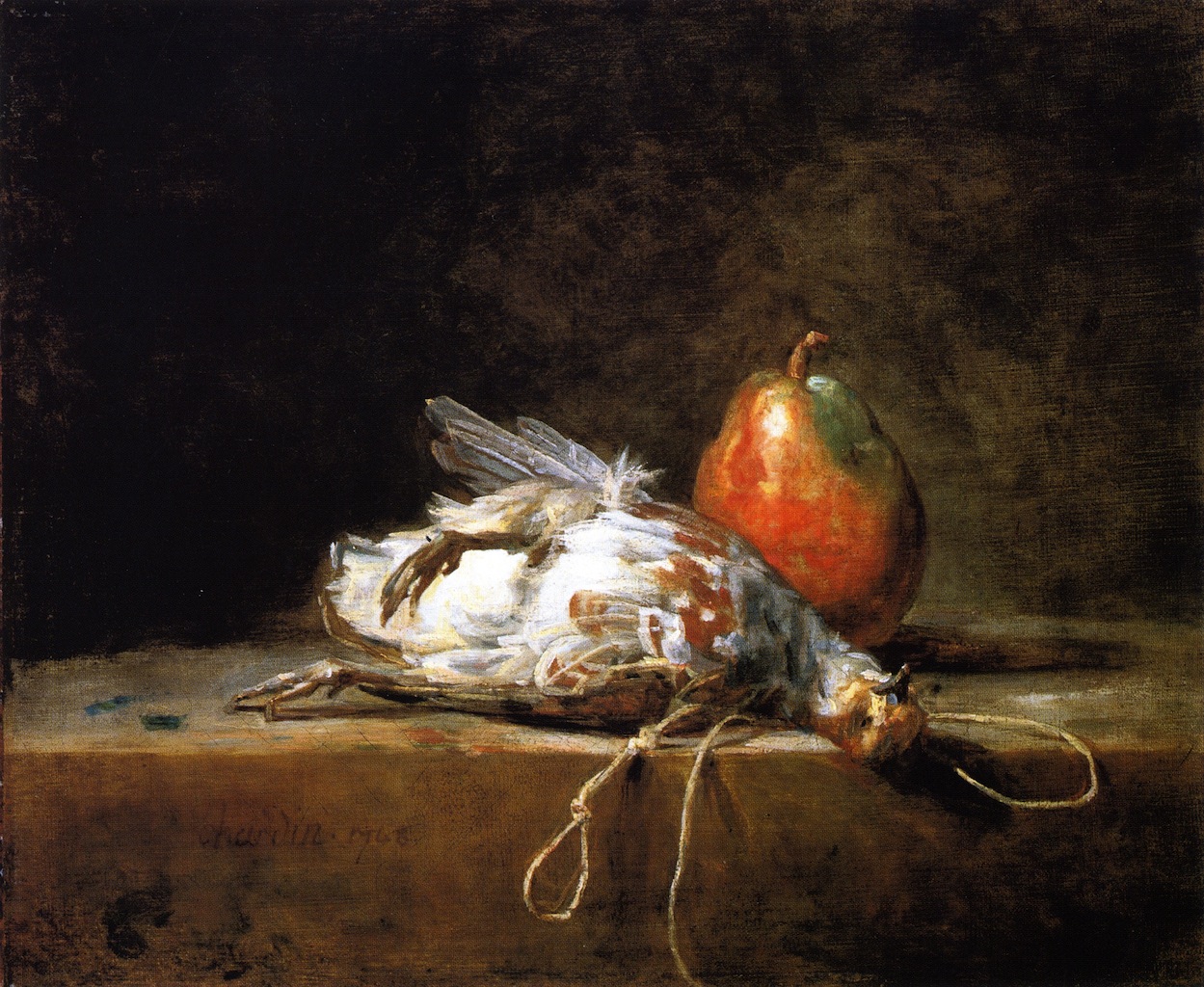
Chardin’s Grey Partridge Pear and Snare on Stone Table, one of Hassan’s favorite paintings.

Next step, Paris. Hassan starts as a sous chef with a couple of smaller restaurants. After a few years, he decides to open his own and is approached by a benefactor who offers him reduced rent in an upscale location near the Panthéon. The one-hundred foot journey has brought him fine training, now he can take flight.

Here is his trademark dish:

the Siberian ptarmigan, roasted with the tundra herbs taken from the bird’s own crop, and served with caramelized pears in an Armagnac sauce.

We as readers are privy to the actual cooking procedure beginning with the feathered live bird.

For me, more a movie buff than a foodie, the book conjures up many cinematic images… the colours and conflicts in The Best Exotic Marigold Hotel, the prejudice in Chocolat, the sumptuous offering in Babette’s Feast, and, the training sessions in the The Karate Kid. Dev Patel (Marigold Hotel, Slumdog Millionaire) will be perfect for the role as young Hassan. I couldn’t help but think, this book is good movie material.

And then I found out from the Acknowledgements after I finished, the book is an homage to the late Ismail Merchant, the film producer behind the Merchant Ivory productions (Room With A View, Howards End, The Remains of the Day) who met an untimely death in 2005. The bond between the author Richard Morais and his friend Ismail Merchant was food. This book was started with a subsequent movie in mind.

In-depth research has gone into writing the book, culinary history, recipes, game, desserts, soups, the French kitchen, the Indian kitchen, restaurant operations, even for me the uninformed and casual eater, there are plenty to savour. The book is a smorgasbord of gastronomic delights. My only criticism is that its literary treatment may taste a bit raw, simplistic, and at times, didactic. However, read it like a comedy, it can satisfy like a dessert.

~~~ Ripples

The Hundred-Foot Journey by Richard C. Morais, Scribner, NY, 2010, 245 pages.

***

The Best Exotic Marigold Hotel

Outsourcing old age, that’s the idea.

Imagine in the distant (or not so distant) future, you retire to a warm climate, enjoy a colourful land and best of all, affordable living in a retirement resort. The concept is sold to several retirees from Britain. Little do they know the advertised Best Exotic Marigold Hotel for the Elderly and Beautiful is a run-down establishment of faded glory. The place is Jaipur, India.

The Hotel owner is Sonny Kapoor (Dev Patel of Slumdog Millionaire fame) who has inherited the property from his late father. Despite his mother’s insistence to close it down and get him back to live with her in Delhi to marry the girl of her choice, Sonny is determined to make it on his own. He has already picked out his girl, and is positive about his plan to outsource retirement, among many other services India is already offering to foreign countries.

The trailer doesn’t do justice to the movie. When I first watched it, I was totally baffled … why would such a top-notch cast of veteran British actors take up what seems to be a shallow and silly farce? But after watching the movie, I think I can make a guess: they must have known what fun it would be to do this, they must have sensed the thematic relevance as well. Why I went out to see it if I didn’t like the trailer? I just couldn’t resist the combined star power and my trust in their judgment.

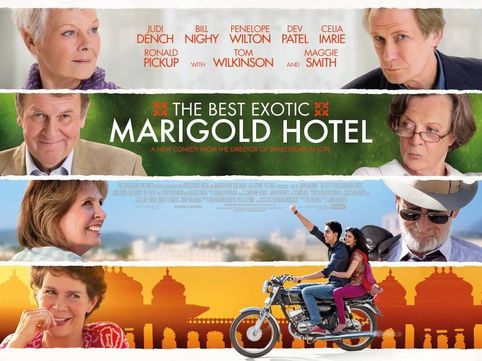
Where can you see these actors together on one big screen: Judi Dench, Evelyn, who has depended on her husband all the years but now recently widowed, decides to take charge of her life; Maggie Smith, Muriel, who is xenophobic and won’t eat anything she can’t pronounce, goes to India mainly to have a hip replacement she can afford; Bill Nighy and Penelope Wilton, Douglas and Jean, are an incompatible couple who sticks together out of habit and loyalty; Tom Wilkinson, Graham, a judge who follows his heart and returns to his former home to look for a long-lost friend; Celia Imrie, Madge, who at retirement is still looking for the right one, and Ronald Pickup, Norman, seems to know exactly what he wants.

The humour is natural and not forced, the dialogues are witty and refreshing. Something that is not easily found in comedies, with the expert cast of veteran actors, a sense of seriousness exudes from their performance, giving weight to the characters and making their simple storylines convincing.

Oscar nominated director John Madden (Shakespeare In Love,1998) has done a great job in concocting the on-screen chemistry of his cast. Their camaraderie as fellow travellers from the UK and as guests in the Marigold Hotel emit an appealing and quiet persuasion. I’ve enjoyed every one of their storylines. From the very start of the film, I’m drawn into each of the characters while they are still in England. I follow their journey expectantly, open and ready to accept the unfolding of events.

As with all ‘exotic’ movies, there bound to be cultural features that can easily lead to stereotyping and patronizing. That I expected. But what I didn’t was that these ‘typical’ renderings are few and mostly restrained. Further, shot right in Udaipur, India, many scenes are in situ happenings that come out naturalistic and real. The whole movie is a delightful surprise, probably the main one is, I don’t mind watching it again.

~ ~ ~ Ripples