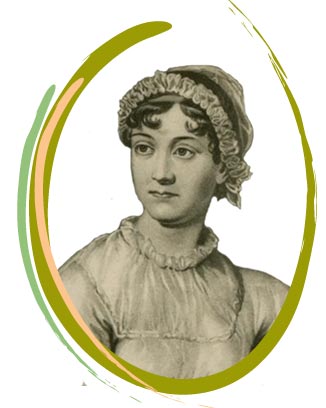
A Jane Austen Education by William Deresiewicz

I’ve been following William Deresiewicz’s articles in The American Scholar for a few years. His idea of solitude has inspired my posts “No Texting for Lent and the End of Solitude” and “Alone Again… Unnaturally.”

I’ve not seen any pictures of him, but know that he has taught English at Yale for ten years. So I’ve always thought him to be one calm, cool, and collected (older) academic. Well, I was totally surprised as I read his book A Jane Austen Education: How Six Novels Taught Me About Love, Friendship, and the Things That Really Matter. Expecting a book on literary criticism, and from the title, maybe a dash of personal anecdote, I found it to be much more than these.

It is all of the following: literary analysis, biography, memoir and even confessional. Introduced to Jane Austen by his professor in graduate school, Deresiewicz had encountered numerous ‘eureka moments’ of self-discovery from reading her six novels. He unabashedly discloses how his own life experiences, and often youthful foibles, parallel those of Austen’s characters from each book. For us who have savored Austen’s works, we already know how wise and perceptive she is. But Deresiewicz has gone much deeper by being so brave as to reveal his self-absorbed psyche of younger days, his romantic mishaps, true friends and those who appear to be, the painful conflicts between his parents, and his search for self apart from a domineering father, all in light of Austen’s colorful literary canvas.

So before the calm, cool and collected guy emerged, there was one rebel, alienated follower of the modernists. Seems like every guy who comes to Austen is being dragged along with much reluctance, “just thinking about her made me sleepy.” But his reading, studying and writing a dissertation chapter on Austen’s works totally reshaped his views, and life.

Here’s an outline of Deresiewicz’s journey of maturity, of finding true love, and most importantly, of becoming one who has the capacity to love, all due to Austen’s novels. Too good to be true, isn’t it? I admit at times I found there were too many coincidences and perfect parallels, a bit contrived. But as I read, I knew I must decide one way or the other. And I was persuaded to see it as audacious honesty. His self-deprecating and revealing account of his journey towards maturity and improvement is entertaining, bold even as he mentally draws the line between friends and ‘foes’, true and fake, albeit keeping them anonymous. I’m sure those he’d described would definitely recognize themselves in the book.

As with Austen’s opening lines in her novels, Deresiewicz’s opening line sets the stage of what’s to come:

I was twenty-six, and about as dumb, in all human things, as any twenty-six-year-old has a right to be, when I met the woman who would change my life.

That woman, of course, is Jane Austen. Here are some of the key lessons:

From Emma, he learns to put aside his academic snobbery, that there’s no one too lowly for him to know, nothing too trivial or common for him to pass by. For these are the very ingredients that make up life.

Not that I hadn’t always taken my plans and grand ambitions seriously–of course I had. What I hadn’t taken seriously were the little events, the little moments of feeling, that my life actually consisted of. I wasn’t Stephen Dedalus or Conrad’s Marlow, I was Emma. I was Jane Fairfax. I was Miss Bates. I wasn’t a rebel, I was a fool. I wasn’t floating in splendid isolation a million miles above the herd. I was part of the herd. I was a regular person, after all. Which means, I was a person.

From Pride and Prejudice, he learns to grow up.

For [Austen], growing up has nothing to do with knowledge or skills, because it has everything to do with character and conduct… Growing up means making mistakes… to learn to doubt ourselves…

By making mistakes, and recognizing her mistakes, and testing her impulses against the claims of logic, the heroine of Pride and Prejudice learned the most important lesson of all. She learned that she wasn’t the center of the universe.

From Northanger Abbey, he learns to learn, and by so doing, to teach.

The habit of learning: if Catherine could learn to love a hyacinth when she was seventeen… I could keep learning to love new things my whole life. Of course, it was my professor himself who had helped me learn to love Jane Austen in the first place, against expectations at least as stubborn as the ones that Catherine brought to Northanger Abbey. But I was starting to get it now: the wonderful thing about life, if you live it right, is that it keeps taking you by surprise.

From Mansfield Park, he learns to see it as a mirror of “the rich Manhattanites” circle he was trying to get in.

… the greed beneath the elegance, the cruelty behind the glow–and what I myself had been doing in it… If my friend was a social climber, then what the hell was I?… my attraction to that golden crowd, my ache to be accepted by them, what did it amount to if not the very same thing? Who was I becoming? Who had I already become?

… we also have an aristocracy in this country, and I was looking at it.

From Persuasion, and from his own experience, he learns to prove Nora Ephron wrong. Unlike her movie “When Harry Met Sally”, man and woman can be friends, without “the sex thing getting in the way.”

A man and a woman, even two young, available ones, could talk to each other, understand each other, sympathize with each other, be drawn to each other, even share their intimate thoughts and feelings with each other–as Anne and Benwick did–without having to be attracted to each other–as Anne and Benwick clearly weren’t. They could, in other words, be friends.

Anne and Harville shared a common footing in the conversation, debating each other with mutual respect and affection and esteem. Men and women can be equals, Austen was telling us, so men and women can be friends.

And finally, from Sense and Sensibility, he learns what it means to fall in love.

To Austen, love at first sight is a contradiction in terms… As dull as it sounded, I now saw, Elinor’s way of going about things is the right one: to see a great deal of a person, to study their sentiments, to hear their opinions. … And it is a person’s character, not their body, with which we fall in love.

Like all Austen’s novels, Deresiewicz’s book ends with a marriage, his own. But without first reading the six Austen novels, he would have been totally unprepared for such a relationship. “Love, for Austen, is not becoming forever young. It’s about becoming an adult.” The book is the best way to show his gratitude to the matchmaker.

~ ~ ~ Ripples

***

A Jane Austen Education: How Six Novels Taught Me About Love, Friendship, And The Things That Really Matter by William Deresiewicz, The Penguin Press, New York, 2011, 255 pages.

This article has been published in the Jane Austen Online Magazine. CLICK HERE to go there for more Regency and Austen reads.

CLICK HERE to William Deresiewicz’s website, and watch interviews of him with the editorial director of Penguin Classics, Elda Rotor.

Which Jane Austen Heroine Was Jane Most Like?

A while ago due to a glitch on my blog, I lost all the visual images on my side bar, including a poll. Accidentally I found it again today and glad to see the results are still there.

So here it is, for all you Janeites, book and literature lovers out there. If you haven’t voted, you can do that now. If you have voted before, and just might have changed your opinion, vote again. I’m sure Jane wouldn’t mind.

Life imitates art… art imitates life? Which of Jane Austen’s heroines do you think the author most resembled in terms of character?

.

You’re welcome to share with us why you vote that way.

Other related posts on Ripple Effects:

Jane Austen: Sense Or Sensibility?

What Was Jane Austen Really Like? Reading Tomalin and Shields

Art Imitates Life, Life Imitates Art, or

Can a movie adaptation ever be as good as the book?

The more I watch movies and read books, the more I see the two as totally different art forms. They evoke different kinds of pleasure and enjoyment. A direct translation just may not work. I used to seek for how ‘faithful’ a movie is compared to its literary source, but more and more, I’m looking for how good it stands alone as a production in terms of cinematic elements.

A film adaptation can make an apt homage to the original literary work. It is not merely an ‘illustrated book’, but a new creation, if you will, one that offers a different experience from reading. In telling the story from a visual and sound perspective, it offers a multidimensional take on the original work. By so doing, it may need to alter the source material. But then again, how do you know the images on-screen are not those already conjured up in some readers’ minds as they interact with the text… or, theirs are not even more far-fetched?

While a film is the artistic expression of the filmmaker’s interpretation, it is also a collaboration of talents and perspectives, as cast and crew contribute their expertise, in cinematography, set design, costume, writing, sound, music, editing… all under the artistic direction and insight of the auteur. It is an alchemy of sights and sounds. On top of that, there are the key agents of delivery, the actors. An intelligent and nuanced performance can bring out the literary essence, unfurling the thematic matter, characters and conflicts, and above all, the humanity embedded in the text.

In his article entitled “Snobbery”, Ta-Nehisi Coates, senior editor for The Atlantic, says that as he reads Pride and Prejudice, Austen’s brilliant literary depiction has formed some vivid images in his mind.

I like the pictures in my head, and would not see them overthrown.

Yes, that’s usually the case with many readers who guard the ownership of their imagination as sacred territory, hence, the refusal to step out to explore other grounds of artistic expressions. So, despite hearing how splendid the BBC version of Pride & Prejudice is, Ta-Nehisi Coates has this to say:

I don’t doubt it–but I think mine is better. For right now, I’m just a snob that way. I reserve the right to change.

I’ve been mulling over this ‘snobbery’ idea after reading his article back in March, and feel that another word might be more apt to describe such a condition: “hegemony”… the claim of the literary being supreme, over other forms of artistic expression. On a personal level, it is also the hegemony of subjectivity… valuing one’s own mental images exclusively. It’s about sharing, isn’t it, seeing and experiencing what others’ imaginary worlds are like in response to a piece of literary work? I believe we are richer when we share, especially, our vision and imagination.

As a literature lover and a Janeite myself, I’m only glad to hear another high praise of Austen’s ingenuity, not that her works need any more approval to be of value. However, as a film lover I don’t want to wage war by dichotomizing the literary and the visual. They are two different art forms, two distinct vehicles of storytelling. Even though the story comes from the same source, it could be told from different perspectives, filtered through different lenses, structured in different styles, and ultimately received by interacts with the reader and the viewer in a very individual and personal way.

I’ve appreciated Kazuo Ishiguro’s openness regarding the creative process during the film adaptation of his book Never Let Me Go. According to a TIME magazine article, Ishiguro said to Alex Garland, the screenwriter:

Your only duty is to write a really good screenplay with the same title as my book.

What ended up was both the author and the screenwriter share a very similar vision. Here is what director Romanek has done to bring out the literary:

… he imparts a mood so subtle, with so many emotional cataclysms conveyed through a glance or a few tears, that the film might have been made by the Japanese master Yasujiro Ozu.  The nuance is both emotional and visual… Romanek also researched the Japanese notion of wabi-sabi, ‘which is the beauty of things that are broken and worn and rusted and imperfect. So production designer Mark Digby and I, we just wabi-sabied everything. The dried flowers are an example of that. There’s nothing new in the film. Everything shows the wear of time.

Watching a film then is like listening to another language, the language of the visual, and appreciating the significance of mise-en-scène.

***

As a language and literature lover as well as a movie buff, I’m always on the lookout for the perfect fusion. To those who insist that a movie will never be as good as the book, allow me to suggest the following sampler. No, they aren’t perfect, but some are close to it. They are all worthy of and have done justice to their source material. Just from memory I’ve made the following list. All I’ve read and watched, some several times. (click on the link to read my review). There are more good movie adaptations of course, but I’m just listing those which I’ve both read the book and seen the film, thereby able to evaluate the adaptions against their source material:

Great Expectations (1946)
Novel by Charles Dickens, directed and screenplay co-written by the legendary David Lean.

Diary of a Country Priest (1951)
Novel by Georges Bernanos, screenplay and directed by Robert Bresson

To Kill A Mockingbird (1962)
Novel by Harper Lee, Robert Mulligan director, Gregory Peck IS Atticus Finch

The Heart is a Lonely Hunter (1968)
Novel by Carson McCullers, Memorable performance by Alan Arkin

A Room With A View (1985)
Novel by E. M. Forster, a Merchant Ivory film. Helena Bonham Carter emerged.

Howards End (1992)
Another E. M. Forster/Merchant Ivory film. Ruth Prawer Jhabvala won Oscar for Best Adapted Screenplay, Emma Thompson Best Actress. Beautiful rendition of sight and sound. Helena Bonham Carter, Vanessa Redgrave, Anthony Hopkins and many more made up the talented cast.

The Music of Chance (1993)

Paul Auster’s absurdist/existential novel is hauntingly adapted into film (How can you show philosophical concepts? Here it is) perfectly interpreted by James Spader and Mandy Patinkin. Excellent cast and superbly directed by Philip Haas.

The Remains of the Day (1993)
Kazuo Ishiguro’s Booker Prize winning novel, another Merchant Ivory film. Poignant performance by Emma Thompson and Anthony Hopkins.

Pride and Prejudice (1995, BBC)
In my opinion, the definitive version of Jane Austen’s film adaptation. BBC production, Andrew Davis screenplay. Colin Firth remains the inimitable Mr. Darcy to this day.

Sense and Sensibility (1995)
Emma Thompson did justice to Jane Austen with her Oscar winning screenplay. Ang Lee directs Emma Thompson, Kate Winslet, Alan Rickman, Hugh Grant. Still my favorite version of S & S.

The English Patient (1996)
Booker Prize winning novel by Michael Ondaatje, directed and screenplay written by Anthony Minghella. Ralph Fiennes, Kristin Scott Thomas, Juliette Binoche.

Girl With A Pearl Earring (2003)
Novel by Tracy Chevalier, Peter Webber directs Colin Firth as Johannes Vermeer, Scarlett Johansson as the servant girl Griet. An artistic, nuanced production.

Bleak House (2005, BBC)
The TV mini-series that prompted me to read the 1,000 page book by Charles Dickens. Gillian Anderson, Anna Maxwell Martin, Denise Lawson, and a cast of talented actors delivered a most enjoyable and exceptional rendition.

Away From Her (2006)
Short story by Alice Munro, the young Canadian talent Sarah Polley wrote the screenplay and directed veteran actors Julie Christie and Gordon Pinsent. A moving portrait of the destruction of a marriage by Alzheimer.

3:10 to Yuma (2007)

Short story by Elmore Lenard, James Mangold directs Christian Bale and Russell Crowe. Movie captures the psychological conflicts marvellously.

Atonement (2007)
Novel by Ian McEwan, Joe Wright directs Keira Knightly and James McAvoy. Saoirse Ronan’s breakout performance.

When Did You Last See Your Father? (2007)
Memoir by Blake Morrison, David Nicholls screenplay. Anand Tucker directs Colin Firth, Jim Broadbent, Juliet Stevenson and the young rising stars Carey Mulligan and Matthew Beard.

The Diving Bell and the Butterfly (2007)
Jean-Dominique Bauby ‘wrote’ the book by blinking one eye. Julian Schnabel director. Mathieu Amalric plays Bauby, the true story of a stroke survivor who was left paralyzed except the movement of his left eye.

Never Let Me Go (2010)
Novel by Kazuo Ishiguro, Alex Garland screenplay, Mark Romanek directs the talented British trio of Carey Mulligan, Keira Knightly, and Andrew Garfield.

True Grit (2010)

Book by Charles Portis. This is an updated movie version by the Coen brothers, Hailee Steinfeld’s breakout role, deservedly garnering her an Oscar nom. Jeff Bridges is better than John Wayne I feel. 10 Oscar nominations in total.

Still more…

The Hours (2002)
Pulitzer Prize winning novel by Michael Cunningham, David Hare screenplay, Stephen Daldry directs. Homage to Virginia Woolf and Mrs. Dalloway. Nicole Kidman won Oscar Best Actress as V. Woolf. Moving performance also by Julianne Moore, Meryle Streep, and Ed Harris.

Doubt (2008)
John Patrick Shanley wrote the play, later the screenplay as well as directed the film. Engaging performance by Meryl Streep, Amy Adams, Phillip Seymour Hoffman, Viola Davis. (For this one, I’ve yet to read the play)

A Single Man (2009)
Novel by Christopher Isherwood, Tom Ford’s directorial debut. Colin Firth’s first Oscar nom. Julianne Moore, Matthew Goode, Nicholas Hoult. Heart- stirring music.

An Education (2009)
Memoir (essay) by Lynn Barber, screenplay by Nick Hornby, directed by Lone Scherfig. Carey Mulligan got her first Oscar nom. Peter Saarsgard, Dominic Cooper, Rosamund Pike, Olivia Williams.

Life of Pi (2012)

12 Years A Slave (2013)

2015 UPDATES:

45 Years (based on the short story “In Another Country” by David Constantine)

Room 

2016 UPDATES:

Love & Friendship

Arrival

Silence

2017

Lion: From Personal Memoir to the Big Screen

Certain Women

Mudbound

2018

Wildlife

2019

Little Women

2021

Nomadland

Passing

2022

The Power of the Dog

Drive My Car

2023

The Quiet Girl

**What are your favourite film adaptations of literary works?

***

Austen Inspired Acceptance Speech

2011 is the 200th anniversary of the publication of Jane Austen’s Sense And Sensibility, her first published novel.  And since we are in the midst of Awards Season, inundated (or soon to be) with speeches, I’d like to join these two occasions and celebrate both Austen and fine speeches.

The 1995 film adaptation of Sense and Sensibility had received numerous awards, most notably accolades for Emma Thompson’s screenplay, which had garnered the Golden Globe, BAFTA, and ultimately, the Oscar. I have posted this before a few years ago, but think it is high time we read or reread Austen’s wonderful novel and be entertained again by the very talented Emma Thompson.

Also, I’m sure you would love to read a transcript of it, one of the most unique awards acceptance speeches of some time. Since the event occurred some fifteen years ago, I have taken the liberty to annotate (in parentheses) and format it in a way to enhance your reading pleasure.

Here it is, Emma Thompson’s Acceptance Speech at the 53rd Golden Globe, 1996, for Best Adapted Screenplay, Sense And Sensibility:

“I can’t thank you enough, Hollywood Foreign Press, for honouring me in this capacity.  I don’t wish to burden you with my debts, which are heavy and numerous, but I think that everybody involved in the making of this film knows that we owe all our pride and all our joy to the genius of Jane Austen.  And, it occurred to me to wonder how she would react to an evening like this.  This is what I came up with:

Four A.M.   Having just returned from an evening at the Golden Spheres, which despite the inconveniences of heat, noise and overcrowding, was not without its pleasures.  Thankfully, there were no dogs and no children.  The gowns were middling.  There was a good deal of shouting and behaviour verging on the profligate, however, people were very free with their compliments and I made several new acquaintances.

  • Miss Lindsay Doran (producer), of Mirage, wherever that might be, who is largely responsible for my presence here, an enchanting companion about whom too much good cannot be said.
  • Mr. Ang Lee (director), of foreign extraction, who most unexpectedly appeared to understand me better than I understand myself.
  • Mr. James Schamus (co-produceer), a copiously erudite gentleman, and
  • Miss Kate Winslet (role of Marianne Dashwood) , beautiful in both countenance and spirit.
  • Mr. Pat Doyle, a composer and a Scot, who displayed the kind of wild behaviour one has learnt to expect from that race.
  • Mr. Mark Canton, an energetic person with a ready smile who, as I understand it, owes me a vast deal of money.
  • Miss Lisa Henson — a lovely girl, and
  • Mr. Gareth Wigan — a lovely boy.

I attempted to converse with Mr. Sydney Pollack (executive producer), but his charms and wisdom are so generally pleasing that it proved impossible to get within ten feet of him.  The room was full of interesting activity until eleven P.M. when it emptied rather suddenly.  The lateness of the hour is due therefore not to the dance, but to the waiting, in a long line for a horseless carriage of unconscionable size. The modern world has clearly done nothing for transport.

P.S. Managed to avoid the hoyden Emily Tomkins who has purloined my creation and added things of her own.  Nefarious creature.

With gratitude and apologies to Miss Austen, thank you.”

***

Transcript of Emma Thompson’s speech taken from the book The Sense And Sensibility Screenplay & Diaries by Emma Thompson, published by Newmarket, 2007.

Note here on the back of the cover page these words:

ACKNOWLEDGEMENTS

“I should like to acknowledge the profoundest debt for my having developed any sense of humour to Jane Austen, Monty Python and The Magic Roundabout


Upcoming Books Into Films

Looking for book suggestions for yourself or your book group in the coming year? The following is a list of books being planned for a movie adaptation. Books turning into movies always generate a lot of debates and discussions.  Better still, read the book then watch the movie together… I’m sure more debates will ensue.

Hope the following list can furnish you or your group with some ideas. Do note that these titles are in various stages of development, meaning some may come out in the next year or two, some may take longer if they get started at all.  Click on titles (links) for more details.

***

1984 by George Orwell

A Thousand Splendid Suns by Khaled Hosseini

The Adjustment Team (short story) by Philip K. Dick (Film: The Adjustment Bureau)

The Adventures of Tintin: The Secret of the Unicorn by Hergé

All Quiet on the Western Front by Erich Maria Remarque (Daniel Radcliffe)

American Pastoral by Philip Roth

Anna Karenina by Leo Tolstoy (Keira Knightly)

Atlas Shrugged by Ayn Rand

Bel Ami by Guy de Maupassant (short story)

The Bell Jar by Sylvia Plath

Blink by Malcolm Gladwell

The Book Thief by Markus Zusak

Brave New World by Aldous Huxley

The Chronicles of Narnia: The Silver Chair by C. S. Lewis

The Corrections by Jonathan Franzen

Don Quixote by Miguel de Cervantes

East of Eden by John Steinbeck

Extremely Loud and Incredibly Close by Jonathan Safran Foer (Tom Hanks, Sandra Bullock)

Fahrenheit 451 by Ray Bradbury

Flowers for Algernon by Daniel Keyes

The Giver by Lois Lowry

The Great Gatsby by F. Scott Fitzgerald (Carey Mulligan, Leonardo DiCaprio)

Hamlet by William Shakespeare

The Help by Kathryn Stockett

The Historian by Elizabeth Kostova

The History of Love by Nicole Krauss

The Hobbit by J. R. R. Tolkien

The Invention of Hugo Cabret by Brian Selznick

Ivan the Fool by Leo Tolstoy

Jane Eyre by Charlotte Brontë

Life of Pi by Yann Martel

The Lincoln Lawyer by Michael Connelly

Middlemarch by George Eliot

On Chesil Beach by Ian McEwan

On the Road by Jack Kerouac

One Day by David Nicholls

One for the Money by Janet Evanovich

Paradise Lost by John Milton

The Piano Tuner by Daniel Mason

Pride and Prejudice by Jane Austen (A new take: Jane Austen Handheld)

Pride and Prejudice and Zombies by Seth Grahame-Smith

Pygmalion by Bernard Shaw (My Fair Lady, Carey Mulligan, Emma Thompson script)

The Screwtape Letters by C. S. Lewis

Sense and Sensibility by Jane Austen (A Latina spin: From Prada to Nada)

Tender is the Night by F. Scott Fitzgerald (Matt Damon, Keira Knightly)

The Three Musketeers by Alexandre Dumas

The Tiger by John Vaillant

Tinker Tailor Soldier Spy by John Le Carré (Colin Firth)

Water for Elephant by Sara Gruen

Wuthering Heights by Emily Brontë

***

For a more updated list, click here to “More Upcoming Books Into Movies”.

If you know of any other titles, you are welcome to add to this list by leaving the info in the comment section.

CLICK HERE for WordPress Tag: Book Into Film.


Bath’s Persuasion

Solution to Arti’s Cryptic Challenge #2:  Bath

From London’s Paddington Station we took the 90 minute train ride to Bath Spa, saving us half the time than with the bus.  The City of Bath is a UNESCO World Heritage Site.  Its magnificent Roman Baths and stylish Georgian streets and architecture make this a wonderful gem for tourists.  The first time I visited there was in December, 2007. For a more general overview of the beauty of Bath you can find my two previous posts here and here.

In this revisit, I was a more intentional traveller.  I let Austen’s Persuasion be my guide.  With a detailed street map of Bath in my hand, I went exploring the places mentioned in the novel, coincidentally, many of them I missed in my last visit.

“I was not so much changed…” was Anne Elliot’s words to Captain Wentworth upon seeing him eight years after turning him down.  The termination of their relationship was not her own intention, but duty had driven her to yield to Lady Russell’s persuasion.  It would have been a “throw-away” for Anne at 19 to engage with “a young man who had nothing but himself to recommend him, and no hopes of attaining affluence, … uncertain profession, and no connections.” (p. 20)

But the star-crossed lovers are granted the bliss of a second chance, and rightly grab it this time.  Austen’s setting of Bath in the book is no coincidence.  The Georgian City was the centre of fashion and the epitome of genteel society, a hotbed of social phenom for the critic and satirist in Austen.  Jane had lived in Bath herself for four years, 1801 – 1805, with her sister Cassandra and their parents.  Ironically, she was unpersuaded by its attractions according to her biographer Claire Tomalin.

Austen aptly uses Bath’s addresses for the purpose of her characterization.  Geographical location is everything in a class-conscious society, as Keiko Parker’s excellent article Jane Austen’s Use of Bath in Persuasion points out.

First off,  there’s the Pump Room, where in Jane Austen’s days people socialized and met one another, gathered to drink the therapeutic water, catch the latest fashion, simply to see and be seen.  The magnificent structure and decor makes The Pump Room a fine restaurant now:

Despite its grand decor, the areas around the baths are residences for the common folks in Austen’s time.  Mrs. Smith, the poor, infirmed widow with whom Anne maintains a loyal friendship, lives in the Westgate Buildings close to the Baths.  Anne becomes a laughing stock for the snobbish Sir Walter when he hears of her least favourite daughter is determined to visit Mrs. Smith instead of accepting an invitation to Lady Dalrymple’s, someone belonging to the upper echelon of society:

“Miss Anne Elliot, you have the most extraordinary taste! Everything that revolts other people, low company, paltry rooms, foul air, disgusting associations, are inviting to you.” (p. 113)

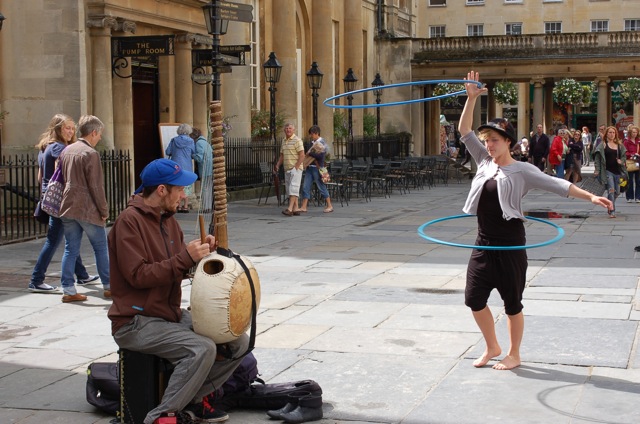
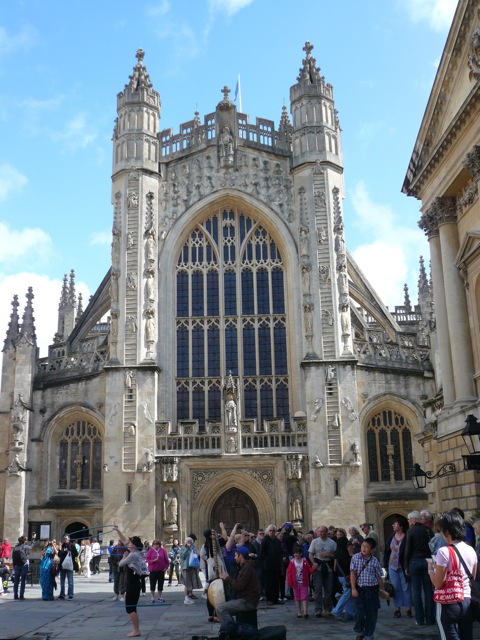
Today, the open area outside the Pump Room by the Roman Baths is perhaps the most popular tourist gathering place. Tour buses stop at the Bath Abbey for pick up and drop off, buskers perform in the open space outside the Roman Baths and Pump Room:

.

Nearby is Sally Lunn’s Bun, originated in 1680 by a young French refugee, in the oldest house of Bath, ca. 1482.  Now a restaurant on top with the cellar a museum that houses the original kitchen and cookwares, Sally Lunn’s serves this traditional creation: a large, soft, round bun that can go with just about anything.  But probably best like this, simply with garlic butter:


The beautiful street corner outside Sally Lunn’s:

.

Further up the town, there’s Milsom Street, a vibrant commercial area of shops and businesses.  The first time Anne saw Captain Wentworth again in Bath was on Milsom Street.  Here’s a present day view of the same site:

.

.

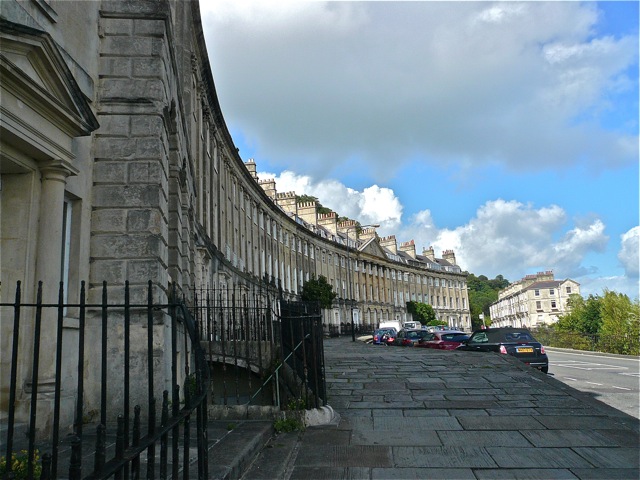
As for Sir Walter himself, despite having to rent out his country mansion Kellynch Hall to avoid financial ruins, he has no intention that his retreat to Bath should compromise his status and comfort.  It’s only natural that others are curious: “What part of Bath do you think they’ll settle in?”  The answer is quite obvious:  the part that is befitting their social standing.  According to Keiko Parker’s insightful article, physical elevation in Bath directly corresponds to social standing.  The highest point at that time would have to be Camden Place, which is today’s Camden Crescent.  While I was looking for it,  the ‘Ye Old Farmhouse Pub’ was mentioned to me as the marker.  I was glad to find it while walking up Landsdown Road, for it was indeed quite an uphill walk.

.

.

“Sir Walter had taken a very good house in Camden Place, a lofty, dignified situation, such as becomes a man of consequence; and both he and Elizabeth were settled there, much to their satisfaction.

Anne entered it with a sinking heart, anticipating an imprisonment of many months…” (p. 98)

Just typical Austen, the overt contrast of characters using something indirect, here, the sense of place.

The houses on Camden Crescent has unobstructive view of lower Bath.  They are not grand mansions, but then again, location is everything.  The following are some of the houses found on this road across from the escarpment:

.

And where do Sir Walter’s tenants Admiral and Mrs. Croft lodge during their short stay in Bath?  On Gay Street, not too high, not too low: “… perfectly to Sir Walter’s satisfaction.  He was not at all ashamed of the acquaintance, and did, in fact, think and talk a great deal more about the Admiral than the Admiral ever thought or talked about him.” (p. 121)

Elizabeth is not even half as kind as her vain and snobbish father.  Regarding the Crofts’ arrival in Bath, she suggests to Sir Walter that “We had better leave the Crofts to find their own level.” (p. 120)

In contrast, Anne has a good impression of the Admiral and his dear wife, the kind and down-to-earth couple, Mrs. Croft being the sister of Captain Wentworth having minimal bearing on Anne’s fondness of them. During their sojourn in Bath to mend a gouty Admiral Croft, Anne enjoys watching them strolling together, “it was a most attractive picture of happiness to her.” (p. 121)

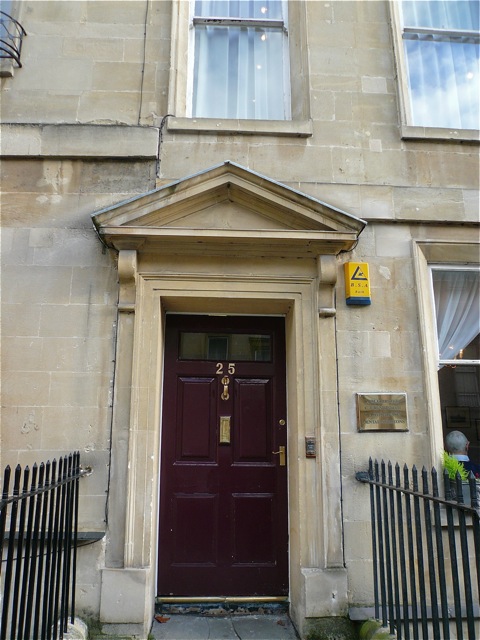
So I’m just not a bit surprised to see their temporary lodging in Bath being on Gay Street.  Who else had lived there?  Jane Austen herself: #25 to be exact:

.

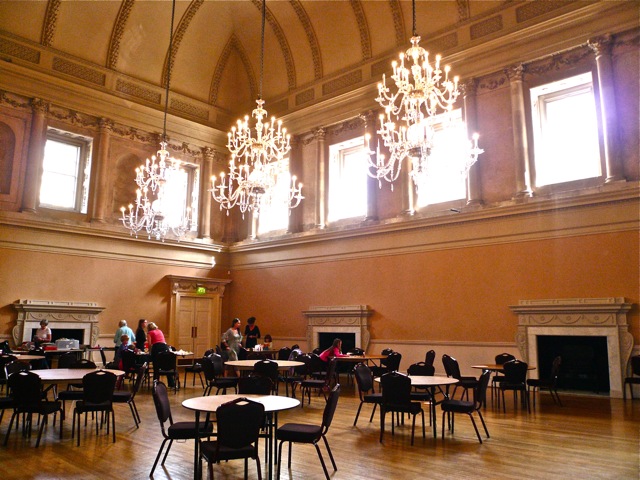
As for a suitable place for socializing, Sir Walter and his favourite daughter Elizabeth choose the Upper Assembly Rooms, a much newer development closer to their upper, more fashionable side of town, although he would prefer entertaining in private which is even more prestigious.

The Assembly Rooms are a magnificent architectural legacy in their own rights.  Designed by John Wood the Younger, who raised the £20,000 needed for the venture, the ground-breaking project began in 1769 and opened for public use in 1771.  It was the biggest investment in a single building in 18th Century Bath. Four public rooms made up the suite:  The Octagon, Ball Room, Card Room, and Tea Room.

“Sir Walter, his two daughters, and Mrs, Clay, were the earliest of all their party at the rooms in the evening; and as Lady Dalrymple must be waited for, they took their station by one of the fires in the Octagon Room (p. 131).

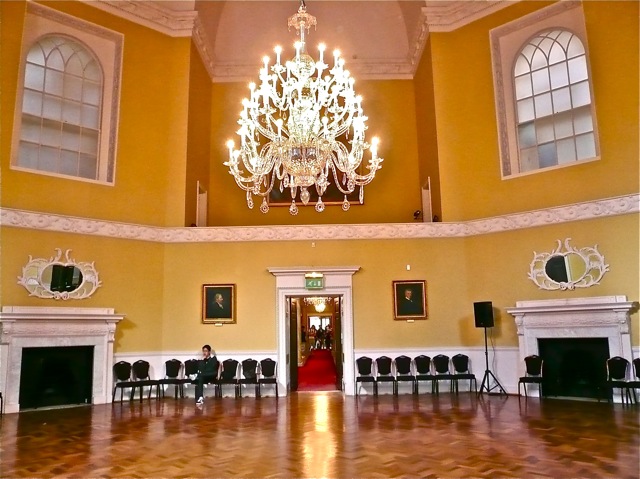
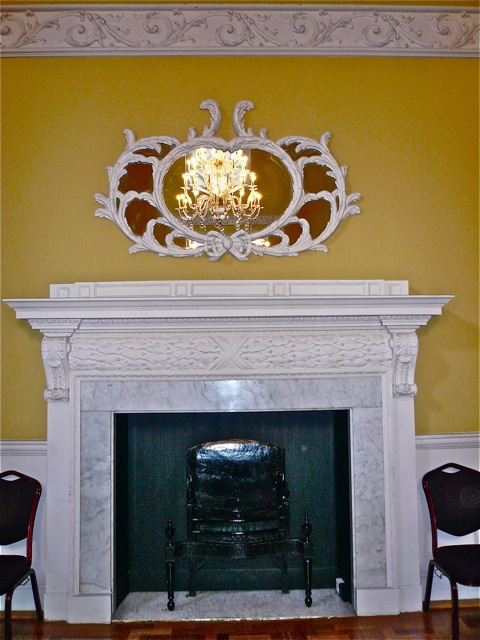
Here’s the exquisite Octagon Room:

Regarding the chandelier, there’s this interesting account in The Authorised Guide (p.7):

“On 15 August 1771 Jonathan Collett quoted £400 for supplying five cut-glass chandeliers for the Ball Room.  They were up in time for the opening of the Rooms in September, but the following month disaster struck when ‘one of the arms of the chandilers in the Ballroom fell down during the time the company was dancing, narrowly missing  Gainsborough.  What could be salvaged from the set was made up into a single chandelier, which now hangs in the Octagon.”

I was just simply amazed at how long these chandeliers had lasted, well over 300 years, and in excellent shape.  Their brilliance had not faded, evolving first from candlelight, then to gas, and now electric:

.

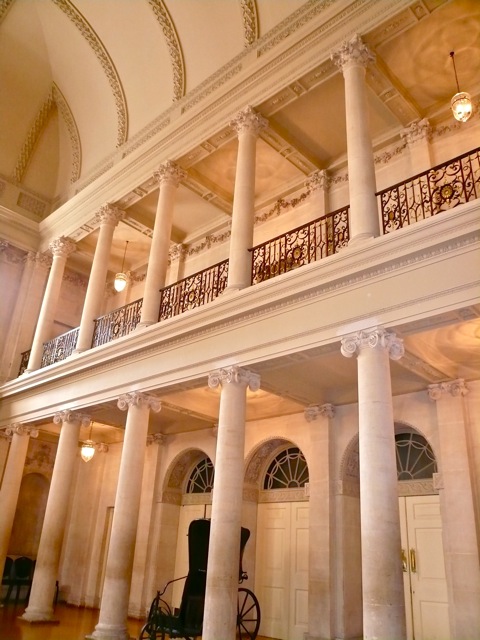
Anne and her party attend a music program in the Concert Hall.  That’s a function in the Tea Room.  Despite the name which seems to convey a small and cozy setting, the Tea Room is a gorgeous room of 60 ft. by 43 ft. dimension.  On one end is a magnificent colonnade of the Ionic order.  Subscription concerts are regular events held in the Tea Room. Mozart and Haydn had written compositions to be performed there, with Haydn himself having graced the magnificent venue.

.

.

But what does Anne Elliot think about all the grandeur?  After earlier in the Octagon Room talking with Captain Wentworth, who has openly expressed his long-held passion for her, Anne, overwhelmed by a great flood of euphoria, now walks into the Concert Room (Tea Room):

“Anne saw nothing, thought nothing of the brilliancy of the room.  Her happiness was from within.  Her eyes were bright, and her cheeks glowed; but she knew nothing about it.  She was thinking only of the last half hour…” (p. 134)

As a visitor to the historic venue, I was captivated by the well-maintained interior and its elegance, and presently amused and surprised to find this display in between two columns: The Chair, which is mentioned several times in Persuasion. The Bath Chair was invented right here in the Georgian City to transport the rich and the sick.  It could be steered by the passenger:

.

.

Jane might have noticed the frivolity and seen through the façade of high society of her time, and sharply depicted her observations in her brilliant novels, but as a modern day tourist and Janeite, I’m just amazed at how well history has been preserved, and that all these locations and life had been experienced by Jane herself. She might have the burden of society on her, which ironically had inspired and unleashed her talents, but for me, a present day tourist and reader of her works, I am totally persuaded that Bath is a place I will definitely revisit some more in the future.

***

All photos taken by Arti of Ripple Effects, August 2010.  All Rights Reserved.

References:

1. Jane Austen: A Life by Claire Tomalin, Penguin Books, 2000.

2.  Persuasion by Jane Austen, The Modern Library Classics, Introduction by Amy Bloom, Modern Library Paperback Edition, 2001.

3. The Authorised Guide: The Assembly Rooms, Bath. Published by the Heritage Services division of Bath and North East Somerset Council in association with the National Trust.  Written by Oliver Garnett and Patricia Dunlop.

4. “What Part of Bath Do You Think They Will Settle In?”: Jane Austen’s Use of Bath in Persuasion by Keiko Parker.  Retrieved Online http://www.jasna.org/persuasions/printed/number23/parker.pdf

Emma (2009, TV): Episode 3

The final instalment of Emma has a major challenge, to reveal the hidden agendas, and to tie up all the loose ends in just under an hour. The hurried scenes leave me with a feeling of watching a trailer, a montage of excerpts loosely linking up the story.  This is especially so in the first half dealing with Jane Fairfax and Frank Churchill’s secret relationship.

If the story feels a bit fragmented in this last episode, the cinematography makes up for that shortfall.  The hour is saturated with stunning shots, magnificent scenic views and exquisite interior renditions.  The Box Hill picnic scene is a vivid example:

Ironically, the pivotal Box Hill scene was not shot in Box Hill, a busy tourist attraction in Surrey.  Instead, it was shot in Leith Hill, Mole Valley, another much quieter scenic point.  For an interesting comparison of the two hills, click here to go to ‘this is surrey today’.

The Box Hill picnic is a crucial turning point in the story.  Emma’s callous and sarcastic joke on Miss Bate and the subsequent scolding she receives from Mr. Knightly is nothing short of an epiphany in self-knowledge.  The genuine remorse she feels could well reflect her greatest strength.  I’m sure such quality of character is what seizes Mr. Knightly with tenderness, moving him to consider her “faultless in spite of all her faults.”

I have a feeling too that this is the very reason Austen finds her heroine likable.  Romola Garai has effectively portrayed a contrite and humbled Emma, while Jonny Lee Miller has delivered convincingly a silent lover with passion and principle.  My initial reservation about his role has definitely changed for the better in this final episode.

Fortunately as well, the endearing lines of Mr. Knightly to Emma, no, not the ‘badly done!’ admonition, but the heartfelt praise he spurts out in spontaneity, remains intact and without any modernized alteration from screenwriter Sandy Welch.  Of course it needs to be declared in its authentic whole… Miller has the best lines of the series:

“I cannot make speeches, Emma… If I loved you less, I might be able to talk about it more.  But you know what I am.  You hear nothing but truth from me.  I have blamed you, and lectured you, and you have borne it as no other woman in England would have borne it.”

As with all Austen’s novels, the ending comes with nuptial ties. But as Masterpiece Classic’s host Laura Linney points out at the opening, considering the social discriminations inflicted upon the woman in Jane Austen’s time, allowing no ownership of properties, no decent employment (even Jane Fairfax compares the governess position with slavery), and no respect or rights given to the single female of low means, it is only a justifiable reward for the author to end her story with loving marriages for her well-deserved protagonists.

Towards this end, the camera takes us to the magnificent view of Beachy Head in the last scene.  As Emma and Mr. Knightly stand on the edge of the cliff overlooking the boundless ocean, we see the series come to an idealistic end, maybe a broader stroke than that in Austen’s novel. But as some critics have noted, it is love that the author emphasizes rather than romance.  From that perspective, looking outward together to the ocean vast instead of gazing into each other’s eyes may well be an apt interpretation of Austen’s heart.

***

CLICK HERE to go to Episode 1

CLICK HERE to go to Episode 2

Arti’s reviews of Emma (2009), Episodes 1 to 3, have been compiled into one article and published in the Jane Austen Centre Online Magazine. CLICK HERE to read the many other interesting articles on Jane Austen and her time.

**Photo Sources: Box Hill Picnic bbc.com; Beachy Head, not a scene from the movie, taken from Wikimedia Commons.

Emma (2009, TV): Episode 2

‘An authentic human being’ is how the host of Masterpiece Classic Laura Linney describes Emma.  Jane Austen’s characters have no supernatural powers, she notes.  But herein lies the magic of her writing.  She takes the ordinary and draws out the unnoticed features.  From these everyday characters like you and me, she skillfully displays the intricacies woven in their interactions, and reveals the undercurrents of hidden intentions and desires.  It is in the revealing of the subtext that makes her story so captivating even for us modern day readers.

Episode 2 continues with this interesting story as we see Emma confused by her own feeling towards Frank Churchill, Harriet’s shifting admiration for the same, Frank Churchill’s seemingly open admiration for Emma, Mr. Knightly’s growing sentiments for the same, and, Jane Fairfax’s hidden anguish, ignored by the subject of her desire.  It seems that everybody’s feeling is mixed up with everybody else’s.  The comedy of errors gathers momentum.

Cinematography continues to be a major contributor to the storytelling.  I particularly appreciate the several Vermeer moments, like the one with Emma gazing out the window deep in thought, or the camera silently captures her playing the pianoforte, immersed in diffused light.  I’ve also enjoyed how the visual reveals inner thoughts.  Mr. Knightly’s longing is projected by the flashback of his dancing with Emma, shifting to the single swan in the pond, warm music enfolding… a beautiful cinematic moment where the visual and music communicate effectively without words.

Mrs. Elton is animatedly played by Christina Cole.  In terms of comedic and obnoxious effects, she is of her husband’s equal, a good match indeed. While Rupert Evans is proficient in portraying a sly Frank Churchill, he does not look like the one I have in mind.  But that is not important. My main concern is with the role of Jane Fairfax.  This second episode confirms my misgiving from the beginning.  I feel there is a miscast here.  I miss her elegance, poise and subtleties as described by the author.  She is supposed to be Emma’s worthy rival after all.

The dance at The Crown Inn is a delight to watch.  That is also the occasion showing everybody’s true colour.  And Mr. Knightly has proven himself to be one considerate gentleman as he invites Harriet to dance after she is slighted by Mr. Elton.  Also, we’re beginning to see Mr. Knightly more and more in love, while the object of his desire remains relatively clueless, albeit a sense of appreciation has arisen in her confused heart.  The dances are fun to watch too, much more lively and convivial than the courtly dances we see in other Austen adaptations.

After two episodes, the story and the characters are well developed, the overall effects pleasing and enjoyable.  I look forward to the next instalment.

*****

CLICK HERE TO GO TO MY REVIEW OF EPISODE 1

CLICK HERE TO GO TO EPISODE 3, THE CONCLUSION

Arti’s reviews of Emma (2009), Episodes 1 to 3, have been compiled into one article and published in the Jane Austen Centre Online Magazine. CLICK HERE to read the many other interesting articles on Jane Austen and her time.


Emma (2009, TV): Episode 1

Previously on Masterpiece Classic

Yes, treat this post as a recap to prepare you for Episode 2 in just a couple of days.

So finally, North American viewers have the chance to see the long awaited 2009 BBC production of Emma, three months after its release in the UK.  A click on imdb will find no less than 15 different versions of this popular Austen work.  Yet another one?  It just naturally leads one to question, why?  After seeing this first episode, let me give it a shot: just because it’s so much fun to do.

That’s how I felt as I watched the PBS broadcast last Sunday.  This newest adaptation of Emma is probably the best I’ve seen, and Romola Garai easily the best-cast Emma so far.  Yes, I’m comparing her with Gwyneth Paltrow (1996) and Kate Beckinsale (1996, TV).  She may well be one of the best-cast Austen heroines for their roles in my opinion, let’s just say, neck and neck with Jennifer Ehle’s Elizabeth Bennet.

What a difference from her guilt-ridden Briony in the movie Atonement.  Well, Garai’s Emma is guilt-ridden too as the errant, over-confident matchmaker, but her genuine heart and willingness to own up to her misjudgment have made her personality shine through.

In creating Emma, Austen had said that “I’m going to take a heroine whom no-one but myself will much like.”  Seems like this adaptation does a great service pulling us over to Austen’s side. Garai’s Emma reflects the probable reasons why the author found her character likable: vivacious, charmingly clueless, and above all, her readiness to admit faults, her genuine heart towards herself and others.  Garai’s animated performance is most apt in a comedic genre such as this.  So far in the first episode, the irony and humor have come through.

The impressive cinematography matches perfectly the personality and atmosphere of the novel, brisk, agile, fun, and yes, as Mr. Knightly narrates in the beginning, golden.  Just the kind of colour scheme for a clever comedy, the exact reflection of its main character.  As a comedy, a little exaggeration in the colours is acceptable and quite effective I think.  Overall, the visuals are captivating, beautiful shots of the English country landscape, the well situated mansions and their interior renderings.  I’ve particularly appreciated the few overhead shots, and some of the contrasting darker scenes in the beginning.

And yes, the beginning is where a film can captivate right away.  I’ve enjoyed screenwriter Sandy Welch’s treatment of the plot, drawing out three characters, Emma, Frank Churchill, and Jane Fairfax, who had all lost their mother as a young child, and focusing on how markedly different their lives have turned out.

For the casting of Jonny Lee Miller as Mr. Knightly, however, I have a little reservation, in this first episode anyway.  The sparks between Emma and him look more like sibling bickering than the undercurrents of subliminal lovers’ quarrels, which Austen so brilliantly depicts. The 16 years of age difference is almost unobservable here, although in real life they are ten years apart.  But I’ve enjoyed Jonny Lee Miller’s portrayal of the conflicting Mr. Knightly, at times detached, at times involved, and at times, exasperated.

Michael Gambon is excellent as the fastidious Mr. Woodhouse. The legendary actor has delivered a convincing performance as an endearing but taxing hypochondriac.  As for Harriet Smith and Jane Fairfax, I’m afraid my preference is the 1996 TV production‘s casting of Samantha Morton and Olivia Williams in these roles.  But then again, my view can change as I continue watching.

This first episode strikes me as a lively, contemporary rendition. While screenwriter Sandy Welch had chosen to use more modern language in her dialogues, I don’t think she needed to stray too far from the original to achieve this.  As I’m re-reading Emma for these screenings, I find the book very accessible for modern readers, the characters are those whom we can relate to, their motives and emotions very similar to what we are familiar with.  Austen’s skills in observation and her intelligence in depicting human nature and her characters’ inner world are simply impressive, considering she was writing almost a hundred years before Freud and the birth of modern psychology.

****

CLICK HERE TO GO TO MY REVIEW OF EPISODE 2

CLICK HERE TO GO TO EPISODE 3, THE CONCLUSION

Arti’s reviews of Emma (2009), Episodes 1 to 3, have been compiled into one article and published in the Jane Austen Centre Online Magazine. CLICK HERE to read the many other interesting articles on Jane Austen and her time.


Why We Read Jane Austen

The first challenge you face when writing about Pride and Prejudice is to get through your first sentences without saying, “it is a truth universally acknowledged…”

—–  Martin Amis

Isn’t it true that these words from the clever and satirical opening line of Jane Austen’s Pride and Prejudice [1] have been so overused that they have sadly become a cliché in our contemporary language, together with ‘zombies’ and ‘vampires’?

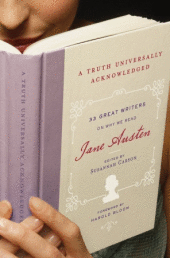
So what did I expect from a book entitled A Truth Universally Acknowledged:  33 Great Writers on Why We Read Jane Austen?

I admit, at first I thought it was a literary version of those lifetime achievement award presentations, where the honoree is showered with superfluous speeches by his/her peers, over champagne and frivolous dinner, something which Jane Austen herself would abhor.

I found out soon enough that between the modest and classic looking covers, Susannah Carson, the editor of the volume, had gathered the essays of 33 writers, not toasts or roasts, but detailed biographical notes, thoughtful musings, heartfelt admiration and in-depth analysis of Austen characters and works.  It is a collection of articles stemming from a balanced fusion of sense and sensibility, something that Austen herself would have approved.

Included are literary figures from the late 19th to 20th centuries like E. M. Forster, W. Somerset Maugham, C. S. Lewis, Eudora Welty and Virginia Woolf.  Contemporary contributors include writers, academics, Austen historian, and screenwriters.  There are views from Harold Bloom, Lionel Trilling, Janet Todd, Anna Quindlen, A. S. Byatt, Amy Bloom, to name a few.  All of them point to Austen’s inimitable humor, incisive observations of human nature and unwavering moral stance that make her works still relevant two hundred years later today.

The following are some samples from this smorgasboard of Austen delights.

Harold Bloom, writing the preface, concludes with these lines:

We read Austen because she seems to know us better than we know ourselves, and she seems to know us so intimately for the simple reason that she helped determine who we are both as readers and as human beings.

Anna Quindlen, defending the subject matter in Austen’s works being mainly about the family (it’s a pity that she even needs to do this):

…[Austen was] a writer who believed the clash of personalities was as meaningful as—perhaps more meaningful than—the clash of sabers.  For those of us who suspect that all the mysteries of life are contained in the microcosm of the family, that personal relationships prefigure all else, the work of Jane Austen is the Rosetta stone of literature.

Austen once referred her own writing as “the little bit (two inches wide) of ivory on which I work with so fine a brush, as produces little effect after much labour.”  In response, screenwriter and director Amy Heckerling, who has adapted Emma into the movie ‘Clueless’, compares Austen’s writing to a Vermeer painting:

“Sometimes the finest brushes paint the biggest truths.”

James Collins, a writer and editor, and frequent contributor to The New Yorker, shares a very personal view:

I find that reading Jane Austen helps me clarify ethical choices, helps me figure out a way to live with integrity in the corrupt world, even helps me adopt the proper tone and manner in dealing with others… Reading Austen I sometimes feel as if my morals are a wobbly figurine that her hand reaches out and steadies.

But she is not all didactic and stern… far from it.  Jane Austen has long been celebrated for her animated humour and witty ironies, the essence of her writing.  I love this analogy that Collins uses:

Her ironies swirl and drop like the cast of a fly fisherman. This rhythmic motion seems to me ideal for both accepting and rejecting the ways of the wretched world while maintaining balance.

Demonstrating the relevance of her satires for today, Benjamin Nugent, the author of American Nerd: The Story of My People, discusses the nerds in Pride and Prejudice, Mary Bennett and Mr. Collins, and why they miss out on life.

If you read sci-fi novels, you’ll generally read about worlds in which scientists and the technologies they create drive the plot; if you read Austen, you’ll read about a world in which technology means nothing and the triumphs and failures of conversational agility drive everything.

His advice for modern day nerds:

Young nerds should read Austen because she’ll force them to hear dissonant notes in their own speech they might otherwise miss, and open their eyes to defeats and victories they otherwise wouldn’t even have noticed.  Like almost all worthwhile adolescent experience, it can be depressing, but it can also feel like waking up.

It takes a sharp ear and intelligence to be a good humorist, and Austen shows that she has what it takes to be one at an early age.  About her prodigious talent, Virginia Woolf praises her first work, the novella Love and Friendship, written when Austen was only 15:

an astonishing and unchildish story… Spirited, easy, full of fun, verging with freedom upon sheer nonsense–Love and Friendship is all that…  The girl of fifteen is laughing, in her corner, at the world.

Indeed, as editor Susannah Carson has stated, any hint of ‘romance’ in her novels is merely the irony of it. About the seemingly unconvincing romantic plot in Northanger Abbey, Carson asserts:

What if Austen actually intended the romance plot to be unconvincing?  … It is probable… that Austen intended the failure of the romance plot, not to sabotage her own work, but to make a point about romance plots in general… that [they] are inherently artificial.

That Northanger Abbey is a satire on the gothic novel has long been noted.  Other writers also stress that Austen should not be labelled as a ‘romance writer’ because of the satirical styling behind her writing.  W. Somerset Maugham keenly observes:  “She had too much common sense and too sprightly a humor to be romantic.”

In his essay ‘Beautiful Mind’, writer Jay McInerney bravely admits that: “If my actual romantic life has sometimes been influenced by superficial considerations, as an Austen reader the basis of my affections has been almost entirely cerebral.

Amy Bloom sums it up succinctly about this common confusion about romance and love:

Jane Austen is, for me, the best writer for anyone who believes in love more than in romance, and who cares more for the private than the public. She understands that men and women have to grow up in order to deserve and achieve great love, that some suffering is necessary (that mewling about it in your memoir or on a talk show will not help at all), and that people who mistake the desirable object for the one necessary and essential love will get what they deserve.

To master such a distinction could well be one of the main reasons why we read Jane Austen.

**

A Truth Universally Acknowledged:  33 Great Writers on Why We Read Jane Austen, edited by Susannah Carson, published by Random House, NY, 2009, 295 pages.

**

[1] The first line of Pride and Prejudice goes like this: “It is a truth universally acknowledged, that a single man in possession of a good fortune, must be in want of a wife.”

Photos Sources: Book cover randomhouse.com, Jane Austen Portrait tvo.org, Jane Austen Centre, Bath, taken by Arti of Ripple Effects, Dec. 07.

This article has recently been published in the current Jane Austen Centre Online Magazine. Click to go there for other interesting articles on Jane and the Regency world.

**

Related Posts you might enjoy:

In Praise of Austen: Virginia Woolf’s A Room Of One’s Own

A Jane Austen Education by William Deresiewicz

**

Books and the Gender Issue

My review of Girl With A Pearl Earring has recently been linked to a book list. While I appreciate the link, I must admit it has stirred up in me some unintended ripples.  It’s the title of the list:  ‘101 Books Every Woman Should Read’.

Now I’m always wary about books that are labeled and geared towards one gender.  Like recently I came across a book entitled 100 Places in Italy Every Woman Should Go… makes you wonder what exactly they’re luring you into. Imagine a book called 100 Places Every Man Should Go…

Anyway, back to the list of books every woman should read.  The range is eclectic with the titles neatly categorized.

Just let me list a sample from each of the categories:

The Classics: Frankenstein by Mary Shelly, The Fountainhead by Ayn Rand, Howards End by E. M. Forster, To Kill a Mockingbird by Harper Lee, Pride and Prejudice by Jane Austen, Wuthering Heights by Emily Bronte, Middlemarch by George Eliot, Mrs. Dalloway by Virginia Woolf…

Children’s Literature:  Pippi Longstockings by Astrid Lindgren, The Wizard of Oz by L. Frank Baum, Charlotte’s Web by E. B. White, Alice’s Adventures in Wonderland by Lewis Carroll…

Books into Movies:  The English Patient by Michael Ondaatje, Beloved by Toni Morrison, Memoirs of a Geisha by Arthur Golden, Out of Africa by Isak Dinesen…

Books Featuring Familial Relationships:  The Joy Luck Club by Amy Tan, The Poisonwood Bible by Barbara Kingslover, The God of Small Things by Arundhati Roy, Away by Jane Urquhart…

Books Celebrating the Strength of Women:  Jane Eyre by Charlotte Bronte, The Bell Jar by Sylvia Plath, The Scarlet Letter by Nathaniel Hawthorn, Babette’s Feast by Isak Dinesen…

Current Literature:  Unaccustomed Earth by Jhumpa Lahiri, The Elegance of the Hedgehog by Muriel Barbery, Water for Elephants by Sara Gruen…

Books about Finding Oneself:  Bee Season by Myla Goldberg, The Heart is a Lonely Hunter by Carson McCullers…

Stories of Real Women: I Know Why the Caged Bird Sings by Maya Angelou,  Amelia: A Life of the Aviation Legend by Donald M. Goldstein and Katherine V. Dillon, Diary of a Young Girl by Anne Frank, The Story of My Life by Helen Keller, Portrait of an Artist: A Biography of Georgia O’Keeffe by Laurie Lisle…

Banned or Challenged Books:  Leaves of Grass by Walt Whitman, Fahrenheit 451 by Ray Bradbury, Of Mice and Men by John Steinback, The Kite Runner by Khaled Hosseini.

Non-Fiction: Pilgrim at Tinker Creek by Annie Dillard, Silent Spring by Rachel Carson, Gorillas in the Mist by Dian Fossey, On Death and Dying by Elisabeth Kubler-Ross,  A Room of One’s Own by Virginia Woolf

You get my point.  Sounds like any typical high school and college reading list, but why specify women?

Yes, they’re mostly written by women authors, and many with strong female protagonists.  They depict the journey of self-discovery, of overcoming odds, of seeking meaningful relationships and ideals in a hostile world.  In the non-fiction section there are influential books that have achieved significance in the area of writing, psychology, environmentalism, social justice.

But my query is:  If these books depict the inner journey of women, or portray the poignant reality of their struggles, if they have shed any light on the human race in terms of equality, justice, or existential meaning, are these not all the more reasons for men, or anyone, to read them?

Of course, for the sake of argument, one could point out that the statement “books every woman should read” doesn’t preclude that men should not.  But that’s just being contentious.

Books for women, books for men, why can’t books be just books?  Maybe it has to do with the writing of books, or, step back further, society’s view on male and female authors.

Posting on the Guardian blog, writer and editor Harriet Evans vehemently declares that:

“I’m fed up with seeing some of our best novelists written off as ‘chick lit’ — you don’t see the same belittling line taken with male writers…

It winds me up that books about young women are seen as frivolous and silly, while books about young men’s lives that cover the same topics, are reviewed and debated, seen as valid and interesting contributions to the current social and media scene.

And regarding the reading public, it has been noted that women read more than men, both in the U.S. and the U.K.  With that in mind, Evans goes on to state that:

The truth is, women happily read books (and watch films and TV) aimed primarily at men…. They read thrillers, travel books, biographies – and yet the majority of these books are marketed for men… But men rarely try women’s fiction, because they’ve been conditioned to think they can’t pick up a book with a pink cover.”

Indeed, worthy literature written by women authors are sometimes reduced to ‘romance’ or ‘chick lit’.  Jane Austen is a prime example.  Her incisive social satires, eloquent writing and sense of humor have often been swept aside while the romantic union of the protagonists at the end is given the main focus.  In this way, her work is conveniently labeled as ‘chick lit’, dreaded by male readers, until some brave souls dare to take up the challenge and are floored by her relevance and intelligence.

Virginia Woolf sharply observes in her Cambridge lecture series compiled in A Room Of One’s Own that historically, social norm has always been one that coops up women in the domestic while offering men the world.

Taking her view further, I can understand why the dichotomy, however arbitrary, in male and female writing, their difference in subject matters, subsequently, books for men and books for women.

I have a feeling that if the protagonist of The Catcher In The Rye is called Helen Caulfield, the book could well be dismissed as another trivial version of teen angst, schoolgirl blues, fussing over boys and growing up.  And likely we won’t see it on any reading list.

Top 100 Books & Summer Reading Lists

Summers come and summers go,  reading lists for students tend to remain a constant, or… no?

According to The Boston Globe, the following are a few titles from high school summer reading lists over the years:

1915-1916 (long list of choices for regular year and summer)

  • Walden by Henry David Thoreau
  • Gulliver’s Travels by Jonathan Swift
  • Mill on the Floss by George Eliot
  • Works by Stevenson, Twain, and Dickens

1984 (requirements by grade and academic level)

  • The Grapes of Wrath by John Steinbeck
  • Jane Eyre by Charlotte Bronte
  • The Woman Warrior by Maxine Hong Kingston

2009 (recommendations, not requirements)

  • Twilight by Stephenie Meyer
  • Into the Wild by Jon Krakauer
  • Angels and Demons by Dan Brown
  • Pride and Prejudice and Zombies by Seth Grahame-Smith

ah…  the times they are a-changin.

Instead of (or, hopefully, on top of) reading the original Pride and Prejudice, students today are offered the zombies version… optional, of course.  The current view is, students should be enticed to read, not forced to.  Reading is supposed to be fun, after all, it’s summer.  

Summer

Around the same time, Newsweek published The Meta-List of Top 100 Books of all time.  The List is a compilation of 10 top book lists, including Modern Library, the New York Public Library, St. John’s College reading list, The Telegraph, The Guardian, Oprah’s, and others.  The Meta-List… the mother of all lists.

Here are the top 30,  just for a taste of the selections.  For the complete list, click on the above link.

  1. War and Peace by Leo Tolstoy (1869)
  2. 1984 by George Orwell (1949)
  3. Ulysses by James Joyce (1922)
  4. Lolita by Vladimir Nabokov (1955)
  5. The Sound and the Fury by William Faulkner (1929)
  6. Invisible Man by Ralph Ellison (1952)
  7. To the Lighthouse by Virginia Woolf (1927)
  8. The Illiad and The Odyssey by Homer (8th Century B.C.)
  9. Pride and Prejudice by Jane Austen (1813)
  10. Divine Comedy by Dante Alighieri (1321)
  11. Canterbury Tales by Geoffrey Chaucer (15th Century)
  12. Gulliver’s Travels by Jonathan Swift (1726)
  13. Middlemarch by George Eliot (1874)
  14. Things Fall Apart by Chinua Achebe (1958)
  15. The Catcher in the Rye by J. D. Salinger (1951)
  16. Gone with the Wind by Margaret Mitchell (1936)
  17. One Hundred Years of Solitude by Gabriel Garcia Marquez (1967)
  18.  The Great Gatsby by F. Scott Fitzgerald (1925)
  19. Catch-22 by Joseph Heller (1961)
  20. Beloved by Toni Morrison (1987)
  21. The Grapes of Wrath by John Steinbeck (1939)
  22. Midnight’s Children by Salman Rushdie (1981)
  23. Brave New World by Aldous Huxley (1932)
  24. Mrs. Dalloway by Virginia Woolf  (1925)
  25. Native Son by Richard Wright (1940)
  26. Democracy in America by Alexis de Tocqueville (1835)
  27. On The Origin of Species by Charles Darwin (1859)
  28. The Histories by Herodotus (440 B.C.)
  29. The Social Contract by Jean-Jacques Rousseau (1762)
  30. Das Kapital by Karl Marx (1867)

… and so on and so forth.  You get the idea.  Nothing on the top 100 list is later than 1987 (Beloved by Morrison) except Pullman (no. 84), and quite a few dating back to Centuries B.C. 

Now, is this literary elitism that has not caught up with the times?  Or, has our younger generation been short changed by not being taught to appreciate some valuable cultural legacy?  How do we reconcile the discrepancy between what’s recommended to our students and what experts think are the best books ever written?  Or, reading tastes vary, people are free to read whatever they like… Any list produced is therefore prescriptive and hegemonic?

Of course, one  could argue summer reading lists are not academic syllabi, give our students a break.  They’ll have the chance to read these great books at school… or, will they ever?

Still another debate would be the all too familiar struggle  even among book lovers: Literary or Popular Fiction, old or contemporary classics?   How do we choose?   Reading widely or reading deeply?  

 And, the very practical question:  How can I extend my 24 hours? 

***