‘The Holdovers’ is easy viewing for the holidays

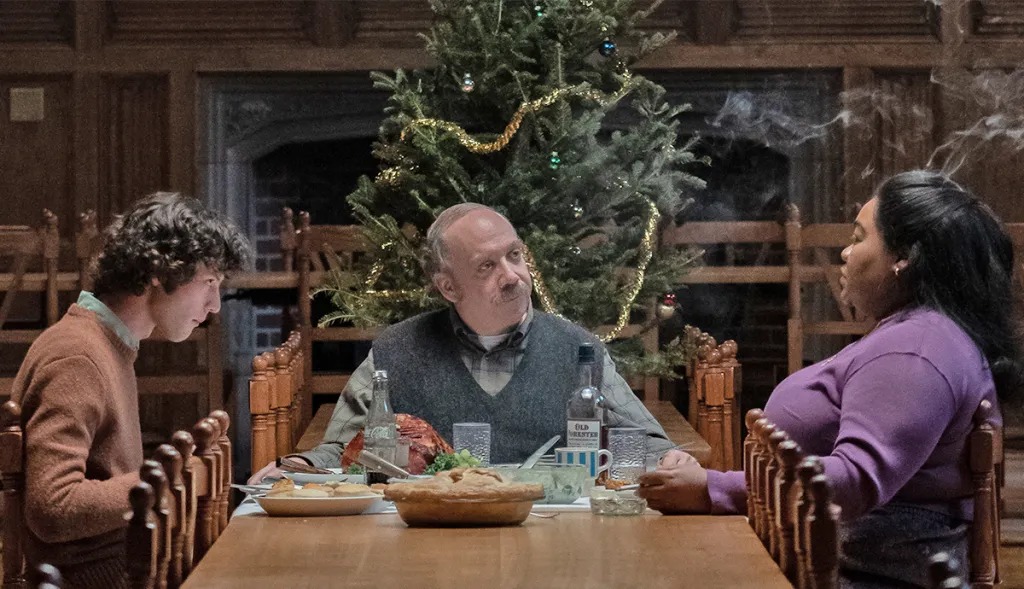
Alexander Payne’s newest feature is a pleasant dramedy for this coming holidays season. Set in a 1970 remote New England winter, boarding school history teacher Paul Hunham (Paul Giamatti) is tasked with supervising the few students who can’t go home during Christmas break, the holdovers.

When a helicopter sent by one of the students’ rich daddy comes to pick up the group, Angus Tully (Dominic Sessa) is left behind as he is just like his cranky history teacher at Barton Academy, unpopular among his peers. Angus’ pain stems more from being abandoned by his mother who wants to spend Christmas with her new boyfriend alone. Together with the chief cook of the school Mary Lamb (Da’Vine Joy Randolph), a grieving mother who has just lost his son in Vietnam, three damaged souls are left to spend their winter holidays in an empty boarding school.
Payne has won two Oscars for Best Writing, Adapted Screenplay, for The Descendants (2011) and Sideways (2004), both with which he was also nominated for Directing. His third directing Oscar nom was for the black-and-white feature Nebraska (2014). Payne’s forte of capturing the humanity in conflicting relationships is apparent in his works. Such is the main drive and the fun found in The Holdovers, where we see Payne reunites with Sideways‘s Giamatti. The idea for the film came from a 1935 French movie, but interestingly, Payne chose to have the TV writer David Hemingson do the screenplay, his debut feature.

The story idea isn’t new, misfits thrown together in reluctant circumstances starting out repelling each other but through unexpected turns of events, human decency shines through. Watching The Holdovers brings back memories of Dead Poets Society and Scent of a Woman. But this is a much lighter and warmer feature with nonetheless poignancy towards the end. Payne’s signature style of sprinkling humour with pathos is prevalent here, at times even with slapstick, Chaplain-like actions added in. Later a road trip to Boston solidifies the unlikely companionship, events leading to the triumphant transformation of self for all three characters.

The 133-minute screen time could be tightened though, especially in the first part where it feels likes the story has not started until everyone has gone and only the three remaining characters are left in the empty school. It then picks up momentum when a road trip is in gear. The first part is set up for slow-paced viewing offering scenic New England in the snow; the song selections are appealing, and maybe with a touch of sarcasm. While waiting for the inciting turn to kick start the story, viewers can sit back and maybe for some, reminisce on their own prep school experiences.

He may be pompous and grumpy, Hunham’s sadistic approach to teaching just shows that his intention is genuine in preparing his students to enter Ivy League schools by their own academic merits and not because their fathers give money for a new building or a fancy gym. He even has the gall to fail a senator’s son, hence, his unpopular status among the principal, faculty, and needless to say, his students. As a classics and ancient history teacher, Hunham’s personal vernacular is where some of the humor lies. His lines are quotable quotes. Giamatti is perfectly cast, a natural in portraying such an eccentric. Come awards time, he is likely to be noted for his performance.

Da’Vine Joy Randolph as Mary is superb. Despite nursing deep loss, she is sensitive to others’ needs, a character foil against Hungham. her quiet presence exudes a much needed sensibility to balance out the incompatible trio. It’s always heartwarming to see human decency and kindness seep through the clouds of personal pain.

Sessa is discovered from an audition at an actual New England boarding school. It’s interesting that he looks more mature than a high school student. So, in that sense, he doesn’t seem to be a fitting cast. However, to make up for his appearance, his acting is natural and in this his movie debut, has shown himself to be a pristine actor with much potential.

The Holdovers could make another crowd pleasing Christmas movie with holding power in the years to come. It’s easy viewing and inviting for rewatch, especially to catch the quotable lines, Hunham style.

~ ~ ~ Ripples

***

Related Ripple Review:

Nebraska (2013): Color is Superfluous

and a related quote from a previous post:

“Medicine, law, business, engineering, these are noble pursuits and necessary to sustain life. But poetry, beauty, romance, love, these are what we stay alive for.” — Dead Poets Society
‘NYAD’ is a movie of two heroes

Diana Nyad is the first person to swim more than 100 miles from Havana, Cuba to Key West, Florida without a protective shark cage. The date was September 2, 2013. Nyad reached Florida shore after 53 hours of swimming in open water at the age of 64.

First off, I’m aware of the controversy surrounding this achievement of Nyad’s, as well as those of her past as a marathon swimmer. However, I’m here to discuss the movie NYAD only, so that’s what this post is about. The movie is based on Diana Nyad’s memoir Find a Way: the Inspiring Story of One Woman’s Pursuit of a Lifelong Dream (2016); since I’ve not read the book, I won’t be touching on any of its content or comparing the source material with the adaptation.

NYAD is the first narrative feature of Oscar winning documentarian couple Jimmy Chin and Elizabeth Chai Vasarhelyi. Chin himself is no stranger to extreme sports. An acclaimed mountaineer and National Geographic photographer who has reached the top of Mount Everest twice and skied down its vertical surface. With Free Solo (my review), the husband-and-wife filmmakers won the Best Documentary Feature Oscar in 2019. The film chronicles rock climber Alex Honnold scaling the 3,000 feet vertical wall of El Capitan in California’s Yosemite National Park using his bare hands and feet, solo and free from ropes and safety gears.

I can see right away how this feat of Honnold’s parallels that of Nyad’s, who swam in the open ocean with no enclosed protection from sharks, albeit in her successful, final attempt, donned a jellyfish protective suit to finish her challenge. Both the mountain climber and the marathon swimmer possess the same drive: an obsessive, iron will.

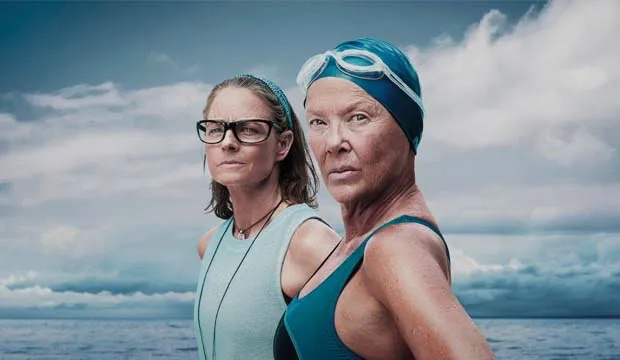
Annette Bening is perfect in her portrayal of Nyad, a determined but difficult, and sometimes abrasive character. It takes such kind of one-track stubbornness––and a whole supporting team including an expert navigator (John Bartlett, aptly played by Rhys Ifans), boat pilot, medic, jellyfish expert, shark detracting divers, and others––sailing alongside the marathon swimmer to achieve such an arduous venture.

Above all, it’s Nyad’s lifelong friend and coach Bonnie Stoll––superbly-matched casting of Jodie Foster––who supports and trains her during this grueling ordeal, albeit reluctantly at the start. Nyad might be the ultimate triumph, but it is Bonnie, the loyal friend being pushed into her own onerous hero’s journey that makes it possible, preparing the swimmer both physically and psychologically to realize her dream. Bening and Foster playing off each other is the best stroke of the movie. A moving scene towards the end shifts the focus of the motivating force, surely it requires an indomitable will, but it’s deep, genuine love that finishes the course.

As documentary filmmakers shooting their first dramatic narrative, Chin and Vasarhelyi deftly insert actual footage of Nyad’s earlier failed attempts, the first one when she was only 28, as well as her interviews and talks. Such inclusions strengthen the authenticity of the drama. It’s inspiring to see that Nyad is not afraid to look at her past failures. Ironically, it is her first failed attempt at 28 that sparks the idea to try again when she’s 60, and prods her to face the challenge head-on at 61, then tries again, and again, until she finally achieves her goal in her fifth attempt at 64. Showing such repeated efforts could make the film look redundant, but Bening and Foster’s on screen relationship captures my attention throughout.

Bening needs to be applauded for her willingness to go all out to portray Nyad in the most realistic way she could. Chin had noted in an interview that the actress spent four to eight hours a day in the water shooting the film, “and she did all the swimming.” To prepare for her role, Bening, who was well into her 60’s at the time, had to go through a year of intense training in swimming and physicality before the production. Most likely Mary Oliver had struck Bening just the same as her poetic voice had moved Nyad. In the movie, these lines from ‘The Summer Day’ were the initial motivation inspiring Nyad to take up such a Herculean challenge at 60:

“Doesn’t everything die at last, and too soon?
Tell me, what is it you plan to do
with your one wild and precious life?”

Another insertion the directors use to dramatize the seemingly monotonous swims is fantasy sequences, which are not too well received by some reviewers. Not for me. Like one lost in the desert wearing out to the brink of expiring with thirst, mirages appear in the hallucinated mind. This is a parallel situation. In the dire demand of the grueling swim in treacherous waters almost to the brink of death, disorientation could set in.

Another dramatic device are the faded flashbacks of Nyad as a young swimmer, including some hazy implications of abuse. While serving the biopic element of the feature, these flashbacks lack the significance and continuity with the present day Nyad and her goal. Tighter editing and elaboration of these scenes might serve their purpose better.

Must mention is the original score by Alexandre Desplat whose expansive repertoire include two Oscar wins (The Shape of Water, The Grand Budapest Hotel). The song selections are interesting as well, maybe only appeal to certain demographics; some of these titles must have brought back fond memories from viewers of Nyad’s generation. The opening of the film are underwater shots of Nyad swimming in the pool, and to my pleasant surprise, ‘The Sound of Silence’ comes on, reminiscence of a similar scene where a dazed Benjamin, freshly graduated from college trying to figure out his path in life. We all know where that comes from.

I’m excited to see Chin and Vasarhelyi venture out into the narrative feature genre. The fusion of dramatization with actual documentary footage is an effective transition into their new mode of storytelling. NYAD is an inspiring film not just for its subject matter but for the performance of the two lead actors which is most memorable.

~ ~ ~ Ripples

***

‘Anatomy of a Fall’ or how to dissect a marriage

In lieu of heading to Toronto for TIFF as in pre-Covid time, I stay put in my city hoping some of my anticipated films might trickle down. Of the nine titles on my to-be-watched list, only one came to the Calgary International Film Festival. I’m glad it’s this year’s Palme d’Or winner Anatomy of a Fall.

French director Justine Triet is the third woman to have won the Palme d’Or, Cannes Film Festival’s top prize in sixty-eight years. The two previous winners were Julia Ducournau for Titane in 2021 and Jane Campion for The Piano in 1993. It’s interesting to note that Triet co-writes the screenplay with her husband Arthur Harari, encompassing English, French and a little German in the dialogues, showing how language can connect as well as alienate a couple depending upon the circumstance.

A teacher and struggling writer, Samuel (Samuel Theis) is found dead on the snow-covered ground of his chalet in the French Alp. The only other person in the house at that time is his wife Sandra (Sandra Hüller), a successful German novelist who has just finished an interview with a journalist in the living room, and loud music is on all this time from somewhere else in the house. The body is discovered by their eleven year-old son, Daniel (Milo Machado Graner), who comes home after walking their family dog Snoop. Actually, it’s Snoop that first finds the body as Daniel is visually impaired.

Two possibilities are pondered in the investigation of the fall, suicide or murder, Samuel being pushed out of the balcony outside the high attic. The main segment of the film is the trial a year later of Sandra, the wife, who stands accused of murdering her husband, with their blind son the sole witness in the courtroom drama. Sandra seeks the help of an old friend Vincent (Swann Arlaud) to be her attorney. Vincent isn’t a high profile lawyer, but he’s empathetic and rational in his reasoning. Since accidental death is the least plausible in this case, the only option to defend his client is to present evidence for suicide. Sandra might look stoic and aloof but Vincent’s support is essential during such a difficult time.

Vincent (Swann Arlaud) and Sandra (Sandra Hüller) in Anatomy of a Fall

Intense and riveting throughout, Anatomy of a fall brings back the joy of pure cinema experience, that is, watching a film that’s made up of a well-crafted script delivered by superb acting, captured in astute camera work, especially with close-ups depicting the nuances of emotions, with no CGI effects, no car chases or apocalyptic explosions, just mere human interactions that speak volumes. And with that note, I must add too that sound or its absence is important in the film. From the loud music of a song by 50 Cent at the beginning to the piano pieces played by Daniel, extension of his inner struggles, all are crucial in the storytelling.

When a wife is on trial for the murder of her husband, every minute detail of their marital relationship will be dissected, dirty laundries aired out and conversations scrutinized without discretion. Out of consideration for not hurting Daniel’s feelings, he is excused on the day some raw evidence from a recording of a fight between his parents is to be played out in court, but he insists to be there. ‘I’ve already been hurt,’ he says.

And it is this voice recording––juxtaposed with flashback sequences for us viewers––that form the pivotal segment of the film, a highly charged, epitome of powerful acting especially from Hüller. It is also this raging recording that casts a doubt in Daniel’s mind regarding his mother, and a little clarity in understanding the balance of relational power between his parents. The flashback scene is for us viewers; in court, only the voices are heard. For Daniel, that is enough. What follows is the key to the the ingenuity of the script, leading to the eventual outcome of the trial.

Not only is her marriage on trial, Sandra’s own personal, psychological makeup is questioned. The prosecutor (Antoine Reinartz) uses anything he can find to create an image of Sandra being a cold and revengeful wife. The content of her novels are examined and taken as a revealing of her psyche. Herein lies an intriguing issue: can a work of fiction be used as evidence to incriminate its author in a court of law? For the prosecutor, to help his case, it’s convenient to equate Sandra’s novels as parallels of her real life. Defence lawyer Vincent is quick to rebut this reasoning, “is Stephen King a serial killer?”

The two and a half hour duration could have been tightened a bit, but sitting through it in the dark theatre with my sole attention drawn to the nuanced performance by the whole cast and in high anticipation of the trial result, I wasn’t aware of the time passing. Just found out France has submitted another film to enter the Best International Film category for 2024 Oscars, rendering Anatomy of a Fall out of the race in that category. Nevertheless, Hüller is worthy of a Best Actress Oscar nom, Machado Graner playing Daniel deserves some high praises, and Triet’s directing and her original screenplay need to be noted, the film could have a chance in the Best Picture category. Overall, a captivating work of suspense, character study, and intelligent filmmaking.

~ ~ ~ 1/2 Ripples

***

The Netflix Diversion

As two of my highly anticipated movies (see my list here) coming out in the fall will be on Netflix: Maestro and NYAD, I just can’t resist anymore. Three days ago I decided to subscribe to Netflix. While waiting for these two movies to show up, I’ve got plenty of others to watch. These past few days, I’ve finished a few. Yes… daily life has been a bit diverted. My capsule reviews in the following. All three TV series are worth watching and the doc on Joan Didion, a must-see.

BEEF –– A road rage incident pushes two lives down the abyss of rage and revenge which ultimately torpedoes into an explosive meltdown. The fight between Amy Lau (Ali Wong), an entrepreneur, wife and mother living in an upper middle class neighborhood and her adversary Danny Cho (Steven Yeun), a handyman striving to make ends meet as a dutiful son and watchful older brother is not only a satire of the disparity between the rich and the poor, but a realistic depiction of the existential angsts shared by all regardless of social and economic status, or, as the series has effectively shown, racial background. Highly addictive, cleverly written and first-rate acting. 13 Primetime Emmy Awards nominations.

The Diplomat –– Kate Wyler (Keri Russell) is appointed by the POTUS (Michael McKean) as the new ambassador to the United Kingdom, a post she reluctantly takes up. With her previous experience in war-torn countries and Afghanistan which she expects to return, her new post in London is a major cultural clash, hence resulting in some mismatched decorum and humorous moments. Adding to her maladjustment and complicating matters when dealing with volatile, international crises is her husband Hal (Rufus Sewell), himself the former ambassador to the UK. The once political influencer now has to take up the role as a diplomat’s wife in a precarious marriage. Interesting play on gender politics, marital/power relationships, on top of intense, political chess play. Russell is nominated for Outstanding Lead Actress in a Drama Series in the upcoming Emmy Awards, deservedly. Interesting to note some of the language used here is quite similar to the rage-filled one in BEEF.

The Lincoln Lawyer –– I pick up from the current Season 3. While I like Michael Connelly’s character, former LAPD detective Harry Bosch, more than his Mickey Haller, a lawyer who works out of a Lincoln dealing with seedy clients, I’ve enjoyed the TV adaptation. Haller, aptly played by Manuel Garcia-Rulfo, is a pleasing yet complex character, resourceful, smart, an upholder of the law but has his blind spots. As a recovering addict, vulnerability coexists with his assets. Other characters are also well cast, jumping out of Connelly’s novels to become well fleshed-out and likable human beings (we just might be using this term more now to distinguish between the real and the fake), making up a lively supporting cast. Interesting to note that in the 10 episodes of S3, despite dealing with crimes and criminals, the language used is relatively free of foul play.

________________

Joan Didion: The Center Will Not Hold

Directed by Griffin Dunne, actor/director and Joan Didion’s nephew, this brief, biographical documentary of Didion follows her career and life during some of America’s tumultuous decades. Dunne’s interviews with her aunt elicit some intimate conversation and poignant memories from Didion, by now frail and with apparent impediment. An astute observer of society, Didion had given us some monumental commentaries of her times with her writings. Listening to the narration in the documentary and seeing the iconic photos and footage of significant turns of history, Didion’s analyses just as well could have applied to our world today, just as she has quoted in her Slouching Towards Bethlehem the line in Yeats’s poem: “Things fall apart; the centre cannot hold.”

The latter part of the documentary is about Didion’s own personal tragedy, chronicling the sudden death of her husband John Gregory Dunne and just months later, her daughter Quintana, her grief poured out in The Year of Magical Thinking and Blue Nights. English playwright David Hare had been her anchor in transforming mourning and loss into artistic expression on stage, giving her some sort of a closure. Hare directs the Broadway play adaptation of The Year of Magical Thinking with Vanessa Redgrave as the sole performer. Redgrave shared a similar experience as her daughter Natasha Richardson died suddenly after a ski accident. The documentary has kept a short clip from the play and presented personal recollections from Hare and those close to her life, friends and colleagues. A poignant and moving feature.

~ ~ ~ 1/2 Ripples

***

Related Posts on Ripple Effects:

Blue Nights: A Book Review

Voice of the Poet: Things Fall Apart

TIFF 2023 Lineups and my TBW List

While Barbenheimer is dominating the box office, a phenomenon that coins a new word in our vernacular thanks to the simultaneous release of the two movies Barbie and Oppenheimer, my attention, however, is drawn to the lineups in the film festivals beginning the end of August with Venice and then the Toronto International Film Festival in September. All others follow in the fall.

I won’t be heading to TIFF this year but I do have a To Be Watched list after browsing through their lineups if any of these films ever show up in my city or for streaming. Do watch for these titles, as I’m sure you’d find some that pique your interest… and might show up in the Awards Seasons later this year. Here’s my list:

NYAD 
International Premiere. True story of Diana Nyad, at age 64, became the first person to swim 110 miles from Cuba to Florida without a shark cage. Starring Jodie Foster and Annette Bening, directed by the Oscar winning husband and wife adventure team Jimmy Chin and Elizabeth Chai Vasarhelyi (Free Solo, 2019). Now, you might ask … who’s playing the swimmer Nyad?

Anatomy of a Fall
Winner of the Palme d’Or at Cannes this year, a French film directed by Justine Triet and starring German actress Sandra Hüller. A man is found dead and his wife is put on trial for his murder while their visually impaired son faces a moral dilemma as the sole witness. Sounds most intriguing. Other than Cannes, the film has also won the Audience Award at the Sydney Film Festival.

In Restless Dreams: The Music of Paul Simon 
World Premiere. Documentary following America’s music icon Paul Simon into the studio making his new album Seven Psalms while looking back on his six-decade career from Sounds of Silence to Graceland.

North Star 
World Premiere. Directorial debut of veteran British star Kristin Scott Thomas (The English Patient, 1996) A family drama about three sisters returning home for the third wedding of their twice-widowed mother. The past and the future converge as mother and daughters reunite with some unexpected guests. Could be autobiographical.

The Critic 
World Premiere. Adaptation of the 2015 novel Curtain Call by Anthony Quinn. A mystery thriller storyline driven by ambitions and deceits in the theatre world. Directed by Anand Tucker (Girl with a Pearl Earring, 2003) with a wonderful UK cast including Lesley Manville, Gemma Arterton, Mark Strong, Ben Barnes, Romola Garai, and Ian McKellen.

Monster 
The North American Premiere of acclaimed Japanese auteur Hirokazu Koreeda, who is a master of family drama such as Shoplifters (2018), Our Little Sister (2015), and Like Father, Like Son (2013) From TIFF’s webpage, Monster is “a delicate story of love and humanity, a moral tale about school bullying, scored by the late Ryuichi Sakamoto.”

Wildcat
Ethan Hawkes explores the life and art of writer Flannery O’Connor and featuring his daughter Maya Hawks as the titular character. Laura Linney in supporting role.

The Zone of Interest 
Adaptation of Martin Amis’s 2015 Walter Scott Prize winning novel directed by Jonathan Glazer. Premiered at Cannes in May, garnering the Grand Prix and the FIPRESCI Prize. The story is a macabre juxtaposition of horror and a love affair between a Nazi officer the wife of the commandant of the Auschwitz concentration camp.

Maestro
I placed it last on this list because it’s not at TIFF but in Venice, just a week before TIFF kicks off. The Maestro refers to the American legendary composer and conductor Leonard Bernstein, played by Bradley Cooper. The story explores his complex relationship with his wife Felicia, played by Carey Mulligan. High on my anticipation list. Bradley Cooper directs his second musician-based feature after A Star is Born (2018)

***

‘Past Lives’ and the Road not Taken

Hae Sung (Teo Yoo) visits Nora (Greta Lee) in New York, a scene from “Past Lives”. Photo courtesy of Elevation Pictures

“Past Lives” is a meticulously crafted feature that is autobiographical in nature, naturalistic in style, and far-reaching in its resonance. The directorial debut of Korean-Canadian playwright Celine Song who is now based in the US, it premiered at Sundance early this year and subsequently was nominated for a Golden Berlin Bear at the 73rd Berlinale. Most recently on July 2, its accolades continued at the Hollywood Critics Association Midseason Awards winning Best Indie Film, Best Actress for Greta Lee and Best Screenplay for Song.

Nora (Greta Lee), immigrated to Canada from South Korea when she was twelve, following her parents’ decision. As a child, she has always been Na Young (Moon Seung-ah), now given a new name, Nora, by her father as they prepare to leave. Her departure severs a close tie with her childhood sweetheart Hae Sung (Seung Min Yim).

Twelve years later, Nora makes a move to New York City from Canada in pursuit of a career in writing, a decision this time of her own choosing. While there, she happens to come into contact with Hae Sung (Teo Too) online. The two meet again via texts and Skype but that connection is short-lived as Nora initiates a termination, for she wants to focus on her writing career and setting roots in her newly adopted home. Fast forward some more years, Hae Sung comes to New York in person to seek her out. Nora’s past thus re-emerges. 

In a writer’s retreat, Nora meets Arthur (John Magaro) and they soon fall in love. When Hae Sung comes to New York, Nora has been married to Arthur for seven years. Despite being in a secure and loving marriage, Nora feels the conflicts of navigating between two men from the present and the past, as well as choosing a path for the future. ‘Yet knowing how way leads on to way’ as the poet Robert Frost poignantly utters, she laments the loss that comes with only one path to tread, one road to take. 

While it may sound like a typical immigrant story–the ambivalence of losing and gaining as one makes decisions about leaving one’s homeland to start a new life in a foreign country–Nora’s narrative ripples out beyond the immigrant experience. We are all constrained by time and space. Somewhere in our life, we are bound to have left behind a part of ourselves, our childhood, our roots as we move forward to another stage of life.

In the opening bar scene where Nora sits in between her husband and her childhood sweetheart, she is the interpreter of two languages, navigating between cultures, and juggling two identities of self. Nora finds herself acting as an intermediary between two men who love her but in different ways and as a different persona, Nora and Na Young. This is a real-life scenario Song had once found herself in and which became the initial spark of the making of “Past Lives.”

Arthur is in an awkward situation. In one of the pivotal scenes, an intimate husband and wife conversation in bed, he tells Nora that she speaks Korean in her dreams, “there’s a part in you that I won’t be able to know.” That part is the first twelve years of Nora’s life where Arthur was absent and which Hae Sung longs to recapture. Arthur admits, “I can’t compete.” However, instead of handling the conflict as a clichéd love triangle, Song has turned it into a cinematic pondering of life choices, what one leaves behind and what one gains in a new chapter of life. 

Magaro delivers a superb portrayal of the ambivalence in Arthur’s predicament. His screen presence and dialogues with Nora offer much clarity. As well, his is a character that has the power to elicit deep empathy from viewers, on top of adding some subtly humorous moments. I wish there is more of such screen time for this admirable role. Arthur’s mature love for Nora overrides any jealousy or traces of inferiority complex when Nora casually compares the two men, effectively shifting viewers’ attention from the reunion of childhood sweethearts to this third party, the loving and silent husband stepping aside to let his wife dwell on her past. 

And Nora appreciates Arthur’s love, albeit it doesn’t eliminate the lament she feels about the loss of a former self. Having transplanted in New York City, she has gained a new cultural identity as a ‘Korean-American.’ After meeting Hae Sung again, she finds him firmly rooted as a ‘Korean-Korean.’ Song’s dialogues are astute. Lee’s screen presence is affable and nuanced, a pleasant character with whom viewers can readily empathize. Hae Sung seems to subscribe firmly in In-Yun, the Korean concept of predestined fate.

Young Hae Sung (Seung Min Yim) and young Nora (Moon Seung-ah) part ways. Photo courtesy of Elevation Pictures

There is a recurring shot which speaks volume. A fork in the alley where young Hae Sung and Na Young walk home after school in Seoul. Two roads diverge. On the left is the boy continuing his way, on the right is his sweetheart, walking up the steps, two separate paths, two life trajectories. It’s not about taking the road less travelled as Frost would tell with a sigh, but the road not taken that keeps the traveller thinking what could have been. While such is a typical existential pondering of the immigrant experience as one leaves one’s homeland to start another life, it is also a universal question as we concede our limitation as humans, feeling the loss of opportunities or the what if’s with the road not taken. Song’s feature is like a visual depiction of Frost’s poem, illustrating a real life scenario. 

Song excels here in elliptical storytelling. Some sequences are almost dreamlike with blocked-out dialogues, or a still camera pointing at Hae Sung and Nora gazing at each other in silence; viewers are free to imagine what’s going through their minds.

However, with the short 105 minutes film duration, I feel more time could have been spent on a deeper characterization of Hae Sung in Korea. What kind of a man has he grown into other than merely the soju drinking young man or later just the outward changes in appearance; and how he still clings to a childhood image of Na Young now that they are adults. If Hae Sung can be developed into a more solid, three-dimensional character instead of like a ghost of Nora Past, the conflicts could have a more powerful impact. 

Surely, this is Nora’s story, and Lee has delivered effectively with pathos and realism. Further, Song has proven herself to be a filmmaker to watch in the future. 

~ ~ ~ Ripples

___________________________

I thank Asian American Press for the permission to repost my review here in full.

‘Living’: The Old Becomes New

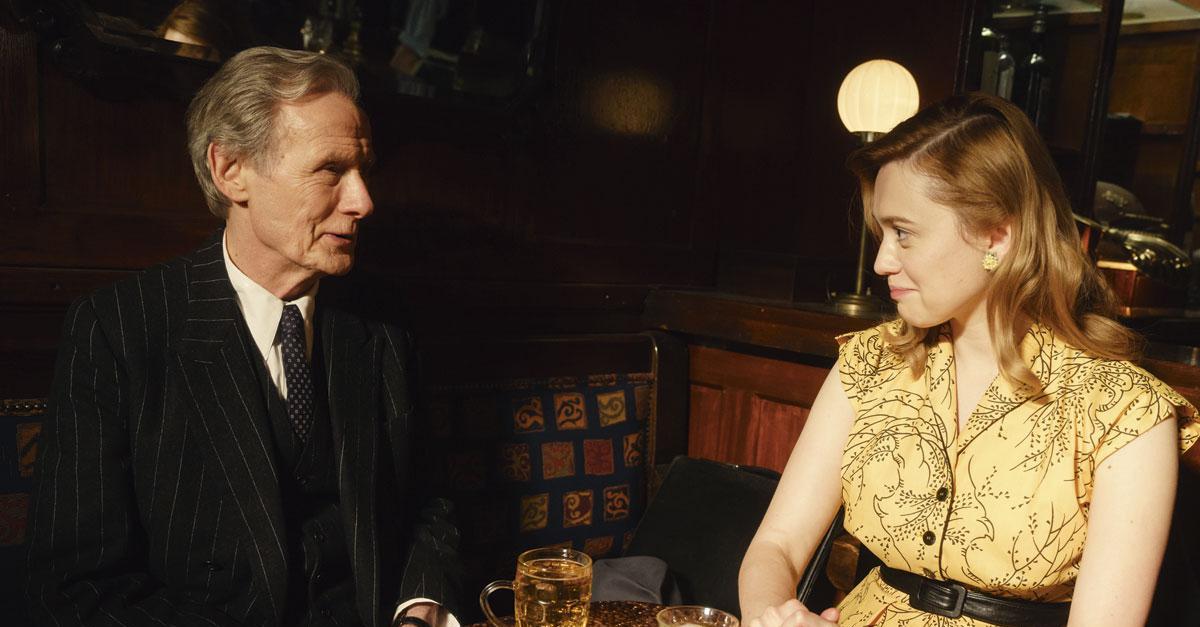
Living is based on the Japanese auteur Akira Kurosawa’s classic Ikiru (1952, meaning of title: ‘to live’). Nobel laureate Kazuo Ishiguro adapted it to make an English version with Bill Nighy in mind when he wrote the screenplay, creating a setting in 1950’s London. Interestingly, Kurosawa himself was inspired by Leo Tolstoy’s The Death of Ivan Ilyich when he made Ikiru, and with his eloquent camera, transposed the Russian master’s novella into a Japanese story on screen.

With Living, the Japanese-British novelist Ishiguro has succinctly condensed Kurosawa’s 142 minute film into a shorter feature of 102 minutes, helmed by South African director Oliver Hermanus. It’s interesting to note the cross-cultural transferral, for the film is about the universal theme that we all share as a humanity, living a meaningful life in the face of death.

This is one of the less-hyped movies during the 2022 Awards Season, despite the film getting two Oscar nominations: Best Adapted Screenplay for Ishiguro, and Best Actor for Bill Nighy, his first and long due Oscar nod.

It’s timely that I finally get the chance to watch Living now in April, a month that signifies new births. Considering the change in the main character Mr. Williams (Bill Nighy), even the idea of resurrection is apt when taken metaphorically, from death to life, ironically, for a man who has just been diagnosed with terminal illness.

As the head of the public works department at County Hall for numerous years, Williams is contented with following the bureaucratic daily routine by the clock, pushing papers to other departments, or, if the file has to stay in his, stalling it till it becomes extinct.

The camera angles give us a vivid perspective. From the overhead shot above the train station, we see a mass of uniformity, men in dark suit and bowler hat heading to work. Looking down from above, they are small and insignificant. And from the slow motion of them walking, we see the wheel of work turning, ever so slowly, in mundane routine heading to the office and the same vehicle bringing them home at the end of the day.

After Williams gets the confirmed diagnosis of cancer and that he will have just six months to live, there appears the audio motif of a clock ticking; this time, it’s not to remind him of work routine but the limited time of life remaining.

In the wake of the ominous news, Williams’ reactions change from stoically bearing the shock to actively seeking a meaningful existence, and ultimately finding a purpose that he feels can fulfill his life. Nighy’s performance is immersive, reserved, and nuanced, and at times, allowing a ray of deadpan humour to seep through. If the restrained ‘Englishness’ is what the actor naturally possesses, or one that he has fully grasped in his cultural milieu, then it has served him perfectly in this role.

In an online interview, Ishiguro explains this ‘Englishness’ as a metaphor:

A certain type of Englishness becomes a universal metaphor for something that is inside all human beings, the need to conform, perhaps a fear of emotions, the frustration of wanting to express yourself but not being able to break out of your professional role, or the role that society has given you. There were many things I thought we could talk about of the whole human condition by looking at this type of figure.

Many scenes in Living are direct parallels of Kurosawa’s Ikiru with his protagonist Kanji Watanabe (Takashi Shimura). Both men confide their terminal illness not to their son who lives with them, but to a stranger in a restaurant, sharing their last wish, that is, to live life, for a change. The sympathetic listener brings the despondent man to various places for him to ‘live it up’. In both films, we see the same places but in different cultural context, amusement parks, bars, dance hall, strip club, but what Williams and Watanabe find are but superficial, ephemeral flares.

The ultimate change in Williams is sparked by a young, female staff Margaret Harris (Aimee Lou Wood), who needs his reference as she has found a new job. Meeting her by chance on the street, Williams invites her to have a ‘simple’ lunch with him at the Fortnum, where he can write her reference letter. It’s there that we see Williams break out with a genuine smile for the first time, forty-one minutes into the movie. Harris’s youthful and vivacious spirit later inspires Williams to go back to the office as a new man after his few days of escapade, to get down to work and this time, doing something that’s meaningful and benevolent.

A crucial addition in Living, and kudos to Ishiguro, is bringing in a young, new worker, Peter Wakeling (Alex Sharp), to the public works department, first day on his job. From his fresh, untainted eyes, we see the novice civil servant being open and ready to accept whatever the bureaucratic system requires of him. His boss Williams’ new-found purpose and subsequent change at work has left him with an indelible impression. And with co-worker Miss Harris, a warm storyline of budding romance adds flavour to the film, albeit introduced a bit late towards the end.

One poignant scene in both films is the protagonist singing in a bar. For Nighy, this is probably the best cinematic moment for him to leave his mark as a soulful singer, a deep and heartfelt performance in contrast to his farcical ‘Christmas is all around’ in Love Actually (2003). The scene here in Living is when a slightly drunk Williams asks the pianist at a pub to play as he sings ‘The Rowan Tree,’ a Scottish folk song that evokes longing for the past and loved ones gone.

Later, in the remake of Kurosawa’s iconic scene from Ikiru, we see Williams sitting on a swing and hearing his moving reprise of the song, this time sober and clear of what’s waiting for him. As the final credits roll, the mesmerizing voice of Lisa Knapp stirs ripples in my heart long after the visuals end.

‘The Rowan Tree’ sung by Lisa Knapp

________________

~ ~ ~ 1/2 Ripples

‘Everything Everywhere All at Once’: An After Oscar Review*

In this the universe that we all know, a movie from the indie studio A24 called “Everything Everywhere All at Once” just won seven Academy Awards out of its eleven nominations, including Best Picture, Best Director, Original Screenplay, Best Actress, Best Supporting Actor, Best Supporting Actress, and Best Editing. The date is March 12th, 2023, at the 95th Academy Awards held in the Dolby theatre in Los Angeles, California. 

A historic night as this is the first Sci-Fi genre movie to win Best Picture, and Michelle Yeoh the first Asian to garner the Best Actress honor in the ninety-five years of Oscar history. As well, the movie has set a record of the most acting wins together with Best Picture and Best Director wins from a single movie. “Everything Everywhere All at Once” is now A24’s highest-grossing feature of all time, surpassing $100 million at the box office. Surely there are still laundry and taxes to do, but at this point in time in this universe of ours, this is a defining moment in the film industry.

Oscar winning directors Daniel Kwan and Daniel Scheinert, the Daniels, have created more than just a Sci-Fi movie. Calling it genre bending sounds outdated now as its multiverse jumping idea in their Best Original Screenplay fuses science fiction, action, comedy, and family drama all at once. Genre jumping might be a better term to describe the Daniels’ creative mode of filmmaking.

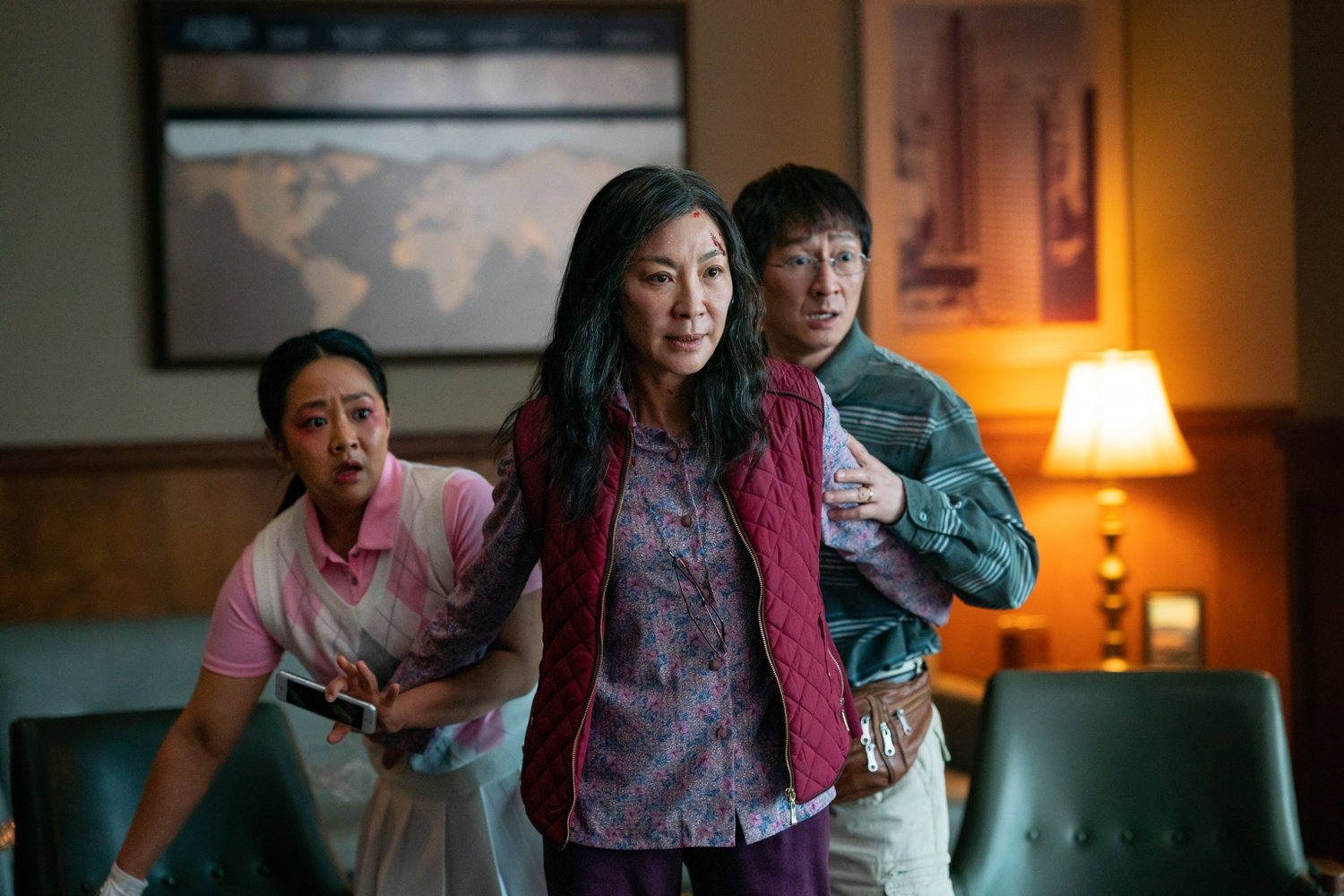
Never underestimate a middle age immigrant laundromat owner, wife and mother. Evelyn Wang (Yeoh) has lots on her plate as she has to deal with the mountainous paperwork facing an IRA audit, a daughter dangerously depressed, and husband Waymond initiating a divorce proceeding. Unbeknownst to her is that in another universe, she is Evelyn the superhero whose mission is to save the multiverse from the villain Jobu Tupaki, who, lo and behold, is her daughter Joy’s destructive alter ego. 

Ke Huy Quan’s comeback to the acting scene after decades of absence and winning the Oscar Best Supporting Actor is extraordinary. Credits to the casting director (Sarah Halley Finn) and the Daniels’ foresight, for Quan is the perfect guy to play Waymond. His movie role and his real-life persona look to be a perfect match. Quan has won over sixty awards for this role and now garnering the ultimate acclaim. After his magnificent action sequences in the IRS building, the fanny pack just might enjoy a comeback as well. 

From a background in New York City’s comedy and improv scene, Stephanie Hsu goes all out in her dual portrayal as Joy, the despondent daughter who feels unseen and unloved by her mother Evelyn, and her alter ego in another universe: Jobu Tupaki, the powerful and destructive villain in the multiverse taking everyone with her into a nihilistic hole, sucked into the everything bagel which she has created and pitted all her despair, pain and guilt on it, an absurdist escape from her meaningless existence.

Creating a multiverse action movie to tell a family story with all its generational dysfunction and disappointment is outside the box thinking. The Daniels’ concept and execution are audacious and innovative, incorporating multiple forms of visuals, animations, and symbolism. Every battle between Superhero Evelyn and Jobu Tupaki is a metaphor for the mother/daughter conflict. As a daughter whose self-image has hit rock bottom, Joy is in despair having failed to live up to her mother’s expectations, choosing to jump right into the everything bagel. Evelyn, not just a superhero but more importantly, a mother, fights to snatch her daughter back. 

In a silent scene without spoken dialogues––a much-needed respite from the chaos and sensory overload––Joy the rock chooses to fall off the cliff into oblivion. And what does the mother rock do? She moves to the edge of the precipice and rolls down after her daughter. This may sound ludicrous, but this soundless scene with the two rocks is one of the most poignant cinematic moments in the movie.

IRS paper pusher Deirdre, played by Oscar winning Best Supporting Actress Jamie Lee Curtis, is a follower of Jobu Tupaki in another universe. Her interactions with Evelyn offer some of the spontaneous fun in the movie. Action comedy at its best, not just in the fight scenes, but also in the universe where they have hotdog fingers, their feet and toes ever versatile. Debussy would have been impressed to hear Deirdre’s version of ‘Clair de Lune’ on the piano.

The last person to make up the award-winning ensemble cast is 94 year-old James Hong as grandfather Gong Gong. Hong’s earliest roles in his seventy years of acting were with such classic figures like Cary Grant and Groucho Marx. Here his role is understated but nuanced. Just the scene in the elevator where Waymond urgently tells Evelyn her multiverse mission, using an umbrella to block out the security camera, the oblivious Gong Gong is sitting in his wheelchair casually picking his teeth, one of the many hilarious scenes in the movie.

Finished shooting in just thirty-eight days, the Covid lockdown gave Oscar winning editor Paul Rogers solitary time to complete a tall order, putting together scenes from multiple universes, of multiple timelines, and in extreme variation of locales, real and imaginary, to make sense of a story that needs multiple viewings for one to grasp its layered meaning. 

Within the dense and oversaturated visuals and actions, the Daniels have packed in homages to iconic filmmakers like Wong Kar Wai and Stanley Krubrick, fun and significant insertions. Memorable is the scene emulating Wong’s “In the Mood for Love,” when Waymond reveals to Evelyn his romantic self: “In another life, I would have really liked just doing laundry and taxes with you.” This is the way he fights, with kindness and love. And that’s the key to Evelyn’s ultimate change.

And what’s with the googly eyes? That’s Waymond’s mark of existence, harmless fun. He puts them on everything. Evelyn dislikes them at the beginning. In the final battle against Jobu Tupaki and her forces, she puts one on her own forehead. Like a third eye, she begins to see things from a new perspective.

Waymond, seemingly weak, holds a powerful weapon: kindness. “This is how I fight,” he says, moving Evelyn to emulate in the last action scene. When everyone has their googly eyes on, their deadly weapons are turned into innocuous objects; a hand grenade now becomes a perfume atomizer. Universal human kindness wins the final battle. 

Didn’t get the metaphors and wacky symbolism? Good reason to re-watch. “Everything Everywhere All at Once” is a movie that demands multiple viewings. Outside the box filmmaking requires outside the box viewing. Those familiar with the Marvel, DC, or Manga universes could be more ready to appreciate it. 

A thought about diversity. The Daniels are themselves an exemplar of mixed-race collaboration. “Everything Everywhere All at Once” succeeds not just because of diversity but universality: The mother daughter reconciliation, the husband wife rekindling of first love, and the theme of kindness and love overcoming malice would override any specific cultural or racial border. And here’s my hope for the future of filmmaking, go for universality. That which joins us as a humanity will naturally include diversity. Specific representation is important, but the utopic end would be one when race and color are not the defining focus but the common ground that we share as a human society.

~ ~ ~ 1/2 Ripples

__________________

*This article first appeared the day after the Oscars in Asian American Press, on Monday, March 13th. I thank AAPress for allowing me to re-post my review in full here on Ripple Effects.

__________________

The Banshees of Inisherin: To be friend or not to be friend

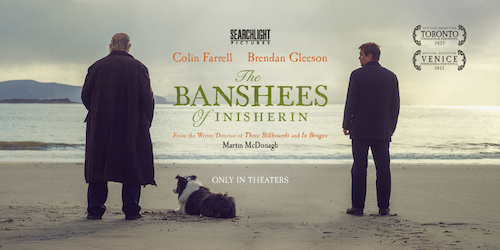
Like his previous movie Three Billboards Outside Ebbing, Missouri (2017), writer director Martin McDonagh opens The Banshees of Inisherin with a quiet and peaceful song. The lush green landscape of the island of Inisherin merging with the calm and harmonious chorus pulls us into this cinematic fable right away. McDonagh loses no time to bring out the heart of the matter, the sudden fallout of a lifelong friendship between Pádraic (Colin Farrell) and Colm (Brendan Gleeson). In parallel, across the island on the mainland, the Irish civil war rages. The year is 1923. 

The juxtaposition of mellow, ponderous music with outward conflicts always makes interesting contrasts, just like mixing comedy with drama, humour and sadness, which McDonagh is so apt in doing. An acclaimed British-Irish playwright whose plays have been performed in the West End and on Broadway, McDonagh is astute in his dialogues, embedding them with humour and poignancy to reveal the nature of the characters:

Pádraic’s sister Siobhán (Kerry Condon) likes to read and is the most sensible character in the movie. In one scene, Siobhán is reading.

Pádraic: How’s the book?
Siobhán: Sad.
Pádraic: Sad? You should read a not sad one, Siobhán, else you might get sad.
Siobhán: Mm.
(pause)
Siobhán: Do you never get lonely, Pádraic? 
Pádraic: Never get wha?
Siobhán: Lonely.
Pádraic: (mutter in annoyance) No. “Do I never get lonely?” What’s the matter with everybody? 

That could give a hint why Colm stops being friends with Pádraic because “he’s dull”. Colm is older and he now thinks more about how he will be remembered when he’s gone. A fiddle player, Colm spends his time playing and composing music. “I just don’t have a place for dullness in my life anymore,” he tells Siobhán. So, when Pádraic, baffled and hurt, confronts his old friend, “you used to be nice,” Colm engages with him about the value of being nice versus being remembered. Mozart, though living in the 17th century, he says, is still being remembered today for his musical legacy. Paintings last; poetry lasts. Who’s going to remember your niceness?

Even though happy go lucky, Pádraic is now saddened by the sudden termination of friendship. He doesn’t care about Mozart, or whatsisname Borvoven, but he remembers his Mammy and Daddy, they were nice, and his sister, “she’s nice. I’ll remember her, forever.” But Colm counters, no one else would remember them other than you. Colm may be facing an existential crisis, seeking for something more permanent or trying to leave a legacy, but McDonagh’s humour seeps through simple dialogues and not let the high ideals of his character be taken too seriously by movie viewers. In this scene, Siobhán has the last word. She corrects Colm, “it was the 18th century, anyway. Mozart. Not the 17th.” Then turns and walks away. This is a dark comedy, after all. 

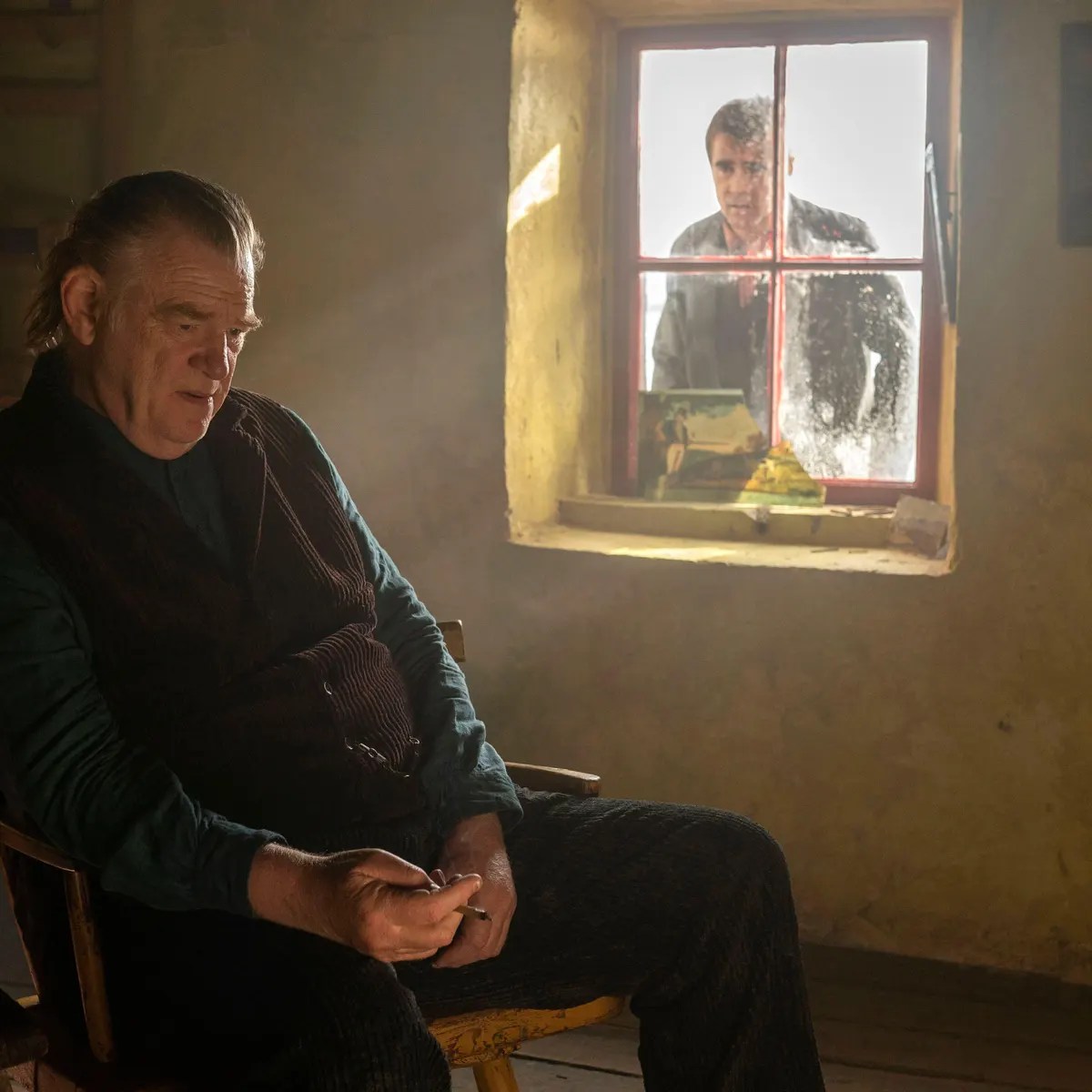
The superb cast brings out McDonagh’s writing perfectly. Farrell and Gleeson reunite after In Bruges (2008, Oscar nom for McDonagh’s original screenplay). It’s fun watching the pair engage, a simple, usually happy Pádraic stonewalled by his best friend’s sudden withdrawal of friendship, not only that, but shocked by his drastic action to cut off one of his own fiddler finger every time Pádraic talks to him.

Condon as Siobhán is most apt in representing the rational mind amidst this absurd development. Her later decision to seek a saner and more meaningful existence is poignant. The yellow coat she wears is a bright symbol of hope. The fourth character that makes up this outstanding ensemble of actors is Barry Keoghan as Dominic, the jester who is probably the saddest of them all and one who sees more clearly than he appears.

One more crucial character must be credited, and that’s Jenny the miniature donkey (Jenny), which plays a pivotal role in the final act, inciting a drastic action from Pádraic. Friendship between man and animal just might be more steadfast than between humans. And that last vengeful resort by Pádraic brings back a similar scene in Three Billboards.

Director of photography Ben Davis’s camera is crucial in revealing the deeper meaning of McDonagh’s fable. Often we see Pádraic on the outside peering through the window into Colm’s home, or into the pub looking for Colm. Poor Pádraic now is an unwanted outsider, rejected and isolated, reminiscence of similar shots in Bresson’s Diary of a Country Priest. Or, the metaphor of the Banshee, the omen of death, represented by Mrs. McCormick (Sheila Flitton), her creepy appearance exemplifies the ever-present threat of mortality, just like the Grim Reaper in Ingmar Bergman’s The Seventh Seal (1957). They don similar costume too. And the ubiquitous religious symbols and activities––the statue of the Virgin Mary on the island, the cross, the Latin mass––just make one question how their faith is relevant in the actions of these islanders.

The Banshees of Inisherin is nominated for nine Oscars in the coming awards night to be held on March 12: Best Picture, Martin McDonagh for Directing and Original Screenplay, Colin Farrell for Best Actor, Kerry Condon Supporting Actress, Brendan Gleeson and Barry Keoghan both for Supporting Actors, Film Editing, and Music (Original Score).

~ ~ ~ 1/2 Ripples

***

Related posts mentioned in this review:

Don’t Just Drive Past Three Billboards

Diary of a Country Priest: Film Adaptation (1951)

***

March is Read Ireland Month 2023 at Cathy 746 Books. You can read the screenplay of The Banshees of Inisherin online here.  Upcoming posts will include books by Irish writers and possible book to screen adaptations. 

***

Tár: To Catch a Falling Star

There are movies that you admire especially upon rewatching but still leave you emotionally detached. The overall tone is artistic and elegant, the camera clever, editing seamless, fantasy sequences enhance the tension, and needless to say, superb acting delivered by the cast. You admire and appreciate the director’s execution, yet you’re not emotionally engaged. Tár is one such movies for me.

Writer director Todd Field’s masterpiece is a film packed with ideas and layered with symbolism conveyed through technical brilliance. It explores power and ambition, identity politics, the separation of the art from the artist, and cancel culture in our contemporary society. Using a phrase ubiquitous in this awards season, it is everything, everywhere, all at once.

At the beginning of the film, New Yorker writer Adam Gopnik (playing himself) introduces conductor and composer Lydia Tár (Cate Blanchett) by reading out a list of her accolades for his live audience and us, movie viewers who would see, in the next two and a half hours, how a radiant star fall from grace. As the film opens, Tár is at the summit of the classical music world, helming the prestigious Berlin Philharmonic. A Harvard PhD, she was mentored by Leonard Bernstein in the emergence of her career, and is currently one of only 15 EGOT winners (Emmy, Grammy, Oscar, Tony); her upcoming book Tár on Tár will no doubt be a bestseller.

Field’s feature is nominated for six Oscars in this awards season. It is a forceful narrative and an astute study of power set within an artistic and cultured realm. Blanchett’s Tár embodied success driven by ambition and sustained by ruthless arrogance. She may appear courteous and mild mannered, and that’s where the danger lies. She doesn’t need to raise her voice to be heard.

From the beginning of the movie, the sequence of the custom tailoring of her suit––a symbol of power––sets the premise. The film is not about gender politics, for Tár’s position is a given; she is already at the podium leading a world renown orchestra and is hailed as one of the best living composers.

There are, of course, higher mountains to scale. The self-propelled driving force soon turns Tár into a delusional egotist, her self-will overriding all that comes in her way, destroying not just her career but her relationship with her spouse Sharon (Nina Hoss), concert-master in the orchestra. Field wrote the screenplay with Blanchett in mind. He had mentioned in an interview that if she declined the role, he would not go ahead with the movie. Blanchett delivers with convincing mastery. 

While being a fictional character, Tár embodies some real-life issues with much relevance in contemporary society. Her being in a lesbian marriage exemplifies the fact that power can corrupt regardless of gender and sexual orientation. She has the power to endow opportunities and thereby raising the career of young musicians to new heights, or, destroy them. Her obsession with success soon becomes unmanageable, distorting her view of reality, pulling her into the abyss of delusion and even madness. 

Among the various issues the film touches on, the Juilliard teaching scene is particularly telling. Tár is teaching a conducting class in a lecture theatre. The camera expertly captures the ten-minute scene with one long take (no cutting). The blocking of the two main characters––Tár and the student Max (Zethphan Smith-Gneist)––speaks volumes.

Max chooses a contemporary piece by the Icelandic composer Anna Thorvaldsdottir to conduct. Stopping him midway, Tár brings up the importance of Bach’s work, sitting down beside him as equal to discuss and ask if he would consider conducting a Bach piece. Here’s Max’s response:

“Honestly, as a BIPOC, pangender person, I’d say Bach’s misogenystic life makes it kind of impossible for me to take his music seriously.” He’s referring to the composer having had fathered 21 offsprings. 

Boycotting Bach for his brood of children?

Here’s Tár’s restrained response: “I’m unclear as to what his prodigious skill on the marital bed has to do with [his Mass in] B minor.” Pointing out the issue of separating the art from the artist.

Drawing out the thought in Max, she says: “Can classical music written by a bunch of straight Austro-German church going white guys exalt us?” To answer that, she invites Max to sit by her side at the piano, going through with him some Bach pieces. To her credit, in both instances, her persuasion is gentle and egalitarian as the camera captures teacher and student sitting at the same level.

Max’s viewpoint is a biting issue today: can a BIPOC (Black, Indigenous, People of Colour), pangender person acknowledge the contribution of straight, ancient white guys? Tár’s response is obvious. The artists’ works override their nationality, colour and gender. Likewise, she challenges Max to look at the composer of his own choice, Icelandic, female composer Anna Thorvaldsdottir. What is the resemblance that Max has to identify with her?

Brilliant question. To which Max responds by picking up his stuff and walks out, with a verbal swipe of expletive for his teacher. Tár replies: “And you’re a robot. The architect of your soul appears to be social media.”

Who wins this debate? Field leaves it to his viewers to decide. As with the other issues laid out in the film as well as the ending, there are more questions than answers. Yes, Blanchett’s performance is top-notch, but I come out having a higher appreciation of Field’s writing.

~ ~ ~ Ripples

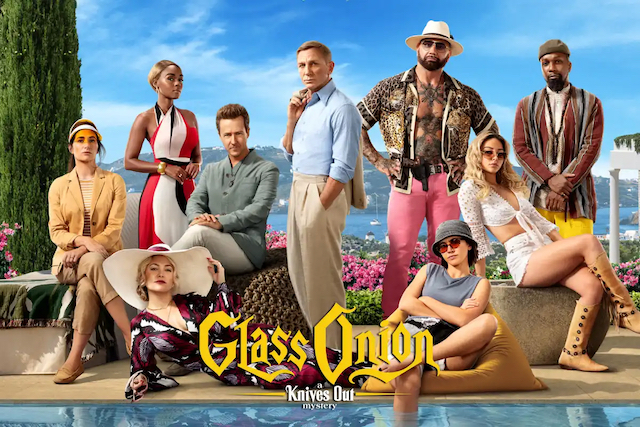
Glass Onion: A Knives Out Mystery with a Magic Fugue

Even before we see anything with the screen black, we hear the subject melody, the quiet and ponderous single line of piano music. What piece is this? One might ask. Eight minutes into the movie, in a convivial house party, we get the answer.

Fashion icon Birdie Jay (Kate Hudson) is intrigued by the tune as well when she tries to open a mystery box sent to her by the tech mogul Miles Bron (Edward Norton). Before she can Shazam it, the answer is given by none other than the renowned cellist Yo-Yo Ma himself. That’s Bach’s ‘Little Fugue’ in G minor, he explains to Peg (Jessica Henwick) while munching on some sort of finger food in her house party.
“A fugue is a beautiful musical puzzle based on just one tune. And when you layer this tune on top of itself, it starts to change and turn into a beautiful new structure,” the virtuoso casually points out. An apt description of what’s to come.

And, of course, Birdie Jay can’t get her answer, for she’s talking to a lamp to Shazam the tune thinking it’s Alexa.

Writer/director Rian Johnson’s sequel to Knives Out (2019) is a totally different offering in sight and sound. A comedic murder mystery in the vein of an Agatha Christie novel with the Knives Out detective Benoit Blanc (Daniel Craig, never mind his accent), a dapper Columbo, a sunny locale, striking set design, a well-written screenplay and seamless editing, and not least, an animated ensemble cast, we get an entertaining feature.

The connections are multiple, watching it viewers become sleuths themselves to decipher the associations and allusions, visually, musically, and cinematically. Spotting all those cameos is fun too: Angela Lansbury, Stephen Sondheim, Kareem Abdul-Jabbar, Serena Williams. Or check out what’s Ethan Hawke and Hugh Grant are doing there.

Miles is a friendly egotist, seen as a genius by some, extreme danger by others, probably knowing his personal philosophy is “fake it till you make it.” The tech titan has invited his insider group of ‘Disruptors’ to an annual reunion weekend. This time the event takes place on his private Greek island in the form of a murder mystery party; his guests are to solve his own murder. The Disruptors are fashionista Birdie Jay, social media influencer Duke Cody (Dave Bautista), politician Claire Debella (Kathryn Hahn), and scientist Lionel Toussaint (Leslie Odom Jr.)

The key person to show up shocking them all is Andi Brand (Janelle Monáe) who used to be Miles’s business partner. So, some background story needs to be peeled off. Miles’s home on the island is the Glass Onion, a spectacle of an architecture that looks exactly as its name denotes, a metaphor for the core truth actually is hidden in plain sight through visible layers.

The sounding of the hourly dong that echoes through the island (voice of Joseph Gordon-Levitt) is one of those moments in the movie that evokes a chuckle, especially when we hear Miles say he got Phil Glass to compose that. Yes, that’s Philip Glass, the minimalist composer creating that one note sound of the gong for Miles. No, not a joke on Glass but more on the self-importance of the tech mogul himself.

Same with the Mona Lisa encased in a sensitive glass protective display case. More chuckles from that too. The world famous painting is on loan to Miles from the Louvre via the French government during the pandemic when all arts venues are closed and revenues lost. Miles is pleased that the art world, even government, bows to his whims, “I wanna be responsible for something that gets mentioned in the same breath as the Mona Lisa. Forever.” And now he has it in his palm, no, not the Mona Lisa, but a little solid hydrogen fuel crystal which will be a gamechanger in global energy source. His plan is to invite national leaders to the Glass Onion to unveil it.

As the story begins to peel off layer by layer, we know each of these Disruptors have their reasons to be loyal to Miles as their personal interest depends on his patronage. Ironically, they also harbour resentment towards him.

Half way into the movie an important layer peels off, revealing the backstory. I have no issue with such a twist, for now I anticipate new conflicts on a different level, heightening the tension. From here on, viewers are shown the point of view of Andi’s character. Reminiscence of Kurosawa’s Rashomon, we can now see more clearly what actually happened in the previous sequence of events, this time, from the perspective of Andi’s; now we understand her as our reluctant heroine.

Repeating the scenes isn’t necessarily redundant, Bach would have said. That’s exactly what he did with the fugue, the same tune appearing in a different context in the contrapuntal composition. While he would probably have found the movie ending shocking, he’d likely be curious to hear songs by singing groups called The Beatles, Red Hot Chili Peppers, The Bee Gees… among others, or listen to the harpsichord and orchestral theme by a 21st century composer called Nathan Johnson (Rian’s cousin).

From Bond to Blanc, Craig’s collaboration with the Johnsons has made the Knives Out movies a promising and entertaining franchise.

~ ~ ~ Ripples

Women Direct Films 2022

Director Jane Campion and cinematographer Ari Wegner on the set of
The Power of the Dog (Source: Netflix)

Last year on this day, March 8, I listed films directed by women in recent years. A month later, Chloe Zhao became the second woman in the 93 year history of the Oscars to win Best Director with Nomadland. And this year, in the upcoming 94th Academy Awards on March 27, two of the ten Best Picture nominees are directed by women, Jane Campion’s The Power of the Dog and Sian Heder’s CODA.

This may look bright and hopefully the trend will hold. After all, women first directed films in 1896! I wrote about that in my March 8 post last year. However, the latest data aren’t that promising. According to the Celluloid Ceiling Report (Figure 2) published in January 2022, the percentage of women directors working on the top 100 films decreased from a record high of 16% in 2020 to 12% in 2021.

For this March 8, 2022, here’s a new list of some upcoming movies directed by women. There are, needless to say, many more women working behind the scenes as film editors, script writers, cinematographers, production designers, sound professionals, costume and makeup artists, composers, casting directors, producers… all striving to break through the celluloid ceiling.

________

Aline directed by Valérie Lemercier, a fictionalized biopic of Céline Dion.

Where the Crawdads Sing directed by Olivia Newman, adaptation of the popular novel by Delia Owens.

Hallelujah: Leonard Cohen, A Dream, A Song a documentary co-directed by Dayna Goldfine

She Said ­­directed by Maria Schrader, based on the book that chronicles the fall of Harvey Weinstein and the rise of a movement. Carey Mulligan and Zoe Kazan star.

Barbie directed by Greta Gerwig, the cast that brings a doll to life includes Margot Robbie, Ryan Gosling, America Ferrera, Simu Liu.

Turning Red directed by Domee Shi, whose animated short Bao won her an Oscar in 2019. Sandra Oh, Billie Eilish and Finneas O’Connell lend their voice and talents.

Don’t Worry Darling directed by Olivia Wilde, who has been called ‘a modern-day renaissance woman’. Attractive cast includes Florence Pugh, Harry Styles, Chris Pine, Gemma Chan.

I Wanna Dance With Somebody directed by Kasi Lemmons, acclaimed director of Harriet (2019) turns her attention to depict the life of Whitney Houston.

The Stars at Noon directed by Claire Denis, who just won the Silver Berlin Bear for Best Director at Berlinale 2022. Adaptation of the 1986 novel by Denis Johnson.

Catherine, Called Birdy directed by Lena Dunham, based on the children’s novel by Karen Cushman, on the adventures of a 14 year-old girl in medieval England.

The Mother directed by Niki Caro, who has helmed an interesting variety of works like Mulan (2020), The Zookeeper’s Wife (2017), Whale Rider (2002). An action thriller, The Mother stars Jennifer Lopez and Joseph Fiennes.

Lady Chatterley’s Lover directed by Laure de Clermont-Tonnerre, adaptation of D. H. Lawrence’s classic novel.

Persuasion directed by Carrie Cracknell. Another Jane Austen classic to be transposed onto screen coming out this year.

Rosaline directed by Karen Maine. A comedic take on Romeo and Juliet from the POV of Rosaline Capulet, Juliet’s cousin and Romeo’s first love.

***