A Summer in Genoa (2008) DVD

A film that you have not seen in the theatre in North America. It premiered at the 2008 Toronto International Film Festival and disappeared until it emerged on DVD in April, 2012. A Summer in Genoa is a fine film that has slipped through the blockbuster-craving, profit-driven distribution network.

This is from Colin Firth’s pre-Oscar days, a performance that could well be a foreshadow of his Oscar nominated role in A Single Man a year later.

In A Summer in Genoa, Firth plays Joe, an English professor in Chicago who has lost his wife Marianne (Hope Davis) in a car accident. As father to teenager Kelly (Willa Holland) and her younger sister Mary (superbly played by then 10 year-old Perla Haney-Jardine), Joe has to lay aside his grief to continue with his family life in taking care of his daughters.

Five months after the accident, Joe’s old colleague Barbara (Catherine Keener) has lined up a teaching position for him in Genova, Italy. It is summer. The beautiful, historical seaside city will be a totally different scenery from Chicago. Joe thinks that could be a good change for all of them.

How does a family deal with loss? Here we see each person has to face it individually before coming together as a family.

Acclaimed director Michael Winterbottom (A Mighty Heart, 2007) uses a naturalistic style to depict the three of them adjusting to a new situation in their own way. Through a hand-held camera, we are privy to the life of a family like watching a home video. As with any other family, their daily routine is ordinary and mundane. Yet because of their predicament, we care for these characters, especially with young Mary always drifting off on her own. We fear for her safety.

I’ve appreciated Winterbottom’s naturalism throughout the film, not only in the camera work, but with the ‘non-acting’ of the characters (using Bresson’s notion). They come across as real people dealing with daily issues we could relate to. On top of adjusting to a new city and nursing or ignoring a wound that has yet closed, a family still needs to go on living as a family.

We see Joe make breakfast for his girls, go to teach at the university, come home and make dinner. The girls go to their piano lessons, and Kelly takes her younger sister walking in long and narrow alleyways of the old city finding their way. We see Kelly making acquaintances with some young men, and how she riskily push the limits and attempt some youthful explorations. As for the younger Mary, we see her sorely locked in her solitary self of guilt and loss.

The young actor Perla Haney-Jardine’s performance as Mary is particularly poignant. With her father and older sister preoccupied with their own interests, she is left alone to deal with her private pain. She sees her mother appear to her, communicating to her with her presence and words.

The music selection is a major appeal to me. A film that starts off with the beginning theme of Chopin’s Etude no.3 and carries it as a motif throughout is sure to capture my attention. Music is also a legacy from their mother who used to teach piano at the university.

But I’m totally won over as this is read with a voiceover. A final class assignment Joe gives out to his students. He listens to the recording with them, his face lost in thought. It is so thematically perfect. As he ponders, he must have tasted the relevance of its words to his own predicament, raising his two daughters, through life’s ebb and flow. Here in this shot confirms Firth’s talent of ‘non-acting’.

Shakespeare’s Sonnet 2

When forty winters shall besiege thy brow,
And dig deep trenches in thy beauty’s field,
Thy youth’s proud livery so gazed on now,
Will be a tatter’d weed, of small worth held: 
Then being asked, where all thy beauty lies,
Where all the treasure of thy lusty days; 
To say, within thine own deep sunken eyes,
Were an all-eating shame, and thriftless praise.
How much more praise deserved thy beauty’s use,
If thou couldst answer ‘This fair child of mine
Shall sum my count, and make my old excuse,’
Proving his beauty by succession thine!
This were to be new made when thou art old,
And see thy blood warm when thou feel’st it cold.

Special Features include equally naturalistic behind-the-scenes footage and cast interviews.

~ ~ ~ Ripples

Another title for the film is Genova.

***

We Need To Talk About Kevin (2011)

On International Women’s Day, we need to talk about mothers. Motherhood, the role that can bring so much joy, and so much grief. No grief can compare to that of seeing your child self-destruct, and in the process, destroying others.

To start with, the wandering, free-spirited Eva (Tilda Swinton) before motherhood reflects an unsettling soul. Seems like she accidentally trespasses into the territory that calls for extreme commitment when she gets pregnant. While other expectant mothers fully embrace their swollen bellies, Eva faces her pregnancy with apprehension and awkwardness. Once Kevin is born, she knows full well that it is an irreversible life-long occupation.

Kevin screams all day and night as a baby, is incommunicable as a toddler, foul-mouthed, menacing and hateful as a child. The first thing he does to his newborn younger sister while visiting her in the hospital is to splash water into her eyes. This act will be repeated when he becomes a teenager, but it won’t be as harmless as water. Can’t his parents see it coming? I must give credit to Tilda Swinton, who has given us an audacious and engaging performance as Eva, but one, I’m afraid, that may not appear quite as sensible as it should.

If you are not a tiger mom, but has a tiger son on your hands, what are you to do? Wouldn’t you have sought professional help for your child, or counselling for yourself? Yes, we see Eva take Kevin to a doctor when he’s a non-communicating toddler, but what about all the years hence, until at 16 when all hell breaks loose? Ezra Miller as teenaged Kevin is a persona of a most disturbed young man; unfortunately, his self-absorbed, relentless evil scheming renders his performance two-dimensional.

I have not read the book by Lionel Shriver. We Need to Talk About Kevin was the Orange Prize Winner of 2005, an award honoring women’s writing. Shriver might well have depicted her characters and their inner turmoils with more depth, as a literary rendition can.

I knew of the plot in general before I stepped into the theatre. My expectation was that the film would be exploring the issues of parental responsibility and guilt from raising a wayward child despite all good intentions. I thought it would deal with the problem of evil, or the issue of nature and nurture, and the choices we can make in spite of our predicament.

But the film surprises me in that it has not delivered what could have been a study of any of the above issues. Maybe parental guilt, but still, not in depth. We only see the stunned look of Eva in every scene. Even before the tragic end, with overwhelming evidences of a terribly disturbed son, we hear little communication between Eva and her unsuspecting husband Franklin (John C. Reilly), who encourages Kevin’s interest in archery. (ah-ha… big hint)  Seems like director Lynne Ramsay’s goal is just to shock and disturb with exaggerated visuals and sounds, or its lack of to create mood. The ubiquitous red, another obvious hint. It is effective as an absorbing, suspenseful thriller, relentless in its portrayal of evil, but for the purpose of…?

The film has been talked about much in the UK. And on both sides of the Atlantic, many critics have given it high acclaim; others have pointed to its Oscar snub. While I had high expectation before I saw it, I left with a void of disappointment, which, I’m afraid, has extinguished my interest to read the book. If you have read it, I’d love to hear you tell me otherwise.

But on this very day, let us give kudos to all mothers who, regardless of results, stay true to their role and love in spite of everything. This we can see in the final scene and the last shot, the embrace in prison, probably the most meaningful in the whole film.

~ ~ 1/2 Ripples

***

The Tree of Life by Terrence Malick

(It is impossible to review The Tree of Life without writing about what it is about, hence: Spoiler Alert for this post.)

“The Tree of Life” is the fifth feature film in the forty-year career of the reclusive director Terrence Malick. It received mixed reactions at the Cannes Film Festival in May this year. There were boos and applause. That it finally won the top prize at the festival, the prestigious Palme d’Or, indicates which side was gratified. But, it is a film that needs to be experienced personally before one takes side, and maybe seeing it more than once.

Watching the film is an experience in itself. It starts off with this quote from Job 38: 4 and 7:

Where were you when I laid the foundation of the earth? When the morning stars sang together
 and all the sons of God shouted for joy?

With this premise, the film pours forth mysterious yet majestic visual sequences depicting the cosmos, our molten earth, prehistoric era where dinosaurs roam, early life forms, the roaring ocean, blood streams, fetal heartbeats. The first part.

Upon such visuals we hear a voice over:

There are two ways through life — the way of nature and the way of grace. You have to choose which one you’ll follow. Grace doesn’t try to please itself. Accepts being slighted, forgotten, disliked. Accepts insults and injuries. Nature only wants to please itself. Get others to please it too. Likes to lord it over them. To have its own way…

From the macro scale of the universe we now focus on the micro, something with which we can identify, a family. We see it from the point of view of Jack O’Brien (Sean Penn). An architect now, Jack is haunted by memories of his past, in particular, the death of his younger brother at age 19. We see scenes of his parents receiving the bad news. We hear his yearning for the people he loves through his whisper in voice over: ”Brother, mother.” We are then privy to Jack’s childhood days in 1950’s Texas.

From the O’Brien family we see how grace and human nature play out. Jack’s childhood in Waco, Texas, begins in innocence. With a capable father (Brad Pitt) and an almost angelic mother (Jessica Chastain) who is loving, nurturing, grace manifest, young Jack’s (Hunter McCracken) early days are blissful. Two younger brothers later, the siblings form a close bond. But as the boys grow older, the father becomes stern and strict, callous with his sons, demanding total obedience, expecting love where the seeds of fear are sown. From this character, we see human nature manifest in its destructive, self-seeking mode.

Other incidents further shatter the once blissful young life. Jack goes to town with his mother and brothers, he sees a crippled man make his way awkwardly across the street. He also witnesses the unlawful being arrested. While at the swimming pool, he watches a boy drowned despite frantic rescue. We hear young Jack’s whisper in voice over: “Was he bad? Where were you? You let a boy die.” The problem of pain, suffering, and evil begin to churn in his mind. Direct questions to God, not unlike Job.

Watching his father’s harsh handling of his sons, young Jack slowly discovers that he himself too has the latent capacity to not just think, but to commit wrongs, “I do what I hate.” In a moving scene, after he has hurt his little brother, Jack becomes remorseful and asks for forgiveness. We see the power of love at work. We also see his innocence slowly taken over by conflicts in his heart, love and hate, good and evil… grace and nature.  The second part.

Jack’s father loses his job and the family has to leave town. The uprooting is the most painful the boys have experienced. Everything is lost, it seems, friends, the house, the neighborhood, memories, … But among the loss, we hear the graceful voice of Jack’s mother: “The only way to be happy is to love. Unless you love, your life will flash by… Do good, wonder, hope.” Yet poignantly, she experiences the most devastating blow later, the death of her own son. We hear her heartbreaking whisper in voice over: “Where were you? Did you know?” Again, reiterating the questions that were on Job’s mind.

But ultimately light takes over darkness. We are assured that all is not lost. We hear Jack’s yearning whisper, like a prayer: “Keep us, guide us, to the end of time.” In the eternal scheme of things, shown by the display of the magnificent cosmic visuals, we see all members of the O’Brien family reunite and bathed in a warm bright light. Jack once again embraces the ones he loves, his mother and his brothers. He also stands shoulder to shoulder with the one who has inflicted in him the mixed emotions of pain, anger and love, his father, now reconciled under the brilliant light.  The third part.

Yes, we have the big names. Sean Penn as adult Jack appears only sporadically. Brad Pitt nails his role as the stern and difficult father. The relatively new film actor Jessica Chastain is grace embodied. In an interview she recalls that director Terrence Malick had asked her to watch a lot of Lauren Bacall movies to prepare for her role. But the most impressive of all is Hunter McCracken playing young Jack. The casting is brilliant here. His mesmerizing portrayal of a conflicting boy incubating the later character of a tormented adult Penn is deeply moving, a reflection too of Malick’s sensitive direction. As with his other films, cinematography is superb. You’ll have plenty of time to savour the long sections of cosmic and natural wonders.

“The Tree of Life” is for the patient viewer. It is a slow movie, and rightly so. You have to take the two hours and eighteen minutes as a respite from your busy schedule, and experience the film as a quiet meditation on life, family, God, and relationship with Him. It is also a portrait of love, faith, doubts, and promise. It poses questions in whispers, and answers with majestic visuals in silence, and at times, in engulfing themes of torrential music. Smetana’s “The Moldau” still flows through my mind at 4:30 a.m.

Boos or applause, what does it matter? To quote Bresson: “All is grace.”

~ ~ ~ ~ Ripples

***


CLICK HERE to read my post on another Malick film, Days of Heaven (1978), which won an Oscar for Best Cinematography.

Forget About Tiger Mothering, Try Inspirational Parenting

One of the most memorable lines in last week’s Academy Awards is Tom Hooper’s: “The moral of the story is: Listen to your mother.”

What more satisfaction can a mom get than to hear her son utter these words in front of a billion viewers worldwide.

Here’s the excerpt of his speech leading to this final conclusion:

“My mum was invited to a fringe theater play-reading of an unproduced, unrehearsed play called The King’s Speech in 2007She came home, rang me up and said, ‘Tom, I think I found your next film.’

I followed The New York Times reporter/blogger Melena Ryzik’s The Carpetbagger on Twitter through the Awards Season. Of all the Oscar interview write-ups I’ve read, and there are numerous, Ryzik’s “A Chat With The Mother Who Knows Best” has left the most lasting impression on me. And it was in that article that I found these two words, “inspirational parenting”. They were nothing short of an epiphany for me, striking a chord instantly.

Photo Credit: Matt Sayles/Associated Press

Ryzik talked to “The King’s Speech” director Tom Hooper’s mother after her son’s Oscar win, calling her “an exemplar of inspirational parenting”. Meredith Hooper is an academic and author of over 60 fiction and non-fiction works for children. Here are some excerpts from Ryzik’s article:

Did she realize she’d caused worldwide guilt among children for not listening to their mothers?

“I did not!” Ms. Hooper protested. “I didn’t say it. My advice is exactly the opposite — that we should all listen to our children.”

Now isn’t that the kind of talk that can make Amy Chua cringe? The kind of parenting style that prompted her to write about her own school of tough love parenting in her memoir Battle Hymn of the Tiger Mother, now 7 weeks so far on the NYT Bestsellers List. It’s all that debate about teacher-fronted or child-centred learning all over again.

I’ve left comments on others’ blogs about my view of this current hot topic of the “Tiger Mom”, but have not posted about it here on Ripple Effects. The main reason is that I have not read the book, so I should not say too much when I haven’t heard all that Amy Chua has to say, albeit I can understand her perspective since I share similar ethnic and cultural roots.

Nevertheless, I’d rather write about ‘inspirational parenting’. It just sounds… more uplifting. Just savor the two words… aren’t they sublime? I think I just might adopt the first word as a personal axiom, ‘inspirational’ anything… in speaking, thinking, writing, being… mmm, something to aspire to.

Ok, back to “The King’s Speech”. After seeing the play, Meredith Hooper saw a great potential for a film in this story so full of human interest, irony and humor. As an Australian herself, she was bemused by Logue’s task to teach an English royal to speak:

Logue came as an Australian, and taught the king to speak. How incredible! Because we colonials — it’s assumed that the English would teach us how to speak. So I loved this reversal of roles, that this Australian would arrive in England with his democratic attitude, and no assumptions about class and society and status, all of which I’ve experienced.

Now this just might work for parenting as well. A practice of role reversal could bring about more empathy for both parents and children. Only when we listen and try to understand can we begin to deepen a relationship. I know, only as a therapy session, for kids would be more than willing to take back their role after momentary reversal. Who would want a more arduous job than they need to?

A story, a film, real life, it all boils down to…

So here it was, this simple need to communicate, in a play or in a film. Brilliant! Because it’s all about communicating, every piece of dramatic writing is all about communicating, and this was about someone who couldn’t.”

It’s interesting that Tom did not take up his mother’s enthusiasm right away. Convinced of the latent power in the story, Meredith explained to her son how the elements of effective storytelling fall naturally in place. They shared ideas. It was five months later that the initial notion began to take shape as a film project.

I must add too that the inspirational parenting ends where the creative spark ignites. A wise mother knows when to stop and allow the seed to grow into a life of its own. That’s what Meredith Hooper did… and the rest is Oscar history.

***

Click Here to read Melena Ryzik’s NYT article “A Chat With The Mother Who Knows Best”.

Related Posts on Ripple Effects:

Oscar Winners 2011

The King’s Speech (2010): Movie Review

The King’s Speech: Fact And Fiction

Every Day (2010)

In the movie Shadowlands, there’s a line that goes like this: “We read to know we are not alone.”  I think it applies to watching movies as well.

I’m glad somebody thinks the every day family life worthy of movie material.  Nothing spectacular or heroic, nonetheless difficult and to some, a struggle.  This is especially true when it comes to the so called sandwich generation, adult children who needs to care for their elderly parents as well as their own children.  Caught in the middle, parents to both.  In the midst of daily challenges, there remains the key relationship, the meat in the sandwich if you will, that which is between husband and wife, and always, the bare essence of a person and his/her integrity.  Herein lies the ingredients of the story.

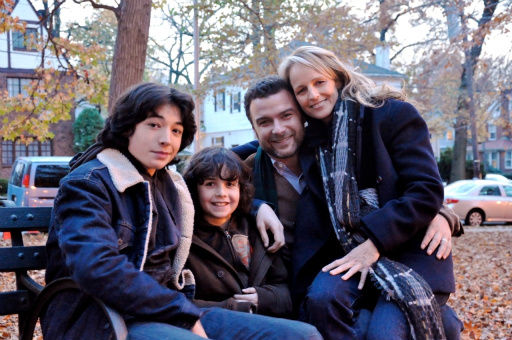
Screened at the Calgary International Film Festival last night, the indie dramedy stars Liev Schreiber and Helen Hunt as a NYC couple, Ned and Jeannie.  Their marriage faces a testing turn as Jeannie, driven by guilt and responsibility, brought her recently widowed father home to stay.  Ernie (Brian Dennehy) is not just any grumpy old man.  He is wheelchair confined, in ill health, and utterly bitter about everything and with everyone.  Jeannie is stressed out as she keeps pace just to live every single day.

Ned too has his share of problems at work.  As a scriptwriter for a seedy TV series, he has to meet the perverted demands of his boss Garrett (Eddie Izzard) to churn out scripts that are beneath his style.  To solve the problem he is assigned to work with a flirtatious colleague Robin (Carla Gugino) to rewrite something more daring and less boring.  Ned is tempted to do exactly that not only in his script.

And for their sons, they may look alright, but both yearn for direction and care just the same.  15 year-old Jonah (Ezra Miller) has just come out and is heading towards some risky friendship.  The younger one Ethan (Skyler Fortgang), though talented, has to deal with a defeating self-image. Amidst their own problems, Ned and Jeannie try to be good parents, loving yet setting limits, albeit finding a happy medium is hard to do.

Though not meant to be a serious film, it does touch on two thought-provoking questions implied by two unlikely characters.  From Robin the seducer:  Is a marriage finished when the ‘fun’ is over? Similarly from Ernie the bitter old man:  Should a life be ended when there is no happiness?

With subject matters as such, sitting through Every Day could be a gloomy ordeal.  But as a fusion of comedy and drama, it has come through to me as an enjoyable film. Written and directed by Richard Levine of the TV series “Nip/Tuck” fame, Every Day could seem episodic.  But the fast scene changes keeps the momentum going and the subplots clear.  Liev Schreiber is convincing as the family man in mid-life crisis.  Brian Dennehy is a veteran and spot on in his performance.  The boys are alright.  I have enjoyed Helen Hunt the most.  Her precarious roles of mother, wife, and daughter have resonated with me.  It has been three years since her directorial debut Then She Found Me.  I look forward to more of her works in the coming year.

Every Day premiered at the Tribeca Film Festival in NYC this April.  During the Q & A after the screening, Schreiber mentioned that the film is “a simple story and simple stories are often overlooked.”  Somebody has to make simple films like this, and somebody has to watch them.  I was one of the lucky ones last night at the CIFF.

~ ~ ~ Ripples

Photo Source: myveronanj.com

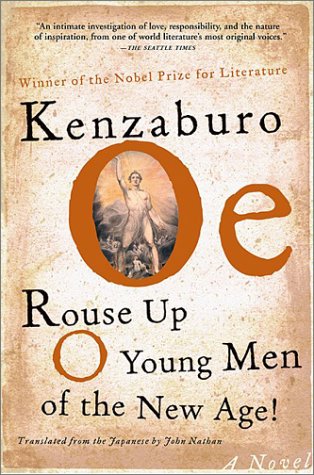
Rouse Up O Young Men of the New Age!

Thanks to Bellezza’s Japanese Literature Challenge 4, I have the chance to explore the intricate world of Kenzaburo Oe (pronounced ‘oh-ay’, 大江 健三郎 ), Japan’s second Nobel Laureate for Literature (1994), after Yasunari Kawabata (川端 康成) received the Prize in 1968.

Like his earlier work A Personal Matter*, Rouse Up O Young Men of the New Age! is an autobiographical novel dealing with the author’s experiences of raising a handicapped child.  A Personal Matter was written when Oe was young, describing an ordeal still raw from the initial shock of the birth of his brain-damaged child. Rouse Up was published in 1983, almost twenty years after A Personal Matter.

Rouse Up chronicles a more mature protagonist, the writer K, who has gone past the stage of denial and escape, to come to terms with the reality of fathering a handicapped child. Through the arduous journey, the writer has gained insights and pleasure from his relationship with his son Hikari, whom he nicknamed Eeyore in his novels.

Oe starts off the book with K’s plan to write a dictionary of terms for his now maturing son, to prepare him for his entry into the real, adult world.  This turns out to be a learning task in itself.  How do you explain to a brain-damaged person what the word ‘foot’ means?  Or ‘river’, ‘life’, or ‘death’?  He needs to deconstruct the realities of his everyday life before he can grasp the essence and meaning of his encounters.

It’s interesting to see how K get through to his son in defining ‘foot’. Eeyore understands it in relation to ‘gout’ from which his father once suffered. After the healing of the pain and swelling of the gout, it has turned into ‘a nice foot’.  So, the understanding of ‘foot’ comes in light of the pain it had experienced. K soon realizes that the definitions are more for himself as for Eeyore.

The author’s long journey of acceptance and self-discovery owes mostly to his love for the works of William Blake.  Rouse Up is a smorgasbord of selections if you are a Blake scholar. So admittedly, I have had a hard time ploughing through Oe’s use of parallels from Blake’s poetic and artistic symbolisms to reflect on his own predicament.  In certain parts, Oe’s writing is just as esoteric as Blake’s mythical depictions.  However, one thing is clear.  My enjoyment of this novel is no less, and the poignancy of a father-son relationship no weaker as I find my way through the Blake maze.  The book requires and deserves multiple reading.

Despite its complexity and denseness, the essence filters through Oe’s meticulous descriptions.  Further, John Nathan’s translation navigates effectively through Oe’s nuanced and sensitive narratives.  I’m just curious as to what the original Japanese version looks like since there are numerous references and quotes from Blake.  Are they in English or in Japanese translation?

Two lines from The Four Zoas seem to have outlined K’s personal journey:

“That Man should Labour & sorrow & learn & forget, & return
To the dark valley whence he came to begin his labours anew.”

It’s a perpetual striving, not unlike Sisyphus’s effort, and yet still leads from one path to the next, prompting a renewed acceptance and offering novel discoveries on the way.

Aside from the esoteric passages of Blake’s visions, some very simple lines shine through, and they are the ones that are most moving for me:

… healing the rift with my son, I became aware of his grief through the agency of a Blake poem, “On Another’s Sorrow,” which includes this stanza:

Can I see a falling tear,
And not feel my sorrows share,
Can a father see his child,
Weep, nor be with sorrow fill’d.

One of the “Songs of Innocence,” the poem concludes with the following verse:

O! he gives to us his joy,
That our grief he may destroy
Till our grief is fled & gone
He doth sit by us and moan.

In his attempt to know more about Eeyore, K explores the power of dreams and the imagination. Using Blake’s mythological poetry and artwork, he tries to understand Eeyore’s internal world. Both he and his wife know Eeyore does not dream, but that does not preclude he does not have imagination.

Subscribing to Blake’s conviction that: “The Imagination is not a State:  It is the Human Existence itself.”, K strives in earnest to cultivate Eeyore’s imagination. Eeyore has an almost instinctive response to bird calls, distinguishing them even before he adopts human language.  As he grows older, he is drawn towards the music of Bach and Mozart.  His imagination soon finds a channel of expression in composing, an amazing accomplishment nurtured by a highly supportive and loving family.  In real life, Oe’s son Hikari is a composer.

Adopting Blake’s vision, K sees a future for father and son together in a state of grace, from Blake’s Jerusalem:

“Jesus replied Fear not Albion unless I die thou canst not live
But if I die I shall arise again & thou with me
This is friendship & Brotherhood without it Man is Not

So Jesus spoke! The Covering Cherub coming on in darkness
Overshadowed them & Jesus and Thus do Men in Eternity
One for another to put off by forgiveness, every sin.”

From coming to terms with the tragic reality of fathering a brain-damaged child, to ultimately, almost symbiotically, sharing his life with his son, is a process not short of a personal epiphany.  At the end of the novel, Eyeore has grown to be a twenty-year-old man. While still having a limited mental capacity, Eeyore has his way of exuding his own humor, love and care for those around him.  The story is a poignant tapestry weaving real-life and the visionary, through which an imagined world of reality is beautifully conceived.

As for the source of the book title, it comes as a moving episode at the end of the book.  I should keep that for you to discover.  A heart-warming finish to a poignant chronicle.

John Nathan’s Afterword is an eloquent tribute to the father, son, and the nurturing family. It is also a helpful annotation of the novel.

Rouse Up O Young Men of the New Age! by Kenzaburo Oe, translated by John Nathan, published by Grove Press, NY, 2002.  259 pages.

***

* A touching review of A Personal Matter has been posted recently by Claire at Kiss A Cloud.  Also, Mel U’s A Reading Life has posted extensively on Oe and other Japanese writers.  Of course, there’s Bellezza at Dolce Bellezza, who has hosted Japanese Literature Challenge all these years, now in its fourth term.  I thank them all for their inspiration.

eReaders, iPad, and Home Literacy

“If a cluttered desk is a sign of a cluttered mind, of what then, is an empty desk?” — Albert Einstein

.

eReaders and the iPad could well be the best house-cleaning appliances ever invented. All the clutter on your bookshelves, magazines and newspapers strewn everywhere, and even those ubiquitous household bills can all be swept under the eCarpet. Yes, even flyers, ads, and coupons, they are now online or in apps… and maps? Just bring your iPhone.

But wait, what’s with this study done by Dr. Mariah Evans, sociologist at the University of Nevada, Reno, recently published in the journal Research in Social Stratification and MobilityAccording to its abstract, the study found that:

Children growing up in homes with many books get 3 years more schooling than children from bookless homes, independent of their parents’ education, occupation, and class.

Together with her colleagues at the University of Nevada, UCLA and Australian National University, Evans studied 70,000 children in 27 countries over a span of 20 years, one of the largest and most comprehensive studies ever conducted on what influences the level of education a child will attain. The difference between a bookless home and a home with 500 books amounts to an average of 3.2 years of further education. In China, the difference is 6.6 years.

As a sociologist, Dr. Evans is concerned with helping children of rural communities in Nevada to achieve higher education. Regardless of parents’ socio-economic and educational levels, the number of books at home is the single most significant correlate of educational attainment.

I know what’s on your mind… how many families have more than 500 books in their home. Well the idea is, the more the better:

Even a little bit goes a long way,” in terms of the number of books in a home. Having as few as 20 books in the home still has a significant impact on propelling a child to a higher level of education, and the more books you add, the greater the benefit.

You get a lot of ‘bang for your book’,” she said. “It’s quite a good return-on-investment in a time of scarce resources.

In an interview which is available on MP3, Evans explains:

When you have very highly educated parents, you still get some result of additional books in the home. But you get much more of what you might call ‘bang for your book’ for parents who have little education.

So now, back to our house-cleaning issue. How would home literacy be affected if more and more books are being swept away and stored in electronic devices and less and less on our shelves and strewn on the floor? Can the neat and tidy Kindle or iPad have the same effects as a real home library or ‘literacy mess’ for a child? Can 500 books in the eReader influence a child as much as 500 books around the home? Just some thoughts for future research.

.

.

You might ask what good do mere numbers do if you don’t use them. You can’t assume usage with presence, right? Well the question is, how can you use them if they are not around?  Evans claimed that just having them there, and watching a parent read a book is significant enough. If you’re caught reading a book, you are reading a book. But if you’re caught using an iPad, you may not be reading, you could be shopping, checking your stocks, or playing video games.

As for usage, electronic gadgets tend to promote individualized activities. The traditional ways of using books just might not be as compatible with these devices, like the cuddly moments of mother and child sharing a book at bedtime (see those teeth marks on the board books), the intimacy between book and reader, the appreciation and touch, the joy their aesthetics could bring, the picking up of a pen or pencil and marking and doodling around the pages, the practice of real life literacy activities with them, both personal and communal. And oh, the pleasure of browsing in a bookstore and the excitement of looting in a book sale.

Further, home literacy is more than just books. I was involved in an ethnographic study on language learning several years ago. I spent hours in several homes of young children, observing their literacy environment. My observations included materials that could foster language development. I noted, other than books, alphabet magnets on the fridge, newspapers, magazines, calendars, recipes, personal notes, notice boards, TV guides, shopping lists, food packaging, flyers, coupons, and ‘junk mails’, any print materials exposing a child to words and writing. One parent I observed had purposely placed newspapers in the bathroom, making the printed word more accessible to her child.  The rationale behind the study was that preschool children growing up in a home milieu rich in print materials are primed for language and literacy learning long before they even begin formal schooling.

With the arrivals of eBooks and eEverything else, printed matters are on the decline. Sure, it’s not all or nothing. Printed books will still be around.  But with eBook sales now surpassing hard copies at Amazon, the trend is obvious. eReaders and iPads are definitely ingenious and convenient devices, but how would home literacy change with these gadgets? And, how would we change as a human reader? It’s not about holding on to the archaic or being a Luddite, it’s all about our future, our very human future.

Of course, I’d appreciate a clean house. But hey, please don’t touch that pile. I know exactly where to find what under which. Thanks.

***

*And, to satisfy your curiosity, how many families Evans found to have 500 or more books in their homes? In the U.S., 18%.

“Family scholarly culture and educational success: Books and schooling in 27 nations” by M. D. R. Evans, Jonathan Kelley, Joanna Sikora, and Donald J. Trelman. Published in Research In Social Stratification and Mobility, Volume 28, Issue 2, June 2010, Pages 171 – 197. Click Here to go to the article.

Whip It (2009)

Whip It

I can’t recall how many times I’d watched roller derby on TV, years back, maybe just a few times.  When I asked my niece who watched the movie with me, as a twenty-something, she hasn’t even seen it once.   But Drew Barrymore, in her directorial debut, has effectively captured the human side of a sport not many know about.  And with it, she has poignantly woven in some relevant issues her audience could relate to, no matter what demographics they’re in: coming-of-age, finding love, confronting parental expectations, searching for personhood and empowerment, parenting and letting go.

After watching Juno (2007), I knew I must see more of Ellen Page.  Here in Whip It, Page has proven that she’s not just impressive as an actor, but also as an athlete.   She plays Bliss Cavendar, a 17 year-old small town Texas girl, bored, docile, shuffled from one beauty pageant to another by her overbearing mother Brooke, a former beauty queen turned middle-age mail clerk (sensitively played by Marcia Gay Harden, Mystic River, 2003; Pollack, 2000).

After she watches a roller derby game with her best friend Pash (Alia Shawkat), and successfully tries out for the team Hurl Scouts in Austin, Texas, Bliss, now Babe Ruthless, sees her life take off with high octane energy.  She has passionately fallen for the high contact sport and a new boyfriend, rock band member Oliver (Landon Pigg).

The head-smashing, rowdy derby culture is probably the farthest away from the frothy and genteel beauty pageants of Texas, thus forms the great chasm between mother and daughter.  Of course Bliss tries to hide all her activities from her mother, until it can’t be covered anymore.  For she has become the poster girl for the final championship.

There are cliché sequences that we’ve all seen before, the light version of physical prowess as in Million Dollar Baby (2004), the get-back-up perseverance of Rocky, and, reminiscence of Shall We Dance (2004) in the final championship.  But, it’s all fun and even exhilarating.  Thanks to a great cast, the humor comes through naturally.  I must mention some great deadpan act from diner manager Birdman (Carlo Alban), who reminds me of Pedro in Napoleon Dynamite (2004).   Another great support is Hurl Scouts coach Razor played by Andrew Wilson.  His performance makes me feel like I’m watching a Wes Anderson movie.  Later I find out he’s older brother to Owen, then it’s all clear to me… it runs in the family.

[picapp src=”6/4/3/c/Whip_It_Los_86ef.JPG?adImageId=5337308&imageId=6660163″ width=”180″ height=”250″ /]  Barrymore has effectively created some powerful and touching scenes that make the comedy worthwhile.  It’s scenes like these that propel a comedy into the realm of meaning.  She has balanced the comical with hard reality, for it’s not simply about a girl choosing what she wants to do, purely from her own point of view.  Often our choices are entangled in a web of relationships.  Yes, we may have the autonomy to choose, but our choices also affect others.  Some gratifying moments are sensitively performed, between mother and daughter, father and daughter, and a 36 year-old derby teammate who openly shares her heart with Bliss in the car, with her young son in the back seat.

Into its second week of screening, Whip It has not fared as well as expected at the box office.  But for screenwriter Shauna Cross, who has turned her own novel Derby Girl into screenplay, I trust this is just another blow she’s got all too used to, as a roller derby girl herself from Austin Texas, before moving to L.A.  She knows how to get back up and keep on skating, even in the aggressive arena that’s L.A.

(Top Photo Source: USA Today, Bottom: PicApp.com)

~ ~ ~ Ripples

Movies for Mom

If you’re reading this on a site that is not Ripple Effects, your’re reading a post that has been copied without permission. Stop reading and CLICK HERE to go to the original post written by Arti of Ripple Effects. https://rippleeffects.wordpress.com

OK, now that the little bit of housekeeping is done, we can start. Mind you, the above words are the only pink, or red, you’ll see here, because this is not your typical Mother’s Day post. I’ve checked on several Mother’s Day sites for good movie ideas. They’re all framed by pink templates. They all point you to movies as old as Gone With The Wind (1939), or as teary as Terms of Endearment (1983), or as dysfunctional as The Joy Luck Club (1993). I mean these are great, but, renting an old DVD for Mom on Mother’s Day? Hasn’t she seen enough Sleepless in Seattle (1993) on Encore Avenue?

By all means, take Mom out to the theaters to watch a movie on her special day!

And guys, you don’t have to sit there, endure and groan silently for two hours. Because here you’ll find iconoclastic, i.e., stereotype bashing, non-chick-flick-genre movies that you and Mom will enjoy watching. Who says mothers are naturally drawn to pink or chick-flicks anyway? I’m speaking from experience. Nothing can make me more proud than to have my teenage son accompany me to the movies. (Bravo to him for his boldness!) Yes, just mother and son. And nothing is more rewarding than to share an experience that we can talk about afterwards.

Here’s Arti’s list of current movie recommendations for Mother’s Day, 2009. As I said earlier, this is the stereotype bashing list, so you won’t see Shopaholic here. Thrillers, actions, sci-fi’s, dramas… who doesn’t need an adrenalin rush every now and then to keep the body functioning?

State of Play

state-of-play

An absorbing story of corruption, deceit, and investigative journalism. The movie presents an interesting scenario: the old-school investigative newspaper reporter is pitted against the fresh-out-of-college blogger, both hired by the same newspaper to draw readership, a version of PC vs. Mac on the battlefield of journalism. When the female research assistant of congressman Stephen Collins (Ben Affleck) is murdered on the day of a crucial congressional hearing, Washington Globe reporter Cal McAffrey (Russell Crowe) is drawn into the search for the truth. He has to partner up, reluctantly, with Della Frye (Rachel McAdams), a pseudo-journalist/blogger. That’s the executive order handed down by their feisty and no-nonsense boss Cameron Lynne (Helen Mirren). As the investigation peels off layers of suspense, the pair is entangled with dangerous life and death situations. Adding to the intrigue is the role of Robin Wright Penn as the Congressman’s wife, and the colorful Jason Bateman as Dominic Foy, a crucial lead to solving the case. Mom would enjoy the performance by the stellar cast and the well edited screenplay. As to who saves the day at the end? I won’t spoil it for you… you deserve the credit for entertaining Mom.

Taken

taken

This may be in your second run theaters by now, well, so much the better. Don’t miss it on the big screen. After March 18, I look at Liam Neeson differently. Here in Taken, he embodies the superhero of parenthood. He shows us what a father will do to save his daughter, especially an ex-CIA dad against a human smuggling ring of bad guys. Bryan Mills (Neeson), a highly skilled agent who has retired early to make up for lost time with his daughter Kim (Maggie Grace), has to use all his resources when she is kidnapped while visiting Paris. The action-packed, fast-paced sequences leave you no time to be skeptical of the impossibilities. Mills’ expertly-trained speed and agility would make Jason Bourne drop his jaw (literally or figuratively). And, stand aside James Bond, you’re not in the league, it’s heart we’re talking about. Lose yourself, be swept away, it’s pure escape and fantasy. Any parent can identify with the fear of a child being taken and hurt and the feeling of helplessness that ensues. Liam Neeson just acts out the imaginary scenario, the omnipotent father coming to the rescue of his own, and he’s won my heart. (So remember, it’s great for Father’s Day too, but Dad will likely have to watch the DVD.)

Star Trek (2009)

Wolverine too hairy? Bad manicure? Bring Mom to Star Trek then, if she’ s up to pushing her way through the crowds. I’m sure she’d enjoy at least some elements of the movie. While you’re cheering for the young, new Kirk, she might be reminiscing the First Generation. This deserves a brand new post. So watch for it in the days to come.

Other recommendations have been reviewed on Ripple Effects. If they’re still on the big screen, Mother’s Day is a good time to enjoy them with Mom:

The key to making Mom happy: Spend time to talk afterwards.

****

Photo Source: Taken, msnbc.com; State of Play, usatoday.com

The Poets’ Corner

poets-corner-book-cover

Just got this from the library, and it’s a gem.  The Poets’ Corner is subtitled The One-And-Only Poetry Book for the Whole Family, compiled by John Lithgow.  Yes, that’s John Lithgow of the ‘3rd Rock from the Sun’.  From Matthew Arnold to W. B. Yeats, Geoffrey Chaucer to Allen Ginsberg, it’s more like a high school curriculum than your light family reading.  However, the collection includes many favorite selections, ideal to share as literary heirloom.

Lithgow presents fifty poets whose work he had grown up with.  He has written a two-page introduction for each of them, a personal response to a piece of literary art.  In the introduction of the book, he explains how it all started.  Lithgow was invited to host a benefit for a non-profit organization.  The fund raiser was for the fostering of creative approaches to educating autistic children.  He was given a few poems to read out that night, poignant poetry that speaks to the heart of parents with autistic children.  That night, Lithgow saw the power of poems read out, the voice and the words striking a shared chord with deep resonance. Thus planted the seed for this book.

The central theme here is not autism, but the selections here speak to a general and wider audience, humanity at large.  The bonus is a CD featuring readings from Lithgow And Friends.  I believe that poetry read out loud offers a heightened enjoyment than just from silent reading.  I had heard recordings of Robert Frost and William Carlos Williams  reading their own work, leaving indelible resonance that I didn’t get from reading off the page.

Here in this CD, what we have are  professional performers, experienced and well-trained in the art of speech, dramatically performing these selections. And Lithgow’s ‘Friends’ include: Eileen Atkins, Kathy Bates, Glenn Close, Jodie Foster, Morgan Freeman, Helen Mirren, Lynn Redgrave, Susan Sarandon, Gary Sinise, and Sam Waterston… what a cast.

Here are  some of my favorites, too bad I can’t embed the sound track.  But do check it out from your local library, or even get a copy of your own.  It’s a keeper.

We Real Cool by Gwendolyn Brooks

(Read by Morgan Freeman)

The Pool Players.

Seven at the Golden Shovel.

We real cool. We

Left school. We

Lurk late. We

Strike straight. We

Sing sin. We

Thin gin. We

Jazz June. We

Die soon.

***

I Wandered Lonely As A Cloud by William Wordsworth

(Read by Helen Mirren)

I wandered lonely as a cloud

That floats on high o’er vales and hills,

When all at once I saw a crowd,

A host, of golden daffodils;

Beside the lake, beneath the trees,

Fluttering and dancing in the breeze.

*

Continuous as the stars that shine

And twinkle on the milky way,

They stretched in never-ending line

Along the margin of a bay:

Ten thousand saw I at a glance,

Tossing their heads in sprightly dance.

*

The waves beside them danced; but they

Out-did the sparkling waves in glee: A poet could not but be gay, In such a jocund company: I gazed—and gazed—but little thought

What wealth the show to me had brought:

*

For oft, when on my couch I lie

In vacant or in pensive mood,

They flash upon that inward eye

Which is the bliss of solitude;

And then my heart with pleasure fills,

And dances with the daffodils.

***

The Red Wheelbarrow

by William Carlos Williams

(Read by Jodie Foster)

so much depends

upon

a red wheel

barrow

glazed with rain

water

beside the white

chickens.

***

No Doctors Today, Thank You by Ogden Nash

(Read by John Lithgow… I LOL listening to him)

They tell me that euphoria is the feeling of feeling wonderful,

well, today I feel euphorian,

Today I have the agility of a Greek god and the appetitite of a Victorian.

Yes, today I may even go forth without my galoshes,

Today I am a swashbuckler, would anybody like me to buckle any swashes?

This is my euphorian day,

I will ring welkins and before anybody answers I will run away.

I will tame me a caribou

And bedeck it with marabou.

I will pen me my memoirs.

Ah youth, youth! What euphorian days them was!

I wasn’t much of a hand for the boudoirs,

I was generally to be found where the food was.

Does anybody want any flotsam?

I’ve gotsam.

Does anybody want any jetsam?

I can getsam.

I can play chopsticks on the Wurlitzer,

I can speak Portuguese like a Berlitzer.

I can don or doff my shoes without tying or untying the laces because

I am wearing moccasins,

And I practically know the difference between serums and antitoccasins.

Kind people, don’t think me purse-proud, don’t set me down as vainglorious,

I’m just a little euphorious.

**

Lithgow and friends have convinced me all the more that poetry is written to be heard.

Poets’ Corner:  The One-And-Only Poetry Book For The Whole Family, compiled by John Lithgow, Grand Central Publishing, 2007,  280 pages.

WALL-E (2008, DVD)

Continuing with my review of  ‘hopeful movies’ for the new year,  this is a must-see… for your whole family.

wall-e

WALL-E has re-defined for me what makes a good movie.  It doesn’t need human actors, doesn’t even need dialogues.  Its visuals are stunning and thought-provoking, and the silent scenes speak volumes. Especially the first part of the movie, I’m fascinated by how human meanings and sentiments are conveyed with almost no dialogues yet with such eloquence.  It is ironic, I know, that it takes an animated robot, or two, to bring out what is important for us humans: The need to connect, the joy of simplicity, the power of a tiny green sapling bursting with life, and love, the essence of being human.  The creators of WALL-E have invented a fresh and entertaining way to send these age-old messages back to us humans, with grace, humor, and wonderment.  Now that’s creativity.

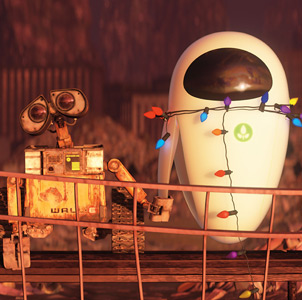
The time is post-apocalyptic, some time in the future where Earth is no longer habitable because its junks are piled up higher than sky scrappers.  WALL-E is a robot with one directive: garbage compacting.   Earth is no man’s land now.  One ‘human remains’ that WALL-E treasures is an old video tape of “Hello Dolly”.  WALL-E plays it constantly to admire that very human act and emotion:  courtship and love.  One day, he witnesses the landing of a spacecraft, from which comes Eve, an exploratory robot.  Now WALL-E has a chance to practice what he has learned.

As Earth is no longer viable for life, humans, ever ingenious, especially when it comes to their own enjoyment and gratuitous consumerism, have branched out into space, the final frontier.  They have created for themselves a utopia in a cruise ship, perpetually holidaying in space.  Their pastime is lounging on a couch, being served by automated robots.  Due to lack of use, their limbs have shrunk while their bodies have bloated.  No matter, they only need one finger to press buttons to eat, drink, and be merry.  WALL-E’s adventures begin as he follows Eve back to this ultra high-tech space station.

wall-e-and-eve

But Earth is home for humans, not a cruise ship in space.  Earth is meant for us to cultivate, to nurture, and to enjoy.  So, that’s the ultimate epiphany for all these perpetual space vacationers.  Herein lies the miniscule hope, symbolized by the tiny sapling of green, that there’s still a chance to return home and set roots once again, to live and grow.  The movie ends with all the right notes without being preachy or turning into a propaganda, nor does it wake us up by scare tactics.  It leads you on a pleasant ride and brings you to its intended destination without coercion or didactics.

The DVD has some excellent special features including a couple of animated short films, deleted scenes, and many more.  But my favorite part is ‘Animation Sound Design: Building Worlds From the Sound Up”, in which the legendary sound designer Ben Burtt shares secrets of creating the sounds of WALL-E. Credited by writer/director Andrew Stanton as the genius behind WALL-E, Burtt has won Oscars for his sound effects in E.T. The Extra-Terrestrial, Star Wars, and Indiana Jones movies.

Teach your children well… while there’s still time,  that’s the underlying axiom (the name of the cruise ship) of the movie.  An animation more relevant for adults than kids. After all, who are in a better position to bring hope to the next generation other than parents themselves?

~ ~ ~ ½ Ripples


Then She Found Me: Book Review

This is one of those frequent examples where a film is so drastically different from the book that they are virtually two very separate entities. But what’s unusual is, I’ve enjoyed them both.

Then She Found Me, published in 1990, is written by award winning New England author Elinor Lipman. Helen Hunt, together with Alice Arlen and Victor Levin, wrote the screenplay and turned it into a movie. I can understand why those who have read the book first before seeing the movie are flabbergasted. The only commonality between the book and the film other than the title may just well be the two main characters, the quiet and rational high school Latin teacher April Epner and her birth mother Bernice Graverman, the ostentatious TV talk show host who wants to claim back the daughter she had given up for adoption more than 30 years ago. There are almost no traces of the original story in the movie.

The amusing character contrast in the book is a springboard for some creative channelling for Hunt and her screenwriter team, kudos to Lipman’s original conception of the story idea. Despite its digression from the book, the movie still works and entertains. What more, it has preserved the spirit of the book and has brought to the screen the basic issues the book touches on, the major one being the meaning of motherhood, and the inevitable debate over the value of the birth versus the adoptive mother. For my detailed review of the movie, click here.

The She Found Me is my introduction to Elinor Lipman, the acclaimed author of eight books of fiction and short stories. The book is almost script ready, for it is predominantly dialogues, witty, intelligent, and incisive dialogues. Lipman’s sensitivity and subtle humor effectively bring out the nuances of her characters and their relationships, at times sarcastic, at times genuine, at times poignant.

36 year-old April Epner is a high school Latin teacher, quiet, rational, academic, and single. Her long-sleeved cotton jersey and drop-waist Indian cotton jumper persona hides a kind and genuine soul. The only parents she has known all her life are her adoptive Jewish parents Trude and Julius Epner, Holocaust survivors, who have lovingly brought her up and given her a Radcliffe education. After they have passed away and as she stands in the crossroads of her life, the last thing April needs is to be found by a brassy and impulsive talk show host Bernice Graverman, who claims to be her birth mother. Conscientious April has to match wit with evasive Bernice, with the help of her school librarian Dwight, who happens to be much more than just a supplier of encyclopedic information. Without giving out spoilers, let me just say the story unfolds with sprightly twists and turns, effectively driven by Lipman’s first-rate, cutting and entertaining dialogues.

Those who have seen the movie but have not read the book should move right along to savor the source material. In here you’ll find the intended closure to the seemingly unsolvable conflict and ambivalence. I can see this as a good choice for book/movie discussion in reading groups and book clubs.

As I was reading, I thought I saw Jane Austen cameo. What Lipman has created here is something close to what Austen would have written today: a contemporary comedy of manners, a likable heroine reminiscence of Anne Elliot, an anti-Darcy male character, albeit with similar height and social ineptness, and through the characters and their situations, dares to explore some serious social issues that are masked by very funny, sharp and witty lines. The result is a tasty concoction of humor and heart.

And lo and behold, guess whose portrait I see when I open up Elinor Lipman’s website ?

Then She Found Me by Elinor Lipman is published by Washington Square Press, 1990, 307 pages.

~ ~ ~ Ripples